reset MERCEDES-BENZ GLK-Class 2012 X204 Owner's Manual
[x] Cancel search | Manufacturer: MERCEDES-BENZ, Model Year: 2012, Model line: GLK-Class, Model: MERCEDES-BENZ GLK-Class 2012 X204Pages: 316, PDF Size: 13.21 MB
Page 14 of 316
Malfunctions relevant to safetyReporting ......................................... 24
Matte finish (cleaning
instructions) ...................................... 245
mbrace Call priority .................................... 229
Display message ............................ 184
Downloading destinations
(COMAND) ..................................... 229
Emergency call .............................. 226
Important safety notes ..................225
Locating a stolen vehicle ...............231
MB info call button ........................228
Remote vehicle locking ..................230
Roadside Assistance button ..........227
Search & Send ............................... 230
Self-test ......................................... 226
System .......................................... 225
Vehicle remote unlocking ..............230
Mechanical key
Function/notes ................................ 71
Locking vehicle ................................ 77
Unlocking the driver's door ..............77
Memory card (audio) ......................... 173
Memory function ............................... 100
Message memory (on-board
computer) .......................................... 179
Messages see Display messages
Mirrors
see Exterior mirrors
see Rear-view mirror
see Vanity mirror
Mobile phone
Menu (on-board computer) ............173
Modifying the programming
(SmartKey) ........................................... 71
MP3 Operating ....................................... 173
see separate operating instructions
Multifunction display
Function/notes ............................. 168
Permanent display .........................175
Multifunction steering wheel
Operating the on-board computer . 167
Overview .......................................... 31Multifunction steering wheel (4
buttons) see 4-button multifunction
steering wheel
N
Navigation Menu (on-board computer) ............171
see separate operating instructions
NECK-PRO head restraints
Operation ......................................... 50
Resetting after being triggered ........50
Notes on breaking-in a new
vehicle ................................................ 130
O
Occupant Classification System
(OCS) Faults ............................................... 49
Operation ......................................... 44
System self-test ............................... 47
Occupant safety
Children in the vehicle .....................55
System overview .............................. 38
Octane number (fuel) ........................ 305
Odometer ........................................... 170
see Trip odometer
Off-road driving
Checklist after driving off-road ......150
Checklist before driving off-road .... 150
General information .......................149
Important safety notes ..................149
Traveling uphill ............................... 150
Off-road system
4MATIC .......................................... 153
Oil
see Engine oil
On-board computer
Audio menu ................................... 172
Convenience submenu ..................177
Displaying a service message ........243
Display messages ..........................179
Factory settings submenu .............178
Important safety notes ..................166
Instrument cluster submenu ..........175
Lighting submenu .......................... 176
12Index
Page 15 of 316
Menu overview .............................. 169
Message memory .......................... 179
Navigation menu ............................ 171
Operating video DVD .....................173
Operation ....................................... 167
Service menu ................................. 175
Settings menu ............................... 175
Standard display ............................ 170
Telephone menu ............................ 173
Time/Date submenu .....................176
Trip menu ...................................... 170
Vehicle submenu ........................... 177
Opening and closing the side trim
panels ................................................. 112
Operating system see On-board computer
Outside temperature display ........... 167
Overhead control panel ...................... 34
Override feature Rear side windows ...........................60
P
Paint code number ............................ 301
Paintwork (cleaning instructions) ... 245
Panic alarm .......................................... 60
Panorama roof with power tilt/
sliding panel Opening/closing .............................. 86
Opening/closing the roller
sunblind ........................................... 87
Problem (malfunction) .....................87
Resetting ......................................... 87
Panorama sliding sunroof
Important safety notes ....................85
Parcel net ........................................... 214
Parking ............................................... 143
Important safety notes ..................143
Parking brake ................................ 144
Position of exterior mirror, front-
passenger side ................................. 99
Rear view camera .......................... 157
see PARKTRONIC
Parking aid
see Exterior mirrors
see PARKTRONIC
Parking brake
Display message ............................ 183
Notes/function .............................. 144
Parking lamps (changing bulbs) ...... 111
PARKTRONIC Deactivating/activating .................156
Driving system ............................... 154
Function/notes ............................. 154
Problem (malfunction) ...................157
Range of the sensors .....................154
Trailer towing ................................. 156
Warning display ............................. 155
PASSENGER AIRBAG OFF indicator
lamp ...................................................... 44
Pedals ................................................. 145
Permanent four-wheel drive see 4MATIC (permanent four-
wheel drive)
Plastic trim (cleaning instructions) . 248
Power washers .................................. 244
Power windows see Side windows
Preventive occupant safety
system
see PRE-SAFE ®
(Preventive
occupant safety system)
Product information ............................ 20
Program selector button .................. 137
Pulling away Automatic transmission .................133
Q
Qualified specialist workshop ........... 23
R
Radio Selecting a station .........................172
see separate operating instructions
Reading lamp ..................................... 107
Rear compartment Setting the airflow .........................123
Setting the air vents ......................126
Rear fog lamp
Changing bulbs .............................. 113
Display message ............................ 190
Switching on/off ........................... 104
Index13
Page 17 of 316
Folding the backrest (rear
compartment) forwards/back .......215
Folding the rear bench seat
forwards/back ............................... 214
Important safety notes ....................91
Seat heating problem ......................95
Storing settings (memory
function) ........................................ 100
Switching seat heating on/off .........95
Sensors (cleaning instructions) ....... 247
Service see ASSYST PLUS service interval
display
Service interval display
Displaying service messages .........243
Hiding service messages ...............243
Notes ............................................. 243
Service messages ..........................242
Service menu (on-board computer) . 175
Service products Brake fluid ..................................... 306
Capacities ...................................... 304
Coolant (engine) ............................ 307
Engine oil ....................................... 305
Fuel ................................................ 304
Important safety notes ..................302
Refrigerant (air-conditioning
system) .......................................... 306
Washer fluid ................................... 307
Settings
Factory (on-board computer) .........178
On-board computer .......................175
Setting the air distribution ............... 122
Setting the airflow ............................ 123
Side impact air bag ............................. 42
Side marker lamp (display
message) ............................................ 190
Side marker lamps (changing
bulbs) ................................................. 112
Side windows Convenience closing feature ............83
Convenience opening feature ..........83
Important safety information ...........82
Opening/closing .............................. 82
Problem (malfunction) .....................85
Resetting ......................................... 84Sliding sunroof
see Panorama roof with power
tilt/sliding panel
SmartKey
Changing the battery .......................72
Changing the programming .............71
Checking the battery .......................72
Convenience closing feature ............83
Convenience opening feature ..........83
Display message ............................ 198
Door central locking/unlocking .......68
Important safety notes ....................68
Loss ................................................. 74
Mechanical key ................................ 71
Positions (ignition lock) .................131
Problem (malfunction) .....................74
Starting the engine ........................132
Snow chains ...................................... 272
Sockets Center console .............................. 223
Luggage compartment ...................224
Points to observe before use .........223
Rear compartment .........................224
Spare wheel
Notes/data .................................... 297
Storage location ............................ 252
Stowing .......................................... 253
see Emergency spare wheel
Specialist workshop ............................ 23
Speed, controlling see Cruise control
Speedometer
Digital ............................................ 170
In the Instrument cluster .................29
Segments ...................................... 167
Selecting the unit of
measurement ................................ 175
see Instrument cluster
SRS (Supplemental Restraint
System) Display message ............................ 184
Introduction ..................................... 38
Warning lamp ................................. 205
Warning lamp (function) ................... 38
Standing lamps
Changing bulbs .............................. 111
Display message ............................ 190
Switching on/off ........................... 102Index15
Page 20 of 316
Installing the ball coupling .............161
Lights display message ..................188
Mounting dimensions ....................308
Power supply ................................. 164
Removing the ball coupling ............164
Shift range ..................................... 137
Storing the ball coupling ................164
Trailer loads ................................... 309
Towing away
With both axles on the ground .......265
Tow-starting
Emergency engine starting ............266
Important safety notes ..................264
Trailer coupling
see Towing a trailer
Trailer loads and drawbar
noseweights ...................................... 163
Trailer towing
ESP ®
................................................ 64
PARKTRONIC ................................. 156
Permissible trailer loads and
drawbar noseweights .....................163
Transmission
see Automatic transmission
Transporting the vehicle .................. 266
Traveling uphill Brow of hill ..................................... 150
Driving downhill ............................. 151
Maximum gradient-climbing
capability ....................................... 150
Trim pieces (cleaning instructions) . 248
Trip computer (on-board
computer) .......................................... 170
Trip meter see Trip odometer
Trip odometer
Calling up ....................................... 170
Resetting (on-board computer) ......171
Trunk
see Tailgate
Turn signals
Changing bulbs (front) ...................112
Changing bulbs (rear) ....................113
Display message ............................ 189
Switching on/off ........................... 105
TWR (Tongue Weight Rating)
(definition) ......................................... 294Type identification plate
see Vehicle identification plate
U
Unlocking Emergency unlocking .......................77
From inside the vehicle (central
unlocking button) ............................. 76
V
Vanity mirror (in sun visor) .............. 221
Vehicle Correct use ...................................... 23
Data acquisition ............................... 24
Display message ............................ 197
Equipment ....................................... 20
Individual settings ..........................175
Limited Warranty ............................. 24
Loading .......................................... 281
Locking (in an emergency) ...............77
Locking (SmartKey) .......................... 69
Lowering ........................................ 258
Maintenance .................................... 21
Parking for a long period ................ 144
Pulling away ................................... 133
Raising ........................................... 255
Reporting problems .........................24
Towing away .................................. 264
Transporting .................................. 266
Unlocking (in an emergency) ...........77
Unlocking (SmartKey) ......................69
Vehicle data ................................... 308
Vehicle battery
see Battery (vehicle)
Vehicle data ....................................... 308
see Technical data
Vehicle dimensions ........................... 308
Vehicle emergency locking ................ 77
Vehicle identification number see VIN
Vehicle identification plate .............. 301
Vehicle tool kit .................................. 252
Video (DVD) ........................................ 173
VIN ...................................................... 301
18Index
Page 45 of 316
Improper repair work on the doors or the
modification or addition of components to the
doors create a risk of rendering the side
impact air bags inoperative or causing
unintended air bag deployment. Work on the
doors must therefore only be performed by
qualified technicians. Contact an authorized
Mercedes-Benz Center.GWARNING
Only use seat covers which have been tested
and approved by Mercedes-Benz for your
vehicle model. Using seat covers or other seat
coverings can cause a malfunction of the side
impact air bags and/or the pelvis air bags.
Contact an authorized Mercedes-Benz Center
for availability.
When deployed, the side impact air bags offer
additional protection for the thorax of the
vehicle occupants on the side of the vehicle
on which the impact occurs. However, they
do not protect the:
R head
R neck
R arms
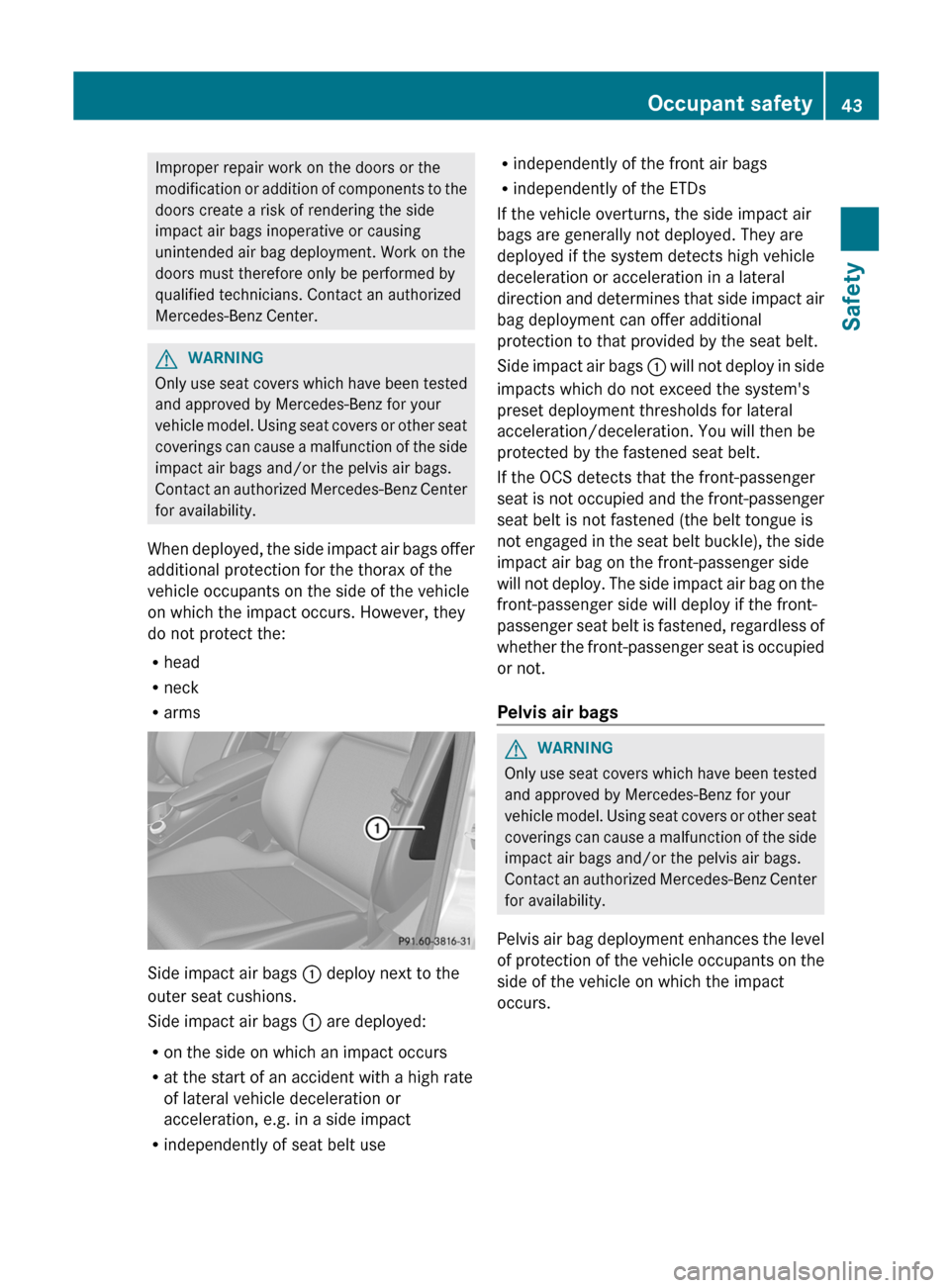
Side impact air bags : deploy next to the
outer seat cushions.
Side impact air bags : are deployed:
R on the side on which an impact occurs
R at the start of an accident with a high rate
of lateral vehicle deceleration or
acceleration, e.g. in a side impact
R independently of seat belt use
R
independently of the front air bags
R independently of the ETDs
If the vehicle overturns, the side impact air
bags are generally not deployed. They are
deployed if the system detects high vehicle
deceleration or acceleration in a lateral
direction and determines that side impact air
bag deployment can offer additional
protection to that provided by the seat belt.
Side impact air bags : will not deploy in side
impacts which do not exceed the system's
preset deployment thresholds for lateral
acceleration/deceleration. You will then be
protected by the fastened seat belt.
If the OCS detects that the front-passenger
seat is not occupied and the front-passenger
seat belt is not fastened (the belt tongue is
not engaged in the seat belt buckle), the side
impact air bag on the front-passenger side
will not deploy. The side impact air bag on the
front-passenger side will deploy if the front-
passenger seat belt is fastened, regardless of
whether the front-passenger seat is occupied
or not.
Pelvis air bagsGWARNING
Only use seat covers which have been tested
and approved by Mercedes-Benz for your
vehicle model. Using seat covers or other seat
coverings can cause a malfunction of the side
impact air bags and/or the pelvis air bags.
Contact an authorized Mercedes-Benz Center
for availability.
Pelvis air bag deployment enhances the level
of protection of the vehicle occupants on the
side of the vehicle on which the impact
occurs.
Occupant safety43SafetyZ
Page 46 of 316
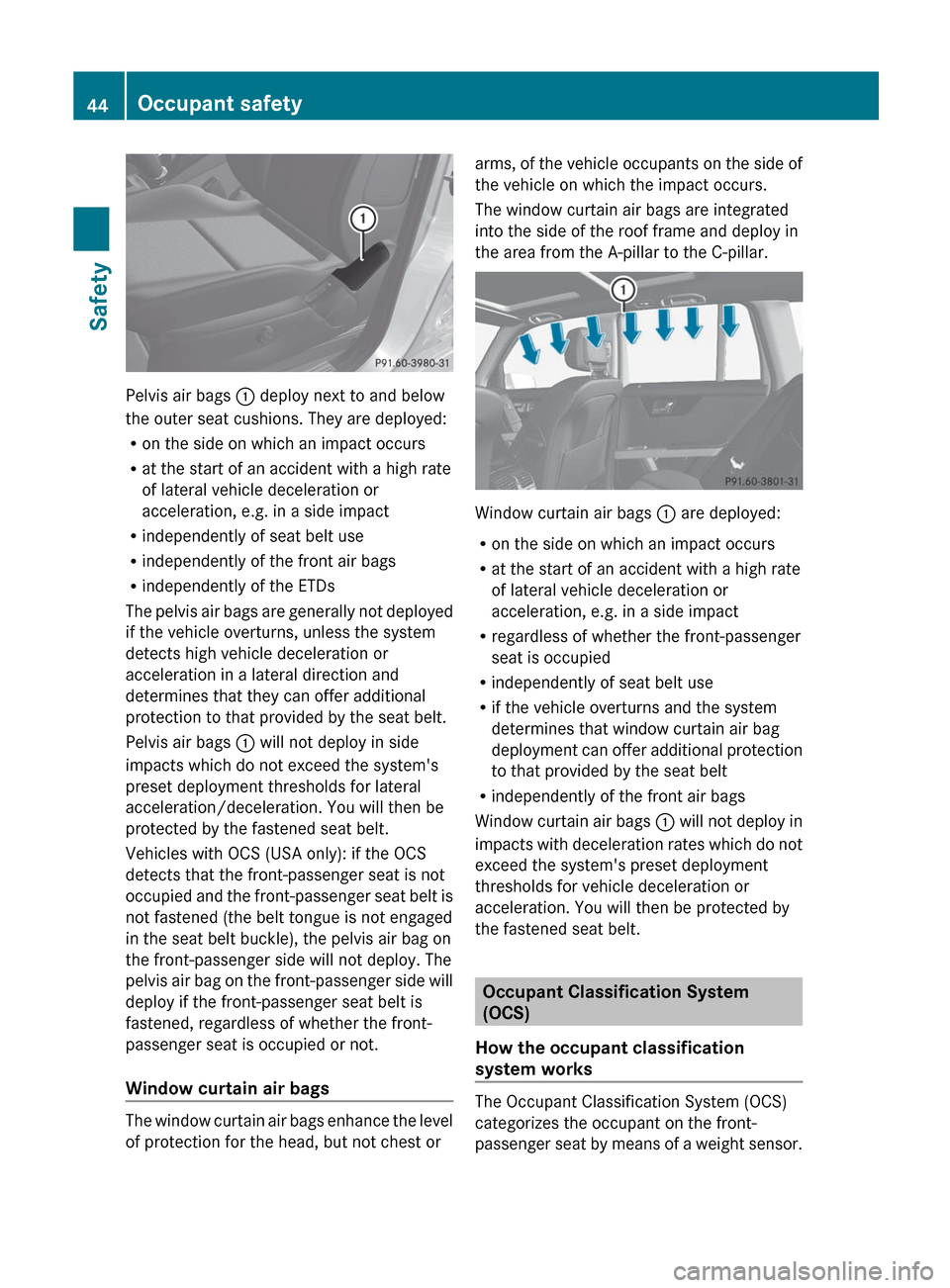
Pelvis air bags : deploy next to and below
the outer seat cushions. They are deployed:
R on the side on which an impact occurs
R at the start of an accident with a high rate
of lateral vehicle deceleration or
acceleration, e.g. in a side impact
R independently of seat belt use
R independently of the front air bags
R independently of the ETDs
The pelvis air bags are generally not deployed
if the vehicle overturns, unless the system
detects high vehicle deceleration or
acceleration in a lateral direction and
determines that they can offer additional
protection to that provided by the seat belt.
Pelvis air bags : will not deploy in side
impacts which do not exceed the system's
preset deployment thresholds for lateral
acceleration/deceleration. You will then be
protected by the fastened seat belt.
Vehicles with OCS (USA only): if the OCS
detects that the front-passenger seat is not
occupied and the front-passenger seat belt is
not fastened (the belt tongue is not engaged
in the seat belt buckle), the pelvis air bag on
the front-passenger side will not deploy. The
pelvis air bag on the front-passenger side will
deploy if the front-passenger seat belt is
fastened, regardless of whether the front-
passenger seat is occupied or not.
Window curtain air bags
The window curtain air bags enhance the level
of protection for the head, but not chest or
arms, of the vehicle occupants on the side of
the vehicle on which the impact occurs.
The window curtain air bags are integrated
into the side of the roof frame and deploy in
the area from the A-pillar to the C-pillar.
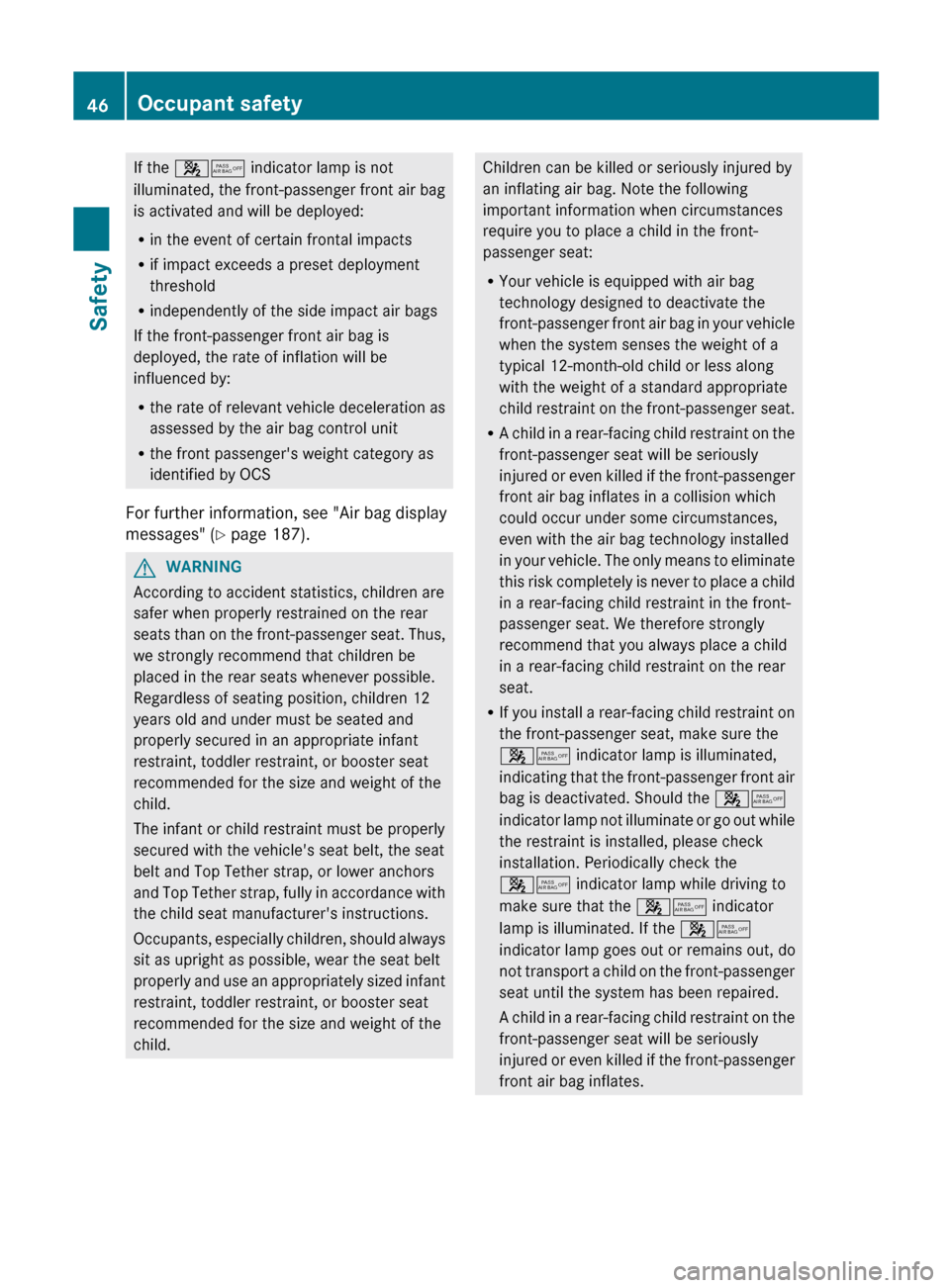
Window curtain air bags : are deployed:
R on the side on which an impact occurs
R at the start of an accident with a high rate
of lateral vehicle deceleration or
acceleration, e.g. in a side impact
R regardless of whether the front-passenger
seat is occupied
R independently of seat belt use
R if the vehicle overturns and the system
determines that window curtain air bag
deployment can offer additional protection
to that provided by the seat belt
R independently of the front air bags
Window curtain air bags : will not deploy in
impacts with deceleration rates which do not
exceed the system's preset deployment
thresholds for vehicle deceleration or
acceleration. You will then be protected by
the fastened seat belt.
Occupant Classification System
(OCS)
How the occupant classification
system works
The Occupant Classification System (OCS)
categorizes the occupant on the front-
passenger seat by means of a weight sensor.
44Occupant safetySafety
Page 48 of 316
If the 45 indicator lamp is not
illuminated, the front-passenger front air bag
is activated and will be deployed:
R in the event of certain frontal impacts
R if impact exceeds a preset deployment
threshold
R independently of the side impact air bags
If the front-passenger front air bag is
deployed, the rate of inflation will be
influenced by:
R the rate of relevant vehicle deceleration as
assessed by the air bag control unit
R the front passenger's weight category as
identified by OCS
For further information, see "Air bag display
messages" ( Y page 187).GWARNING
According to accident statistics, children are
safer when properly restrained on the rear
seats than on the front-passenger seat. Thus,
we strongly recommend that children be
placed in the rear seats whenever possible.
Regardless of seating position, children 12
years old and under must be seated and
properly secured in an appropriate infant
restraint, toddler restraint, or booster seat
recommended for the size and weight of the
child.
The infant or child restraint must be properly
secured with the vehicle's seat belt, the seat
belt and Top Tether strap, or lower anchors
and Top Tether strap, fully in accordance with
the child seat manufacturer's instructions.
Occupants, especially children, should always
sit as upright as possible, wear the seat belt
properly and use an appropriately sized infant
restraint, toddler restraint, or booster seat
recommended for the size and weight of the
child.
Children can be killed or seriously injured by
an inflating air bag. Note the following
important information when circumstances
require you to place a child in the front-
passenger seat:
R Your vehicle is equipped with air bag
technology designed to deactivate the
front-passenger front air bag in your vehicle
when the system senses the weight of a
typical 12-month-old child or less along
with the weight of a standard appropriate
child restraint on the front-passenger seat.
R A child in a rear-facing child restraint on the
front-passenger seat will be seriously
injured or even killed if the front-passenger
front air bag inflates in a collision which
could occur under some circumstances,
even with the air bag technology installed
in your vehicle. The only means to eliminate
this risk completely is never to place a child
in a rear-facing child restraint in the front-
passenger seat. We therefore strongly
recommend that you always place a child
in a rear-facing child restraint on the rear
seat.
R If you install a rear-facing child restraint on
the front-passenger seat, make sure the
45 indicator lamp is illuminated,
indicating that the front-passenger front air
bag is deactivated. Should the 45
indicator lamp not illuminate or go out while
the restraint is installed, please check
installation. Periodically check the
45 indicator lamp while driving to
make sure that the 45 indicator
lamp is illuminated. If the 45
indicator lamp goes out or remains out, do
not transport a child on the front-passenger
seat until the system has been repaired.
A child in a rear-facing child restraint on the
front-passenger seat will be seriously
injured or even killed if the front-passenger
front air bag inflates.46Occupant safetySafety
Page 52 of 316
NECK-PRO head restraints
The NECK-PRO head restraints increase
protection to the driver's and front
passenger's head and neck. To this end, the
NECK-PRO head restraints on the driver's and
front-passenger seats are moved forwards
and upwards in the event of a rear-end
collision of a certain severity. This provides
better head support.GWARNING
Do not secure any objects (e.g. coat hangers)
on the NECK-PRO head restraints. Otherwise,
the NECK-PRO head restraints may not
function properly, or in the event of a rear-end
collision may not be able offer the level of
protection they are designed to provide.
GWARNING
Seat or head restraint covers can cause a
malfunction when the NECK-PRO head
restraints are activated or when the side
impact air bags or pelvis air bags are
deployed, or they can prevent this completely.
The NECK-PRO head restraints or side impact
air bags/pelvis air bags can therefore not
provide the intended protection. Do not use
any seat or head restraint covers.
If the NECK-PRO head restraints have been
triggered in an accident, reset the NECK-PRO
head restraints on the driver’s and front-
passenger seat ( Y page 50). Otherwise, the
additional protection will not be available in
the event of another rear-end collision. You
can recognize when NECK-PRO head
restraints have been triggered by the fact that
they have moved forwards and can no longer
be adjusted.
GWARNING
For your protection, drive only with properly
positioned head restraints.
Adjust the head restraint so that it is as close
to the head as possible and the center of the
head restraint supports the back of the head
at eye level. This will reduce the potential for
injury to the head and neck in the event of an
accident or similar situation.
Resetting triggered NECK-PRO head
restraints
GWARNING
For safety reasons, have the NECK-PRO head
restraints checked at an authorized
Mercedes-Benz Center after a rear-end
collision.
GWARNING
When pushing back the NECK-PRO head
restraint cushion, make sure your fingers do
not become caught between the head
restraint cushion and the cover. Failure to
observe this could result in injuries.
i Resetting the NECK-PRO head restraints
requires a lot of strength. If you have
difficulty resetting the NECK-PRO head
restraints, have this work carried out at a
qualified specialist workshop, e.g. an
authorized Mercedes-Benz Center.
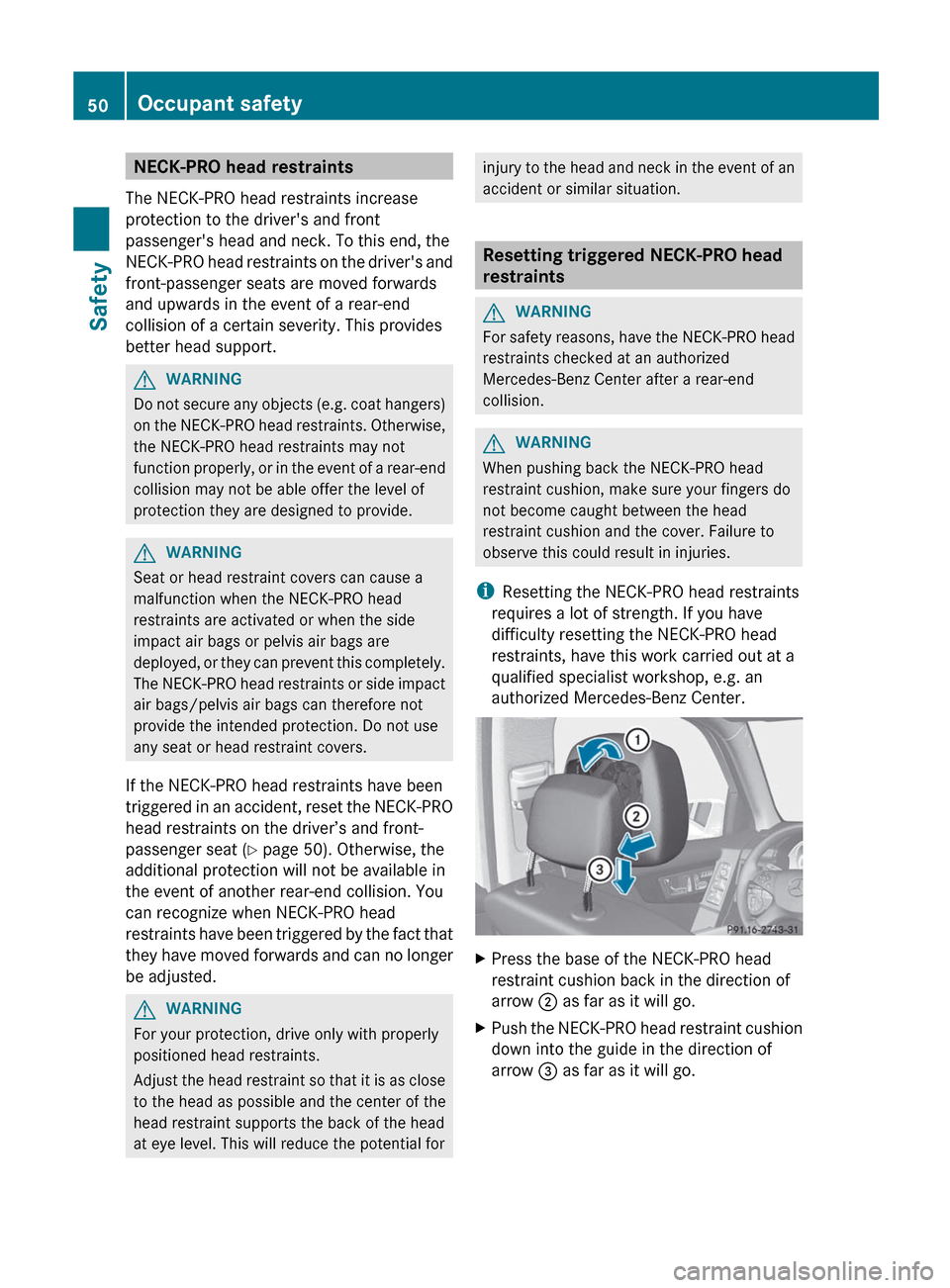
XPress the base of the NECK-PRO head
restraint cushion back in the direction of
arrow ; as far as it will go.XPush the NECK-PRO head restraint cushion
down into the guide in the direction of
arrow = as far as it will go.50Occupant safetySafety
Page 54 of 316
that could result in serious injuries in the
event of an accident.
R Each occupant should wear their seat belt
at all times, because seat belts help reduce
the likelihood of and potential severity of
injuries in accidents, including rollovers.
The integrated restraint system includes
SRS (driver front air bag, driver's side knee
bag, front-passenger front air bag, side
impact air bags, pelvis air bags, window
curtain air bags for the side windows),
Emergency Tensioning Devices, seat belt
force limiters, and front seat knee bolsters.
The system is designed to enhance the
protection offered to properly belted
occupants in certain frontal (front air bags,
driver's side knee bag and ETDs) and side
(side impact air bags, window curtain air
bags, and ETDs) impacts which exceed
preset deployment thresholds and in
certain rollovers (window curtain air bags
and ETDs).
R Never wear the shoulder belt under your
arm, across your neck or off your shoulder.
In a frontal crash, your body would move
too far forward. That would increase the
chance of head and neck injuries. The seat
belt would also apply too much force to the
ribs or abdomen, which could severely
injure internal organs such as your liver or
spleen.
Adjust the seat belt so that the shoulder
section is located as close as possible to
the middle of the shoulder. It should not
touch the neck. Never pass the shoulder
portion of the seat belt under your arm. For
this purpose, you can adjust the height of
the seat belt outlet.
R Position the lap belt as low as possible on
your hips and not across the abdomen. If
the lap belt is positioned across your
abdomen, it could cause serious injuries in
a crash.
R Never wear seat belts over rigid or
breakable objects in or on your clothing,such as eyeglasses, pens, keys etc., as
these might cause injuries.
R Make sure the seat belt is always fitted
snugly. Take special care of this when
wearing loose clothing.
R Never use a seat belt for more than one
person at a time. Do not fasten a seat belt
around a person and another person or
other objects at the same time.
R Seat belts should not be worn twisted. In a
crash, you would not have the full width of
the seat belt to distribute impact forces.
The twisted seat belt against your body
could cause injuries.
R Pregnant women should also always use a
lap-shoulder belt. The lap belt portion
should be positioned as low as possible on
the hips to avoid any possible pressure on
the abdomen.
R Place the seat backrest in a position that is
as upright as possible.
R Check your seat belt during travel to make
sure it is properly positioned.
R Never place your feet on the instrument
panel, dashboard, or on the seat. Always
keep both feet on the floor in front of the
seat.
R When using a seat belt to secure infant
restraints, toddler restraints, or children in
booster seats, always follow the child seat
manufacturer's instructions.GWARNING
Do not pass seat belts over sharp edges. They
could tear.
Do not allow the seat belt to get caught in the
door or in the seat adjustment mechanism.
This could damage the seat belt.
Never attempt to make modifications to seat
belts. This could impair the effectiveness of
the seat belts.
52Occupant safetySafety
Page 86 of 316
Vehicles with KEYLESS-GO:
R Release the locking button on the exterior
door handle in order to interrupt the closing
procedure.
R Pull the same exterior door handle
immediately and hold it firmly. The side
windows and the panorama roof with power
tilt/sliding panel open for as long as the
door handle is held without actually
opening the door.
Using the SmartKey
i The SmartKey must be close to the
driver's door handle.
XPoint the tip of the SmartKey at the driver's
door handle.XPress and hold the & button until the
side windows and the panorama roof with
power tilt/sliding panel are fully closed.XMake sure that all the side windows and the
panorama roof with power tilt/sliding
panel are closed.
On vehicles with a panorama roof with power
tilt/sliding panel:
XPress and hold the & button again until
the roller sunblinds of the panorama roof
with power tilt/sliding panel close.XTo interrupt convenience closing:
release the & button.
Using KEYLESS-GO
The KEYLESS-GO key must be outside the
vehicle. All the doors must be closed.
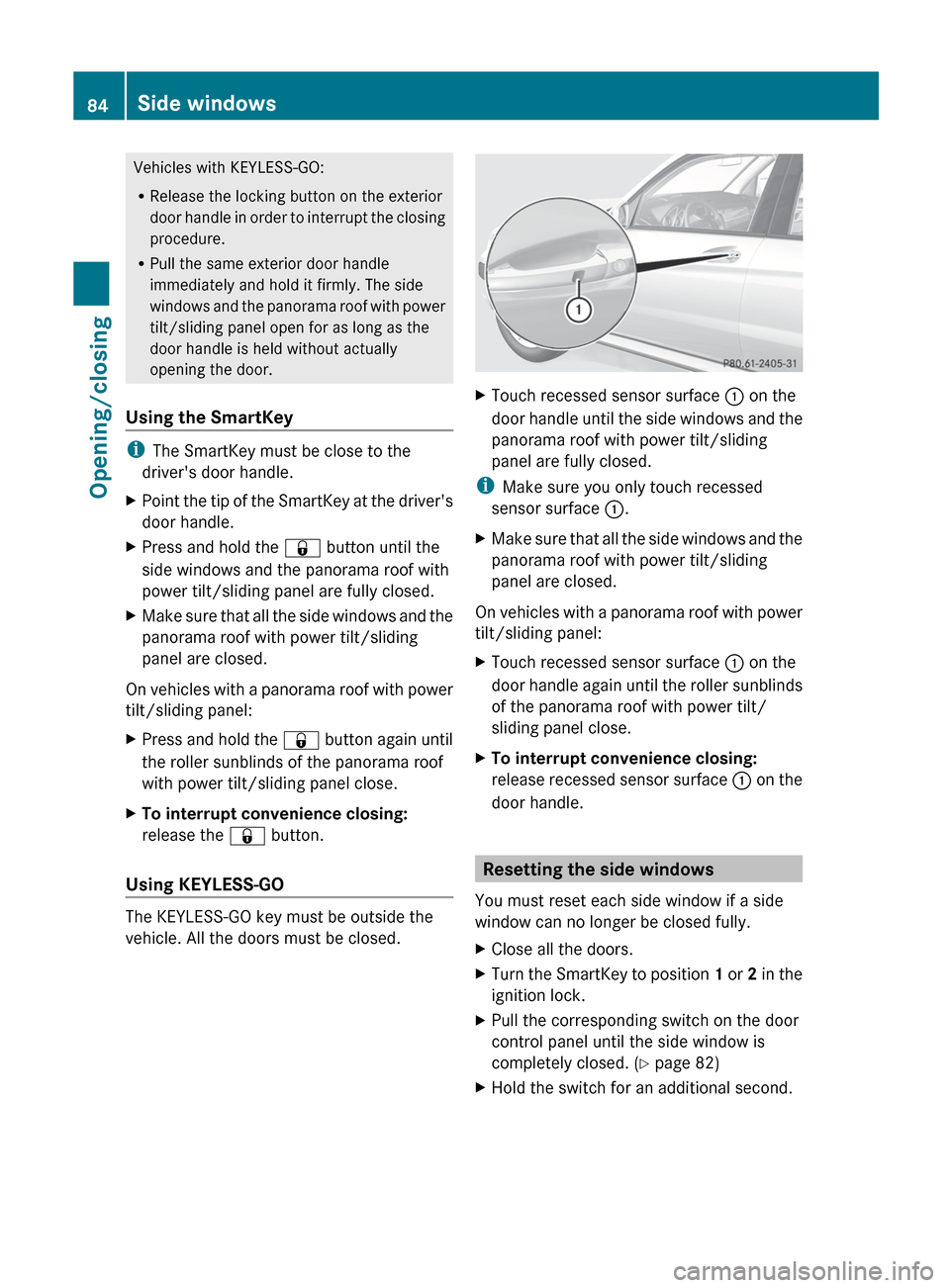
XTouch recessed sensor surface : on the
door handle until the side windows and the
panorama roof with power tilt/sliding
panel are fully closed.
i Make sure you only touch recessed
sensor surface :.
XMake sure that all the side windows and the
panorama roof with power tilt/sliding
panel are closed.
On vehicles with a panorama roof with power
tilt/sliding panel:
XTouch recessed sensor surface : on the
door handle again until the roller sunblinds
of the panorama roof with power tilt/
sliding panel close.XTo interrupt convenience closing:
release recessed sensor surface : on the
door handle.
Resetting the side windows
You must reset each side window if a side
window can no longer be closed fully.
XClose all the doors.XTurn the SmartKey to position 1 or 2 in the
ignition lock.XPull the corresponding switch on the door
control panel until the side window is
completely closed. ( Y page 82)XHold the switch for an additional second.84Side windowsOpening/closing