wheel MERCEDES-BENZ GLK-CLASS SUV 2013 User Guide
[x] Cancel search | Manufacturer: MERCEDES-BENZ, Model Year: 2013, Model line: GLK-CLASS SUV, Model: MERCEDES-BENZ GLK-CLASS SUV 2013Pages: 380, PDF Size: 19.54 MB
Page 21 of 380
Structure and characteristics
(definition) .....................................
349
Summer tires ................................. 330
Temperature .................................. 345
TIN (Tire Identification Number)
(definition) ..................................... 351
Tire bead (definition) ......................351
Tire pressure (definition) ................ 351
Tire pressures (recommended)
......349
Tire size (data) ............................... 357
Tire size designation, load-bearing
capacity, speed rating .................... 346
Tire tread ....................................... 329
Tire tread (definition) .....................351
Total load limit (definition) ............. 352
Traction ......................................... 344
Traction (definition) ....................... 351
Tread wear ..................................... 344
TWR (permissible trailer drawbar
noseweight) (definition) .................351
Uniform Tire Quality Grading
Standards ...................................... 344
Uniform Tire Quality Grading
Standards (definition) .................... 349
Unladen weight (definition) ............ 350
Wear indicator (definition) .............352
Wheel rim (definition) .................... 349
see Flat tire
Top Tether ............................................ 62
Towing Important safety guidelines ...........320
Installing the towing eye ................ 321
Removing the towing eye ...............321
With the rear axle raised ................ 322
Towing a trailer
Active Parking Assist .....................188
Cleaning the trailer tow hitch ......... 308
Coupling up a trailer ......................210
Decoupling a trailer ....................... 212
Driving tips .................................... 208
Important safety notes .................. 208
Installing the ball coupling .............210
Lights display message .................. 239
Mounting dimensions .................... 374
Power supply ................................. 213
Removing the ball coupling ............213
Shift range ..................................... 151Storing the ball coupling
................213
Trailer loads ................................... 374
Towing away
With both axles on the ground ....... 322
Tow-starting
Emergency engine starting ............ 323
Important safety notes
..................320
Trailer coupling
see Towing a trailer
Trailer loads and drawbar
noseweights ...................................... 212
Trailer towing Active Blind Spot Assist ................. 205
Active Lane Keeping Assist .... 202, 208
Blind Spot Assist ............................ 200
PARKTRONIC ................................. 183
Permissible trailer loads and
drawbar noseweights .....................212
Transfer case ..................................... 154
Transmission see Automatic transmission
Transmission position display .........149
Transmission position display
(DIRECT SELECT lever) ......................149
Transporting the vehicle .................. 322
Traveling uphill Brow of hill ..................................... 169
Driving downhill ............................. 169
Maximum gradient-climbing
capability ....................................... 169
Trim pieces (cleaning instructions) . 309
Trip computer (on-board
computer) .......................................... 219
Trip odometer Calling up ....................................... 219
Resetting (on-board computer) ...... 220
see Trip odometer
Turn signals
Changing bulbs (front) ................... 119
Display message ............................ 240
Switching on/off ........................... 112
see Turn signals
TWR (Tongue Weight Rating)
(definition) ......................................... 351
Type identification plate see Vehicle identification plate Index
19
Page 22 of 380
U
Unlocking Emergency unlocking .......................81
From inside the vehicle (central
unlocking button) ............................. 80V
Vanity mirror (in the sun visor) ........ 279
Vehicle Data acquisition ............................... 28
Display message ............................ 254
Emergency locking ........................... 81
Emergency unlocking .......................81
Equipment
....................................... 23
Individual settings ..........................226
Limited Warranty ............................. 28
Loading .......................................... 339
Locking (in an emergency) ............... 81
Locking (SmartKey) .......................... 74
Lowering ........................................ 356
Maintenance .................................... 24
Parking for a long period ................ 161
Pulling away ................................... 143
Raising ........................................... 354
Reporting problems .........................27
Securing from rolling away ............353
Towing away .................................. 320
Transporting .................................. 322
Unlocking (in an emergency) ........... 81
Unlocking (SmartKey) ......................74
Vehicle data ................................... 373
Vehicle data ....................................... 373
Vehicle dimensions ...........................373
Vehicle emergency locking ................81
Vehicle identification number see VIN
Vehicle identification plate ..............364
Vehicle tool kit .................................. 312
Video (DVD) ........................................ 223
VIN ...................................................... 364W
Warning and indicator lamps ABS ................................................ 259
Brakes ........................................... 259
Check Engine ................................. 264Coolant
.......................................... 265
Distance warning ........................... 267
DISTRONIC PLUS
...........................
267
ESP ®
.............................................. 261
ESP ®
OFF ....................................... 262
Fuel tank ........................................ 264
Overview .......................................... 32
PASSENGER AIR BAG OFF
indicator lamp .................................. 47
Reserve fuel
................................... 264
Seat belt ........................................ 257
SRS ................................................ 263
Tire pressure monitor .................... 268
Warranty ............................................ 364
Washer fluid Display message ............................ 255
Wheel bolt tightening torque ...........356
Wheel chock ...................................... 353
Wheels Changing a wheel .......................... 352
Checking ........................................ 329
Cleaning ......................................... 305
Cleaning (warning) .........................353
Emergency spare wheel ................. 359
Important safety notes .................. 328
Interchanging/changing ................352
Mounting a new wheel ................... 355
Mounting a wheel .......................... 353
Removing a wheel ..........................355
Storing ........................................... 352
Tightening torque ........................... 356
Wheel size/tire size ....................... 357
Window curtain air bag
Display message ............................ 236
Operation ......................................... 46
Windows
see Side windows
Windshield
Defrosting ...................................... 134
see Windshield
Windshield washer fluid
see Windshield washer system
Windshield washer system .............. 303
Notes ............................................. 372
Windshield wipers
Problem (malfunction) ...................124
Rear window wiper ........................12120
Index
Page 25 of 380
Have aftermarket accessories installed at
a qualified specialist workshop.
You could jeopardize the operating safety of
your vehicle if you use
parts, tires and wheels
as well as accessories relevant to safety
which have not been approved by Mercedes.
This could lead to malfunctions in safety-
relevant systems, e.g. the brake system. Use
only genuine Mercedes-Benz parts or parts of
equal quality. Only use tires, wheels and
accessories that have been specifically
approved for your vehicle.
Genuine Mercedes-Benz parts are subject to
strict quality control. Every part has been
specifically developed, manufactured or
selected for and adapted to Mercedes-Benz
vehicles. Only genuine Mercedes-Benz parts
should therefore be used.
More than 300,000 different genuine
Mercedes-Benz parts are available for
Mercedes-Benz models.
All authorized Mercedes-Benz Centers
maintain a supply of genuine Mercedes-Benz
parts for necessary service and repair work.
In addition, strategically located parts
delivery centers provide quick and reliable
parts service.
Always specify the vehicle identification
number (VIN) ( Y page 364) and the engine
number (Y page 365) when ordering genuine
Mercedes-Benz parts. Operator's Manual
General notes
Before you first drive off,
read this Operator's
Manual carefully and familiarize yourself with
your vehicle.
For your own safety and a longer vehicle life,
follow the instructions and warning notices in
this manual. Disregarding them may lead to
damage to the vehicle or personal injury.
Vehicle damage resulting from the disregard
of the instructions is not covered by the
Mercedes-Benz Limited Warranty. Vehicle equipment
This Operator's Manual describes all models
and all standard and optional equipment of
your vehicle available at the time of going to
print. Country-specific differences are
possible. Please note that your vehicle may
not be equipped with all features described.
This also applies to safety-related systems
and functions. The equipment in
your vehicle
may therefore differ from some of the
descriptions or illustrations.
The original purchase agreement lists all
systems installed in your vehicle.
Contact an authorized Mercedes-Benz Center
if you have any questions about equipment or
operation.
The Operator's Manual and Maintenance
Booklet are important documents and should
be kept in the vehicle. Service and vehicle operation
Service and literature
Your vehicle is covered under
the terms of the
warranties printed in the Service and
Warranty Information booklet. Your
authorized Mercedes-Benz Center will
exchange or repair any defective parts
originally installed in the vehicle in
accordance with the terms of the following
warranties:
R New Vehicle Limited Warranty
R Emission Systems Warranty
R Emission Performance Warranty
R California, Connecticut, Maine,
Massachusetts, New York, Pennsylvania,
Rhode Island and Vermont Emission
Control Systems Warranty
R State warranty enforcement laws (lemon
laws) Introduction
23 Z
Page 28 of 380
networked components. In particular,
systems relevant to safety could also be
affected. As a result, these may no longer
function as intended and/or jeopardize the
operating safety of the vehicle. There is an
increased risk of an accident and injury.
Never tamper with the wiring as well as
electronic components or their
software.
You
should have all work to electrical and
electronic equipment carried out at a qualified
specialist workshop.
There is a risk of damage to the vehicle if:
R the vehicle becomes stuck, e.g. on a high
curb or an unpaved road
R you drive too fast over an obstacle, e.g. a
curb or a hole in the road
R a heavy object strikes the undercarriage or
parts of the chassis.
In situations like this, the body, the
undercarriage, chassis parts, wheels or tires
could be damaged without the damage being
visible. Components damaged in this way can
unexpectedly fail or, in the case of an
accident, no longer withstand the strain they
are designed to.
If the underbody paneling is damaged,
combustible materials such as leaves, grass
or twigs can gather between the underbody
and the underbody paneling. If these
materials come in contact with hot parts of
the exhaust system for an extended period,
they can catch fire.
Have the vehicle checked and repaired
immediately at a qualified specialist
workshop. If on continuing your journey you
notice that driving safety is impaired, pull over
and stop the vehicle immediately, paying
attention to road and traffic conditions. In
such cases, visit a qualified specialist
workshop. Declarations of conformity
Vehicle components which receive
and/or transmit radio waves USA: "The wireless devices of this vehicle
comply with Part 15 of the FCC Rules.
Operation is subject to the following two
conditions: 1) These devices may not cause
harmful interference, and 2) These devices
must accept any interference received,
including interference that may cause
undesired operation. Changes or
modifications not expressly approved by the
party responsible for compliance could void
the user’s authority to operate the
equipment."
Canada:
"The wireless devices of
this vehicle
comply with Industry Canada license-exempt
RSS standard(s). Operation is subject to the
following two conditions: (1) These devices
may not cause interference, and (2) These
devices must accept any interference,
including interference that may cause
undesired operation of the device." Diagnostics connection
The diagnostics connection is only intended
for the connection of diagnostic
equipment at
a qualified specialist workshop. G
WARNING
If you connect equipment to the diagnostics
connection in the vehicle, it may affect the
operation of the vehicle systems.
As a result,
the operating safety of the vehicle could be
affected. There is a risk of an accident.
Do not connect any equipment to a
diagnostics connection in the vehicle. G
WARNING
Objects in the driver's footwell can restrict the
pedal travel or obstruct a depressed pedal.
The operating and road safety of the vehicle
is jeopardized. There is a risk of an accident. 26
Introduction
Page 31 of 380
Dashboard ...........................................
30
Instrument cluster ..............................31
Multifunction steering wheel .............33
Center console .................................... 34
Overhead control panel ......................36
Door control panel .............................. 37 29At a glance
Page 32 of 380
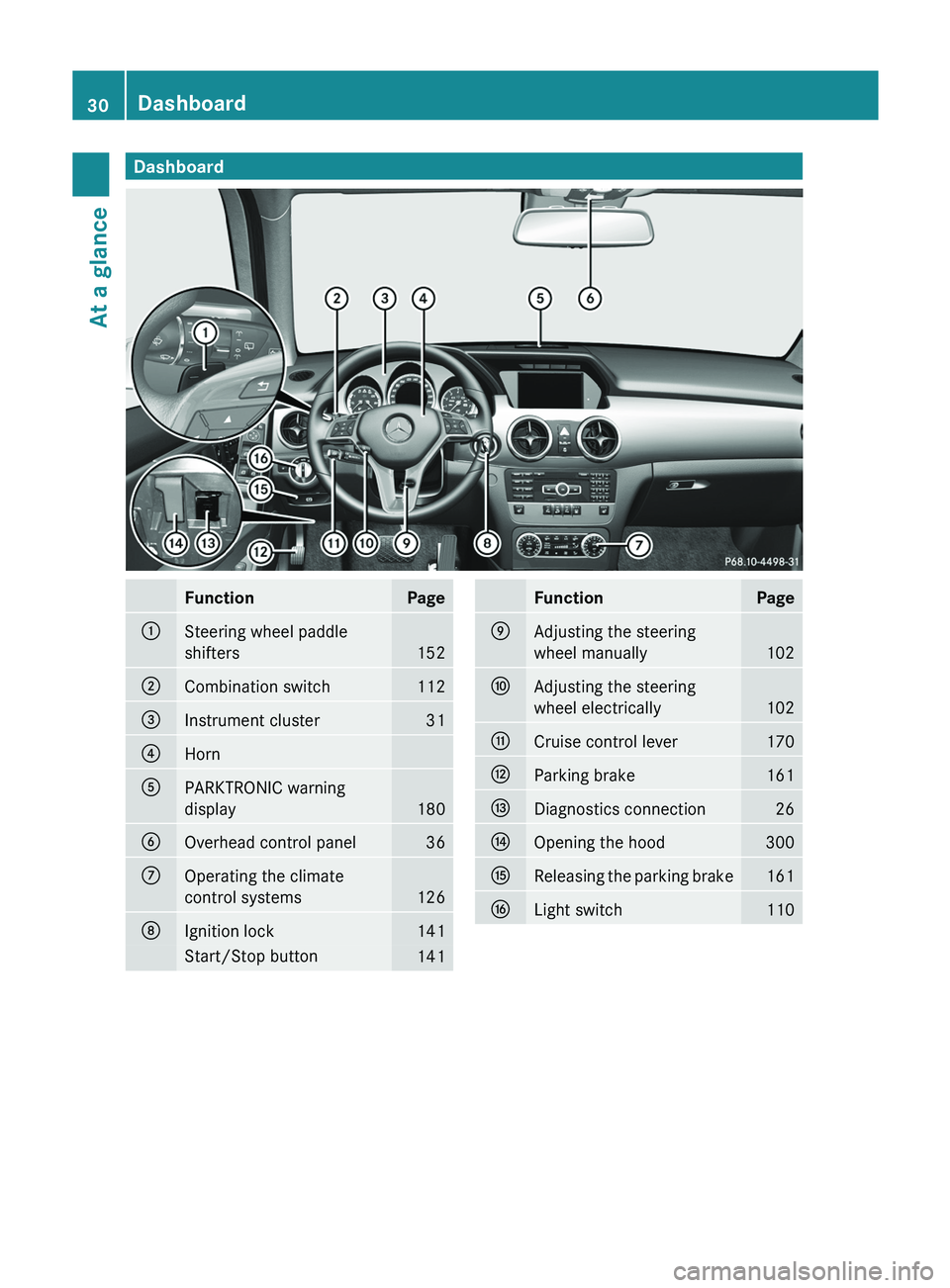
Dashboard
Function Page
0043
Steering wheel paddle
shifters
152
0044
Combination switch 112
0087
Instrument cluster 31
0085
Horn
0083
PARKTRONIC warning
display
180
0084
Overhead control panel 36
006B
Operating the climate
control systems
126
006C
Ignition lock 141
Start/Stop button
141 Function Page
006D
Adjusting the steering
wheel manually
102
006E
Adjusting the steering
wheel electrically
102
006F
Cruise control lever 170
0070
Parking brake 161
0071
Diagnostics connection 26
0072
Opening the hood 300
0073
Releasing the parking brake 161
0074
Light switch 11030
DashboardAt a glance
Page 35 of 380
Multifunction steering wheel
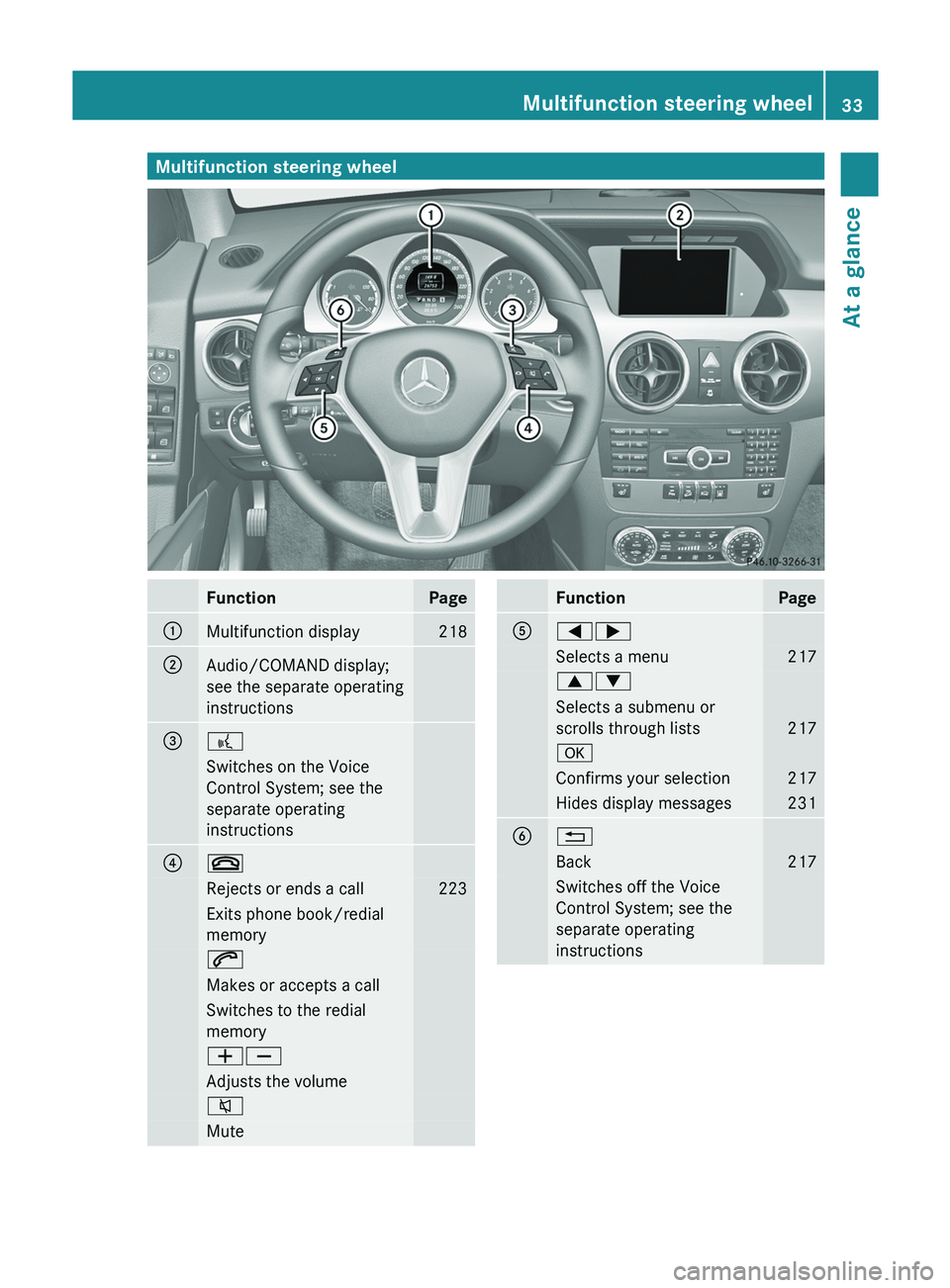
Function Page
0043
Multifunction display 218
0044
Audio/COMAND display;
see the separate operating
instructions
0087
0059
Switches on the Voice
Control System; see the
separate operating
instructions
0085
0076
Rejects or ends a call 223
Exits phone book/redial
memory
0061
Makes or accepts a call
Switches to the redial
memory
00810082
Adjusts the volume
0063
Mute Function Page
0083
00590065
Selects a menu 217
00630064
Selects a submenu or
scrolls through lists
217
0076
Confirms your selection 217
Hides display messages 231
0084
0038
Back 217
Switches off the Voice
Control System; see the
separate operating
instructionsMultifunction steering wheel
33At a glance
Page 39 of 380
Door control panel
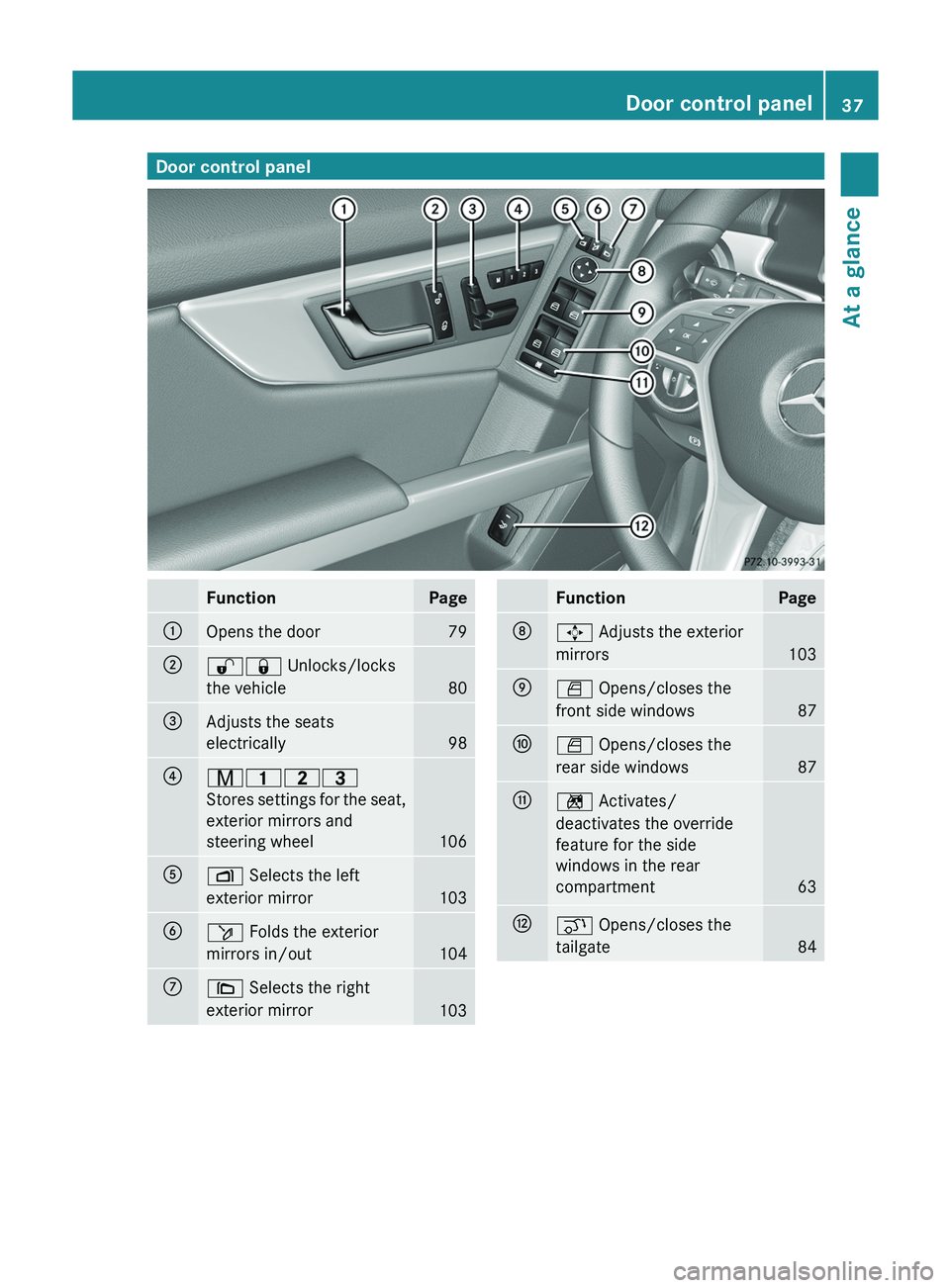
Function Page
0043
Opens the door 79
0044
00360037 Unlocks/locks
the vehicle
80
0087
Adjusts the seats
electrically
98
0085
008D003700380040
Stores settings for the
seat,
exterior mirrors and
steering wheel 106
0083
0070 Selects the left
exterior mirror
103
0084
00F5 Folds the exterior
mirrors in/out
104
006B
0071 Selects the right
exterior mirror
103 Function Page
006C
0062 Adjusts the exterior
mirrors
103
006D
0062 Opens/closes the
front side windows
87
006E
0062 Opens/closes the
rear side windows
87
006F
0089 Activates/
deactivates the override
feature for the side
windows in the rear
compartment
63
0070
008C Opens/closes the
tailgate
84Door control panel
37At a glance
Page 44 of 380
R
Do not change or remove any component
or part of the SRS.
R Do not install additional trim
material, seat
covers, badges, etc. over the steering
wheel hub, front-passenger front air bag
cover, outer sides of the seat backrests,
door trim panels, or door frame trims.
R Do not install additional electrical/
electronic equipment on or near SRS
components and wiring.
R Keep area between air bags and occupants
free of objects (e.g. packages, purses,
umbrellas, etc.).
R Do not hang items such as coat hangers
from the coat hooks or handles over the
door. These items may be thrown around in
the vehicle and cause head and other
injuries when the window curtain air bag is
deployed.
R Air bag system components will be hot after
an air bag has inflated. Do not touch them.
R Never place your feet on the instrument
panel, dashboard, or on the seat. Always
keep both feet on the floor in front of the
seat.
R Improper repair work on the SRS creates a
risk of rendering the SRS inoperative or
causing unintended air bag deployment.
Work on the SRS must therefore only be
performed by qualified technicians.
Contact an authorized Mercedes-Benz
Center.
R For your protection and the protection of
others, when scrapping the air bag unit or
ETD, our safety instructions must be
followed. These instructions are available
from any authorized Mercedes-Benz
Center.
R Given the considerable deployment speed,
required inflation volume, and the material
of the air bags, there is the possibility of
abrasions or other, potentially more serious
injuries resulting from air bag deployment.
If you sell your vehicle, Mercedes-Benz
strongly recommends that you inform the subsequent owner that the vehicle is
equipped with SRS. Also, refer them to the
applicable section in the Operator's Manual.
Air bags
Important safety notes G
WARNING
Air bags are designed to reduce the incidence
of injuries and fatalities in certain situations:
R frontal impacts (driver's and front-
passenger front air bags and driver's knee
bag)
R side impacts (side impact air
bags, window
curtain air bags and pelvis air bags)
R rollover (window curtain air bags)
However, no system available today can
completely eliminate injuries and fatalities.
When the air bags are deployed, a small
amount of powder is released. The powder
generally does not constitute a health hazard
and does not indicate that there is a fire in the
vehicle. In order to prevent potential
breathing difficulties, you should leave the
vehicle as soon as it is safe to do so. If you
have any breathing difficulty but cannot get
out of the vehicle after the air bag inflates,
then get fresh air by opening a window or
door. G
WARNING
In order to reduce the potential danger of
injuries caused during the deployment of the
front air bags, the driver and front passenger
must always be correctly seated and wear
their seat belts.
For maximum protection in the event of a
collision, you must always be in the normal
seat position with your back against the
backrest. Fasten your
seat belt
and make sure
that it is correctly positioned on your body. 42
Occupant safety
Safety
Page 45 of 380
As the air bag inflates with considerable
speed and force, a proper seating position
and correct positioning of the hands on the
steering wheel will help
to
keep you at a safe
distance from the air bag. Occupants who are
not wearing their seat belt, are not seated
properly or are too close to the air bag can be
seriously injured or killed by an air bag, as it
inflates with great force instantaneously:
R sit with the seat belt fastened correctly and
in a position that is as upright as possible
with your back against the backrest.
R move the driver's seat as far back as
possible, still permitting proper operation
of vehicle controls. The distance from the
center of the driver's chest to the center of
the air bag cover on the steering wheel
must be at least 10 inches (25 cm). You
should be able to accomplish this by
adjusting the seat and steering wheel. If
you have any difficulties, please contact an
authorized Mercedes-Benz Center.
R do not lean your head or chest close to the
steering wheel or dashboard.
R only hold the steering wheel on the outside.
Placing hands and arms inside the rim can
increase the risk and potential severity of
hand/arm injury if the driver front air bag
inflates.
R adjust the front-passenger seat as far back
as possible from the dashboard when the
seat is occupied.
R occupants, especially children, should
never place their bodies or lean their heads
in the area of the door where the side
impact air bag inflates. This could result in
serious or fatal injuries should the side
impact air bag be deployed. Always sit as
upright as possible, wear the seat belt
properly and use an appropriately sized
infant restraint, toddler restraint or booster
seat recommended for the size and weight
of the child.
Failure to follow these instructions can result
in severe injuries to you or other occupants. If you sell your vehicle, it is important that you
make the buyer aware of this safety
information. Be sure to give the buyer this
Operator's Manual.
G
WARNING
Accident research shows that the safest place
for children in an automobile
is in a rear seat.
A side impact air bag related injury may occur
if occupants, especially children, are not
properly seated or restrained when next to a
side impact air bag which needs to deploy
rapidly in a side impact in order to do its job.
To help avoid the possibility of injury, please
follow these guidelines:
(1) Always sit as upright as possible and use the seat belts properly.
Make sure that children 12 years
old and under use an
appropriately
sized child restraint, infant
restraint, or booster seat
recommended for the size and
weight of the child.
(2) Always wear seat belts properly.
The air bags are only deployed if the air bag
control unit detects the need
for deployment.
Only in the event of such a situation, will the
air bags provide their supplemental
protection.
If the driver and front passenger do not wear
their seat belts, it is not possible for the air
bags to provide their supplemental
protection.
In the event of other types of impacts and
impacts below air bag deployment
thresholds, the air bags will not deploy. The
driver and passenger will then be protected
to the extent possible by a properly fastened
seat belt. A properly fastened seat belt is also
needed to provide the best possible
protection if the vehicle rolls over.
Air bags are not a substitute for seat belts.
Always wear your seat belt, regardless of
whether or not your vehicle is equipped with
air bags. Occupant safety
43
Safety Z