lock MERCEDES-BENZ GLK-CLASS SUV 2014 User Guide
[x] Cancel search | Manufacturer: MERCEDES-BENZ, Model Year: 2014, Model line: GLK-CLASS SUV, Model: MERCEDES-BENZ GLK-CLASS SUV 2014Pages: 384, PDF Size: 48.23 MB
Page 21 of 384
Tire bead (definition
)...................... 353
Tire pressure (definition) ................353
Tire pressures (recommended )...... 351
Tire size (data) ............................... 359
Tire size designation, load-bearing
capacity, speed rating .................... 348
Tire tread ....................................... 331
Tire tread (definition) .....................353
Total load limit (definition) .............354
Traction ......................................... 346
Traction (definition) .......................353
Tread wea r..................................... 346
TWR (permissible trailer drawbar
noseweight) (definition) .................353
Uniform Tire Quality Grading
Standards ...................................... 346
Uniform Tire Quality Grading
Standards (definition) ....................351
Unladen weight (definition) ............352
Wear indicator (definition) .............354
Wheel rim (definition) ....................351
see Flat tire
Top Tether ............................................ 65
Towing Important safety guidelines ...........322
Installing the towing eye ................323
Removing the towing eye ...............323
With the rear axle raised ................324
Towing a trailer
Active Parking Assist .....................192
Cleaning the trailer tow hitch ......... 310
Coupling up a trailer ......................214
Decoupling a trailer .......................216
Driving tips .................................... 212
Important safety notes ..................212
Installing the ball coupling .............214
Lights display message ..................243
Mounting dimensions ....................376
Power supply ................................. 217
Removing the ball coupling ............216
Storing the ball coupling ................217
Trailer loads ................................... 376
Towing away
With both axles on the ground .......324
Tow-starting
Emergency engine starting ............325
Important safety notes ..................322Trailer coupling
see Towing a trailer
Trailer loads and drawbar
noseweights ...................................... 216
Trailer towing Active Blind Spot Assist .................209
Active Lane Keeping Assist .... 206, 212
Blind Spot Assist ............................ 204
PARKTRONIC ................................. 187
Permissible trailer loads and
drawbar noseweights .....................216
Transfer case ..................................... 158
Transmission see Automatic transmission
Transmission position display .........153
Transmission position display
(DIRECT SELECT lever) ......................153
Transporting the vehicle ..................324
Traveling uphill Brow of hill ..................................... 173
Driving downhill ............................. 173
Maximum gradient-climbing
capability ....................................... 173
Trim pieces (cleaning instructions) .311
Trip computer (on-board computer) 223
Trip odometer Calling up ....................................... 223
Resetting (on-board computer) ......224
Turn signals
Changing bulbs (front) ...................121
Display message ............................ 244
Switching on/off ........................... 114
TWR (Tongue Weight Rating)
(definition) ......................................... 353
Type identification plate see Vehicle identification plate U
Unlocking Emergency unlocking .......................83
From inside the vehicle (central
unlocking button) ............................. 82 Index
19
Page 22 of 384
V
Vanity mirror (in the sun visor) ........ 283
Vehicle Correct use ...................................... 27
Data acquisition ............................... 28
Display message ............................ 258
Emergency locking ........................... 83
Emergency unlocking .......................83
Equipment ....................................... 23
Individual settings ..........................230
Limited Warranty ............................. 28
Loading .......................................... 342
Locking (in an emergency) ...............83
Locking (SmartKey) .......................... 76
Lowering ........................................ 358
Maintenance .................................... 24
Parking for a long period ................ 165
Pulling away ................................... 147
Raising ........................................... 356
Reporting problems .........................27
Securing from rolling away ............355
Towing away .................................. 322
Transporting .................................. 324
Unlocking (in an emergency) ...........83
Unlocking (SmartKey) ......................76
Vehicle data ................................... 375
Vehicle data ....................................... 375
Vehicle data (off-road driving) Approach/departure angl e............ 376
Fording depth ................................ 375
Maximum gradient climbing ability 376
Vehicle dimensions ...........................375
Vehicle emergency locking ................83
Vehicle identification number see VIN
Vehicle identification plate ..............366
Vehicle tool kit .................................. 314
Video (DVD) ........................................ 227
VIN ...................................................... 366W
Warning and indicator lamps ABS ................................................ 263
Brakes ........................................... 263
Check Engine ................................. 268
Coolant .......................................... 269Distance warning
........................... 271
DISTRONIC PLUS ........................... 271
ESP ®
.............................................. 265
ESP ®
OFF ....................................... 266
Fuel tank ........................................ 268
Overview .......................................... 34
PASSENGER AIRBAG OFF ................49
Reserve fuel ................................... 268
Seat belt ........................................ 261
SRS ................................................ 267
Tire pressure monitor ....................272
Warranty ............................................ 366
Washer fluid Display message ............................ 259
Wheel bolt tightening torque ...........358
Wheel chock ...................................... 355
Wheels Changing a wheel .......................... 354
Checking ........................................ 331
Cleaning ......................................... 307
Cleaning (warning) .........................355
Emergency spare wheel .................361
Important safety notes ..................330
Interchanging/changing ................354
Mounting a new wheel ...................357
Mounting a wheel .......................... 355
Removing a wheel ..........................357
Storing ........................................... 355
Tightening torque ........................... 358
Wheel size/tire size .......................359
Window curtain air bag
Display message ............................ 240
Operation ........................................ .48
Windows
see Side windows
Windshield
Defrosting ...................................... 137
Windshield washer fluid
see Windshield washer system
Windshield washer system ..............305
Notes ............................................. 373
Windshield wipers
Problem (malfunction) ...................126
Rear window wiper ........................123
Replacing the wiper blades ............123
Switching on/off ........................... 12220
Index
Page 34 of 384
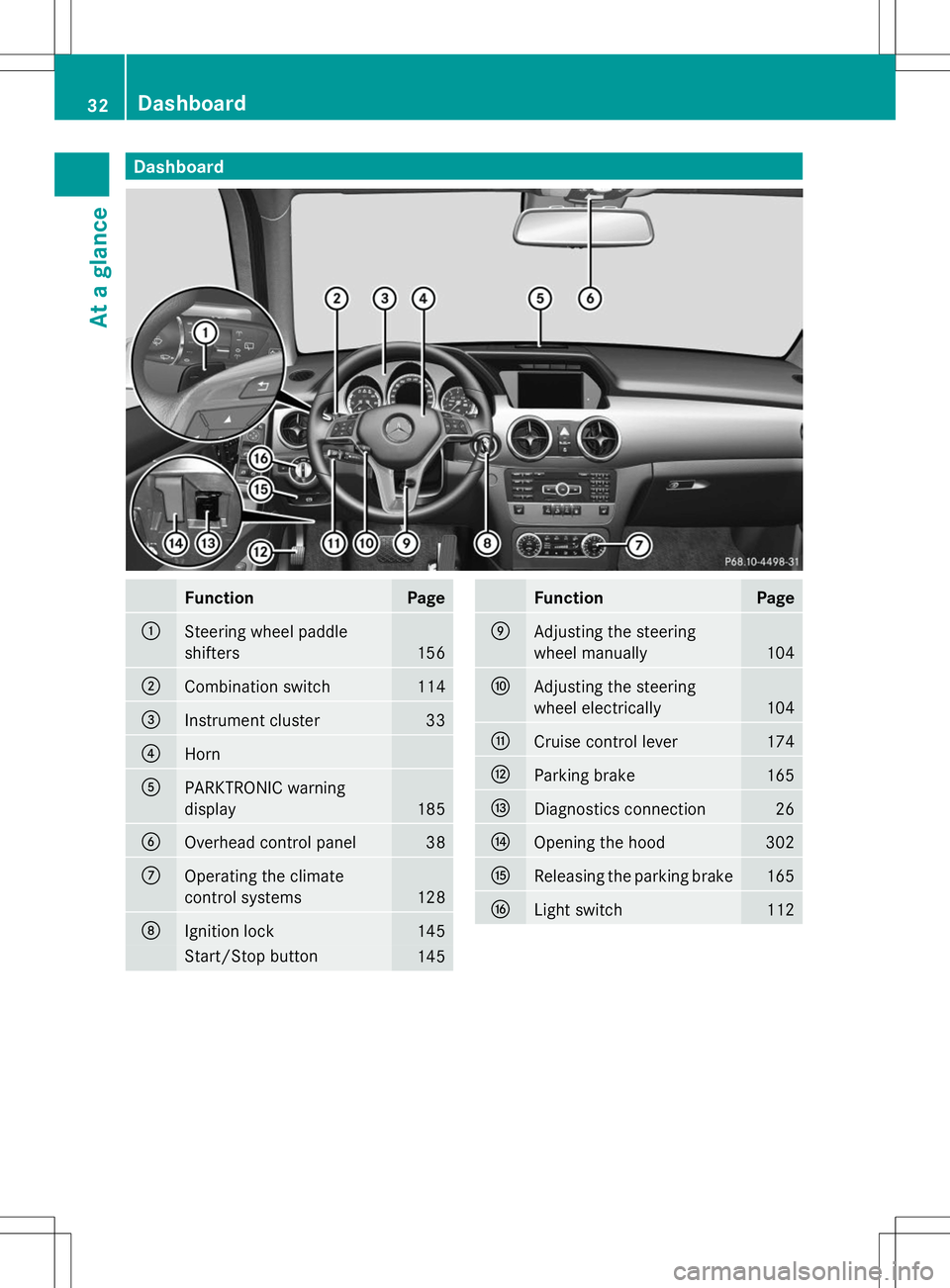
Dashboard
Function Page
:
Steering wheel paddle
shifters
156
;
Combination switch 114
=
Instrument cluster 33
?
Horn
A
PARKTRONIC warning
display
185
B
Overhead control panel 38
C
Operating the climate
control systems
128
D
Ignition lock 145
Start/Stop button
145 Function Page
E
Adjusting the steering
wheel manually
104
F
Adjusting the steering
wheel electrically
104
G
Cruise control lever 174
H
Parking brake 165
I
Diagnostics connection 26
J
Opening the hood 302
K
Releasing the parking brake 165
L
Light switch 11232
Dashboa
rdAt a glance
Page 41 of 384
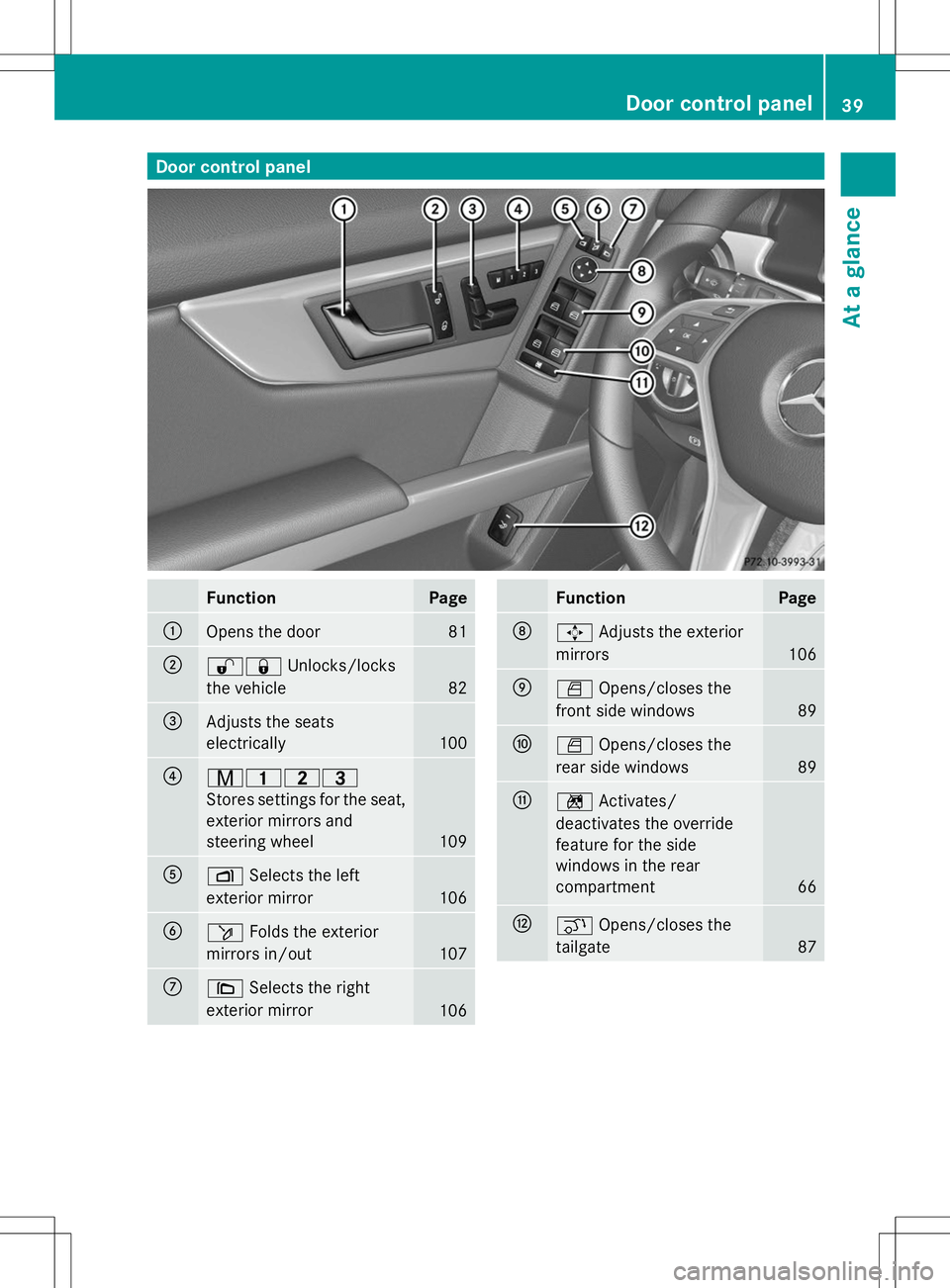
Door control panel
Function Page
:
Opens the door 81
;
%&
Unlocks/locks
the vehicle 82
=
Adjusts the seats
electrically 100
?
r45=
Stores settings for the seat,
exterior mirrors and
steering wheel 109
A
Z
Selects the left
exterior mirror 106
B
ö
Folds the exterior
mirrors in/out 107
C
\
Selects the right
exterior mirror 106 Function Page
D
7
Adjusts the exterior
mirrors 106
E
W
Opens/closes the
front side windows 89
F
W
Opens/closes the
rear side windows 89
G
n
Activates/
deactivates the override
feature for the side
windows in the rear
compartment 66
H
q
Opens/closes the
tailgate 87Door cont
rol panel
39At a glance
Page 43 of 384
Useful information
..............................42
Panic alarm .......................................... 42
Occupant safety .................................. 42
Children in the vehicle ........................61
Driving safety systems .......................67
Theft deterrent locking system .........73 41Safety
Page 44 of 384
Useful information
i This Operator's Manual describes all
models and all standard and optional
equipment of your vehicle available at the
time of publication of the Operator's
Manual. Country-specific differences are
possible. Please note that your vehicle may
not be equipped with all features
described. This also applies to safety-
related systems and functions.
i Read the information on qualified
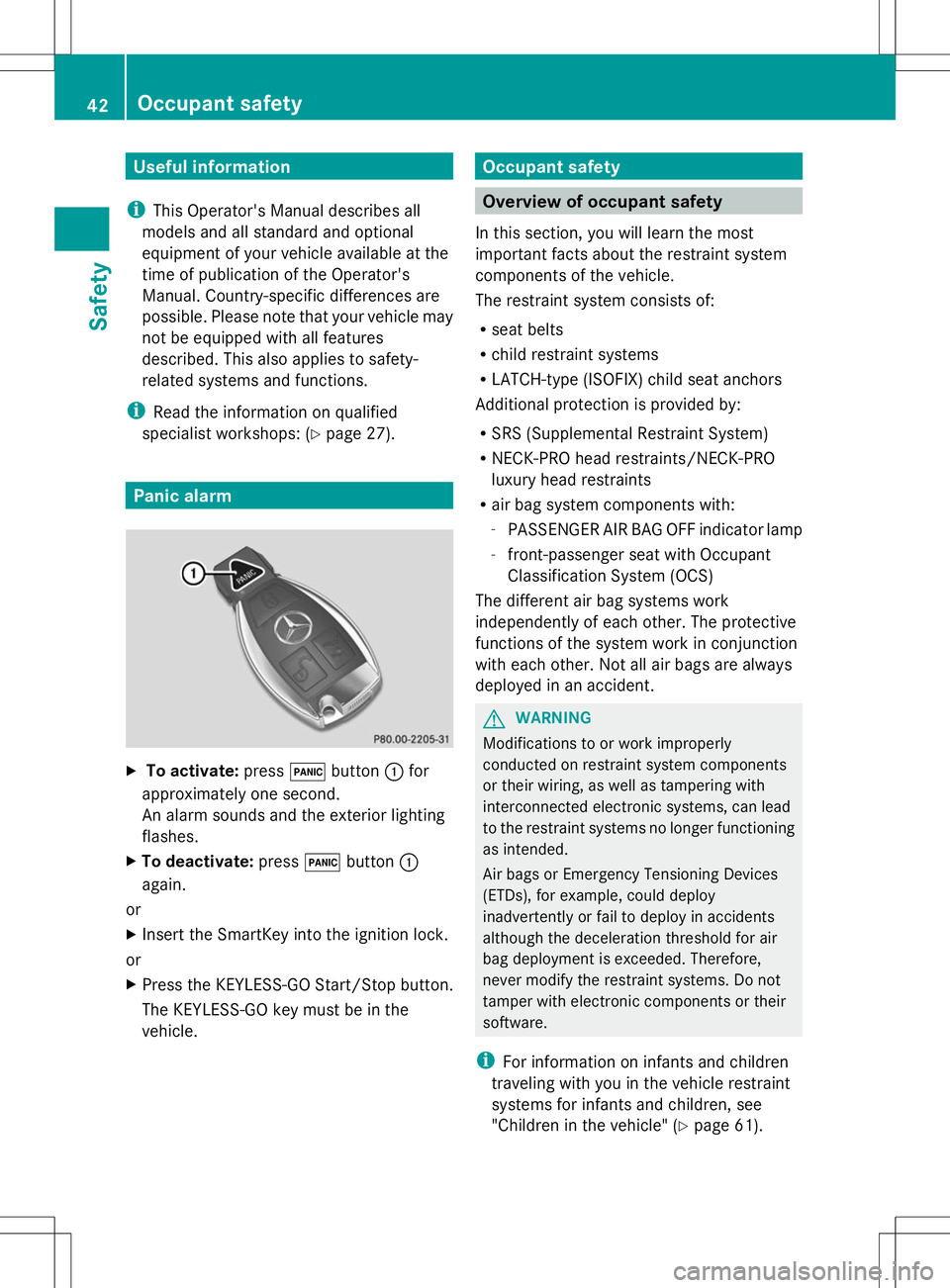
specialist workshops: (Y page 27).Panic alarm
X
To activate: press!button :for
approximately one second.
An alarm sounds and the exterior lighting
flashes.
X To deactivate: press!button :
again.
or
X Insert the SmartKey into the ignition lock.
or
X Press the KEYLESS-GO Start/Stop button.
The KEYLESS-GO key must be in the
vehicle. Occupant safety
Overview of occupant safety
In this section, you will learn the most
important facts about the restraint system
components of the vehicle.
The restraint system consists of:
R seat belts
R child restraint systems
R LATCH-type (ISOFIX) child seat anchors
Additional protection is provided by:
R SRS (Supplemental Restraint System)
R NECK-PRO head restraints/NECK-PRO
luxury head restraints
R air bag system components with:
-PASSENGER AIR BAG OFF indicator lamp
- front-passenger seat with Occupant
Classification System (OCS)
The different air bag systems work
independently of each other. The protective
functions of the system work in conjunction
with each other. Not all air bags are always
deployed in an accident. G
WARNING
Modifications to or work improperly
conducted on restraint system components
or their wiring, as well as tampering with
interconnected electronic systems, can lead
to the restraint systems no longer functioning
as intended.
Air bags or Emergency Tensioning Devices
(ETDs), for example, could deploy
inadvertently or fail to deploy in accidents
although the deceleration threshold for air
bag deployment is exceeded. Therefore,
never modify the restraint systems. Do not
tamper with electronic components or their
software.
i For information on infants and children
traveling with you in the vehicle restraint
systems for infants and children, see
"Children in the vehicle" (Y page 61).42
Occupant safetySafety
Page 53 of 384
front-passenger front air bag in your vehicle
when the system senses the weight of a
typical 12-month-old child or less along
with the weight of a standard appropriate
child restraint on the front-passenger seat.
R A child in a rear-facing child restraint on the
front-passenger seat will be seriously
injured or even killed if the front-passenger
front air bag inflates in a collision which
could occur under some circumstances,
even with the air bag technology installed
in your vehicle. The only means to eliminate
this risk completely is never to place a child
in a rear-facing child restraint in the front-
passenger seat. We therefore strongly
recommend that you always place a child
in a rear-facing child restraint on the rear
seat.
R If you install a rear-facing child restraint on
the front-passenger seat, make sure the
45 indicator lamp is illuminated,
indicating that the front-passenger front air
bag is deactivated. Should the 45
indicator lamp not illuminate or go out while
the restraint is installed, please check
installation. Periodically check the
45 indicator lamp while driving to
make sure that the 45indicator
lamp is illuminated. If the 45
indicator lamp goes out or remains out, do
not transport a child on the front-passenger
seat until the system has been repaired.
A child in a rear-facing child restraint on the
front-passenger seat will be seriously
injured or even killed if the front-passenger
front air bag inflates. R
If you place a child in a forward-facing child
restraint on the front-passenger seat:
-move the seat as far back as possible
- use the proper child restraint
recommended for the age, size and
weight of the child
- secure child restraint with the vehicle's
seat belt according to the child seat
manufacturer's instructions
R For children larger than the typical 12-
month-old child, the front-passenger front
air bag may or may not be activated.
If the driver's air bag deploys, this does not
mean that the front-passenger front air bag
will also deploy.
The OCS may have detected that the seat:
R is empty or occupied by the weight of a
typical child up to twelve months old,
seated in a child restraint system.
R is occupied by a small individual, such as a
young teenager or a small adult.
R is occupied by a child in a child restraint
system whose weight is greater than that
of a typical twelve month old child.
These are examples of when the OCS
deactivates the front-passenger front air bag.
Deactivation takes place although the
collision fulfills the criteria for deploying the
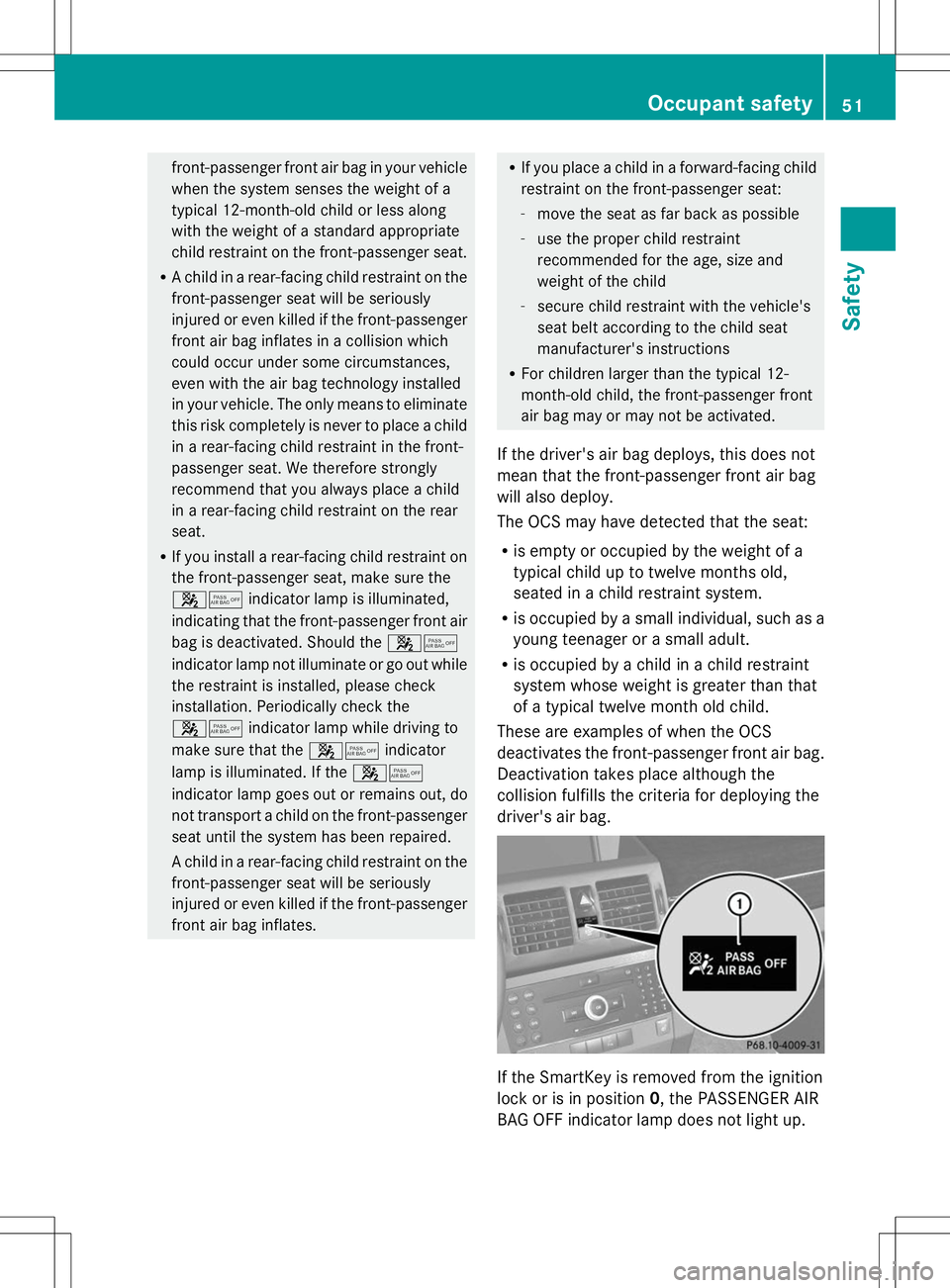
driver's air bag. If the SmartKey is removed from the ignition
lock or is in position
0, the PASSENGER AIR
BAG OFF indicator lamp does not light up. Occupant safety
51Safety Z
Page 54 of 384
G
WARNING
If the red 6SRS warning lamp in the
instrument cluster and the 45
indicator lamp light up simultaneously, the
OCS is malfunctioning. The front passenger
front air bag will be deactivated in this case.
Have the system checked by qualified
technicians as soon as possible. Contact an
authorized Mercedes-Benz Center.
Only have the seat repaired or replaced at an
authorized Mercedes-Benz Center.
In order to ensure proper operation of the air
bag system and OCS:
R Sit with the seat belt properly fastened in a
position that is as upright as possible with
your back against the seat backrest.
R When seated, a passenger should not
position him/herself in such a way as to
cause the passenger's weight to be lifted
from the seat cushion as this may result in
the OCS being unable to correctly
approximate the passenger's weight
category.
R Read and observe all warnings in this
chapter.
System self-test The PASSENGER AIR BAG OFF indicator lamp
lights up if you:
R turn the SmartKey to position 1or 2in the
ignition lock
R press the KEYLESS-GO Start/Stop button
once or twice on vehicles with KEYLESS-
GO.
When an adult is sitting correctly on the front-
passenger seat and is categorized by the OCS
system as an adult, the PASSENGER AIR BAG
OFF indicator lamp lights up and goes off
again after approximately six seconds.
If the seat is not occupied and the OCS
system classifies the front-passenger seat as
being empty, the PASSENGER AIR BAG OFF
indicator lamp will continue to light up and
not go out. G
WARNING
If the 45indicator lamp does not
illuminate, the system is not functioning. You
must contact an authorized Mercedes-Benz
Center before seating any child on the front
passenger seat.
For more information about the OCS, see
"Problems with the Occupant Classification
System" (Y page 53). G
WARNING
Objects between the seat surface and the
child restraint system could affect the
function of the OCS. This could result in the
front-passenger front air bag not functioning
as intended during an accident. This poses an
increased risk of injury or even fatal injury.
Do not place any objects between the seat
surface and the child restraint system. Make
sure that the bottom and back of the child
restraint system make full contact with the
front-passenger seat cushion and backrest.
Always comply with the child restraint system
manufacturer's installation instructions. 52
Occupant safetySafety
Page 56 of 384

G
WARNING
If the 45 indicator lamp does not illuminate or remains out with the weight of a typical
12-month-old child in a standard child restraint or less, or is unoccupied, on the front-passenger
seat, do not transport a child on the front-passenger seat until the system has been repaired. PRE-SAFE
®
(anticipatory occupant
protection system) G
WARNING
The PRE-SAFE ®
system reduces the impact of
an accident on vehicle occupants, as long as
their seat belts have been fastened correctly.
Although your vehicle is equipped with a PRE-
SAFE ®
system, the possibility of injury in the
event of an accident cannot be ruled out. You
should therefore always drive carefully and
adapt your driving style to the prevailing road,
weather and traffic conditions.
PRE-SAFE ®
takes preemptive measures to
protect occupants in certain hazardous
situations.
PRE-SAFE ®
intervenes:
R if BAS PLUS intervenes powerfully on
vehicles with DISTRONIC PLUS
R if, on vehicles with DISTRONIC PLUS, the
radar sensor system detects an imminent
danger of collision in certain situations
R in critical driving situations, e.g. when
physical limits are exceeded and the
vehicle understeers or oversteers severely
If the seat belts are not released:
X When the vehicle is stationary, move the
backrest or seat back slightly.
The seat belt pre-tensioning is reduced and
the locking mechanism is released. G
WARNING
Make sure that nobody can become trapped
as you adjust the seat.
! Make sure that there are no objects in the
footwell or behind the seats when resetting
the seats. There is a risk that the seats
and/or the objects could be damaged. More information about seat belt adjustment,
a convenience function integrated into PRE-
SAFE
®
, can be found in the "Seat belt
adjustment" section ( Ypage 58). NECK-PRO head restraints/NECK-
PRO luxury head restraints
G
WARNING
The function of the head restraint may be
impaired if you:
R attach objects such as coat hangers to the
head restraints, for example
R use head restraint covers
If you do so, the head restraints cannot fulfill
their intended protective function in the event
of an accident. In addition, objects attached
to the head restraints could endanger other
vehicle occupants. There is an increased risk
of injury.
Do not attach any objects to the head
restraints and do not use head restraint
covers.
NECK-PRO head restraints/NECK-PRO luxury
head restraints increase protection of the
driver's and front-passenger's head and
neck. In the event of a rear collision of a
certain severity, the NECK-PRO head
restraints/NECK-PRO luxury head restraints
on the driver's and the front-passenger seats
are moved forwards and upwards. This
provides better head support.
If the NECK-PRO head restraints/NECK-PRO
luxury head restraints have been triggered in
an accident, reset the NECK-PRO head
restraints/NECK-PRO luxury head restraints
on the driver's and front-passenger seats
(Y page 55). Otherwise, the additional 54
Occupant safetySafety
Page 60 of 384

Fastening seat belts
G
WARNING
According to accident statistics, children are
safer when properly restrained on the rear
seats than on the front-passenger seat. Thus,
we strongly recommend that children be
placed in the rear seat whenever possible.
Regardless of seating position, children 12
years old and under must be seated and
properly secured in an appropriately sized
child restraint system or booster seat
recommended for the size and weight of the
child. For additional information, see the
"Children in the vehicle" section.
A child's risk of serious or fatal injuries is
significantly increased if the child restraints
are not properly secured in the vehicle and/
or the child is not properly secured in the child
restraint. X
Adjust the seat and move the backrest to
an almost vertical position (Y page 98).
X Pull the seat belt smoothly through belt
sash guide :.
X Without twisting it, guide the shoulder
section of the seat belt across the middle
of your shoulder and the lap section across
your pelvis.
X Engage belt tongue ;in buckle =. X
If necessary, adjust the seat belt to the
appropriate height (Y page 58).
X If necessary, pull upwards on the shoulder
section of the seat belt to tighten the belt
across your body.
All seat belts except the driver's seat belt are
equipped with a special seat belt retractor to
securely fasten child restraint systems in the
vehicle. For further information on special
seat belt retractors, see (Y page 64).
For more information about releasing the seat
belt with release button ?, see "Releasing
seat belts" ( Ypage 59).
Seat belt adjustment The seat-belt adjustment function adjusts the
driver's and front-passenger seat belt to the
upper body of the occupants.
The belt strap is tightened slightly when:
R you engage the belt tongue in the belt
buckle and you then turn the SmartKey to
position 2in the ignition lock.
The seat-belt adjustment will apply a
retraction force if any slack is detected
between the occupant and the seat belt. Do
not hold on to the seat belt tightly while it is
adjusting. You can switch the seat-belt
adjustment on and off in the on-board
computer (Y page 233).
The seat-belt adjustment is an integral part of
the PRE-SAFE ®
convenience function. More
information about PRE-SAFE ®
can be found
in the "PRE-SAFE ®
(anticipatory occupant
protection system)" section (Y page 54).
Belt height adjustment You can adjust the seat belt height on the
driver's seat and the front-passenger seat.58
Occupant safetySafety