belt MERCEDES-BENZ GLK-CLASS SUV 2014 Owners Manual
[x] Cancel search | Manufacturer: MERCEDES-BENZ, Model Year: 2014, Model line: GLK-CLASS SUV, Model: MERCEDES-BENZ GLK-CLASS SUV 2014Pages: 384, PDF Size: 48.23 MB
Page 8 of 384
Parking brake
........................ 165, 169
Warning lamp ................................. 263
Breakdown
see Flat tire
see Towing away/tow-starting
Bulbs
see Replacing bulbs C
California Important notice for retail
customers and lessees ....................24
Calling up a malfunction
see Display messages
Car
see Vehicle
Care
Carpets .......................................... 312
Car wash ........................................ 306
Display ........................................... 310
Exterior lights ................................ 309
Gear or selector lever ....................311
Interior ........................................... 310
Matte finish ................................... 308
Notes ............................................. 305
Paint .............................................. 307
Plastic trim .................................... 310
Power washer ................................ 307
Rear view camera .......................... 309
Roof lining ...................................... 312
Seat belt ........................................ 312
Seat cover ..................................... 311
Sensors ......................................... 309
Steering wheel ............................... 311
Tail pipes ....................................... 310
Trim pieces .................................... 311
Washing by hand ........................... 306
Wheels ........................................... 307
Windows ........................................ 308
Wiper blades .................................. 308
Wooden trim .................................. 311
Cargo compartment cover ...............278
Cargo compartment
enlargement ...................................... 276
Cargo compartment floor Opening/closing ............................ 281
Stowage well (under) .....................281Cargo net
Attaching ....................................... 280
Important safety information .........279
Cargo tie down rings .........................277
Car wash (care) ................................. 306
CD player/CD changer (on-board
computer) .......................................... 226
Center console Lower section .................................. 37
Upper section .................................. 36
Central locking
Automatic locking (on-board
computer) ...................................... 232
Locking/unlocking (SmartKey) ........76
Changing bulbs
Cornering light function .................121
High-beam headlamps ...................120
Low-beam headlamps ....................120
Parking lamps ................................ 120
Reversing lamps ............................ 122
Standing lamps (front) ...................120
Turn signals (front) ......................... 121
Child-proof locks
Important safety notes ....................66
Rear doors ....................................... 66
Children
In the vehicle ................................... 61
Restraint systems ............................ 61
Special seat belt retractor ...............64
Child seat
LATCH-type (ISOFIX) child seat
anchors ............................................ 64
Top Tether ....................................... 65
Cigarette lighter ................................ 284
Cleaning Mirror turn signal ........................... 309
Trailer tow hitch ............................. 310
Climate control
Adjusting the airflow (AIR FLOW) ...135
Automatic climate control (3-zone) 132
Controlling automatically ...............135
Cooling with air dehumidification ..133
Defrosting the windows .................138
Defrosting the windshield ..............137
Dual-zone automatic climate
control ........................................... 129
Important safety notes ..................128
Indicator lamp ................................ 135 6
Index
Page 18 of 384
Seat belts
Adjusting the driver's and front-
passenger seat belt .........................58
Adjusting the height ......................... 58
Belt force limiters ............................ 60
center rear-compartment sea t......... 59
Cleaning ......................................... 312
Correct usage .................................. 56
Emergency Tensioning Devices ....... .60
Fastening ......................................... 58
Important safety guidelines .............56
Releasing ......................................... 59
Safety guidelines ............................. 43
Switching belt adjustment on/off
(on-board computer) ......................233
Warning lamp ................................. 261
Warning lamp (function) ................... 59
Seats
Adjusting (electrically) ...................100
Adjusting lumbar support ..............102
Adjusting the 4-way lumbar
support .......................................... 103
Adjusting the head restraint ..........101
Cleaning the cover .........................311
Correct driver's seat position ........... 98
Folding the backrest (rear
compartment) forwards/back .......276
Folding the rear bench seat
forwards/back ............................... 276
Important safety notes ....................99
Seat heating problem ....................104
Storing settings (memory function) 109
Switching seat heating on/off .......103
Sensors (cleaning instructions) .......309
Service menu (on-board computer) .230
Service products Brake fluid ..................................... 372
Coolant (engine) ............................ 372
DEF special additives .....................370
Engine oil ....................................... 371
Fuel ................................................ 367
Important safety notes ..................367
Refrigerant (air-conditioning
system) .......................................... 374
Washer fluid .................................. .373
Settings
Factory (on-board computer) .........234
On-board computer .......................230Setting the air distribution
...............136
Setting the airflow ............................137
Side impact air bag .............................47
Side marker lamp (display
message) ............................................ 245
Side windows Cleaning ......................................... 308
Convenience closing feature ............90
Convenience opening feature ..........90
Important safety information ...........88
Opening/closing .............................. 89
Problem (malfunction) .....................92
Resetting ......................................... 91
Sliding sunroof
see Panorama roof with power
tilt/sliding panel
SmartKey
Changing the battery .......................79
Changing the programming .............77
Checking the battery .......................79
Convenience closing feature ............90
Convenience opening feature ..........90
Display message ............................ 260
Door central locking/unlocking .......76
Important safety notes ....................76
Loss ................................................. 80
Mechanical key ................................ 78
Positions (ignition lock) .................145
Problem (malfunction) .....................80
Starting the engine ........................147
Snow chains ...................................... 333
Sockets Center console .............................. 284
General notes ................................ 284
Rear compartment .........................285
Spare wheel
Storage location ............................ 362
Stowing .......................................... 363
Specialist workshop ............................ 27
Special seat belt retractor .................. 64
Speed, controlling see Cruise control
Speedometer
Digital ............................................ 224
In the Instrument cluster .................33
Segments ...................................... 221
Selecting the unit of measurement 230
see Instrument cluster 16
Index
Page 22 of 384
V
Vanity mirror (in the sun visor) ........ 283
Vehicle Correct use ...................................... 27
Data acquisition ............................... 28
Display message ............................ 258
Emergency locking ........................... 83
Emergency unlocking .......................83
Equipment ....................................... 23
Individual settings ..........................230
Limited Warranty ............................. 28
Loading .......................................... 342
Locking (in an emergency) ...............83
Locking (SmartKey) .......................... 76
Lowering ........................................ 358
Maintenance .................................... 24
Parking for a long period ................ 165
Pulling away ................................... 147
Raising ........................................... 356
Reporting problems .........................27
Securing from rolling away ............355
Towing away .................................. 322
Transporting .................................. 324
Unlocking (in an emergency) ...........83
Unlocking (SmartKey) ......................76
Vehicle data ................................... 375
Vehicle data ....................................... 375
Vehicle data (off-road driving) Approach/departure angl e............ 376
Fording depth ................................ 375
Maximum gradient climbing ability 376
Vehicle dimensions ...........................375
Vehicle emergency locking ................83
Vehicle identification number see VIN
Vehicle identification plate ..............366
Vehicle tool kit .................................. 314
Video (DVD) ........................................ 227
VIN ...................................................... 366W
Warning and indicator lamps ABS ................................................ 263
Brakes ........................................... 263
Check Engine ................................. 268
Coolant .......................................... 269Distance warning
........................... 271
DISTRONIC PLUS ........................... 271
ESP ®
.............................................. 265
ESP ®
OFF ....................................... 266
Fuel tank ........................................ 268
Overview .......................................... 34
PASSENGER AIRBAG OFF ................49
Reserve fuel ................................... 268
Seat belt ........................................ 261
SRS ................................................ 267
Tire pressure monitor ....................272
Warranty ............................................ 366
Washer fluid Display message ............................ 259
Wheel bolt tightening torque ...........358
Wheel chock ...................................... 355
Wheels Changing a wheel .......................... 354
Checking ........................................ 331
Cleaning ......................................... 307
Cleaning (warning) .........................355
Emergency spare wheel .................361
Important safety notes ..................330
Interchanging/changing ................354
Mounting a new wheel ...................357
Mounting a wheel .......................... 355
Removing a wheel ..........................357
Storing ........................................... 355
Tightening torque ........................... 358
Wheel size/tire size .......................359
Window curtain air bag
Display message ............................ 240
Operation ........................................ .48
Windows
see Side windows
Windshield
Defrosting ...................................... 137
Windshield washer fluid
see Windshield washer system
Windshield washer system ..............305
Notes ............................................. 373
Windshield wipers
Problem (malfunction) ...................126
Rear window wiper ........................123
Replacing the wiper blades ............123
Switching on/off ........................... 12220
Index
Page 27 of 384
If you have purchased a used car, please send
us the "Notification of Used Car Purchase" in
the Service and Guarantee booklet or simply
call the Mercedes-Benz Customer Assistance
Center (USA) at the hotline number
1-800-FOR-MERCedes(1-800-367-6372) or
Customer Service (Canada) at
1-800-387-0100. Vehicle operation outside the USA
and Canada
If you plan to operate your vehicle in foreign
countries, please be aware that:
R service facilities or replacement parts may
not be readily available.
R unleaded fuel for vehicles with a catalytic
converter may not be available. Leaded fuel
may cause damage to the catalytic
converter.
R the fuel may have a considerably lower
octane rating. Unsuitable fuel can cause
engine damage.
Some Mercedes-Benz models are available
for delivery in Europe through our European
Delivery Program. For details, consult an
authorized Mercedes-Benz Center or write to
one of the following addresses.
In the USA
Mercedes-Benz USA, LLC
European Delivery Department
One Mercedes Drive
Montvale, NJ 07645-0350
In Canada
Mercedes-Benz Canada, Inc.
European Delivery Department
98 Vanderhoof Avenue
Toronto, Ontario M4G 4C9 Sports Utility Vehicle
G
WARNING
Due to the high center of gravity, the vehicle
may start to skid and roll over in the event of an abrupt steering maneuver and/or when
the vehicle's speed is not adapted to the road
conditions. There is a risk of an accident.
Always adapt your speed and driving style to
the vehicle's driving characteristics and to the
prevailing road and weather conditions.
Utility vehicles have a significantly higher
rollover rate than other types of vehicles.
Failure to operate this vehicle safely may
result in an accident, rollover of the vehicle,
and severe or fatal injury.
In a rollover crash, an unbelted person is
significantly more likely to die than a person
wearing a seat belt.
You and all vehicle occupants should always
wear your seat belts. Operating safety
Important safety notes
G
WARNING
If you do not have the prescribed service/
maintenance work or any required repairs
carried out, this can result in malfunctions or
system failures. There is a risk of an accident.
Always have the prescribed service/
maintenance work as well as any required
repairs carried out at a qualified specialist
workshop. G
WARNING
If you switch off the ignition while driving,
safety-relevant functions are only available
with limitations, or not at all. This could affect,
for example, the power steering and the brake
boosting effect. You will require considerably
more effort to steer and brake. There is a risk
of an accident.
Do not switch off the ignition while driving. G
WARNING
Modifications to electronic components, their
software as well as wiring can impair their
function and/or the function of other Introduction
25 Z
Page 30 of 384
If NHTSA receives similar complaints, it may
open an investigation, and if it finds that a
safety defect exists in a group of vehicles, it
may order a recall and remedy campaign.
However, NHTSA cannot become involved in
individual problems between you, your
dealer, or Mercedes-Benz USA, LLC.
To contact NHTSA, you may call the Vehicle
Safety Hotline toll-free at
1-888-327-4236(TTY: 1-800-424-9153 );go
to http://www.safercar.gov; or write to:
Administrator, NHTSA, 400 Seventh Street,
SW., Washington, DC 20590.
You can also obtain other information about
motor vehicle safety from
http://www.safercar.gov Limited Warranty
! Follow the instructions in this manual
about the proper operation of your vehicle
as well as about possible vehicle damage.
Damage to your vehicle that arises from
culpable contraventions against these
instructions is not covered either by the
Mercedes-Benz Limited Warranty or by the
New or Used-Vehicle Warranty. Data stored in the vehicle
Information about electronic data
acquisition in the vehicle
(Including notice pursuant to California Code
§ 9951)
Please note that your vehicle is equipped with
devices that can record vehicle systems data.
If your vehicle is equipped with mbrace
(Canada: TELE AID), data is transmitted in the
event of an accident. This information helps, for example, to test
vehicle systems after an accident and to
continually improve vehicle safety.
Daimler AG can access these data and submit
them:
R for safety research or vehicle diagnosis
purposes
R with the consent of the vehicle owner
R on the instruction of prosecuting
authorities
R for use in arbitration of disputes that
involve Daimler AG, its subsidiaries or its
sales and service organizations
R as otherwise required or permitted by law
Please check your mbrace (Canada: TELE
AID) purchase agreement to find out more
about data that can be recorded and
transmitted by this system.
This vehicle is equipped with an event data
recorder (EDR). The main purpose of an EDR
is to record data that will assist in
understanding how a vehicle’s systems
performed in certain crash or near crash-like
situations, such as during air bag deployment
or when hitting a road obstacle. The EDR is
designed to record data related to vehicle
dynamics and safety systems for a short
period of time, typically 30 seconds or less.
The EDR in this vehicle is designed to record
such data as:
R how various systems in your vehicle are
operating
R whether or not the driver and passenger
seat belts are fastened
R how far (if at all) the driver is depressing the
accelerator and/or brake pedal and
R how fast the vehicle is traveling
This data can help provide a better
understanding of the circumstances in which
crashes and injuries occur. NOTE: EDR data
is recorded by your vehicle only if a non-trivial
crash situation occurs; no data is recorded by
the EDR under normal driving conditions and
no personal data (e.g., name, gender, age,
and crash location) are recorded. However, 28
Introduction
Page 36 of 384
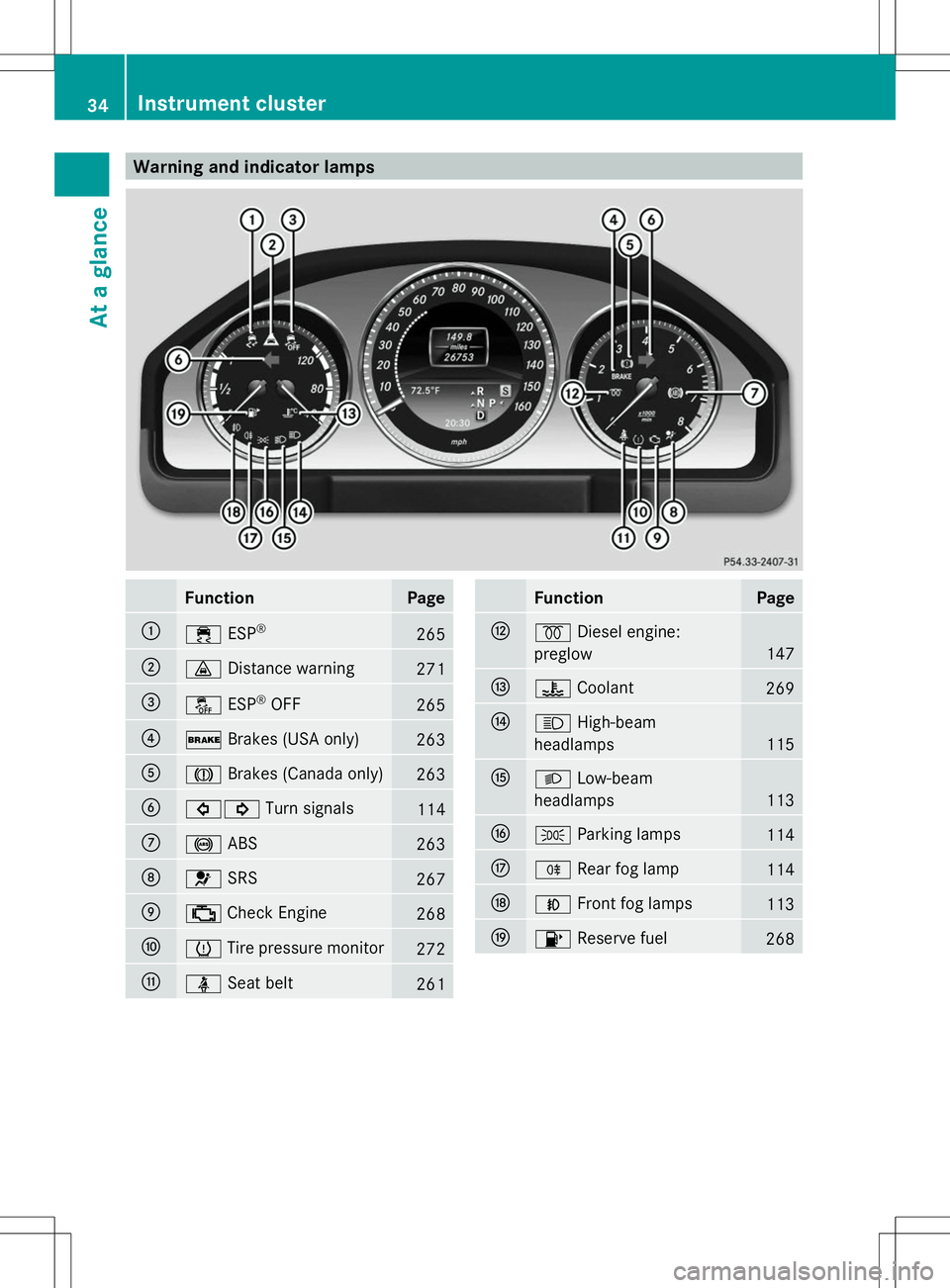
Warning and indicator lamps
Function Page
:
÷
ESP® 265
;
·
Distance warning 271
=
å
ESP®
OFF 265
?
$
Brakes (USA only) 263
A
J
Brakes (Canada only) 263
B
#!
Turn signals 114
C
!
ABS 263
D
6
SRS 267
E
;
Check Engine 268
F
h
Tire pressure monitor 272
G
ü
Seat belt 261 Function Page
H
%
Diesel engine:
preglow 147
I
?
Coolant 269
J
K
High-beam
headlamps 115
K
L
Low-beam
headlamps 113
L
T
Parking lamps 114
M
R
Rear fog lamp 114
N
N
Front fog lamps 113
O
8
Reserve fuel 26834
Instrument clusterAt a glance
Page 44 of 384
Useful information
i This Operator's Manual describes all
models and all standard and optional
equipment of your vehicle available at the
time of publication of the Operator's
Manual. Country-specific differences are
possible. Please note that your vehicle may
not be equipped with all features
described. This also applies to safety-
related systems and functions.
i Read the information on qualified
specialist workshops: (Y page 27).Panic alarm
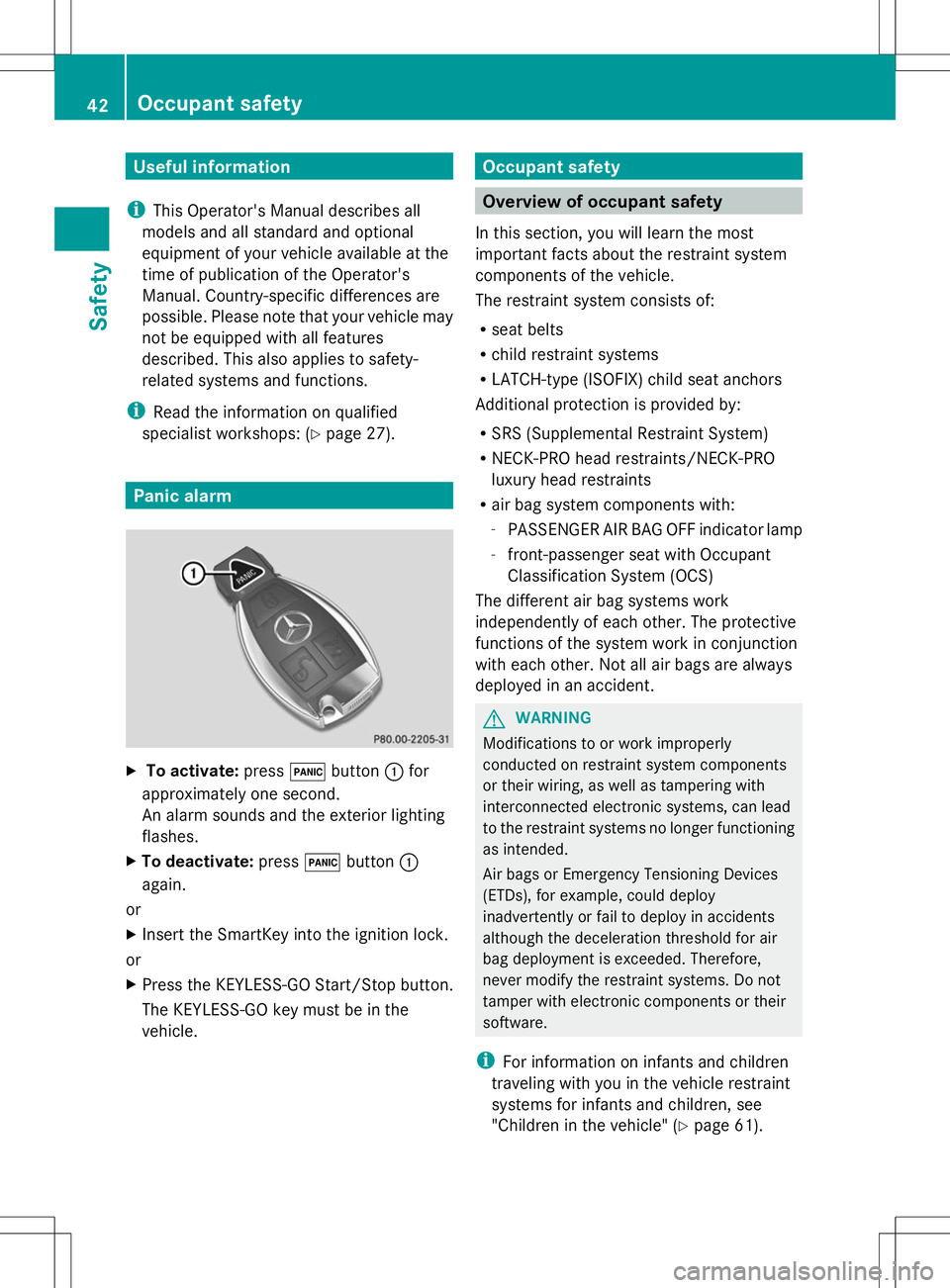
X
To activate: press!button :for
approximately one second.
An alarm sounds and the exterior lighting
flashes.
X To deactivate: press!button :
again.
or
X Insert the SmartKey into the ignition lock.
or
X Press the KEYLESS-GO Start/Stop button.
The KEYLESS-GO key must be in the
vehicle. Occupant safety
Overview of occupant safety
In this section, you will learn the most
important facts about the restraint system
components of the vehicle.
The restraint system consists of:
R seat belts
R child restraint systems
R LATCH-type (ISOFIX) child seat anchors
Additional protection is provided by:
R SRS (Supplemental Restraint System)
R NECK-PRO head restraints/NECK-PRO
luxury head restraints
R air bag system components with:
-PASSENGER AIR BAG OFF indicator lamp
- front-passenger seat with Occupant
Classification System (OCS)
The different air bag systems work
independently of each other. The protective
functions of the system work in conjunction
with each other. Not all air bags are always
deployed in an accident. G
WARNING
Modifications to or work improperly
conducted on restraint system components
or their wiring, as well as tampering with
interconnected electronic systems, can lead
to the restraint systems no longer functioning
as intended.
Air bags or Emergency Tensioning Devices
(ETDs), for example, could deploy
inadvertently or fail to deploy in accidents
although the deceleration threshold for air
bag deployment is exceeded. Therefore,
never modify the restraint systems. Do not
tamper with electronic components or their
software.
i For information on infants and children
traveling with you in the vehicle restraint
systems for infants and children, see
"Children in the vehicle" (Y page 61).42
Occupant safetySafety
Page 45 of 384
SRS (Supplemental Restraint System)
Introduction SRS consists of:
R
The 6 SRS warning lamp
R Air bags
R Air bag control unit (with crash sensors)
R Emergency Tensioning Devices
R Belt force limiters
SRS reduces the risk of occupants coming
into contact with the vehicle's interior in the
event of an accident. It can also reduce the
effect of the forces to which occupants are
subjected during an accident.
SRS warning lamp G
WARNING
If SRS is malfunctioning, child restraint
system components may be triggered
unintentionally or might not be triggered at all
in the event of an accident with a high rate of
vehicle deceleration. There is an increased
risk of injury, possibly even fatal.
Have SRS checked and repaired immediately
at a qualified specialist workshop.
SRS functions are checked regularly when
you switch on the ignition and when the
engine is running. Therefore, malfunctions
can be detected in good time.
The 6 SRS warning lamp in the instrument
cluster lights up when the ignition is switched
on. It goes out no later than a few seconds
after the engine is started.
The SRS components are in operational
readiness when the 6SRS warning lamp
goes out while the engine is running. There is a malfunction if:
R
the 6 SRS warning lamp does not light
up when the ignition is switched on
R the engine is running and the 6SRS
warning lamp does not go out after a few
seconds
R the engine is running and the 6SRS
warning lamp lights up again
Safety guidelines for seat belts,
Emergency Tensioning Devices (ETDs)
and air bags G
WARNING
R Damaged seat belts or seat belts that have
been subjected to stress in an accident
must be replaced. Their anchoring points
must also be checked. Only use seat belts
installed or supplied by an authorized
Mercedes-Benz Center.
R Air bags and pyrotechnic Emergency
Tensioning Devices (ETDs) contain
perchlorate material, which may require
special handling and regard for the
environment. Check your national disposal
guidelines. California residents, see
www.dtsc.ca.gov/HazardousWaste/
Perchlorate/index.cfm .
R Air bags and ETDs are designed to function
on a one-time-only basis. An air bag or ETD
that has deployed must be replaced.
R Do not pass seat belts over sharp edges.
They could tear.
R Do not make any modification that could
change the effectiveness of the seat belts.
R Do not bleach or dye seat belts as this may
severely weaken them. In a crash they may
not be able to provide adequate protection.
R No modifications of any kind may be made
to any components or wiring of the SRS.
R Do not change or remove any component
or part of the SRS.
R Do not install additional trim material, seat
covers, badges, etc. over the steering
wheel hub, front-passenger front air bag Occupant safety
43Safety
Z
Page 47 of 384
G
WARNING
In order to reduce the potential danger of
injuries caused during the deployment of the
front air bags, the driver and front passenger
must always be correctly seated and wear
their seat belts.
For maximum protection in the event of a
collision, you must always be in the normal
seat position with your back against the
backrest. Fasten your seat belt and make sure
that it is correctly positioned on your body.
As the air bag inflates with considerable
speed and force, a proper seating position
and correct positioning of the hands on the
steering wheel will help to keep you at a safe
distance from the air bag. Occupants who are
not wearing their seat belt, are not seated
properly or are too close to the air bag can be
seriously injured or killed by an air bag, as it
inflates with great force instantaneously:
R sit with the seat belt fastened correctly and
in a position that is as upright as possible
with your back against the backrest.
R move the driver's seat as far back as
possible, still permitting proper operation
of vehicle controls. The distance from the
center of the driver's chest to the center of
the air bag cover on the steering wheel
must be at least 10 inches (25 cm). You
should be able to accomplish this by
adjusting the seat and steering wheel. If
you have any difficulties, please contact an
authorized Mercedes-Benz Center.
R do not lean your head or chest close to the
steering wheel or dashboard.
R only hold the steering wheel on the outside.
Placing hands and arms inside the rim can
increase the risk and potential severity of
hand/arm injury if the driver front air bag
inflates.
R adjust the front-passenger seat as far back
as possible from the dashboard when the
seat is occupied.
R occupants, especially children, should
never place their bodies or lean their heads
in the area of the door where the side impact air bag inflates. This could result in
serious or fatal injuries should the side
impact air bag be deployed. Always sit as
upright as possible, wear the seat belt
properly and use an appropriately sized
infant restraint, toddler restraint or booster
seat recommended for the size and weight
of the child.
Failure to follow these instructions can result
in severe injuries to you or other occupants.
If you sell your vehicle, it is important that you
make the buyer aware of this safety
information. Be sure to give the buyer this
Operator's Manual.
The air bag installation locations are
identified by the AIR BAG symbol.
The air bags are deployed if the air bag control
unit detects the need for deployment. Only in
the event of such a situation will the air bags
provide their supplemental protection.
If the driver and front passenger do not wear
their seat belts, it is not possible for the air
bags to provide their supplemental
protection.
In the event of other types of impacts and
impacts below air bag deployment
thresholds, the air bags will not deploy. The
driver and passenger will then be protected
to the extent possible by a properly fastened
seat belt. A properly fastened seat belt is also
needed to provide the best possible
protection in a rollover.
Air bags provide additional protection; they
are not, however, a substitute for seat belts.
All vehicle occupants must fasten their seat
belts regardless of whether your vehicle is
equipped with air bags or not.
It is important for your safety and that of your
passenger to have deployed air bags replaced
and to have any malfunctioning air bags
repaired. This will help to make sure the air
bags continue to perform their protective
function for the vehicle occupants in the
event of a crash. Occupant safety
45Safety Z
Page 48 of 384
i
After an air bag has been deployed, have
the vehicle towed to the nearest qualified
specialist workshop, even if your vehicle is
ready to drive.
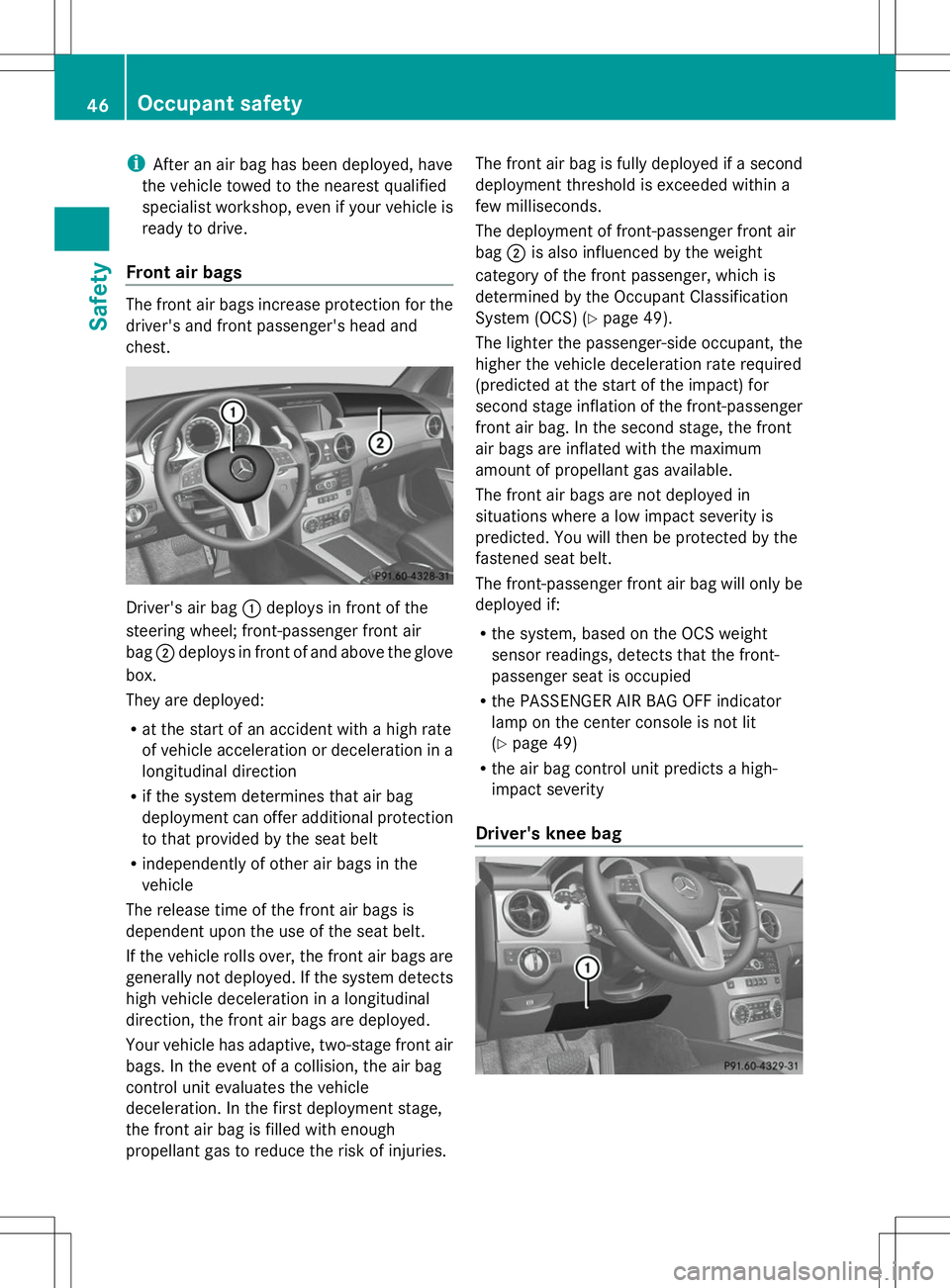
Front air bags The front air bags increase protection for the
driver's and front passenger's head and
chest. Driver's air bag
:deploys in front of the
steering wheel; front-passenger front air
bag ;deploys in front of and above the glove
box.
They are deployed:
R at the start of an accident with a high rate
of vehicle acceleration or deceleration in a
longitudinal direction
R if the system determines that air bag
deployment can offer additional protection
to that provided by the seat belt
R independently of other air bags in the
vehicle
The release time of the front air bags is
dependent upon the use of the seat belt.
If the vehicle rolls over, the front air bags are
generally not deployed. If the system detects
high vehicle deceleration in a longitudinal
direction, the front air bags are deployed.
Your vehicle has adaptive, two-stage front air
bags. In the event of a collision, the air bag
control unit evaluates the vehicle
deceleration. In the first deployment stage,
the front air bag is filled with enough
propellant gas to reduce the risk of injuries. The front air bag is fully deployed if a second
deployment threshold is exceeded within a
few milliseconds.
The deployment of front-passenger front air
bag ;is also influenced by the weight
category of the front passenger, which is
determined by the Occupant Classification
System (OCS) (Y page 49).
The lighter the passenger-side occupant, the
higher the vehicle deceleration rate required
(predicted at the start of the impact) for
second stage inflation of the front-passenger
front air bag. In the second stage, the front
air bags are inflated with the maximum
amount of propellant gas available.
The front air bags are not deployed in
situations where a low impact severity is
predicted. You will then be protected by the
fastened seat belt.
The front-passenger front air bag will only be
deployed if:
R the system, based on the OCS weight
sensor readings, detects that the front-
passenger seat is occupied
R the PASSENGER AIR BAG OFF indicator
lamp on the center console is not lit
(Y page 49)
R the air bag control unit predicts a high-
impact severity
Driver's knee bag 46
Occupant safetySafety