ignition MERCEDES-BENZ GLK-CLASS SUV 2014 Owners Manual
[x] Cancel search | Manufacturer: MERCEDES-BENZ, Model Year: 2014, Model line: GLK-CLASS SUV, Model: MERCEDES-BENZ GLK-CLASS SUV 2014Pages: 384, PDF Size: 48.23 MB
Page 13 of 384
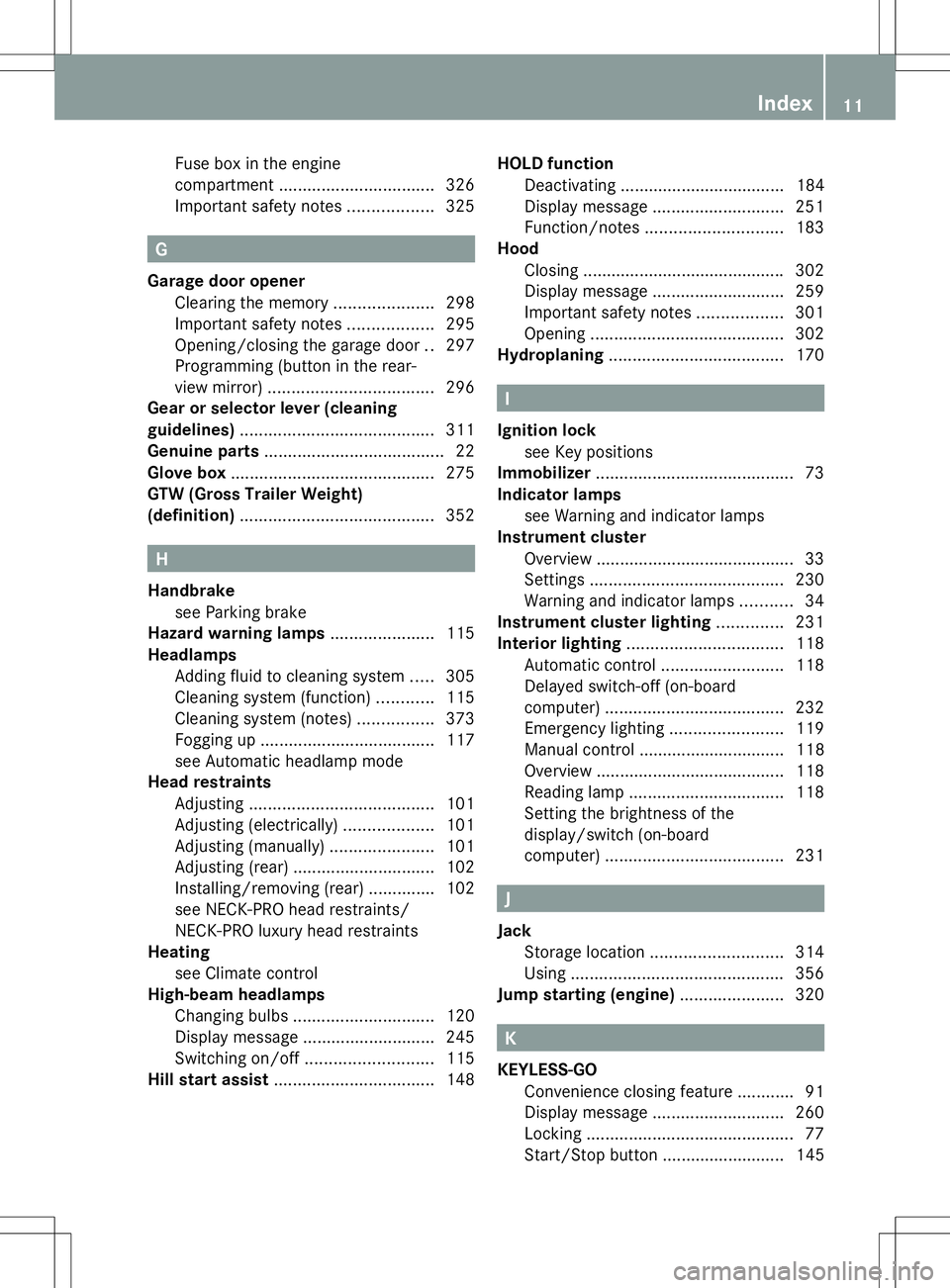
Fuse box in the engine
compartment
................................. 326
Important safety notes ..................325 G
Garage door opener Clearing the memory .....................298
Important safety notes ..................295
Opening/closing the garage door ..297
Programming (button in the rear-
view mirror) ................................... 296
Gear or selector lever (cleaning
guidelines) ......................................... 311
Genuine parts ...................................... 22
Glove box ........................................... 275
GTW (Gross Trailer Weight)
(definition) ......................................... 352H
Handbrake see Parking brake
Hazard warning lamps ......................115
Headlamps Adding fluid to cleaning system .....305
Cleaning system (function) ............115
Cleaning system (notes) ................373
Fogging up ..................................... 117
see Automatic headlamp mode
Head restraints
Adjusting ....................................... 101
Adjusting (electrically) ...................101
Adjusting (manually). .....................101
Adjusting (rear) .............................. 102
Installing/removing (rear) ..............102
see NECK-PRO head restraints/
NECK-PRO luxury head restraints
Heating
see Climate control
High-beam headlamps
Changing bulbs .............................. 120
Display message ............................ 245
Switching on/off ........................... 115
Hill start assist .................................. 148HOLD function
Deactivating ................................... 184
Display message ............................ 251
Function/notes ............................. 183
Hood
Closing .......................................... .302
Display message ............................ 259
Important safety notes ..................301
Opening ......................................... 302
Hydroplaning ..................................... 170 I
Ignition lock see Key positions
Immobilizer .......................................... 73
Indicator lamps see Warning and indicator lamps
Instrument cluster
Overview .......................................... 33
Settings ......................................... 230
Warning and indicator lamps ...........34
Instrument cluster lighting ..............231
Interior lighting ................................. 118
Automatic control ..........................118
Delayed switch-off (on-board
computer) ...................................... 232
Emergency lighting ........................119
Manual control ............................... 118
Overview ........................................ 118
Reading lamp ................................. 118
Setting the brightness of the
display/switch (on-board
computer) ...................................... 231 J
Jack Storage location ............................ 314
Using ............................................. 356
Jump starting (engine) ......................320 K
KEYLESS-GO Convenience closing feature ............91
Display message ............................ 260
Locking ............................................ 77
Start/Stop button .......................... 145 Index
11
Page 18 of 384
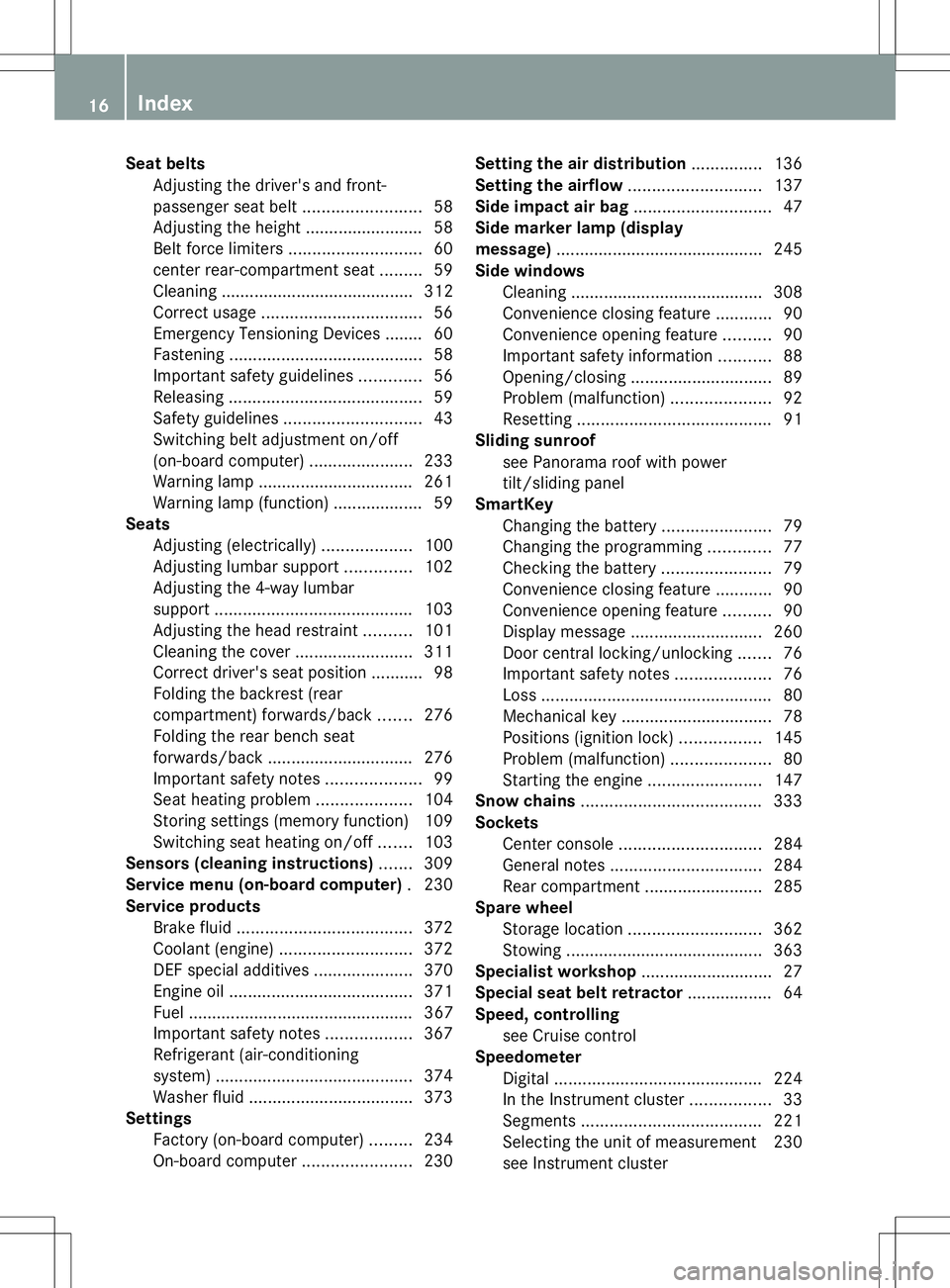
Seat belts
Adjusting the driver's and front-
passenger seat belt .........................58
Adjusting the height ......................... 58
Belt force limiters ............................ 60
center rear-compartment sea t......... 59
Cleaning ......................................... 312
Correct usage .................................. 56
Emergency Tensioning Devices ....... .60
Fastening ......................................... 58
Important safety guidelines .............56
Releasing ......................................... 59
Safety guidelines ............................. 43
Switching belt adjustment on/off
(on-board computer) ......................233
Warning lamp ................................. 261
Warning lamp (function) ................... 59
Seats
Adjusting (electrically) ...................100
Adjusting lumbar support ..............102
Adjusting the 4-way lumbar
support .......................................... 103
Adjusting the head restraint ..........101
Cleaning the cover .........................311
Correct driver's seat position ........... 98
Folding the backrest (rear
compartment) forwards/back .......276
Folding the rear bench seat
forwards/back ............................... 276
Important safety notes ....................99
Seat heating problem ....................104
Storing settings (memory function) 109
Switching seat heating on/off .......103
Sensors (cleaning instructions) .......309
Service menu (on-board computer) .230
Service products Brake fluid ..................................... 372
Coolant (engine) ............................ 372
DEF special additives .....................370
Engine oil ....................................... 371
Fuel ................................................ 367
Important safety notes ..................367
Refrigerant (air-conditioning
system) .......................................... 374
Washer fluid .................................. .373
Settings
Factory (on-board computer) .........234
On-board computer .......................230Setting the air distribution
...............136
Setting the airflow ............................137
Side impact air bag .............................47
Side marker lamp (display
message) ............................................ 245
Side windows Cleaning ......................................... 308
Convenience closing feature ............90
Convenience opening feature ..........90
Important safety information ...........88
Opening/closing .............................. 89
Problem (malfunction) .....................92
Resetting ......................................... 91
Sliding sunroof
see Panorama roof with power
tilt/sliding panel
SmartKey
Changing the battery .......................79
Changing the programming .............77
Checking the battery .......................79
Convenience closing feature ............90
Convenience opening feature ..........90
Display message ............................ 260
Door central locking/unlocking .......76
Important safety notes ....................76
Loss ................................................. 80
Mechanical key ................................ 78
Positions (ignition lock) .................145
Problem (malfunction) .....................80
Starting the engine ........................147
Snow chains ...................................... 333
Sockets Center console .............................. 284
General notes ................................ 284
Rear compartment .........................285
Spare wheel
Storage location ............................ 362
Stowing .......................................... 363
Specialist workshop ............................ 27
Special seat belt retractor .................. 64
Speed, controlling see Cruise control
Speedometer
Digital ............................................ 224
In the Instrument cluster .................33
Segments ...................................... 221
Selecting the unit of measurement 230
see Instrument cluster 16
Index
Page 27 of 384
If you have purchased a used car, please send
us the "Notification of Used Car Purchase" in
the Service and Guarantee booklet or simply
call the Mercedes-Benz Customer Assistance
Center (USA) at the hotline number
1-800-FOR-MERCedes(1-800-367-6372) or
Customer Service (Canada) at
1-800-387-0100. Vehicle operation outside the USA
and Canada
If you plan to operate your vehicle in foreign
countries, please be aware that:
R service facilities or replacement parts may
not be readily available.
R unleaded fuel for vehicles with a catalytic
converter may not be available. Leaded fuel
may cause damage to the catalytic
converter.
R the fuel may have a considerably lower
octane rating. Unsuitable fuel can cause
engine damage.
Some Mercedes-Benz models are available
for delivery in Europe through our European
Delivery Program. For details, consult an
authorized Mercedes-Benz Center or write to
one of the following addresses.
In the USA
Mercedes-Benz USA, LLC
European Delivery Department
One Mercedes Drive
Montvale, NJ 07645-0350
In Canada
Mercedes-Benz Canada, Inc.
European Delivery Department
98 Vanderhoof Avenue
Toronto, Ontario M4G 4C9 Sports Utility Vehicle
G
WARNING
Due to the high center of gravity, the vehicle
may start to skid and roll over in the event of an abrupt steering maneuver and/or when
the vehicle's speed is not adapted to the road
conditions. There is a risk of an accident.
Always adapt your speed and driving style to
the vehicle's driving characteristics and to the
prevailing road and weather conditions.
Utility vehicles have a significantly higher
rollover rate than other types of vehicles.
Failure to operate this vehicle safely may
result in an accident, rollover of the vehicle,
and severe or fatal injury.
In a rollover crash, an unbelted person is
significantly more likely to die than a person
wearing a seat belt.
You and all vehicle occupants should always
wear your seat belts. Operating safety
Important safety notes
G
WARNING
If you do not have the prescribed service/
maintenance work or any required repairs
carried out, this can result in malfunctions or
system failures. There is a risk of an accident.
Always have the prescribed service/
maintenance work as well as any required
repairs carried out at a qualified specialist
workshop. G
WARNING
If you switch off the ignition while driving,
safety-relevant functions are only available
with limitations, or not at all. This could affect,
for example, the power steering and the brake
boosting effect. You will require considerably
more effort to steer and brake. There is a risk
of an accident.
Do not switch off the ignition while driving. G
WARNING
Modifications to electronic components, their
software as well as wiring can impair their
function and/or the function of other Introduction
25 Z
Page 34 of 384
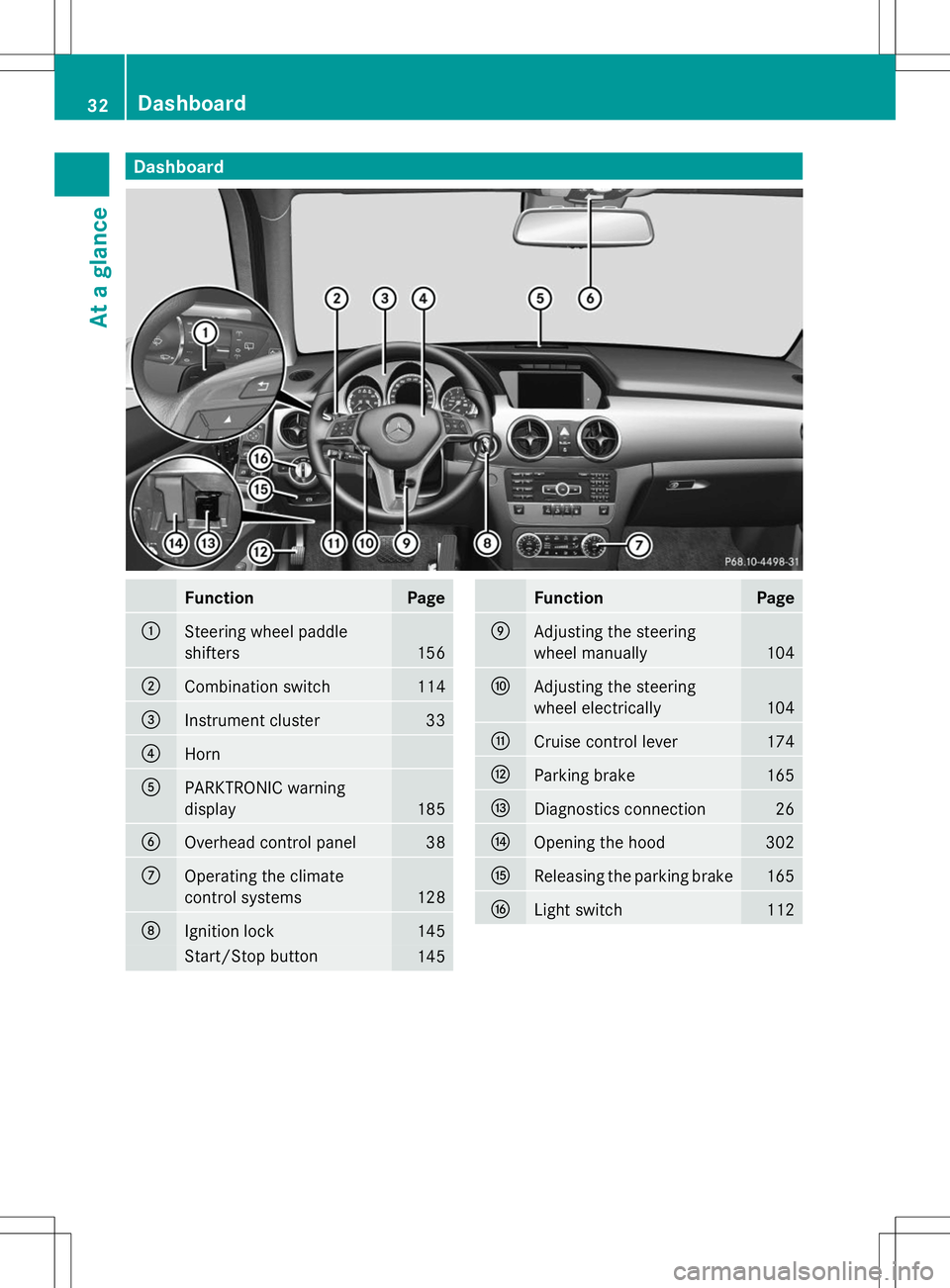
Dashboard
Function Page
:
Steering wheel paddle
shifters
156
;
Combination switch 114
=
Instrument cluster 33
?
Horn
A
PARKTRONIC warning
display
185
B
Overhead control panel 38
C
Operating the climate
control systems
128
D
Ignition lock 145
Start/Stop button
145 Function Page
E
Adjusting the steering
wheel manually
104
F
Adjusting the steering
wheel electrically
104
G
Cruise control lever 174
H
Parking brake 165
I
Diagnostics connection 26
J
Opening the hood 302
K
Releasing the parking brake 165
L
Light switch 11232
Dashboa
rdAt a glance
Page 44 of 384
Useful information
i This Operator's Manual describes all
models and all standard and optional
equipment of your vehicle available at the
time of publication of the Operator's
Manual. Country-specific differences are
possible. Please note that your vehicle may
not be equipped with all features
described. This also applies to safety-
related systems and functions.
i Read the information on qualified
specialist workshops: (Y page 27).Panic alarm
X
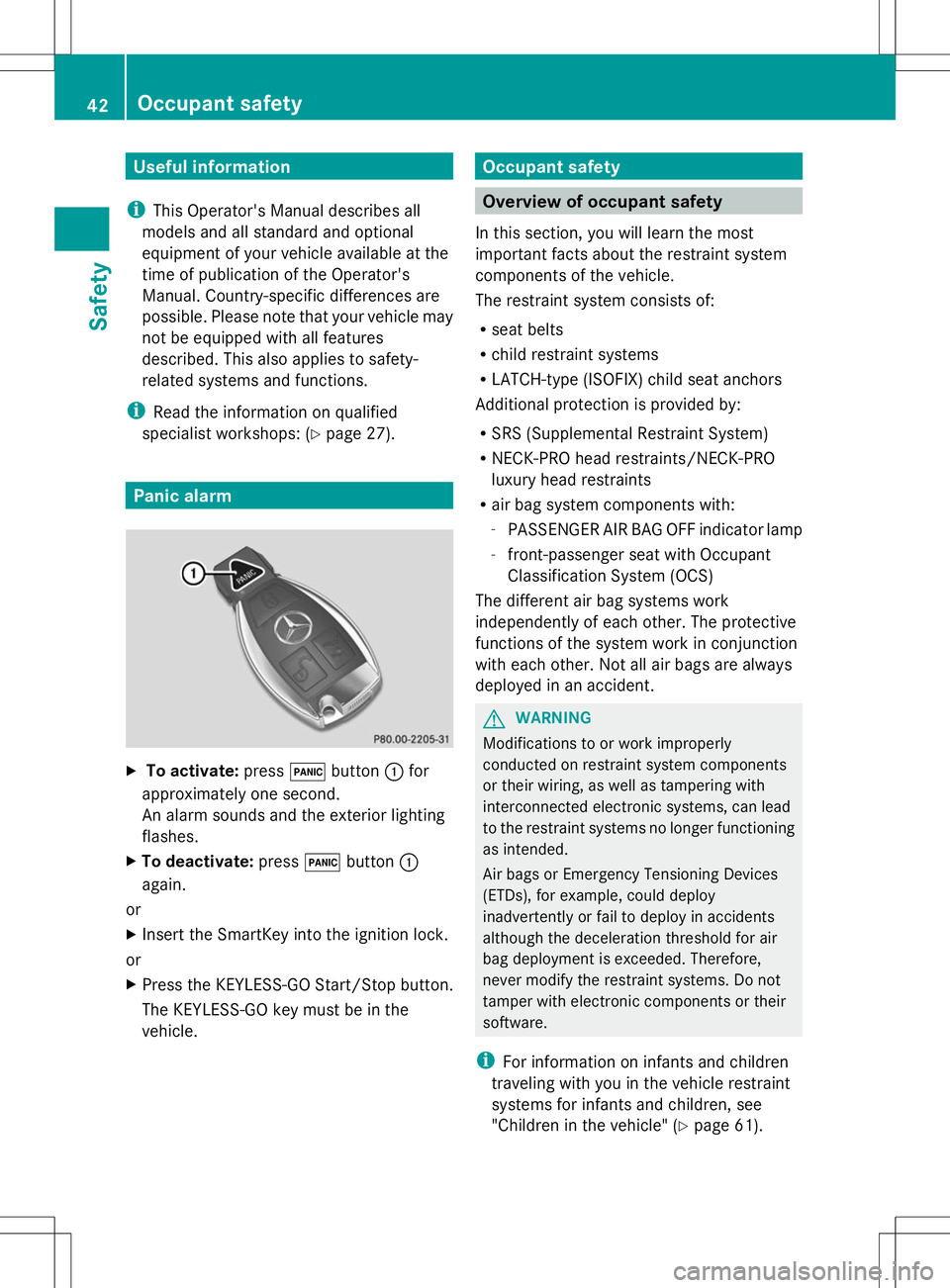
To activate: press!button :for
approximately one second.
An alarm sounds and the exterior lighting
flashes.
X To deactivate: press!button :
again.
or
X Insert the SmartKey into the ignition lock.
or
X Press the KEYLESS-GO Start/Stop button.
The KEYLESS-GO key must be in the
vehicle. Occupant safety
Overview of occupant safety
In this section, you will learn the most
important facts about the restraint system
components of the vehicle.
The restraint system consists of:
R seat belts
R child restraint systems
R LATCH-type (ISOFIX) child seat anchors
Additional protection is provided by:
R SRS (Supplemental Restraint System)
R NECK-PRO head restraints/NECK-PRO
luxury head restraints
R air bag system components with:
-PASSENGER AIR BAG OFF indicator lamp
- front-passenger seat with Occupant
Classification System (OCS)
The different air bag systems work
independently of each other. The protective
functions of the system work in conjunction
with each other. Not all air bags are always
deployed in an accident. G
WARNING
Modifications to or work improperly
conducted on restraint system components
or their wiring, as well as tampering with
interconnected electronic systems, can lead
to the restraint systems no longer functioning
as intended.
Air bags or Emergency Tensioning Devices
(ETDs), for example, could deploy
inadvertently or fail to deploy in accidents
although the deceleration threshold for air
bag deployment is exceeded. Therefore,
never modify the restraint systems. Do not
tamper with electronic components or their
software.
i For information on infants and children
traveling with you in the vehicle restraint
systems for infants and children, see
"Children in the vehicle" (Y page 61).42
Occupant safetySafety
Page 45 of 384
SRS (Supplemental Restraint System)
Introduction SRS consists of:
R
The 6 SRS warning lamp
R Air bags
R Air bag control unit (with crash sensors)
R Emergency Tensioning Devices
R Belt force limiters
SRS reduces the risk of occupants coming
into contact with the vehicle's interior in the
event of an accident. It can also reduce the
effect of the forces to which occupants are
subjected during an accident.
SRS warning lamp G
WARNING
If SRS is malfunctioning, child restraint
system components may be triggered
unintentionally or might not be triggered at all
in the event of an accident with a high rate of
vehicle deceleration. There is an increased
risk of injury, possibly even fatal.
Have SRS checked and repaired immediately
at a qualified specialist workshop.
SRS functions are checked regularly when
you switch on the ignition and when the
engine is running. Therefore, malfunctions
can be detected in good time.
The 6 SRS warning lamp in the instrument
cluster lights up when the ignition is switched
on. It goes out no later than a few seconds
after the engine is started.
The SRS components are in operational
readiness when the 6SRS warning lamp
goes out while the engine is running. There is a malfunction if:
R
the 6 SRS warning lamp does not light
up when the ignition is switched on
R the engine is running and the 6SRS
warning lamp does not go out after a few
seconds
R the engine is running and the 6SRS
warning lamp lights up again
Safety guidelines for seat belts,
Emergency Tensioning Devices (ETDs)
and air bags G
WARNING
R Damaged seat belts or seat belts that have
been subjected to stress in an accident
must be replaced. Their anchoring points
must also be checked. Only use seat belts
installed or supplied by an authorized
Mercedes-Benz Center.
R Air bags and pyrotechnic Emergency
Tensioning Devices (ETDs) contain
perchlorate material, which may require
special handling and regard for the
environment. Check your national disposal
guidelines. California residents, see
www.dtsc.ca.gov/HazardousWaste/
Perchlorate/index.cfm .
R Air bags and ETDs are designed to function
on a one-time-only basis. An air bag or ETD
that has deployed must be replaced.
R Do not pass seat belts over sharp edges.
They could tear.
R Do not make any modification that could
change the effectiveness of the seat belts.
R Do not bleach or dye seat belts as this may
severely weaken them. In a crash they may
not be able to provide adequate protection.
R No modifications of any kind may be made
to any components or wiring of the SRS.
R Do not change or remove any component
or part of the SRS.
R Do not install additional trim material, seat
covers, badges, etc. over the steering
wheel hub, front-passenger front air bag Occupant safety
43Safety
Z
Page 53 of 384
front-passenger front air bag in your vehicle
when the system senses the weight of a
typical 12-month-old child or less along
with the weight of a standard appropriate
child restraint on the front-passenger seat.
R A child in a rear-facing child restraint on the
front-passenger seat will be seriously
injured or even killed if the front-passenger
front air bag inflates in a collision which
could occur under some circumstances,
even with the air bag technology installed
in your vehicle. The only means to eliminate
this risk completely is never to place a child
in a rear-facing child restraint in the front-
passenger seat. We therefore strongly
recommend that you always place a child
in a rear-facing child restraint on the rear
seat.
R If you install a rear-facing child restraint on
the front-passenger seat, make sure the
45 indicator lamp is illuminated,
indicating that the front-passenger front air
bag is deactivated. Should the 45
indicator lamp not illuminate or go out while
the restraint is installed, please check
installation. Periodically check the
45 indicator lamp while driving to
make sure that the 45indicator
lamp is illuminated. If the 45
indicator lamp goes out or remains out, do
not transport a child on the front-passenger
seat until the system has been repaired.
A child in a rear-facing child restraint on the
front-passenger seat will be seriously
injured or even killed if the front-passenger
front air bag inflates. R
If you place a child in a forward-facing child
restraint on the front-passenger seat:
-move the seat as far back as possible
- use the proper child restraint
recommended for the age, size and
weight of the child
- secure child restraint with the vehicle's
seat belt according to the child seat
manufacturer's instructions
R For children larger than the typical 12-
month-old child, the front-passenger front
air bag may or may not be activated.
If the driver's air bag deploys, this does not
mean that the front-passenger front air bag
will also deploy.
The OCS may have detected that the seat:
R is empty or occupied by the weight of a
typical child up to twelve months old,
seated in a child restraint system.
R is occupied by a small individual, such as a
young teenager or a small adult.
R is occupied by a child in a child restraint
system whose weight is greater than that
of a typical twelve month old child.
These are examples of when the OCS
deactivates the front-passenger front air bag.
Deactivation takes place although the
collision fulfills the criteria for deploying the
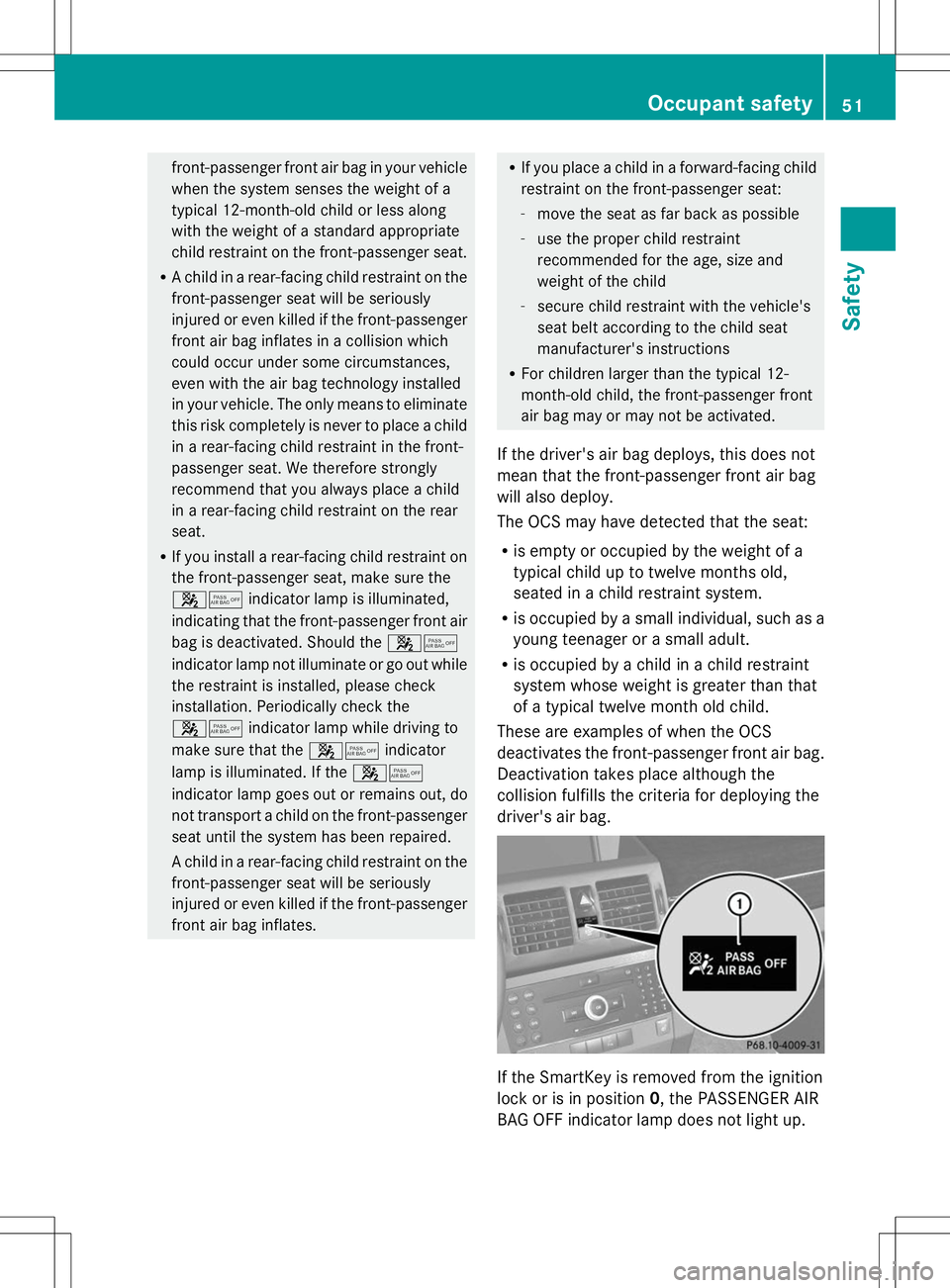
driver's air bag. If the SmartKey is removed from the ignition
lock or is in position
0, the PASSENGER AIR
BAG OFF indicator lamp does not light up. Occupant safety
51Safety Z
Page 54 of 384
G
WARNING
If the red 6SRS warning lamp in the
instrument cluster and the 45
indicator lamp light up simultaneously, the
OCS is malfunctioning. The front passenger
front air bag will be deactivated in this case.
Have the system checked by qualified
technicians as soon as possible. Contact an
authorized Mercedes-Benz Center.
Only have the seat repaired or replaced at an
authorized Mercedes-Benz Center.
In order to ensure proper operation of the air
bag system and OCS:
R Sit with the seat belt properly fastened in a
position that is as upright as possible with
your back against the seat backrest.
R When seated, a passenger should not
position him/herself in such a way as to
cause the passenger's weight to be lifted
from the seat cushion as this may result in
the OCS being unable to correctly
approximate the passenger's weight
category.
R Read and observe all warnings in this
chapter.
System self-test The PASSENGER AIR BAG OFF indicator lamp
lights up if you:
R turn the SmartKey to position 1or 2in the
ignition lock
R press the KEYLESS-GO Start/Stop button
once or twice on vehicles with KEYLESS-
GO.
When an adult is sitting correctly on the front-
passenger seat and is categorized by the OCS
system as an adult, the PASSENGER AIR BAG
OFF indicator lamp lights up and goes off
again after approximately six seconds.
If the seat is not occupied and the OCS
system classifies the front-passenger seat as
being empty, the PASSENGER AIR BAG OFF
indicator lamp will continue to light up and
not go out. G
WARNING
If the 45indicator lamp does not
illuminate, the system is not functioning. You
must contact an authorized Mercedes-Benz
Center before seating any child on the front
passenger seat.
For more information about the OCS, see
"Problems with the Occupant Classification
System" (Y page 53). G
WARNING
Objects between the seat surface and the
child restraint system could affect the
function of the OCS. This could result in the
front-passenger front air bag not functioning
as intended during an accident. This poses an
increased risk of injury or even fatal injury.
Do not place any objects between the seat
surface and the child restraint system. Make
sure that the bottom and back of the child
restraint system make full contact with the
front-passenger seat cushion and backrest.
Always comply with the child restraint system
manufacturer's installation instructions. 52
Occupant safetySafety
Page 60 of 384

Fastening seat belts
G
WARNING
According to accident statistics, children are
safer when properly restrained on the rear
seats than on the front-passenger seat. Thus,
we strongly recommend that children be
placed in the rear seat whenever possible.
Regardless of seating position, children 12
years old and under must be seated and
properly secured in an appropriately sized
child restraint system or booster seat
recommended for the size and weight of the
child. For additional information, see the
"Children in the vehicle" section.
A child's risk of serious or fatal injuries is
significantly increased if the child restraints
are not properly secured in the vehicle and/
or the child is not properly secured in the child
restraint. X
Adjust the seat and move the backrest to
an almost vertical position (Y page 98).
X Pull the seat belt smoothly through belt
sash guide :.
X Without twisting it, guide the shoulder
section of the seat belt across the middle
of your shoulder and the lap section across
your pelvis.
X Engage belt tongue ;in buckle =. X
If necessary, adjust the seat belt to the
appropriate height (Y page 58).
X If necessary, pull upwards on the shoulder
section of the seat belt to tighten the belt
across your body.
All seat belts except the driver's seat belt are
equipped with a special seat belt retractor to
securely fasten child restraint systems in the
vehicle. For further information on special
seat belt retractors, see (Y page 64).
For more information about releasing the seat
belt with release button ?, see "Releasing
seat belts" ( Ypage 59).
Seat belt adjustment The seat-belt adjustment function adjusts the
driver's and front-passenger seat belt to the
upper body of the occupants.
The belt strap is tightened slightly when:
R you engage the belt tongue in the belt
buckle and you then turn the SmartKey to
position 2in the ignition lock.
The seat-belt adjustment will apply a
retraction force if any slack is detected
between the occupant and the seat belt. Do
not hold on to the seat belt tightly while it is
adjusting. You can switch the seat-belt
adjustment on and off in the on-board
computer (Y page 233).
The seat-belt adjustment is an integral part of
the PRE-SAFE ®
convenience function. More
information about PRE-SAFE ®
can be found
in the "PRE-SAFE ®
(anticipatory occupant
protection system)" section (Y page 54).
Belt height adjustment You can adjust the seat belt height on the
driver's seat and the front-passenger seat.58
Occupant safetySafety
Page 62 of 384
If after six seconds the driver or front
passenger have not fastened their seat belts
and the doors are closed, the 7seat belt
warning lamp lights up:
R until the driver's or front passenger's seat
belt is fastened
R if a vehicle speed of 15 mph (25 km/h) is
exceeded, a warning tone also sounds with
increasing intensity for a maximum of
60 seconds or until the driver or front-
passenger seat belt has been fastened.
If the driver/front passenger unfasten their
seat belt while the vehicle is in motion, the
7 seat belt warning lamp lights up and a
warning tone sounds again.
The warning tone ceases even if the driver or
front-passenger seat belt has still not been
fastened after 60 seconds. The 7seat belt
warning lamp stops flashing but remains
illuminated.
After the vehicle comes to a standstill, the
warning tone is reactivated and the 7seat
belt warning lamp flashes again if the vehicle
speed again exceeds 15 mph (25 km/h).
The 7 seat belt warning lamp only goes
out if:
R both the driver and the front passenger
have fastened their seat belts.
or
R the vehicle is stationary and a door is open.
i For more information on the 7seat
belt warning lamp, see "Warning and
indicator lamps in the instrument cluster,
seat belts" (Y page 261).
Emergency Tensioning Devices, seat
belt force limiters G
WARNING
Pyrotechnic Emergency Tensioning Devices
that have been deployed are no longer
operational and are unable to perform their
intended protective function. This poses an
increased risk of injury or even fatal injury. Therefore, have pyrotechnic Emergency
Tensioning Devices which have been
triggered immediately replaced at a qualified
specialist workshop.
! If the front-passenger seat is not
occupied, do not engage the seat belt
tongue in the buckle on the front-
passenger seat. Otherwise, the Emergency
Tensioning Device could be triggered in the
event of an accident.
i Vehicles with PRE-SAFE ®
: Emergency
Tensioning Devices that are triggered by an
electric motor can be deployed as often as
desired and do not need to be replaced.
The seat belts for the front seats and rear
outer seats are equipped with ETDs and seat
belt force limiters.
The ETDs tighten the seat belts in an accident,
pulling them close against the body.
The ETDs do not correct incorrect seat
positions or incorrectly fastened seat belts.
The ETDs do not pull vehicle occupants back
towards the backrest.
The ETDs can only be activated when:
R the ignition is switched on
R the restraint systems are operational; see
"SRS warning lamp "(Y page 43)
R the belt tongue is engaged in the buckle on
each of the lap-shoulder belts in the front
R the front-passenger seat is occupied and
the belt tongue is engaged in the buckle on
the front-passenger side
The ETDs on the outside seats in the rear
compartment are triggered independently of
the lock status of the seat belts.
The Emergency Tensioning Devices are
triggered depending on the type and severity
of an accident, if:
R in certain situations where the vehicle rolls
over and the system determines that it can
provide additional protection
R in the event of a head-on or rear-end
collision, the vehicle decelerates or 60
Occupant safetySafety