warning lights MERCEDES-BENZ GLK-CLASS SUV 2014 Owners Manual
[x] Cancel search | Manufacturer: MERCEDES-BENZ, Model Year: 2014, Model line: GLK-CLASS SUV, Model: MERCEDES-BENZ GLK-CLASS SUV 2014Pages: 384, PDF Size: 48.23 MB
Page 8 of 384
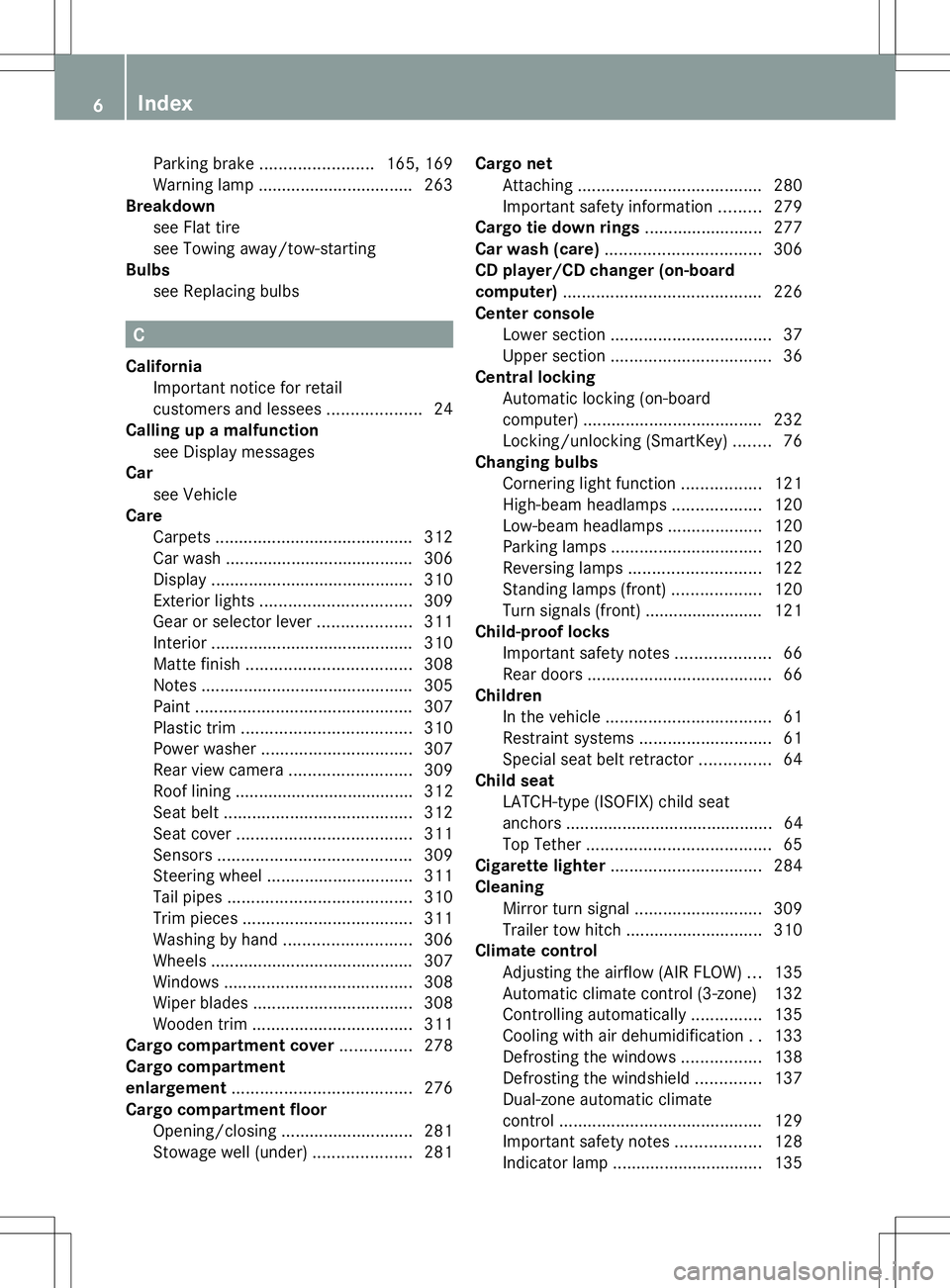
Parking brake
........................ 165, 169
Warning lamp ................................. 263
Breakdown
see Flat tire
see Towing away/tow-starting
Bulbs
see Replacing bulbs C
California Important notice for retail
customers and lessees ....................24
Calling up a malfunction
see Display messages
Car
see Vehicle
Care
Carpets .......................................... 312
Car wash ........................................ 306
Display ........................................... 310
Exterior lights ................................ 309
Gear or selector lever ....................311
Interior ........................................... 310
Matte finish ................................... 308
Notes ............................................. 305
Paint .............................................. 307
Plastic trim .................................... 310
Power washer ................................ 307
Rear view camera .......................... 309
Roof lining ...................................... 312
Seat belt ........................................ 312
Seat cover ..................................... 311
Sensors ......................................... 309
Steering wheel ............................... 311
Tail pipes ....................................... 310
Trim pieces .................................... 311
Washing by hand ........................... 306
Wheels ........................................... 307
Windows ........................................ 308
Wiper blades .................................. 308
Wooden trim .................................. 311
Cargo compartment cover ...............278
Cargo compartment
enlargement ...................................... 276
Cargo compartment floor Opening/closing ............................ 281
Stowage well (under) .....................281Cargo net
Attaching ....................................... 280
Important safety information .........279
Cargo tie down rings .........................277
Car wash (care) ................................. 306
CD player/CD changer (on-board
computer) .......................................... 226
Center console Lower section .................................. 37
Upper section .................................. 36
Central locking
Automatic locking (on-board
computer) ...................................... 232
Locking/unlocking (SmartKey) ........76
Changing bulbs
Cornering light function .................121
High-beam headlamps ...................120
Low-beam headlamps ....................120
Parking lamps ................................ 120
Reversing lamps ............................ 122
Standing lamps (front) ...................120
Turn signals (front) ......................... 121
Child-proof locks
Important safety notes ....................66
Rear doors ....................................... 66
Children
In the vehicle ................................... 61
Restraint systems ............................ 61
Special seat belt retractor ...............64
Child seat
LATCH-type (ISOFIX) child seat
anchors ............................................ 64
Top Tether ....................................... 65
Cigarette lighter ................................ 284
Cleaning Mirror turn signal ........................... 309
Trailer tow hitch ............................. 310
Climate control
Adjusting the airflow (AIR FLOW) ...135
Automatic climate control (3-zone) 132
Controlling automatically ...............135
Cooling with air dehumidification ..133
Defrosting the windows .................138
Defrosting the windshield ..............137
Dual-zone automatic climate
control ........................................... 129
Important safety notes ..................128
Indicator lamp ................................ 135 6
Index
Page 10 of 384
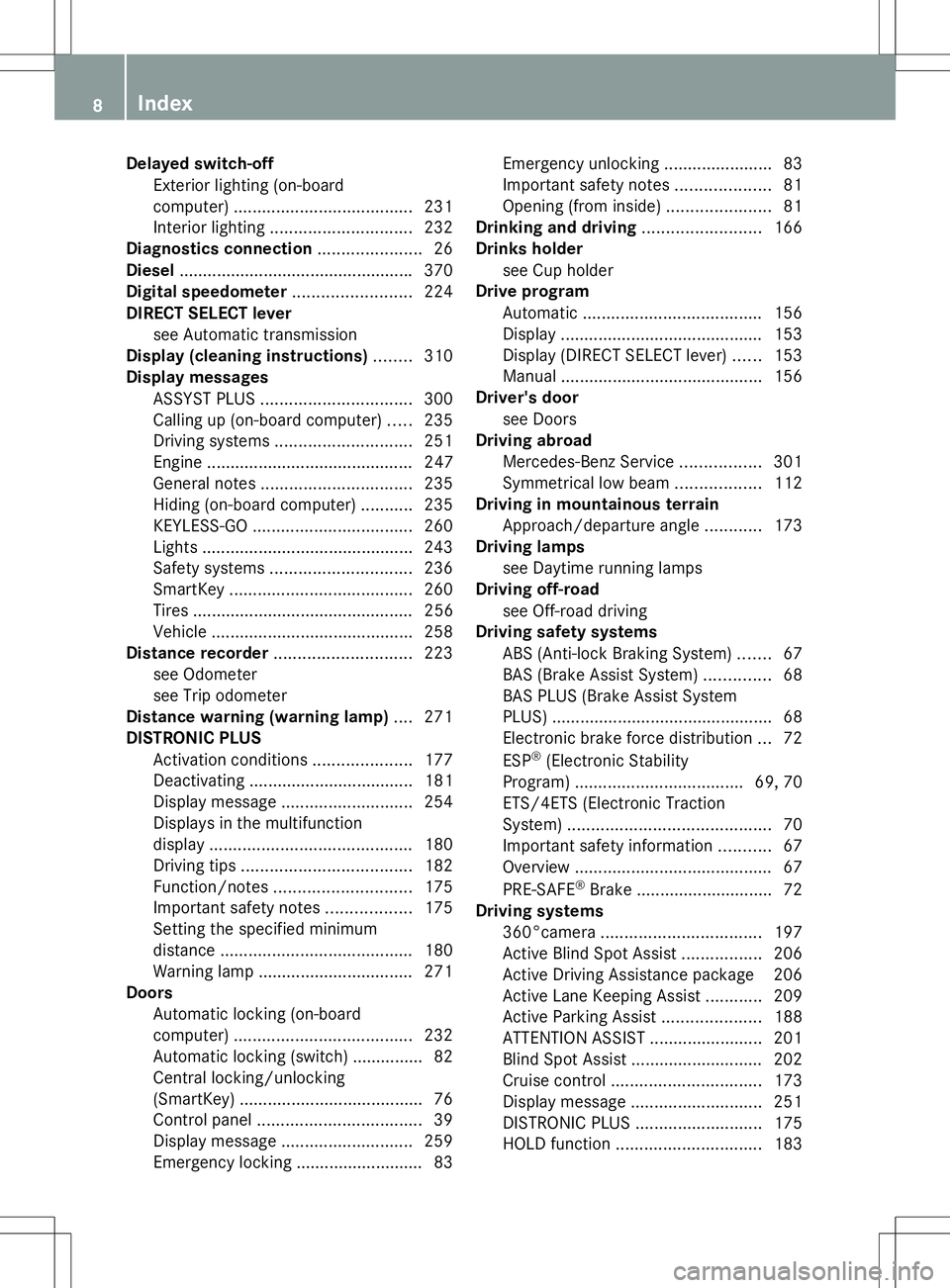
Delayed switch-off
Exterior lighting (on-board
computer) ...................................... 231
Interior lighting .............................. 232
Diagnostics connection ......................26
Diesel ................................................. .370
Digital speedometer .........................224
DIRECT SELECT lever see Automatic transmission
Display (cleaning instructions) ........310
Display messages ASSYST PLUS ................................ 300
Calling up (on-board computer) .....235
Driving systems ............................. 251
Engine ............................................ 247
General notes ................................ 235
Hiding (on-board computer) ...........235
KEYLESS-GO .................................. 260
Lights ............................................ .243
Safety systems .............................. 236
SmartKey ....................................... 260
Tires ............................................... 256
Vehicle .......................................... .258
Distance recorder ............................. 223
see Odometer
see Trip odometer
Distance warning (warning lamp) ....271
DISTRONIC PLUS Activation conditions .....................177
Deactivating ................................... 181
Display message ............................ 254
Displays in the multifunction
displa y........................................... 180
Driving tips .................................... 182
Function/notes ............................. 175
Important safety notes ..................175
Setting the specified minimum
distance ......................................... 180
Warning lamp ................................. 271
Doors
Automatic locking (on-board
computer) ...................................... 232
Automatic locking (switch) .............. .82
Central locking/unlocking
(SmartKey) ...................................... .76
Control panel ................................... 39
Display message ............................ 259
Emergency locking ........................... 83 Emergency unlocking
.......................83
Important safety notes ....................81
Opening (from inside) ......................81
Drinking and driving .........................166
Drinks holder see Cup holder
Drive program
Automatic ...................................... 156
Display ........................................... 153
Display (DIRECT SELECT lever) ......153
Manual .......................................... .156
Driver's door
see Doors
Driving abroad
Mercedes-Benz Service .................301
Symmetrical low bea m.................. 112
Driving in mountainous terrain
Approach/departure angl e............ 173
Driving lamps
see Daytime running lamps
Driving off-road
see Off-road driving
Driving safety systems
ABS (Anti-lock Braking System) .......67
BAS (Brake Assist System) ..............68
BAS PLUS (Brake Assist System
PLUS) .............................................. .68
Electronic brake force distributio n... 72
ESP ®
(Electronic Stability
Program) .................................... 69, 70
ETS/4ETS (Electronic Traction
System) ........................................... 70
Important safety information ...........67
Overview .......................................... 67
PRE-SAFE ®
Brake ............................ .72
Driving systems
360°camera .................................. 197
Active Blind Spot Assist .................206
Active Driving Assistance package 206
Active Lane Keeping Assist ............209
Active Parking Assist .....................188
ATTENTION ASSIST ........................201
Blind Spot Assist ............................ 202
Cruise control ................................ 173
Display message ............................ 251
DISTRONIC PLUS ........................... 175
HOLD function ............................... 1838
Index
Page 12 of 384
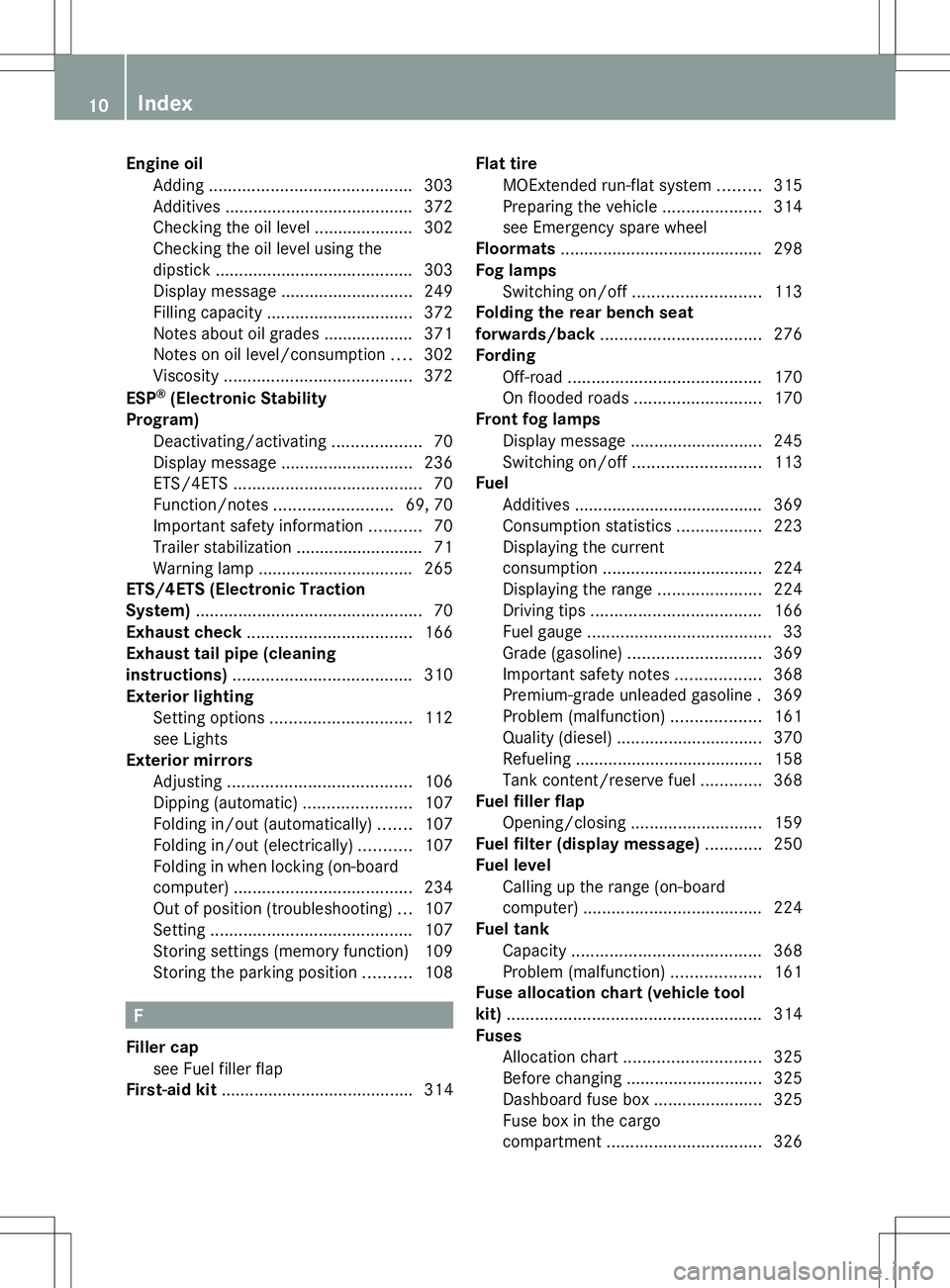
Engine oil
Adding ........................................... 303
Additives ........................................ 372
Checking the oil level ..................... 302
Checking the oil level using the
dipstick .......................................... 303
Display message ............................ 249
Filling capacity ............................... 372
Notes about oil grades ................... 371
Notes on oil level/consumption ....302
Viscosity ........................................ 372
ESP ®
(Electronic Stability
Program) Deactivating/activating ...................70
Display message ............................ 236
ETS/4ETS ........................................ 70
Function/notes ......................... 69, 70
Important safety information ...........70
Trailer stabilization ........................... 71
Warning lamp ................................. 265
ETS/4ETS (Electronic Traction
System) ................................................ 70
Exhaust check ................................... 166
Exhaust tail pipe (cleaning
instructions) ...................................... 310
Exterior lighting Setting options .............................. 112
see Lights
Exterior mirrors
Adjusting ....................................... 106
Dipping (automatic) .......................107
Folding in/out (automatically). ......107
Folding in/out (electrically). ..........107
Folding in when locking (on-board
computer) ...................................... 234
Out of position (troubleshooting) ...107
Setting ........................................... 107
Storing settings (memory function) 109
Storing the parking position ..........108 F
Filler cap see Fuel filler flap
First-aid kit ......................................... 314 Flat tire
MOExtended run-flat system .........315
Preparing the vehicle .....................314
see Emergency spare wheel
Floormats ........................................... 298
Fog lamps Switching on/off ........................... 113
Folding the rear bench seat
forwards/back .................................. 276
Fording Off-road ......................................... 170
On flooded roads ........................... 170
Front fog lamps
Display message ............................ 245
Switching on/off ........................... 113
Fuel
Additives ........................................ 369
Consumption statistics ..................223
Displaying the current
consumption .................................. 224
Displaying the range ......................224
Driving tips .................................... 166
Fuel gauge ....................................... 33
Grade (gasoline) ............................ 369
Important safety notes ..................368
Premium-grade unleaded gasoline .369
Problem (malfunction) ...................161
Quality (diesel )............................... 370
Refueling ........................................ 158
Tank content/reserve fuel .............368
Fuel filler flap
Opening/closing ............................ 159
Fuel filter (display message) ............250
Fuel level Calling up the range (on-board
computer) ...................................... 224
Fuel tank
Capacity ........................................ 368
Problem (malfunction) ...................161
Fuse allocation chart (vehicle tool
kit) ...................................................... 314
Fuses Allocation chart ............................. 325
Before changing ............................. 325
Dashboard fuse box .......................325
Fuse box in the cargo
compartment ................................. 32610
Index
Page 14 of 384
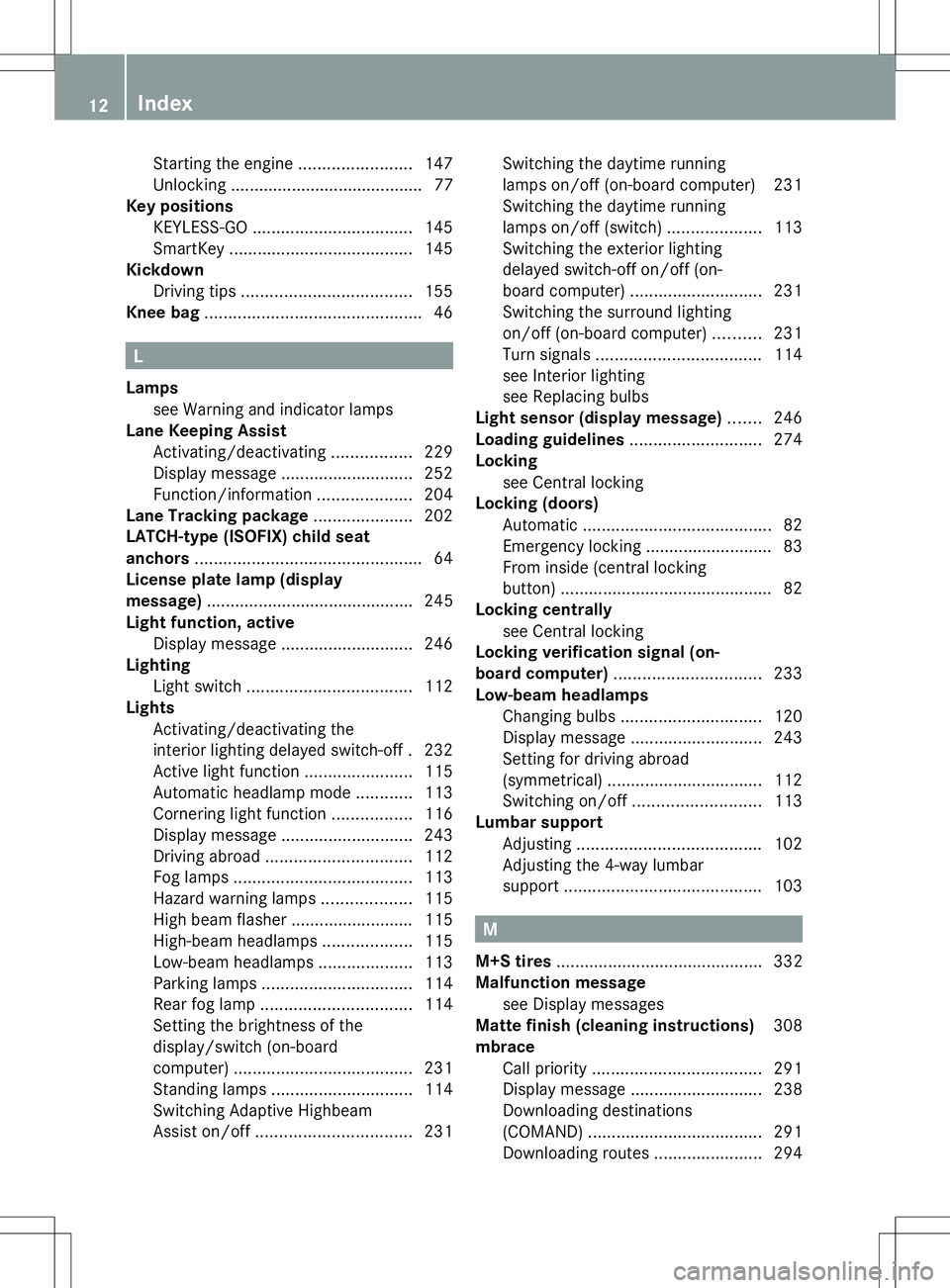
Starting the engine
........................147
Unlocking ......................................... 77
Key positions
KEYLESS-GO .................................. 145
SmartKey ....................................... 145
Kickdown
Driving tips .................................... 155
Knee bag .............................................. 46L
Lamps see Warning and indicator lamps
Lane Keeping Assist
Activating/deactivating .................229
Display message ............................ 252
Function/informatio n.................... 204
Lane Tracking package .....................202
LATCH-type (ISOFIX) child seat
anchors ................................................ 64
License plate lamp (display
message) ............................................ 245
Light function, active Display message ............................ 246
Lighting
Light switch ................................... 112
Lights
Activating/deactivating the
interior lighting delayed switch-off .232
Active light function .......................115
Automatic headlamp mode ............113
Cornering light function .................116
Display message ............................ 243
Driving abroad ............................... 112
Fog lamps ...................................... 113
Hazard warning lamps ...................115
High beam flasher .......................... 115
High-beam headlamps ...................115
Low-beam headlamps ....................113
Parking lamps ................................ 114
Rear fog lamp ................................ 114
Setting the brightness of the
display/switch (on-board
computer) ...................................... 231
Standing lamps .............................. 114
Switching Adaptive Highbeam
Assist on/off ................................. 231Switching the daytime running
lamps on/off (on-board computer) 231
Switching the daytime running
lamps on/off (switch)
....................113
Switching the exterior lighting
delayed switch-off on/off (on-
board computer) ............................ 231
Switching the surround lighting
on/off (on-board computer) ..........231
Turn signals ................................... 114
see Interior lighting
see Replacing bulbs
Light sensor (display message) .......246
Loading guidelines ............................274
Locking see Central locking
Locking (doors)
Automatic ........................................ 82
Emergency locking ........................... 83
From inside (central locking
button) ............................................. 82
Locking centrally
see Central locking
Locking verification signal (on-
board computer) ............................... 233
Low-beam headlamps Changing bulbs .............................. 120
Display message ............................ 243
Setting for driving abroad
(symmetrical) ................................. 112
Switching on/off ........................... 113
Lumbar support
Adjusting ....................................... 102
Adjusting the 4-way lumbar
support .......................................... 103 M
M+S tires ............................................ 332
Malfunction message see Display messages
Matte finish (cleaning instructions) 308
mbrace Call priority .................................... 291
Display message ............................ 238
Downloading destinations
(COMAND) ..................................... 291
Downloading routes .......................29412
Index
Page 45 of 384
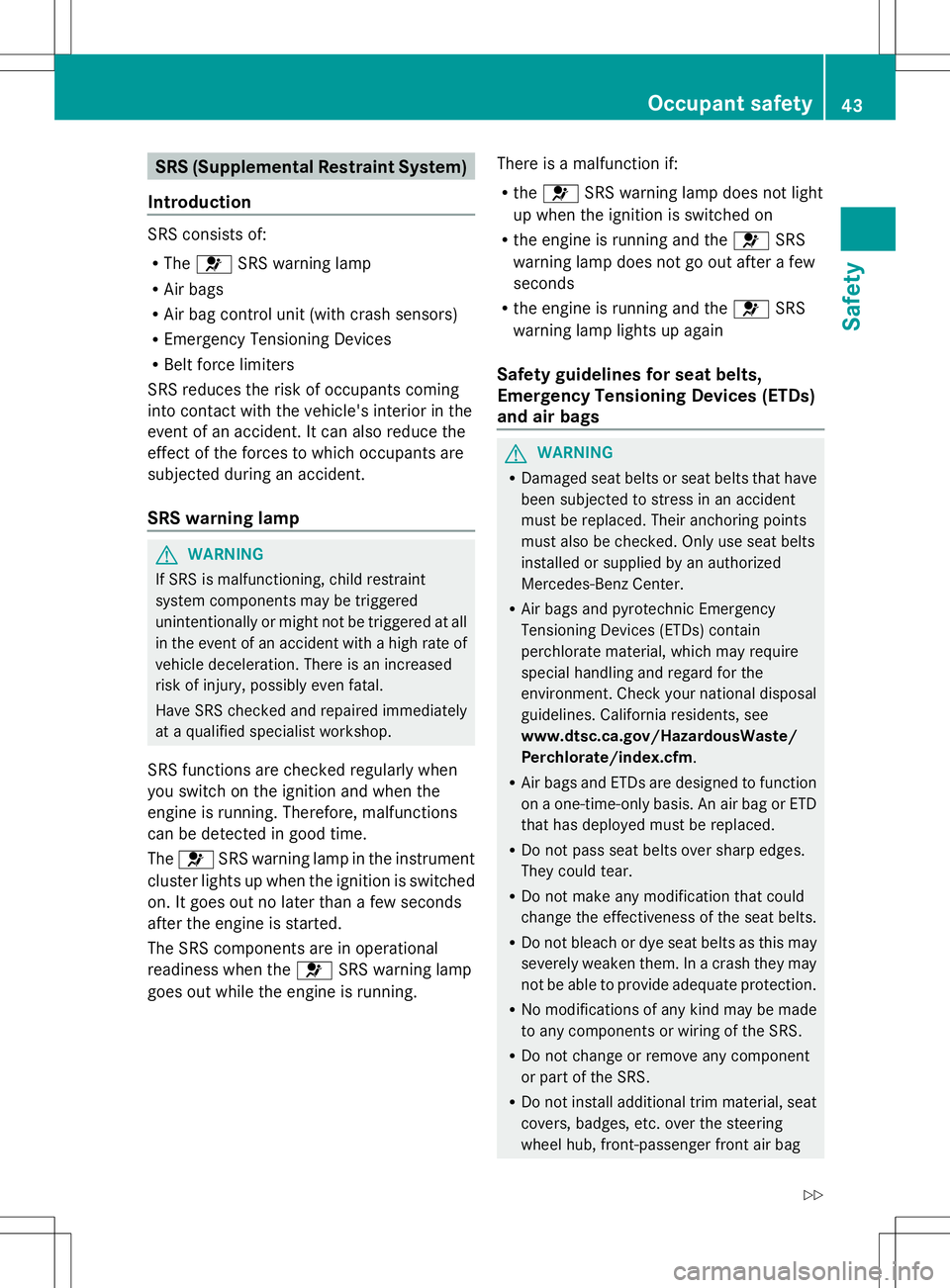
SRS (Supplemental Restraint System)
Introduction SRS consists of:
R
The 6 SRS warning lamp
R Air bags
R Air bag control unit (with crash sensors)
R Emergency Tensioning Devices
R Belt force limiters
SRS reduces the risk of occupants coming
into contact with the vehicle's interior in the
event of an accident. It can also reduce the
effect of the forces to which occupants are
subjected during an accident.
SRS warning lamp G
WARNING
If SRS is malfunctioning, child restraint
system components may be triggered
unintentionally or might not be triggered at all
in the event of an accident with a high rate of
vehicle deceleration. There is an increased
risk of injury, possibly even fatal.
Have SRS checked and repaired immediately
at a qualified specialist workshop.
SRS functions are checked regularly when
you switch on the ignition and when the
engine is running. Therefore, malfunctions
can be detected in good time.
The 6 SRS warning lamp in the instrument
cluster lights up when the ignition is switched
on. It goes out no later than a few seconds
after the engine is started.
The SRS components are in operational
readiness when the 6SRS warning lamp
goes out while the engine is running. There is a malfunction if:
R
the 6 SRS warning lamp does not light
up when the ignition is switched on
R the engine is running and the 6SRS
warning lamp does not go out after a few
seconds
R the engine is running and the 6SRS
warning lamp lights up again
Safety guidelines for seat belts,
Emergency Tensioning Devices (ETDs)
and air bags G
WARNING
R Damaged seat belts or seat belts that have
been subjected to stress in an accident
must be replaced. Their anchoring points
must also be checked. Only use seat belts
installed or supplied by an authorized
Mercedes-Benz Center.
R Air bags and pyrotechnic Emergency
Tensioning Devices (ETDs) contain
perchlorate material, which may require
special handling and regard for the
environment. Check your national disposal
guidelines. California residents, see
www.dtsc.ca.gov/HazardousWaste/
Perchlorate/index.cfm .
R Air bags and ETDs are designed to function
on a one-time-only basis. An air bag or ETD
that has deployed must be replaced.
R Do not pass seat belts over sharp edges.
They could tear.
R Do not make any modification that could
change the effectiveness of the seat belts.
R Do not bleach or dye seat belts as this may
severely weaken them. In a crash they may
not be able to provide adequate protection.
R No modifications of any kind may be made
to any components or wiring of the SRS.
R Do not change or remove any component
or part of the SRS.
R Do not install additional trim material, seat
covers, badges, etc. over the steering
wheel hub, front-passenger front air bag Occupant safety
43Safety
Z
Page 54 of 384
G
WARNING
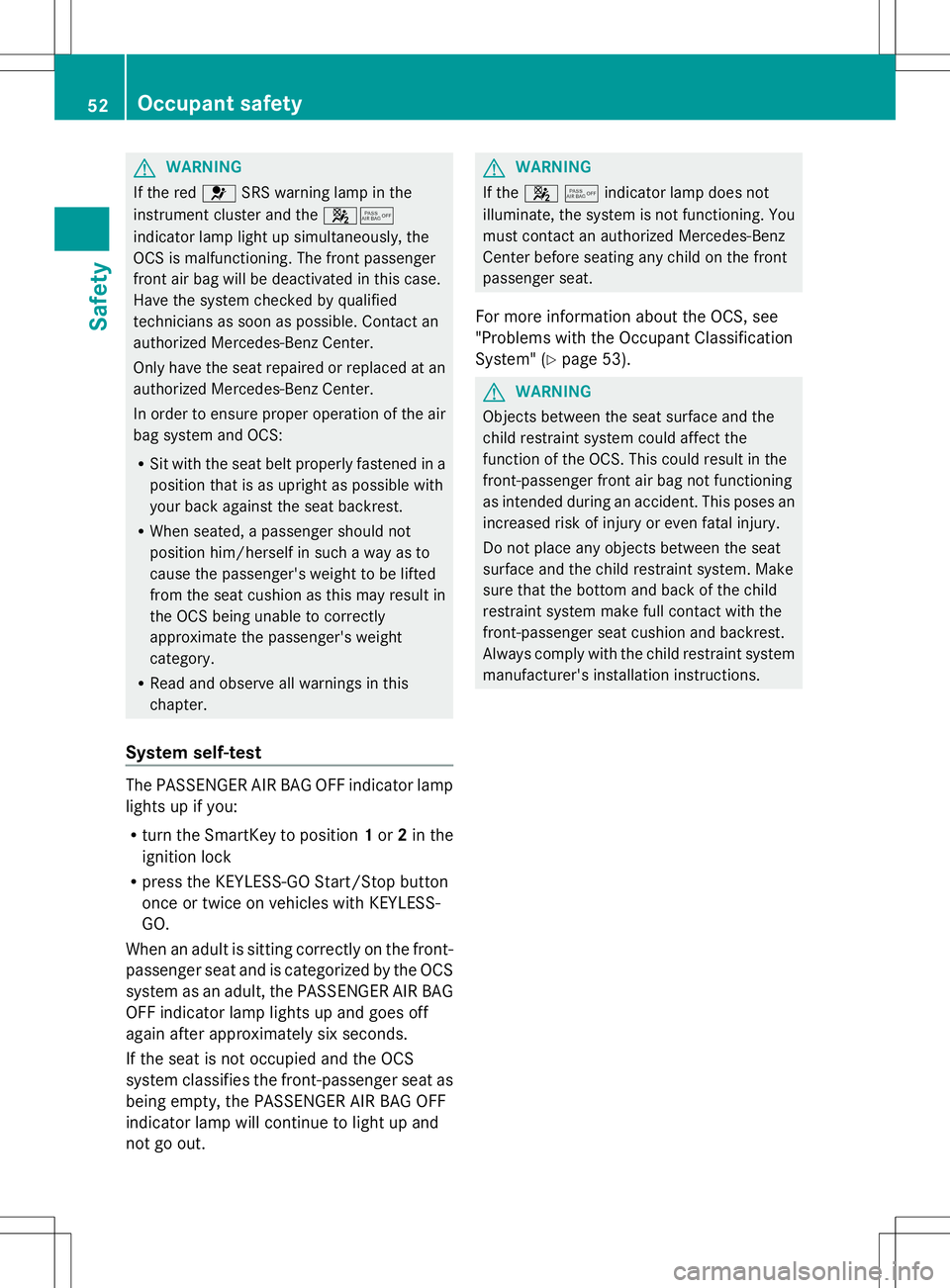
If the red 6SRS warning lamp in the
instrument cluster and the 45
indicator lamp light up simultaneously, the
OCS is malfunctioning. The front passenger
front air bag will be deactivated in this case.
Have the system checked by qualified
technicians as soon as possible. Contact an
authorized Mercedes-Benz Center.
Only have the seat repaired or replaced at an
authorized Mercedes-Benz Center.
In order to ensure proper operation of the air
bag system and OCS:
R Sit with the seat belt properly fastened in a
position that is as upright as possible with
your back against the seat backrest.
R When seated, a passenger should not
position him/herself in such a way as to
cause the passenger's weight to be lifted
from the seat cushion as this may result in
the OCS being unable to correctly
approximate the passenger's weight
category.
R Read and observe all warnings in this
chapter.
System self-test The PASSENGER AIR BAG OFF indicator lamp
lights up if you:
R turn the SmartKey to position 1or 2in the
ignition lock
R press the KEYLESS-GO Start/Stop button
once or twice on vehicles with KEYLESS-
GO.
When an adult is sitting correctly on the front-
passenger seat and is categorized by the OCS
system as an adult, the PASSENGER AIR BAG
OFF indicator lamp lights up and goes off
again after approximately six seconds.
If the seat is not occupied and the OCS
system classifies the front-passenger seat as
being empty, the PASSENGER AIR BAG OFF
indicator lamp will continue to light up and
not go out. G
WARNING
If the 45indicator lamp does not
illuminate, the system is not functioning. You
must contact an authorized Mercedes-Benz
Center before seating any child on the front
passenger seat.
For more information about the OCS, see
"Problems with the Occupant Classification
System" (Y page 53). G
WARNING
Objects between the seat surface and the
child restraint system could affect the
function of the OCS. This could result in the
front-passenger front air bag not functioning
as intended during an accident. This poses an
increased risk of injury or even fatal injury.
Do not place any objects between the seat
surface and the child restraint system. Make
sure that the bottom and back of the child
restraint system make full contact with the
front-passenger seat cushion and backrest.
Always comply with the child restraint system
manufacturer's installation instructions. 52
Occupant safetySafety
Page 55 of 384
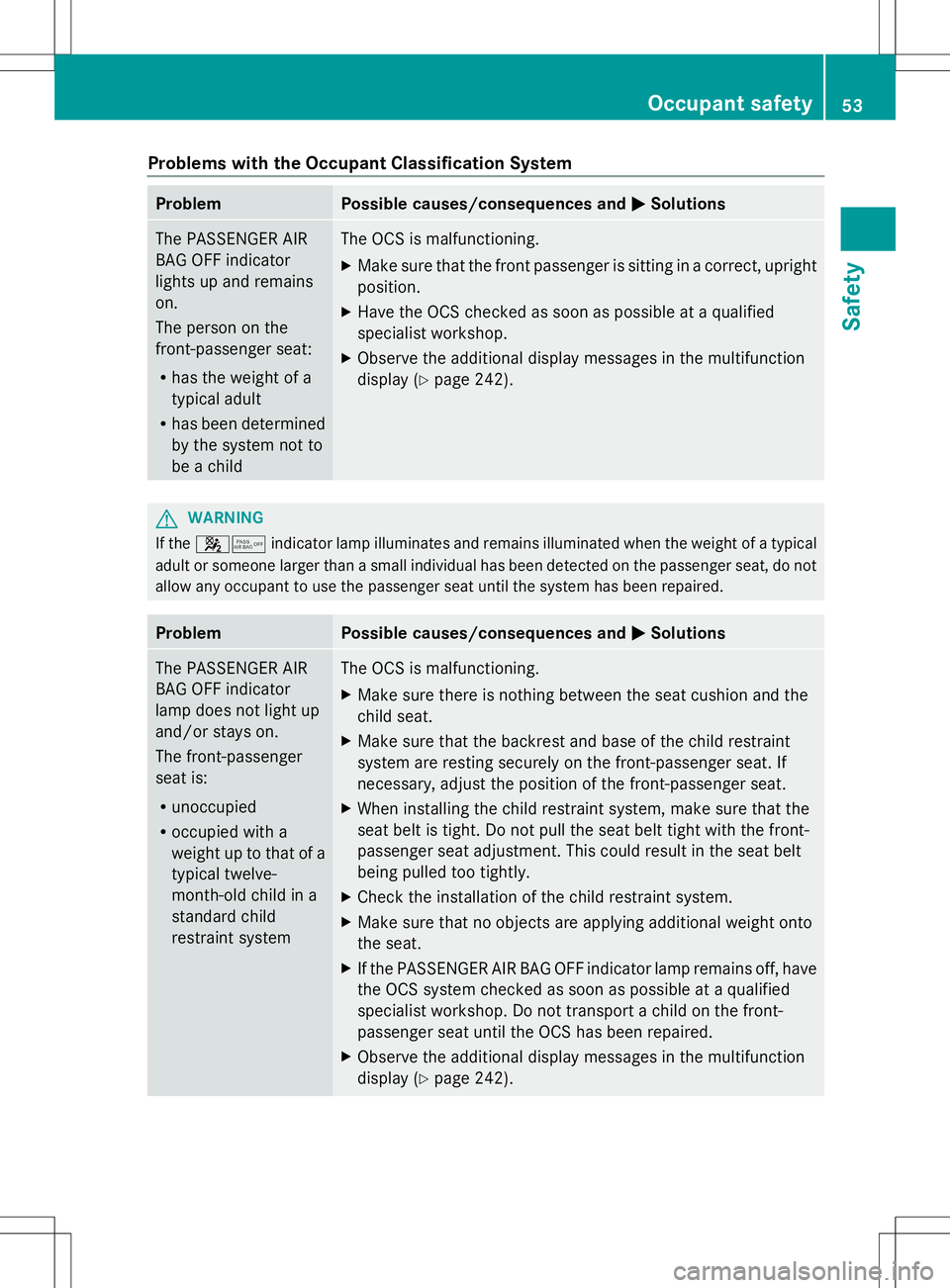
Problems with the Occupant Classification System
Problem Possible causes/consequences and
M
MSolutions The PASSENGER AIR
BAG OFF indicator
lights up and remains
on.
The person on the
front-passenger seat:
R
has the weight of a
typical adult
R has been determined
by the system not to
be a child The OCS is malfunctioning.
X
Make sure that the front passenger is sitting in a correct, upright
position.
X Have the OCS checked as soon as possible at a qualified
specialist workshop.
X Observe the additional display messages in the multifunction
display (Y page 242). G
WARNING
If the 45 indicator lamp illuminates and remains illuminated when the weight of a typical
adult or someone larger than a small individual has been detected on the passenger seat, do not
allow any occupant to use the passenger seat until the system has been repaired. Problem Possible causes/consequences and
M MSolutions The PASSENGER AIR
BAG OFF indicator
lamp does not light up
and/or stays on.
The front-passenger
seat is:
R
unoccupied
R occupied with a
weight up to that of a
typical twelve-
month-old child in a
standard child
restraint system The OCS is malfunctioning.
X
Make sure there is nothing between the seat cushion and the
child seat.
X Make sure that the backrest and base of the child restraint
system are resting securely on the front-passenger seat. If
necessary, adjust the position of the front-passenger seat.
X When installing the child restraint system, make sure that the
seat belt is tight. Do not pull the seat belt tight with the front-
passenger seat adjustment. This could result in the seat belt
being pulled too tightly.
X Check the installation of the child restraint system.
X Make sure that no objects are applying additional weight onto
the seat.
X If the PASSENGER AIR BAG OFF indicator lamp remains off, have
the OCS system checked as soon as possible at a qualified
specialist workshop. Do not transport a child on the front-
passenger seat until the OCS has been repaired.
X Observe the additional display messages in the multifunction
display (Y page 242). Occupant safety
53Safety Z
Page 61 of 384
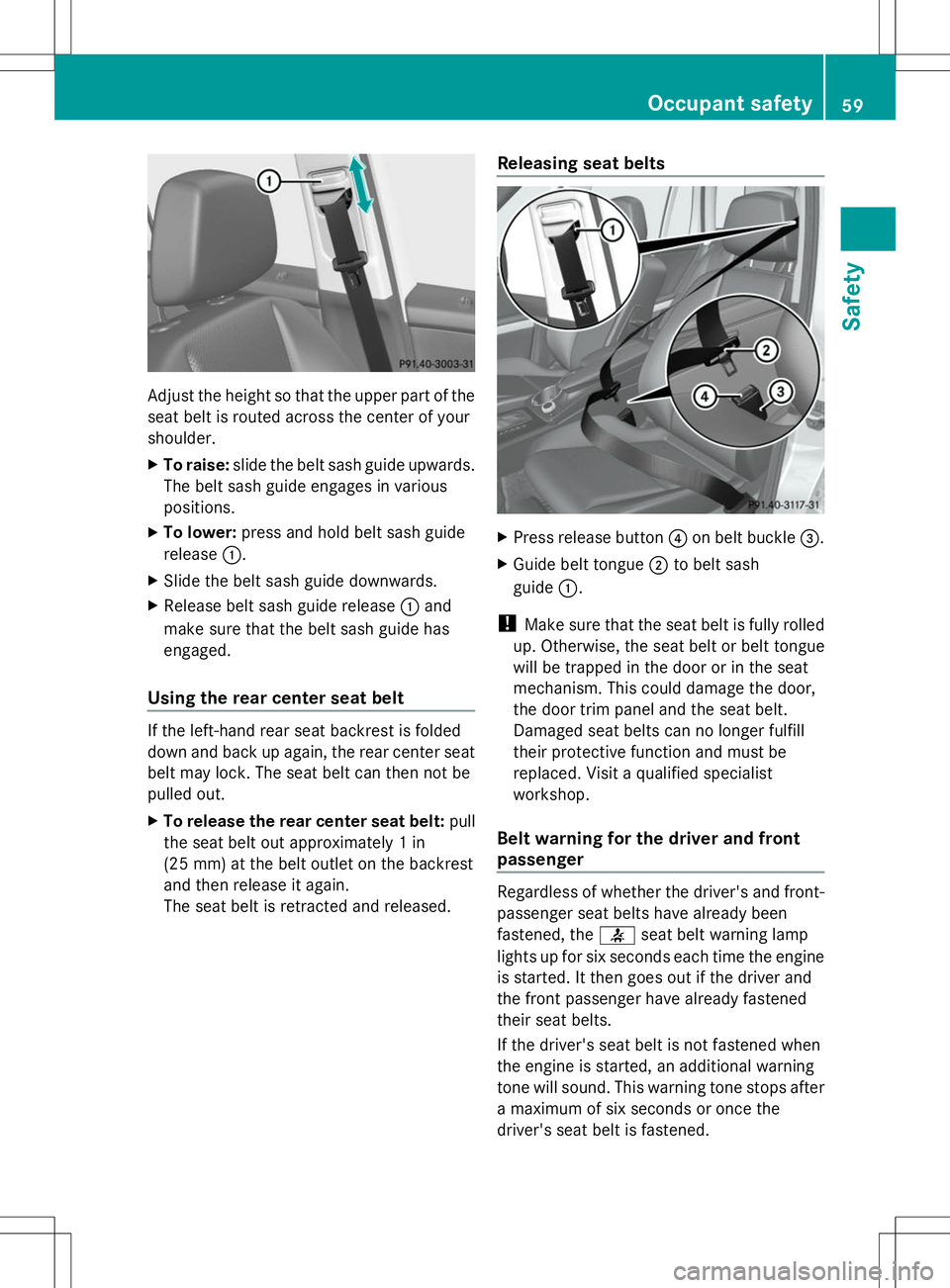
Adjust the height so that the upper part of the
seat belt is routed across the center of your
shoulder.
X To raise: slide the belt sash guide upwards.
The belt sash guide engages in various
positions.
X To lower: press and hold belt sash guide
release :.
X Slide the belt sash guide downwards.
X Release belt sash guide release :and
make sure that the belt sash guide has
engaged.
Using the rear center seat belt If the left-hand rear seat backrest is folded
down and back up again, the rear center seat
belt may lock. The seat belt can then not be
pulled out.
X To release the rear center seat belt: pull
the seat belt out approximately 1 in
(25 mm) at the belt outlet on the backrest
and then release it again.
The seat belt is retracted and released. Releasing seat belts X
Press release button ?on belt buckle =.
X Guide belt tongue ;to belt sash
guide :.
! Make sure that the seat belt is fully rolled
up. Otherwise, the seat belt or belt tongue
will be trapped in the door or in the seat
mechanism. This could damage the door,
the door trim panel and the seat belt.
Damaged seat belts can no longer fulfill
their protective function and must be
replaced. Visit a qualified specialist
workshop.
Belt warning for the driver and front
passenger Regardless of whether the driver's and front-
passenger seat belts have already been
fastened, the
7seat belt warning lamp
lights up for six seconds each time the engine
is started. It then goes out if the driver and
the front passenger have already fastened
their seat belts.
If the driver's seat belt is not fastened when
the engine is started, an additional warning
tone will sound. This warning tone stops after
a maximum of six seconds or once the
driver's seat belt is fastened. Occupant safety
59Safety Z
Page 62 of 384
If after six seconds the driver or front
passenger have not fastened their seat belts
and the doors are closed, the 7seat belt
warning lamp lights up:
R until the driver's or front passenger's seat
belt is fastened
R if a vehicle speed of 15 mph (25 km/h) is
exceeded, a warning tone also sounds with
increasing intensity for a maximum of
60 seconds or until the driver or front-
passenger seat belt has been fastened.
If the driver/front passenger unfasten their
seat belt while the vehicle is in motion, the
7 seat belt warning lamp lights up and a
warning tone sounds again.
The warning tone ceases even if the driver or
front-passenger seat belt has still not been
fastened after 60 seconds. The 7seat belt
warning lamp stops flashing but remains
illuminated.
After the vehicle comes to a standstill, the
warning tone is reactivated and the 7seat
belt warning lamp flashes again if the vehicle
speed again exceeds 15 mph (25 km/h).
The 7 seat belt warning lamp only goes
out if:
R both the driver and the front passenger
have fastened their seat belts.
or
R the vehicle is stationary and a door is open.
i For more information on the 7seat
belt warning lamp, see "Warning and
indicator lamps in the instrument cluster,
seat belts" (Y page 261).
Emergency Tensioning Devices, seat
belt force limiters G
WARNING
Pyrotechnic Emergency Tensioning Devices
that have been deployed are no longer
operational and are unable to perform their
intended protective function. This poses an
increased risk of injury or even fatal injury. Therefore, have pyrotechnic Emergency
Tensioning Devices which have been
triggered immediately replaced at a qualified
specialist workshop.
! If the front-passenger seat is not
occupied, do not engage the seat belt
tongue in the buckle on the front-
passenger seat. Otherwise, the Emergency
Tensioning Device could be triggered in the
event of an accident.
i Vehicles with PRE-SAFE ®
: Emergency
Tensioning Devices that are triggered by an
electric motor can be deployed as often as
desired and do not need to be replaced.
The seat belts for the front seats and rear
outer seats are equipped with ETDs and seat
belt force limiters.
The ETDs tighten the seat belts in an accident,
pulling them close against the body.
The ETDs do not correct incorrect seat
positions or incorrectly fastened seat belts.
The ETDs do not pull vehicle occupants back
towards the backrest.
The ETDs can only be activated when:
R the ignition is switched on
R the restraint systems are operational; see
"SRS warning lamp "(Y page 43)
R the belt tongue is engaged in the buckle on
each of the lap-shoulder belts in the front
R the front-passenger seat is occupied and
the belt tongue is engaged in the buckle on
the front-passenger side
The ETDs on the outside seats in the rear
compartment are triggered independently of
the lock status of the seat belts.
The Emergency Tensioning Devices are
triggered depending on the type and severity
of an accident, if:
R in certain situations where the vehicle rolls
over and the system determines that it can
provide additional protection
R in the event of a head-on or rear-end
collision, the vehicle decelerates or 60
Occupant safetySafety
Page 63 of 384
accelerates rapidly in a longitudinal
direction during the initial stages of the
impact
R in the event of a side impact, the vehicle
decelerates or accelerates rapidly in a
lateral direction on the side opposite the
impact
If the ETDs are deployed, you will hear a bang,
and a small amount of powder may also be
released. Only in rare cases will the bang
affect your hearing. The powder that is
released generally does not constitute a
health hazard and does not indicate that there
is a fire in the vehicle. The dust might cause
some temporary breathing difficulty for
people with asthma or other breathing
trouble. To avoid this, you may wish to get out
of the vehicle as soon as it is safe to do so.
You can also open the window to allow fresh
air to enter the vehicle interior. The 6SRS
warning lamp lights up.
If the seat belt is also equipped with a seat
belt force limiter and this is triggered, the
force exerted by the seat belt on the vehicle
occupant is reduced.
The seat belt force limiters for the front seats
are synchronized with the front air bags,
which take on a part of the deceleration force.
This results in the force exerted on the
occupant being distributed over a greater
area. Children in the vehicle
Child restraint systems
Important safety notes Mercedes-Benz recommends that you always
properly secure all infants and children with
a child or infant seat restraint system for the
trip.
The use of seat belts and infant and child
restraint systems is required by law in:
R all 50 states
R the U.S. territories R
the District of Columbia
R all Canadian provinces
Infants and children must always be seated in
an appropriate infant or child restraint system
recommended for the size and weight of the
child. The infant or child restraint system
must be properly secured in accordance with
the manufacturer's instructions.
All infant or child restraint systems must meet
the following standards:
R U.S. Federal Motor Vehicle Safety
Standards 213 and 225
R Canadian Motor Vehicle Safety Standards
213 and 210.2
Confirmation that the child restraint system
corresponds to the standards can be found
on an instruction label on the child restraint
system. This confirmation can also be found
in the installation instructions that are
included with the child restraint system.
Always read and follow the manufacturer's
instructions when using an infant or child
restraint system or booster seat.
Observe all warning signs in the vehicle
interior and on the infant or child restraint. G
WARNING
According to accident statistics, children are
safer when properly restrained in the rear
seating positions than in the front seating
position. Thus, we strongly recommend that
children be placed in the rear seats whenever
possible. Regardless of seating position,
children 12 years old and under must be
seated and properly secured in an appropriate
infant restraint, toddler restraint, or booster
seat recommended for the size and weight of
the child.
The infant or child restraint must be properly
secured with the vehicle's seat belt, the seat
belt and top tether strap, or lower anchors and
top tether strap, fully in accordance with the
child seat manufacturer's instructions.
Occupants, especially children, should always
sit as upright as possible, wear the seat belt
properly and use an appropriately sized infant Children in the vehicle
61Safety
Z