engine MERCEDES-BENZ GLS 2018 Owners Manual
[x] Cancel search | Manufacturer: MERCEDES-BENZ, Model Year: 2018, Model line: GLS, Model: MERCEDES-BENZ GLS 2018Pages: 398, PDF Size: 5.73 MB
Page 225 of 398
Messages in the multifunction display If a gear change process has not been successful, the following messages may be displayed in the
multifunction display:
Display messages
Possible causes/consequences and P Solutions
LOW RANGE Max.
Speed 24 mph You have been driving faster than 24 mph (40 km/h). Additionally, the
indicator lamp on the button in the center console is flashing. X
Slow down to change gear.
LOW RANGE Shift to
Position N Briefly The transmission is in position D and you are driving at below
40 km/h. X
Shift the transmission to N to complete the gear change process.
LOW RANGE Shifting
Canceled Please
Reactivate The gear change process was not carried out. X
Ensure that all gear change conditions are fulfilled and carry out the
gear change process again.
LOW RANGE Stop
Apply Parking Brake A warning tone also sounds. The gear change process has not been
completed. LOW RANGE is in the neutral position. There is no con-
nection between the engine and the drive wheels.
! Do not drive any further. You could otherwise damage the vehi-
cle's drive train. X
Stop the vehicle. Take into account the road and traffic conditions
when doing this. X
Depress the electric parking brake ( Y
page 162).X
Carry out the gear change process again.
If the gear change process has been carried out, the LOW RANGE
Stop Apply Parking Brake message disappears.
Driving dynamics display in the
COMAND display (vehicles with the Off-
Road Engineering package)
General notes
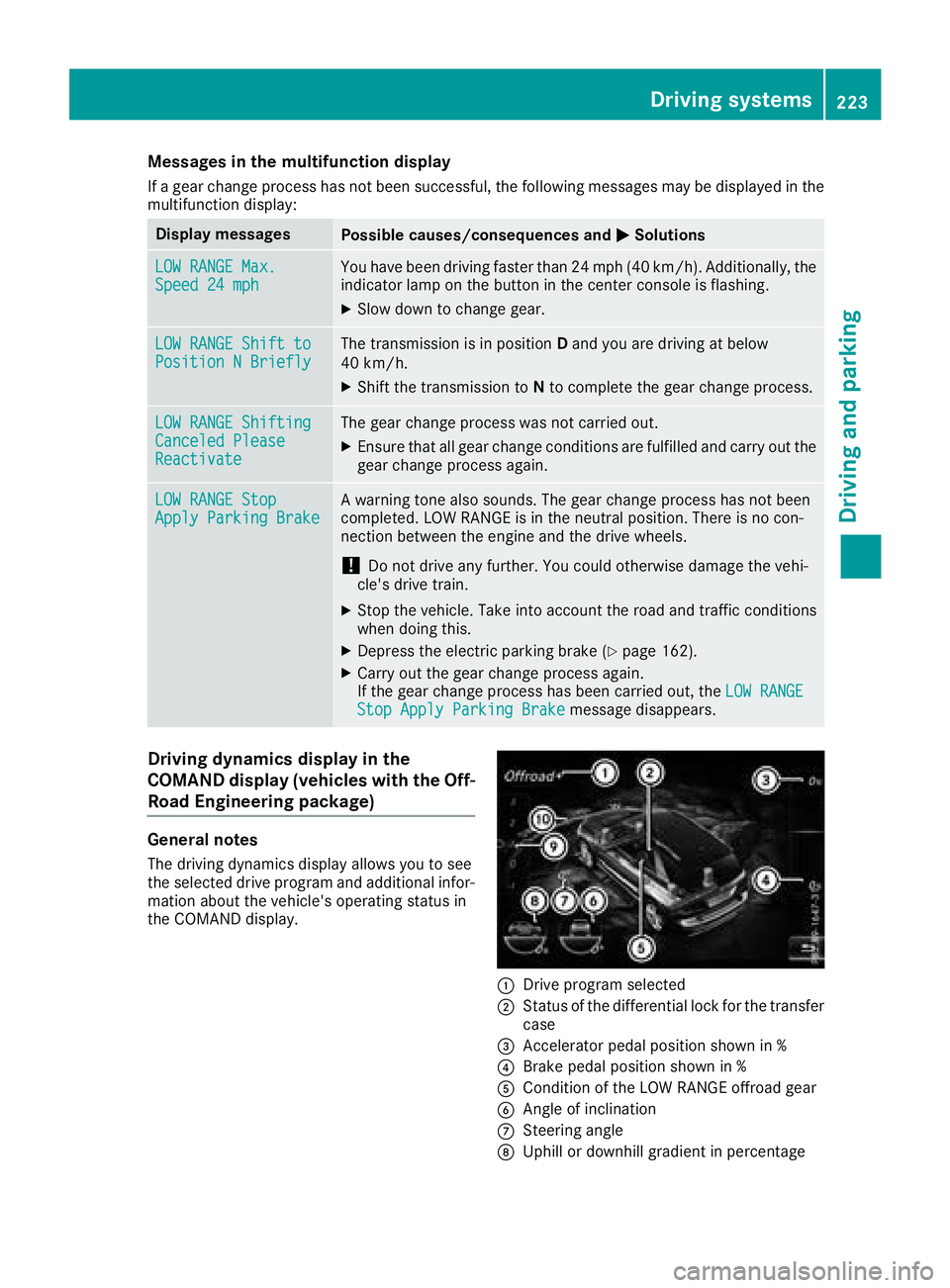
The driving dynamics display allows you to see
the selected drive program and additional infor-
mation about the vehicle's operating status in
the COMAND display.
C
Drive program selected
D
Status of the differential lock for the transfer
case
Page 227 of 398
R
is affected more by strong crosswinds R
demands more sensitive steering R
has a larger turning circle
This could impair the handling characteristics.
When towing a trailer, always adjust your speed
to the current road and weather conditions. Do
not exceed the maximum permissible speed for
your vehicle/trailer combination.
Notes on towing a trailer
General notes
! If you have a trailer tow hitch retrofitted,
changes to the cooling system and drive train
may be necessary, depending on the vehicle
type.
If you have a trailer tow hitch retrofitted,
observe the anchorage points on the chassis
frame. R
Do not exceed the legally prescribed maxi-
mum speed for vehicle/trailer combinations
in the relevant country.
This lowers the risk of an accident. R
Only install an approved trailer coupling on
your vehicle.
More information on availability and installa-
tion can be obtained at any qualified special-
ist workshop. R
The bumpers of your vehicle are not suitable
for installing detachable trailer couplings. R
Do not install hired trailer couplings or other
detachable trailer couplings on the bumpers
of your vehicle. R
If you no longer need the ball coupling,
remove it from the ball coupling recess. This
will reduce the risk of damage to the ball cou-
pling.
When towing a trailer, set the tire pressure on
the rear axle of the towing vehicle for the max-
imum load. You will find the values in the tire
pressure table in the fuel filler flap of the vehicle
( Y
page 372).
Please note that when towing a trailer, the fol-
lowing driving systems have limited availability
or are not available at all: R
Parking Assist PARKTRONIC ( Y
page 192)R
Blind Spot Assist ( Y
page 209)R
Active Lane Keeping Assist ( Y
page 215) On vehicles without level control, the height of
the ball coupling will alter according to the load
placed on the vehicle. If necessary, use a trailer
with a height-adjustable drawbar.
You will find installing dimensions and loads
under "Technical data" ( Y
page 395).
Driving tips Also observe the notes on pulling away with a
trailer ( Y
page 143).
The maximum permissible speed for vehicle/
trailer combinations depends on the type of
trailer. Before beginning the journey, check the
trailer's documents to see what the maximum
permissible speed is for your trailer. Observe the
legally permissible maximum speed in the rele-
vant country.
For certain Mercedes-Benz vehicles, the maxi-
mum permissible rear axle load is increased
when towing a trailer. See "Technical data" to
find out whether this applies to your vehicle
( Y
page 395). If you utilize any of the added
maximum rear axle load when towing a trailer,
the vehicle/trailer combination may not exceed
a maximum speed of 60 mph (100 km/h) for
reasons concerning the operating permit. This
also applies in countries in which the maximum
permissible speed for car/trailer combinations
is greater than 60 mph (100 km/h).
When towing a trailer, your vehicle's handling
characteristics will be different in comparison
with when driving without a trailer.
Use the left-hand steering wheel paddle shifter
to shift into a lower gear in good time on long
and steep downhill gradients.
This also applies if you have activated cruise
control or Distance Pilot DISTRONIC.
This will use the braking effect of the engine, so
that less braking will be required to maintain the
speed. This relieves the load on the brake sys-
tem and prevents the brakes from overheating
and wearing too quickly. If you need additional
braking, depress the brake pedal repeatedly
rather than continuously.
Driving tips
If the trailer swings from side to side: X
Do not accelerate. X
Do not counter-steer. X
Brake if necessary.Towing a trailer 225
Driving and parking Z
Page 228 of 398
R
Maintain a greater distance from the vehicle
in front than when driving without a trailer. R
Avoid braking abruptly. If possible, brake gen-
tly at first to allow the trailer to run on. Then,
increase the braking force rapidly. R
The values given for gradient-climbing capa-
bilities from a standstill refer to sea level.
When driving in mountainous areas, note that
the power output of the engine and, conse-
quently, the vehicle's gradient-climbing capa-
bility, decreases with increasing altitude.
Installing the ball coupling
G WARNING
If the ball coupling is not correctly installed
and secured, it can come loose during the
journey and endanger other road users. There
is a risk of an accident and injury.
Always install and secure the ball coupling as
described. Before every journey, ensure that
the ball coupling is secured with the bolt and
the corresponding spring cotter.
G WARNING
If the ball coupling is not installed correctly or
not secured with the bolt provided and the
corresponding spring cotter, the trailer may
come loose. There is a risk of an accident.
Always install and secure the ball coupling as
described. Before every journey, ensure that
the ball coupling is secured with the bolt and
the corresponding spring cotter.
G WARNING
If the ball coupling is not installed and secured
correctly the trailer may come loose. There is
a risk of an accident.
Install and secure the ball coupling as descri-
bed in the ball coupling installation instruc-
tions. Make sure that the ball coupling is
installed and secured correctly before every
journey. X
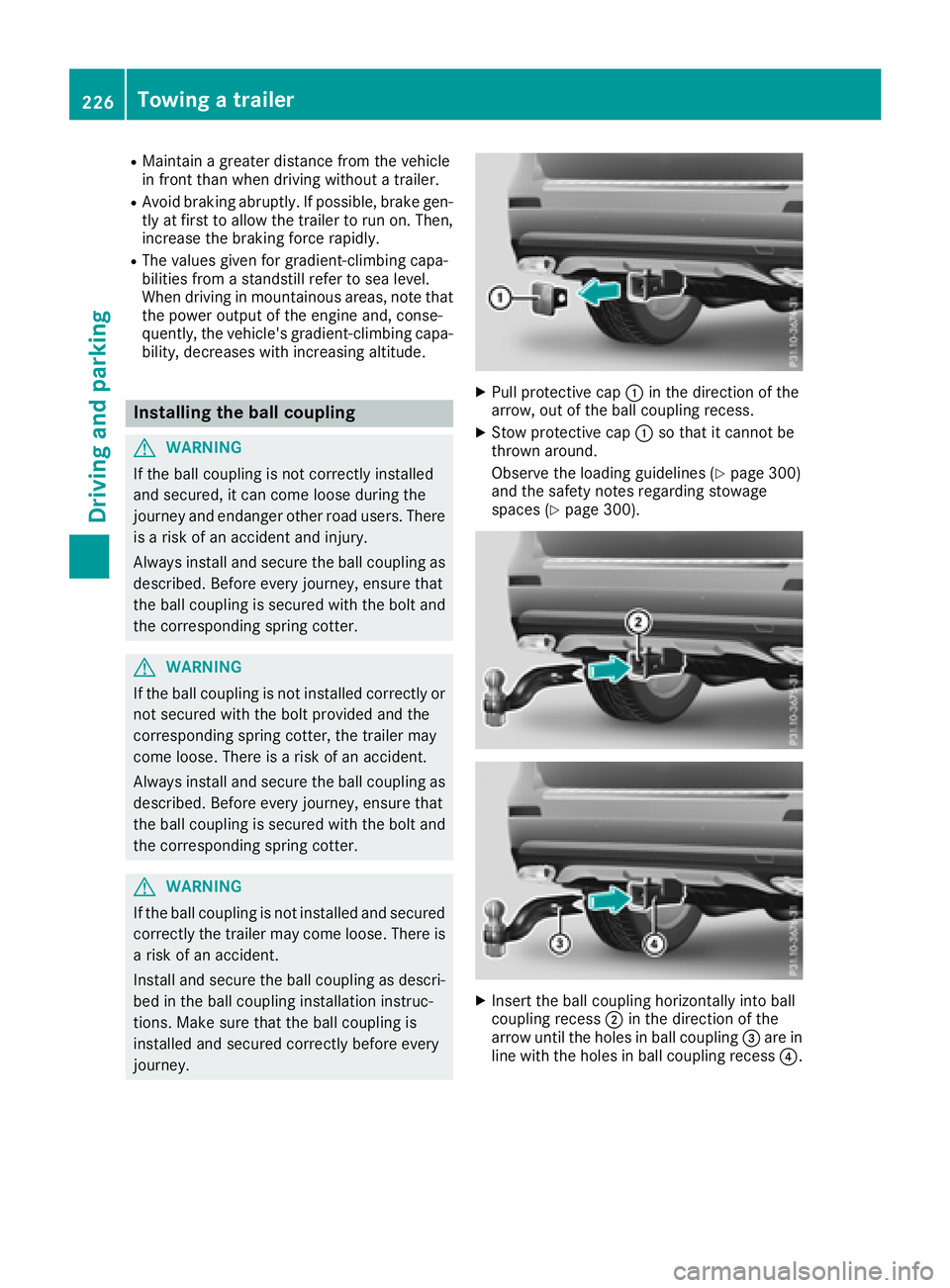
Pull protective cap C in the direction of the
arrow, out of the ball coupling recess. X
Stow protective cap C so that it cannot be
thrown around.
Observe the loading guidelines ( Y
page 300)
and the safety notes regarding stowage
spaces ( Y
page 300).
X
Insert the ball coupling horizontally into ball
coupling recess D in the direction of the
arrow until the holes in ball coupling
Page 230 of 398
Most U.S. states and all Canadian provinces
require by law: R
Safety chains between the towing vehicle and
the trailer. The chains should be cross-wound
under the trailer drawbar. They must be fas-
tened to the vehicle's trailer coupling, not to
the bumper or the axle.
Leave enough play in the chains to make tight
cornering possible. R
A separate brake system for certain types of
trailer. R
Safety switch for braked trailers. Check the
specific legal requirements applicable to your
state.
If the trailer becomes detached from the tow-
ing vehicle, the safety feature triggers the
trailer brakes.
Towing a trailer There are numerous legal requirements con-
cerning the towing of a trailer, e.g. speed restric-
tions. Make sure that your car/trailer combina-
tion complies with the local regulations: R
in your place of residence R
in the location to which you are driving
The police and local authorities can provide reli-
able information.
Observe the following when towing a trailer: R
To gain driving experience and to become
accustomed to the new handling characteris-
tics, you should practice the following in a
traffic-free location: -
cornering -
stopping -
backing up R
Before driving, check: -
trailer tow hitch -
safety switch for braked trailers -
safety chains -
electrical connections -
lights -
wheels R
Adjust the exterior mirrors to provide an
unobstructed view of the rear section of the
trailer. R
If the trailer has electronically controlled
brakes, pull away carefully. Brake manually using the brake controller and check whether
the brakes function correctly. R
Secure any objects on the trailer to prevent
the cargo from slipping when the vehicle is in
motion. R
When you couple up a trailer, check at regular
intervals that the load is firmly secured. If the
trailer is equipped with trailer lights and
brakes, check the trailer to ensure that these
are working. R
Bear in mind that the handling will be less
stable when towing a trailer than when driving
without one. Avoid sudden steering move-
ments. R
The vehicle/trailer combination is heavier,
accelerates more slowly, has a decreased
gradient climbing capability and a longer
braking distance.
It is more susceptible to side winds and
requires more careful steering. R
If possible, do not brake suddenly, but instead
depress the brake pedal moderately at first so
that the trailer can activate its brakes. Then
increase the pressure on the brake pedal. R
If the automatic transmission repeatedly
shifts between gears on uphill or downhill gra-
dients, shift to a lower gear using the left-hand
steering wheel paddle shifter.
A lower gear and lower speed reduce the risk
of engine failure. R
When driving downhill, shift to a lower gear to
utilize the engine's braking effect.
Avoid continuous brake application as this
may overheat the vehicle brakes and, if instal-
led, the trailer brakes. R
If the coolant temperature increases dramat-
ically while the air-condition ing system is
switched on, switch off the air-conditioning
system.
Coolant heat can also be dissipated by open-
ing the windows and switching the ventilation
blower and the interior temperature to the
highest level. R
When overtaking, pay particular attention to
the extended length of your vehicle/trailer
combination.
Due to the length of the vehicle/trailer com-
bination, you require additional road space in
relation to the vehicle you are overtaking
before you can change back to the original
lane.228
Towing a trailer
Driving and parking
Page 231 of 398
Decoupling a trailer
G WARNING
If you uncoupl e a trailer wit h th e overrun
brake engaged, you could trap your han d
between th e vehicle and th e trailer drawbar .
There is a ris k of injury.
Do no t uncoupl e a trailer if th e overrun brake
is engaged.
G WARNING
Vehicles wit h level control:
The vehicle is lowered as soo n as you discon-
nect th e trailer cable. Thi s could result in your
limbs or those of other people that are
between th e vehicle bod y and tires or under-
neat h th e vehicle bein g trapped. There is a
ris k of injury.
Mak e sur e that nobod y is in th e immediate
vicinit y of th e whee l housings or under th e
vehicle when you disconnec t th e trailer cable.
! Do no t disconnec t a trailer wit h an engage d
overrun brake . Otherwise , your vehicle could
be damaged by th e reboundin g of th e overrun
brake .X
Shift th e transmissio n to position P .X
Apply th e vehicle' s electric parking brake .X
Start th e engine.X
Clos e th e doors and tailgate.X
Apply th e trailer's parking brake .X
Detach th e trailer cable and decoupl e th e
trailer .X
Switc h of f th e engine.
Permissible trailer loads an d drawbar
loads
Weight specifications
Maximum allowable gross mass
The gross vehicle weight of th e trailer is calcu-
lated by addin g th e weight of th e trailer to th e
weight of th e load and equipmen t on th e trailer .
You will fin d installin g dimensions and load s
under "Technical data" ( Y
page 395). Permissible noseweigh tYou will fin d installin g dimensions and load s
under "Technical data" ( Y
page 395).
Loading a trailer R
Whe n loadin g th e trailer , mak e sur e that nei-
ther th e permissible gross weight of th e trailer
no r th e gross vehicle weight are exceeded.
The permissible gross vehicle weight is indi-
cated on th e identification plat e located on
th e B-pilla r on th e driver's sid e of th e vehicle.
You can fin d th e maximum permissible values
on th e typ e plates of your vehicle and th e
trailer . Whe n calculatin g how muc h weight
th e vehicle and trailer may carry, pay atten-
tion to th e respective lowest values. R
The trailer drawbar load on th e ball couplin g
mus t be adde d to th e rea r axl e load to avoid
exceedin g th e permissible gross axl e weight .
The permissible gross vehicle weight is indi-
cated on th e identification plat e located on
th e B-pilla r on th e driver's sid e of th e vehicle.
i Mercedes-Ben z recommends a trailer load
wher e th e trailer drawbar noseweigh t
accounts fo r 8 % to 15 % of th e trailer's per -
missible gross weight .
i The weight of additional accessories , pas-
sengers, and cargo reduce s th e permissible
trailer load and drawbar load fo r your vehicle.
Checking th e vehicle an d trailer weigh tR
To chec k that th e weight s of th e towin g vehi-
cl e and th e trailer compl y wit h th e maximum
permissible values, hav e th e vehicle/trailer
combination (includin g th e driver , passen -
gers, and cargo wit h a full y lade n trailer )
weighed on a calibrated weighbridge .R
Chec k th e gross axl e weight ratin g of th e fron t
and rea r axles, th e gross weight of th e trailer
and th e trailer drawbar noseweight.
Removin g th e ball coupling X
Remov e th e sprin g cotter.X
Remov e th e bolt from th e ball couplin g
recess . X
Remov e th e ball couplin g from th e ball cou-
plin g recess .Towing a trailer 229
Driving and parking Z
Page 235 of 398
Important safety notes
G WARNIN G
If you operate information systems and com-
munication equipmen t integrate d in th e vehi-
cle when driving , you may be distracte d from
th e traffic situation . You could also lose con-
trol of th e vehicle. Ther e is a ris k of an acci-
dent.
Only operate this equipmen t when th e traffic
situation permits. If you are no t sur e that this
is possible , park th e vehicl e payin g attention
to traffic condition s and operate th e equip-
men t when th e vehicl e is stationary.
You must observ e th e legal requirements for th e
country in whic h you are currentl y driving when
operating th e on-board computer.
G WARNIN G
If th e instrumen t cluste r has faile d or mal-
functioned, you may no t recognize function
restriction s in systems relevan t to safety. The
operating safet y of your vehicl e may be
impaired . Ther e is a ris k of an accident.
Drive on carefully. Hav e th e vehicl e checke d
at a qualified specialist workshop immedi-
ately.
If th e operating safet y of your vehicl e is
impaired , pull ove r as soo n as it is saf e to do so.
Contac t a qualified specialist workshop.
The on-board computer only shows message s or
warning s from certain systems in th e multifunc-
tion display. You should therefor e mak e sur e
your vehicl e is operating safely at all times .
Fo r an overview, see th e instrumen t panel illus-
tration ( Y
page 37).
Displays and operation
Instrument cluster lighting
The lighting in th e instrumen t cluster, in th e dis-
plays and th e control s in th e vehicl e interior can
be adjusted usin g th e brightness control knob.
The brightness control knob is locate d on th e
botto m lef t of th e instrumen t cluste r
( Y
page 37). X
Turn th e brightness control knob clockwise or
counter-clockwise.
If you tur n th e ligh t switch to X , ` or
X , th e brightness is dependen t upon th e
brightness of th e ambien t light.
i The ligh t sensor in th e instrumen t cluste r
automatically control s th e brightness of th e
multifunction display.
In daylight, th e displays in th e instrumen t
cluste r are no t illuminated.
Speedometer with segments The segments in th e speedometer indicat e
whic h spee d range is available. R
Cruis e control activated ( Y
page 174):
The segments ligh t up from th e store d spee d
to th e maximum speed. R
Distanc e Pilot DISTRONI C is activated
( Y
page 176):
On e or two segments in th e set spee d range
ligh t up. R
Distanc e Pilot DISTRONI C detects a vehicl e in
fron t moving mor e slowly than th e store d
speed:
The segments between th e spee d of th e vehi-
cle in fron t and th e store d spee d ligh t up.
Tachometer
! Do no t driv e in th e overrevving range, as this
could damag e th e engine.
The red ban d in th e tachometer indicates th e
engine's overrevving range.
The fuel suppl y is interrupted to protect th e
engin e when th e red ban d is reached.
Outside temperature display You should pay special attention to road condi-
tion s when temperatures are aroun d freezing
point.
Bea r in min d that th e outside temperature dis-
play indicates th e temperature measured and
does no t record th e road temperature.
The outside temperature display is in th e multi-
function display ( Y
page 235).Displays and operation 233
On-board computer and displays Z
Page 236 of 398
There is a short delay before a change in outside
temperature appears in the multifunction dis-
play.
Coolant temperature gauge
G WARNING
Opening the hood when the engine is over-
heated or when there is a fire in the engine
compartment could expose you to hot gases
or other service products. There is a risk of
injury.
Let an overheated engine cool down before
opening the hood. If there is a fire in the
engine compartment, keep the hood closed
and contact the fire department.
! If the coolant temperature is too high, a dis-
play message is shown.
If the coolant temperature display is in the
area marked in red, do not continue driving.
Otherwise, the engine will be damaged.
The coolant temperature gauge is in the instru-
ment cluster on the right-hand side ( Y
page 37).
Under normal operating conditions and with the
specified coolant level, the coolant temperature
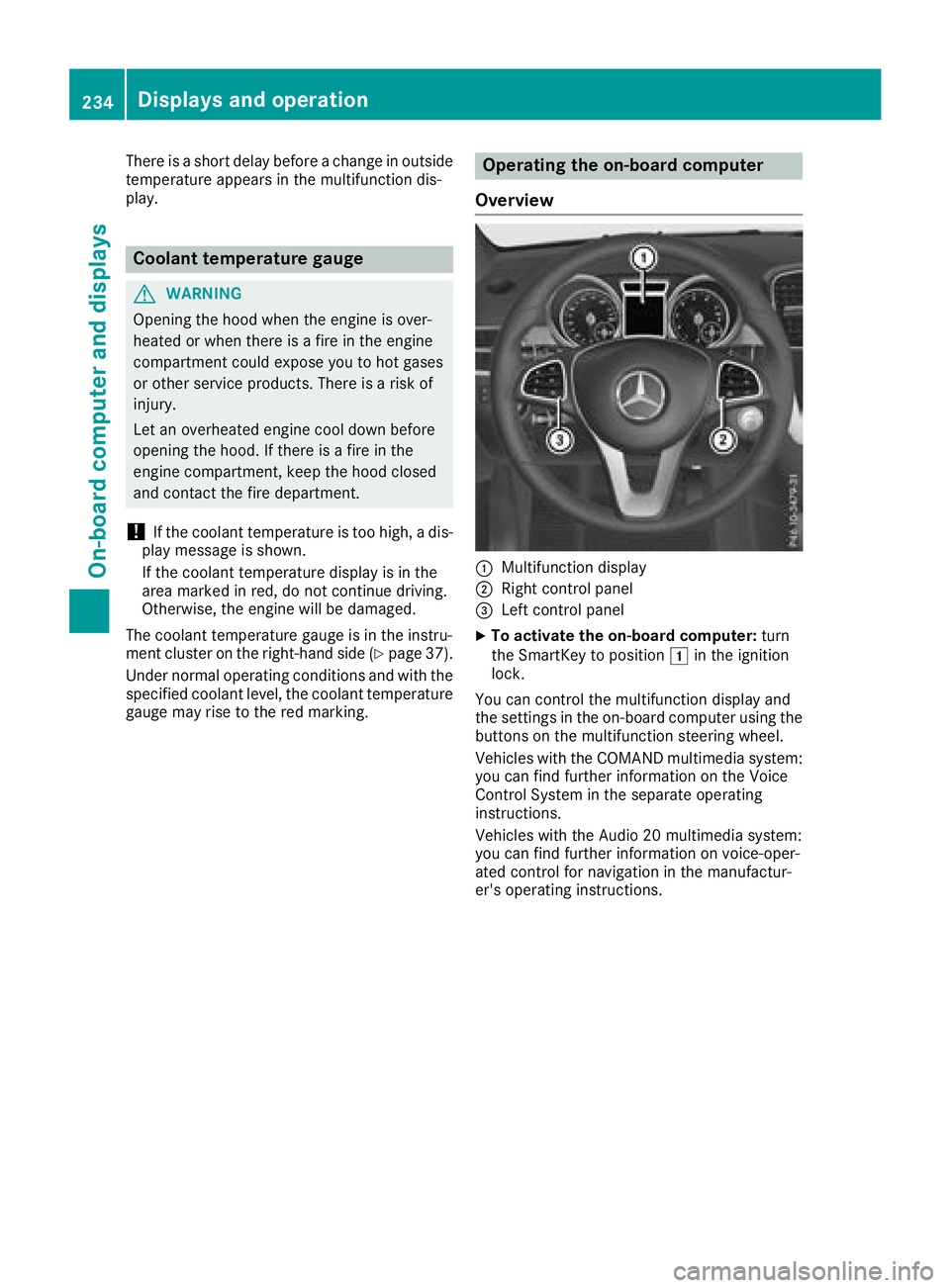
gauge may rise to the red marking. Operating the on-board computer
Overview
C
Multifunction display D
Right control panel
Page 243 of 398
X
Press the a or v button to start dialing.
or X
To exit the redial memory: press the v
or 8 button.
Assistance menu
Introduction Depending on the equipment installed in the
vehicle, you have the following options in the
DriveAssist menu:R
Displaying the assistance graphic
( Y
page 241) R
Activating/deactivating the Traffic Sign
Assist display ( Y
page 241)R
Activating or deactivating Steering Pilot
( Y
page 241) R
Activating or deactivating Active Brake Assist
( Y
page 242) R
Activating or deactivating Active Brake Assist
with cross-traffic function ( Y
page 242)R
Activating/deactivating ATTENTION ASSIST
( Y
page 242) R
Activating/deactivating Blind Spot Assist or
Active Blind Spot Assist ( Y
page 242)R
Activating/deactivating Lane Keeping Assist
or Active Lane Keeping Assist ( Y
page 242)
Displaying the assistance graphic
X
Press the Y or e button on the steering
wheel to select the DriveAssist menu.X
Press c or d to select Assistance
Graphic .X
Confirm by pressing v on the steering
wheel.
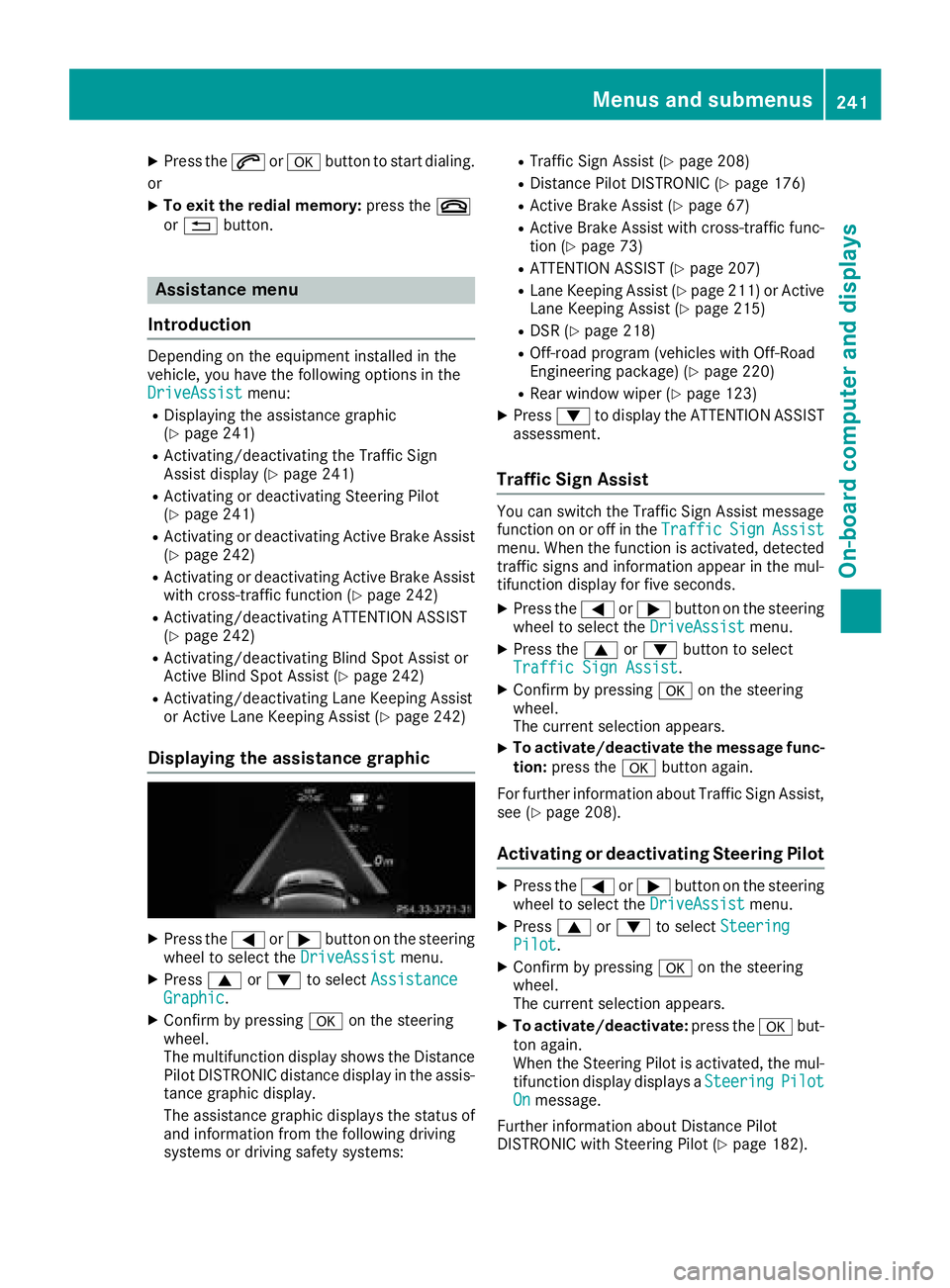
The multifunction display shows the Distance
Pilot DISTRONIC distance display in the assis-
tance graphic display.
The assistance graphic displays the status of
and information from the following driving
systems or driving safety systems: R
Traffic Sign Assist ( Y
page 208)R
Distance Pilot DISTRONIC ( Y
page 176)R
Active Brake Assist ( Y
page 67)R
Active Brake Assist with cross-traffic func-
tion ( Y
page 73) R
ATTENTION ASSIST ( Y
page 207)R
Lane Keeping Assist ( Y
page 211) or Active
Lane Keeping Assist ( Y
page 215)R
DSR ( Y
page 218) R
Off-road program (vehicles with Off-Road
Engineering package) ( Y
page 220)R
Rear window wiper ( Y
page 123)X
Press d to display the ATTENTION ASSIST
assessment.
Traffic Sign Assist You can switch the Traffic Sign Assist message
function on or off in the Traffic Sign Assist
menu. When the function is activated, detected
traffic signs and information appear in the mul-
tifunction display for five seconds. X
Press the Y or e button on the steering
wheel to select the DriveAssist menu.X
Press the c or d button to select
Traffic Sign Assist .X
Confirm by pressing v on the steering
wheel.
The current selection appears. X
To activate/deactivate the message func-
tion: press the v button again.
For further information about Traffic Sign Assist,
see ( Y
page 208).
Activating or deactivating Steering Pilot X
Press the Y or e button on the steering
wheel to select the DriveAssist menu.X
Press c or d to select Steering
Pilot . X
Confirm by pressing v on the steering
wheel.
The current selection appears. X
To activate/deactivate: press the v but-
ton again.
When the Steering Pilot is activated, the mul-
tifunction display displays a Steering Pilot
On message.
Further information about Distance Pilot
DISTRONIC with Steering Pilot ( Y
page 182).Menus and submenus 241
On-board computer and displays Z
Page 247 of 398
For further information on belt adjustment, see
( Y
page 48).
Switching the fold-in mirrors when lock-
ing feature on/off This function is only available when the vehicle is
equipped with the electrical fold-in function.
When you activate the Auto. Mirror Folding
function, the exterior mirrors are folded in when
the vehicle is locked. The exterior mirrors fold
out automatically again as soon as you unlock
the vehicle. X
Press the Y or e button on the steering
wheel to select the Sett. menu.X
Press the d or c button to select the
Convenience submenu.X
Press v to confirm.X
Press the d or c button to select the
Auto. Mirror Folding function.
If the Auto. Mirror Folding function is
switched on, the multifunction display shows
the exterior mirror in orange. X
Press the v button to save the setting.
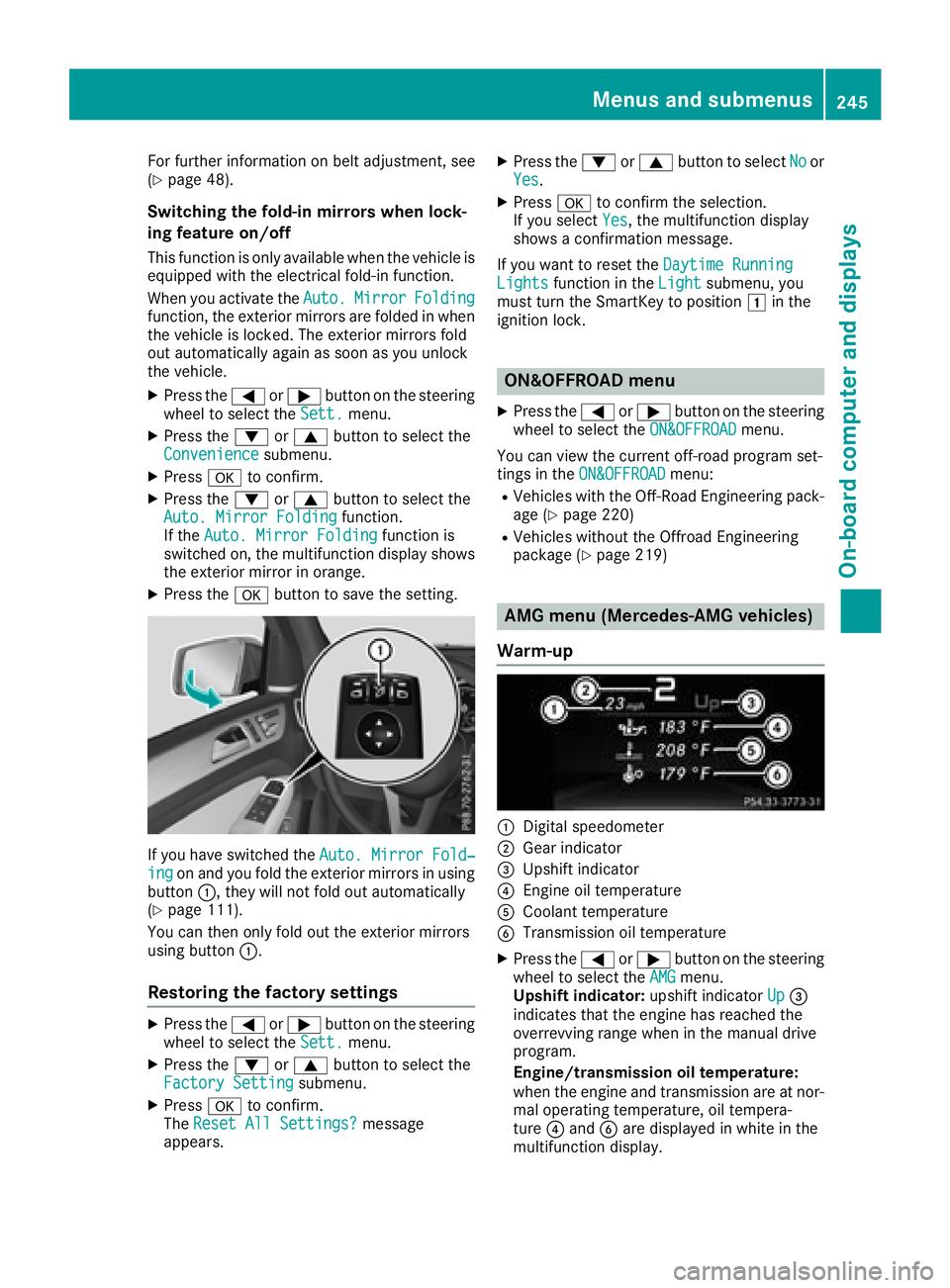
If you have switched the Auto. Mirror Fold‐
ing on and you fold the exterior mirrors in using
button C , they will not fold out automatically
( Y
page 111).
You can then only fold out the exterior mirrors
using button C .
Restoring the factory settings X
Press the Y or e button on the steering
wheel to select the Sett. menu.X
Press the d or c button to select the
Factory Setting submenu.X
Press v to confirm.
The Reset All Settings? message
appears. X
Press the d or c button to select No or
Yes . X
Press v to confirm the selection.
If you select Yes , the multifunction display
shows a confirmation message.
If you want to reset the Daytime Running
Lights function in the Light submenu, you
must turn the SmartKey to position G in the
ignition lock.
ON&OFFROAD menu X
Press the Y or e button on the steering
wheel to select the ON&OFFROAD menu.
You can view the current off-road program set-
tings in the ON&OFFROAD menu:R
Vehicles with the Off-Road Engineering pack-
age ( Y
page 220) R
Vehicles without the Offroad Engineering
package ( Y
page 219)
AMG menu (Mercedes-AMG vehicles)
Warm-up
C
Digital speedometer D
Gear indicator
Page 249 of 398
X
Press the 8 button on the steering wheel.X
Confirm Yes with v .
The RACETIMER interrupts timing if you stop the
vehicle and turn the SmartKey to position G in
the ignition lock. If you turn the SmartKey to
position I and then press v to confirm
Start timing is continued.
Resetting the current lap X
Stop the RACETIMER. X
Press the Y or e button to select
Reset Lap .X
Press v to reset the lap time to "0".
Deleting all laps
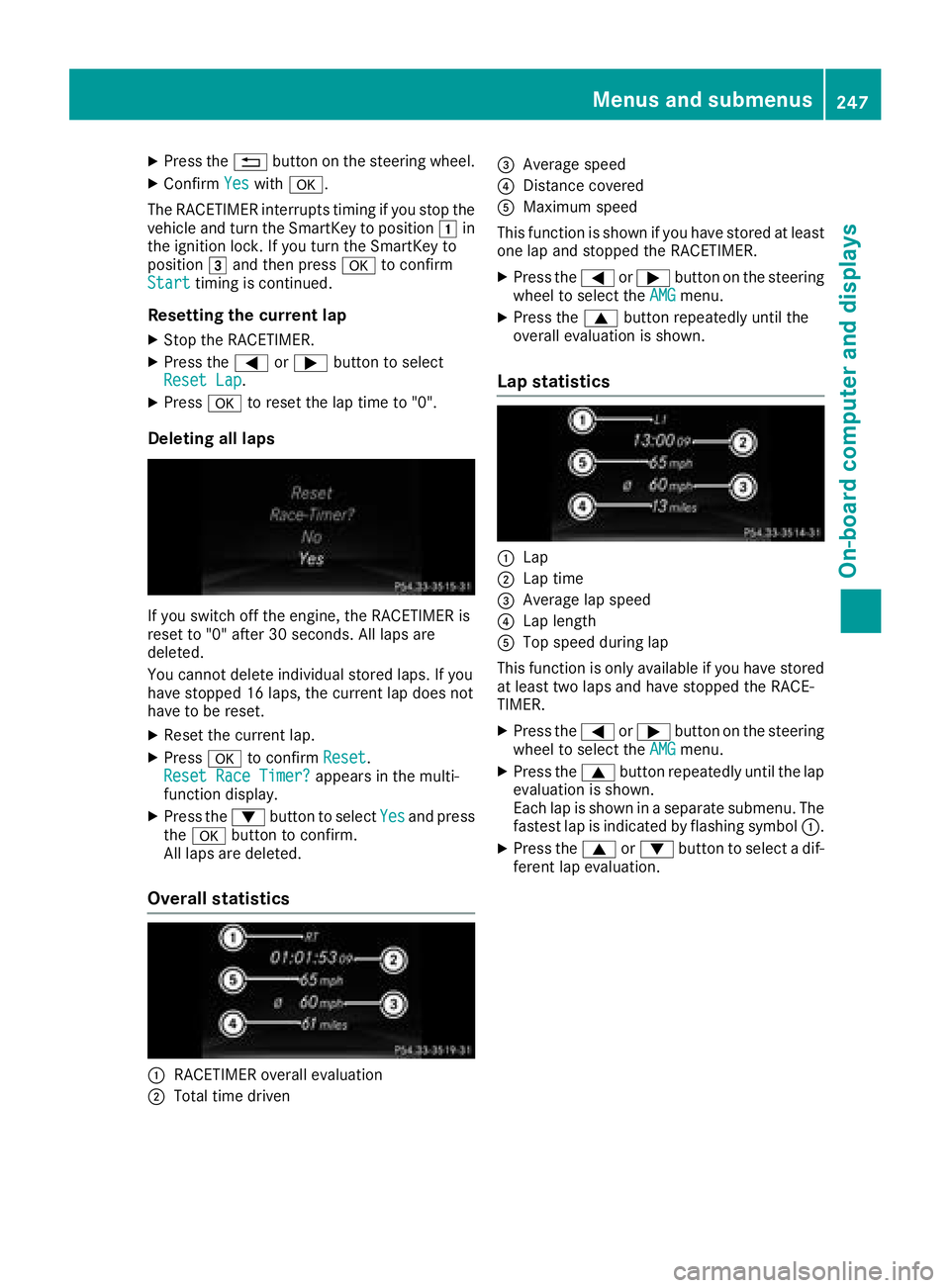
If you switch off the engine, the RACETIMER is
reset to "0" after 30 seconds. All laps are
deleted.
You cannot delete individual stored laps. If you
have stopped 16 laps, the current lap does not
have to be reset. X
Reset the current lap. X
Press v to confirm Reset .
Reset Race Timer? appears in the multi-
function display. X
Press the d button to select Yes and press
the v button to confirm.
All laps are deleted.
Overall statistics
C
RACETIMER overall evaluation
D
Total time driven