ECU MERCEDES-BENZ GLS 2018 Owner's Manual
[x] Cancel search | Manufacturer: MERCEDES-BENZ, Model Year: 2018, Model line: GLS, Model: MERCEDES-BENZ GLS 2018Pages: 398, PDF Size: 5.73 MB
Page 144 of 398
ignite if in contact with the exhaust system or
parts of the engine that heat up. There is a risk
of fire.
Carry out regular checks to make sure that
there are no flammable foreign materials in
the engine compartment or in the exhaust
system.
General notes Vehicles with a gasoline engine: the catalytic
converter is preheated for up to 30 seconds
after a cold start. The sound of the engine may
change during this time.
Automatic transmission X
Shift the transmission to position ]
( Y
page 148).
The transmission position indicator on the
multifunction display shows ]
( Y
page 149).
i You can start the engine in transmission
position ] and \\ .
Starting procedure with the SmartKey X
To start a diesel engine: turn the SmartKey
to position H in the ignition lock
( Y
page 140).
The \( preglow indicator lamp in the instru-
ment cluster lights up. X
Turn the SmartKey to position I in the igni-
tion lock ( Y
page 140) and release it as soon
as the engine is running.
i Vehicles with a diesel engine: you can
start the engine without preglow if the engine
is warm.
Using KEYLESS-GO to start the engine The Start/Stop button can be used to start the
vehicle without inserting the SmartKey into the
ignition lock. The Start/Stop button must be
inserted in the ignition lock and the SmartKey
must be in the vehicle. This mode for starting the
engine operates independently of the ECO
start/stop automatic engine start function. X
Depress the brake pedal and keep it
depressed. X
Press the Start/Stop button once
( Y
page 140).
Vehicles with a gasoline engine: the engine
starts.
Vehicles with a diesel engine: preglow is
activated and the engine starts.
Starting procedure via smartphone Observe the important safety notes on starting
the engine ( Y
page 141).
You can also start your engine via your smart-
phone from outside the vehicle. In this case, the
previously selected climate control setting is
activated. In this way you can cool or heat the
interior of the vehicle before starting the jour-
ney.
Only start the engine via your smartphone if it is
safe to start and run the engine where your vehi-
cle is parked.
Observe the legal stipulations in the area where
your vehicle is parked. Engine start via smart-
phone may be limited to certain countries or
regions.
You can execute a maximum of two consecutive
starting attempts via your smartphone. If you
insert the SmartKey into the ignition lock, you
can carry out two more starting attempts.
Once you have started the engine, you can
switch the engine off via your smartphone at any
time.
You can only start the engine via your smart-
phone if: R
the SmartKey is in the ignition lock R
park position ] is selectedR
the accelerator pedal is not depressed R
the anti-theft alarm system is not activated R
the panic alarm is not activated R
the hazard warning lamps are switched off R
the hood is closed R
the doors are closed and locked R
the windows and sliding sunroof are closed
Also make sure that: R
the fuel tank is sufficiently filled R
the starter battery is sufficiently charged142
Driving
Driving and parking
Page 145 of 398
G WARNING
Limbs could be crushed or trapped if the
engine is started unintentionally during ser-
vice or maintenance work. There is a risk of
injury.
Always secure the engine against uninten-
tional starting before carrying out mainte-
nance or repair work.
Make sure that the engine cannot be started via
your smartphone before carrying out mainte-
nance or repairs. You can prevent an engine
start via your smartphone, for example, if you: R
switch on the hazard warning lamps R
do not lock the doors R
open the hood
Pulling away
General notes
G WARNING
If the engine speed is above the idling speed
and you engage transmission position D or R ,
the vehicle could pull away suddenly. There is
a risk of an accident.
When engaging transmission position D or R ,
always firmly depress the brake pedal and do
not simultaneously accelerate.
Depress the accelerator carefully when pulling
away.
The vehicle locks centrally once you have pulled
away. The locking knobs in the doors drop down.
You can open the doors from the inside at any
time.
You can also deactivate the automatic locking
feature ( Y
page 244).
It is only possible to shift the transmission from
position P to the desired position if you depress
the brake pedal. Only then is the parking lock
released. If you do not depress the brake pedal,
the DIRECT SELECT lever can still be moved but
the parking lock remains engaged.
i Upshifts take place at higher engine speeds
after a cold start. This helps the catalytic con-
verter to reach its operating temperature
more quickly. Information on the automatic release of the
electric parking brake ( Y
page 163).
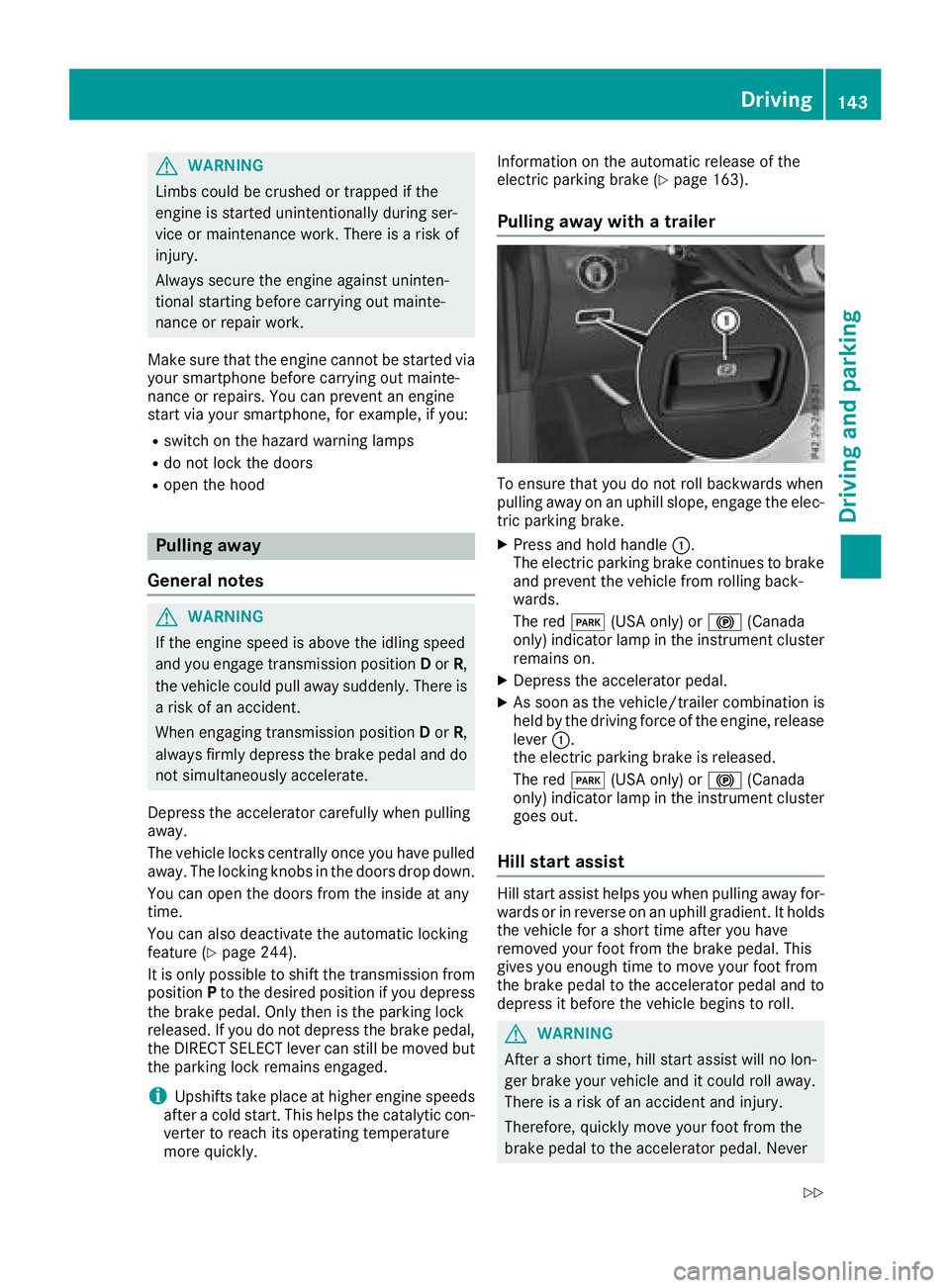
Pulling away with a trailer
To ensure that you do not roll backwards when
pulling away on an uphill slope, engage the elec-
tric parking brake. X
Press and hold handle C .
The electric parking brake continues to brake
and prevent the vehicle from rolling back-
wards.
The red I (USA only) or $ (Canada
only) indicator lamp in the instrument cluster
remains on. X
Depress the accelerator pedal. X
As soon as the vehicle/trailer combination is
held by the driving force of the engine, release
lever C .
the electric parking brake is released.
The red I (USA only) or $ (Canada
only) indicator lamp in the instrument cluster
goes out.
Hill start assist Hill start assist helps you when pulling away for-
wards or in reverse on an uphill gradient. It holds
the vehicle for a short time after you have
removed your foot from the brake pedal. This
gives you enough time to move your foot from
the brake pedal to the accelerator pedal and to
depress it before the vehicle begins to roll.
G WARNING
After a short time, hill start assist will no lon-
ger brake your vehicle and it could roll away.
There is a risk of an accident and injury.
Therefore, quickly move your foot from the
brake pedal to the accelerator pedal. Never Driving 143
Driving and parking Z
Page 146 of 398
leave the vehicle when it is held by hill start
assist.
Hill start assist is not active if: R
you are pulling away on a level road or on a
downhill gradient. R
the transmission is in position N .R
the electric parking brake is applied. R
ESP ®
is malfunctioning.
ECO start/stop function
Introduction The ECO start/stop function switches the
engine off automatically if the vehicle is stopped
under certain conditions.
The engine starts automatically when the driver
wants to pull away again. The ECO start/stop
function thereby helps you to reduce the fuel
consumption and emissions of your vehicle.
Important safety notes
G WARNING
If the engine is switched off automatically and
you exit the vehicle, the engine is restarted
automatically. The vehicle may begin moving.
There is a risk of accident and injury.
If you wish to exit the vehicle, always turn off
the ignition and secure the vehicle against
rolling away.
General notes
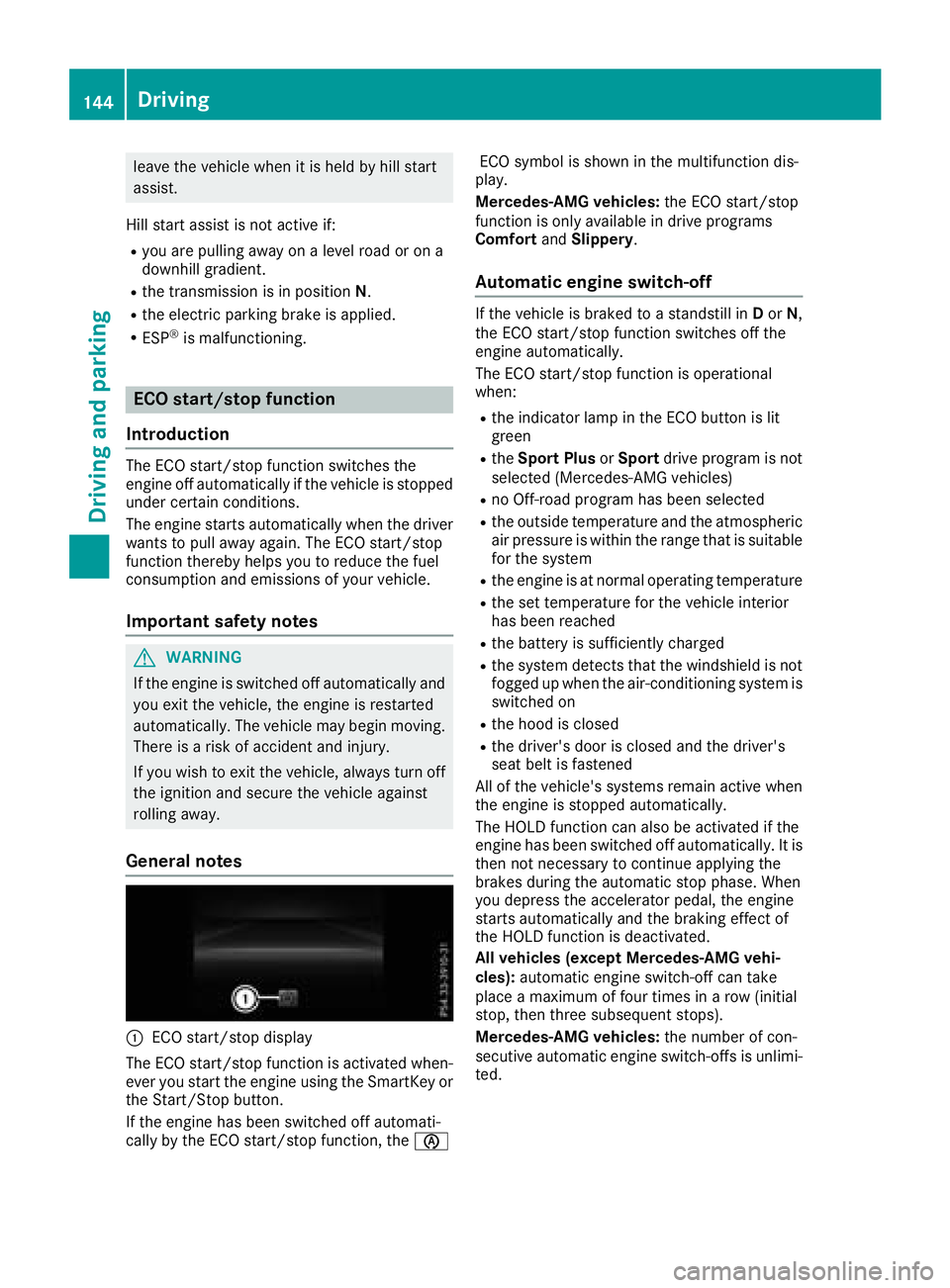
C
ECO start/stop display
The ECO start/stop function is activated when-
ever you start the engine using the SmartKey or
the Start/Stop button.
If the engine has been switched off automati-
cally by the ECO start/stop function, the
Page 152 of 398
The arrows in the transmission position display
show how and into which transmission positions
you can shift using the DIRECT SELECT lever.
If the transmission position display on the mul-
tifunction display is not working, you should pull
away carefully to check whether the desired
transmission position is engaged. Ideally, you
should select transmission position [ and, in
Mercedes-AMG vehicles, drive program C or S .
Transmission positions E Park position
Only shift the transmission into posi-
tion P when the vehicle is stationary
( Y
page 161). The parking lock
should not be used as a brake when
parking. Always apply the electronic
parking brake in addition to the park-
ing lock in order to secure the vehi-
cle.
If the vehicle electronics are malfunc-
tioning, the transmission may be
locked in position P . Have the vehicle
electronics checked immediately at a
qualified specialist workshop.
Park position P is automatically
engaged if: R
you switch off the engine using the
SmartKey and remove the Smart-
Key R
you switch off the engine using the
SmartKey or using the Start/Stop
button and open the driver's door
or front-passenger door R
the driver's door is opened when
the vehicle is stationary or driving
at very low speed and the trans-
mission is in position D or R
F Reverse gear
Only shift the transmission into posi-
tion R when the vehicle is stationary. D Neutral
Do not shift the transmission to N
while driving. Otherwise, the auto-
matic transmission could be dam-
aged.
No power is transmitted from the
engine to the drive wheels.
Releasing the brakes will allow you to
move the vehicle freely, e.g. to push
it or tow it.
If ESP ®
is deactivated or faulty: shift
the transmission to position N if the
vehicle is in danger of skidding, e.g.
on icy roads.
If you switch the engine off with the
transmission in position R or D , the
automatic transmission shifts to N
automatically.
! Coasting in neutral \\ may
cause damage to the drive train.
: Drive
The automatic transmission changes
gear automatically. All forward gears
are available.
Driving tips
Changing gear The automatic transmission shifts through the
individual gears automatically when it is in trans-
mission position [ . This automatic gear shift-
ing behavior is determined by: R
the selected drive program R
the position of the accelerator pedal R
the road speed
Accelerator pedal position Your style of driving influences how the auto-
matic transmission shifts gear: R
little throttle: early upshifts R
more throttle: late upshifts150
Automatic transmission
Driving and parking
Page 162 of 398
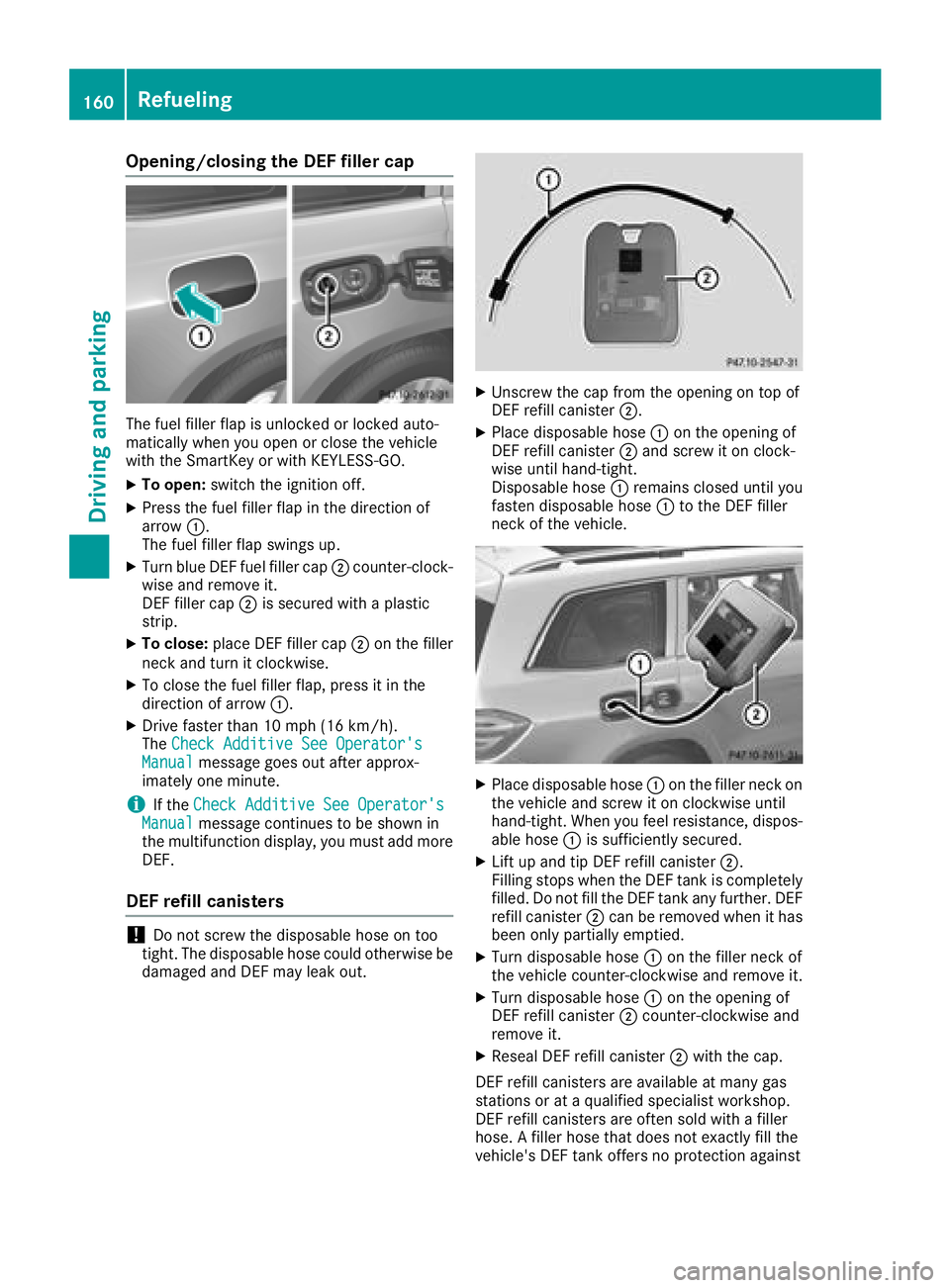
Opening/closing the DEF filler cap
The fuel filler flap is unlocked or locked auto-
matically when you open or close the vehicle
with the SmartKey or with KEYLESS-GO. X
To open: switch the ignition off.X
Press the fuel filler flap in the direction of
arrow C .
The fuel filler flap swings up. X
Turn blue DEF fuel filler cap D counter-clock-
wise and remove it.
DEF filler cap D is secured with a plastic
strip. X
To close: place DEF filler cap D on the filler
neck and turn it clockwise. X
To close the fuel filler flap, press it in the
direction of arrow C .X
Drive faster than 10 mph (16 km/h).
The Check Additive See Operator's
Manual message goes out after approx-
imately one minute.
i If the Check Additive See Operator's
Manual message continues to be shown in
the multifunction display, you must add more
DEF.
DEF refill canisters
! Do not screw the disposable hose on too
tight. The disposable hose could otherwise be
damaged and DEF may leak out. X
Unscrew the cap from the opening on top of
DEF refill canister D .X
Place disposable hose C on the opening of
DEF refill canister D and screw it on clock-
wise until hand-tight.
Disposable hose C remains closed until you
fasten disposable hose C to the DEF filler
neck of the vehicle.
X
Place disposable hose C on the filler neck on
the vehicle and screw it on clockwise until
hand-tight. When you feel resistance, dispos-
able hose C is sufficiently secured. X
Lift up and tip DEF refill canister D .
Filling stops when the DEF tank is completely
filled. Do not fill the DEF tank any further. DEF
refill canister D can be removed when it has
been only partially emptied. X
Turn disposable hose C on the filler neck of
the vehicle counter-clockwise and remove it. X
Turn disposable hose C on the opening of
DEF refill canister D counter-clockwise and
remove it. X
Reseal DEF refill canister D with the cap.
DEF refill canisters are available at many gas
stations or at a qualified specialist workshop.
DEF refill canisters are often sold with a filler
hose. A filler hose that does not exactly fill the
vehicle's DEF tank offers no protection against160
Refueling
Driving and parking
Page 163 of 398
overfilling. DEF may leak if overfilled. Mercedes-
Benz offers a special disposable hose with over-
fill protection. You can obtain this from any
authorized Mercedes-Benz Center. DEF is avail-
able in a variety of containers and receptacles.
Only use the disposable hose with the
Mercedes-Benz DEF refill canisters.
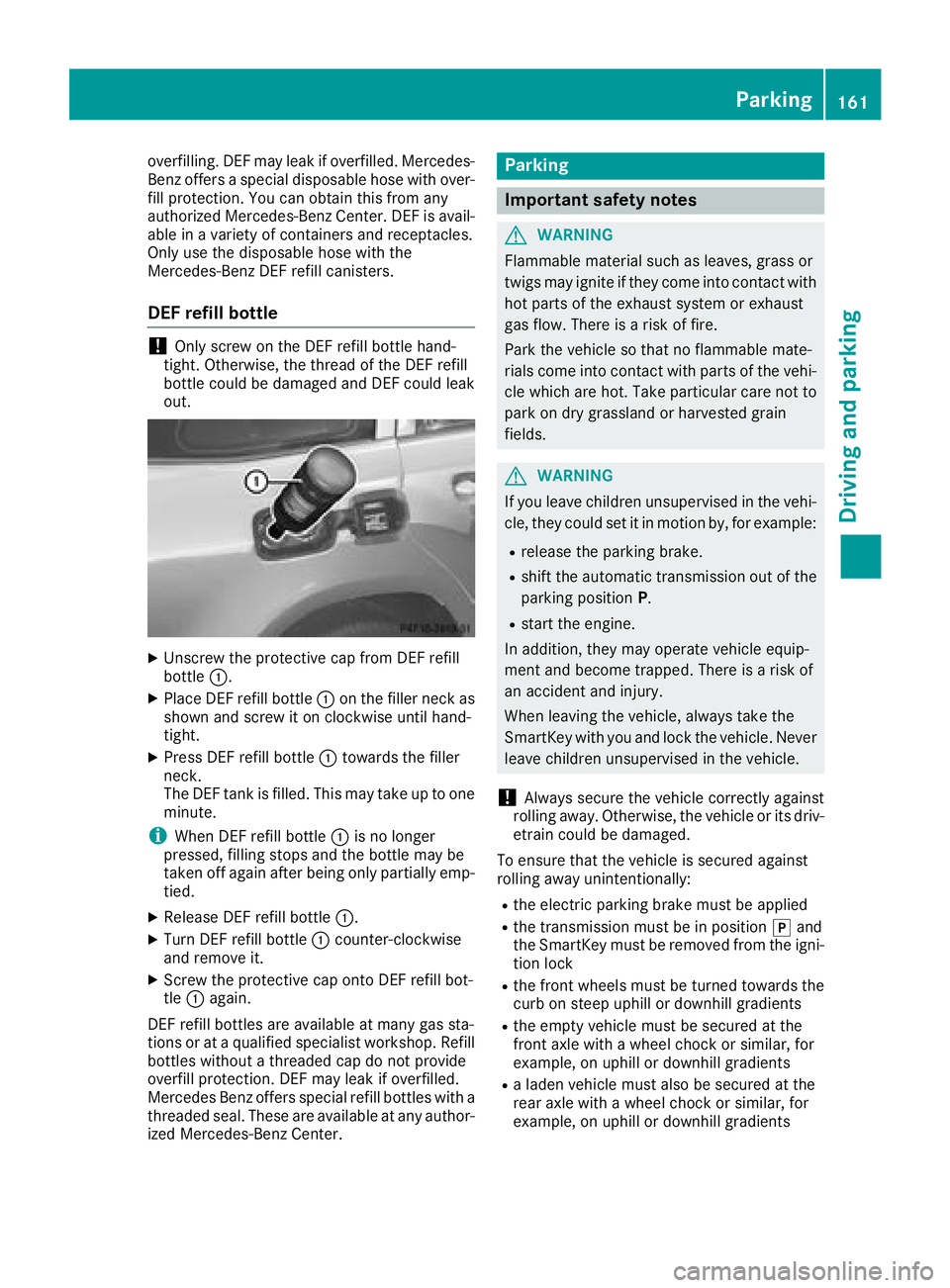
DEF refill bottle
! Only screw on the DEF refill bottle hand-
tight. Otherwise, the thread of the DEF refill
bottle could be damaged and DEF could leak
out.
X
Unscrew the protective cap from DEF refill
bottle C .X
Place DEF refill bottle C on the filler neck as
shown and screw it on clockwise until hand-
tight. X
Press DEF refill bottle C towards the filler
neck.
The DEF tank is filled. This may take up to one
minute.
i When DEF refill bottle C is no longer
pressed, filling stops and the bottle may be
taken off again after being only partially emp-
tied. X
Release DEF refill bottle C .X
Turn DEF refill bottle C counter-clockwise
and remove it. X
Screw the protective cap onto DEF refill bot-
tle C again.
DEF refill bottles are available at many gas sta-
tions or at a qualified specialist workshop. Refill
bottles without a threaded cap do not provide
overfill protection. DEF may leak if overfilled.
Mercedes Benz offers special refill bottles with a
threaded seal. These are available at any author-
ized Mercedes-Benz Center. Parking
Important safety notes
G WARNING
Flammable material such as leaves, grass or
twigs may ignite if they come into contact with
hot parts of the exhaust system or exhaust
gas flow. There is a risk of fire.
Park the vehicle so that no flammable mate-
rials come into contact with parts of the vehi-
cle which are hot. Take particular care not to
park on dry grassland or harvested grain
fields.
G WARNING
If you leave children unsupervised in the vehi-
cle, they could set it in motion by, for example: R
release the parking brake. R
shift the automatic transmission out of the
parking position P . R
start the engine.
In addition, they may operate vehicle equip-
ment and become trapped. There is a risk of
an accident and injury.
When leaving the vehicle, always take the
SmartKey with you and lock the vehicle. Never
leave children unsupervised in the vehicle.
! Always secure the vehicle correctly against
rolling away. Otherwise, the vehicle or its driv-
etrain could be damaged.
To ensure that the vehicle is secured against
rolling away unintentionally: R
the electric parking brake must be applied R
the transmission must be in position ] and
the SmartKey must be removed from the igni-
tion lock R
the front wheels must be turned towards the
curb on steep uphill or downhill gradients R
the empty vehicle must be secured at the
front axle with a wheel chock or similar, for
example, on uphill or downhill gradients R
a laden vehicle must also be secured at the
rear axle with a wheel chock or similar, for
example, on uphill or downhill gradients Parking 161
Driving and parking Z
Page 173 of 398
Familiarize yourself with the characteristics of
your vehicle and the gear shift operation before
driving through difficult terrain.
The following driving systems are specially
adapted to off-road driving: R
the Off-road drive program (vehicles without
Off-Road Engineering package)
( Y
page 219) R
Off-road and Off-road Plus drive programs
(vehicles with Off-Road Engineering package)
( Y
page 220) R
LOW RANGE off-road gear (vehicles with the
Off-Road Engineering package)
( Y
page 221) R
Differential lock (vehicles with the Off-Road
Engineering package) ( Y
page 221)R
Off-road ABS ( Y
page 67)R
Off-road 4ETS ( Y
page 70)R
Off-road ESP ®
( Y
page 71)R
AIRMATIC package (vehicle level)
( Y
page 188) R
DSR (Downhill Speed Regulation)
( Y
page 218)
Observe the following notes: R
Stop the vehicle before starting to drive along
an off-road route. If necessary, select the off-
road program ( Y
page 220) or shift to the
LOW RANGE off-road gear ( Y
page 221).R
Select a vehicle level that is suitable for the
terrain. To avoid damaging the vehicle, make
sure there is always sufficient ground clear-
ance. R
Check that items of cargo and loads are
stowed safely and are well secured
( Y
page 305). R
Always keep the engine running and in gear
when driving on a downhill gradient. Activate
DSR ( Y
page 218).R
Always keep the engine running and in gear
when driving down an incline. R
Adapt your speed to the terrain. The rougher,
steeper or more ruts on the terrain, the slower
your speed should be. R
Do not jump with the vehicle as this will inter-
rupt the vehicle's propulsion. R
Drive with extreme care on unfamiliar off-road
routes where visibility is poor. For safety rea-
sons, get out of the vehicle first and survey
the off-road route. R
Look out for obstacles, such as rocks, holes,
tree stumps and furrows. R
Take care when turning on an uphill or down-
hill slope or when driving across a slope. The
vehicle could otherwise tip over. R
Always keep the doors, the tailgate, the side
windows and the sliding sunroof closed while
the vehicle is in motion. R
Do not shift the automatic transmission to
position \\ . R
Observe the notes on off-road fording
( Y
page 169).
i Information about retrofitting special all-ter-
rain tires is available from any qualified spe-
cialist workshop.
i Do not use the HOLD function when driving
off-road, on steep uphill or downhill gradients
or on slippery or loose surfaces. The HOLD
function cannot hold the vehicle on such sur-
faces.
Checklist before driving off-road
! If the engine oil warning lamp lights up while
the vehicle is in motion, stop the vehicle in a
safe place as soon as possible. Check the
engine oil level. The engine oil warning lamp
warning must not be ignored. Continuing the
journey while the symbol is displayed could
lead to engine damage. X
Engine oil level: check the engine oil level
and add oil if necessary.
When driving on steep gradients, the engine
oil level must be sufficiently high to ensure a
correct oil supply in the vehicle. X
DEF tank (BlueTEC vehicles): check the
level and add if necessary ( Y
page 158).X
Tire-changing tool kit: check that the jack is
working and make sure you have the lug
wrench, a robust tow cable and a folding
spade in the vehicle. X
Wheels and tires: check the tread depth and
pressure of the tires. X
Check for damage and remove any foreign
objects, e.g. small stones, from the wheels/
tires. X
Replace any missing valve caps. X
Replace dented or damaged wheels. X
Rims: dented or bent rims can result in a loss
of tire pressure and damage the tire bead. Driving tips 171
Driving and parking Z
Page 181 of 398
The vehicle can also pull away when it is facing
an unidentified obstacle or is driving on a differ-
ent line from another vehicle. The vehicle then
brakes automatically.
If there is no vehicle in front, Distance Pilot
DISTRONIC operates in the same way as cruise
control.
If Distance Pilot DISTRONIC detects a slower-
moving vehicle in front, it brakes your vehicle. In
this way, the distance you have selected is main-
tained.
If Distance Pilot DISTRONIC detects a faster-
moving vehicle in front, it increases the driving
speed. However, the vehicle is only accelerated
up to the speed you have stored.
Selecting the drive program Distance Pilot DISTRONIC supports a sporty
driving style if you have selected the Sport or
Sport Plus drive program ( Y
page 151). Accel-
eration behind the vehicle in front or to the set
speed is then noticeably more dynamic. If you
have selected the Comfort drive program, the
vehicle accelerates more gently. This setting is
recommended in stop-and-start traffic.
Changing lanes If you change to the overtaking lane, Distance
Pilot DISTRONIC supports you if: R
you are driving faster than 45 mph (70 km/ h)R
you switch on th e appropriat e tur n signalR
Distanc e Pilo t DISTRONI C does no t currentl y
detec t a danger of collision
If these condition s are fulfilled , your vehicl e is
accelerated. Acceleration will be interrupted if
changin g lanes takes to o lon g or if th e distanc e
between your vehicl e and th e vehicl e in fron t
become s to o small.
i Whe n you chang e lanes, Distanc e Pilo t
DISTRONI C monitors th e right lan e (in left-
side traffic) or th e lef t lan e (in right-side traf-
fic). Stopping
G WARNIN G
If you leav e th e vehicl e when it is only bein g
braked by Distanc e Pilo t DISTRONIC, it could
rol l away if: R
there is a malfunction in th e system or in
th e voltag e supply. R
Distanc e Pilo t DISTRONI C is switched off
usin g th e cruise control lever, e.g. by a vehi-
cle occupant or from outside th e vehicl eR
th e electrica l system in th e engin e com-
partment, th e battery or th e fuses are tam -
pered with. R
th e battery is disconnected R
th e vehicl e is accelerated, e.g. by a vehicl e
occupant .
There is a ris k of an accident.
Befor e leavin g th e vehicle, always deactivat e
Distanc e Pilo t DISTRONI C and secure th e
vehicl e against rollin g away.
If Distanc e Pilo t DISTRONI C detects that th e
vehicl e in fron t is stopping , it brakes your vehicl e
to a stop.
Once your vehicl e is stationary, it remain s sta-
tionary and you do no t need to depress th e
brake.
Afte r a time, th e electric parkin g brak e secures
th e vehicl e and relieves th e servic e brake.
Dependin g on th e specified minimum distance,
your vehicl e will come to a standstill at a suffi-
cient distanc e behind th e vehicl e in front. The
specified minimum distanc e is set usin g th e
contro l
on th e cruise control lever.
The transmission is shifted automatically to
position P if, wit h Distanc e Pilo t DISTRONI C
activated and th e vehicl e stationary:R
th e driver's doo r is open and th e driver's seat
belt is unfastened. R
th e engin e is switched off , unless it is auto-
matically switched off by th e ECO start/sto p
function .
The electric parkin g brak e secures th e vehicl e
automatically if, wit h Distanc e Pilo t DISTRONI C
activated and th e vehicl e stationary:R
a system malfunction occurs. R
th e powe r supply is no t sufficient.Driving systems 179
Driving and parking Z
Page 183 of 398
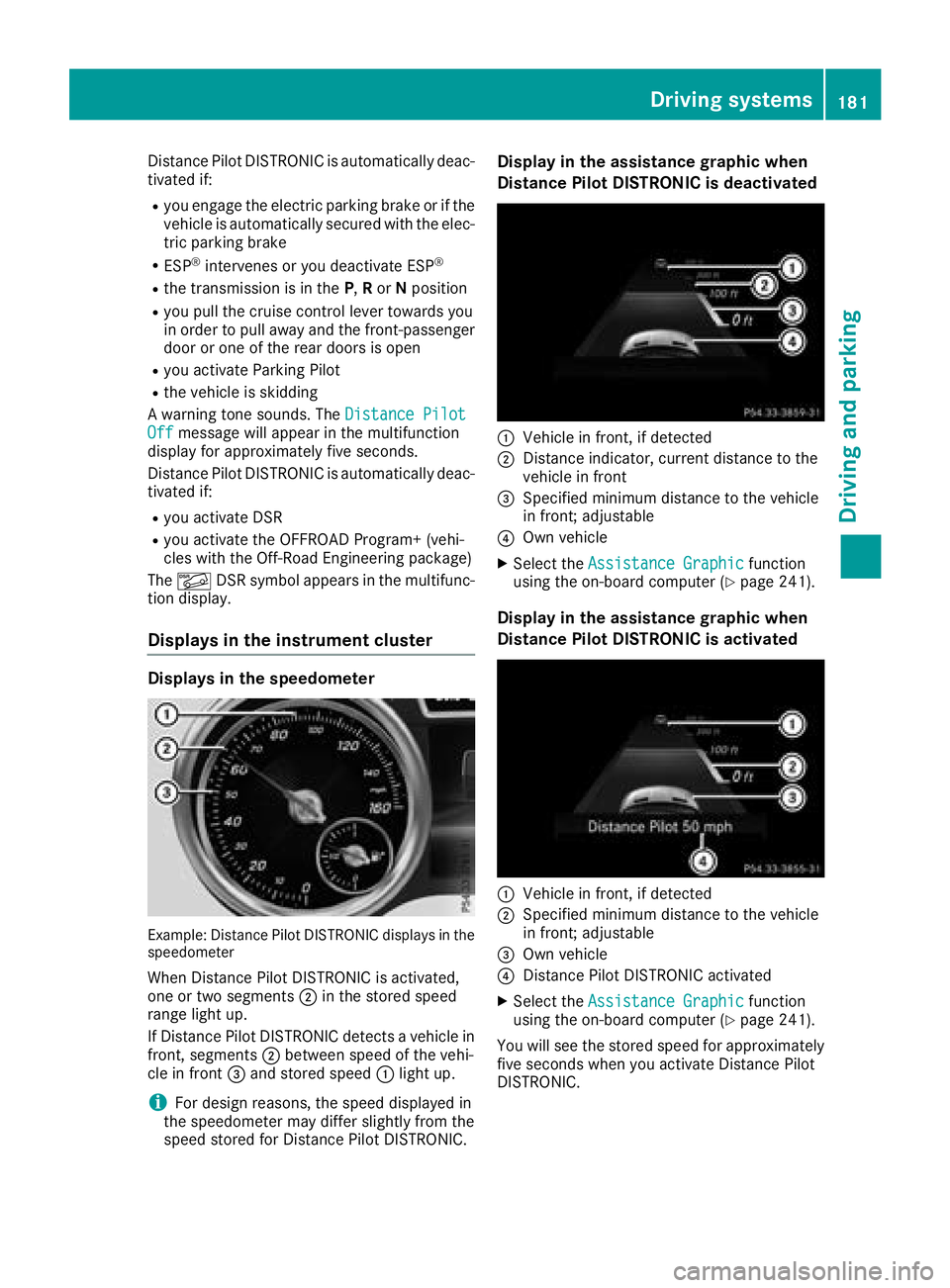
Distance Pilot DISTRONIC is automatically deac-
tivated if: R
you engage the electric parking brake or if the
vehicle is automatically secured with the elec-
tric parking brake R
ESP ®
intervenes or you deactivate ESP ®
R
the transmission is in the P , R or N positionR
you pull the cruise control lever towards you
in order to pull away and the front-passenger
door or one of the rear doors is open R
you activate Parking Pilot R
the vehicle is skidding
A warning tone sounds. The Distance Pilot
Off message will appear in the multifunction
display for approximately five seconds.
Distance Pilot DISTRONIC is automatically deac-
tivated if: R
you activate DSR R
you activate the OFFROAD Program+ (vehi-
cles with the Off-Road Engineering package)
The
Page 189 of 398
HOLD function
General notes The HOLD function can assist the driver in the
following situations: R
when pulling away, especially on steep slopes R
when maneuvering on steep slopes R
when waiting in traffic
The vehicle is kept stationary without the driver
having to depress the brake pedal.
The braking effect is canceled and the HOLD
function deactivated when you depress the
accelerator pedal to pull away.
i Do not use the HOLD function when driving
off-road, on steep uphill or downhill gradients
or on slippery or loose surfaces. The HOLD
function cannot hold the vehicle on such sur-
faces.
Important safety notes
G WARNING
If the vehicle is only braked using the HOLD
function, the vehicle may roll away in the fol-
lowing situations when you leave the vehicle: R
if there is a malfunction in the system or in
the voltage supply R
if the HOLD function is deactivated by
depressing the accelerator pedal or brake
pedal, e.g. by a vehicle occupant R
if the electrical system in the engine com-
partment, the battery or the fuses are tam-
pered with or the battery is disconnected
There is a risk of an accident.
Always deactivate the HOLD function and
secure the vehicle against rolling away before
you leave it.
! When Distance Pilot DISTRONIC or the
HOLD function is activated, the vehicle
brakes automatically in certain situations.
To avoid damage to the vehicle, deactivate
Distance Pilot DISTRONIC and the HOLD
function in the following or similar situations: R
when towing the vehicle R
in the car wash
Deactivate the HOLD function ( Y
page 187). Activation conditions You can activate the HOLD function if: R
the vehicle is stationary R
the engine is running or if it has been auto-
matically switched off by the ECO start/stop
function R
the driver's door is closed or your seat belt is
fastened R
the electric parking brake is released R
the transmission is in position [ , ^ or \\R
Distance Pilot DISTRONIC is deactivated
Activating the HOLD function X
Make sure that the activation conditions are
met. X
Depress the brake pedal. X
Quickly depress the brake pedal further
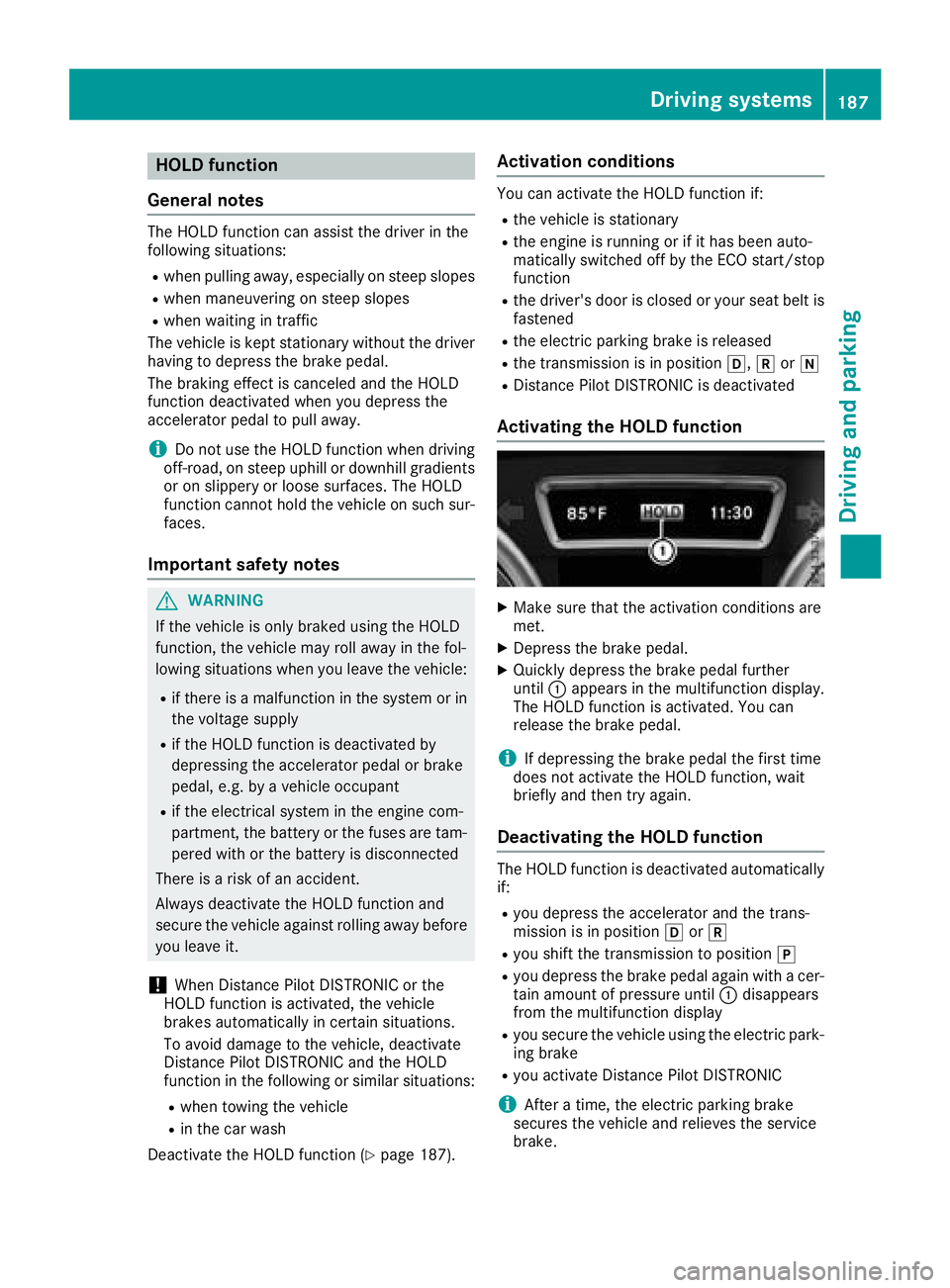
until C appears in the multifunction display.
The HOLD function is activated. You can
release the brake pedal.
i If depressing the brake pedal the first time
does not activate the HOLD function, wait
briefly and then try again.
Deactivating the HOLD function The HOLD function is deactivated automatically
if: R
you depress the accelerator and the trans-
mission is in position [ or ^R
you shift the transmission to position ]R
you depress the brake pedal again with a cer-
tain amount of pressure until C disappears
from the multifunction display R
you secure the vehicle using the electric park-
ing brake R
you activate Distance Pilot DISTRONIC
i After a time, the electric parking brake
secures the vehicle and relieves the service
brake.Driving systems 187
Driving and parking Z