width MERCEDES-BENZ GLS SUV 2019 User Guide
[x] Cancel search | Manufacturer: MERCEDES-BENZ, Model Year: 2019, Model line: GLS SUV, Model: MERCEDES-BENZ GLS SUV 2019Pages: 398, PDF Size: 12.35 MB
Page 369 of 398
in combination, can cause excessive heat
build-up and possible tire failure.
The temperature grades are A (the highest), B,
and C, representing the tire's resistance to the
generation of heat and its ability to dissipate
heat when tested under controlled conditions
on a specified indoor laboratory test wheel. Sus- tained high temperature can cause the material
of the tire to degenerate and reduce tire life, and excessive temperature can lead to sudden tire
failure. The grade C corresponds to a level of
performance which all passenger car tires must
meet under the Federal Motor Vehicle Safety
Standard No. 109. Grades B and A represent
higher levels of performance on the laboratory
test wheel than the minimum required by law. Tire labeling
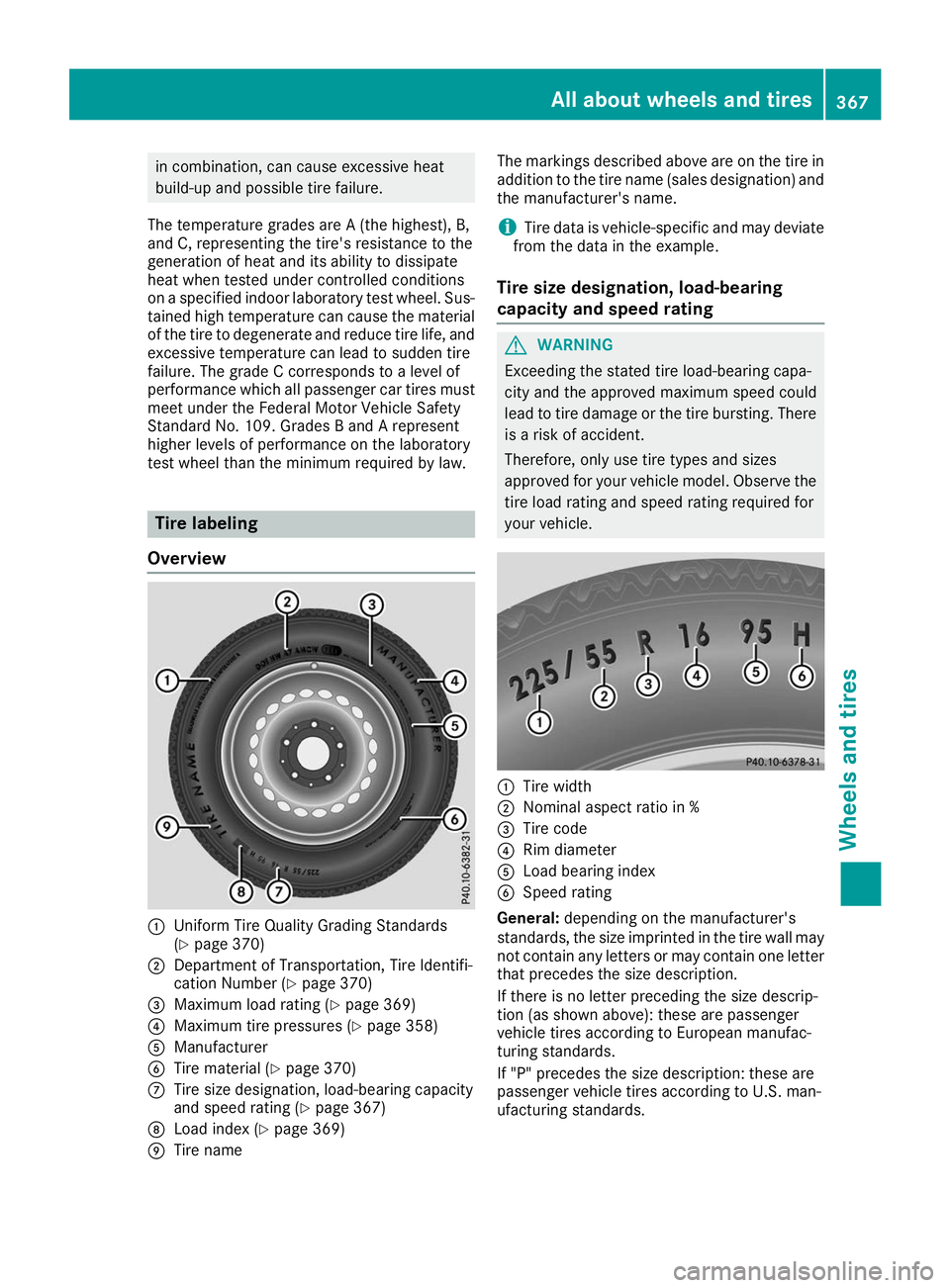
Overview 0043
Uniform Tire Quality Grading Standards
(Y page 370)
0044 Department of Transportation, Tire Identifi-
cation Number (Y page 370)
0087 Maximum load rating (Y page 369)
0085 Maximum tire pressures (Y page 358)
0083 Manufacturer
0084 Tire material (Y page 370)
006B Tire size designation, load-bearing capacity
and speed rating (Y page 367)
006C Load index (Y page 369)
006D Tire name The markings described above are on the tire in
addition to the tire name (sales designation) and the manufacturer's name.
i Tire data is vehicle-specific and may deviate
from the data in the example.
Tire size designation, load-bearing
capacity and speed rating G
WARNING
Exceeding the stated tire load-bearing capa-
city and the approved maximum speed could
lead to tire damage or the tire bursting. There is a risk of accident.
Therefore, only use tire types and sizes
approved for your vehicle model. Observe the
tire load rating and speed rating required for
your vehicle. 0043
Tire width
0044 Nominal aspect ratio in %
0087 Tire code
0085 Rim diameter
0083 Load bearing index
0084 Speed rating
General: depending on the manufacturer's
standards, the size imprinted in the tire wall may not contain any letters or may contain one letterthat precedes the size description.
If there is no letter preceding the size descrip-
tion (as shown above): these are passenger
vehicle tires according to European manufac-
turing standards.
If "P" precedes the size description: these are
passenger vehicle tires according to U.S. man-
ufacturing standards. All about wheels and tires
367Wheels and tires Z
Page 370 of 398
If "LT" precedes the size description: these are
light truck tires according to U.S. manufacturing standards.
If "T" precedes the size description: compact
emergency wheels with high tire pressure that
are only designed for temporary use in an emer-
gency.
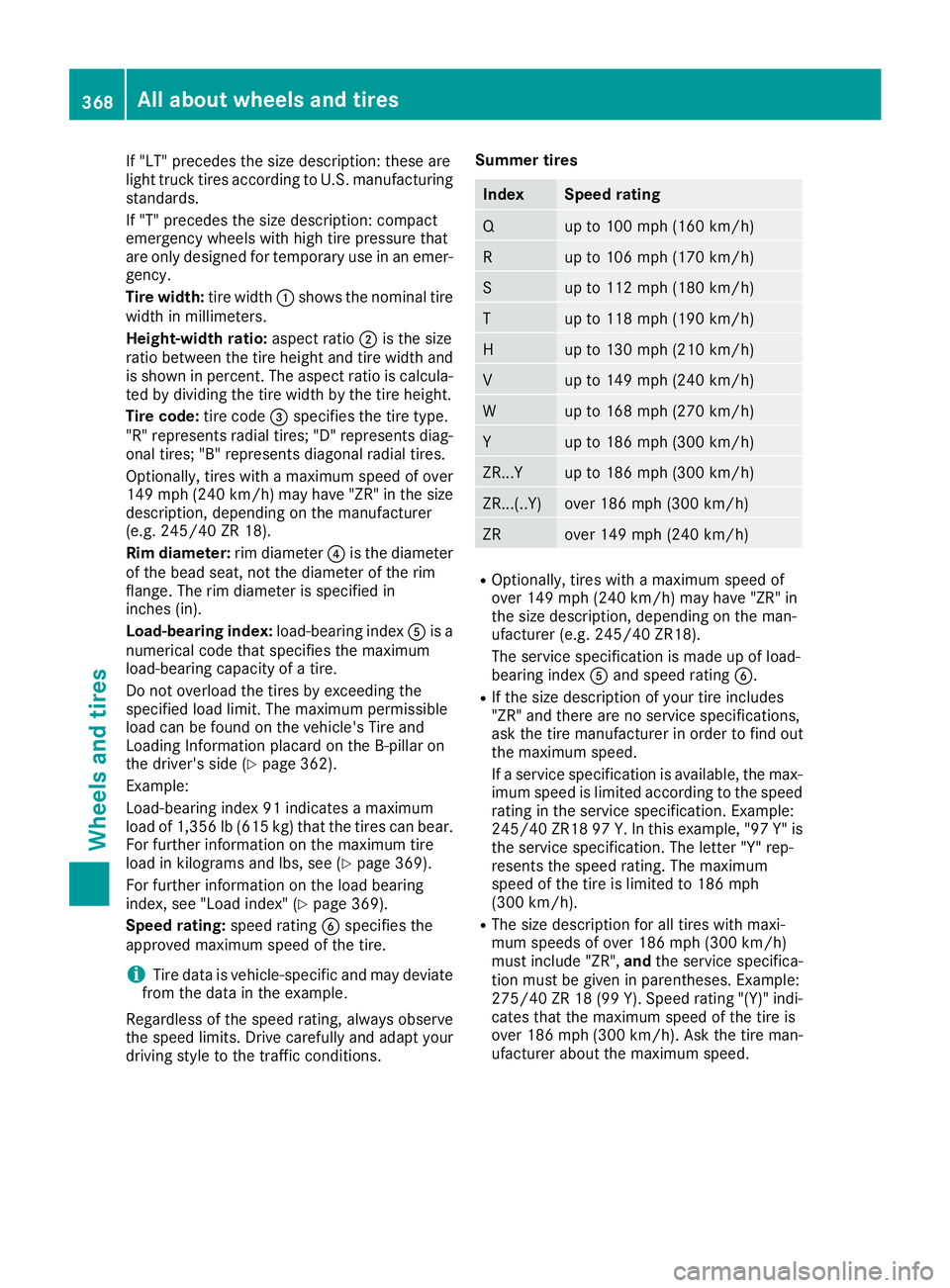
Tire width: tire width0043shows the nominal tire
width in millimeters.
Height-width ratio: aspect ratio0044is the size
ratio between the tire height and tire width and is shown in percent. The aspect ratio is calcula-ted by dividing the tire width by the tire height.
Tire code: tire code0087specifies the tire type.
"R" represents radial tires; "D" represents diag-
onal tires; "B" represents diagonal radial tires.
Optionally, tires with a maximum speed of over
149 mph (240 km/h) may have "ZR" in the size description, depending on the manufacturer
(e.g. 245/40 ZR 18).
Rim diameter: rim diameter0085is the diameter
of the bead seat, not the diameter of the rim
flange. The rim diameter is specified in
inches (in).
Load-bearing index: load-bearing index0083is a
numerical code that specifies the maximum
load-bearing capacity of a tire.
Do not overload the tires by exceeding the
specified load limit. The maximum permissible
load can be found on the vehicle's Tire and
Loading Information placard on the B-pillar on
the driver's side (Y page 362).
Example:
Load-bearing index 91 indicates a maximum
load of 1,356 lb (615 kg) that the tires can bear.
For further information on the maximum tire
load in kilograms and lbs, see (Y page 369).
For further information on the load bearing
index, see "Load index" (Y page 369).
Speed rating: speed rating0084specifies the
approved maximum speed of the tire.
i Tire data is vehicle-specific and may deviate
from the data in the example.
Regardless of the speed rating, always observe
the speed limits. Drive carefully and adapt your
driving style to the traffic conditions. Summer tires Index Speed rating
Q up to 100 mph (160 km/h)
R up to 106 mph (170 km/h)
S up to 112 mph (180 km/h)
T up to 118 mph (190 km/h)
H up to 130 mph (210 km/h)
V up to 149 mph (240 km/h)
W up to 168 mph (270 km/h)
Y up to 186 mph (300 km/h)
ZR...Y up to 186 mph (300 km/h)
ZR...(..Y) over 186 mph (300 km/h)
ZR over 149 mph (240 km/h)
R
Optionally, tires with a maximum speed of
over 149 mph (240 km/h) may have "ZR" in
the size description, depending on the man-
ufacturer (e.g. 245/40 ZR18).
The service specification is made up of load-
bearing index 0083and speed rating 0084.
R If the size description of your tire includes
"ZR" and there are no service specifications,
ask the tire manufacturer in order to find out
the maximum speed.
If a service specification is available, the max-
imum speed is limited according to the speed rating in the service specification. Example:
245/40 ZR18 97 Y.In this example, "97 Y" is
the service specification. The letter "Y" rep-
resents the speed rating. The maximum
speed of the tire is limited to 186 mph
(300 km/h).
R The size description for all tires with maxi-
mum speeds of over 186 mph (300 km/h)
must include "ZR", andthe service specifica-
tion must be given in parentheses. Example:
275/40 ZR 18 (99 Y). Speed rating "(Y)" indi- cates that the maximum speed of the tire is
over 186 mph (300 km/h). Ask the tire man-
ufacturer about the maximum speed. 368
All about wheels and tiresWheels and tires
Page 374 of 398
PSI (pounds per square inch)
A standard unit of measure for tire pressure.
Aspect ratio
Relationship between tire height and tire width
in percent.
Tire pressure
This is pressure inside the tire applying an out-
ward force to each square inch of the tire's sur-
face. The tire pressure is specified in pounds per
square inch (psi), in kilopascal (kPa) or in bar.
The tire pressure should only be corrected when
the tires are cold.
Cold tire pressure
The tires are cold:
R if the vehicle has been parked with the tires
out of direct sunlight for at least three hours
and
R if the vehicle has not been driven further than
1 mile (1.6 km)
Tread
The part of the tire that comes into contact with
the road.
BeadThe tire bead ensures that the tire sits securely
on the wheel. There are several steel wires in the
bead to prevent the tire from coming loose from the wheel rim.
Sidewall The part of the tire between the tread and the
bead.
Weight of optional extras The combined weight of those optional extras
that weigh more than the replaced standard
parts and more than 2.3 kg (5 lbs). These
optional extras, such as high-performance
brakes, level control, a roof rack or a high-per-
formance battery, are not included in the curb
weight and the weight of the accessories.
TIN (Tire Identification Number) This is a unique identifier which can be used by
a tire manufacturer to identify tires, for example for a product recall, and thus identify the pur-
chasers. The TIN is made up of the manufactur-
er's identity code, tire size, tire type code and
the manufacturing date. Load bearing index
The load bearing index (also load index) is a code that contains the maximum load bearing capa-
city of a tire.
Traction
Traction is the result of friction between the tires and the road surface.
TWR (Tongue Weight Rating)
The TWR specifies the maximum permissible
weight that the ball coupling of the trailer tow
hitch can support.
Treadwear indicators Narrow bars (tread wear bars) that are distrib-
uted over the tire tread. If the tire tread is level
with the bars, the wear limit of 00CDin (1.6 mm)
has been reached.
Occupant distribution
The distribution of occupants in a vehicle at their designated seating positions.
Total load limit Nominal load and luggage load plus 68 kg
(150 lbs) multiplied by the number of seats in
the vehicle. Changing a wheel
Flat tire
The "Breakdown assistance" section
(Y page 335) contains information and notes on
how to deal with a flat tire. Information on driv-
ing with MOExtended tires in the event of a flat
tire can be found under "MOExtended tires (tires with run-flat characteristics" (Y page 336).
Vehicles with an emergency spare wheel: in
the event of a flat tire, mount the emergency
spare wheel according to the description under "Mounting a wheel" (Y page 373). Rotating the wheels
G
WARNING
Rotating the front and rear wheels if the
wheels or tires have different dimensions may severely impair the driving characteristics.
The service brake or wheel suspension com- 372
Changing a wheelWheels and tires
Page 392 of 398
All other mod-
els with 0043
0043
Height when
opened 0044
0044
Max.
headroom AIRMATIC
Package
83.9 in -
86.9 in
(2132 mm - 2207 mm) 76.1 in -
79.1 in
(1934 mm - 2009 mm) Offroad
Engi-
neering pack-
age 83.9 in -
88.1 in
(2132 mm - 2237 mm) 76.1 in -
80.3 in
(1934 mm - 2039 mm) Merc
edes‑AMG GLS 63 4M
ATIC Vehicle length
203.2 in
(5162 mm) Vehicle width including
exterior mirrors
84.3 in
(2141 mm) Vehicle width without exte-
rior mirrors 78.0 in
(1982 mm) Vehicle height
72.9 in
(1850 mm) Wheelbase
121.1 in
(3075 mm) Maximum ground clear-
ance
Minimum ground clear-
ance
7.8 in
(198 mm) Turning radius
40.7 ft
(12.40 m) Maximum roof load
220 lbs
(100 kg) All other models
Vehicle length
202.0 in
(5130 mm) Vehicle width including
exterior mirrors
84.3 in
(2141 mm) All other models
Maximum vehicle height
(AIRMATIC package)
75.2 in
(1910 mm) Maximum vehicle height
(Off-Road Engineering
package) 76.4 in
(1940 mm) Minimum vehicle height
72.8 in
(1850 mm) Wheelbase
121.1 in
(3075 mm) Maximum ground clear-
ance (AIRMATIC package)
10.9 in
( 276 mm) Maximum ground clear-
ance (Off-Road Engineer-
ing package)
12.0 in
(306 mm) Minimum ground clear-
ance
7.9 in
(201 mm) Turning radius
40.7 ft
(12.40 m) Maximum roof load
220 lb
(100 kg) Vehicle data for off-road driving
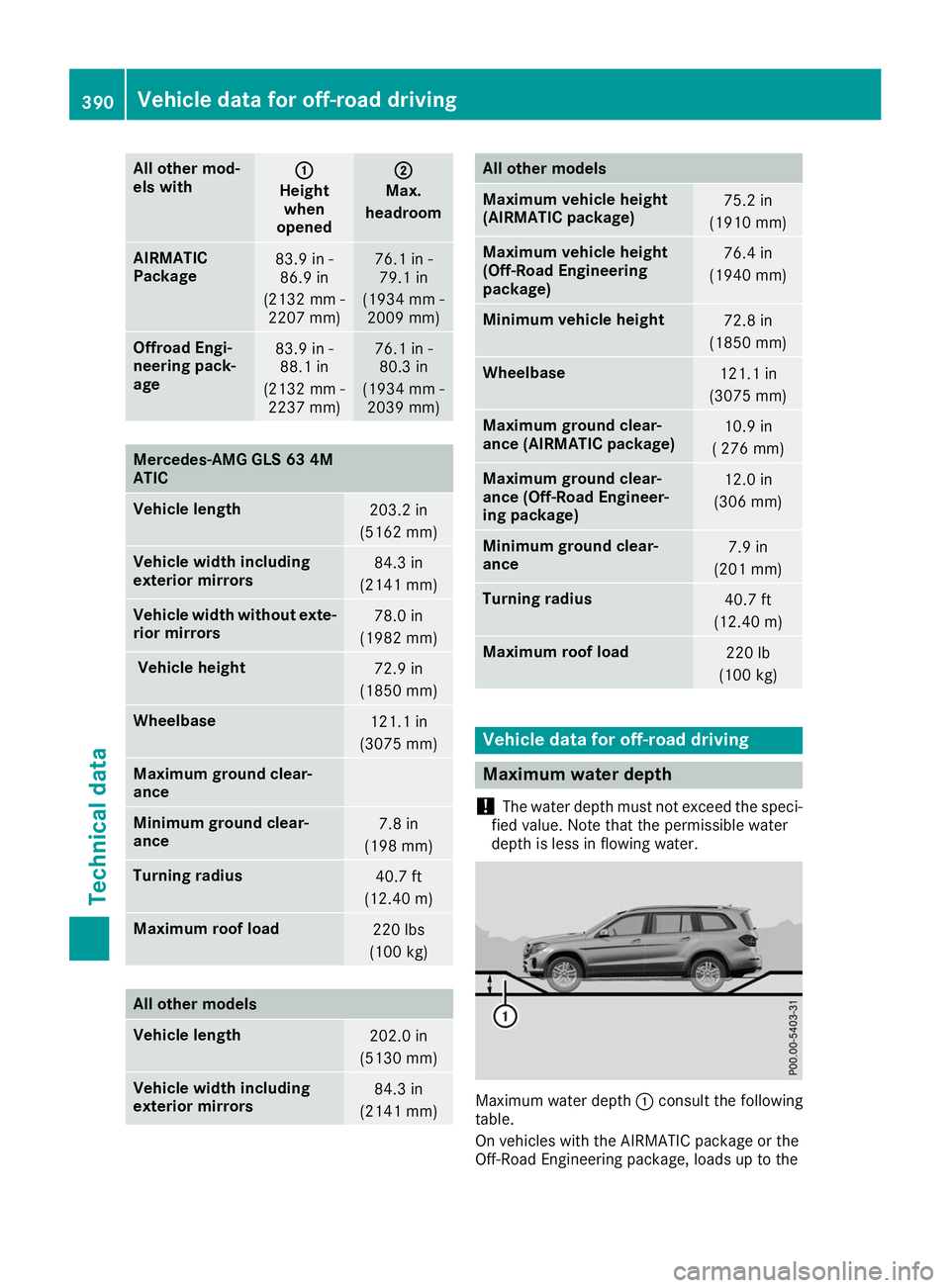
Maximum water depth
! The water depth must not exceed the speci-
fied value. Note that the permissible water
depth is less in flowing water. Maximum water depth
0043consult the following
table.
On vehicles with the AIRMATIC package or the
Off-Road Engineering package, loads up to the 390
Vehicle data for off-road drivingTechnical data