light MERCEDES-BENZ M-Class 2012 W166 User Guide
[x] Cancel search | Manufacturer: MERCEDES-BENZ, Model Year: 2012, Model line: M-Class, Model: MERCEDES-BENZ M-Class 2012 W166Pages: 396, PDF Size: 14.48 MB
Page 35 of 396
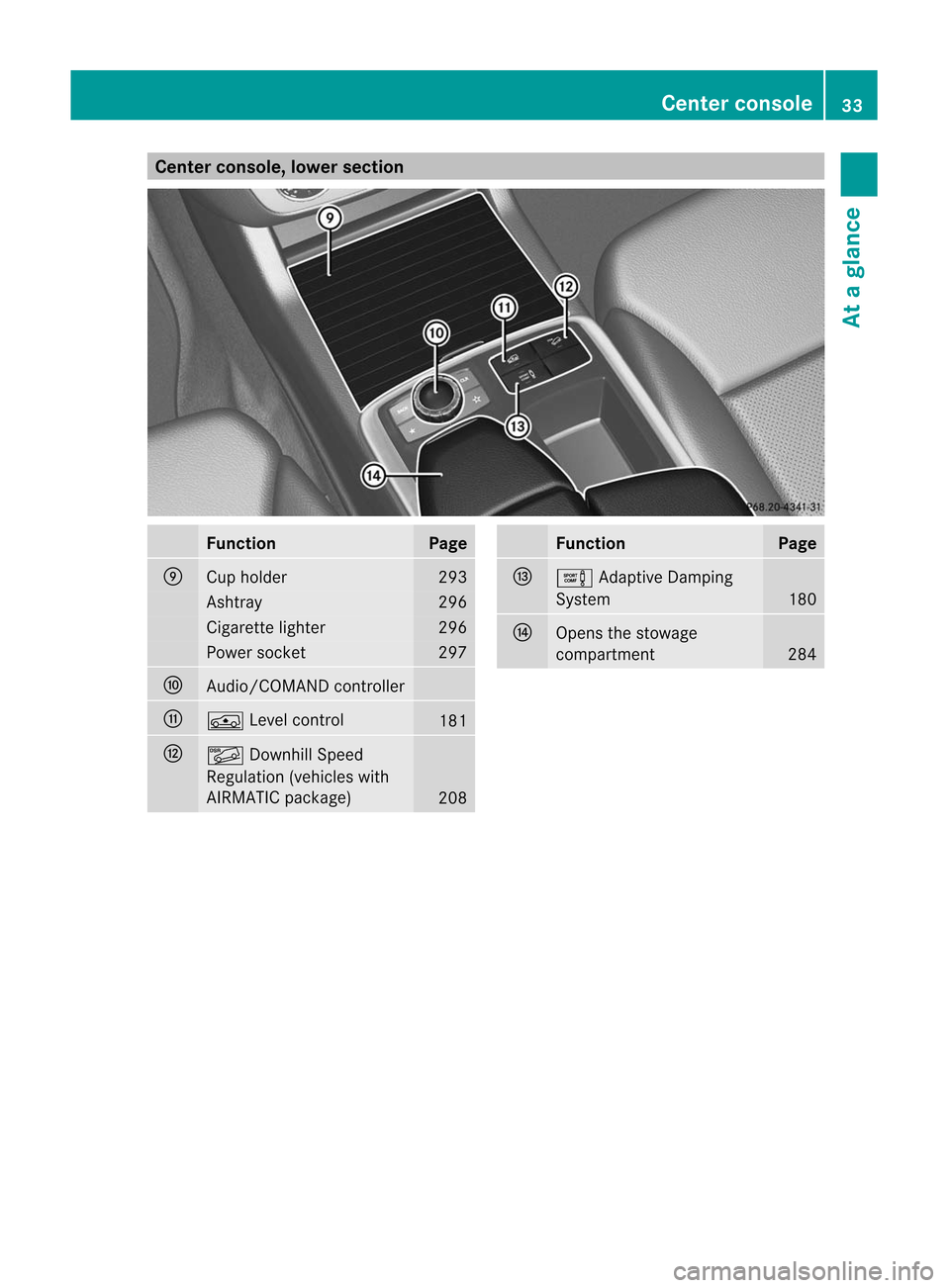
Cent
erconsole, lowersection Funct
ion Pag
e E
Cup
holde r 29
3 As
htray 29
6 Cigare
tte light er 29
6 Power
socket 29
7 F
Audi
o/CO MAND controll er G
Á
Levelco ntrol 18
1 H
Ã
Downh illSpe ed
Regulat ion(veh icleswit h
AI RMA TICpack age) 20
8 Funct
ion Pag
e I
e
Adapt ive Dam ping
Sys tem 18
0 J
Open
sth est owage
co mpar tment 28
4 Cent
erconsole
33At a glance
Page 36 of 396
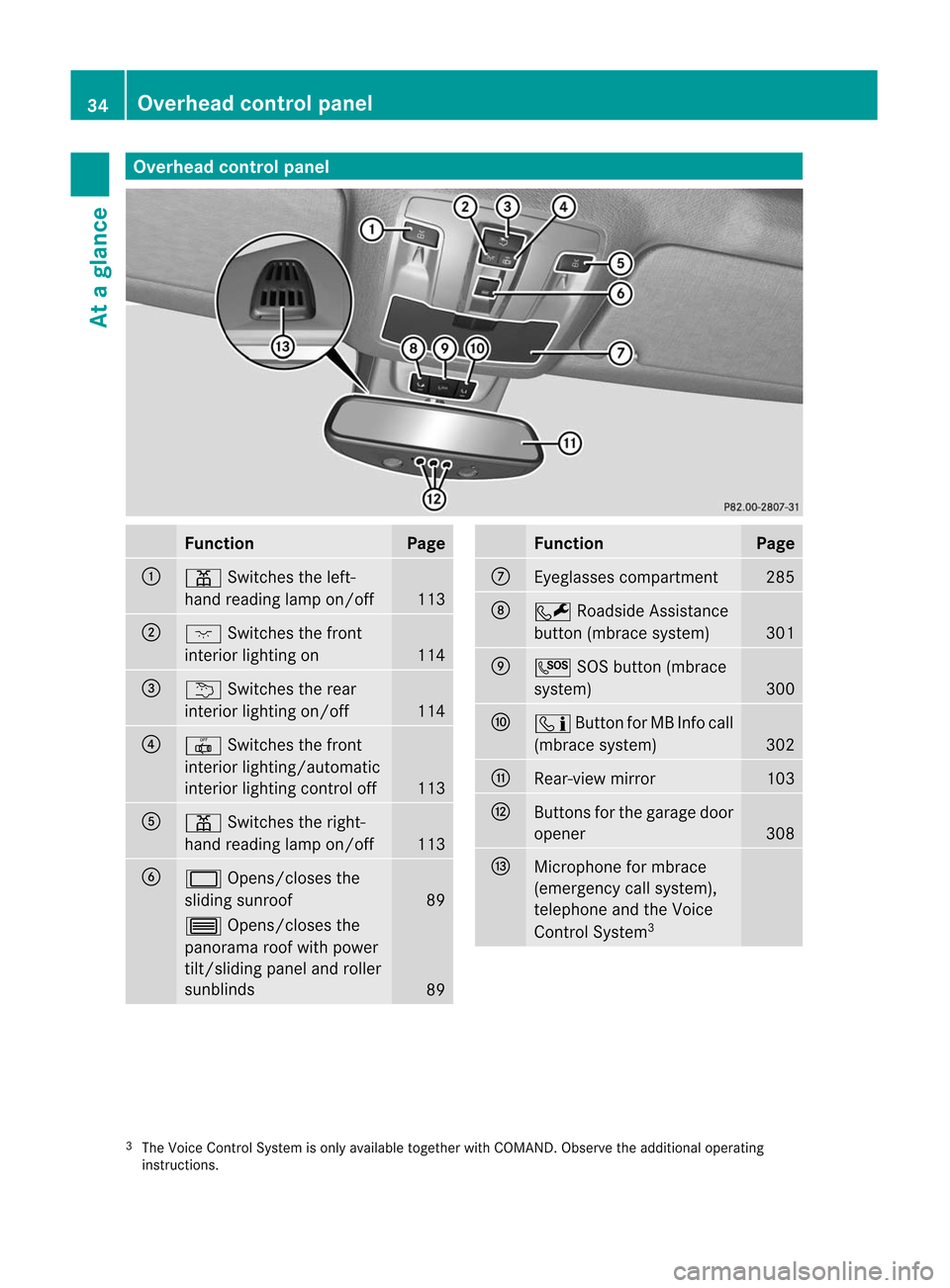
Overhea
dcontr olpa nel Funct
ion Pag
e :
p
Switchesth eleft -
han dreadin glamp on/of f 11
3 ;
c
Switchesth efron t
int erio rlight ingon 114
=
u
Switches therear
int erior lightingon/ off 114
?
|
Switches thefront
int erior lighting/ autom atic
int erior lightingcon trol off 113
A
p
Switches theright -
hand readin glamp on/off 113
B
2
Opens/closes the
slidin gsunr oof 89
3
Opens/closes the
panor amaroofwith power
tilt /slidin gpanel androller
sunblin ds 89 Funct
ion Page
C
Eyeglas
sescom partmen t 285
D
F
Roadside Assistanc e
butt on(mbrac esyst em) 301
E
G
SOSbutton(mbr ace
syst em) 300
F
ï
Button forMB Info call
(mbrac esyst em) 302
G
Rear-v
iewmirr or 103
H
But
tonsfor the garage door
open er 308
I
Micr
ophon efor mbrac e
(emer gencycall system),
telep honeand theVoic e
Cont rolSyst em3 3
The Voic eCont rolSyst emisonly available togeth erwith COMA ND.Obser vethe additio naloperat ing
inst ruct ions . 34
Over
head controlpa nelAt a glance
Page 40 of 396
Useful
information
i This
Operat or'sManual describesall
models andallstan dard andoption al
equipment ofyour vehicle available atthe
time ofpublication ofthe Operat or's
Manual. Country-specificdiffer encesare
possible. Pleasenotethat your vehicle may
not beequipped withallfeature s
descr ibed. Thisalso applies tosafet y-
related systemsand func tions. i
Please
readtheinfor mation onqualified
specialist workshops(Ypage 25). Occupant
safety Overview
ofoccupant safety
In this section, youwilllearn themost
import antfactsabout therest raint system
compo nentsof the vehicle.
The restraint system consists of:
R seat belts
R child restraint system s
R LATCH -type (ISOF IX)child seatanchors
Addit ional protection isprovided by:
R SRS (Supplemen talRestrain tSyst em)
R PRE -SAF E®
R Airb ag syst emcompo nentsw ith:
- PAS SENGER AIRB AG OFF indicator lamp
- fro nt-pa ssenge rseat with Occupant
Classification System(OCS)
The differen tairbag systems work
indep endently of each other.The protective
func tionsof the syst emwork incon junction
with each other.Not allair bags aredeployed
in an acc ident . G
WARN
ING Modif
ications toor work impro perly
con duct edon rest raint systemcom pone nts
or the irwirin g,as well astam perin gwith
int erc onn ectedelect ronicsyst ems, canlead to
the rest raint systems nolong erfunc tioning
as intende d.
Air bags orEm ergen cyTens ionin gDev ices
(ETD s),for exam ple,could deploy
inadv ertent lyor fail todeploy inacc ident s
altho ughthedecele ration threshold forair
bag deploymen tisexceeded. Therefore,
never modify therestraint systems. Donot
tamper withelectronic component sor their
software. i
See
"Children inthe vehicle"
(Y page 54)formore information on
infants andchildren traveling withyouin
the vehicle andrestraints forinfants and
children. SRS
(Supplemental RestraintSystem)
Introduction SRS
consists of:
R the 6 SRSwarning lamp
R air bags
R air bag cont rolunit (with crash sensors)
R Emergenc yTensioning Devicesforthe
front seatbelts andtheouter seatbelts in
the rear
R belt force limiters
SRS reduces therisk ofoccupants coming
into contactwith thevehicle's interiorinthe
event ofan accident. Itcan also reduce the
effect ofthe forces towhich occupants are
subjected duringanaccident.
SRS warning lamp SRS
function sare checked regularlywhen
you switch onthe ignition andwhen the
engine isrunning. Therefore, malfunctions
can bedetected ingood time.
The 6 SRSwarning lampinthe instrument
cluster lightsupwhen theignition isswitched
on. Itgoes outnolater thanafew seconds
after theengine isstarted. 38
Occ
upant safetySafety
Page 44 of 396
It
is important foryou rsafet yand that ofyour
passe ngerto have deplo yedairbags replaced
and tohave anymalf unctionin gair bags
repai red.This willhelp tomak esure theair
bags continue toperf orm their pro tective
fun ction fortheveh icle occupan tsinthe
eve ntofacr ash.
Fron tair bag s The
fron ta irbags increase protection forthe
drive r'sand front-pass enger's head and
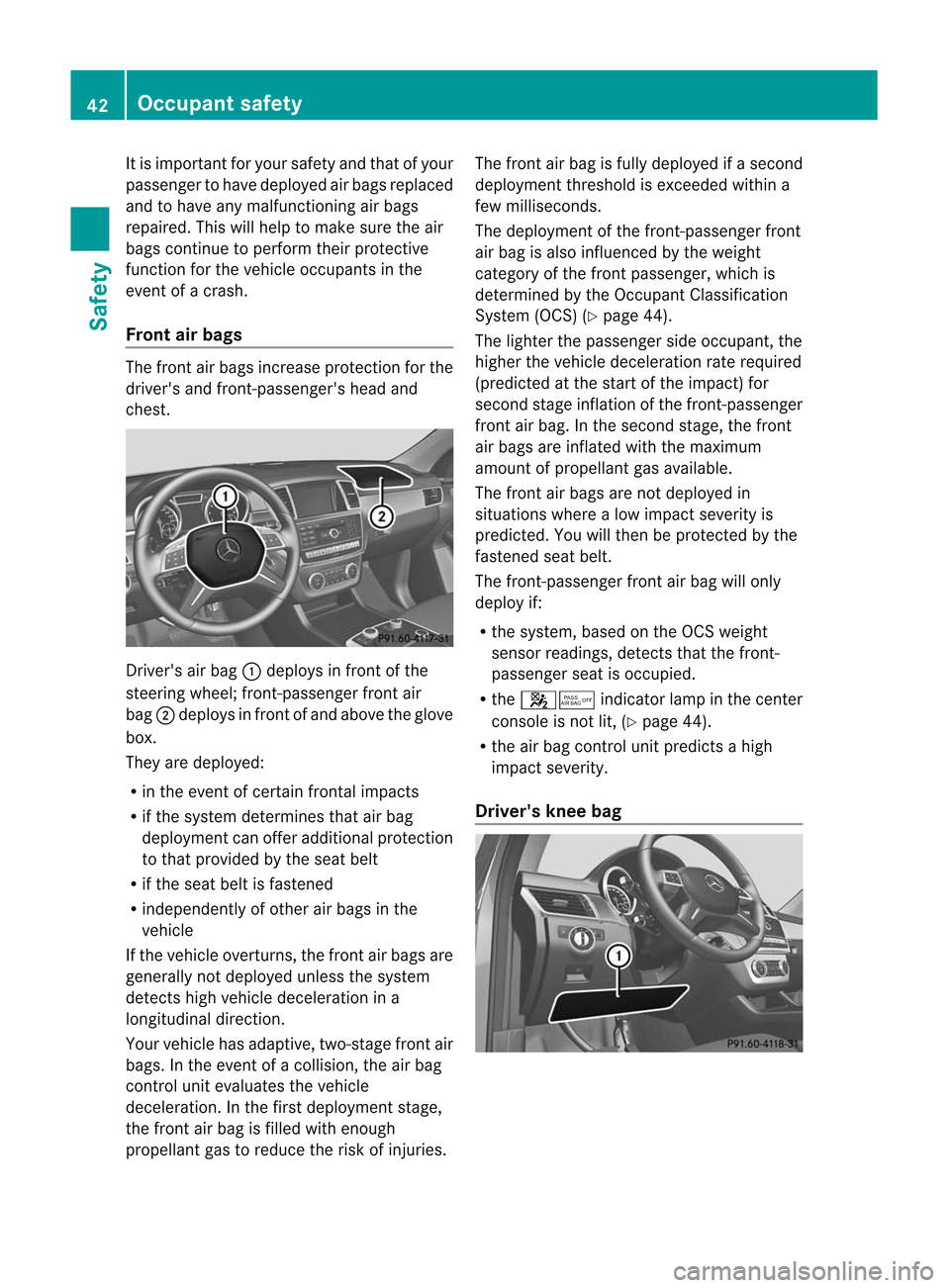
ches t. Dr
iver' sair bag :deploys infro ntofthe
st eerin gwheel; front-pass engerfro ntair
bag ;deploys infro ntofand above theglove
box.
They aredeployed:
R in the even tof cer tain frontal impac ts
R ifthe syst emdete rmin esthat airbag
deploymen tcan offeraddit ionalpro tection
to that pro vide dby theseat belt
R ifth eseat beltisfast ened
R ind epen dentlyofother airbags inthe
veh icle
If th eveh icle overturn s,thefron tairbags are
gen erally notdeployed unlessthesyst em
dete ctshigh vehic ledecele ration ina
long itudin aldirec tion.
Your vehic lehas adaptiv e,two- stage frontair
bags. Inthe even tofa collisio n,the airb ag
co ntrol unit evaluat estheveh icle
dec eler ation.Inthefir st deplo ymentstag e,
the frontairb ag isfille dwit hen ough
pro pellan tgas toreduc eth er isk ofinjuries. The
frontair bag isfully deployed ifaseco nd
deploymen tthreshold isexceeded withina
few milliseconds.
The deploy mentofthe front -passenger front
air bag isalso influenced bythe weight
category ofthe front passenger, whichis
determined bythe Occupant Classification
System (OCS)(Ypage 44).
The lighter thepassenger sideoccupant, the
higher thevehicle deceleration raterequired
(predicted atthe start ofthe impact) for
second stageinflation ofthe front -passenger
front airbag. Inthe second stage,thefront
air bags areinflated withthemaximum
amount ofpropella ntgas availa ble.
The front airbags arenot deploy edin
situations wherealow impact severity is
predicted. Youwillthen beprotect edbythe
fastened seatbelt.
The front -passenger frontairbag willonly
deploy if:
R the system, basedonthe OCS weight
sensor readings, detectsthat thefront -
passenger seatisoccupied.
R the 45 indicatorlampinthe cent er
console isnot lit,(Ypage 44).
R the airbag cont rolunit predicts ahigh
impact severity.
Driver's kneebag 42
Occ
upantsafetySafety
Page 49 of 396
If
the SmartKey hasbeen removed fromthe
ignition lockorisin positio n0, indicator lamp
45: doesnotlightup. G
WARN
ING If
the red 6 SRSwarning lampinthe
inst rument clusterandthe45
indicat orlamp lightupsimultan eously,the
OCS ismalfunc tioning. Thefrontpassen ger
fr on ta irbag willbedeact ivatedin this case.
Have thesyst emchec kedbyqualified
tec hnic ians assoon aspossible .Contac tan
auth orizedMer cedes-Ben zCent er.
Only have theseat repaired orreplaced atan
authorized Mercedes-BenzCenter .
In order toensure properoperation ofthe air
bag system andOCS:
R Sit with theseat beltproperly fastenedina
position thatisas upright aspossible with
your back against theseat backr est.
R When seated, apassenger shouldnot
position him/herselfinsuch away asto
cause thepassenger' sweight tobe lifted
from theseat cushion asthis may result in
the OCS being unable tocorr ectly
approximat ethe passenger' sweight
categor y.
R Read andobserve allwarnings inthis
chapter .
System self-test If
an adult occupant isproperly sitting onthe
passenger seatandtheOCS classifies the
occupant asan adult, the45 indicator
lamp illuminates andgoes outagain after
approximat ely6secon ds.
If the seat isnot occupied andtheOCS
classifies thefron tpasse nger seat asbein g
uno ccupied, the45 indicat orlamp
will illumin ateand notg oout. G
WARNIN
G If
the 45indic atorlamp doesnot
illuminat e,the syst emisnot func tioning. You
must contactan author izedMerc edes- Benz Cent
erbefor eseatin gany child onthe front
passen gerseat.
For more informat ion,see"Problem swith the
Occ upant Classific ationSystem"
(Y page 48). G
WARN
ING Never
placeanything betwee nseat cushion
and child seat(e.g. apillow), sinceitreduces
the effec tivenessofthe OCS. Theunderside
and rear side child restraintsystem mustbe
placed entirely onthe seat cushion andthe
backr estofthe fron t-passenger seat
backr est.
If neces sary,adjust thetiltofthe passenger
seat backr est.
An incor rectlymount edchild seatcould cause
injuries tothe child incase ofan acciden t,
inst ead ofincr easing protectionforthe child.
Follow themanufact urer'sinstruct ions for
inst allation ofchild restraintsystems. Occupant
safety
47Safety Z
Page 51 of 396
PRE-SAFE
®
(preventat iveocc upant
prot ection) G
WARNING The
PRE-SA FE®
system reduces theimpact of
an accident onvehicle occupants, aslong as
their seatbelts havebeen fastened correctly.
Although yourvehicle isequippe dwith aPRE-
SAF E®
system, thepossibility ofinjury inthe
event ofan accident cannotberuled out.You
should therefore alwaysdrive carefully and
adapt yourdriving styletothe prevailing road,
weather andtraffic condition s.
PRE-SA FE®
takes preemptive measuresto
protect occupants incertain hazardous
situations.
PRE-SA FE®
interv enes:
R in emergency brakingsituations, e.g.ifBAS
is activated or,invehicles withDISTRONIC
PLUS, BASPLUS intervenespowerfully
R ifthe radar sensor system detectsan
imminent dangerofcollision incertain
situations (onvehicles withDISTRONIC
PLUS)
R in critic aldriving situations, e.g.when
physical limitsareexceed andthevehicle
understeers oroversteers severely
PRE-SA FE®
takes thefollowing measures
depending onthe hazardous situation
detect ed:
R the front seatbelts arepre-ten sioned.
R on vehicles withmemory functionforthe
front -passenger seat:thefront -passenger
seat isadjusted ifit is in an unfavorable
position.
R ifthe vehicle skids,thesliding sunroof/
panorama roofwith power tilt/sliding
panel andtheside windows areclosed so
that only asmall gapremains.
If the sliding sunroof, panorama roofwith
power tilt/sliding paneloraside window is
obstruct edduring closing, theclosing
procedure isstopped. Theobstruct edsliding
sunroof, panorama roofwith power tilt/ sliding
panelorside window opensagain
slightly.
If the hazardous situationpasseswithout
resulting inan accident, PRE-SAFE®
slackens
the belt pretension ing.Allsettin gsmade by
PRE-SA FE®
can then bereversed.
If the seat belts arenot released:
X Move thebackrest orseat back slightly, but
only when thevehicle isstationary.
The belt pretension ingisreduced andthe
locking mechanism isreleased. G
WARNING Make
surethatnobody canbecome trapped
as you adjust theseat.
! Make surethatthere arenoobject sin the
footwell orbehind theseats when resett ing
the seats. Thereisarisk that theseats
and/or theobject scould bedamaged.
More information aboutseat-belt
adjustment ,a conv enience function
integrated intoPRE-SA FE®
,can befound in
the "Seat-belt adjustment "section
(Y page 52). Seat
belts
Import antsafety notes The
useofseat belts andinfant andchild
restraint systemsisrequired bylaw inall 50
states, theDistr ictofColumbi a,the U.S.
territ ories andallCanadia nprovinces.
Even where thisisnot thecase, allvehicl e
occupa ntsshou ldhave theirseatbelts
fastened whenthevehicl eis in motion. i
For
further informati ononinfants and
child rentraveli nginthe vehicl eand on
infant andchild restrai ntsystems ,see
"C hildren inthe vehicl e"(Y pag e54). G
WARNING Alwa
ysfasten yourseat belt before driving off.
Always makesureallofyour passengers are Occupant
safety
49Safety
Z
Page 54 of 396
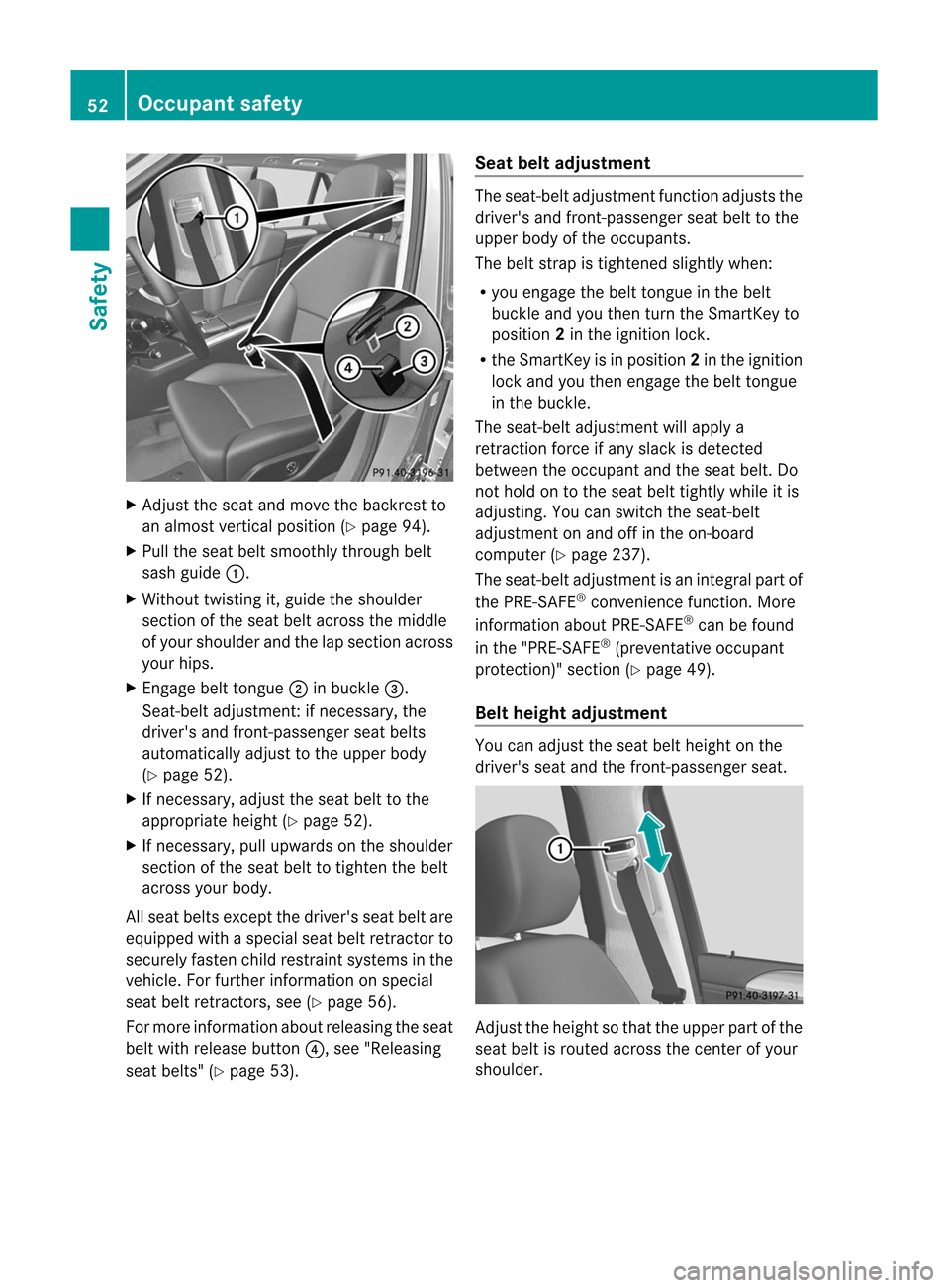
X
Adju stthe seatand movethe backres tto
an almos tvertic alposition (Ypage 94).
X Pull theseat beltsmoot hlythrough belt
sash guide :.
X Without twistingit,guide theshoulder
sect ionofthe seat beltacross themiddle
of your shoulder andthelapsect ionacross
your hips.
X En gage belttongue ;inbuckle =.
Seat- beltadjustm ent:ifn ecessary, the
driver's andfront-passenger seatbelts
automatic allyadjust tothe upper body
(Y page 52).
X Ifnec essary, adjusttheseat belttothe
appropriate height(Ypage 52).
X Ifnec essary, pullupwards onthe shoulder
sect ionofthe seat belttotight enthe belt
across yourbody.
All seat belts except thedriver's seatbeltare
equipped withaspecial seatbeltretractor to
securely fastenchildrestraint systems inthe
vehicle. Forfurth erinfor mation onspecial
seat beltretractor s,see (Ypage 56).
For more information aboutreleasing theseat
belt with release button?,see "Releasing
seat belts" (Ypage 53). Seat
beltadjustm ent The
seat- beltadjustm entfunc tionadjusts the
driver's andfront-passenger seatbelttothe
upper bodyofthe occupants.
The belt strap istight ened slightly when:
R you engage thebelt tongue inthe belt
buckle andyouthen turntheSmart Keyto
position 2in the ignition lock.
R the Smart Keyisin position 2in the ignition
lock andyouthen engage thebelt tongue
in the buckle.
The seat- beltadjustm entwill apply a
retr action forceif any slack isdetec ted
between theoccupant andtheseat belt. Do
not hold ontothe seat belttight lywhile itis
adjustin g.You canswitch theseat- belt
adjustm entonand offinthe on-board
comput er(Y page 237).
The seat- beltadjustm entisan integral partof
the PRE-S AFE®
con venien cefunc tion.More
infor mation aboutPRE-SAFE®
can befound
in the "PRE-S AFE®
(preven tativeocc upant
protec tion)"sect ion(Ypage 49).
Belt height adjustm ent You
canadjust theseat beltheight onthe
driver's seatandthefron t-passenger seat. Adj
ust the height sothat theupper partofthe
seat beltisrouted across thecenterofyour
shoulder. 52
Occupant
safetySafety
Page 55 of 396
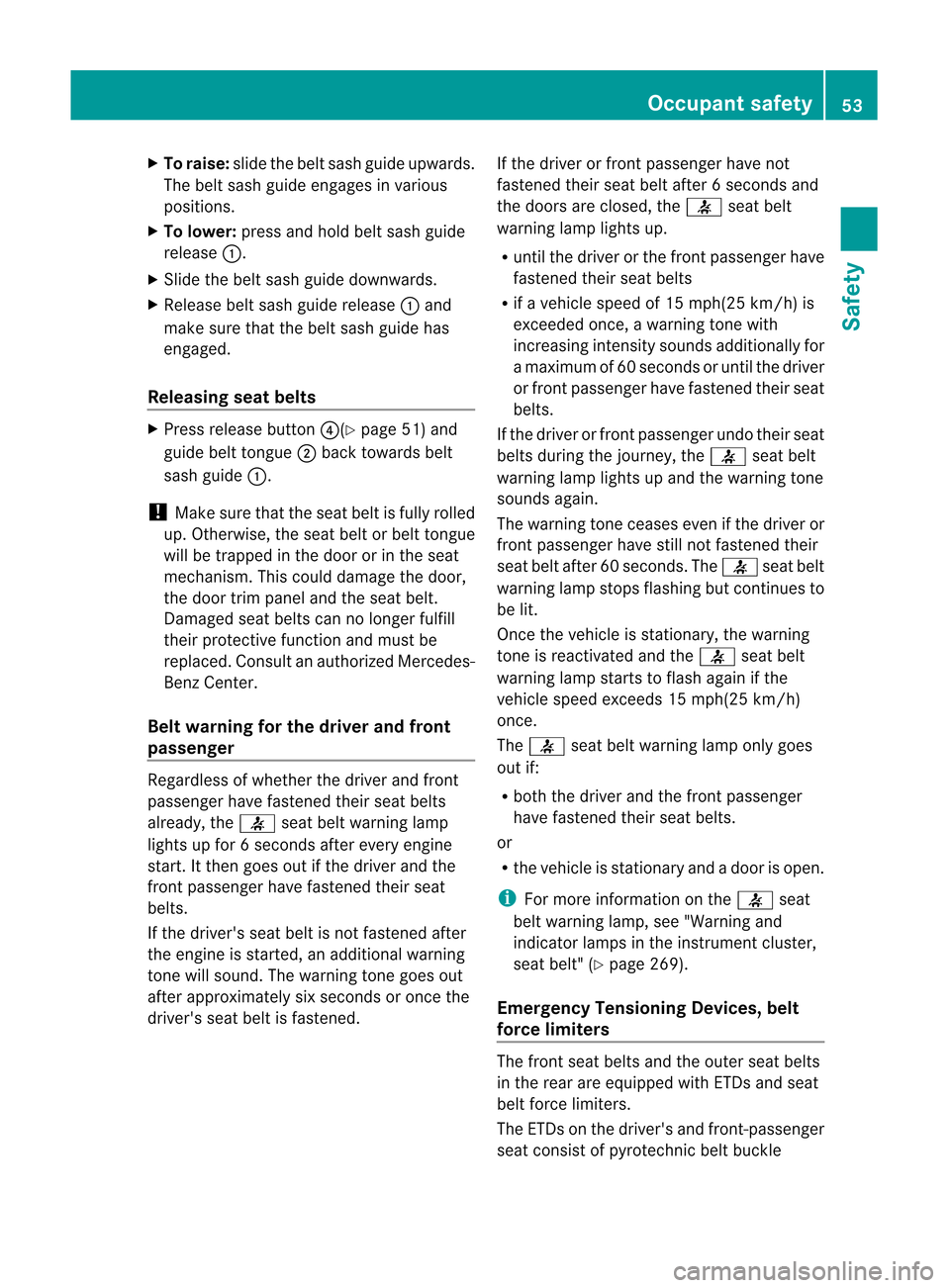
X
To rais e:slid ethe beltsa sh guideup wa rds .
The beltsa sh guide eng ages invario us
po sitio ns.
X To lowe r:pre ssand holdbe ltsa sh guide
rel ease :.
X Sli de the beltsa sh guide do wnw ards.
X Re leas ebe ltsa sh guide rel ease : and
ma kesure tha tthe belt sash guide has
engaged.
Releasing seatbelts X
Press release button?(Ypage51)and
guide belttongue ;back towards belt
sash guide :.
! Make surethattheseat beltisfully rolled
up. Otherwise, theseat beltorbelt tongue
will betrapped inthe door orinthe seat
mechanism. Thiscould damage thedoor,
the door trimpanel andtheseat belt.
Damaged seatbelts cannolonger fulfill
their protect ivefunct ionand must be
replaced. Consultanauthorized Mercedes-
Benz Center.
Belt warning forthe driver andfront
passenger Regardl
essofwhether thedriver andfront
passenger havefastened theirseatbelts
already ,the 7 seatbeltwarning lamp
lights upfor 6secon dsafter every engine
start .It then goes outifthe driver andthe
fron tpasse nger have fastened their seat
belt s.
If th edriv er'sseat beltisno tfast ened after
th een gin eis start ed, anaddit ionalwarn ing
to ne will soun d.The warn ingtone goes out
aft erappro ximatelysix sec onds oronce the
driv er'sseat beltisfast ened. If
th edriv eror fron tpasse nger have not
fast ened their seat beltafter6s econ dsand
the doors areclosed, the7 seatbelt
warning lamplights up.
R until thedriver orthe fron tpasse nger have
fast ened their seat belts
R ifaveh icle spee dof 15 mph (25km/h)is
ex cee ded once, awarn ingtone with
inc reas ingintensitysoun dsaddit ionally for
a max imum of60 sec onds orunt ilth edriv er
or fron tp asse nger have fastened their seat
belt s.
If th edriv eror fron tpasse ngerundo their seat
belt sdurin gth ejo urn ey, the7 seatbelt
warn inglamp lightsup and thewarn ingtone
soun dsagain .
The warn ingtone ceas eseve nifthe driver or
front passenger havestillnotfastened their
seat beltafter 60seconds. The7 seatbelt
warning lampstops flashing butcont inues to
be lit.
Once thevehicle isstationary, thewarning
tone isreactivated andthe7 seatbelt
warning lampstarts toflash again ifthe
vehicle speedexceeds 15mph(25 km/h)
once.
The 7 seatbeltwarning lamponlygoes
out if:
R both thedriver andthefront passenger
have fastened theirseatbelts.
or
R the vehicle isstationary andadoor isopen. i
For
more information onthe 7 seat
belt warning lamp,see"Warning and
indicator lampsinthe instrumen tcluster,
seat belt" (Ypage 269).
Emergency TensioningDevices,belt
force limiters The
front seatbelts andtheouter seatbelts
in the rear areequipp edwith ETDs andseat
belt force limiters.
The ETDs onthe driver's andfront -passenger
seat consist ofpyrotechnic beltbuckle Occ
upantsafety
53Safety Z
Page 56 of 396
tens
ioners andbeltanc horfitting tension ers
that aretriggere dtog eth er. The belt buck le
ten sion erismoun tedonthe B-pillar andthe
belt anchor fittin gis moun tedonthe side of
the seat .Always havebothtension ers
replaced aftertheyhave been trigger ed.
The ETDstight enthe seat belts inan acciden t,
pulling themclose against thebody.
The ETDsdo not corr ectincor rectseat
position sor incor rectlyfasten edseat belts.
The ETDsdo not pull vehicle occupan tsback
towards thebackr est.
Seat beltforcelimiters, whentrigger ed,help
to reduce thepeak forceexerte dby the seat
be lton the vehicleoccu pant.
The seatbelt forc elimiters forthe fron tseats
are synchr onizedwith thefron tairbags.
These takeon apart ofthe decele ration force.
Thus, theforce exer tedonthe occupant is
dist ribut edover agreat erarea.
The ETDscan only beact ivat edwhen:
R the ignit ionisswitc hedon.
R the rest raint systems areoperat ional;see
"SRS warnin glamp" (Ypage 38).
R the belt tongue iseng aged inthe buck leon
each ofthe lap-sh oulder beltsinthe front.
R the front-pass engerseat isocc upied and
the belt tongue iseng aged inthe buck leon
the front-pass engerside.
The ETDson the outs ideseat sin the rear
com partmen tare triggere dindep endently of
the lock status ofthe seat belts.
The ETDs aretriggere ddepe nding onthe type
and severi tyof an accide nt:
R if, inthe event ofahea d-on orrear-end
colli sion, thevehicl edecel erates or
accele ratesrapidlyinalongi tudina l
dire ction duringthe initia lstag esofthe
im pact
R if,in the eventofaside impact, onthe side
op posite the impact the vehicle de
cel era tes oracc elera tes rapidlyin a
la tera ldi rec tion
R if,in cer tains ituat ions where thevehic le
over turns, the syst emdete rmin esthat it
can prov ideadditio nalprot ection
If the airbags aredeployed, youwillhear a
bang, andasmall amoun tofpowder mayalso
be released. Onlyinrare cases willthebang
affect yourhearing. Thepowder thatis
released generally doesnotconst itutea
health hazard. The6 SRSwarning lamp
lights up. G
WARNIN
G Pyrotechn
icEmergen cyTensionin gDevices
that have been deployed mustberenewed.
For your safety, whendisposing ofEmergen cy
Tensionin gDevices, alwaysobserve the
safety instructions. Theseareavailab lefrom
any authorized Mercedes-B enzCenter.
The PRE-S AFE®
system haselectric ally
operated reversible pre-tensioners thatdo
not require replacement afteractivation .
! Ifthe front -passenger seatisnot
occupied, donot engage theseat belt
ton gue inthe buckle onthe front -
passenger seat.Otherwise, theEmergen cy
Tensionin gDevice couldbetriggered inthe
event ofan accident . Children
inthe vehicle Child
restraintsystems
Import antsafety notes We
recomm endthat allinfant sand children
be properly securedinan infant orchild
restr aintsystem atall times whilethevehicle
is in motion .
The useofseat belts andinfant andchild
restr aintsystems isrequired bylaw inall 50
states, theDistr ictofColumbia ,the U.S.
territ ories andallCanadia nprovinces.
Infants andchild renmust alwaysbe seated in
an app ropria teinfant orchild restrai ntsystem 54
Chil
dren inthe vehi cleSafety
Page 58 of 396
Ac
hild inarear-facing childrestraint onthe
front passenger seatwillbeseriously
injured oreven killed ifthe front passenger
front airbag inflates.
R Ifyou have toplace achild inaforward-
facing childrestraint onthe front passenger
seat, move theseat asfar back aspossible,
use theproper childrestraint
recommen dedforthe age, sizeandweight
of the child, andsecure childrestraint with
the vehicle's seatbeltaccording tothe
child seatmanufacturer's instructions. G
WARNING Infant
sand small children shouldnevershare
a seat beltwith another occupant. Duringan
accident, theycould becrushed between the
occupant andseat belt.
Ac hild's riskofserious orfatal injuries is
significantly increasedifthe child restraint s
are not properly securedinthe vehicle and/
or the child isnot properly securedinthe child
restraint .
Children toobigforatoddler restraint must
ride inseats usingregular seatbelts. Position
the shoulder beltacross thechest and
shoulder, notface orneck .Abooster seat
may benecessary toachieve properseatbelt
positioning forchildren over41lb(18 kg)until
they reach aheight wherealap/shoulder belt
fits properly withoutabooster.
When thechild restraint isnot inuse, remove
it from thevehicle orsecure itwith theseat
belt toprevent thechild restraint from
becoming aproject ileinthe event ofan
accident .
If an infant orchild istraveling inthe vehicle:
X Secure theinfant orchild withan
appropriate infantorchild restraint
recommen dedforthe child's ageand
weight.
X Make surethattheinfant orchild is
properly securedatall times whilethe
vehicle isin motion . G
WARNING When
leaving thevehicle, alwaysremove the
Smart Keyfrom theignition lock.Always take
the Smart Keywith youand lock thevehicle.
Do not leave children unattendedinthe
vehicle, evenifthey aresecured inachild
restraint system,orwith access toan
unlocked vehicle.Achild's unsupervised
access toavehicle couldresult inan accident
and/or serious personal injury.Thechildren
could:
R injure themselves onparts ofthe vehicle
R be seriously orfatally injured through
excessive exposuretoextrem eheat orcold
R injure themselves orcause anaccident with
vehicle equipment thatcanbeoperated
even ifthe SmartKey isremoved fromthe
ignition lockorremoved fromthevehicle,
such asseat adjustment ,steering wheel
adjustment ,or the memory function
If children openadoor, theycould injure other
persons orget out ofthe vehicle andinjure
themselves orbe injured byfollowing traffic.
Do not expose thechild restraint systemto
direct sunlight. Thechild restraint system's
metal parts, forexample, couldbecome very
hot, andthechild could beburned onthese
parts. G
WARNING Do
not carry heavy orhard object sin the
passenger compartmen tortrunk unles sthey
are firmly secure din pla ce.
Unsecured orimprop erlypositioned cargo
increase sa child 'srisk ofinjury inthe event
of
R strong braking maneuvers
R sudd enchanges ofdirectio n
R an accide nt
Spec ialseat beltretr act or All
seat beltsexc ept thed river's seatbeltare
equ ipped with aspeci alseat beltretrac tor.
When activated, thespecial seatbelt 56
Childr
eninthevehicleSafety