engine MERCEDES-BENZ M-Class 2012 W166 Manual PDF
[x] Cancel search | Manufacturer: MERCEDES-BENZ, Model Year: 2012, Model line: M-Class, Model: MERCEDES-BENZ M-Class 2012 W166Pages: 396, PDF Size: 14.48 MB
Page 182 of 396
i
If
depres singthebrake pedalthe first
time does notactivate theHOLD function,
wait briefly andthen tryagain. G
WARNING The
vehicle's brakesareappli edwhen the
HOLD functionisactivated. Forthis reason,
deactivate theHOLD functionifthe vehicle is
to be set inmotion byother means (e.g.ina
car wash orby towing).
Deactivating theHOLD function The
HOLD functionisdeactivated
automatically if:
R you accelerate andthetransmission isin
position Dor R.
R the transmission isin position P.
R you apply thebrakes againwithacertain
amount ofpressure until HOLD disappe
ars
from themultifunction display.
R you secure thevehicle usingtheelectric
parking brake.
R you activate DISTRONIC PLUS. i
Aft
eratime, theelectric parking brake
secures thevehicle andrelieves theservice
brake. G
WARNING Never
getout ofthe vehicle whentheHOLD
funct ionisactivated.
The HOLD functionmust never beoperated
or deactivated byapassenger orfrom outside
the vehicle.
The HOLD functiondoes notreplace the
electric parking brakeandmust notbeused
for parking.
The braking effectofthe HOLD functionis
canceled andthevehicle couldrollaway if:
R the HOLD functionisdeactivated by
depressing theaccelerator pedalorthe
brake pedal.
R there isamalfunction inthe system oran
interruption inthe power supply,e.g.
battery failure. R
the electrical systeminthe engine
compartmen t,the battery orthe fuses are
tampered with.
R the battery isdisconnec ted.
The electric parking brakeautomatically
secures thevehicle ifthe HOLD functionis
activated and:
R the driver's doorisopen andthedriver's
seat beltisunfastened.
R the engine isswitched off.
R asystem malfunction occurs.
R the power supply isnot sufficient.
On steep uphillordownhill inclinesorifthere
is amalfunction, thetransmission mayalso
automatically beshifted intoposition P. AIRMATIC
package
General notes AIRMATIC
enablesasuspension tuning
settin gto be selected andregulates the
damping behaviorandlevel ofyour vehicle.
The system comprises aminimum oftwo
componen ts:ADS (Adaptive Damping
System) (Ypage 180)andlevel control
(Y page 181). Yourvehicle mayalsobe
equipp edwith theActive Curve System
(Y page 181).
Observe thenotes ondriving withatrailer
(Y page 210).
ADS (Adaptive DampingSystem) General
notes
ADS adapts thedamping characterist icsto
the current operating anddriving situation.
This depends on:
R your driving style
R the road surface condition s
R the ADS settin g
R the vehicle levelsettin g
Your selection remainsstoredevenifyou
remove theSmartK eyfrom theignition lock. 180
Driving
systemsDriving and parking
Page 183 of 396
X
Start theengi ne.
Spo rtstuni ng
The firmer suspe nsio ntunin ginS port mode
ensures evenbettercon tact with theroad.
Select thismode whenemploying asport y
drivin gstyle, e.g.onwinding countryroads.
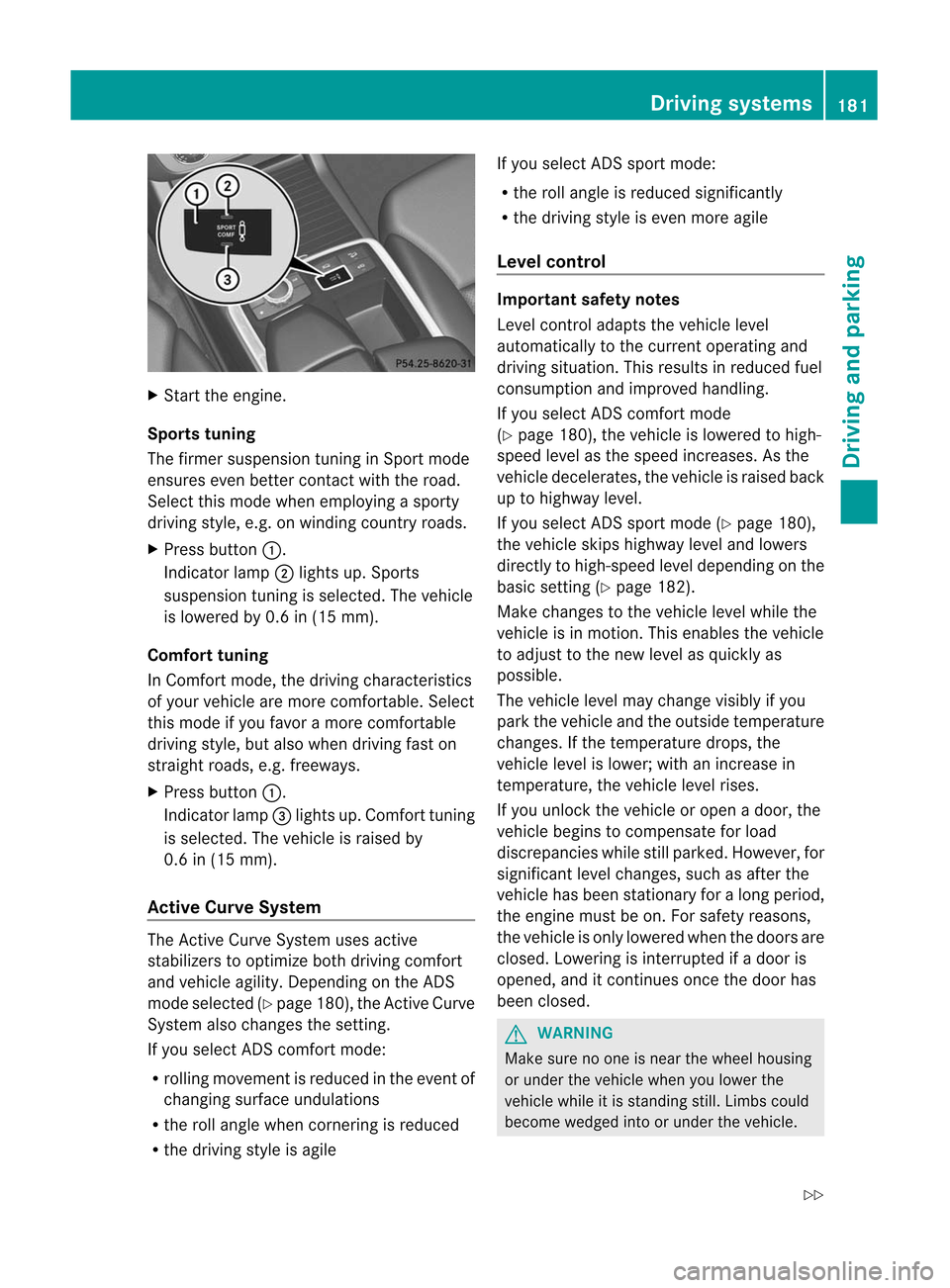
X Press button:.
Indic atorlamp ;lights up.Sport s
suspension tuningis select ed.The vehicle
is lowered by0.6 in(15 mm).
Comfor ttuning
In Comfort mode,thedrivin gcharac teristics
of your vehicle aremore comfortable. Select
this mode ifyou favor amore comfor table
driving style,butalso when driving faston
straight roads,e.g.freeways.
X Press button :.
Indicat orlamp =lights up.Comfort tuning
is selected. Thevehicle israised by
0.6 in(15 mm).
Active CurveSystem The
Active Curve System usesactive
stabilizers tooptimize bothdriving comfort
and vehicle agility.Dependin gon the ADS
mode selected (Ypage 180), theActiveCurve
System alsochanges thesetting.
If you select ADScomfor tmode:
R rolling movemen tisreduced inthe event of
changing surfaceundulations
R the rollangle whencornering isreduced
R the driving styleisagile If
you select ADSsport mode:
R the rollangle isreduced significantly
R the driving styleiseven more agile
Leve lcontrol Importa
ntsafety notes
Level controladap tsthe vehicle level
automaticall yto the current operating and
driving situation. Thisresults inreduced fuel
consumption andimproved handling.
If you select ADScomfort mode
(Y page 180), thevehicle islowered tohigh-
speed levelasthe speed increases. Asthe
vehicle decelerates, thevehicle israised back
up tohighwa ylevel.
If you select ADSsport mode (Ypage 180),
the vehicle skipshighwa ylevel andlowers
directly tohigh-speed leveldepending onthe
basic setting (Ypage 182).
Make changes tothe vehicle levelwhile the
vehicle isin motion. Thisenables thevehicle
to adjust tothe new level asquickly as
possible .
The vehicle levelmaychange visiblyifyou
park thevehicle andtheoutside temperature
changes. Ifthe temperature drops,the
vehicle levelislower; withanincrease in
temperature, thevehicle levelrises.
If you unlock thevehicle oropen adoor, the
vehicle beginstocompensate forload
discrepancies whilestillparked. However, for
significant levelchanges, suchasafter the
vehicle hasbeen stationary foralong period,
the engine mustbeon. For safety reasons,
the vehicle isonly lowered whenthedoors are
closed. Lowering isinterrupted ifadoor is
opened, anditcont inues oncethedoor has
been closed. G
WARNING Make
surenoone isnear thewheel housing
or under thevehicle whenyoulower the
vehicle whileitis standing still.Limbs could
become wedgedintoorunder thevehicle. Driving
systems
181Driving and parking
Z
Page 184 of 396
For
safety reasons, thevehi clecan only be
low ered with alldoo rsand thetailga teclos ed.
Low ering isinterru ptedifadoo rorthe tailgate
is opened andwillcont inue after thedoor is
closed again.
! When driving onextrem elyrough terrain,
select ahigh vehicle levelingood time.
Make surethatthere isalwa yssufficient
ground clearance toprevent damage tothe
vehicle.
! Remove thekey from theignition before
raising oneormore wheels withthe
appropria teequipment.
For information aboutdriving off-road, see
(Y page 162).
Basic settings
The exten ttowhich thevehicle israised or
lowered depends onthe basic setting
selected. Selectraisedlevelforoff-road
driving orhighway /high-speed levelfor
normal roads.
The individual vehiclelevelsdifferfrom
highway levelasfollows:
R +/- 0in (+/- 0mm) atthe highway level
R –0.6 in(–15 mm)atthe high-speed level
R +2. 3in (+ 60 mm) atthe raised level
Raised level
Only select raised levelwhen thisis
appropriate forthe road condit ions.
Otherwise, fuelconsumpt ionmay increase
and handling maybeaffect ed. X
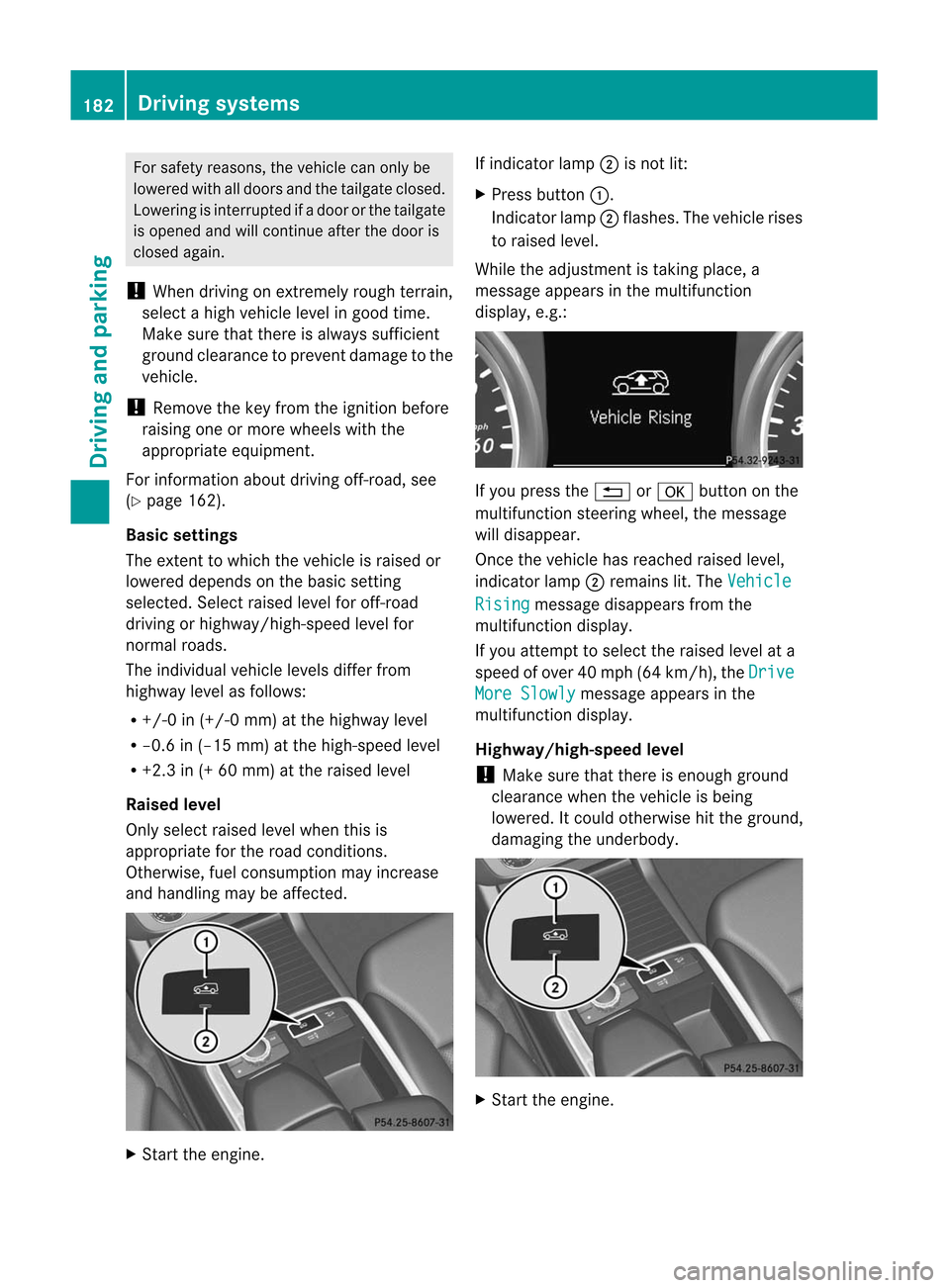
Start theengine. If
indicator lamp;isnot lit:
X Press button :.
Indicat orlamp ;flashes. Thevehicle rises
to raised level.
While theadjustmen tistaking place,a
message appearsinthe multifunction
displa y,e.g.: If
you press the% ora button onthe
multifunction steeringwheel,themessage
will disapp ear.
Once thevehicle hasreached raisedlevel,
indicator lamp;remains lit.The Vehicle
Rising message
disappearsfrom the
multifunction display.
If you attempt toselect theraised levelata
speed ofover 40mph (64km/h), the Drive
More
Slowly message
appearsinthe
multifunction display.
Highway/high-speed level
! Make surethatthere isenough ground
clearance whenthevehicle isbeing
lowered. Itcould otherwise hitthe ground,
damagi ngthe underbody . X
Start theengine. 182
Driving
systemsDriving and parking
Page 187 of 396
segments.
PARKTRONIC isoperational if
yell ow segments showingoperational
readiness =light up.
The selected transmission positionandthe
direction inwhich thevehicle isrolling
determine whichwarning displayis active
when theengine isrunning. Tra
nsmission
position Warning
display D
Front
areaactivated R,
Nor the vehicle
is rolling
backwards Rear
andfront areas
activated P
No
areas activated One
ormore segments lightupasthe vehicle
approa chesanobstacle, depending onthe
vehicle's distancefromtheobstacle.
From the:
R sixth segment onwards, youwillhear an
intermitt entwarning tonefor
approximately twoseconds.
R seventh segment onwards, youwillhear a
warning toneforapproximately two
seconds. Thisindicates thatyouhave now
reached theminimum distance.
Deac tivating/activating PARKTRONIC:
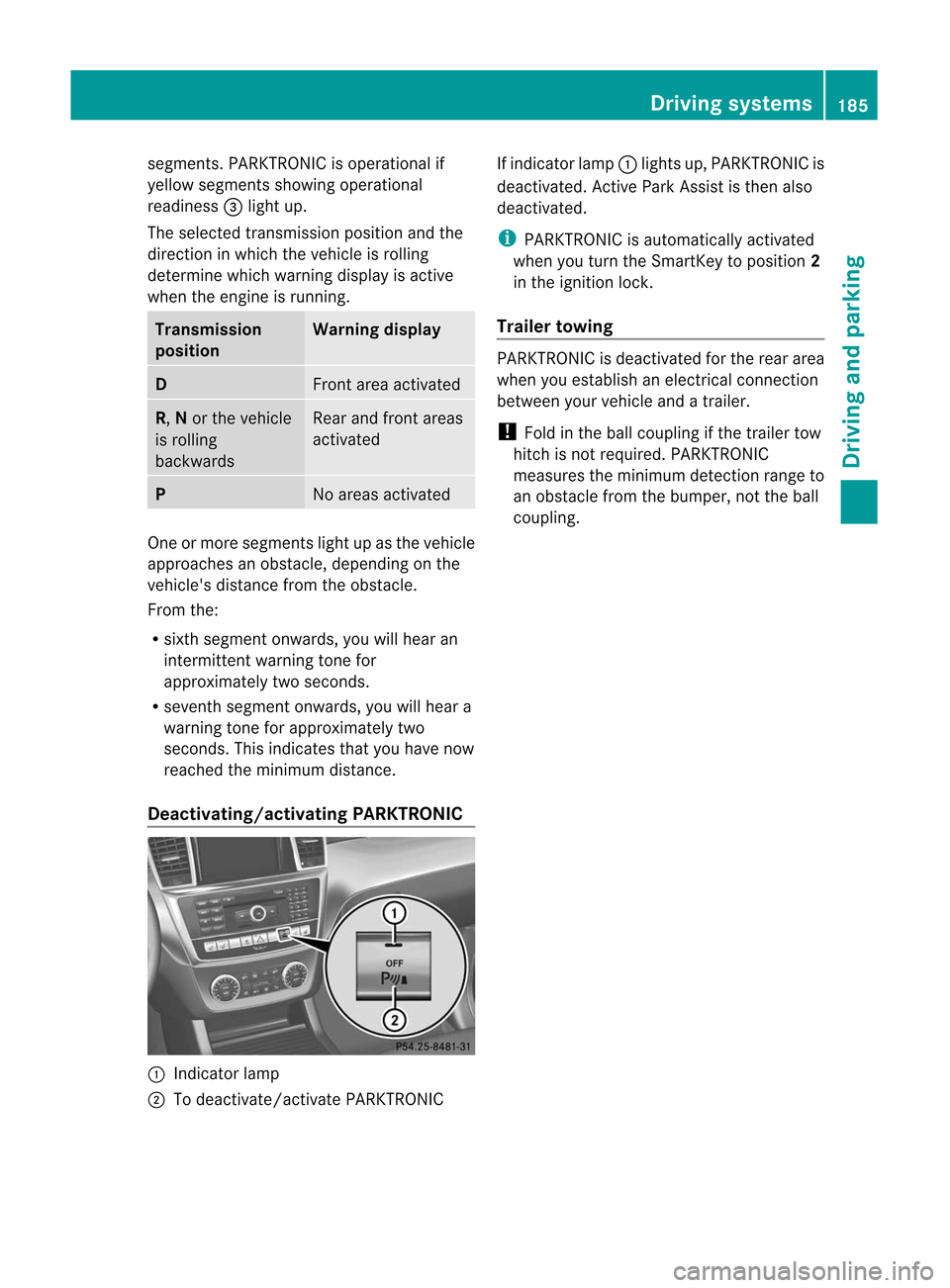
Indicator lamp
; Todeactivate/activate PARKTRONIC If
indicator lamp:lights up,PARKTRONIC is
deactivated. Active Park Assist isthen also
deactivated. i
PARKTRONIC
isautomaticall yactivated
when youturn theSmartKey toposition 2
in the ignition lock.
Tra iler towing PARKTRONIC
isdeactivated forthe rear area
when youestablish anelectrical connection
between yourvehicle andatrailer.
! Fold inthe ball coupling ifthe trailer tow
hitch isnot required. PARKTRONIC
measures theminimum detection rangeto
an obstacle fromthebumper, nottheball
coupling. Driving
systems
185Driving and parking Z
Page 202 of 396
(30
km/h). When thevehic lespeed exceeds
20 mph (30km/h), theindic atorlamp goes
out and BlindSpot Assistisready foruse.
When yourspeed exceeds approx imately
20 mph (30km/h), warnin glamp :light sup
red ontheco rrespo nding side when evera
vehicl eis detected inthe blind spot
monitoring range.Thiswarning isalw ays
given when avehicl eenters theblind spot
monitoring rangefrombehindorfrom the
side .When youarepassing another vehicle,
the warning isemitted onlyifthe difference
in speed isless than 7mph (12km/h).
The yellow indicator lampgoesoutifreverse
gear isengaged. Inthis event, BlindSpot
Assist isno longer active.
The brightness ofthe indicator/warnin g
lamps isadjusted automatically accordingto
the ambient light. G
WARNING Blind
SpotAssist isnot active atspeeds under
approximately 20mph (30km/h). The
indicator lampsinthe exterior mirrorsare
yellow .Vehicles inthe monit oringrange are
then notindicat ed.
Always payatten tiontotraff iccon ditions and
your surroundin gs.Other wise,youmay failto
recogn izedangers intime, cause anacciden t
and injure yourself andother s.
Collisio nwarning
If avehicle isdetec tedinthe monit oringrange
of Blind SpotAssist andyouswitch onthe turn
signal, adouble warning tonesounds. Red
warning lamp:flashes. Ifthe turn signal
remains on,detect edvehicles areindicated
by the flashing ofred warning lamp:.There
are nofurther warning tones.
Switching onBlind SpotAssist
X Make surethattheradar sensor system
(Y page 236)andBlind SpotAssist (Y
page 232)areactivated inthe on-board
computer.
X Turn theSmartK eytoposition 2in the
ignition lock.
Warning lamps:light upred inthe
exterior mirrorsforapproximately 1.5
seconds andthen turnyellow.
Tra iler towing
When youattach atrailer, makesureyouhave
correct lyestablished theelectrical
conn ection. Thiscanbeaccomplished by
check ingthe trailer lighting. Inthis event,
Blind SpotAssist isdeactivated. Theindicator
lamp inthe exterior mirrorslightsupyell ow,
and the Blind
SpotAssist Currently Unavailable
SeeOperator's Manual message
appearsinthe multifunction
displa y. i
You
candeactivate theindicator lampsin
the exterior mirrors.
To do so, switch offBlind SpotAssist when:
R the SmartK eyisin position 2in the
ignition lock.
R the engine isnot running.
R the electrical connection tothe trailer
has been established.
Lane Keeping Assist Import
antsafety notes
Lane Keeping Assistmonitors thearea in
front ofyour vehicle bymeans ofacamera at
the top ofthe windshield. LaneKeeping Assist
detect slane markings onthe road andwarns
you before youleave yourlane
uninten tionally. 200
Driving
systemsDriving and parking
Page 214 of 396
Please
notethat when towing atrailer,
PARKTRONIC (Ypage 183)andBlind Spot
Assist (Ypage 198)areonly availabl ewith
limitations ,or not atall. i
On
vehicles withoutlevelcontrol,the
height ofthe ball coupling willalter
accordin gto the load placed onthe vehicle.
If necess ary,useatrailer withaheight-
adjustable drawbar.
Driving tips i
Observe
theinform ationonESP®
trailer
stabilization (Ypage 64)and onpulling
away withatrailer. (Ypage 141).
The maximum permissible speedforvehicle/
trailer combinat ionsdepends onthe type of
trailer. Before beginnin gthe journ ey,check
the trailer's document sto see what the
maximum permittedspeed is.Observe the
legally prescribed maximumspeedinthe
relevant country.
For cert ainMercedes- Benzvehicles, the
maximum permissible rearaxle load is
incr eased whentowing atrailer. Refertothe
"Technical data"sectiontofind outwhether
this applies toyour vehicle. Ifyou utilize any
of the added maximum rearaxle load when
towing atrailer, thevehicle/t railer
combinat ionmay notexceed amaximum
speed of60 mph(100 km/h)for reasons
conc ernin gthe operating permit.Thisalso
applies incount riesinwhich thepermissible
maximum speedforvehicle/t railer
combinat ionsisabove 60mph(100 km/h).
When towing atrailer, yourvehicle's handling
charact eristics willbedifferen tinc omparison
with when driving without atrail er.
On long andsteep downhill gradients, you
must selectshift range 1,2or 3in good time. i
This
alsoapp liesif you have activated
cruise control orDISTRONIC PLUS.
This willuse thebraking effectofthe engine,
so that lessbraking willbe requ iredto
maintai nthe speed. Thisrelieves theload on
the brake system andprevents thebrakes from
overheating andwearing tooquickly. If
you need additional braking,depressthe
brake pedalrepeatedly ratherthan
cont inuously .
Driving tips R
Maintain agreater distance fromthe
vehicle infront thanwhen driving without a
trailer.
R Avoid braking abruptly. Ifpossible, brake
gently atfirst toallow thetrailer torun on.
Then, increase thebraking forcerapidly .
R The values givenforgradient-c limbing
capabil itiesfrom astandst illrefer tosea
level. When driving inmountainous areas,
note thatthepower output ofthe engine,
and consequent lythe vehicle's gradient-
climbing capability,decrease with
increasing altitude.
If the trailer swings fromsidetoside:
X Do not accelerate.
X Do not counter- steer.
X Brake ifnecessary. Assemblin
gthe ball coupling
! Mercedes-Ben zrecomm endsthatyou
have theball coupling assembled ata
qualified specialist workshop.Only a
qualified specialist workshophas the
nec essary specialist knowledge andtools
to carry outthework required. Youcould
other wiseincorrectlyassemble theball
coupling ortight enthe nut with the
incor recttorque. Thiscould leadtothe ball
coupling andtheball coupling carrier
becomin gdetached whiletowing atrailer.
As aresult, youcould cause anacciden t.
Therefor e,have theball coupling
assembled ataqualified specialist
worksho p.
If the assembled ballcoupling hasbeen
permanen tlymount edon the vehicle, have
the ball coupling regularly checkedfor 212
Tr
ailer towingDriving and parking
Page 218 of 396
G
WARNING Do
not disconnect atrail erwith anengag ed
overru nbrake. Otherwi se,you rhand could
bec ome trapped between thebumpe rand
trai lerd rawb ar.
Observe themaximu mpermissible trailer
dimension s(width andlengt h).
Most federal statesand allCanadian
provin cesrequire bylaw:
R safety chains between thetowing vehicle
and thetrailer. Thechains should becross -
wound underthetrailer drawbar. Theymust
be fasten edtothe vehicle's trailer
coupling, nottothe bumper orthe axle.
Allow forenough playinthe chains to
facilitat eturn ingtight corners.
R aseparate brakesystem forcert aintypes
of trailer.
R asafety switch forbraked trailers. Check
the specific legalrequirement sapplicable
to your federal state.
If the trailer detaches fromthetowing
vehicle, thesafety switch applies the
trailer's brakes.
! Donot connectthe trailer's brakesystem
(if featured) tothe hydrau licbrake system
of the towing vehicle, asthe latter is
equipp edwith ananti-lock brakesystem.
Doing sowill result inaloss offunct ionof
the brake systems ofboth thevehicle and
the trailer.
X Make surethattheautomatic transmission
is set toposition P.
X Apply thevehicle's electricparking brake.
X Start theengine.
X Vehicles withtheAIRMATIC package:
select highway level.
X Vehicles withtheadaptive damping
system: setADS toAUTO orCOMF.
X Switch offthe engine.
X Close alldoors andthetailgate.
X Coupl eup the trailer.
X Est ablish allelectrical connections. i
Vehicles
withtheAIRMATIC package:
if you couple upatrailer, thevehicle always
remains athighway level.When coupling up
a trailer, please observe thefollowing:
R ifhighway levelhasnotbeen set
manually ,the vehicle willautomatically
sink tohighway levelassoon asit
reaches aspeed of5m ph(8km/ h).
R high-spe edlevel isnot available.
These restrictions apply toall access ories
powered through acon nection tothe trailer
power socketofyour vehicle, e.g.abicycle
carrier . Towing
atrail er
Th ere arenum erouslega lreq uirem ents
conce rning the towingofatra iler, e.g.speed
rest rictions. Make surethatyour vehicle/
trailer combin ationcomplies withthelocal
requiremen tsnot only inyour areaof
residen cebut also atany location towhich
you aretrav eling. Thepolice andlocal
authorit iescan provide reliableinformation .
Please observe thefollowing whentowinga
trailer:
R To acquaint yourselfwithdrivin gwith a
trailer andwith theresultin gchang esto
handling, youshould practicecorn ering,
stoppin gand backin gup inatraf fic-free
location .
R Befor edrivin g,chec k:
- the trailer towhitch
- the safety switchfor braked trailers
- the safety chains
- the elect ricalconnection s
- the lights
- the wheels
R Adj ust the exterior mirror sto provide an
unobst ructedview ofthe rear sectionofthe
trailer.
R Ifthe trailer features electronic ally
con trolled brakes, pullaway thevehicle/
trailer combin ationcarefully, manually 216
Tr
ailer towingDriving and parking
Page 219 of 396
brake
usingthebrake controller, andchec k
the brakes forcorr ectfunc tion.
R Sec ureany objec tson the trailer topreven t
the cargo fromslipping whenthevehicle is
in mot ion.
R Ifyou couple upatrailer, regularly check
the cargo forsecure fasteningand make
sure thatthetrailer lamps and(if
applicable) thetrailer brakes are
func tioningcorr ectly.
R Bear inmind thatthehandling willbeless
stable whentowingatrailer thanwhen
drivin gwithout one.Avoid sudden steering
movem ents.
R The vehicle/ trailercombin ationisheavier,
acceler atesmore slowly, hasadecreased
gradient climbingcapability andalonger
brakin gdistan ce.
It is more suscept ibletoside winds and
requires morecareful steering.
R Ifpossible, avoidabrupt braking.Depres s
the brake pedalmoderat elyatfirst ,so that
the trailer canactiv ateitsown brakes. Then
incr ease thepressure onthe brake pedal.
R Ifthe automatic transmission continues to
shift back andforthbetween twogears
when drivingup ordownhill, restrict the
shift range. Selectshiftrange 4,3,2,or 1.
Al ower gearandlower speed reduce the
risk ofengine failure.
R On long andsteep gradients thatare
difficult todrive down inshift range 1,
switch tothe off-road program orengage
the LOW GEAR off-road gear.
R When driving downhill, shifttoalower gear
to utilize theengine's brakingeffect.
Avoid continuous brakeapplication asthis
may overheat thevehicle brakesand,if
installed, thetrailer brakes.
R Ifthe coolant temperat ureincreases
dramatically whiletheair-con ditioning
system isswitched on,switch offthe air-
condit ioning system.
Coolant heatcanadditionally bedissipated
by opening thewindows andbysett ingthe blower
fanand theinterior temperat ureto
maximum.
R When overtak ing,payparticular attention
to the exten dedlength ofyour vehicle/
trailer combinat ion.
Due tothe length ofyour vehicle/t railer
combinat ion,youwillhave totravel an
additional distancebeyondthevehicle you
are overtak ingbefore returningtothe
previous lane. Deco
upling atrail er G
WA
RNI NG Ve
hicle swi th airs uspen sionprogram :While
you arecoupling ordecoupling atrailer, make
sure nobody locksorunlocks thevehicle and/
or opens orcloses doorsorthe tailgate.
The vehicle's levelcould change andyou
could endanger yourselfand/orothersasa
result.
Make surethatyoudonot operate theADS
switch orthe vehicle levelcontrolsystem
when coupling/decoupling thetrailer.
! Donot disconnec ta trailer withan
engaged overrunbrake.Otherwise, your
vehicle couldbedamaged bythe
rebounding ofthe overrun brake.
X Make surethattheautomatic transmission
is set toposition P.
X Apply thevehicle's electricparking brake.
X Start theengine.
X Close alldoors andthetailgate.
X Apply thetrailer's parkingbrake. G
WARNING Vehicles
withairsuspension program:As
soon asyou disconnec tthe electrical
conn ection between thetrailer andthe
vehicle, thevehicle willlower. Tohelp avoid
personal injury,makesurenoone isnear the
wheel housing orunderneath thevehicle
before theelectrical connection is
disconnec ted. Tr
ailer towing
217Driving and parking
Z
Page 220 of 396
When
youdecouple thetrailer, thevehicle is
tempor arilyraised because thesprings are
relieved ofload. Beespecially carefulduring
this process, asyou could otherwise injure
yourself and/orothers.Make sure that any
pers onsrem ainin gin theveh icle donotp ress
the switches forvehicl elevel control orthe
ADS.
X Remo vethe trail ercabl eand decou plethe
trail er.
X Switch offthe engine. Permissi
bletrailer loadsanddrawbar
nos eweig hts
Weig htspec ifications The
gross trailerwei ght iscalcu lated by
add ingthe weight ofthe trail erto the weight
of the loadand equipme nton the trail er.
Maximu mgross vehicl ewei ght: 17
.
The maximu mpermissible trailerdrawbar
noseweight isthe maximum weightwith
which thetrailer drawbar canbeloaded: 17
Threshold forMercedes- Benzapproved
trailer towhitches.
Loading atrail er R
Wh enload ing the trailer, makesure tha t
nei the rthe permissible grossweight ofthe
trailer northegross vehicle weightare
exceeded. Thepermissible grossvehicle
weight isindicated onthe identification
plate onthe B-pillar onthe driver's sideof
the vehicle.
You canfind themaximum permissible
values onthe type plates ofyour vehicle
and thetrailer. Always observe thelowest
respective valuewhen determining the
maximum weightwithwhich youcan load
the vehicle andthetrailer.
R The trailer drawba rload onthe ball coupling
must beadded tothe rear axle load toavoid exceeding
thepermissible grossaxle
weight. Thepermissible grossvehicle
weight isindicated onthe identificat ion
plate onthe B-pillar onthe driver's sideof
the vehicle. i
Mercedes-B
enzrecomm endsloading the
trailer sothat thedrawbar noseweight
remains between 8%and 15% ofthe
permissible grosstrailer weight. i
The
weight ofadditional accessories,
passengers, andcargo reduces the
permissible trailerloadanddrawbar
noseweight foryour vehicle.
Checking thevehicle andtrailer weight R
To check thattheweights ofthe towing
vehicle andthetrailer comply withthe
maximum permissible values,havethe
vehicle/t railercombinat ion(including the
driver, passengers, andcargo withafully
laden trailer) weighed onacalibrated
weighbridge.
R Check thegross axleweight ratingofthe
front andrear axles, thegross weight ofthe
trailer andtrailer drawbar noseweight. Removing
theball coupling
X Remove thespring cotter.
X Remove thebolt from theball coupling
recess.
X Remove theball coupling fromtheball
coupling recess.
X Clean theball coupling ifit is dirty.
Infor mation oncleaning andcare ofthe trailer
tow hitch canbefound at(Y page 322). Storing
theball coupling G
WARNIN
G Do
not carry theball coupling inthe vehicle
interior ifit is not secured.
17 Missing valueswerenotavailabl eattime ofgoing toprin t. 218
Tr
ailer towingDriving and parking
Page 224 of 396
Useful
information
i This
Operat or'sManual describesall
models andallstan dard andoption al
equipment ofyour vehicle available atthe
time ofpublication ofthe Operat or's
Manual. Country-specificdiffer encesare
possible. Pleasenotethat your vehicle may
not beequipped withallfeature s
descr ibed. Thisalso applies tosafet y-
related systemsand func tions. i
Please
readtheinfor mation onqualified
specialist workshops(Ypage 25). Impor
tant safet ynotes You
willfind anillustrat ionofthe instrumen t
clust erinthe "Ataglance" section
(Y page 29). G
WARN
ING A
driver' satt ent ion tothe road andtraffic
con dition smust always behis/her primary
focus whendriving.
For your safetyand thesafet yof other s,
select ingfeature sthr ough themultifun ction
steer ingwheel should onlybedone bythe
driver whentrafficand road condition spermit
it to be done safely.
Bear inmind thatataspeed ofjust 30mph
(approxim ately50km/ h),your vehic leis
cove ringadistan ceof44 feet (approxim ately
14 m)every second. G
WARN
ING No
messages willbedisplayed ifeither the
inst rumen tclust eror the multif unction
display isinoper ative.
As aresult, youwillnotbeable tosee
info rmat ionabout yourdrivin gcon dition s,
such as
R speed
R outside temperatur e
R warnin g/indicato rlamps R
malf unction/ warn ingmes sages
R failur eof any systems
Dr ivin gch arac terist ics may beimpair ed.
If you must continue todriv e,do sowith added
caut ion.Contac tana uth oriz edMer cedes-
Ben zCent eras soon aspossible. G
WARN
ING Malfunct
ionand warning messages areonly
indicat edfor cert ainsystems andare
inten tionally notvery detailed. The
malfunct ionand warning messages are
simply areminder withrespect tothe
operation ofcert ainsystems. Theydonot
replace theowner's and/ordriver's
respons ibilitytomaint ainthe vehicle's
operatin gsafety. Haveallrequired
maint enanc eand safety checksperform edon
the vehicle. Bringthe vehicle toan authorized
Mercedes- BenzCenter toaddress the
malfunct ionand warning messages. Displays
andopera tion Coolant
temperaturedispla y G
WARN
ING Drivin
gwhen yourengine isoverheat edcan
cause somefluidswhich mayhave leaked into
the engine compart menttocatc hfire. You
could beseriously burned.
St eam from anoverheat edengine cancause
serious burnswhich canoccur justbyopening
the engine hood.Stay away fromtheengine
if you seeorhear steam comingfrom it.
St op the vehicle inasafe location awayfrom
other traffic.Turn offthe engine, getout ofthe
vehicle anddonot stand nearthevehicle until
the engine hascooled down.
The coolant temperaturegauge isin the
inst rument clusteronthe right- hand side.
Under normaloperatin gcon ditions andwith
the specified coolantlevel,thecoolant
temper aturemayriseto248 ‡(120 †). 222
Displays
andopera tionOn-board computer and displays