width MERCEDES-BENZ M-Class 2012 W166 Owner's Manual
[x] Cancel search | Manufacturer: MERCEDES-BENZ, Model Year: 2012, Model line: M-Class, Model: MERCEDES-BENZ M-Class 2012 W166Pages: 396, PDF Size: 14.48 MB
Page 53 of 396
ribs
orabd omen, whichcould severel y
injure internal organssuchasyou rliver or
spleen .
Adj ust the seat beltsothat theshoulder
sect ionislocat edasclos eas possible to
the middle ofthe shoulder .Its hould not
touch theneck .Never pass theshoulder
portion ofthe seat beltunder yourarm. For
this purpose, youcan adjust theheight of
the seat beltoutlet.
R Position thelapbelt aslow aspossible on
your hipsandnotacross theabdomen. If
the lapbelt isposition edacross your
abdomen, itcould cause serious injuries in
a crash.
R Never wearseatbelts overrigid or
breakable objectsinor on your clothing,
such aseyeglasses, pens,keysetc.,as
these might cause injuries.
R Make suretheseat beltisalway sfitt ed
snugly. Takespecial careofthis when
wearing looseclothing.
R Never useaseat beltformore thanone
person atatime. Donot fasten aseat belt
around aperson andanoth erperson or
other objectsat the same time.
R Seat belts should notbeworn twisted. Ina
crash, youwould nothave thefullwidth of
the seat belttodistribut eimpact forces.
The twisted seatbeltagainst yourbody
could cause injuries.
R Pregnant womenshouldalsoalway suse a
lap-shoulder belt.Thelapbelt portion
should bepositioned aslow aspossible on
the hips toavoid anypossible pressure on
the abdomen.
R Place theseat backrest inaposition thatis
as upright aspossible.
R Check yourseatbeltduring traveltomake
sure itis properly positioned.
R Never placeyourfeetonthe instr ument
panel, dashboard, oron the seat. Always keep
bothfeetonthe floor infront ofthe
seat.
R When usingaseat belttosecure infant
restraint s,toddler restraint s,or children in
booster seats,alwaysfollow thechild seat
manufacturer' sinstr uctions. G
WARNING Do
not pass seatbelts oversharp edges. They
could tear.
Do not allow theseat belttoget caught inthe
door orinthe seat adjustmen tmechanism.
This could damage theseat belt.
Never attempt tomake modifications toseat
belts. Thiscould impair theeffect iveness of
the seat belts.
Fastening seatbelts G
WARNING Acc
ording toaccident statistics,children are
safer when properly restrained onthe rear
seats thanonthe front -passenger seat.Thus,
we stron glyrecommen dthat children be
placed inthe rear seat whenever possible.
Regardless ofseating position, children12
years oldand under mustbeseated and
properly securedinan appropriately sized
child restraint systemorbooster seat
recommen dedforthe size andweight ofthe
child. Foradditional information,seethe
"Child reninthe vehicle" section.
Ac hild's riskofserious orfatal injuries is
significantly increasedifthe child restraint s
are not properly securedinthe vehicle and/
or the child isnot properly securedinthe child
restraint . Occ
upant safety
51Safety Z
Page 181 of 396
because
ofits narro wwidth. Thedistan ceto
the vehicle infron twillbe too shor t.
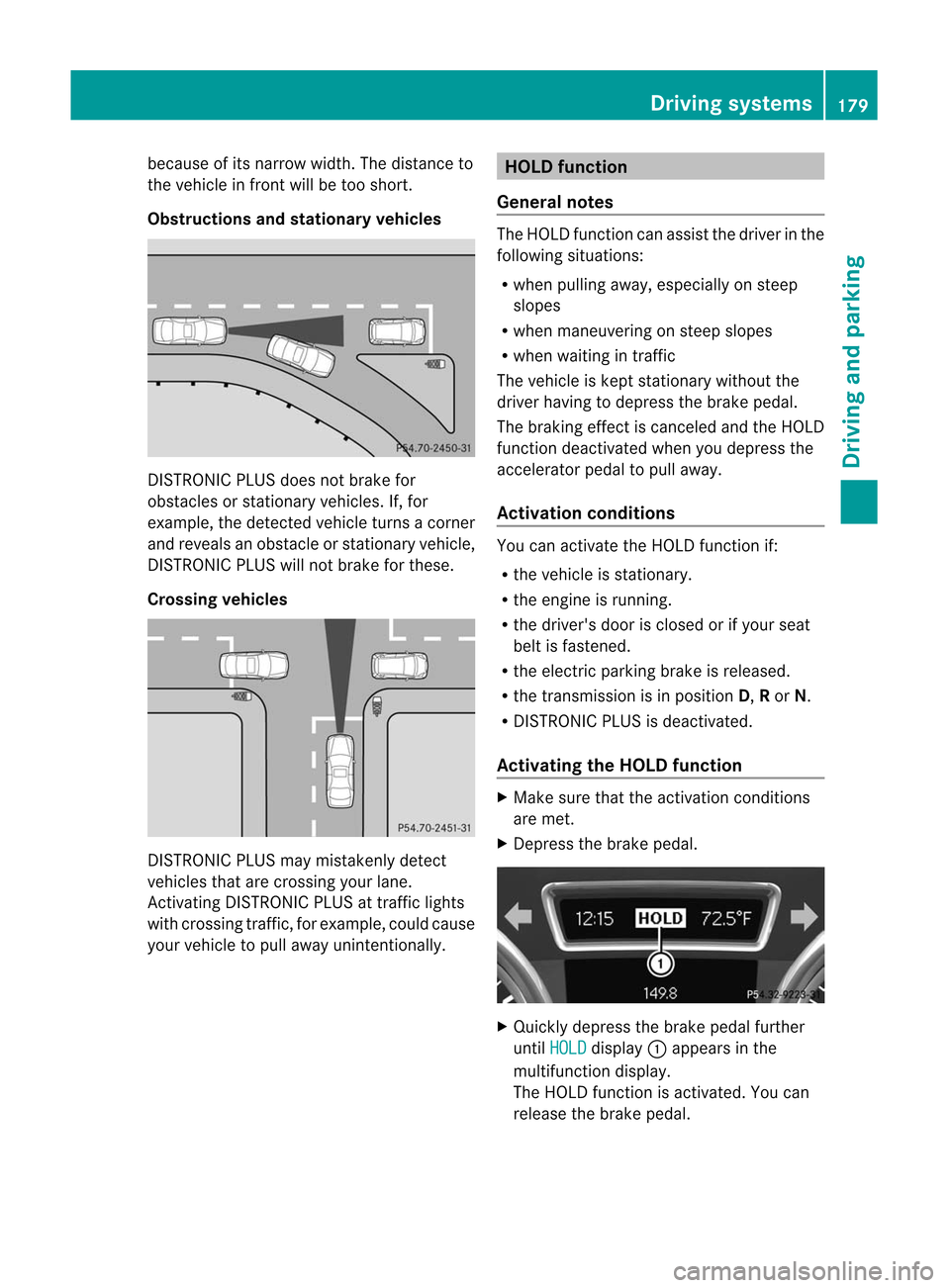
Obst ructions andstationa ryvehicles DI
STRON ICPLUS doesnotbrak efor
obst acles orstation aryvehic les.If,for
exam ple,thedete cted vehic letur ns acor ner
and reve alsanobst acle orstation aryvehic le,
DI STRON ICPLUS willnotbrak efor these.
Crossin gvehicles DI
STRON ICPLUS maymistaken lydete ct
vehic lesthat arecrossin gyour lane.
Ac tivatin gDI STRON ICPLUS attraffic lights
with crossin gtr affic ,for exam ple,could cause
your vehic leto pull away unintention ally. HOLD
function
Gener alnotes The
HOL Dfunc tion can assis tthe driver inthe
following situations:
R when pullingaway ,especiall yon steep
slopes
R when maneuvering onsteep slopes
R when waiting intraffic
The vehicle iskept stationary withoutthe
driver having todepress thebrake pedal.
The braking effectiscanceled andtheHOLD
funct iondeactivated whenyoudepress the
accelerator pedaltopull away .
Activation conditions You
canactivate theHOLD functionif:
R the vehicle isstationary.
R the engine isrunning.
R the driver's doorisclosed orifyour seat
belt isfastened.
R the electric parking brakeisreleased.
R the transmission isin position D,Ror N.
R DIS TRONIC PLUSisdeactivated.
Activating theHOLD function X
Make surethattheactivation conditions
are met.
X Depress thebrake pedal. X
Quickly depress thebrake pedalfurther
until HOLD displa
y: appea rsinthe
multifunction display.
The HOLD functionisactivated. Youcan
release thebrake pedal. Driving
systems
179Driving and parking Z
Page 193 of 396
Acti
vating/d eactivating therea rview
cam era X
To activ ate: make surethattheSmar tKey
is in posit ion2in the ignit ionlock .
X Make surethatthe"rear viewcamer a"
func tion isselec tedinCOMAN D(see the
separate operating instructionsfor
COMAND).
X Engage reverse gear.
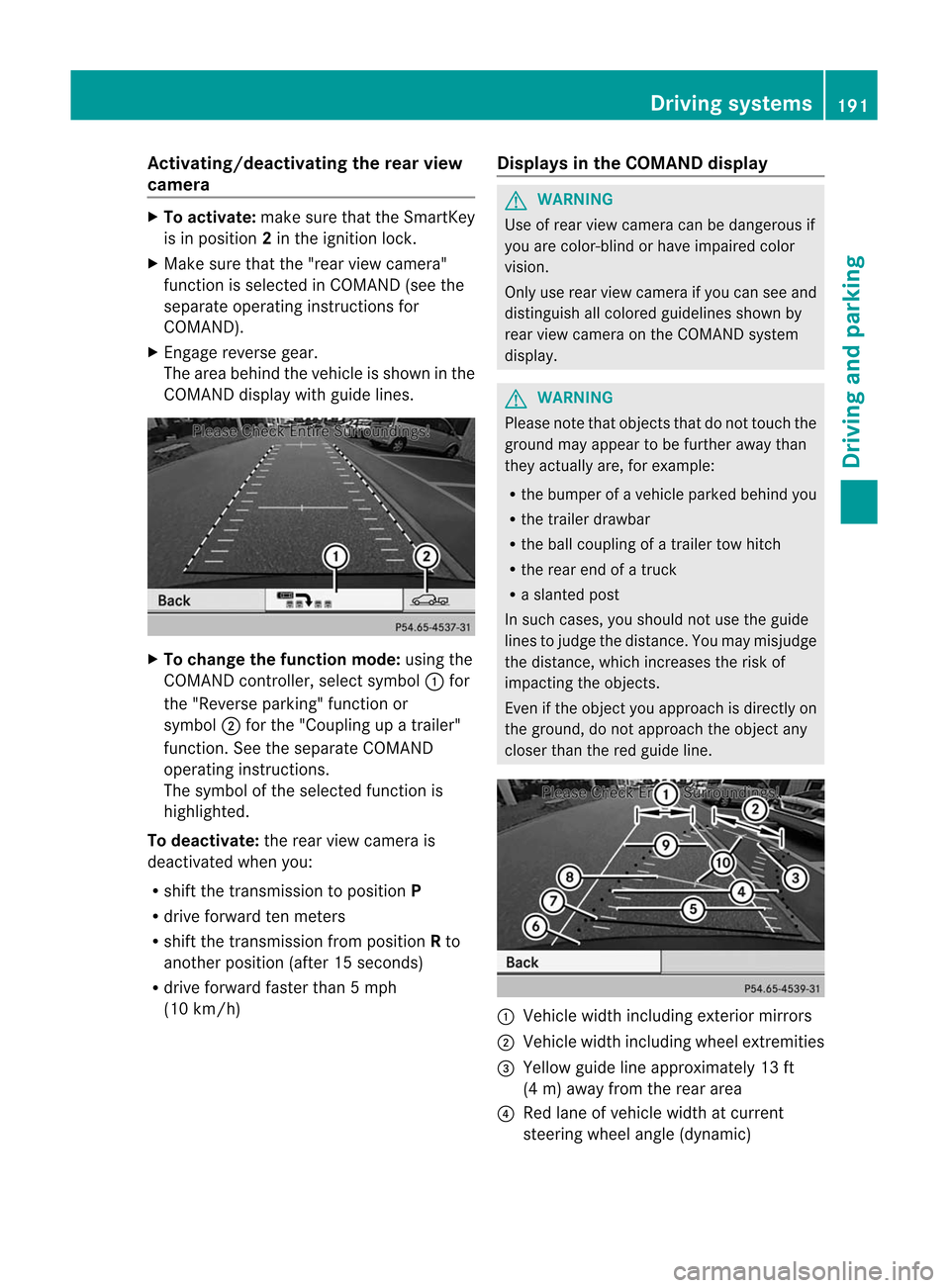
The area behind thevehicle isshown inthe
COMAND displaywith guide lines. X
To change thefunction mode:usingthe
COMAND controller, select symbol :for
the "Reverse parking"functionor
symbol ;for the "Cou pling upatrailer"
function .See the separate COMAND
operatin ginst ruct ions.
The symbol ofthe select edfunc tion is
highlighted.
To deactiva te:the rear view camera is
deactivat edwhen you:
R shift thetran smission toposition P
R drive forward tenmeter s
R shift thetran smission fromposition Rto
anoth erposition (after15secon ds)
R drive forward fasterthan5mph
(10 km/ h) Displays
inthe COMAND display G
WARN
ING Use
ofrear view camera canbedangerous if
you arecolor- blindorhave impaired color
vision.
Only userear view camera ifyou can seeand
distin guish allcolored guidelines shownby
rear view camera onthe COMAND system
display. G
WARN
ING Please
notethat objec tsthat donot touch the
ground mayappear tobe furth eraway than
they actually are,forexample:
R the bumper ofavehicle parkedbehindyou
R the trailer drawbar
R the ball coupling ofatrailer towhitch
R the rear endofatruc k
R aslanted post
In such cases, youshould notuse theguide
lines tojudge thedistanc e.You may misjudge
the distanc e,which increases therisk of
impactin gthe objec ts.
Even ifthe objec tyou approach isdirectly on
the ground, donot approach theobject any
closer thanthered guide line. :
Vehicle widthincluding exteriormirrors
; Vehicle widthincluding wheelextremities
= Yellow guidelineapproximately 13ft
(4 m) away fromtherear area
? Red lane ofvehicle widthatcurrent
steering wheelangle(dynamic) Driving
systems
191Driving and parking Z
Page 194 of 396
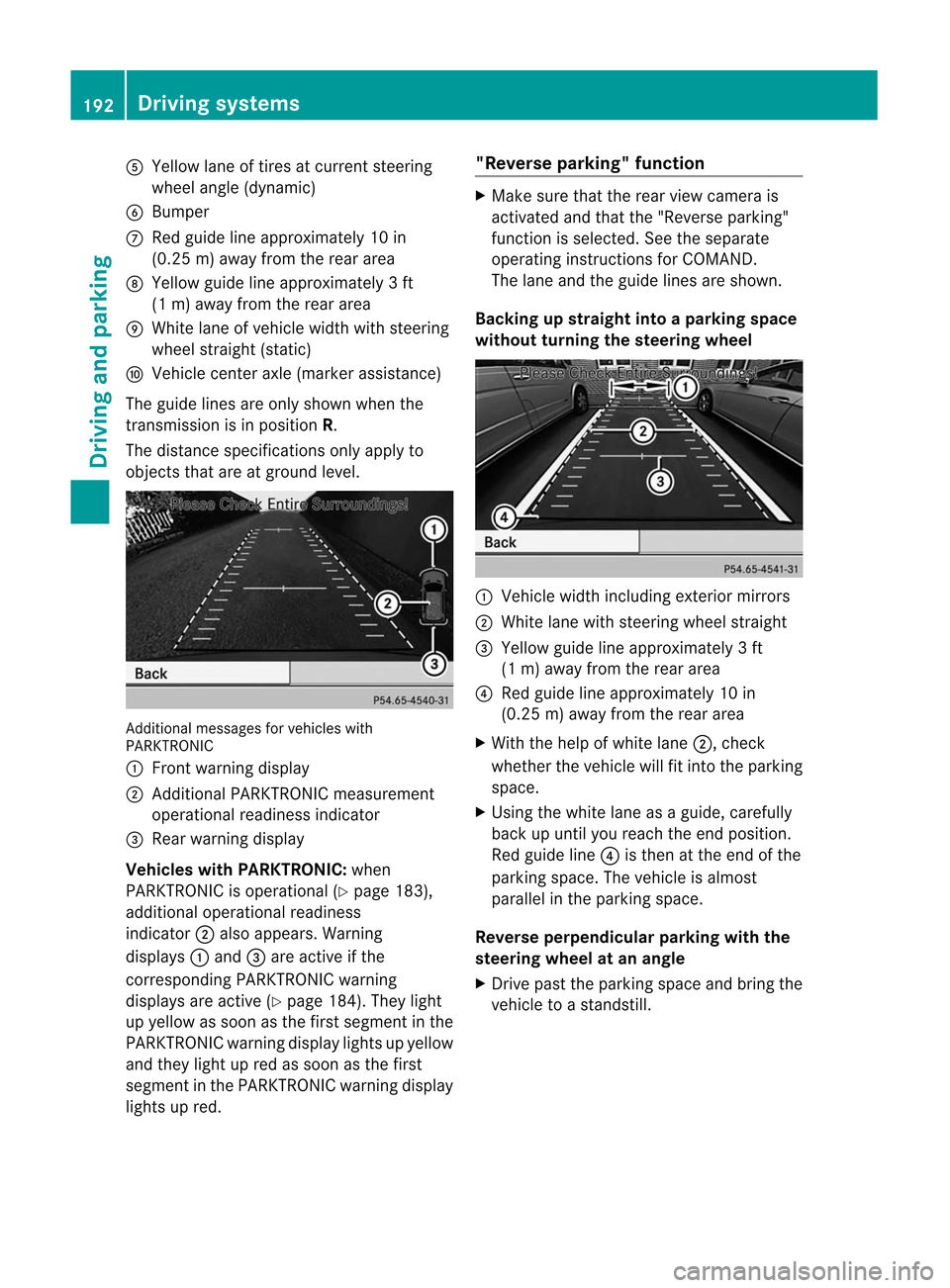
A
Yellow laneoftires atcurr entsteerin g
wheel angle(dynamic )
B Bumpe r
C Red guide lineapprox imately10 in
(0. 25 m)away fromthe rear area
D Yellow guidelineapprox imately3f t
(1 m) away fromtherear area
E White laneofvehic lewidth withsteering
wheel straight (static)
F Vehic lecen teraxle (mark erassist ance)
The guide linesareonly shown whenthe
tr ansm ission isin posit ionR.
The distan cespecif icationsonly apply to
objec tsthat areatgroun dlevel. Addit
ional messages forvehic leswith
PARKTRO NIC
: Frontwarnin gdisplay
; Addit ional PARKTRON ICmeasurem ent
operat ionalreadines sindic ator
= Rear warnin gdisplay
Vehicles withPARKTR ONIC:when
PARKTRON ICisoperat ional(Ypage 183),
addition aloperat ionalreadines s
indic ator;also appears. Warning
displays :and =are active ifthe
cor respon dingPARKTRON ICwarnin g
displays areactive (Ypage 184).They light
up yellow assoon asthe first segmen tint he
PARKTRONIC warningdisplaylights upyell ow
and they light upred assoon asthe first
segment inthe PARKTRONIC warningdisplay
lights upred. "Reverse
parking" function X
Make surethattherear view camera is
activated andthat the"Reverse parking"
funct ionisselected. Seetheseparate
operating instructionsforCOMAND.
The lane andtheguide linesareshown.
Backing upstra ight intoapar king space
without turning thesteering wheel :
Vehicle widthincluding exteriormirrors
; White lanewith steering wheelstraight
= Yellow guidelineapproximately 3ft
(1 m) away fromtherear area
? Red guide lineapprox imately 10in
(0.2 5m) away fromtherear area
X With thehelp ofwhite lane;,chec k
whethe rthe vehicle willfitinto theparking
space.
X Using thewhite laneasaguide, carefully
back upuntil youreach theend position.
Red guide line?isthen atthe end ofthe
parking space.Thevehicle isalmost
parall elin the parking space.
Reverse perpendicular parking with the
steering wheelatan angle
X Drive pasttheparking spaceandbring the
vehicle toastandst ill. 192
Driving
systemsDriving and parking
Page 201 of 396
alte
ringof thedevi cewill void any
warr anties, and isno tp ermit tedbythe
FCC. Donot tamper with,alter, oruse in
any non-approved way.
An yunauthoriz edmodificat iontothis
device couldvoidtheuser’s authorit yto
operate theequipment.
For Blind SpotAssist toassist youwhen
driving, theradar sensor system mustbe
activat ed(Ypage 236)and operation al.
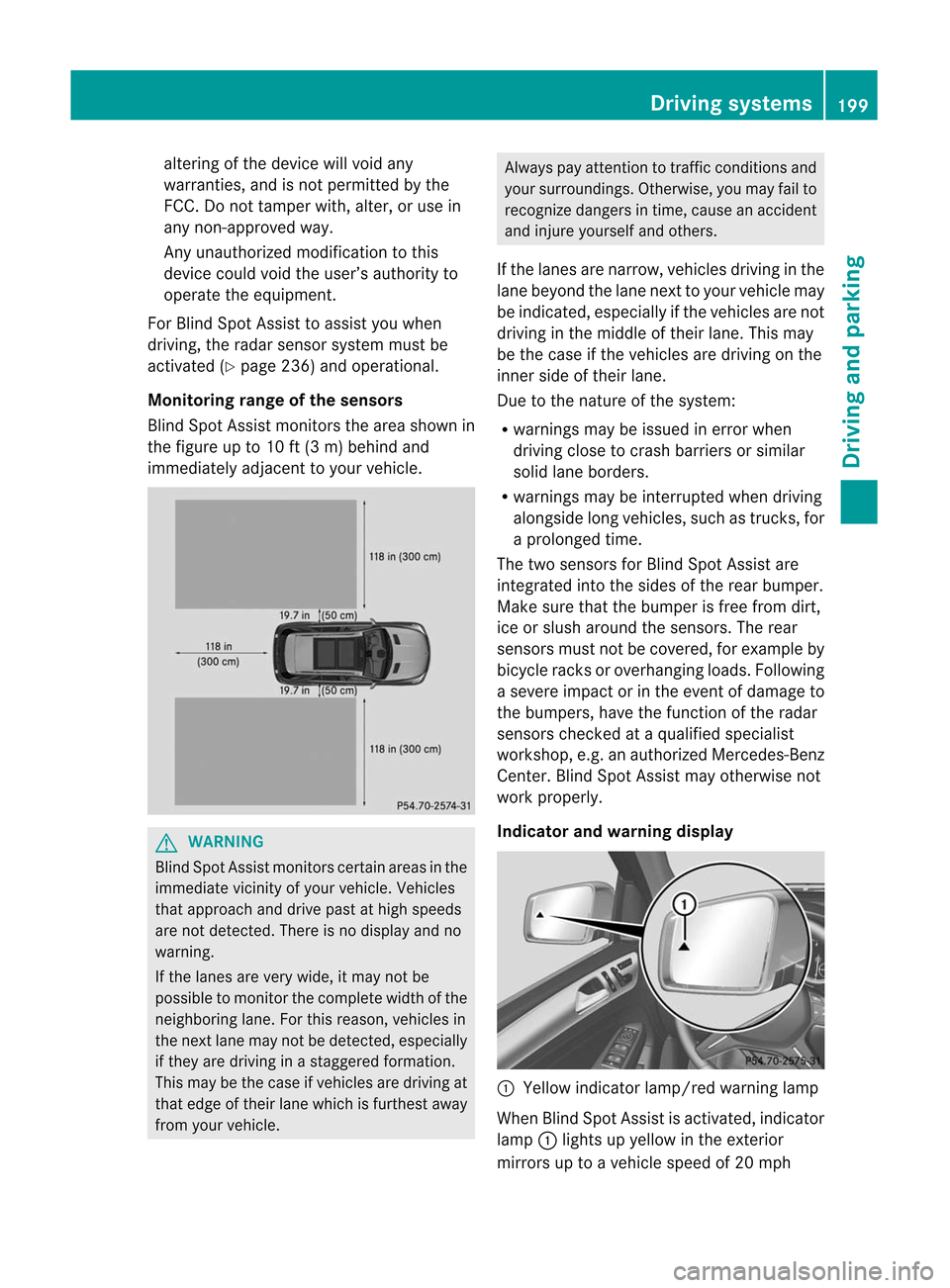
Monitoring rangeofthe sensors
Blind SpotAssist monitorsthe area shown in
the figure upto10 ft(3 m) behind and
immediately adjacenttoyour vehicle. G
WARNIN
G Blind
SpotAssist monitorscert ainareas inthe
immediate vicinityof your vehicle. Vehicles
that approach anddrive pastathigh speeds
are not detect ed.There isno display andno
warning.
If the lanes arevery wide, itmay notbe
possible tomonit orthe complete widthofthe
neighboring lane.Forthis reason, vehicles in
the next lanemaynotbedetect ed,especially
if they aredriving inastaggered formation.
This may bethe case ifvehicles aredriving at
that edge oftheir lanewhich isfurthest away
from yourvehicle. Always
payatten tiontotraffic conditionsand
your surroundings. Otherwise,youmay failto
recogn izedangers intime, cause anaccident
and injure yourself andothers.
If the lanes arenarrow, vehicles drivinginthe
lane beyond thelane next toyour vehicle may
be indicated, especially ifthe vehicles arenot
driving inthe middle oftheir lane. Thismay
be the case ifthe vehicles aredriving onthe
inner sideoftheir lane.
Due tothe nature ofthe system:
R warnings maybeissued inerror when
driving closetocrash barriers orsimilar
solid laneborders.
R warnings maybeinterr upted whendriving
alongside longvehicles, suchastruck s,for
a prolonged time.
The two sensors forBlind SpotAssist are
integr atedintothesides ofthe rear bumper.
Make surethatthebumper isfree from dirt,
ice orslush around thesensors. Therear
sensors mustnotbecovered, forexample by
bicycle racksoroverhanging loads.Following
a severe impact orinthe event ofdamage to
the bumpers, havethefunct ionofthe radar
sensors checkedataquali fiedspecialist
workshop, e.g.anauthorized Mercedes-B enz
Center. BlindSpotAssist mayotherwise not
work properly.
Indicator andwarning display :
Yellow indicator lamp/red warninglamp
When BlindSpotAssist isactivated, indicator
lamp :lights upyellow inthe exter ior
mirrors uptoavehicle speedof20 mph Driving
systems
199Driving and parking Z
Page 205 of 396
i
USA
only:
This device hasbeen approved bythe FCC
as a“Vehicula rRadar System”. The radar
sen sor isint ended foruse inan auto motive
radar systemonly. Remo val,tampering,or
alte ringof thedevi cewill void any
warr anties, and isno tp ermit tedbythe
FCC. Donot tamper with,alter, oruse in
any non-approved way.
An yunauthoriz edmodificat iontothis
device couldvoidtheuser’s authorit yto
operate theequipment.
For Active Blind SpotAssist toassist you
when driving, theradar sensor system must
be activat ed(Ypage 236)and operation al.
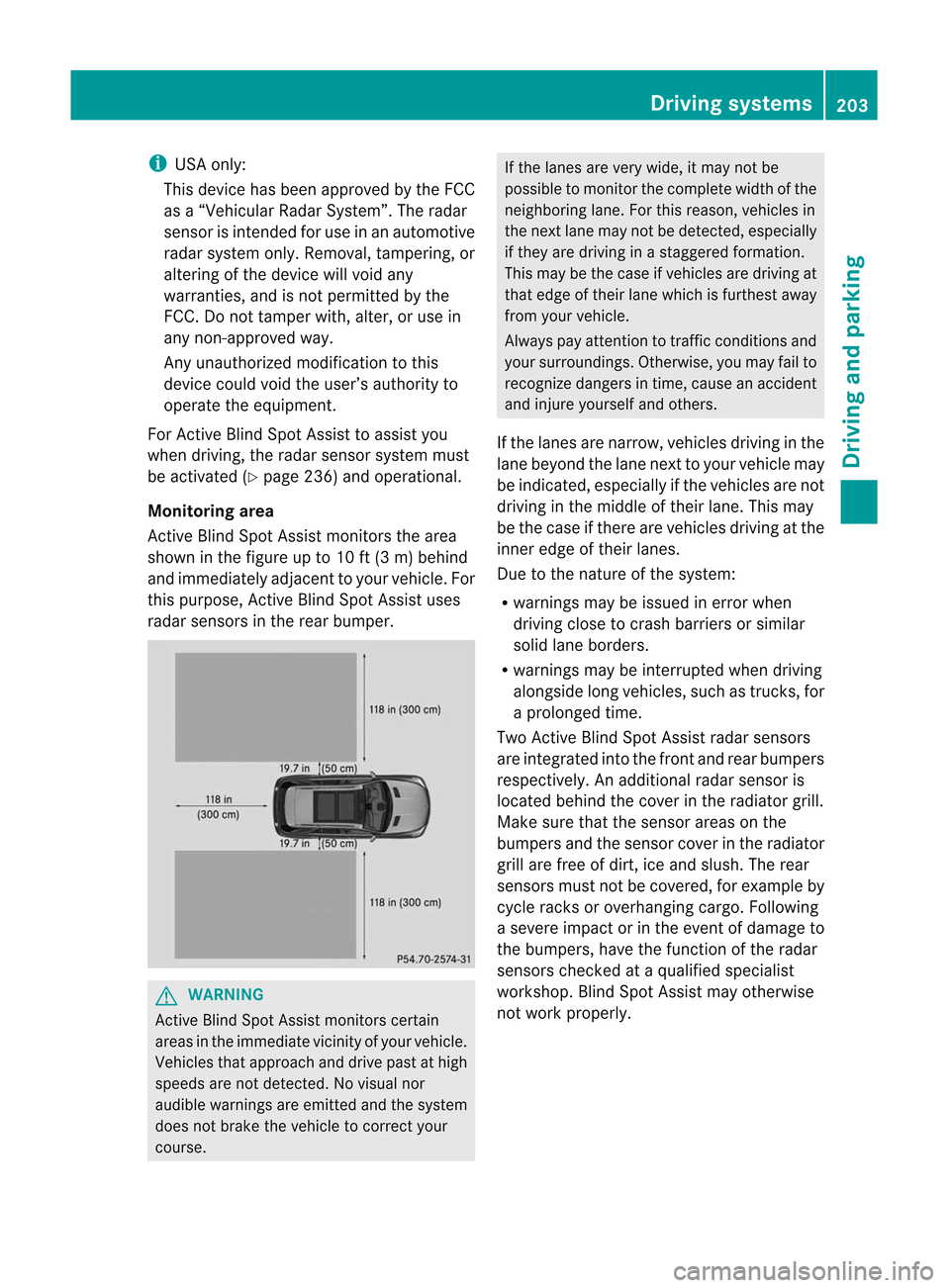
Monitoring area
Ac tive Blind SpotAssist monitorsthe area
shown inthe figure upto10 ft(3 m) behind
and immediately adjacenttoyour vehicle. For
this purpose, Active Blind SpotAssist uses
radar sensors inthe rear bumper. G
WARNIN
G Act
ive Blind SpotAssist monitorscert ain
areas inthe immediate vicinityof your vehicle.
Vehicles thatapproach anddrive pastathigh
speeds arenot detect ed.Novisual nor
audibl ewarnings areemitt edand thesystem
does notbrake thevehicle tocorrec tyour
course. If
the lanes arevery wide, itmay notbe
possible tomonit orthe complete widthofthe
neighboring lane.Forthis reason, vehicles in
the next lanemaynotbedetect ed,especially
if they aredriving inastaggered formation.
This may bethe case ifvehicles aredriving at
that edge oftheir lanewhich isfurthest away
from yourvehicle.
Always payatten tiontotraffic conditionsand
your surroundings. Otherwise,youmay failto
recogn izedangers intime, cause anaccident
and injure yourself andothers.
If the lanes arenarrow, vehicles drivinginthe
lane beyond thelane next toyour vehicle may
be indicated, especially ifthe vehicles arenot
driving inthe middle oftheir lane. Thismay
be the case ifthere arevehicles drivingatthe
inner edgeoftheir lanes.
Due tothe nature ofthe system:
R warnings maybeissued inerror when
driving closetocrash barriers orsimilar
solid laneborders.
R warnings maybeinterr upted whendriving
alongside longvehicles, suchastruck s,for
a prolonged time.
Two Active Blind SpotAssist radarsensors
are integrat edinto thefront andrear bumpers
respect ively.Anadditional radarsensor is
located behindthecover inthe radiator grill.
Make surethatthesensor areasonthe
bumpers andthesensor coverinthe radiator
grill arefree ofdirt, iceand slush. Therear
sensors mustnotbecovered, forexample by
cycle racks oroverhanging cargo.Following
a severe impact orinthe event ofdamage to
the bumpers, havethefunct ionofthe radar
sensors checkedataquali fiedspecialist
workshop. BlindSpotAssist mayotherwise
not work properly. Driving
systems
203Driving and parking Z
Page 218 of 396
G
WARNING Do
not disconnect atrail erwith anengag ed
overru nbrake. Otherwi se,you rhand could
bec ome trapped between thebumpe rand
trai lerd rawb ar.
Observe themaximu mpermissible trailer
dimension s(width andlengt h).
Most federal statesand allCanadian
provin cesrequire bylaw:
R safety chains between thetowing vehicle
and thetrailer. Thechains should becross -
wound underthetrailer drawbar. Theymust
be fasten edtothe vehicle's trailer
coupling, nottothe bumper orthe axle.
Allow forenough playinthe chains to
facilitat eturn ingtight corners.
R aseparate brakesystem forcert aintypes
of trailer.
R asafety switch forbraked trailers. Check
the specific legalrequirement sapplicable
to your federal state.
If the trailer detaches fromthetowing
vehicle, thesafety switch applies the
trailer's brakes.
! Donot connectthe trailer's brakesystem
(if featured) tothe hydrau licbrake system
of the towing vehicle, asthe latter is
equipp edwith ananti-lock brakesystem.
Doing sowill result inaloss offunct ionof
the brake systems ofboth thevehicle and
the trailer.
X Make surethattheautomatic transmission
is set toposition P.
X Apply thevehicle's electricparking brake.
X Start theengine.
X Vehicles withtheAIRMATIC package:
select highway level.
X Vehicles withtheadaptive damping
system: setADS toAUTO orCOMF.
X Switch offthe engine.
X Close alldoors andthetailgate.
X Coupl eup the trailer.
X Est ablish allelectrical connections. i
Vehicles
withtheAIRMATIC package:
if you couple upatrailer, thevehicle always
remains athighway level.When coupling up
a trailer, please observe thefollowing:
R ifhighway levelhasnotbeen set
manually ,the vehicle willautomatically
sink tohighway levelassoon asit
reaches aspeed of5m ph(8km/ h).
R high-spe edlevel isnot available.
These restrictions apply toall access ories
powered through acon nection tothe trailer
power socketofyour vehicle, e.g.abicycle
carrier . Towing
atrail er
Th ere arenum erouslega lreq uirem ents
conce rning the towingofatra iler, e.g.speed
rest rictions. Make surethatyour vehicle/
trailer combin ationcomplies withthelocal
requiremen tsnot only inyour areaof
residen cebut also atany location towhich
you aretrav eling. Thepolice andlocal
authorit iescan provide reliableinformation .
Please observe thefollowing whentowinga
trailer:
R To acquaint yourselfwithdrivin gwith a
trailer andwith theresultin gchang esto
handling, youshould practicecorn ering,
stoppin gand backin gup inatraf fic-free
location .
R Befor edrivin g,chec k:
- the trailer towhitch
- the safety switchfor braked trailers
- the safety chains
- the elect ricalconnection s
- the lights
- the wheels
R Adj ust the exterior mirror sto provide an
unobst ructedview ofthe rear sectionofthe
trailer.
R Ifthe trailer features electronic ally
con trolled brakes, pullaway thevehicle/
trailer combin ationcarefully, manually 216
Tr
ailer towingDriving and parking
Page 353 of 396
Note
son reg ularly inspe cting wheels
and tires G
WA
RNI NG Re
gularly che ckthe tires for dama ge.
Dam aged tires can causetireinf latio n
pre ssu reloss. Asares ult, yo ucou ldlose
contr olof your veh icle.
Wo rn,oldtir es can causeacc idents .Ift he tire
tread isworn tominimum treaddepth, orif
the tires have sustained damage,replace
them.
R Regul arlycheck thewheels andtires of
your vehicle fordamage (e.g.cuts,
punctures, tears,bulges ontires and
deformation orcrack sor severe corrosion
on wheels) atleast once amonth,as well
as after driving off-road oron rough roads.
Damaged wheelscancause aloss oftire
pressure.
R Regula rlycheck thetire tread depth and
the condit ionofthe tread across thewhole
width ofthe tire (Ypage 351). Ifnecessary,
turn thefront wheels tofull lock inorder to
inspect theinner sideofthe tire surface.
R All wheels musthaveavalve captoprotec t
the valve against dirtand moisture. Donot
mount anything ontothe valve (such astire
pressure monitoringsystems) otherthan
the standard valvecaporother valvecaps
approved byMercedes-B enzforyour
vehicle.
R Regula rlycheck thepressure ofall the tires
including theemergenc yspare wheel orthe
spare wheel, particularly priortolong trips,
and correc tthe pressure asnecessary
(Y page 353). Tire
tread G
WARNING Although
theappli cable federal motorvehicle
safety lawsconsider atire tobe worn when
the tread wearindicators (TWI)become
visible atapproximately 1
/ 16 in
(1.6 mm), we recommen
dthat youdonot allow yourtires
to wear down tothat level. Astread depth
approaches 1
/ 8 in
(3 mm), theadhesion
properties onawet road aresharply reduced.
Depending upontheweather and/orroad
surface (conditions), thetire tract ionvaries
widely .
Do not use tires thatareexcessively wornas
the tire tract iononwet road surfaces
decreases significantly whenthetread depth
is less than 1
/ 8 inch
(3mm).
Tread wearindicators (TWI)arerequired by
law. Sixindicators arepositioned onthe tire
tread. Theybecome visibleassoon asatread
depth ofapproximately 1
/ 16 inch
(1.6mm)
has been reached. Ifthis isthe case, thetire
is so worn thatitmust bereplaced.
The recommen dedtread depth forsummer
tires isat least 1
/ 8 inch
(3mm). The
recommen dedtread depth forwinter tiresis
at least 1
/ 6 inch
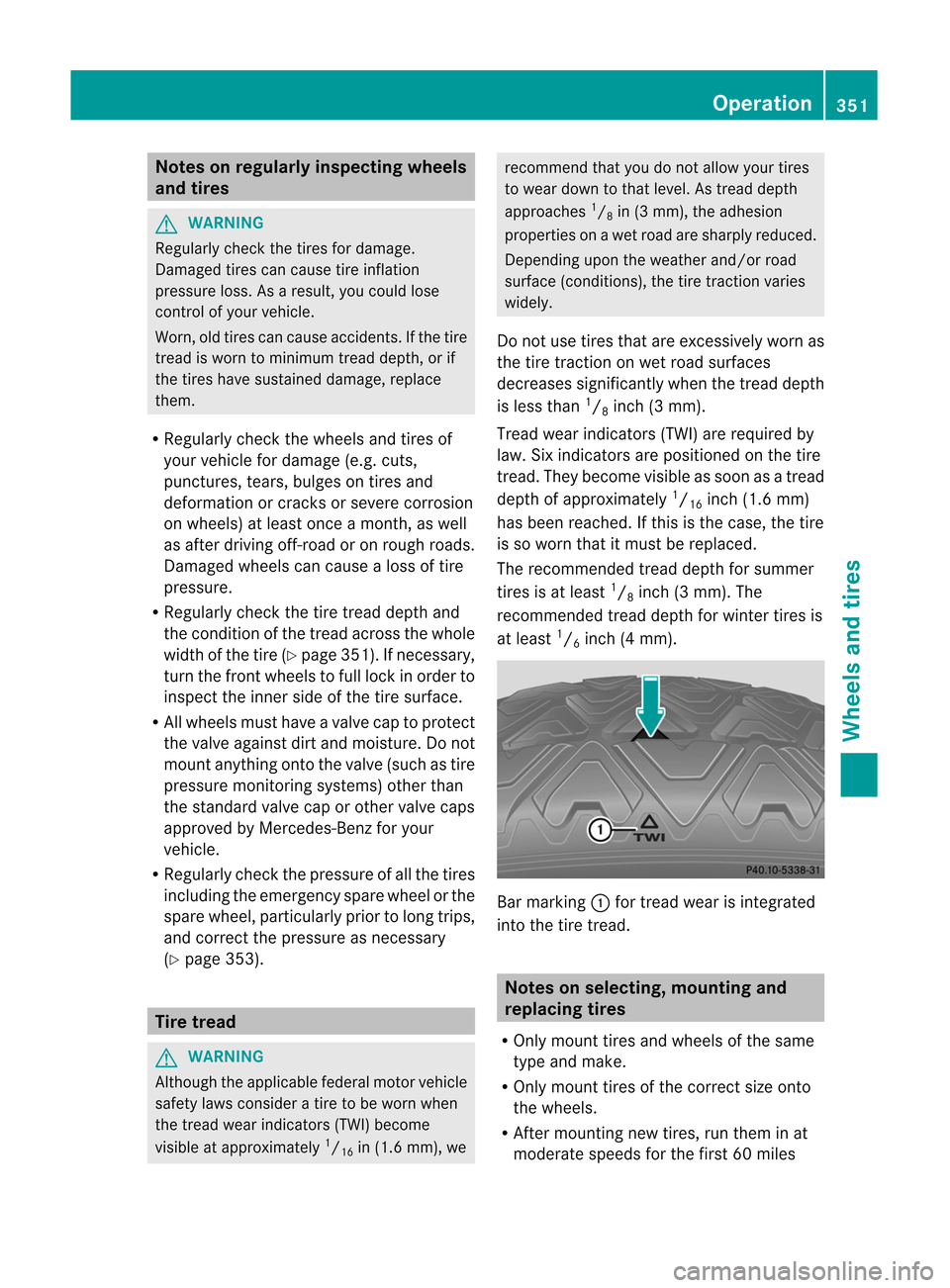
(4mm). Bar
marking :for tread wearisintegrated
into thetire tread. Notes
onselec ting,mounting and
replacing tires
R Only mount tiresandwheels ofthe same
type andmake.
R Only mount tiresofthe correct sizeonto
the wheels.
R Aft ermounting newtires, runthem inat
moderate speedsforthe first 60miles Operat
ion
351Wheels and tires Z
Page 368 of 396
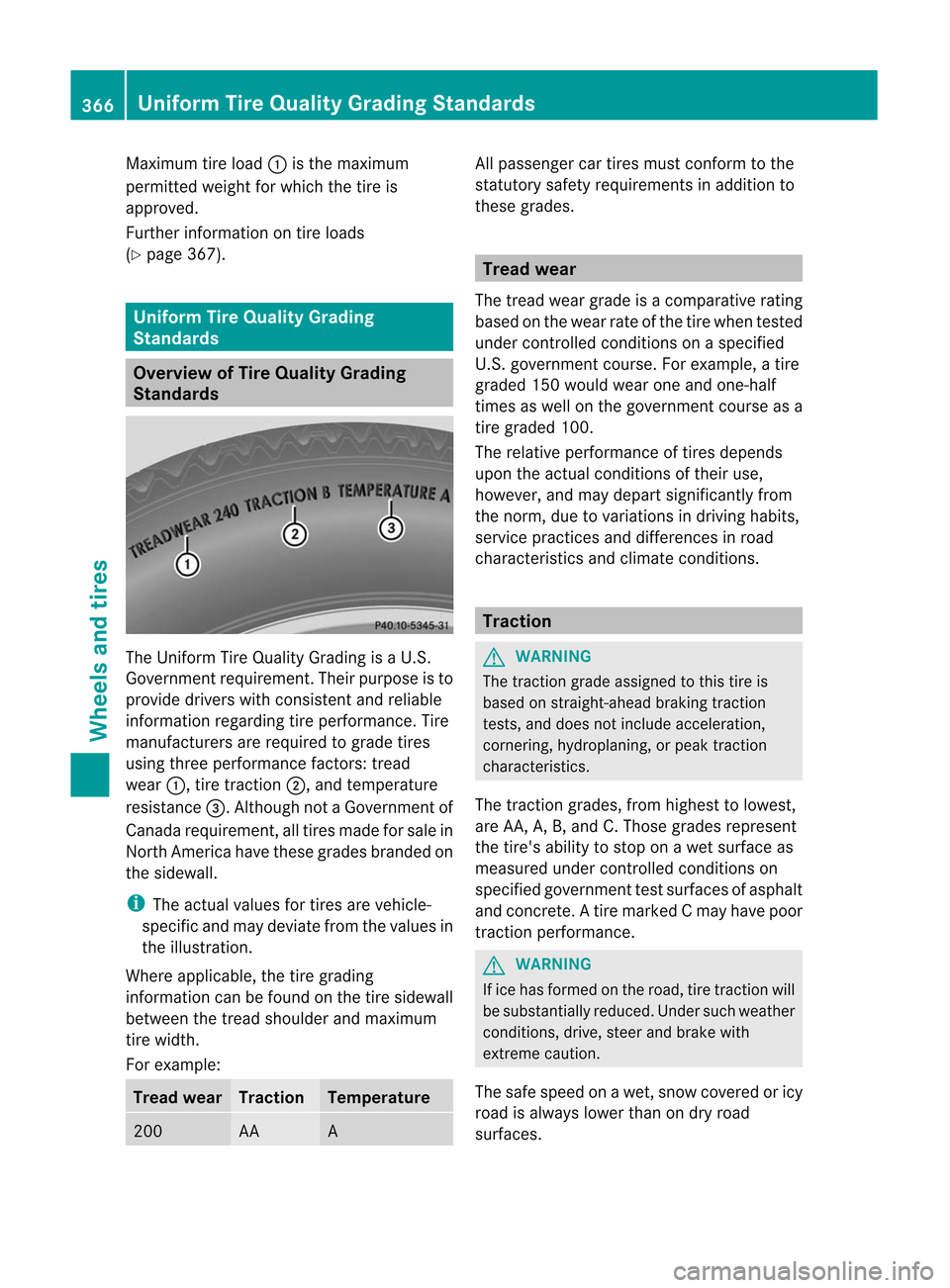
Maximum
tireload :isthe maximum
permitted weightforwhich thetire is
approved.
Further information ontire loads
(Y page 367). Uniform
TireQuality Grading
Stand ards Overview
ofTire Quality Grading
Stand ards The
Uniform TireQuality Grading isaU.S.
Government requirement. Theirpurpose isto
provide driverswithconsist entand reliabl e
information regardingtireperformance. Tire
manufacturers arerequired tograde tires
using threeperformance factors:tread
wear :,tire tract ion;, and temperature
resistance =.Although notaGover nment of
Canada requirement,all tires made forsale in
Nort hAm eric ahave thesegrades brandedon
the sidewall. i
The
actual values fortires are vehic le-
spec ificand may deviat efro mt hevalues in
the illustration .
Where applicable, thetire grading
information canbefound onthe tire sidewa ll
between thetread shoulder andmaximum
tire width.
For example: Tread
wear Tra
ction Temp
erature 200 AA A All
passenger cartires must confor mto the
statutory safetyrequirements inaddition to
these grades. Tread
wear
The tread weargrade isac omparative rating
based onthe wear rateofthe tire when tested
under controlled conditionsonaspecified
U.S. governm entcourse. Forexample, atire
graded 150would wearoneandone-half
times aswell onthe governm entcourse asa
tire graded 100.
The relative performanc eof tires depends
upon theactual conditionsoftheir use,
however, andmay depart significant lyfrom
the norm, duetovariations indriving habits,
service practices anddifferenc esinroad
charact eristics andclimate conditions. Tr
action G
WARNIN
G The
tract iongrade assigned tothis tireis
based onstraight- aheadbraking traction
test s,and does notinclude acceleration,
corn ering, hydroplaning, orpeak traction
character istics.
The tract iongrades, fromhighest tolowest,
are AA, A,B,and C.Those grades represent
the tire's ability tostop onawet surface as
measured undercontrolled conditionson
specified governmenttest surfaces ofasphalt
and conc rete. Atire mark edCmay have poor
tr act ion perf ormance. G
WARN
ING If
ice has formed onthe road, tiretract ion will
be subst antially reduc ed.Und ersuch weathe r
con ditio ns,drive ,ste erand brak ewith
ext reme caution.
The safe speed onawet, snowcov ered oricy
road isalways lowerthanondry road
surf aces. 366
Unifor
mTir eQua lityGrad ing Stand ardsWheels and tires
Page 370 of 396
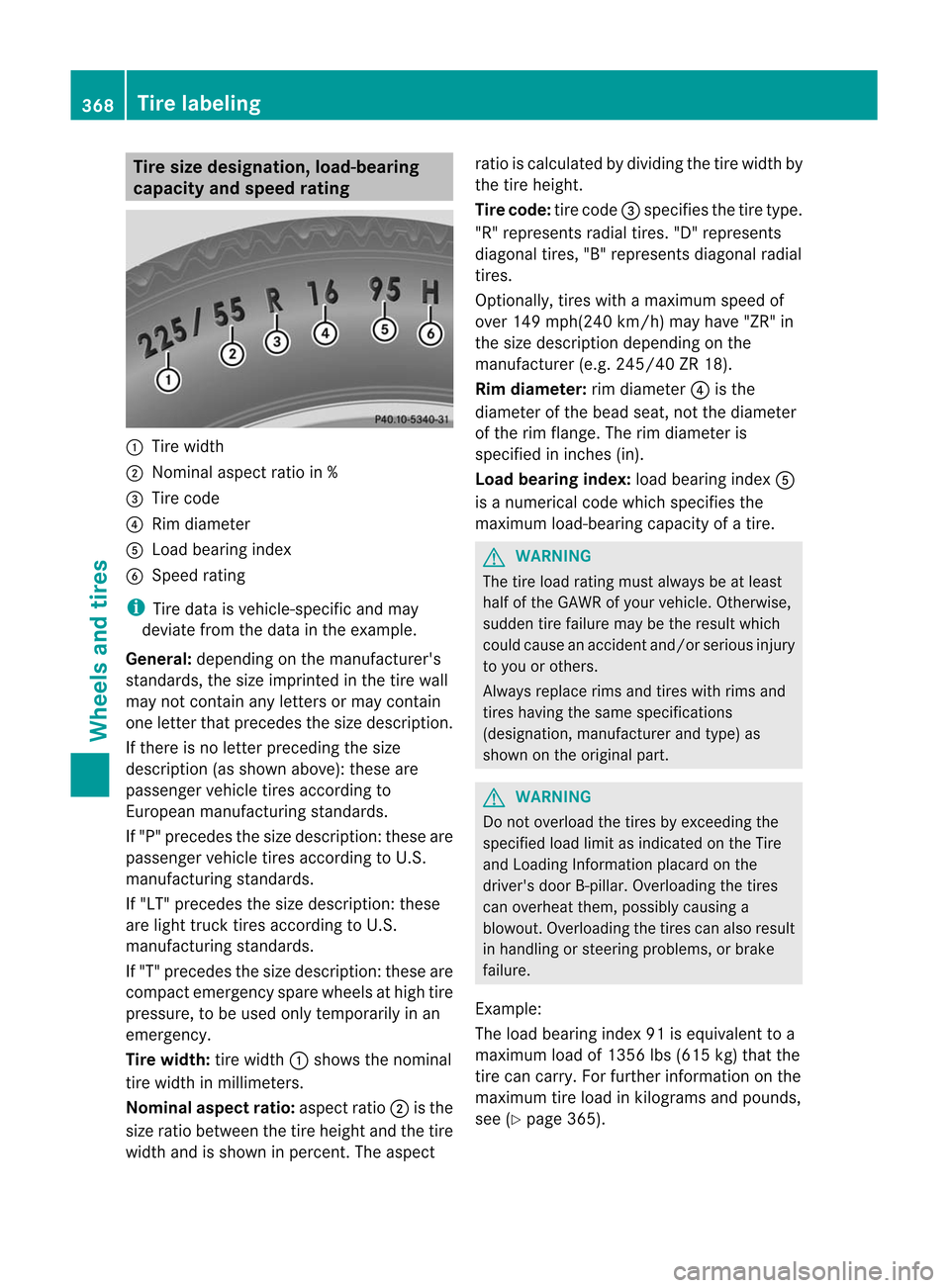
Tire
size des ignati on,load -bea ring
cap acit yand speed ratin g :
Tire width
; Nom inalaspec tratio in%
= Tire code
? Rim diame ter
A Load bearingindex
B Spe edrating i
Tire
datais veh icle-spec ificand may
devi atefrom thedat ain theex ample .
Gener al:depen dingon theman ufacturer's
st and ards ,th esiz eimpr inted inthetir ewall
may notco ntain any letters or may contain
on elet tert hat precedes thesize description.
If there isno letter preceding thesize
description (asshown above): theseare
passenger vehicletiresaccording to
European manufacturing standards.
If "P" precedes thesize description: theseare
passenger vehicletiresaccording toU.S.
manufacturing standards.
If "LT" precedes thesize description: these
are light truck tiresaccording toU.S.
manufacturing standards.
If "T" precedes thesize description: theseare
compact emergency sparewheels athigh tire
pressure, tobe used onlytemporarily inan
emergency.
Tire width: tirewidth :shows thenominal
tire width inmillimeters.
Nominal aspectratio: aspect ratio;isthe
size ratio between thetire height andthetire
width andisshown inpercent .The aspect ratio
iscalculated bydividing thetire width by
the tire height.
Tire code: tirecode =specifies thetire type.
"R" represents radialtires."D"represents
diagonal tires,"B"represents diagonalradial
tires.
Optionally, tireswithamaximum speedof
over 149mph(240 km/h)mayhave "ZR"in
the size description dependingonthe
manufacturer (e.g.245/ 40ZR18).
Rim diamet er:rim diameter ?isthe
diameter ofthe bead seat,notthediameter
of the rim flange. Therimdiameter is
specified ininches (in).
Load bearing index:loadbearing indexA
is anumerical codewhich specifies the
maximum load-bearing capacityofatire. G
WARNING The
tireload rating mustalwaysbe atleast
half ofthe GAWR ofyour vehicle. Otherwise,
sudden tirefailure maybethe result which
could cause anaccident and/orserious injury
to you orothers.
Always replace rimsandtires withrims and
tires having thesame specifications
(designation, manufacturer andtype) as
shown onthe original part. G
WARNING Do
not overload thetires byexceeding the
specified loadlimit asindicated onthe Tire
and Loading Informationplacard onthe
driver's doorB-pillar. Overloading thetires
can overheat them,possibly causinga
blowou t.Overloading thetires canalso result
in handling orsteering problems, orbrake
failure.
Example:
The load bearing index91isequiva lenttoa
maximum loadof1356 lbs(615 kg)that the
tire can carry. Forfurther information onthe
maximum tireload inkilograms andpounds,
see (Ypage 365). 368
Tire
labeli ngWheels and tires