light MERCEDES-BENZ M-Class 2015 W166 User Guide
[x] Cancel search | Manufacturer: MERCEDES-BENZ, Model Year: 2015, Model line: M-Class, Model: MERCEDES-BENZ M-Class 2015 W166Pages: 466, PDF Size: 8.92 MB
Page 21 of 466
In the Instrument cluster .................35
Segments ...................................... 267
Selecting the unit of measure-
ment .............................................. 277
see Instrument cluster
Standing lamps
Changing bulb s.............................. 131
Display message ............................ 299
Switching on/of f........................... 123
Start/stop function
see ECO start/stop function
Starting (engine) ................................ 159
STEER CONTROL .................................. 77
Steering (display message) .............. 316
Steering wheel Adjusting (electrically) ................... 112
Adjusting (manually) ...................... 111
Button overview ............................... 37
Buttons (on-board computer) ......... 267
Cleaning ......................................... 378
Important safety notes .................. 111
Paddle shifters ............................... 172
Steering wheel heating .................. 112
Storing settings (memory func-
tion) ............................................... 116
Steering wheel heating
Problem (malfunction) ................... 113
Switching on/of f........................... 112
Steering wheel paddle shifters ........ 172
Stopwatch (RACETIMER) ................... 282
Stowage areas ................................... 334
Stowage compartments Armrest (under) ............................. 336
Center console .............................. 336
Center console (rear) ..................... 336
Cup holders ................................... 345
Eyeglasses compartment ............... 336
Glove box ....................................... 335
Important safety information ......... 335
Stowage net ................................... 337
Stowage net ....................................... 337
Summer tires ..................................... 402
Sun visor ............................................ 347
Surround lighting (on-board com-
puter) .................................................. 278 Suspension tuning
AMG adaptive sport suspension
system ........................................... 216
SETUP (on-board computer) .......... 281
SUV
(Sport Utility Vehicle) ....................... 27
Switching air-recirculation mode
on/off ................................................. 151 T
Tachometer ........................................ 267
Tailgate Display message ............................ 316
Emergency unlocking ....................... 93
Important safety notes .................... 89
Limiting the opening angle ............... 93
Opening/closing (automatically
from inside) ...................................... 92
Opening/closing (automatically
from outside) ................................... 91
Opening/closing (from outside) ....... 90
Opening dimensions ...................... 456
Power closing .................................. 88
Tail lamps
Display message ............................ 298
Tank
see Fuel tank
Tank content
Fuel gauge ....................................... 35
Technical data
Capacities ...................................... 447
Emergency spare wheel ................. 443
Information .................................... 446
Tires/wheels ................................. 428
Trailer load s................................... 460
Vehicle data ................................... 456
TELEAID
Call priority .................................... 356
Downloading destinations
(COMAND) ..................................... 356
Downloading routes ....................... 359
Emergency call .............................. 353
General notes ................................ 352
Geo fencing ................................... 360
Locating a stolen vehicle ............... 358
MB info call button ........................ 355
Remote vehicle locking .................. 358 Index
19
Page 36 of 466
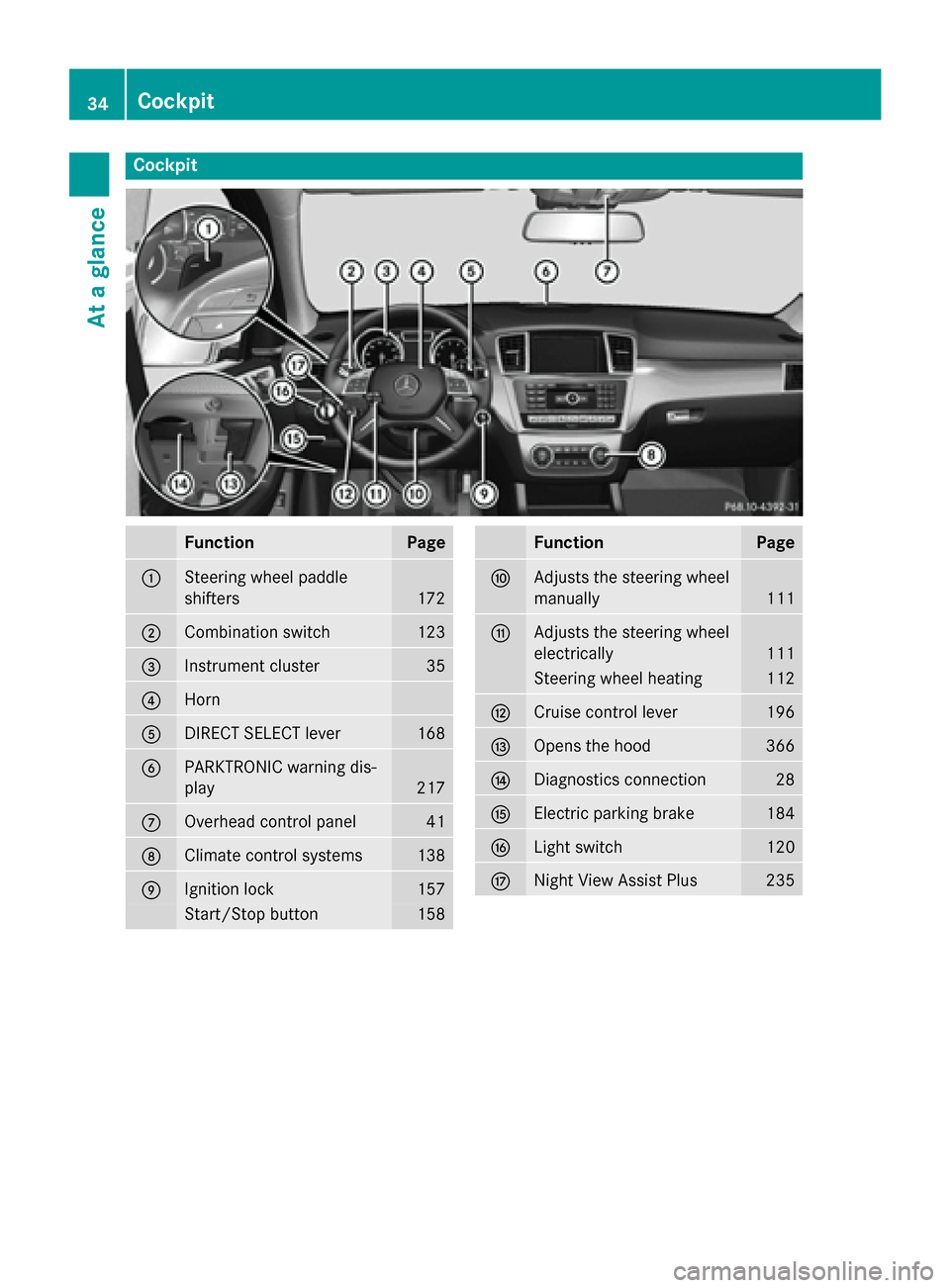
Cockpit
Function Page
0043
Steering wheel paddle
shifters
172
0044
Combination switch 123
0087
Instrument cluster 35
0085
Horn
0083
DIRECT SELECT lever 168
0084
PARKTRONIC warning dis-
play
217
006B
Overhead control panel 41
006C
Climate control systems 138
006D
Ignition lock 157
Start/Stop button 158 Function Page
006E
Adjusts the steering wheel
manually
111
006F
Adjusts the steering wheel
electrically
111
Steering wheel heating 112
0070
Cruise control lever 196
0071
Opens the hood 366
0072
Diagnostics connection 28
0073
Electric parking brake 184
0074
Light switch 120
0075
Night View Assist Plus 23534
CockpitAt a glance
Page 37 of 466
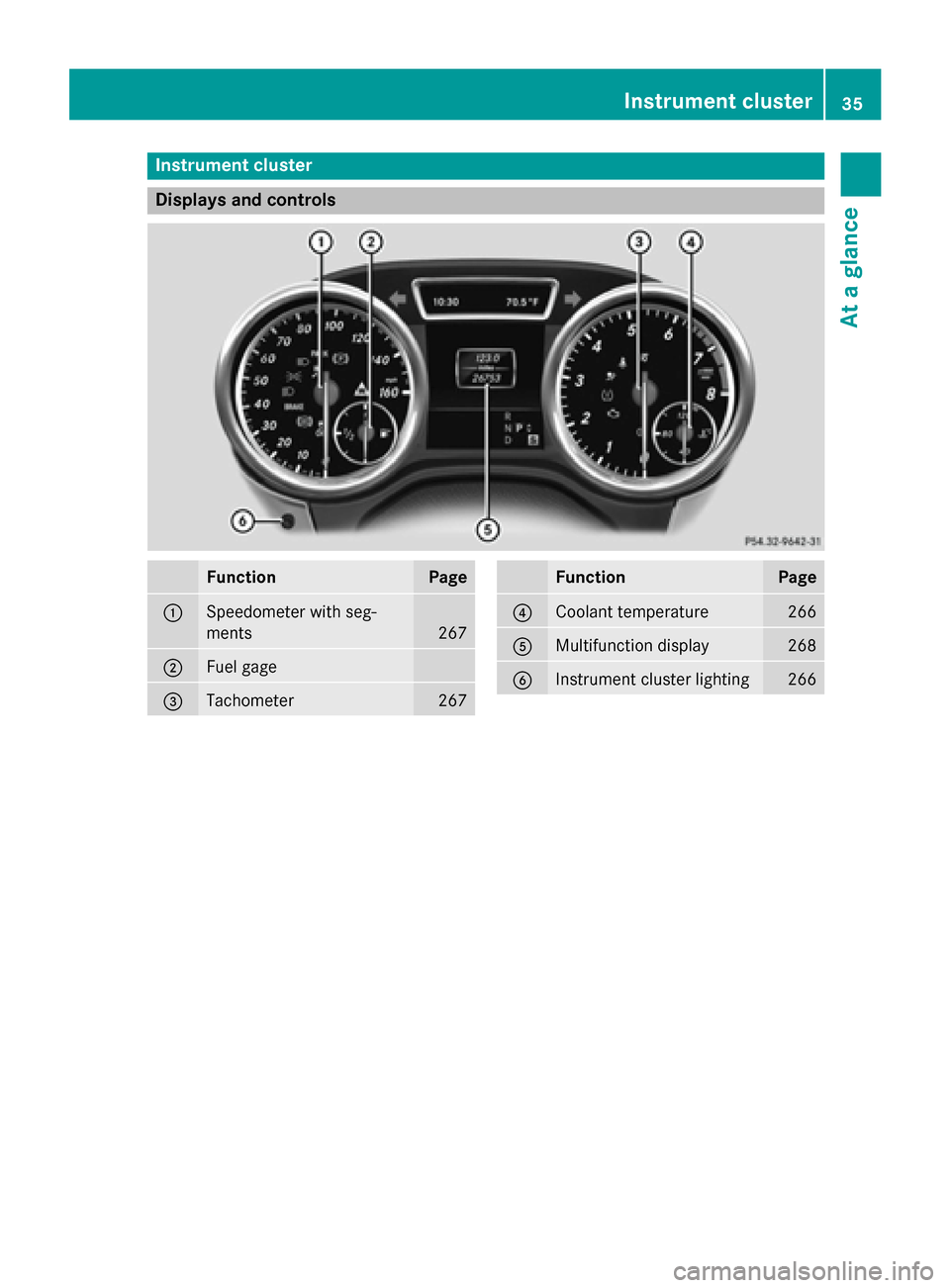
Instrument cluster
Displays and controls
Function Page
0043
Speedometer with seg-
ments
267
0044
Fuel gage
0087
Tachometer 267 Function Page
0085
Coolant temperature 266
0083
Multifunction display 268
0084
Instrument cluster lighting 266Instrument cluster
35At a glance
Page 41 of 466
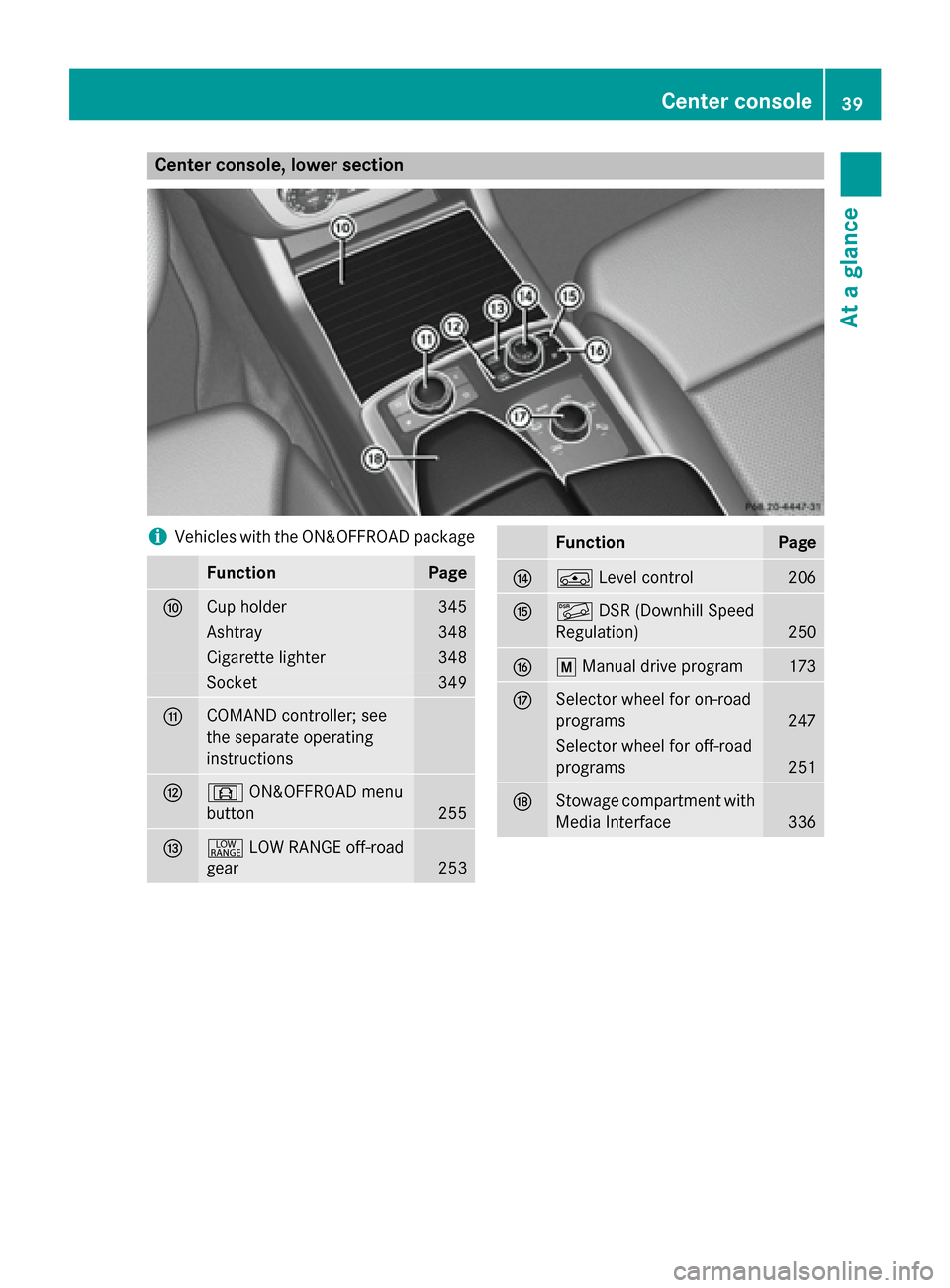
Center console, lower section
i
Vehicles with the ON&OFFROAD package Function Page
006E
Cup holder 345
Ashtray 348
Cigarette lighter 348
Socket 349
006F
COMAND controller; see
the separate operating
instructions
0070
0090
ON&OFFROAD menu
button 255
0071
002E
LOW RANGE off-road
gear 253 Function Page
0072
00C4
Level control 206
0073
00C6
DSR (Downhill Speed
Regulation) 250
0074
0063
Manual drive program 173
0075
Selector wheel for on-road
programs
247
Selector wheel for off-road
programs
251
0076
Stowage compartment with
Media Interface 336Center console
39At a glance
Page 42 of 466
i
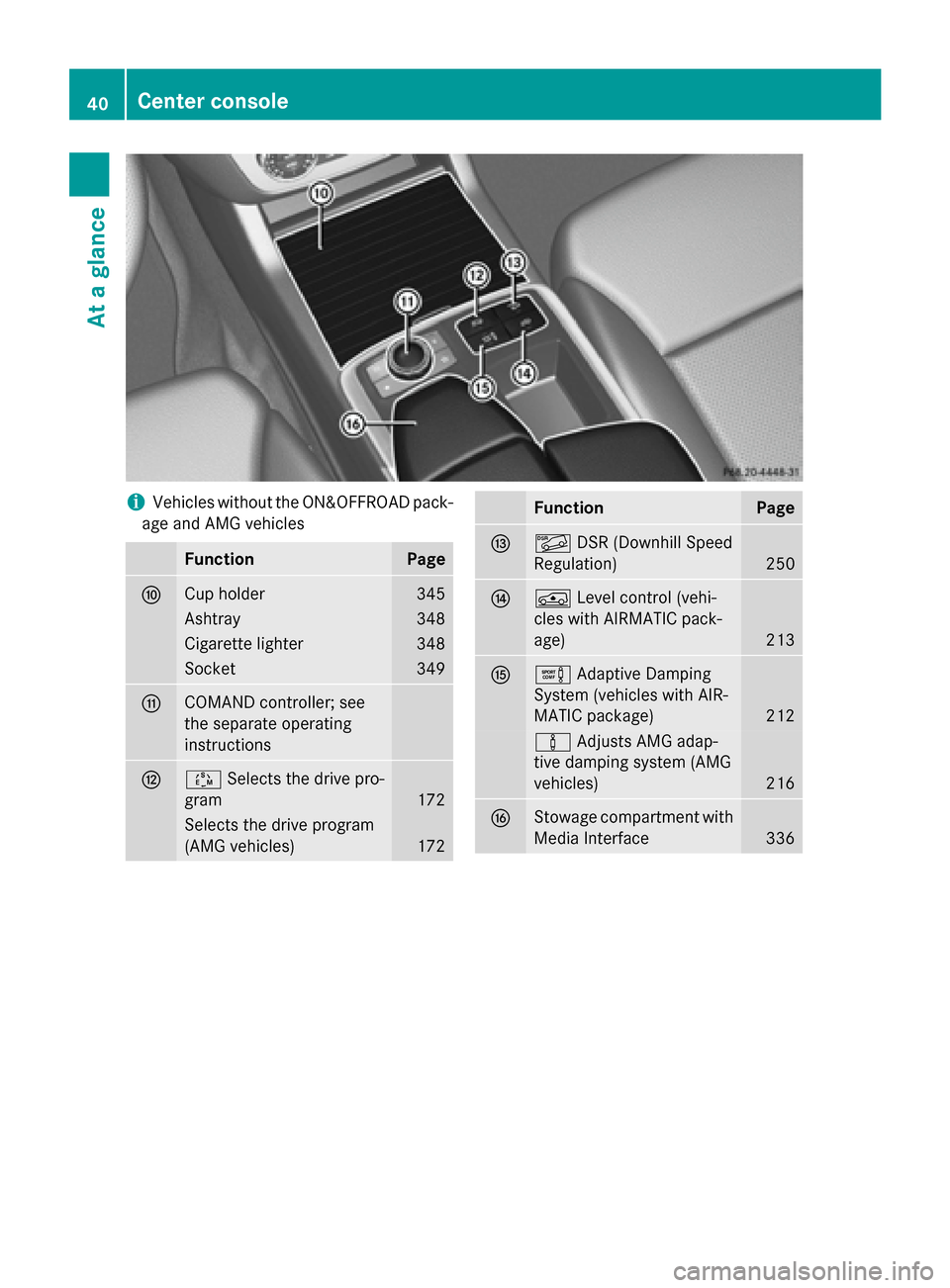
Vehicles without the ON&OFFROAD pack-
age and AMG vehicles Function Page
006E
Cup holder 345
Ashtray 348
Cigarette lighter 348
Socket 349
006F
COMAND controller; see
the separate operating
instructions
0070
00C8
Selects the drive pro-
gram 172
Selects the drive program
(AMG vehicles)
172 Function Page
0071
00C6
DSR (Downhill Speed
Regulation) 250
0072
00C4
Level control (vehi-
cles with AIRMATIC pack-
age) 213
0073
0091
Adaptive Damping
System (vehicles with AIR-
MATIC package) 212
00CC
Adjusts AMG adap-
tive damping system (AMG
vehicles) 216
0074
Stowage compartment with
Media Interface 33640
Center consoleAt a glance
Page 43 of 466
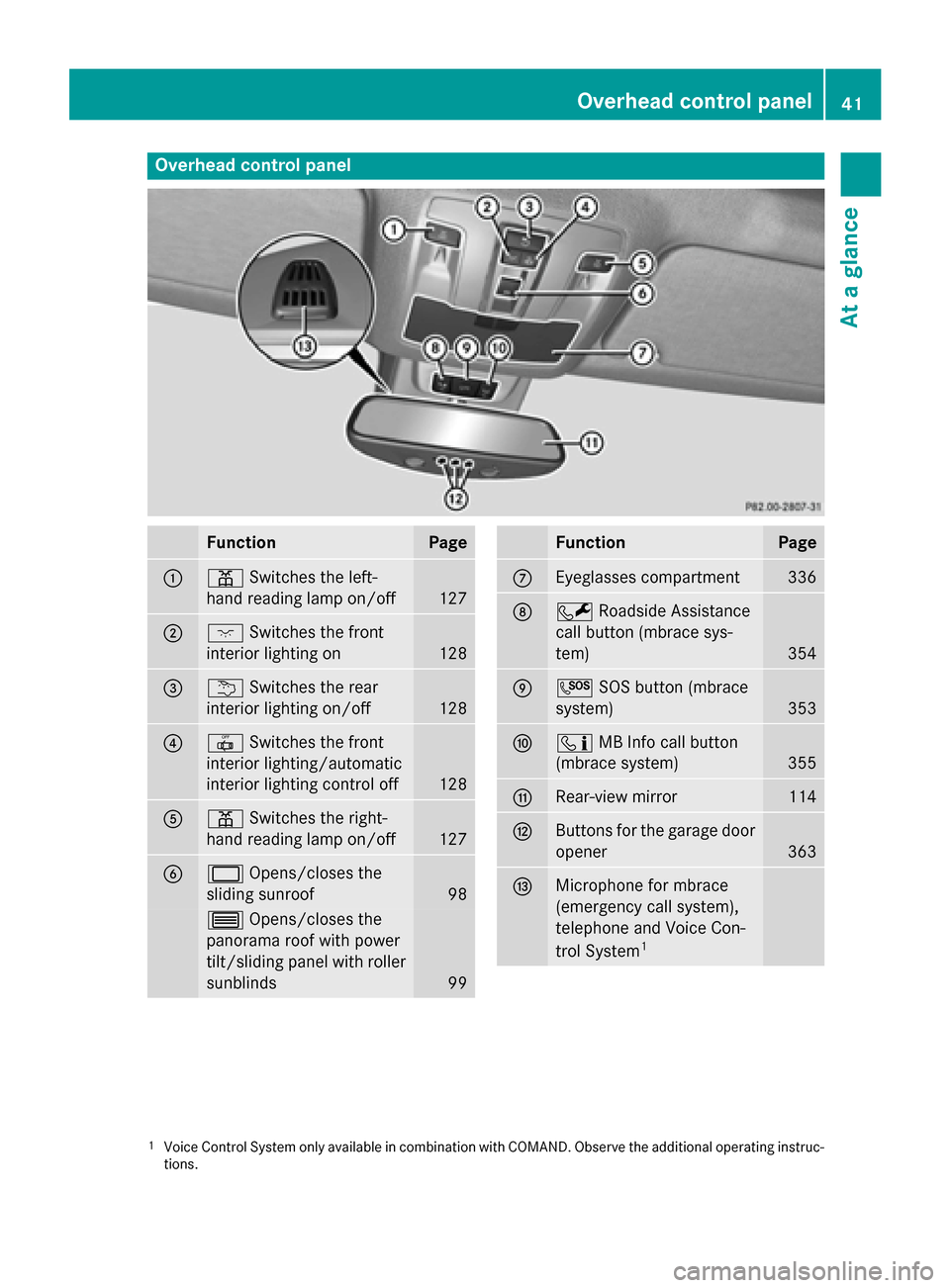
Overhead control panel
Function Page
0043
003D
Switches the left-
hand reading lamp on/off 127
0044
004A
Switches the front
interior lighting on 128
0087
0042
Switches the rear
interior lighting on/off 128
0085
0033
Switches the front
interior lighting/automatic
interior lighting control off 128
0083
003D
Switches the right-
hand reading lamp on/off 127
0084
0056
Opens/closes the
sliding sunroof 98
0057
Opens/closes the
panorama roof with power
tilt/sliding panel with roller sunblinds 99 Function Page
006B
Eyeglasses compartment 336
006C
0052
Roadside Assistance
call button (mbrace sys-
tem) 354
006D
0053
SOS button (mbrace
system) 353
006E
00D9
MB Info call button
(mbrace system) 355
006F
Rear-view mirror 114
0070
Buttons for the garage door
opener 363
0071
Microphone for mbrace
(emergency call system),
telephone and Voice Con-
trol System
1 1
Voice Control System only available in combination with COMAND. Observe the additional operating instruc-
tions. Overhead control panel
41At a glance
Page 46 of 466
Useful information
i This Operator's Manual describes all
models and all standard and optional equip- ment of your vehicle available at the time of
publication of the Operator's Manual.
Country-specific differences are possible.
Please note that your vehicle may not be
equipped with all features described. This
also applies to safety-related systems and
functions.
i Read the information on qualified special-
ist workshops (Y page 29). Panic alarm
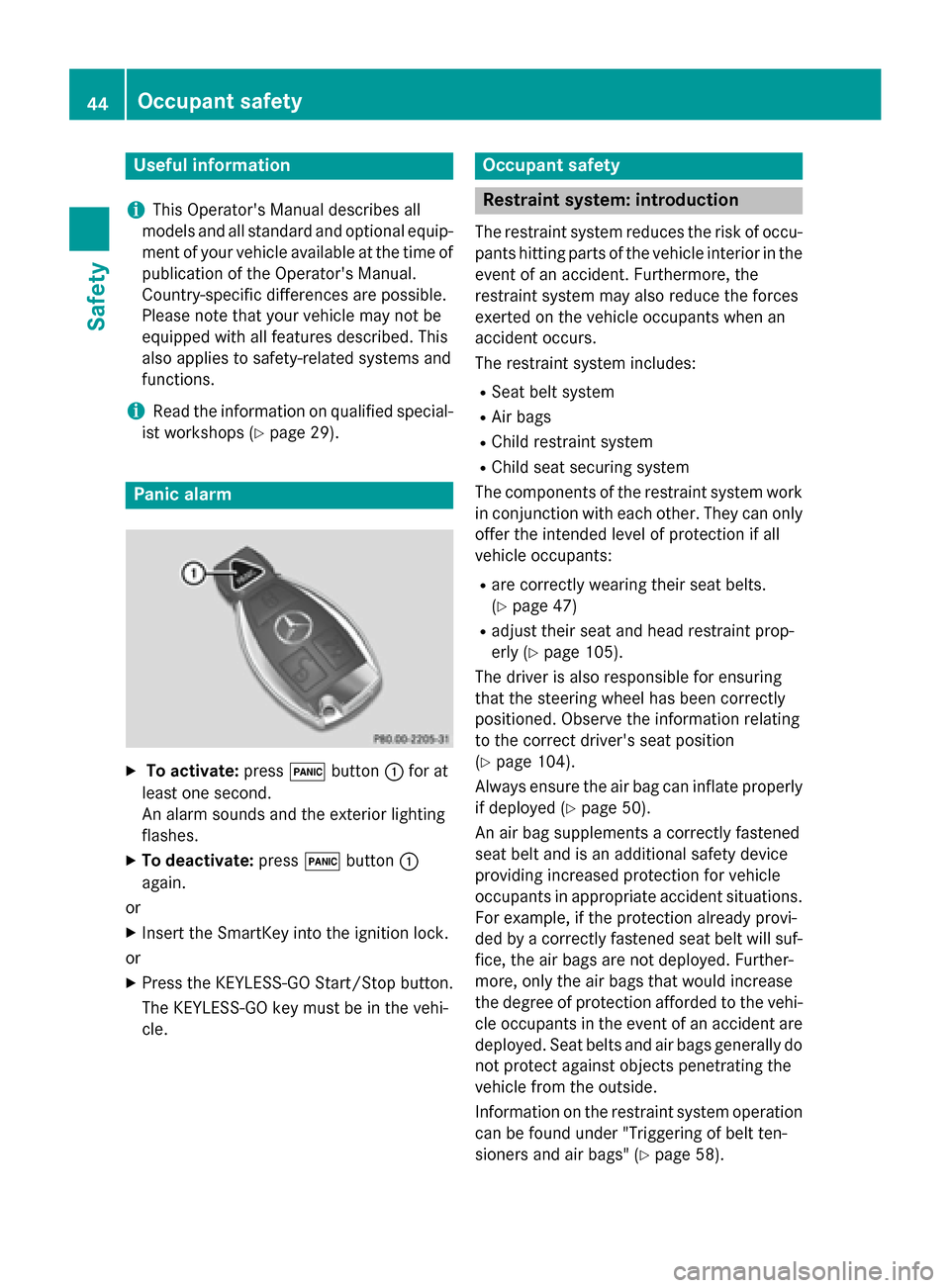
X
To activate: press0033button 0043for at
least one second.
An alarm sounds and the exterior lighting
flashes.
X To deactivate: press0033button 0043
again.
or
X Insert the SmartKey into the ignition lock.
or X Press the KEYLESS-GO Start/Stop button.
The KEYLESS-GO key must be in the vehi-
cle. Occupant safety
Restraint system: introduction
The restraint system reduces the risk of occu-
pants hitting parts of the vehicle interior in the
event of an accident. Furthermore, the
restraint system may also reduce the forces
exerted on the vehicle occupants when an
accident occurs.
The restraint system includes:
R Seat belt system
R Air bags
R Child restraint system
R Child seat securing system
The components of the restraint system work
in conjunction with each other. They can only
offer the intended level of protection if all
vehicle occupants:
R are correctly wearing their seat belts.
(Y page 47)
R adjust their seat and head restraint prop-
erly (Y page 105).
The driver is also responsible for ensuring
that the steering wheel has been correctly
positioned. Observe the information relating
to the correct driver's seat position
(Y page 104).
Always ensure the air bag can inflate properly if deployed (Y page 50).
An air bag supplements a correctly fastened
seat belt and is an additional safety device
providing increased protection for vehicle
occupants in appropriate accident situations.
For example, if the protection already provi-
ded by a correctly fastened seat belt will suf-
fice, the air bags are not deployed. Further-
more, only the air bags that would increase
the degree of protection afforded to the vehi- cle occupants in the event of an accident are deployed. Seat belts and air bags generally do
not protect against objects penetrating the
vehicle from the outside.
Information on the restraint system operation can be found under "Triggering of belt ten-
sioners and air bags" (Y page 58).44
Occupant safetySafety
Page 47 of 466
See “Children in the vehicle” for information
on children traveling with you as well as vehi-
cle restraint systems (Y page 61).Important safety notes
G
WARNING
Modifications to the restraint system may
cause it to no longer work as intended. The
restraint system may then not perform its
intended protective function and may fail in an accident or trigger unexpectedly, for example.
This poses an increased risk of injury or even fatal injury.
Never modify parts of the restraint system.
Never tamper with the wiring, the electronic
components or their software.
If it is necessary to modify an air bag system to
accommodate a person with disabilities, con- tact an authorized Mercedes-Benz Center for
details. USA only: for further information con- tact our Customer Assistance Center at
1-800-FOR-MERCedes (1‑800‑ 367‑6372). Restraint system warning lamp
The functions of the restraint system are
checked after the ignition is switched on and
at regular intervals while the engine is run-
ning. Therefore, malfunctions can be detec-
ted in good time.
The 0075 restraint system warning lamp in
the instrument cluster lights up when the igni- tion is switched on. It goes out no later than afew seconds after the engine is started. The
components of the restraint system are in
operational readiness.
A malfunction has occurred if the 0075
restraint system warning lamp:
R does not light up after the ignition is
switched on
R does not go out after a few seconds with
the engine running
R lights up again while the engine is running G
WARNING
If restraint system is malfunctioning, restraint system components may be triggered unin-
tentionally or might not be triggered at all in
the event of an accident with a high rate of
vehicle deceleration. This can affect the Emer- gency Tensioning Device or air bag, for exam-
ple. This poses an increased risk of injury or
even fatal injury.
Have the restraint system checked and
repaired in a qualified specialist workshop as
soon as possible. PASSENGER AIR BAG OFF indicator
lamp
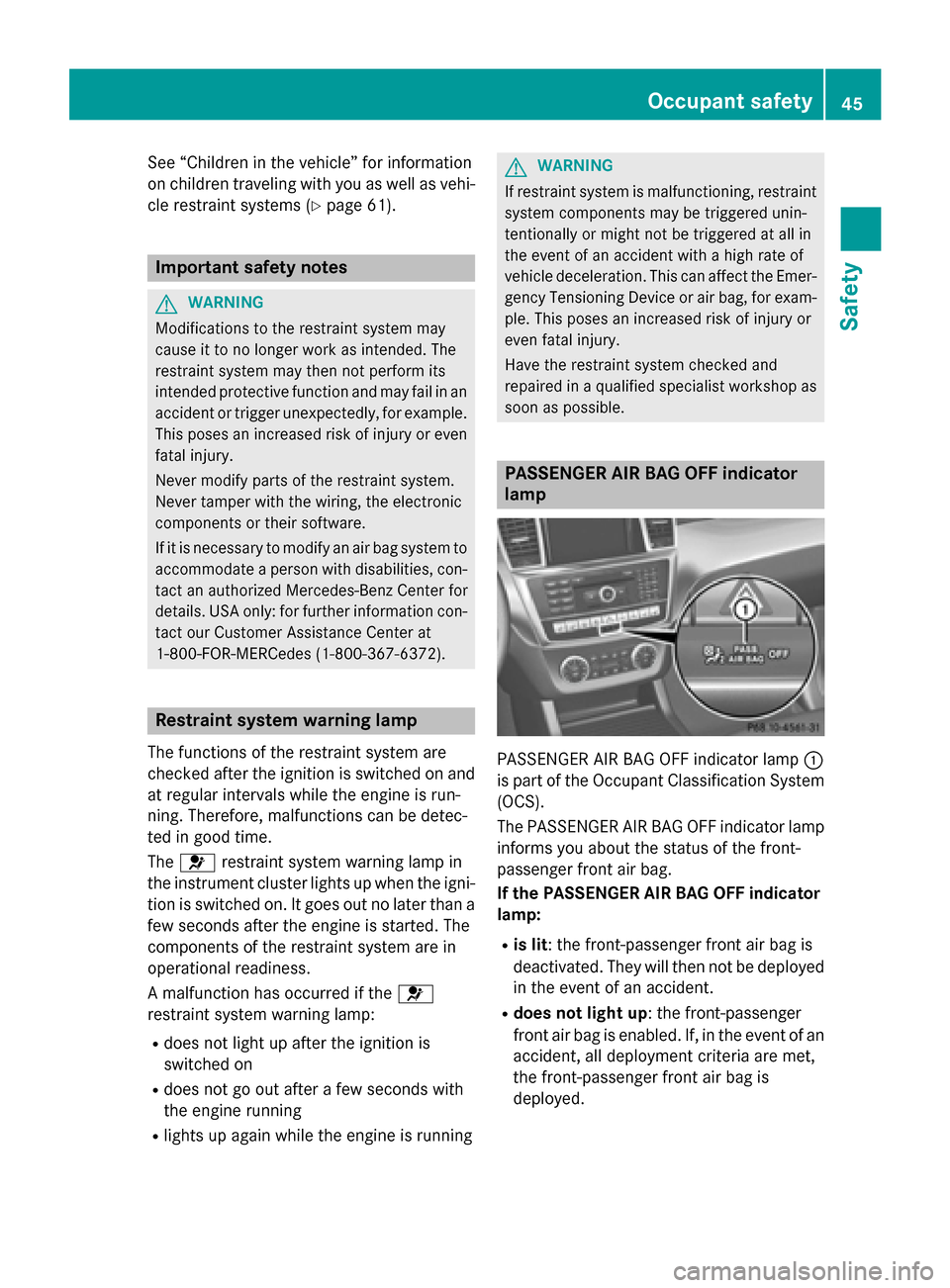
PASSENGER AIR BAG OFF indicator lamp
0043
is part of the Occupant Classification System (OCS).
The PASSENGER AIR BAG OFF indicator lamp
informs you about the status of the front-
passenger front air bag.
If the PASSENGER AIR BAG OFF indicator
lamp:
R is lit : the front-passenger front air bag is
deactivated. They will then not be deployed
in the event of an accident.
R does not light up: the front-passenger
front air bag is enabled. If, in the event of an
accident, all deployment criteria are met,
the front-passenger front air bag is
deployed. Occupant safety
45Safety Z
Page 51 of 466
The shoulder section of the seat belt must
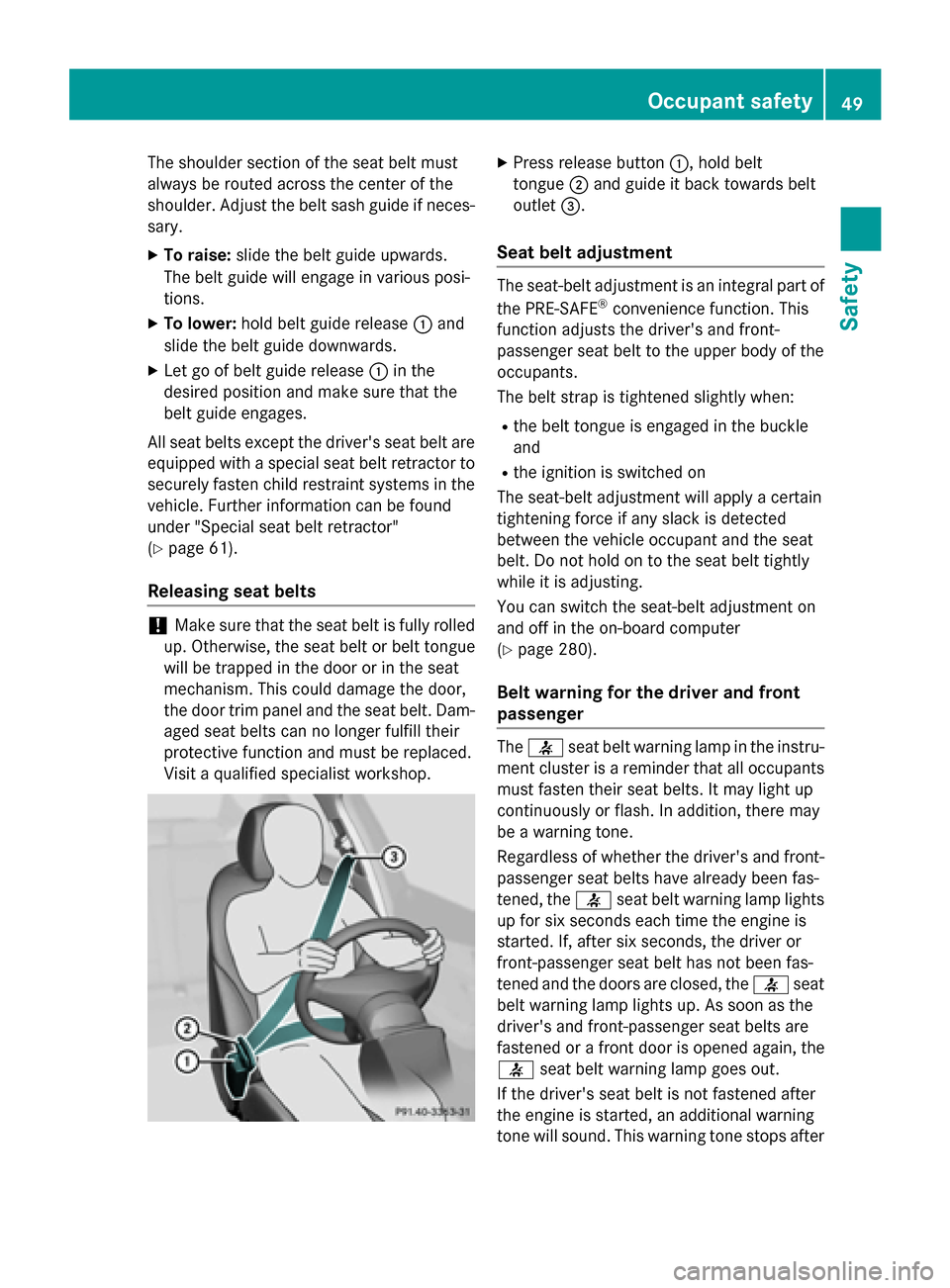
always be routed across the center of the
shoulder. Adjust the belt sash guide if neces-
sary.
X To raise: slide the belt guide upwards.
The belt guide will engage in various posi-
tions.
X To lower: hold belt guide release 0043and
slide the belt guide downwards.
X Let go of belt guide release 0043in the
desired position and make sure that the
belt guide engages.
All seat belts except the driver's seat belt are equipped with a special seat belt retractor to
securely fasten child restraint systems in the
vehicle. Further information can be found
under "Special seat belt retractor"
(Y page 61).
Releasing seat belts !
Make sure that the seat belt is fully rolled
up. Otherwise, the seat belt or belt tongue
will be trapped in the door or in the seat
mechanism. This could damage the door,
the door trim panel and the seat belt. Dam-
aged seat belts can no longer fulfill their
protective function and must be replaced.
Visit a qualified specialist workshop. X
Press release button 0043, hold belt
tongue 0044and guide it back towards belt
outlet 0087.
Seat belt adjustment The seat-belt adjustment is an integral part of
the PRE-SAFE ®
convenience function. This
function adjusts the driver's and front-
passenger seat belt to the upper body of the
occupants.
The belt strap is tightened slightly when:
R the belt tongue is engaged in the buckle
and
R the ignition is switched on
The seat-belt adjustment will apply a certain
tightening force if any slack is detected
between the vehicle occupant and the seat
belt. Do not hold on to the seat belt tightly
while it is adjusting.
You can switch the seat-belt adjustment on
and off in the on-board computer
(Y page 280).
Belt warning for the driver and front
passenger The
0076 seat belt warning lamp in the instru-
ment cluster is a reminder that all occupants
must fasten their seat belts. It may light up
continuously or flash. In addition, there may
be a warning tone.
Regardless of whether the driver's and front- passenger seat belts have already been fas-
tened, the 0076seat belt warning lamp lights
up for six seconds each time the engine is
started. If, after six seconds, the driver or
front-passenger seat belt has not been fas-
tened and the doors are closed, the 0076seat
belt warning lamp lights up. As soon as the
driver's and front-passenger seat belts are
fastened or a front door is opened again, the
0076 seat belt warning lamp goes out.
If the driver's seat belt is not fastened after
the engine is started, an additional warning
tone will sound. This warning tone stops after Occupant safety
49Safety Z
Page 56 of 466
ton once or twice on vehicles with KEY-
LESS-GO.
The system carries out a self-diagnosis.
The PASSENGER AIR BAG OFF indicator lamp
must light up for approximately six second s.
The PA SSENGER AIR BAG OFF indicator lamp
then displays the status of the front-
passenger front air bag. If the status of the
front-passenger front air bag changes while
the vehicle is in motion, an air bag display
message may appear in the instrument clus-
ter (Y page 295). When the front-passenger
seat is occupied, always pay attention to the
PASSENGER AIR BAG OFF indicator lamp. Be aware of the status of the front-passenger
front air bag both before and during the jour-ney.
If the PASSENGER AIR BAG OFF indicator
lamp:
R is lit, the front-passenger front air bag is
deactivated. They will then not be deployed in the event of an accident.
R does not light up: the front-passenger
front air bag is enabled. If, in the event of an
accident, all deployment criteria are met,
the front-passenger front air bag is
deployed. G
WARNING
If the PASSENGER AIR BAG OFF indicator
lamp is lit, the front-passenger front air bag is disabled. It will not be deployed in the event of
an accident and cannot perform its intended
protective function. A person in the front-
passenger seat could then, for example, come
into contact with the vehicle's interior, espe-
cially if the person is sitting too close to the
dashboard. This poses an increased risk of
injury or even fatal injury.
When the front-passenger seat is occupied,
always ensure that:
R the classification of the person in the front-
passenger seat is correct and the front-
passenger front air bag is enabled or disa- bled in accordance with the person in the
front-passenger seat
R the front-passenger seat has been moved
back as far back as possible.
R the person is seated correctly.
Make sure, both before and during the jour-
ney, that the status of the front-passenger
front air bag is correct. G
WARNING
If you secure a child in a child restraint system on the front-passenger seat and the
PASSENGER AIR BAG OFF indicator lamp is
off, the front-passenger front air bag can
deploy in the event of an accident. The child
could be struck by the air bag. This poses an
increased risk of injury or even fatal injury.
Make sure that the front-passenger front air
bag has been disabled. The PASSENGER AIR
BAG OFF indicator lamp must be lit. G
WARNING
If you secure a child in a forward-facing child
restraint system on the front-passenger seat
and you position the front-passenger seat too close to the dashboard, the child could, in the
event of an accident:
R come into contact with the vehicle's inte-
rior if the PASSENGER AIR BAG OFF indi-
cator lamp is lit, for example
R be struck by the air bag if the PASSENGER
AIR BAG OFF indicator lamp is off
This poses an increased risk of injury or even
fatal injury.
Move the front-passenger seat as far back as possible. Always make sure that the shoulder
belt strap is correctly routed from the vehicle
belt sash guide to the shoulder belt guide on
the child restraint system. The shoulder belt
strap must be routed forwards and down-
wards from the vehicle belt sash guide. If nec- essary, adjust the vehicle belt sash guide and
the front-passenger seat accordingly. Always
observe the child restraint system manufac-
turer's installation instructions. 54
Occupant safetySafety