warning MERCEDES-BENZ M-CLASS SUV 2011 Owners Manual
[x] Cancel search | Manufacturer: MERCEDES-BENZ, Model Year: 2011, Model line: M-CLASS SUV, Model: MERCEDES-BENZ M-CLASS SUV 2011Pages: 389, PDF Size: 9.22 MB
Page 342 of 389
the whee
lthat is diagona llyo pposite the
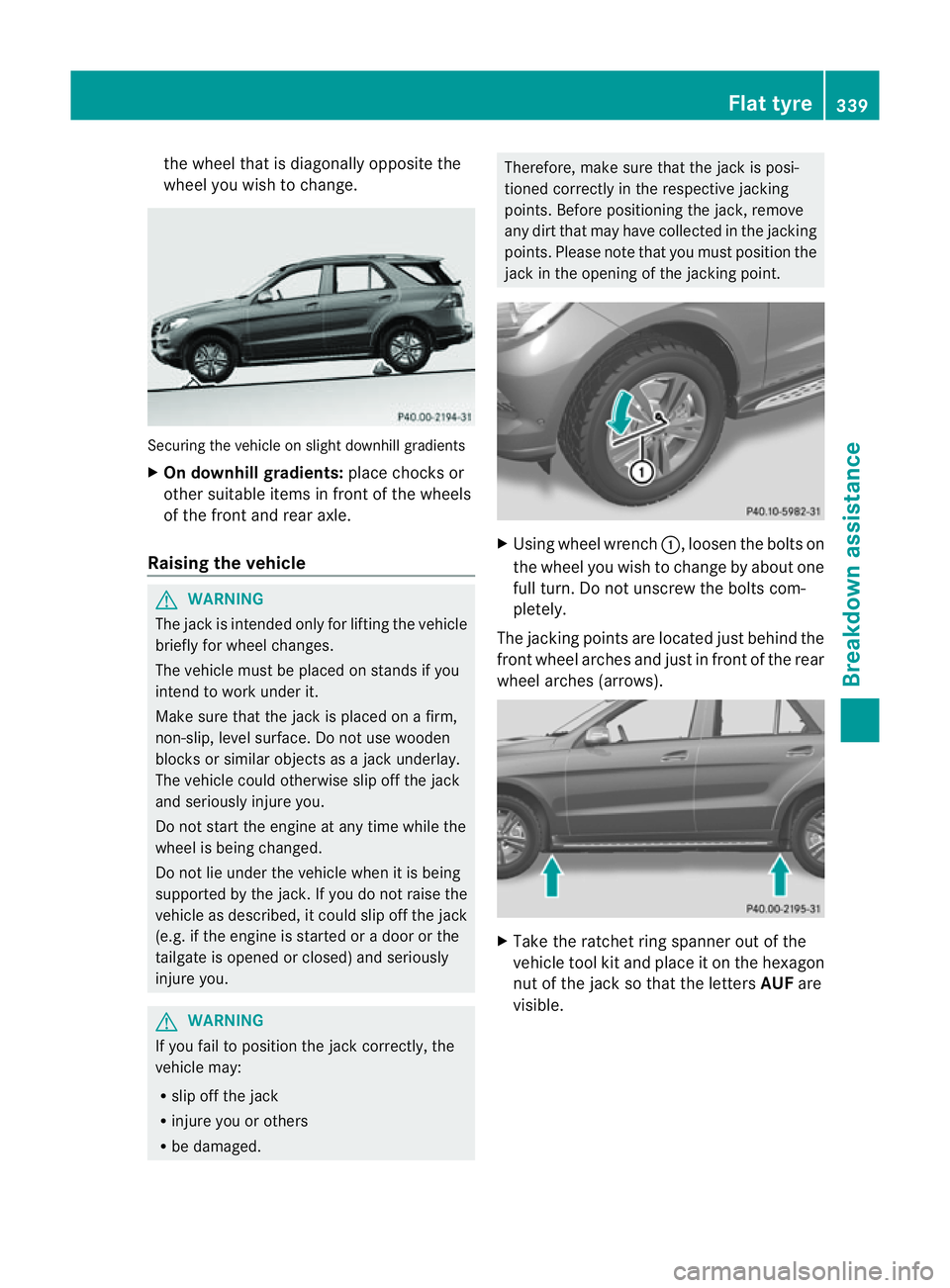
wheel you wish to change. Securing the vehicle on slight downhil
lgradients
X On downhill gradients: place chocks or
othe rsuitabl eitems in front of the wheels
of the front and rear axle.
Raisin gthe vehicle G
WARNING
Th ejack is intended only for lifting the vehicle
briefly for wheel changes.
The vehicle must be placed on stands if you
intend to work under it.
Make sure that the jack is placed on afirm,
non-slip, level surface. Do not use wooden
blocks or similar objects as ajack underlay.
The vehicle could otherwise slip off the jack
and seriousl yinjure you.
Do not start the engine at any time whil ethe
wheel is being changed.
Do not lie unde rthe vehicle when it is being
supported by the jack. If you do not raise the
vehicle as described, it coul dslip off the jack
(e.g. if the engine is started or adoor or the
tailgate is opened or closed) and seriously
injure you. G
WARNING
If you fai ltoposition the jac kcorrectly, the
vehicle may:
R slip off the jack
R injure you or others
R be damaged. Therefore, mak
esure that the jack is posi-
tioned correctly in the respective jacking
points. Before positioning the jack, remove
any dirt that may have collected in the jacking
points. Pleas enote that you must position the
jac kint he openin gofthe jackin gpoint. X
Usin gwheel wrench :,loosen the bolts on
the wheel you wish to change by about one
full turn. Do not unscrew th ebolts com-
pletely.
The jacking points are locate djustb ehind the
fron twheel arches and just in front of the rear
wheel arches (arrows). X
Take the ratchet ring spanner out of the
vehicle tool kit and plac eitont he hexagon
nut of the jac ksothat the letters AUFare
visible. Flat ty
re
339Breakd ownassistance Z
Page 343 of 389
X
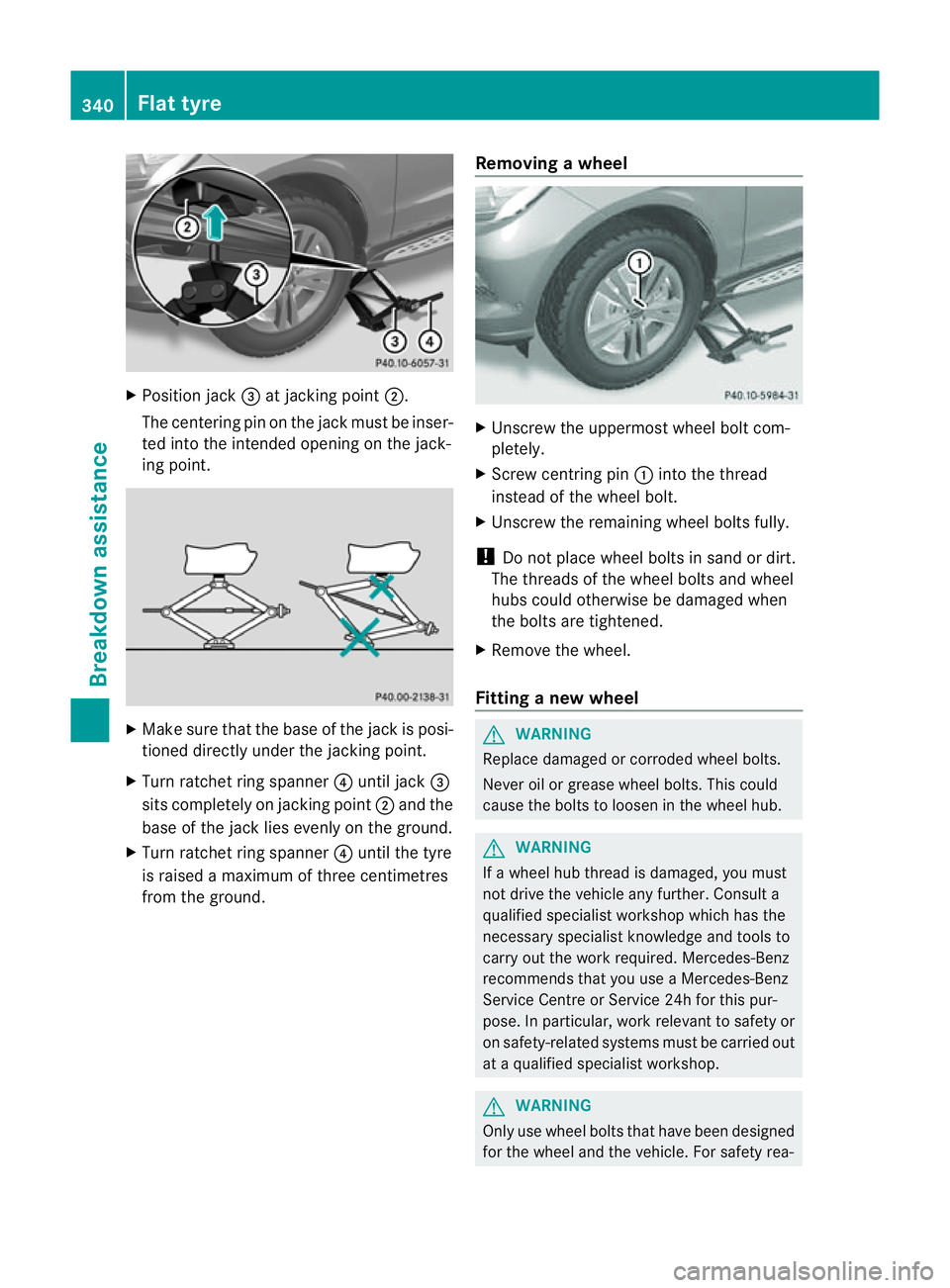
Position jack =at jac king point ;.
The centering pin on the jack must be inser-
ted into the intended opening on the jack-
ing point. X
Make sure that the bas eofthe jac kisp osi-
tioned directly under the jac king point.
X Turn ratchet ring spanner ?until jack =
sits completely on jacking point ;and the
bas eofthe jac klies evenly on the ground.
X Turn ratchet ring spanner ?until the tyre
is raised amaximum of three centimetres
from the ground. Removing
awheel X
Unscre wthe uppermost wheel bolt com-
pletely.
X Screw centring pin :into the thread
instead of the wheel bolt.
X Unscrew the remaining wheel bolts fully.
! Do not place wheel bolts in sand or dirt.
The threads of the wheel bolts and wheel
hubs could otherwise be damaged when
the bolts are tightened.
X Remove the wheel.
Fitting anew wheel G
WARNING
Replac edamaged or corroded wheel bolts.
Never oil or grease wheel bolts. This could
cause the bolts to loosen in the wheel hub. G
WARNING
If aw heel hub thread is damaged, you must
not drive the vehicle any further. Consult a
qualified specialist workshop whic hhas the
necessary specialis tknowledge and tool sto
carry out the work required. Mercedes-Be nz
re commends that you use aMercedes-Benz
Ser vice Centre or Service 24h for thi spur-
pose .Inp articular, work relevant to safety or
on safety-related systems must be carried out
at aq ualified specialist workshop. G
WARNING
Only use wheel bolts that have been designed
for the wheel and the vehicle. For safety rea- 340
Flat tyreBreakdown assistance
Page 344 of 389
sons, Mercedes-Benz recommends that you
only use wheel bolts whic hhave been
approved for Mercedes-Benz vehicles and the
respective wheel. Other wheel bolts could
work loos eordamage the brake system.
Do not tighten the wheel bolts completely
while the vehicle is still jacked up. The vehicle
could topple off the jack. :
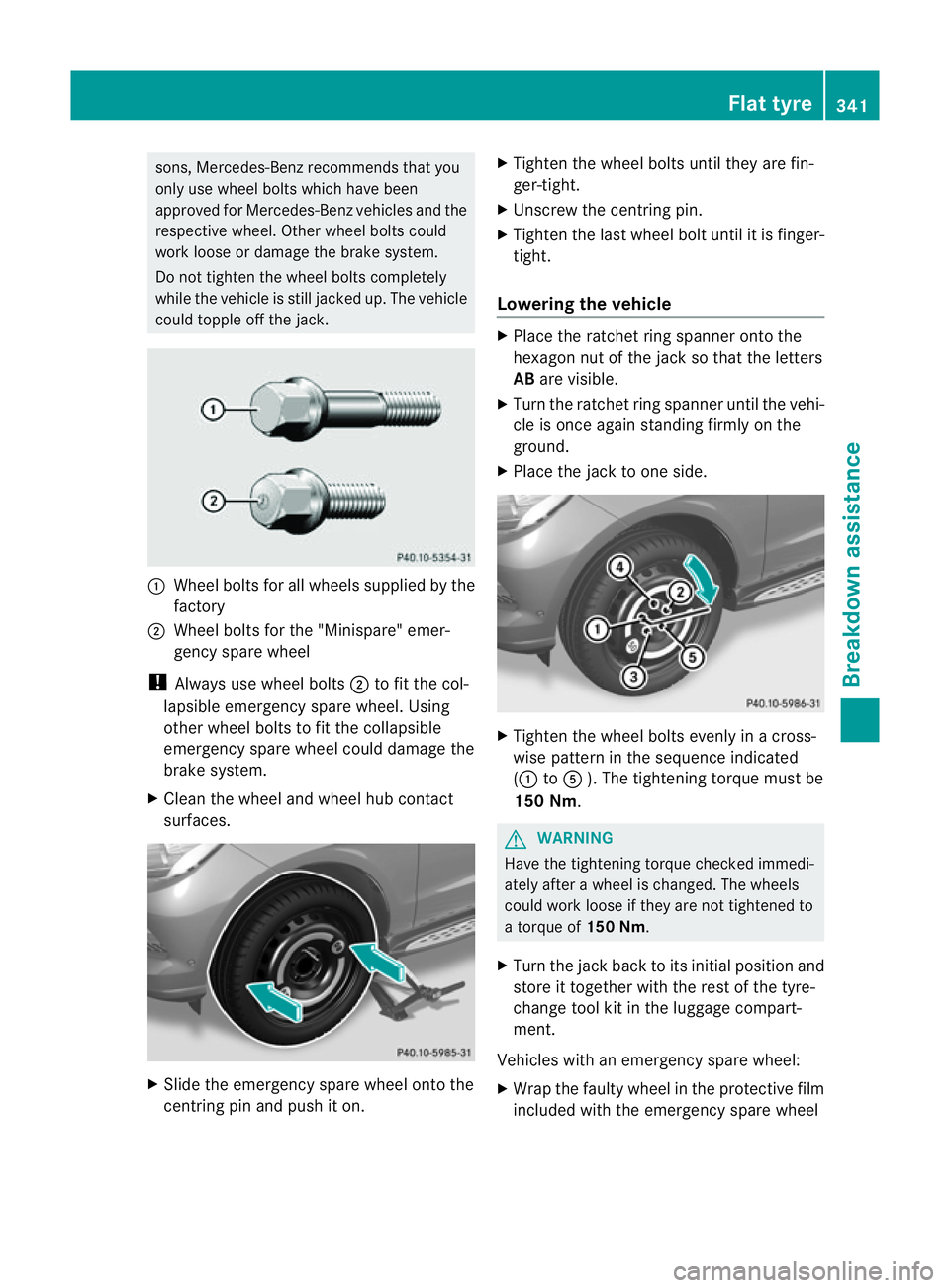
Whee lbolts for all wheels supplied by the
factory
2 Wheel bolts for the "Minispare" emer-
genc yspare wheel
! Always use wheel bolts ;to fit the col-
lapsible emergency spare wheel. Using
other wheel bolts to fit the collapsible
emergency spare wheel could damage the
brak esystem.
X Clea nthe wheel and wheel hub con tact
surfaces. X
Slid ethe emergenc yspare wheel onto the
centrin gpin and push it on. X
Tighten the wheel bolts until they are fin-
ger-tight.
X Unsc rewt he cen tring pin.
X Tighten the last wheel bol tuntil it is finger-
tight.
Lowerin gthe vehicle X
Place th eratchet ring spanner onto the
hexago nnut of the jack so that the letters
AB are visible.
X Turn the ratchet ring spanner until the vehi-
cle is once again standing firmly on the
ground.
X Place the jack to one side. X
Tighten the wheel bolts evenly in across-
wis epattern in the sequence indicated
(: toA ). The tightening torque must be
150 Nm. G
WARNING
Have the tightening torque checked immedi-
ately after awheel is changed. The wheels
coul dwork loose if they are not tightened to
at orqu eof150 Nm.
X Turn the jack back to its initia lposition and
stor eitt ogether with the rest of the tyre-
change tool kit in the luggage compart-
ment.
Vehicles with an emergenc yspare wheel:
X Wrap the faulty wheel in the protec tive film
included with the emergenc yspare wheel Flat ty
re
341Breakd ownassistance Z
Page 345 of 389
and transpor
tthe wheel in the luggage
compartment.
or
X Depending on the size of the wheel, you
ma yalso be able to secure the faulty wheel
in the emergenc yspare wheel well. In this
case, you must remove the stowage tray
from the emergency spare wheel well and
store it securely in the luggage compart-
ment.
i When you are driving with the collapsible
emergency spare wheel fitted, the tyre
pressur eloss warnin gsystem or the tyre
pressure monitor cannot function reliably.
Only restart the tyre pressure los swarning
system/tyre pressure monitor when the
defective wheel has been replaced with a
new wheel.
Vehicles with tyre pressure monitor: all fit-
ted wheels must be equipped with func-
tioning sensors. The defective wheel
should no longer be in the vehicle. MOExtended tyres (tyres with run-flat
characteristics)
MOExtended tyres (tyres with run-flat char-
acteristics) allow you to continue driving the
vehicle even when one or more tyres lose all
air pressure.
MOExtended tyres may only be used in con-
junction with the activated tyre pressure loss
warning system or with the tyre pressure
monitor.
The maximum permissible distance which
can be driven in run-flat mode depends on the
load in the vehicle. It is 80 km if the vehicle
is partially laden and 30 km if fully laden.
The maximum permissible distance which
can be driven in run-flat mode is counted from
the moment the tyre pressure loss warning
appears in the multifunction displ ay.
Yo um ust not exceed amaximum spee dof
80 km/h. G
WARNING
Th eh andling characteristics of your vehicle
deteriorate in run-flat mode, for example:
R when cornering
R when braking
R when accelerating rapidly
Adapt your driving style accordingly and avoid
sudden changes in direction and sudden
acceleration, as well as driving over obstacles
(i.e. kerbs, potholes), and driving off-road.
This is particularly the case when the vehicle
is heavily laden.
The maximum permissible distance that can
be driven in run-flat mode depends to alarge
exten tonthe loads placed on the vehicle. It
can be shorter due to high speeds, aheavy
load, sudden changes in direction, the road
surface condition, outside temperature, etc.,
or further if you driv ecarefully and conserva-
tively.
Do not continue to drive in run-flat mode if:
R you hear banging noises.
R the vehicle starts to shake.
R you see smoke and smell rubber.
R ESP ®
is intervening constantly.
R there are tears in the sidewalls of the tyre.
After driving in run-flat mode, you must have
the wheel(s) checked for damage at aquali-
fied specialist workshop which has the nec-
essary specialist knowledg eand tool stocarry
out the work required. The faulty tyre must be
replaced in every case.
Mercedes-Benz recommends that you use a
Mercedes-Benz Service Centr efor this pur-
pose. In particular ,work relevant to safet yor
on safety-related system smust be carried out
at aq ualified specialist workshop.
i Whe nreplacing one or all tyres, make
sure that you only use tyres marked
MOExtended and of the specified size for
the vehicle.
i Vehicles with MOExtended tyres are not
equipped with aTIREFIT kit at th efactory. 342
Flat tyreBreakdown assistance
Page 346 of 389
It is therefore recommende
dthat you addi-
tionally equip your vehicle with aTIREFIT kit
if yo ufit tyres that do not featur erun-flat
properties, e.g. winter tyres. ATIREFIT kit
can be obtaine dfrom aMercedes-Benz
Ser vice Centre. Battery
Important safety notes
In orde rfor the batter ytoachieve the maxi-
mum possibl eservic elife, it must always be
sufficiently charged.
Hav ethe batter ycharge checked mor efre-
quently if yo uuse the vehicle mainl yfor short
trips or if you leav eitstanding idle for a
lengthy period.
Only replace abatter ywithabatter ythat has
been recommended by Mercedes-Benz.
Consult aMercedes-Benz Ser vice Centre if
you wis htoleave your vehicle parked up for
al ong period of time. G
WARNING
Comply with safety precaution sand take pro-
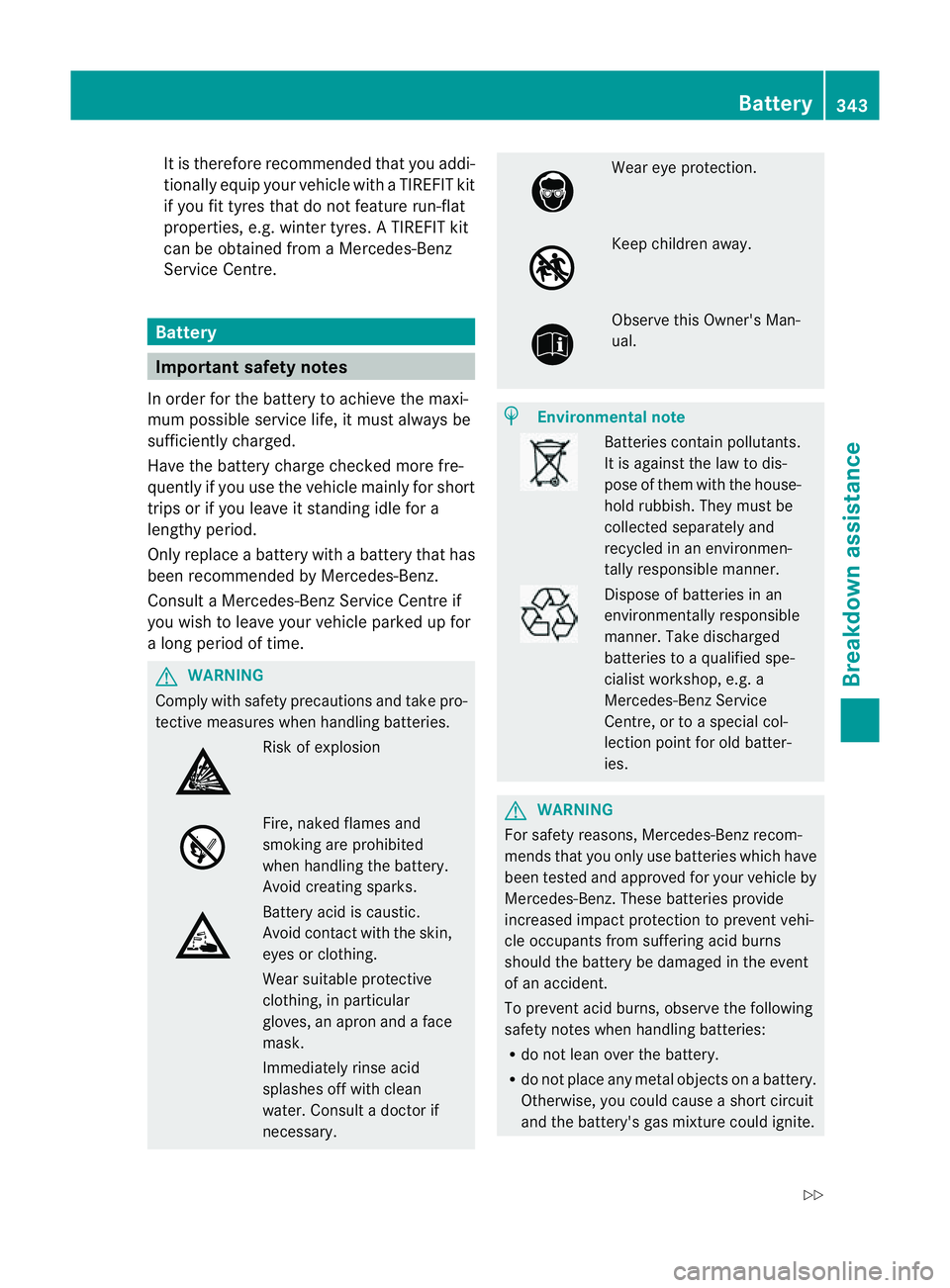
tective measure swhen handling batteries. Risk of explosion
Fire, naked flames and
smoking ar eprohibited
when handling th ebattery.
Avoid creating sparks. Battery acid is caustic.
Avoid contact with the skin,
eyes or clothing.
Wear suitable protective
clothing, in particular
gloves, an apron and aface
mask.
Immediately rinse acid
splashes off with clean
water. Consult adoctor if
necessary. Wear eye protection.
Keep children away.
Observ
ethis Owner's Man-
ual. H
Environmental note Bat
terie sc ontain pollutants.
It is against the law to dis-
pose of them with the house-
hold rubbish. They must be
collec teds eparately and
recycled in an environmen-
tally responsible man ner. Dispose of batteries in an
environmentally responsible
manner. Take discharged
batteries to aqualified spe-
cialist workshop, e.g. a
Mercedes -Benz Ser vice
Centre, or to aspecial col-
lection point for old batter-
ies. G
WAR
NING
For safety reasons, Mercedes-Benz recom-
mends that you only use batteries which have
bee ntested and approved for your vehicle by
Mercedes-Benz .These batteries provide
increased impact protection to prevent vehi-
cle occupants from suffering aci dburns
should the battery be damaged in the event
of an accident.
To prevent acid burns, observe the following
safety notes when handling batteries:
R do not lean over the battery.
R do not place any metal objects on abattery.
Otherwise ,you coul dcause ashort circuit
and the battery's gas mixtur ecould ignite. Battery
343Breakdownassistance
Z
Page 350 of 389
X
Switch off al lelec trical consumers (e.g.
radio ,blow er, etc.).
X Connec tthe positive terminal clamp and
secure the cov er.
X Connect the negative terminal clamp.
i If the power supply ha sbeeninterrupted,
e.g. if yo ureconnect the battery, you will
have to:
R set the clock; see the separate operat ing
instructions.
R rese tthe function for automatically fold-
ing the exterior mirror sin/out by foldi ng
the mirrors out onc e(Ypage 10 1). Charging th
ebattery G
WARNING
Onl ycharge the battery in awell-ventilated
area .Ast he battery is being charged, gases
can escap eand generat eminor explosions.
This could injure you and other person sor
caus edamage to the paintwork or acid cor-
rosion on the vehicle.
You can obtain information about battery
chargers which allow the batter ytobe
charged while still installed from aqualified
specialist workshop ,e.g. aM ercedes-Benz
Ser vice Centre. G
WARNING
There is arisk of acid burns during the charg-
ing process due to the gases which escape
from the battery. Do not lean over the battery
during the chargin gprocess. G
WARNING
Battery aci discaustic. Avoid contact with the
skin, eyes or clothing.
! Only charge the installed batter ywith a
batter ycharger whic hhas been tested and
approved by Mercedes -Benz .These battery
chargers allow the battery to be charged
while still installed. !
Only use battery chargers with amaxi-
mum charging voltage of 14.8 V.
! Only charge the battery using the jump-
start connection point.
The jump-starting connection point is in the
engine compartmen t(Ypage 348).
X Open the bonnet (Y page 318).
X Connec tthe battery charger to the positive
terminal and earth point in the sam eorder
as when connecting th edonor battery in
the jump-startin gprocedure
(Y page 348).
X Read th ebattery charger's operating
instructions before charging the battery. Battery
347Breakdown assistanc e Z
Page 351 of 389
Jum
p-starting G
WARNING
There is arisk of acid burns when jump-starting avehicle due to the gases which escape from
the battery. Do not lean over the batter ywhile the engin eisbeing jump-started. G
WARNING
Gases escapin gfrom th ebattery during jump-starting may cause minor explosions. Avoid cre-
ating sparks. Keep naked flames away from the battery, and do not smoke.
Comply with safety precautions when handling batteries. You will find these under "Battery" in
the index.
! Avoid repeated and lengthy startin gattempts. Otherwise, non-combuste dfuel may dam-
age the catalytic converter 24
and create arisk of fire.
Do not use arapid-charging device to start the engine.
Make sure the jump leads are not damaged.
Make sure the jump leads are not touching any other metal objects when they are connected
to the battery.
If your vehicle's battery is discharged ,the engin ecan be jump-started from another vehicle
or from asecond batter yusing jum pleads.
Observ ethe followin gpoints:
X The battery is not accessible in all vehicles. If the other vehicle' sbattery is not accessible,
jump-start the vehicle using asecond batter yorajump-star ting device.
X Only jump-start the vehicl ewhen th eengineisc old an dthe catalytic converter system has
cooled down 25
.
X Do no tstart the engine if the battery is frozen. Let the battery thaw first.
X Jump-starting may only be performed from batterie swithanominal voltage of 12 V.
X Only use jum pleads which have asufficient cross-section and insulated terminal clamps.
X Make sure that the jump leads cannot come into contact with parts, such as the pulley or
the fan. Thes eparts move when the engine is started and while it is running.
X If the battery is fully discharged ,leave the batter ythat is being used to jump-star tconnected
for afew minutes befor eattempting to start. This charges the empty battery alittle.
i Jump leads and further information about jump-startin gcan be obtained from any
Mercedes-Ben zService Centre, for example.
X Make sure that the two vehicles do not touch.
X Secure the vehicle by applying the electric parking brake.
X Shif tthe transmission to position P.
X Tur nthe key to position 0(Y page 139) in the ignition lock and remove it. On vehicles with
KEYL ESS-GO ,make sure the ignition is switched off (Y page 139). All indicator lamps in the
instrumen tcluster must be off.
24 Only vehicles with apetrol engine.
25 Only vehicles with apetrol engine. 348
Jump-startingBreakdown assistance
Page 352 of 389
X
Switch off al lelec trical consumers (e.g. radio ,blow er, etc.).
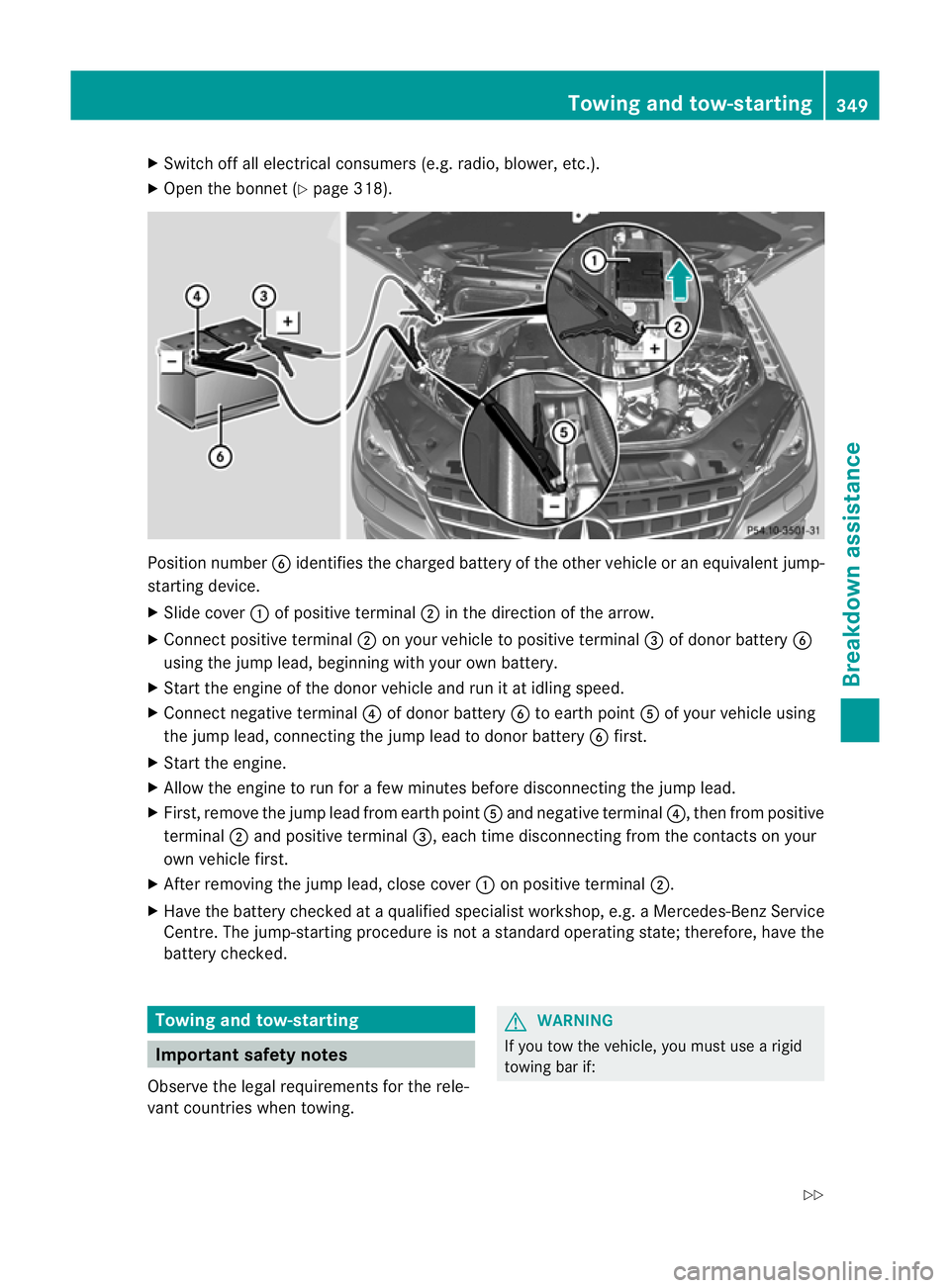
X Ope nthe bonnet (Y page 318). Position number
Bidentifies the charged battery of the other vehicle or an equivalent jump-
startin gdevice.
X Slide cover :of positiv eterminal ;in the direction of the arrow.
X Connect positiv eterminal ;on your vehicle to positiv eterminal =of donor battery B
using the jum plead, beginning with your own battery.
X Start the engine of the donor vehicle and run it at idling speed.
X Connect negative terminal ?of donor battery Bto eart hpoint Aof your vehicle using
the jum plead, connectin gthe jum plead to donor battery Bfirst.
X Start the engine.
X Allow the engine to run for afew minutes befor edisconnecting the jump lead.
X First, remov ethe jum plead from eart hpoint Aand negative terminal ?,then from positive
terminal ;and positive terminal =,each time disconnecting from the contacts on your
own vehicle first.
X After removing the jump lead, close cover :on positive terminal ;.
X Have the battery checked at aqualified specialist workshop, e.g. aMercedes-Ben zService
Cent re.T he jump-star ting procedure is not astandard operatin gstate; therefore, have the
battery checked. Towing and tow-starting
Important safet
ynotes
Observe the legal requirements for the rele-
vant countries when towing. G
WARNING
If you tow the vehicle, you must use arigid
towing bar if: Towing and tow-starting
349Breakdown assis tance
Z
Page 353 of 389
R
the engine is not running.
R there is abrake syst emmalfunction.
R there isam alfunction in the power supply
or the vehicle' selectrical system.
The power assistance for the steering and the
brake forc ebooster do not work when the
engin eisnot running. You will need more
force to steer and brake, you may have to
depress the brake pedal with maximu mforce.
Before towin gaway ,make sure that the steer-
ing can be moved and is not locked.
If you tow or tow-star tanothe rvehicle, its
weight must not exceed the maximu mper-
missible gross vehicle weight of your vehicle. G
WARNING
The vehicle is braked when the HOL Dfunction
or DISTRONIC PLUS is activated. Therefore,
deactivate HOLD and DISTRONIC PLUS if the
vehicle is to be towed.
It is better to have the vehicle transported
than to have it towed.
! You may tow the vehicle for amaximum
of 50 km. Atowing speed of 50 km/h must
not be exceeded.
For towin gdistances over 50 km, the entire
vehicle must be lifted up and transported.
! Make sure that the electric parkin gbrake
is released. If th eelectric parkin gbrake is
faulty, visit aqualified specialist workshop.
! Only secure the tow rope or towing bar to
the towing eyes. The vehicle may otherwise
be damaged.
! Do not use the towing eye for recovery,
as this could damage the vehicle. If in
doubt, recover the vehicle with acrane.
! When towing, pull awa yslowly and
smoothly. If the trac tivepower is too high,
the vehicles could be damaged.
! To tow vehicles with KEYLESS-GO, use
the key instead of the Star t/Stop button.
Th ea utomatic transmission may otherwise switch to position
Pwhen you open the
driver' sorfront-passenger door which
could damag ethe transmission.
! Vehicles with differential locks: make
sur ethe differential lock sare in automatic
mode. Th edifferential locks must not be
switched on by hand when towing the vehi-
cle. The transmission may otherwise be
damaged.
If the vehicle has suffered transmission dam-
age, have it transported on atransporter or
trailer.
Th ea utomatic transmission must be in posi-
tion Nwhen the vehicle is being towed.
The battery must be connected and charged.
Otherwise, you:
R cannot turn the key in the ignition lock to
position 2
R cannot shift the automatic transmission to
position N
i Before the vehicle is towed, switch off the
automatic locking feature (Y page 249).
You could otherwis ebelockedout when
pushing or towing the vehicle.
Deactivate tow-away protection
(Y page 69) before the vehicle is towed. Fitting/removing the towing eye
Fitting the towing eye Vehicles with
atrailer to whitch: if you intend
to use the vehicle for towing, fold out the ball
coupling and connect the towbar to it
(Y page 228).
X Remove the towing eye from the vehicle
tool kit (Y page 333).
The mountings for the removable towing eyes
are located in the bumpers. They are at the
front and at the rear ,under the covers. 350
Towing and tow-startingBreakdow
nassistance
Page 354 of 389
X
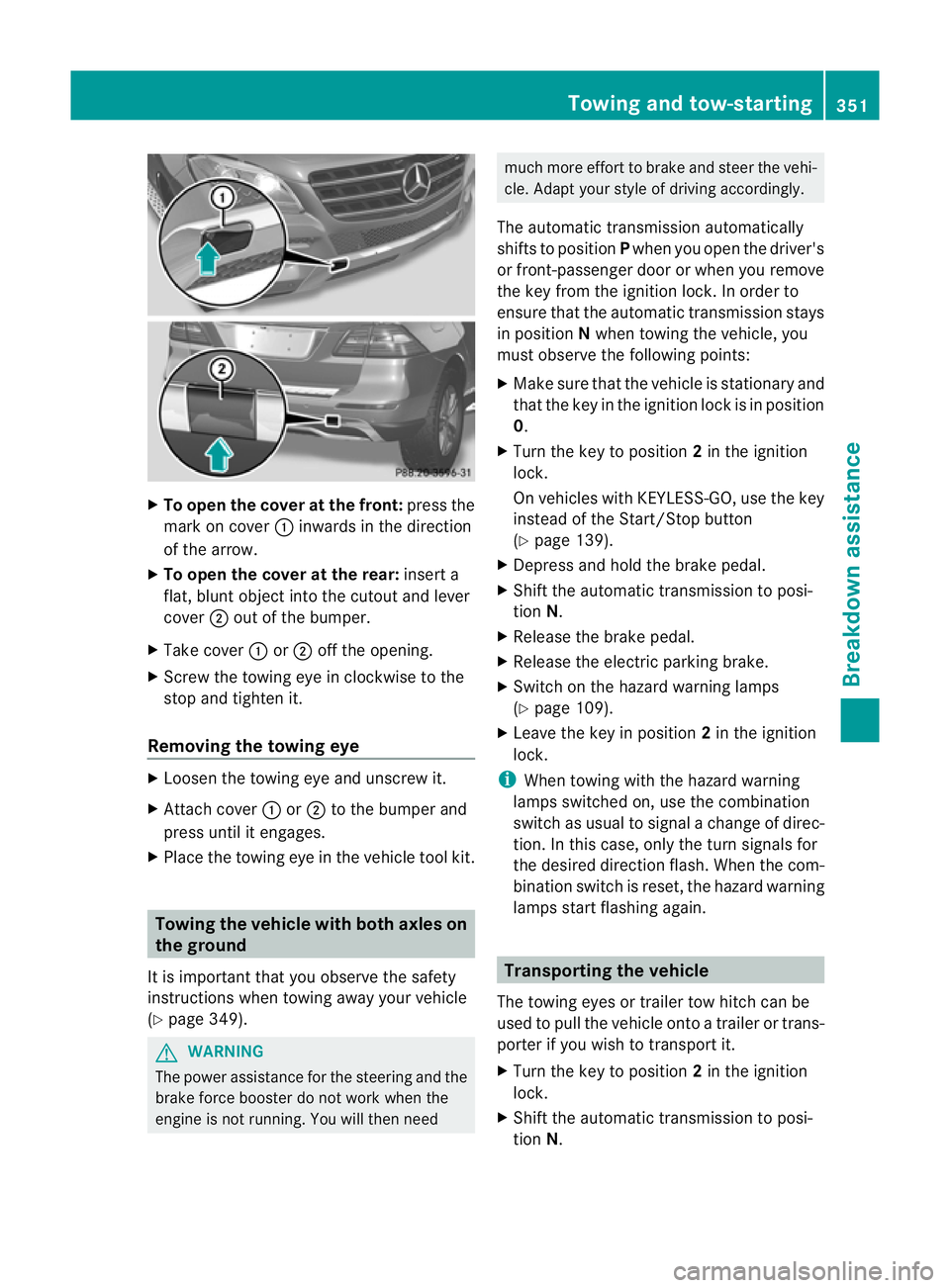
To ope nthe cove ratthe front: press the
mark on cover :inw ards in the direction
of the arrow.
X To open the cover at the rear: insert a
flat ,blunt object into the cutout and lever
cover ;out of the bumper.
X Take cover :or; off the opening.
X Screw the towing eye in clockwise to the
stop and tighten it.
Removin gthe tow inge ye X
Loose nthe towing eye and unscrew it.
X Attach cover :or; to the bumper and
press until it engages.
X Plac ethe towing eye in the vehicle tool kit. Towing th
evehicle with both axles on
the ground
It is importan tthat you observe the safety
instructions when towing away your vehicle
(Y page 349). G
WARNING
The power assistanc efor the steering and the
brake force booster do not work when the
engin eisnot running. You will then need much mor
eeffort to brak eand stee rthe vehi-
cle. Adap tyour style of driving accordingly.
The automatic transmission automatically
shifts to position Pwhen you open the driver's
or front-passenger door or when you remove
the key from the ignition lock. In order to
ensur ethat the automatic transmission stays
in position Nwhen towing the vehicle, you
must observe the followin gpoints:
X Make sure that the vehicle is stationar yand
that the key in the ignition lock is in position
0.
X Turn the key to position 2in the ignition
lock.
On vehicles with KEYLESS-GO, use the key
instead of the Start/Stop button
(Y pag e139).
X Depres sand hol dthe brake pedal.
X Shif tthe automatic transmission to posi-
tion N.
X Release the brake pedal.
X Release the electric parkin gbrake.
X Switch on th ehazard warning lamps
(Y page 109).
X Leave the key in position 2in the ignition
lock.
i When towing with the hazard warning
lamps switched on, use the combination
switch as usua ltosignal achange of direc-
tion .Int his case ,only the turn signals for
the desired direction flash .When the com-
bination switc hisreset, the hazar dwarning
lamps start flashing again. Transporting the vehicle
The towing eyes or trailer tow hitch can be
used to pull the vehicle onto atrailer or trans-
porter if yo uwish to transport it.
X Turn the key to position 2in the ignition
lock.
X Shift the automatic transmission to posi-
tion N. Towing and tow-starting
351Breakdownassis tance Z