belt MERCEDES-BENZ M-CLASS SUV 2011 Owners Manual
[x] Cancel search | Manufacturer: MERCEDES-BENZ, Model Year: 2011, Model line: M-CLASS SUV, Model: MERCEDES-BENZ M-CLASS SUV 2011Pages: 389, PDF Size: 9.22 MB
Page 9 of 389
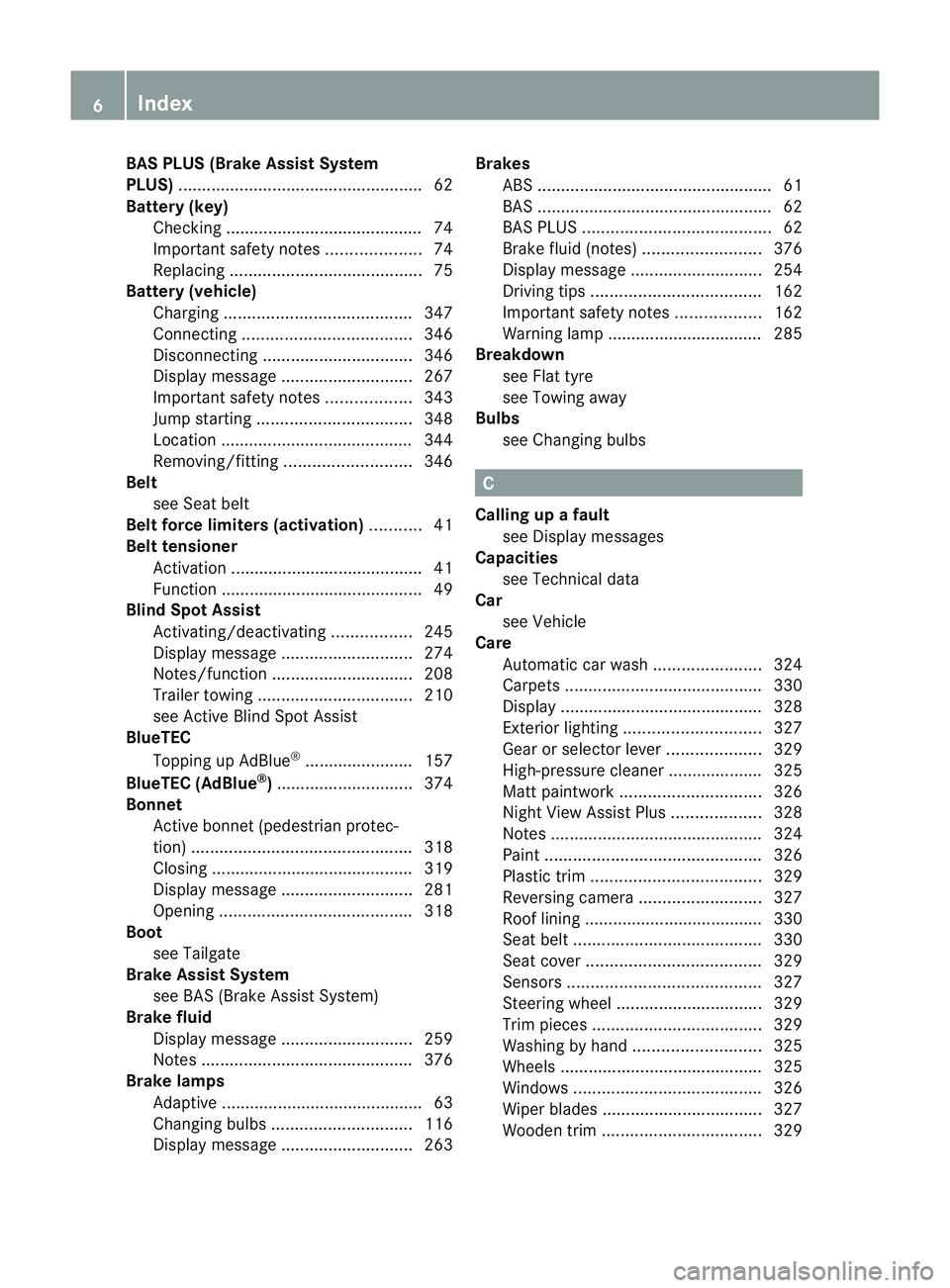
BAS PLUS (Brake Assist System
PLUS) .................................................... 62
Battery (key) Checking .......................................... 74
Important safety notes ....................74
Replacing ......................................... 75
Battery (v ehicle)
Charging ........................................ 347
Connectin g.................................... 346
Disconnecting ................................ 346
Display message ............................ 267
Important safety notes ..................343
Jump starting ................................. 348
Location ......................................... 344
Removing/fittin g........................... 346
Belt
seeS eat belt
Belt force limiters (activation) ...........41
Bel ttensioner
Activation ......................................... 41
Function .......................................... .49
Blind Spo tAssist
Activating/deactiva ting ................. 245
Display message ............................ 274
Notes/function .............................. 208
Traile rtowing ................................. 210
se eA ctive Blind Spo tAssist
BlueTEC
Topping up AdBlue ®
...... ................. 157
BlueTE C(AdBlue ®
) ............................. 374
Bon net
Active bonne t(pedestrian protec-
tion) ............................................... 318
Closing ........................................... 319
Display message ............................ 281
Opening ......................................... 318
Boot
seeT ailgate
Brak eAssist System
see BAS (Brake Assist System)
Brake fluid
Display message ............................ 259
Note s............................................. 376
Brake lamps
Ada ptive .......................................... .63
Changin gbulbs .............................. 116
Display message ............................ 263Brakes
ABS .................................................. 61
BAS .................................................. 62
BAS PLUS ........................................ 62
Brake fluid (notes )......................... 376
Display message ............................ 254
Driving tip s.................................... 162
Important safety notes ..................162
Warn ingl am p................................. 285
Breakdown
seeF lat tyre
see Towing away
Bulbs
see Changing bulbs C
Callin gupaf ault
se eD isplay messages
Capacities
see Technical data
Car
see Vehicle
Care
Automatic car was h....................... 324
Carpets .......................................... 330
Display ........................................... 328
Exterio rlighting ............................. 327
Gea rors electo rlever .................... 329
High-pressure cle aner ...... .............. 325
Matt paintwork .............................. 326
Nig htVie wA ssist Plus ................... 328
Note s............................................. 324
Pa int. ............................................. 326
Pl ast ic trim .................................... 329
Revers ingc amera .......................... 327
Roo flining ...................................... 330
Seat bel t........................................ 330
Sea tcover ..................................... 329
Sensors ......................................... 327
Steering wh eel............................... 329
Tri mp ieces .................................... 329
Washing by hand ........................... 325
Wheels ........................................... 325
Windows ........................................ 326
Wi perb lades .................................. 327
Wooden trim .................................. 3296
Index
Page 20 of 389
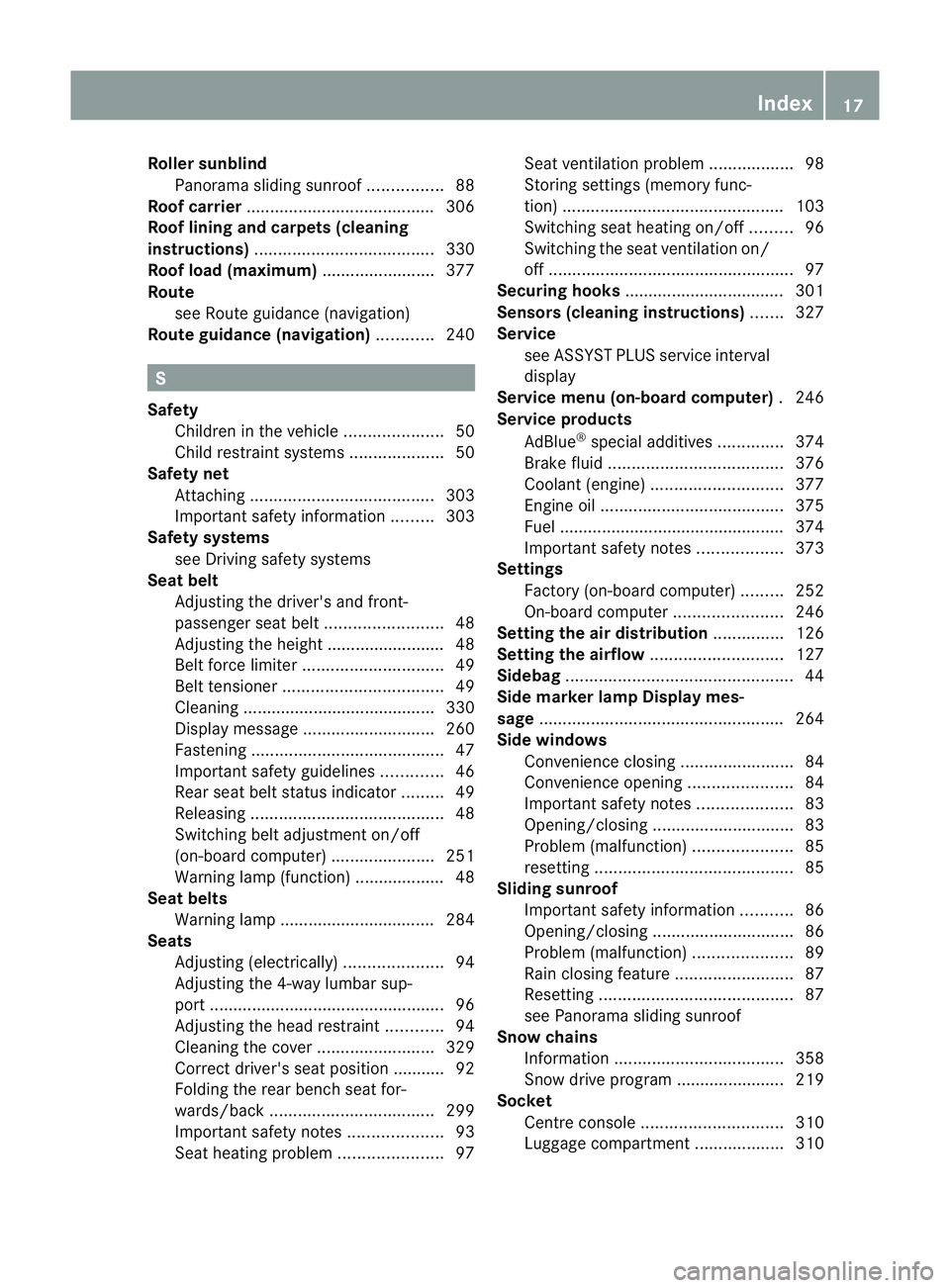
Rolle
rsunb lind
Pa norama sliding sunroo f................ 88
Roof carri er........................................ 306
Roof li ning and carpet s(cle aning
in st ructions) ...................................... 330
Roof load (maximum) ........................377
Route seeR oute guidance (nav igation)
Route guidance (navigation) ............240 S
Safety Children in the vehicle .....................50
Ch ildr estra ints ystems .................... 50
Safety net
Attaching ....................................... 303
Important safety informatio n......... 303
Safety systems
seeD riving safety sy stems
Seat belt
Adjusting the driv er's and front-
pa ssenger sea tbelt ......................... 48
Adjusting the he ight......................... 48
Belt force limiter .............................. 49
Bel ttensioner .................................. 49
Clean ing. ........................................ 330
Disp laym essage ............................ 260
Fasten ing. ........................................ 47
Important safety gu idelines ............. 46
Rea rseat belt status indicator .........49
Releasing ......................................... 48
Switch ingb elta djustment on/off
(on-board computer) ......................251
Warn ingl am p(function) ................... 48
Seat be lts
Warn ingl am p................................. 284
Seats
Adjusting (electrically )..................... 94
Adjusting the 4-way lumba rsup-
port .................................................. 96
Adjusting the head restraint............ 94
Clean ingt he cover ......................... 329
Correct driver's se at position ........... 92
Folding the rear bench sea tfor-
wards/bac k................................... 299
Important safety notes ....................93
Sea theating problem ...................... 97Sea
tventil ation proble m.................. 98
Storing settings (memory func-
tion) ............................................... 103
Switch ings eat heating on/off .........96
Switch ingt he seat ventilation on/
off .................................................... 97
Se curing hooks .................................. 301
Sensors (cleaning instructions) .......327
Service seeA SSYST PLUS service interval
display
Serv icem enu (on-board computer) .246
Service products
AdBl ue®
special additive s.............. 374
Brake fluid ..................................... 376
Co olan t(engine) ............................ 377
Engine oi l....................................... 375
Fue l................................................ 374
Important safety note s.................. 373
Settings
Factory (on-bo ardc omputer )......... 252
On-bo ardc omputer ....................... 246
Settin gthe air distribution ...............126
Settin gthe airfl ow............................ 127
Sidebag ................................................ 44
Side marker lamp Display mes-
sage .................................................... 264
Side windo ws
Convenience closing ........................84
Convenience op ening ...................... 84
Important safety notes ....................83
Opening/closing .............................. 83
Pro blem (malfunction) ..................... 85
resetting .......................................... 85
Sl iding sunroof
Important safety information ...........86
Opening/closing .............................. 86
Pro blem (malfunction) ..................... 89
Rain closing feat ure. ........................ 87
Resetting ......................................... 87
se eP anorama sliding sunroof
Sno wchains
Information .................................... 358
Sno wdrive program ....................... 219
So cket
Centre console .............................. 310
Luggag ecompartmen t................... 310 Index
17
Page 23 of 389
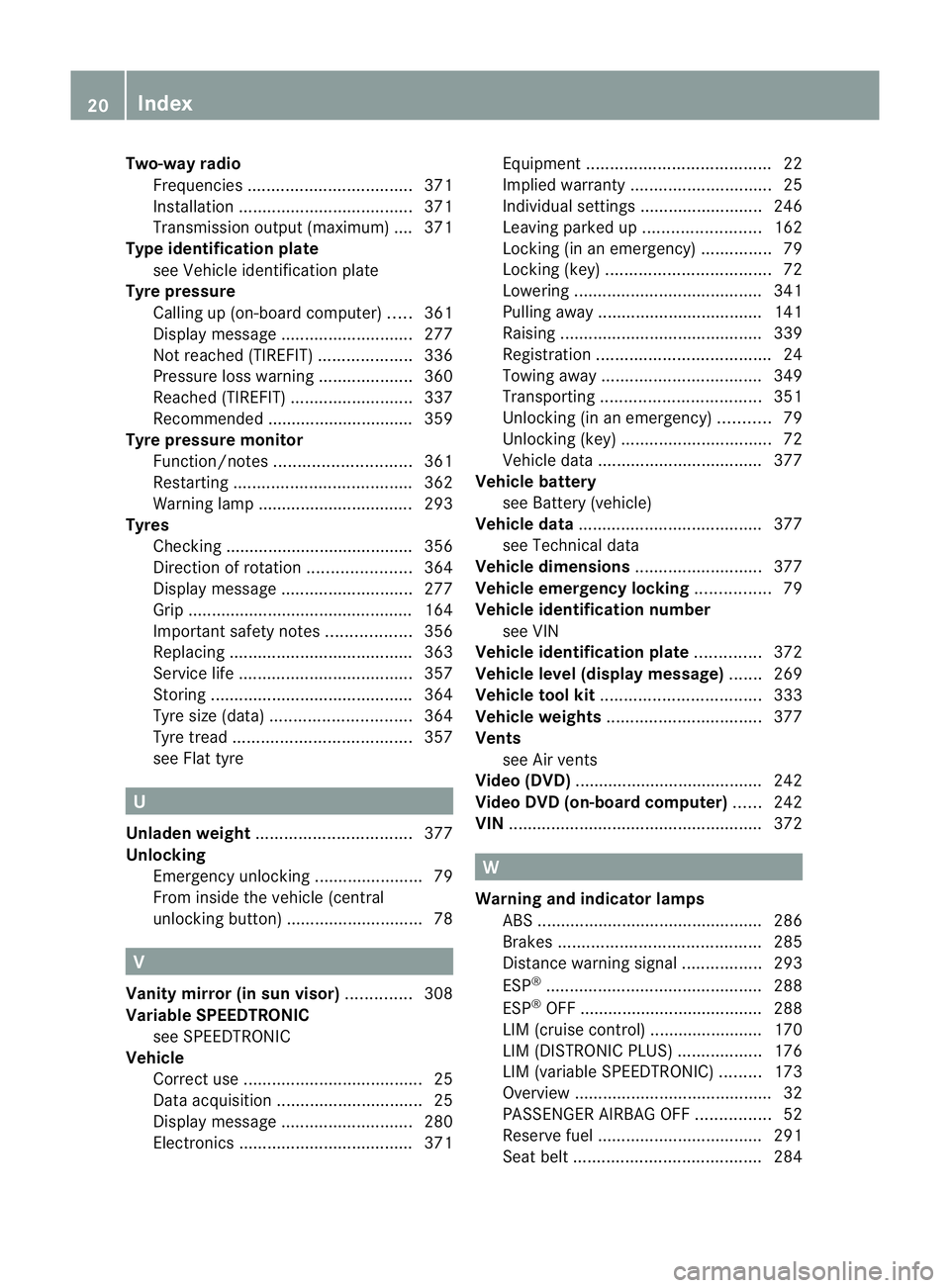
Two-way radio
Frequencie s................................... 371
Installati on .................................... .371
Transmission output (maximum ).... 371
Type identification plate
seeV ehicle identificat ionp late
Tyr epressure
Calling up (on-bo ardc omputer )..... 361
Display message ............................ 277
Not reac hed( TIREFIT) .................... 336
Pressure loss warning ....................360
Reache d(TIREFIT) .......................... 337
Rec ommended ............................... 359
Tyre pressur emonitor
Function/notes ............................. 361
Restarting ...................................... 362
Warn ingl am p................................. 293
Tyres
Checking ........................................ 356
Directi on ofrotation ...................... 364
Display message ............................ 277
Gri p................................................ 164
Important safety note s.................. 356
Replacing ....................................... 363
Service life ..................................... 357
Storing ........................................... 364
Tyr esize (data) .............................. 364
Tyr etrea d...................................... 357
se eF lat tyre U
Unladen weight ................................. 377
Un lock ing
Emergency unlocking .......................79
From insid ethe vehicle (central
unl ocking button) ............................. 78V
Vanity mirror (in sun visor) ..............308
Variable SP EEDTRONIC
se eS PEEDTRONIC
Vehicle
Corr ectu se ...................................... 25
Data acq uisition ............................... 25
Display message ............................ 280
Electronics ..................................... 371Equ
ipment ....................................... 22
Implied warranty .............................. 25
Individua lsettings .......................... 246
Leaving pa rkedup. ........................ 162
Locking (i nanemergency) ............... 79
Locking (ke y)................................... 72
Lowering ........................................ 341
Pullin gaway................................... 141
Rais ing. .......................................... 339
Registratio n..................................... 24
To wing away .................................. 349
Transporting .................................. 351
Unlockin g(in an emergency) ...........79
Unlockin g(key )................................ 72
Veh icle data ................................... 377
Vehi cleb attery
se eB attery (vehicle)
Vehicle data ....................................... 377
se eT echnical data
Vehicle dimensions ...........................377
Vehi clee mergency locking ................79
Vehi clei dentification number
se eV IN
Vehi clei dentification plate ..............372
Vehi clel evel (display message) .......269
Vehi clet ool kit .................................. 333
Vehi clew eights ................................. 377
Vents seeA ir vents
Video (DVD) ....................................... .242
Vide oDVD (on-board computer) ......242
VIN ...................................................... 372 W
Warning and indicator lamps ABS ................................................ 286
Brake s........................................... 285
Distance warning signa l................. 293
ESP ®
.............................................. 288
ESP ®
OFF ....................................... 288
LIM (cruise control )........................ 170
LIM (DISTRONIC PLUS) ..................176
LIM (variabl eSPEEDTRONI C)......... 173
Overview .......................................... 32
PASSENGER AIRBAG OFF ................52
Reserve fuel ................................... 291
Sea tbelt. ....................................... 28420
Index
Page 35 of 389
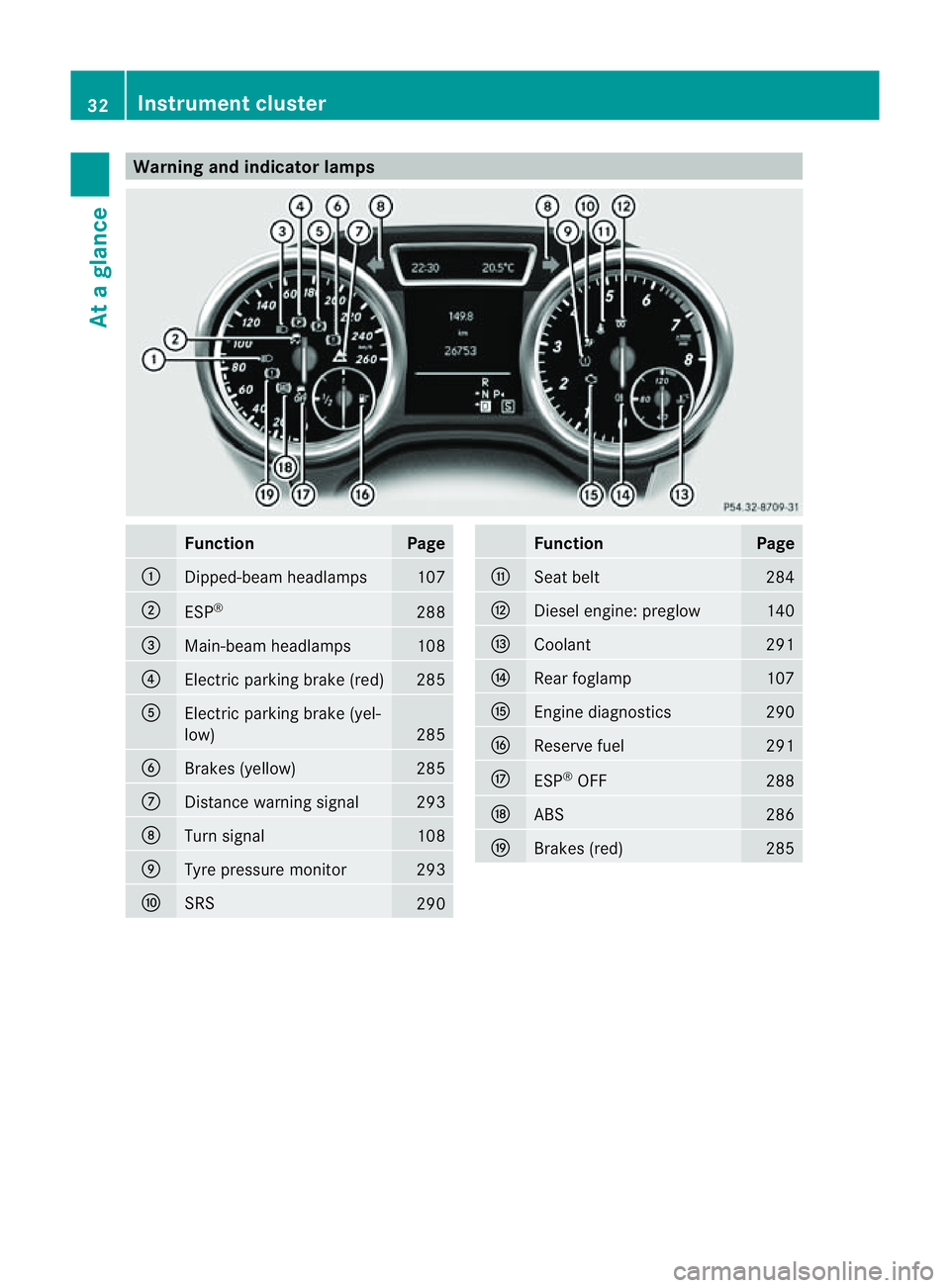
Warnin
gand indicator lamps Fun
ction Page
:
Dipped-bea
mheadlamps 107
;
ESP
® 288
=
Main-beam headlamps 108
?
Electric parkin
gbrake (red) 285
A
Electric parking brake (yel-
low)
285
B
Brakes (yellow) 285
C
Distance warning signal 293
D
Turn signal 108
E
Tyre pressure moni
tor 293
F
SRS
290 Function Page
G
Sea
tbelt 284
H
Diesel engine: preglow 140
I
Coolant 291
J
Rear foglamp 107
K
Engine diagnostics 290
L
Reserv
efuel 291
M
ESP
®
OFF 288
N
ABS 286
O
Brakes (red) 28532
Instrument clusterAt
ag lance
Page 43 of 389
Usefu
linfor mati on
i This Owner's Manual describes all models
and all standard and optional equipment
available to your vehicle at the time of pub-
lication of the Owner's Manual. Country-
specific deviation sare possible .Please
not ethat your vehicle ma ynot be equipped
with all featur es described. This also
applies to safety-releva ntsystems and
functions.
i Please read the information on qualified
specialist workshops (Y page 24).Occupant safety
Important safet
ynotes
Seat belts, together wit hthe Supp lemental
Restrain tSyste m–S RS (Y page 41), are
complementary, co-ordinated restrain tsys-
tems. They reduce the risk of injur yinspe-
cific, pre-defined types of accident situations
and thereby increase occupant safety .How-
ever ,seat belts and airbags generally do not
protec tagainst objec tspenetratin gthe vehi-
cle from the outside.
To ensur ethat the restraint system scan
deliver their full potential protection, make
sure that:
R the seat and head restraint are adjusted
properly (Y page 92).
R the seat belt has been fastened properly
(Y page 47).
R the airbags can inflate unrestricted if
deplo yed (Y page42).
R the steering whee lisadjusted properly
(Y page 92).
R the restraint systems have not been modi-
fied.
i An airba gincrease sthe protection of
vehicle occupants wearing aseat belt. As
such, they are only an additional restraint
system which complemen ts,b ut does not
replace, the seat belt. All vehicle occupants must wear their seat belt correctly at all
times, even if the vehicle is equipped with
airbags. The airbags are not deplo yed inall
types of accidents. For example, if the pro-
tective capacity of correctly fastened seat
belts is not increased by deplo yingthe air-
bags, the airbags will not deploy. Airbag
deploymen tonly provides incre asedpro-
tection if th eseatb eltisw ornc orrect ly
because:
R the sea tbelt helps to keep the vehicle
occupan tinthe best position in relation
to the airbag.
R in ah ead-on collision ,for example, the
seat belt prevents the vehicle occupant
from being propelled towards the point
of impact .Itcan thus reduce the risk of
injury.
In accidents in which an airbag is deployed,
it provides increased protection only if the
seat belt is worn correctly. G
WARNING
If service work is not carried out correctly, the
operating safety of your vehicle may be affec-
ted. This could cause you to lose control of
your vehicle and cause an accident. More-
over, the safety systems may no longer be
able to protect you or others as they are
designed to do.
Always have service work carried out at a
qualified specialist workshop. The workshop
must have the necessary specialist knowl-
edge and tools to carr yout the work required.
Mercedes-Ben zrecom mends that you use a
Mercedes-Benz Service Centre for this pur-
pose. In particular, work relevant to safety or
on safety-related systems must be carried out
at aq ualified specialist workshop. 40
Occupant safetySafety
Page 44 of 389
G
WARNING
Modifications to or work performe dincor-
rectly on the following parts can result in the
restraint systems not functioning as intended:
R the restraint system, consisting of seat
belts and thei ranchorage points, bel tten-
sioners, belt for celimiter sand airbags
R the wiring
R networked electronic systems
Airbags and belt tensioners could fail to
deploy or be trigge redinana ccident despite
the deceleration force being sufficient to trig-
ger the systems, or could be triggered unin-
tentionally. For this reason, never make any
modifications to the restrain tsystems.
Therefore, you must not tamper with elec-
tronic components or their software. SRS (Supplemen
talRestraint System)
Introduction SRS consists of:
R
the 6 SRS warning lamp
R airbags
R airba gcontrol unit (with crash sensors)
R belt tensioner sfor the front seat belts and
the outer seat belts in the rear
R belt force limiters
SRS reduces the risk of occupan ts coming
into contact with the vehicle's interio rinthe
even tofana ccident. It can als oreduce the
effect of the forces to which occupant sare
subjected during an accident.
SRS warnin glamp SRS functions are checked regularly when
you switch on the ignition and when the
engine is running. Therefore ,malfunctions
can be detected in good time.
The 6 SRS warning lamp in the instrument
cluster lights up when the ignition is switched
on. It goes out no later than afew seconds
after the engine is star ted. G
WARNING
If SRS is malfunctioning, individual systems
may be activated unintentionally or may not
be triggered in the even tofanaccident with
ah igh rate of vehicle deceleration.
Am alfunction has occurred if:
R the 6 SRS warning lamp does not light
up when the ignition is switched on.
R the engine is runnin gand the 6SRS
warning lamp doe snot go out after afew
seconds.
R the engine is runnin gand the 6SRS
warning lamp lights up again.
In this case, have SRS checked immediately
at aq ualified specialist workshop .Mercedes-
Benz recommends that you use aMercedes-
Benz Servic eCentr efor this purpose.
In particular ,work relevant to safet yoron
safety-related systems must be carried out at
aq ualified specialist workshop.
Triggering of belt tensioners, belt force
limiters and airbags During the first stage of
acollision ,the airbag
con trol unit evaluates important physical
data relatin gtovehicle deceleration or accel-
eration, such as:
R duration
R direction
R magnitude
Based on the evaluation of this data, the air-
bag control unit pre-emptively triggers the
belt tensioner sinthe first stage.
i The front belt tensioner scan only be trig-
gered if the seat belt tongues on the front
seats are correctly engaged in the seat belt
buckles.
If there is an even higher rate of vehicle decel-
eration or acceleration in alongitudinal direc-
tion ,the front airbags ar ealso deployed.
Your vehicle has adaptive, two-stage front air-
bags. The airbag control unit evaluates vehi-
cle deceleration or acceleration in the event Occupant safety
41Safety Z
Page 45 of 389
of
ac ollision .Inthe first deploymen tstage,
the front airbag is filled with enoug hpropel-
lan tgas to reduce the risk of injuries. The
front airbag is fully deployed if asecond
deployment threshold is exceeded within a
few milliseconds.
The belt tensioner and airbag triggering
thresholds are variable and are adapted to the
rat eofd eceleration or acceleration of the
vehicle. This process is pre-emptive in nature.
The triggerin gprocess mus ttake place in
good time at the start of the collision.
i Airbags are not deployed in all types of
accidents. Also, not all airbags are
deployed together in an accident .The dif-
ferent airbag system swork independently
of each other.
How the airbag system work sisdeter-
mined by the severity of the collision detec-
ted, especially the vehicle deceleration or
acceleration, and the apparent type of acci-
dent:
R head-on collision
R side impact
R overturn
The rat eofvehicle deceleration or accelera-
tion and the direction of the force are essen-
tially determined by:
R the distribution of forces during the colli-
sion
R the collision angle
R the deformation characteristics of the vehi-
cle
R the characteristics of the object with which
the vehicle has collided
Factors which can only be seen and measured
after acollision has occurred do not play a
decisive role in the deployment of an airbag,
nor do they provide an indication of airbag
deployment.
The vehicle ma ybedeformed significantly,
e.g. the bonnet or the wing, without an airbag
being deployed. This is the case if only parts
which are relatively easily deformed are affec- ted and the rat
eofdeceleration is not high.
Conversely, airbags may be deployed even
though the vehicle suffers only minor defor-
mation. This is the case if, for example, very
rigid vehicle part ssuch as longitudinal body
members are hit, and sufficient deceleration
occurs as aresult. Airbags
Important safety notes Airbag deployment slows down and restricts
the movemen
tofthe vehicle occupant.
If the airbags ar edeployed, you will hear a
bang and asmall amount of powder may also
be released. Only in rare cases will th ebang
affect your hearing. The powde rthat is
released generally does not constitute a
healt hhazard. The 6SRS warning lamp
lights up.
The airbag installation locations are identified
by the AIRBA Gsymbol. G
WARNING
Airbags provide additional protection; they
are not, however, asubstitute for seat belts.
Observe the following notes to reduce the risk
of serious or even fatal injury caused by airbag
deployment:
R all vehicle occupants –inparticular ,preg-
nant women –must wear their seat belt
correctly at all times and lean back against
the backrest, which should be positioned
as close to the vertical as possible. The
head restraint must support the back of the
head at about eye level.
R always secur echildren less than 1.50 mtall
and under 12 years of age in suitable child
restraint systems.
R all vehicle occupant smust select aseat
position that is as far away from the airbag
as possible. The driver' sseat position must
allow the vehicle to be driven safely .The
driver's chest should be as fa raway from 42
Occupant safetySafety
Page 47 of 389
Have the airbags replaced at
aqualified spe-
cialist workshop .Otherwi se,o ccupants are
not protecte dbythe airbags in the event of
anothe raccident.
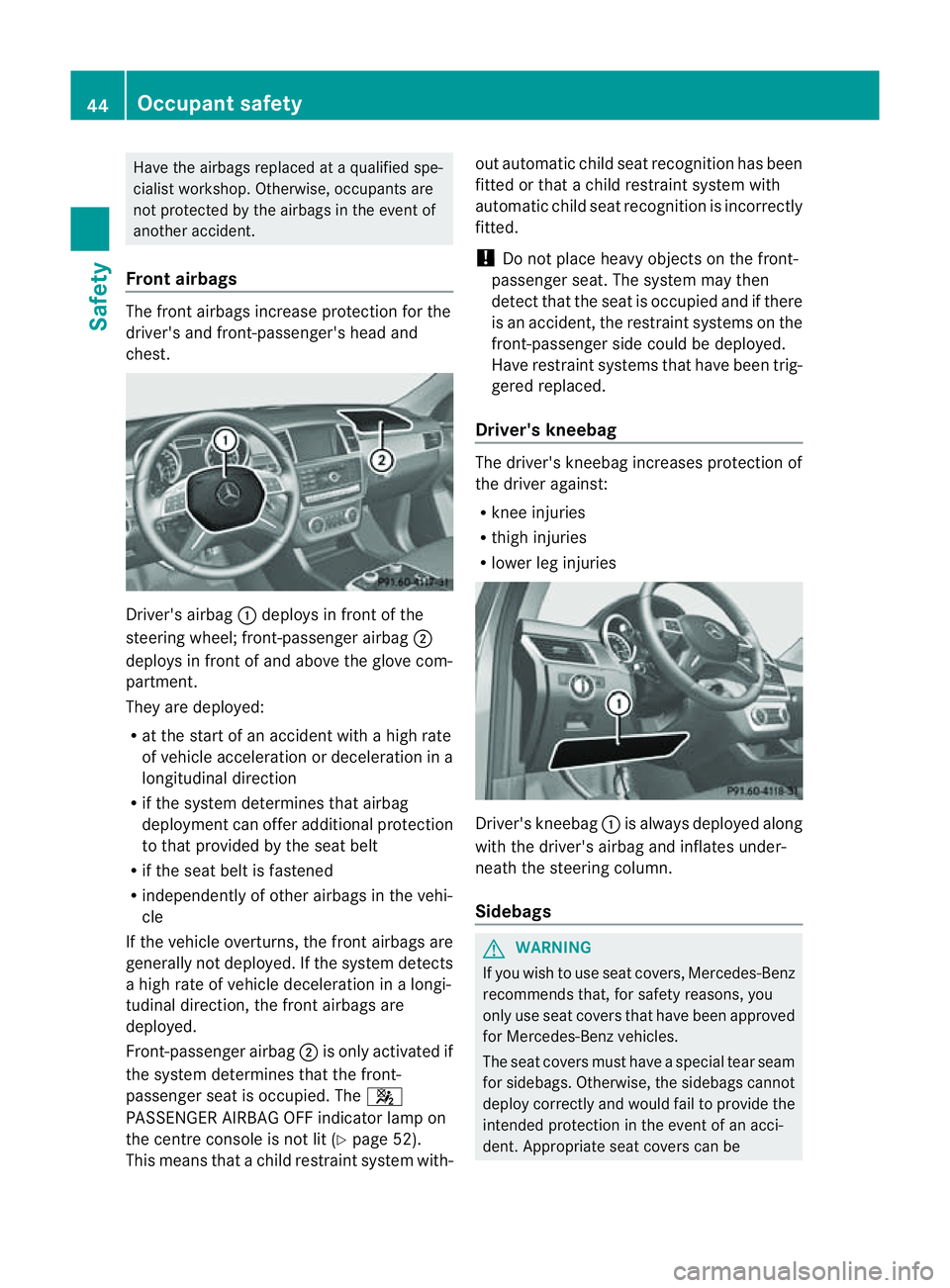
Front airbags Th
ef ront airbags increase protection for the
driver's and front-p assenger' sheada nd
chest. Driver'
sairbag :deploy sinfront of the
st ee ring wheel; front-p assenger airbag ;
deploys in front of and above the glove com-
partment.
They are deployed:
R at the start of an acciden twith ahigh rate
of vehicle acceleration or deceleration in a
longitudinal direction
R if the system determines that airbag
deploymen tcan offer additional protec tion
to that provide dbytheseat belt
R if th eseat belt is fastened
R independently of other airbag sinthe vehi-
cle
If the vehicle overturns ,the front airbags are
generally not deployed. If the system detec ts
ah igh rate of vehicle deceleration in alongi-
tudinal direction, the front airbags are
deployed.
Front-passenger airbag ;is only activated if
the system determines that the front-
passenger seat is occupied. The 4
PASSENGER AIRBA GOFF indicato rlamp on
the centre console is not lit (Y page 52).
This means that achild restraint system with- out automatic chil
dseat recognition has been
fitted or that achild restraint system with
automatic chil dseat recognition is incorrectly
fitted.
! Do not place heavy object sonthe front-
passenger seat. The system ma ythen
detec tthat the seat is occupied and if there
is an accident ,the restraint system sonthe
front-passenger side could be deployed.
Hav erestraint system sthat hav ebeen trig-
gered replaced.
Driver' skneebag The driver'
skneebag increases protection of
the driver against:
R knee injuries
R thig hinjuries
R lowe rleg injuries Driver's kneebag
:is always deployed along
with the driver' sairbag and inflates under-
neath the steering column.
Sidebags G
WARNING
If you wish to use seat covers, Mercedes-Benz
recommends that, for safety reasons, you
only use seat cover sthat hav ebeen approved
for Mercedes-Ben zvehicles.
The seat cover smust have aspecial tear seam
for sidebags. Otherwise, the sidebags cannot
deploy correctly and would fail to provide the
intended protection in the event of an acci-
dent .Appropriate seat cover scan be 44
Occupant safetySafety
Page 48 of 389
obtained from
aMercedes-Benz Service
Centre. G
WARNING
Sensor stocontrol the airbags are located in
the doors. Therefore, do not mak eany modi-
fications to the doors or doo rtrim, e.g .retro-
fit ting loudspeakers. Damage to the doors
can affect operation of the sidebags.
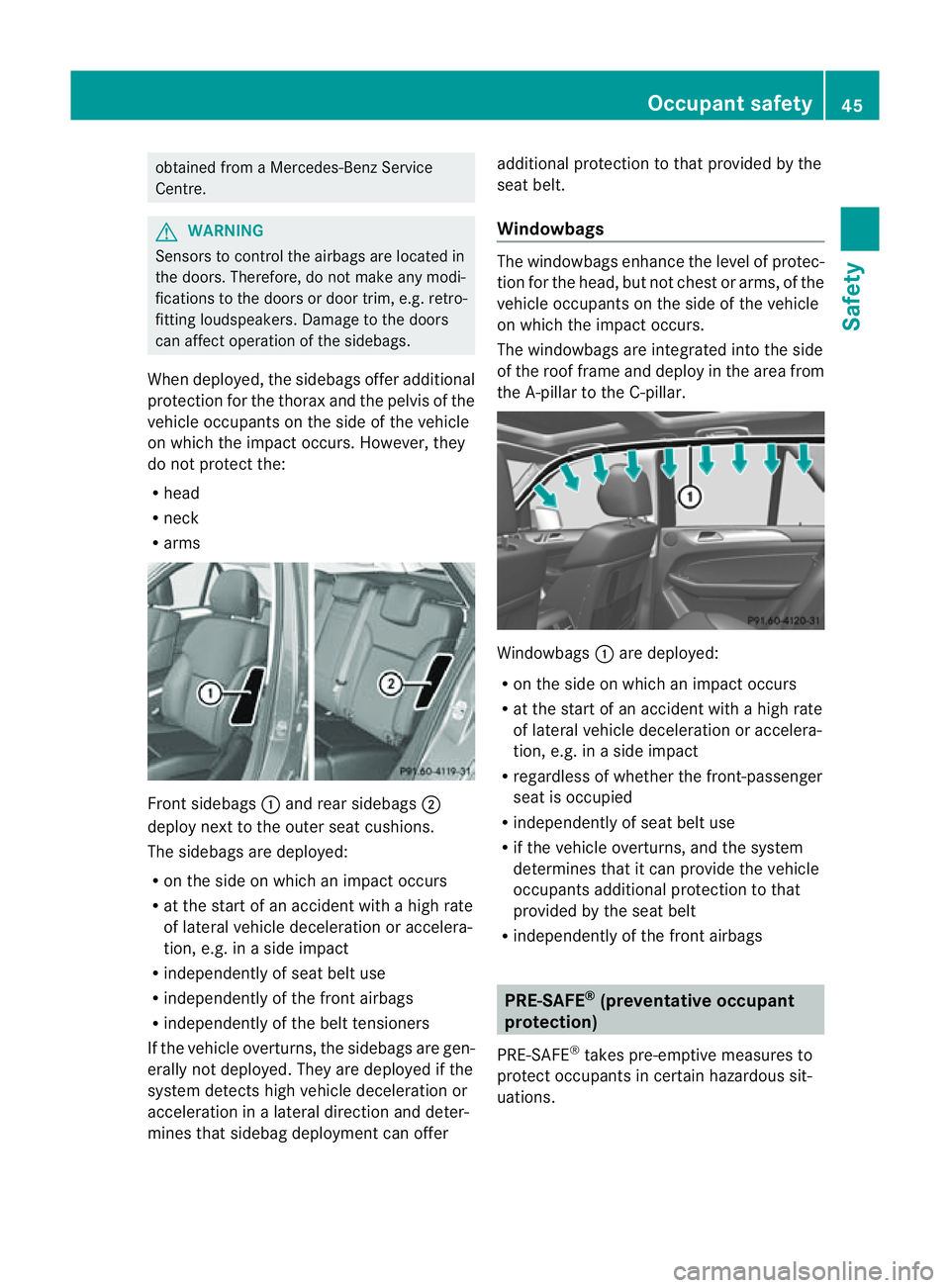
Whe ndeployed, the sidebags offer additional
protection for the thora xand the pelvis of the
vehicl eoccupants on the sid eofthe vehicle
on whic hthe impac toccurs. However, they
do not prote ctthe:
R head
R neck
R arms Fron
tsidebags :and rear sidebags ;
deploy nex ttothe outer seat cushions.
The sidebags ar edeployed:
R on the side on which an impact occurs
R at the star tofanaccident with ahigh rate
of lateral vehicle deceleration or accelera-
tion, e.g. in aside impact
R independently of seat belt use
R independently of the front airbags
R independently of the belt tensioners
If the vehicle overturns, the sidebags are gen-
erally not deployed. They are deployed if the
system detect shigh vehicle deceleration or
acceleration in alateral direction and deter-
mines that sidebag deployment can offer additional protection to that provided by the
seat belt.
Windowbags The windowbag
senhance the level of protec-
tion for the head, but not ches torarms, of the
vehicl eoccupants on the sid eofthe vehicle
on whic hthe impac toccurs.
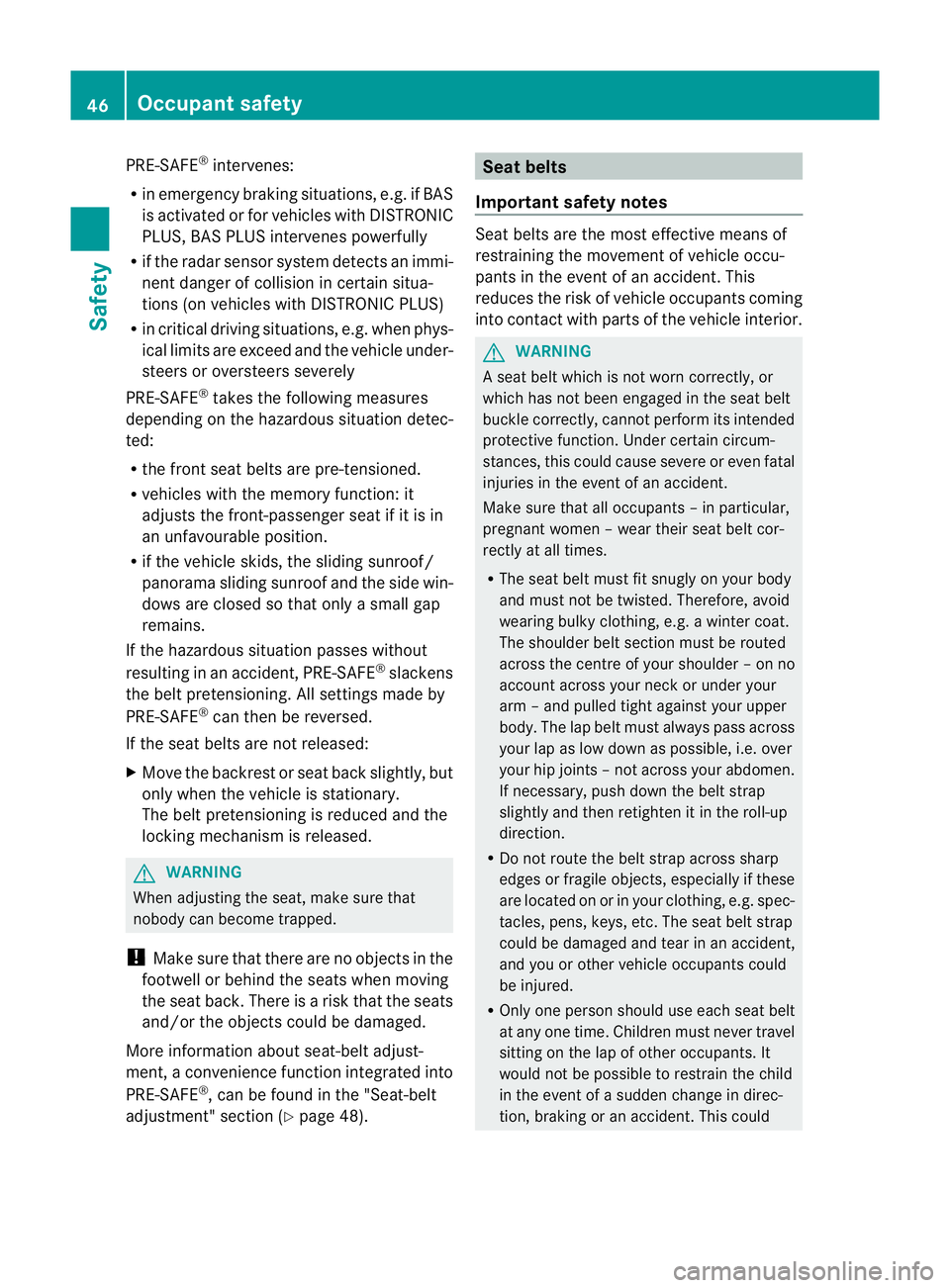
Th ew indowbags are integrated into the side
of the roof frame and deploy in the area from
the A-pillar to the C-pillar. Windowbags
:are deployed:
R on the side on which an impact occurs
R at the start of an accident with ahigh rate
of lateral vehicle deceleration or accelera-
tion, e.g. in aside impact
R regardless of whether the front-passenger
seat is occupied
R independently of seat belt use
R if the vehicle overturns, and the system
determines that it can provide the vehicle
occupant sadditiona lprotectio ntothat
provided by the seat belt
R independen tlyo fthe front airbags PRE-SAFE
®
(preventative occupant
protection)
PRE- SAFE®
take spre-emptive measures to
protect occupants in certain hazardo us sit-
uations. Occupan
tsafety
45Safety Z
Page 49 of 389
PRE-
SAFE®
inte rvenes:
R in emergenc ybraking situations ,e.g. if BAS
is activated or for vehicles with DISTRONIC
PLUS, BAS PLUS intervenes powerfully
R if the radar senso rsystem detects an immi-
nent dange rofcollision in cer tain situa-
tions (on vehicles with DISTRONIC PLUS)
R in critical drivin gsituations, e.g. when phys-
ical limits are exceed and the vehicle under-
steers or oversteers severely
PRE-SAFE ®
takes the following measures
depending on the hazardous situation detec-
ted:
R the fron tseat belts are pre- tensio ned.
R vehicles with the memory fun ction :it
adjust sthe front-pas senger seat if it is in
an unfavourable position.
R if th evehicle skids, th eslidin gsunroof/
panoram aslidin gsunroof and th eside win-
dows are closed so tha tonly asmall gap
remains.
If th ehazardous situatio npasses without
resulting in an accident ,PRE-SAFE ®
slackens
the belt pretensioning. All settings made by
PRE-SAFE ®
can then be reversed.
If the seat belts are not released:
X Move the backrest or seat back sligh tly, but
only when the vehicle is stationary.
The belt pretensionin gisreduced and the
locking mechanis misreleased. G
WARNING
When adjusting the seat, mak esure that
nobody can become trapped.
! Make sure that there are no objects in the
footwell or behind the seats when moving
the seat back. There is arisk that the seats
and/or the objects could be damaged.
More information abou tseat-belt adjust-
men t,ac onvenienc efunction integrated into
PRE-SAFE ®
,c an be found in the "Seat-belt
adjustment" section (Y page 48). Seat belts
Important safety notes Seat belts are the most effective means of
restraining the movemen
tofvehicle occu-
pant sint he even tofana ccident. This
reduce sthe risk of vehicle occupan ts coming
into contact with parts of the vehicl einterior. G
WARNING
As eat belt which is not worn correctly, or
which has not been engaged in the seat belt
buckle correctly, can notp erform its intended
protectiv efunction. Under certain circum-
stances, this could cause severe or even fatal
injuries in the event of an accident.
Make sure that all occupant s–inparticular,
pregnan twome n–w ear their seat belt cor-
rectly at all times.
R The seat belt must fit snugly on your body
and must no tbetwisted. Therefore, avoid
wearing bulky clothing, e.g. awinter coat.
The shoulder belt section must be routed
across the centre of your shoulder –onno
account across your neck or under your
arm –and pulled tight against your upper
body .The lap belt must always pass across
your lap as low down as possible, i.e. over
your hip join ts–n ot across your abdomen.
If necessary ,push down the belt strap
slightly and then retighten it in the roll-up
direction.
R Do not route the belt strap across sharp
edge sorfragil eobjects, especially if these
are located on or in your clothing, e.g. spec-
tacles, pens, keys, etc. The seat belt strap
could be damaged and tear in an accident,
and you or other vehicl eoccupants could
be injured.
R Onl yone person should use each sea tbelt
at any one time. Children must never travel
sittin gont he lap of other occupan ts.It
would not be possible to restrain the child
in the event of asudden change in direc-
tion, braking or an accident .This could 46
Occupant safetySafety