Lights MERCEDES-BENZ METRIS 2016 MY16 Operator’s Manual
[x] Cancel search | Manufacturer: MERCEDES-BENZ, Model Year: 2016, Model line: METRIS, Model: MERCEDES-BENZ METRIS 2016Pages: 310, PDF Size: 7.28 MB
Page 45 of 310
Useful information
This Operator's Manual describes all models as
well as standard and optional equipment of your
vehicle that were available at the time of going
to print.Country-specific variation sare possi-
ble. Note that your vehicle may not be equipped
with all of the described functions. This also
applies to system sand function srelevantt o
safety.
Read the information on qualified specialist
workshops (
Ypage 29).
Occupant safety
Restraint system introduction
The restraint system can reduce the risk of vehi- cle occupants comingi ntoc ontact with parts of
the vehicle' sinterior in the eventofana ccident.
Furthermore, the restraint system may also
reduce the forces exerted on the vehicle occu-
pant swhen an acciden toccurs.
The restraint system includes:
RSeat belt system
RAir bags
RChild restraint system
RChild seat securings ystem
The components of the restraint system work in
conjunction with each other .They can only offer
the intended level of protection if all vehicle
occupants:
Rare correctly wearing their seat belts.
(Ypage 45)
Radjust their seat and head restraint properly
(Ypage 83).
The driver is also responsible for ensurin gthat
the steering wheel has been correctly posi-
tioned. Observet he information relatin gtothe
correct driver'ss eat position (
Ypage 83).
Always ensure the air bag can inflat eproperly if
deployed (
Ypage 48).
An air bag supplement sacorrectly fastened
seat belt. As an additional safetyd evice, the air
bag increases the level of protection for vehicle
occupants in the eventofana ccident. For exam-
ple, if the protection already provided by acor-
rectly fastened seat belt will suffice, the air bags
are not deployed. Furthermore, only the air bags
that would increase the degree of protection
afforded to the vehicle occupants in the evento fan acciden
tare deployed. Seat belts and air
bags generally do not protect against objects
penetratin gthe vehicle from the outside.
Information on restraint system operatio ncan
be found under "TriggeringofE mergencyTen-
sionin gDevices and air bags" (
Ypage 54).
See “Children in the vehicle” for information on children traveling with you as well as vehicle
restraint system s(
Ypage 56).
Important safetyn otes
GWARNING
If the restraint system is modified, it may no
longer work as intended. The restraint system
may then not performi ts intended protective
function by failing in an acciden tortriggering
unexpectedly, for example. There is an
increased risk of injury, possibly even fatal.
Never modify parts of the restraint system .Do
not attempt to modify the wiring as well as
electronic components or their software.
If it is necessary to modify an air bag system to
accommodate aperson with disabilities, con-
tact aMercedes-Benz Commercial Van Cen-
ter for details. USA only: contact our
Mercedes-Benz Customer Assistance Center
at 1-877-762-8267 for details.
Restraint system warning lamp
The restraint system sfunction sare checked
after the ignition is switched on and at regular
intervals when the engin eisrunning. This allows
malfunction stobedetected in good time.
The 6 restraint system warnin glamp in the
instrumentc luster lights up when the ignition is
switched on. It goes out no later than afew sec-
onds after the vehicle is started. The compo-
nents of the restraint system are on standby.
Am alfunction has occurred if the 6restraint
system warnin glamp:
Rdoes not light up after the ignition is switched
on.
Rdoes not go out after afew seconds when the
engin eisrunning.
Rlights up again when the engin eisrunning.
Occupant safety43
Safety
Z
Page 46 of 310
GWARNING
If restraint system is malfunctioning, restraint
system components may be triggere dunin-
tentionall yormight not be triggere datall in
the event of an accident with ahigh rate of
vehicled eceleration. This can affect the Emer-
gency Tensioning Device or air bag ,for exam-
ple.T his poses an increased risk of injury or
even fatal injury.
Have the restraint system checked and
repaired in aqualified specialist worksho pas
soon as possible.
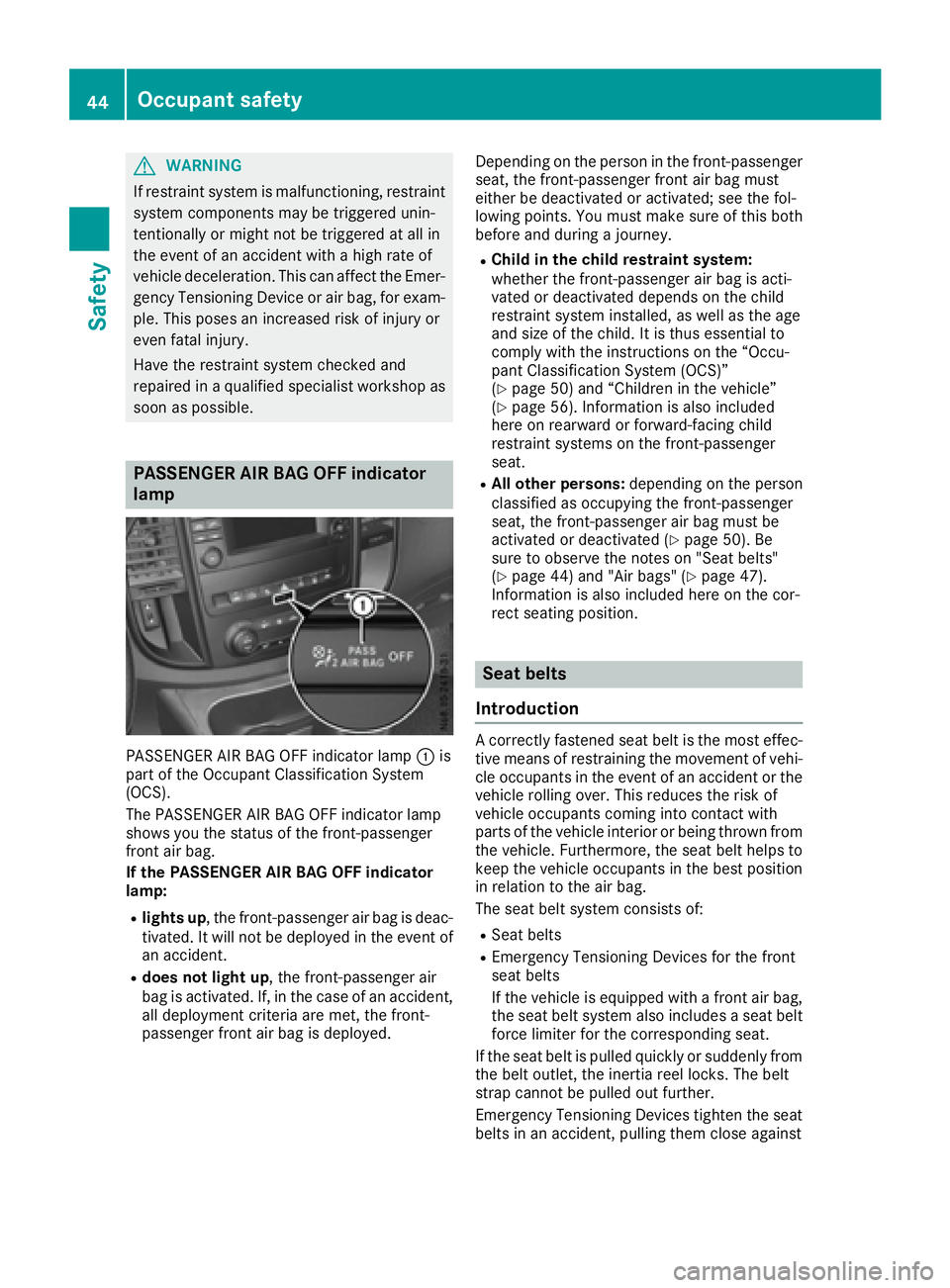
PASSENGER AI RBAG OFF indicator
lamp
PASSENGER AIR BAG OFF indicator lamp :is
part of the Occupant Classification System
(OCS).
The PASSENGER AIR BAG OFF indicator lamp
showsy ou the status of the front-passenger
front air bag.
If the PASSENGER AI RBAG OFF indicator
lamp:
Rlights up,t he front-passenge rair bag is deac-
tivated. It wil lnot be deploye dinthe event of
an accident.
Rdoes not light up,t he front-passengerair
bag is activated. If, in the case of an accident,
all deployment criteria are met, the front-
passenger front air bag is deployed. Depending on the personint
he front-passenger
seat, the front-passenge rfront air bag must
either be deactivated or activated; see the fol-
lowing points. You must make sure of this both
before and during ajourney.
RChil dint he chil drestraint system:
whethe rthe front-passenge rair bag is acti-
vated or deactivated depends on the child
restraint system installed, as wel lasthe age
and size of the child .Itisthus essentialt o
comply with the instructions on the “Occu-
pant Classification System (OCS)”
(
Ypag e50) and “Childre ninthe vehicle”
(Ypag e56). Information is als oincluded
here on rearward or forward-facing child
restraint systems on the front-passenger
seat.
RAll other persons: depending on the person
classifie dasoccupying the front-passenger
seat, the front-passenge rair bag must be
activated or deactivated (
Ypag e50). Be
sure to observe the notes on "Sea tbelts"
(
Ypag e44) and "Air bags" (Ypag e47).
Information is als oincluded here on the cor-
rect seating position.
Seat belts
Introduction
Ac orrectly fastened seat beltist he most effec-
tive means of restraining the movement of vehi- cle occupants in the event of an accident or the
vehicler olling over. This reduces the risk of
vehicleo ccupants coming into contact with
parts of the vehiclei nterior or being thrown from
the vehicle. Furthermore ,the seat belth elpsto
keep the vehicleo ccupants in the best position
in relation to the air bag.
The seat belts ystem consists of:
RSeat belts
REmergency Tensioning Devices for the front
seat belts
If the vehicleise quipped withafront air bag,
the seat belts ystem alsoincludes aseat belt
force limiter for the corresponding seat.
If the seat beltisp ulled quickly or suddenly from
the belto utlet, the inertia reel locks. The belt
strap cannot be pulled out further.
Emergency Tensioning Devices tighten the seat belts in an accident, pulling them close against
44Occupant safety
Safety
Page 49 of 310
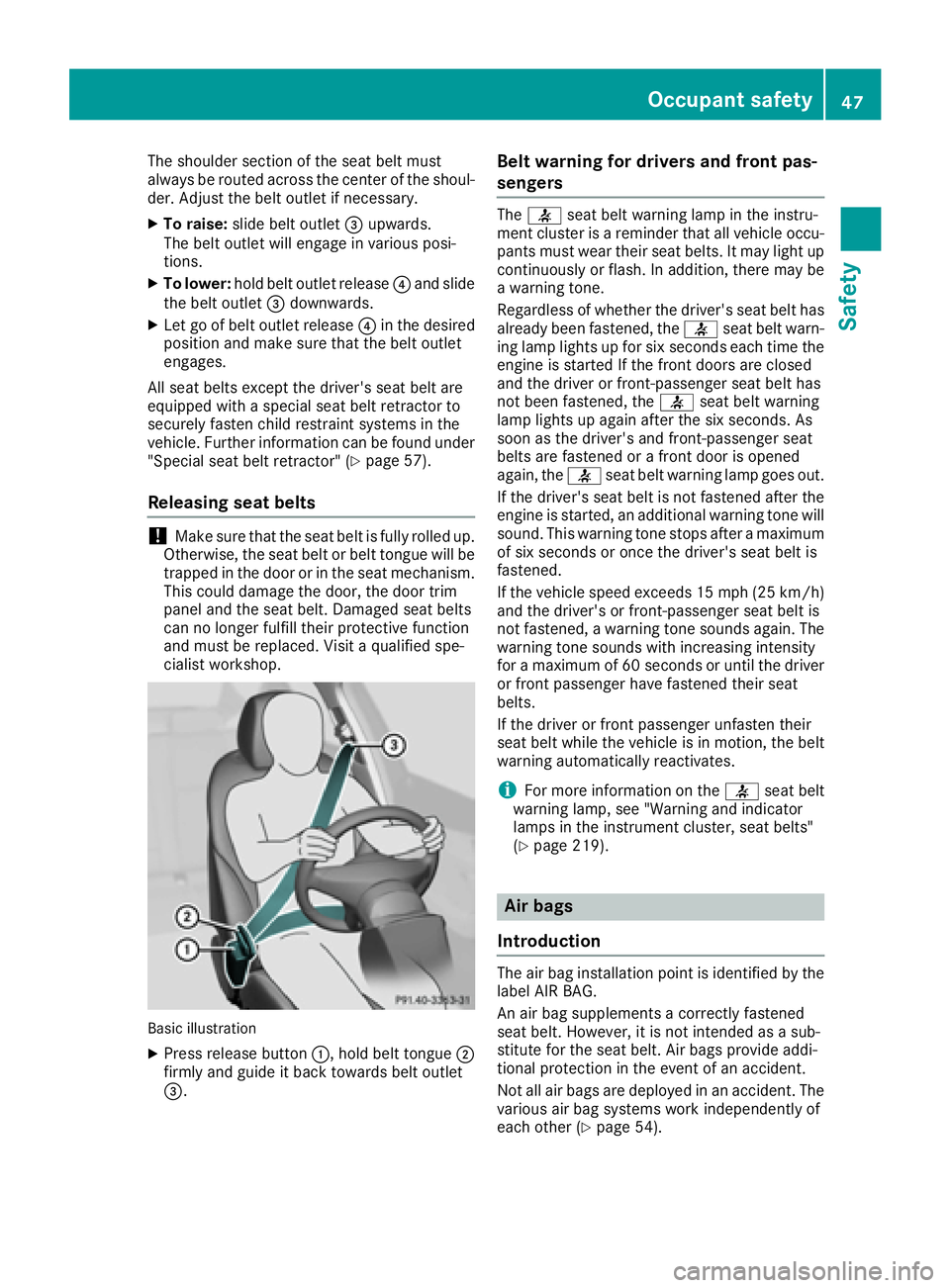
The shoulder section of the seat belt must
alwaysberouted across the center of the shoul-
der. Adjust the belt outlet if necessary.
XTo raise: slide belt outlet =upwards.
The belt outlet will engage in various posi-
tions.
XTo lower: hold belt outlet release ?and slide
the belt outlet =downwards.
XLet go of belt outlet release ?in the desired
position and make sure that the belt outlet
engages.
All seat belts except the driver's seat belt are
equipped with aspecial seat belt retractor to
securely fasten child restraint systems in the
vehicle. Further information can be found under
"Special seat belt retractor" (
Ypage 57).
Releasing seat belts
!Make sure that the seat belt is fully rolled up.
Otherwise, the seat belt or belt tongue will be
trapped in the door or in the seat mechanism.
This could damage the door, the door trim
panel and the seat belt. Damaged seat belts
can no longer fulfill their protective function
and must be replaced. Visit aqualified spe-
cialist workshop.
Basic illustration
XPress release button :,hold belt tongue ;
firmly and guide it back towards belt outlet
=.
Belt warning for driver sand front pas-
sengers
The 7 seat belt warning lamp in the instru-
ment cluster is areminder that all vehicle occu-
pants must wear their seat belts. It may light up
continuously or flash. In addition, there may be
aw arning tone.
Regardless of whether the driver's seat belt has
already been fastened, the 7seat belt warn-
ing lamp lights up for six seconds each time the engine is started If the front doors are closed
and the driver or front-passenger seat belt has
not been fastened, the 7seat belt warning
lamp lights up again after the six seconds. As
soon as the driver's and front-passenger seat
belts are fastened or afront door is opened
again, the 7seat belt warning lamp goes out.
If the driver's seat belt is not fastened after the
engine is started, an additional warning ton ewill
sound. This warning ton estops after amaximum
of six seconds or once the driver's seat belt is
fastened.
If the vehicle speed exceeds 15 mph (2 5km/ h)
and th edriver'sorf ront-passenger seat belt is
no tfastened, awarning tone sounds again.T he
warning tone sounds with increasing intensity
for am aximum of 60 seconds or until th edriver
or frontp assenger have fastene dtheir seat
belts.
If th edriver or frontp assenger unfasten their
seat belt while th evehicle is in motion,t hebelt
warning automatically reactivates.
iFor morei nformationonthe7 seat belt
warning lamp, see "Warning and indicator
lamps in th einstrumentc luster, seat belts"
(
Ypage 219).
Air bags
Introduction
The air bag installatio npointisi dentified by the
label AI RBAG.
An air bag supplements acorrectly fastened
seat belt.H owever,itisnotintended as asub-
stitut efor th eseat belt.A ir bags provide addi-
tional protection in th eeven tofana ccident.
Not all air bags are deployed in an accident. The
various air bag systems work independently of
each other (
Ypage 54).
Occupant safety47
Safety
Z
Page 53 of 310
Occupant Classification System (OCS)
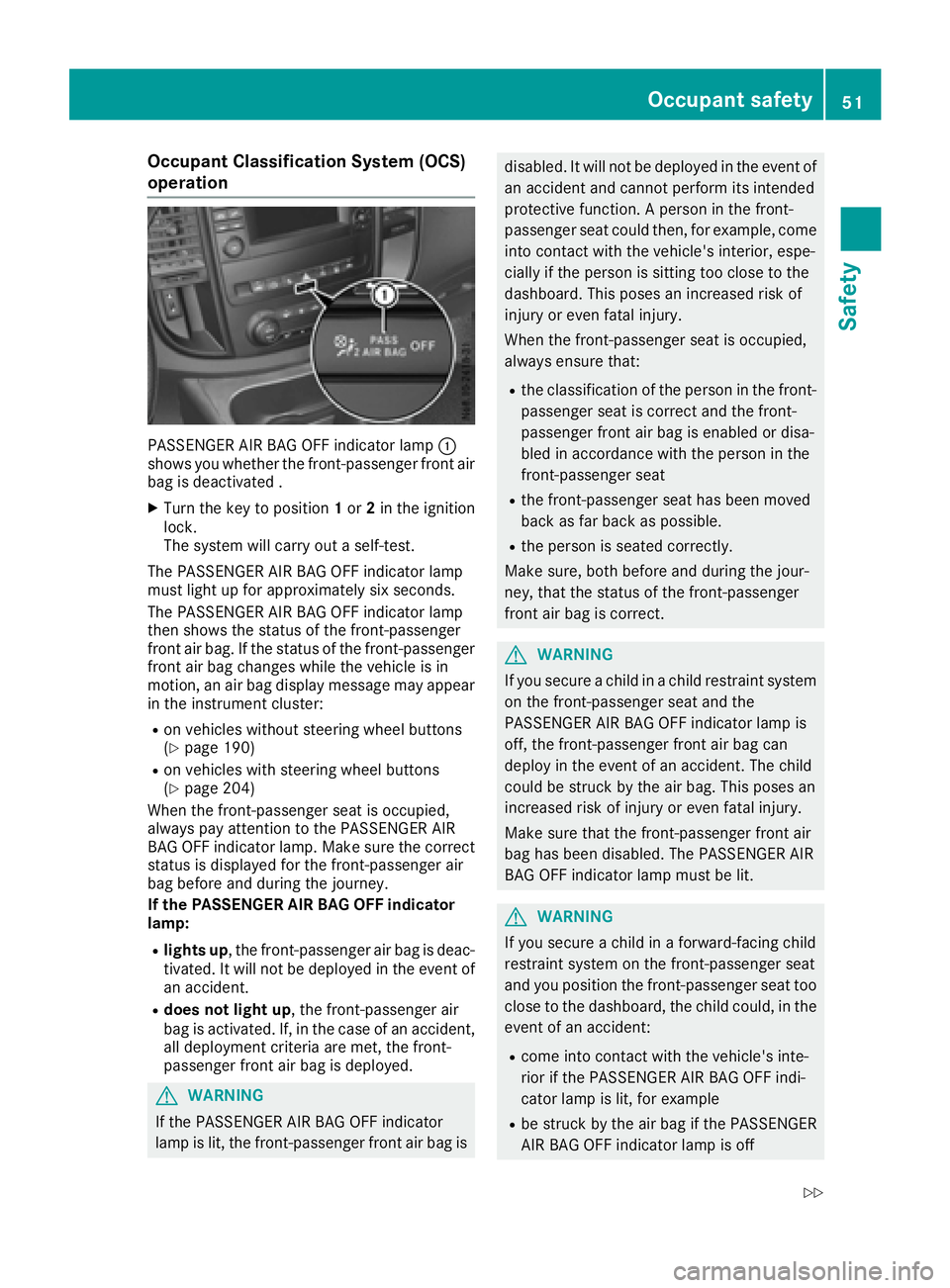
operation
PASSENGER AIR BAG OFF indicator lamp:
shows you whether the front-passenger fronta ir
bag is deactivated .
XTurn the key to position 1or 2in the ignition
lock.
The system will carry out aself-test.
The PASSENGER AIR BAG OFF indicator lamp
must light up for approximately six seconds.
The PASSENGER AIR BAG OFF indicator lamp
then shows the status of the front-passenger
fronta ir bag. If the status of the front-passenger
fronta ir bag changes while the vehicle is in
motion ,anair bag display message may appear
in the instrument cluster:
Ron vehicles without steering wheel buttons
(Ypage 190)
Ron vehicles with steering wheel buttons
(Ypage 204)
When the front-passenger seat is occupied,
alwaysp ay attention to the PASSENGER AIR
BAG OFF indicator lamp. Make sure the correct
status is displayed for the front-passenger air
bag before and during the journey.
If the PASSENGER AIR BAG OFF indicator
lamp:
Rlights up ,the front-passenger air bag is deac-
tivated. It will not be deployed in the event of
an accident.
Rdoes not light up,t he front-passenger air
bag is activated. If, in the case of an accident,
all deployment criteria are met, the front-
passenger fronta ir bag is deployed.
GWARNING
If the PASSENGER AIR BAG OFF indicator
lamp is lit, the front-passenger fronta ir bag is
disabled. It will not be deployed in the event of
an accidenta nd cannot perform its intended
protective function .Aperson in the front-
passenger seat could then ,for example, come
into contact with the vehicle's interior, espe-
cially if the person is sitting too close to the
dashboard. This poses an increased risk of
injur yore ven fatal injury.
When the front-passenger seat is occupied,
alwayse nsure that:
Rthe classification of the person in the front-
passenger seat is correct and the front-
passenger fronta ir bag is enabled or disa-
bled in accordance with the person in the
front-passenger seat
Rthe front-passenger seat has been moved
back as far back as possible.
Rthe person is seated correctly.
Make sure, both before and during the jour-
ney, that the status of the front-passenger
fronta ir bag is correct.
GWARNING
If you secure achild in achild restraint system
on the front-passenger seat and the
PASSENGER AIR BAG OFF indicator lamp is
off, the front-passenger fronta ir bag can
deploy in the event of an accident. The child
could be struc kbythe air bag. This poses an
increased risk of injur yoreven fatal injury.
Make sure that the front-passenger fronta ir
bag has been disabled. The PASSENGER AIR
BAG OFF indicator lamp must be lit.
GWARNING
If you secure achild in aforward-facing child
restraint system on the front-passenger seat
and you position the front-passenger seat too close to the dashboard, the child could, in the
event of an accident:
Rcome into contact with the vehicle's inte-
rior if the PASSENGER AIR BAG OFF indi-
cator lamp is lit, for example
Rbe struck by the air bag if the PASSENGER
AIR BAG OFF indicator lamp is off
Occupant safety51
Safety
Z
Page 54 of 310
This poses an increased risk of injury or evenfatal injury.
Move the front-passenger seat as far back as
possible. Always make sure that the shoulder belt strap is correctly routed from the vehicle
belt sash guide to the shoulder belt guide on
the child restraint system. The shoulder belt
strap must be routed forwards and down-
wards from the vehicle belt sash guide. If nec-
essary, adjust the vehicle belt sash guide and
the front-passenger seat accordingly. Always
observe the child restraint system manufac-
turer's installation instructions.
If OCS determines that:
Rthe front-passenger seat is unoccupied, the
PASSENGER AIR BAG OFF indicator lamp
lights up after the system self-test and
remains lit. This indicates that the front-
passenger air bag has been deactivated.
Rthe front-passenger seat is occupied by a
child of up to 12 months old in astandard
child restraint system, the PASSENGER AIR
BAG OFF indicator lamp lights up after the
system self-test and remains lit. This indi-
cates that the front-passenger air bag has
been deactivated.
But even in the case of a12-month-old child in
as tandard child restraint system, the
PASSENGER AIR BAG OFF indicator lamp can
go out after the system self-test. This indi-
cates that the front-passenger air bag has
been activated. The classification depends,
among other things, on the child restraint sys-
tem and the size and weight of the child. In
this case, install the child restraint system on
as uitable rear seat.
Rthe front-passenger seat is occupied by aper-
son of smaller stature (e.g. ateenager or
small adult), the PASSENGER AIR BAG OFF
indicator lamp lights up and remains lit after
the system self-test depending on the result
of the classification or, alternatively, goes out.
-If the PASSENGER AIR BAG OFF indicator
lamp is not lit, move the front-passenger
seat as far back as possible. Alternatively, a person of smaller stature can sit on
arear
seat.
-If the PASSENGER AIR BAG OFF indicator
lamp is lit, aperson of smaller stature
should not use the front-passenger seat.
Rthe front-passenger seat is occupied by an
adult or aperson of astature corresponding
t o
that of an adult, the PASSENGER AIR BAG
OFF indicator lamp goes out after the system
self-test. This indicates that the front-
passenger air bag has been activated.
If children are also traveling in the vehicle,
please observe the instructions about “Children
in the vehicle” (
Ypage 56).
If OCS is malfunctioning, the red 6restraint
system warning lamp in the instrument cluster
and the PASSENGER AIR BAG OFF indicator
lamp light up simultaneously. This signals that
the front-passenger air bag has been deactiva-
ted and will not be deployed in the event of an
accident .Have the system checked by aquali-
fied technician as soon as possible. Consult a
Mercedes-Benz Commercial Van Center. The
front-passenger seat should only be repaired at aM ercedes-Benz Commercial Van Center.
If the front-passenger seat, the seat cover or the
upholstery is damaged, have the necessary
repair work carried out at aMercedes-Benz
Commercial Van Center.
For safety reasons, Mercedes-Benz recom-
mends that you only use seating accessories
that have been specially approved for
Mercedes-Benz vehicles.
If the driver's air bag deploys, this does not
mean the front-passenger air bag must also
deploy. The Occupant Classification System
(OCS) classifies occupantsont he front-
passenger seat. Dependin gonthe outcome, the
front-passenger air bag is either activated or
deactivated.
System self-test
GDANGER
If the PASSENGER AIR BAG OFF indicator
lamp does not light up during the system self-
test ,then the system is malfunctioning. The
front-passenger front air bag might be trig-
gered unintentionally or might not be trig-
gered at all in the event of an accident with
high deceleration. This poses an increased
risk of injury or even fatal injury.
52Occupant safety
Safety
Page 56 of 310
Problems with the Occupant Classification System (OCS)
Be sure to observe the notes on "System self-test"(Ypage 52).
ProblemPossible causes/consequences andMSolutions
The PASSENGER AIR
BAG OFF indicator lamp
lights up and remains lit,
even though the front-
passenger seat is occu-
pied by an adult oraper-
son of astature corre-
sponding to that of an
adult.The classification of the person on the front-passenger seat is incor-
rect.
XMake sure the conditionsf orac orrect classification of the person
on the front-passenger seat are met (Ypage 50).
XIf the PASSENGER AIR BAG OFF indicator lamp remains lit, the front-
passenger seat may not be used.
XHave OCS checked as soon as possible at aMercedes-Benz Com-
mercial Van Center.
The PASSENGER AIR
BAG OFF indicator lamp
does not light up and/or
does not stay on.
The front-passenger seat
is:
Runoccupied
Roccupied with the
weight of achild up to
twelve months old in a
child restraint system
OCS is malfunctioning.
XMake sure there is nothin gbetween the seat cushion and the child
seat.
XMake sure that the entire base of the child restraint system rests on
the seat cushion of the front-passenger seat. The backrest of the
forward-facing child restraint system must lie as flat as possible
against the backrest of the front-passenger seat. If necessary,
adjust the position of the front-passenger seat.
XWhen installing the child restraint system, make sure that the seat belt is tight. Do not pull the seat belt tight using the front-passenger
seat adjustment .This could result in the seat belt and the child
restraint system being pulled too tightly.
XCheck for correct installation of the child restraint system.
Make sure that the head restraint does not apply aload to the child
restraint system. If necessary, adjust the head restraint accord-
ingly.
XMake sure that no object sare applying additional weight onto the
seat.
XIf the PASSENGER AIR BAG OFF indicator lamp remains off, do not
install achild restraint system on the front-passenger seat. It is
recommended that you install the child restraint system on asuit-
able rear seat.
XHave OCS checked as soon as possible at aMercedes-Benz Com-
mercial Van Center.
Deployment of Emergency Tensioning
Devices and air bags
Important safety notes
GWARNING
The air bag parts are hot after an air bag has
been deployed. There is arisk of injury.
Do not touch the air bag parts. Have a
deploye dair bag replaced at aqualified spe-
cialist workshop as soon as possible.
GWARNING
Ad eployeda ir bag no longer offers any pro-
tection and cannot provide the intended pro-
tection in an accident. There is an increased
risk of injury.
54Occupant safety
Safety
Page 64 of 310
the electricslidin gdoorusing the corresponding
Å orÆ sliding door button in the center
consol e(
Ypage 75).
Pets in the vehicle
GWARNING
If yo uleave animals unattended or unsecured
in the vehicle, theyc ould press buttons or
switches ,for example.
As aresult, theyc ould:
Ractivate vehicl eequipment and become
trapped ,for example
Ractivate or deactivate systems, thereby
endangering othe rroa du sers
Unsecured animals could also be flung around
the vehicl einthe event of an accident or sud-
de ns teering or braking ,thereb yinjurin gvehi-
cle occupants. There is ariskofana ccident
and injury.
Never leav eanimals unattended in the vehi-
cle .Alway ssecurea nimals properly during
the journey ,e.g.u se asuitabl eanimalt rans-
port box.
Driving safety systems
Overview
In thiss ection, yo uwillf indi nformation about
the following drivin gsafety systems:
REBD ( Ele ctronic Brake Force Distribution)
RABS ( Anti-lock Braking Sys tem)
RBAS ( Brake Assist System)
RESP®(E le ctronic Stability Program)
Important safety notes
If yo ufailtoa dapt your drivin gstyle or if yo uare
inattentive, the drivin gsafety systems can nei-
therr educe the ris kofaccident nor override the
laws of physics .Drivin gsafety systems are
merel yaidsd esig nedtoa ssistdriving. Yo uare
responsibl efor the distance to the vehicl ein
front, for vehicl espeed, braking in good time
and for staying in your lane. Alway sadapt your drivin
gstyle to the prevailing roa dand weather
conditions and maintain asufficient, safe dis-
tance fromo therroa du sers.D rive carefully.
Please note thatt he drivingsafety systems
describe donlyw orko ptimally when:
Rthere is adequate contact between the tires
and the roa dsurface
Ryo uu sewinter tire s(M+ Stires),w iths now
chains if necessary,w hent he roa dconditions
ar ew intry
Rthe spee dinformation determine dbythe
vehicl eiswithint he legall yprescribe ddisplay
accuracy
Pa yp articular attentio ntothe information
regarding tires, coding of the whee lsizeg roups,
tire trea dand winter operatio nunder "Wheels
and tires" (
Ypage 267).
ABS (Anti-lock Braking System)
General notes
ABS regulate sbrake pressure in such awaythat
the wheels do not lock when yo ubrake. This
allows yo utocontinue steering the vehicl ewhen
braking.
The ò warning lamp in the instrument cluster
lights up when the ignition is switched on. The
lamp goes ou twhent he engine starts running.
Important safety notes
Observe the important safety guideline sfor the
drivin gsafety system(Ypage 62).
ABS works fromas peedof abou t5mph
(8 km/h), regardles sofroad-surface conditions.
ABS works on slippery surfaces ,evenw heny ou
onl ybrake gently.
GWARNING
If ABS is faulty, the wheels could lock when
braking .The steerability an dbraking charac-
teristics maybes everel yimpaired. Addition-
ally ,fur the rdrivin gsafety systems ar edeac-
tivated .Ther eisani ncreasedd angerofs kid-
ding and accidents.
Drive on carefully. Hav eABS checked imme-
diately at aquali fied specialis tworkshop.
62Driving safet ysystems
Safety
Page 65 of 310
If ABS is malfunctioning, theòwarning lamp
(Ypage 221) lights up whil ethe engine is run-
ning and the display shows amessage:
Ron vehiclesw ithoutsteering wheel buttons
(Ypage 189)
Ron vehiclesw ith steering wheel buttons
(Ypage 203)
BAS, Hill Start Assist and ESP®and its driving
safety systems and other driving systems also
fail .Observe the notes on the òwarning
lamp and the display messages.
Braking
If ABS intervenes when braking, you wil lfeel a
pulsating in the brake pedal.
The pulsating brake pedalc an be an indication
of hazardous road conditions and functions as a
reminder to take extra care whiled riving.
XIf ABS intervenes:continue to depresst he
brake pedalw ith force until the braking sit-
uatio niso ver.
XTo make afull brake application: depress
the brake pedalw ith full force.
BAS (Brake Assist System)
General notes
BAS operates in emergency braking situations.
If you depresst he brake pedalq uickly, BAS
automatically boosts the braking force, thus
shortening the stopping distance.
Important safety notes
Observe the important safety guidelines for the
driving safety system (Ypage 62).
GWARNING
If BAS is malfunctioning, the braking distance
in an emergency braking situation is
increased .There is arisk of an accident.
In an emergency braking situation, depress
the brake pedalw ith full force. ABS prevents
the wheel sfrom locking.
If BAS is malfunctioning, the ÷warning lamp
lights up whil ethe engine is running
(
Ypage 221) and the display shows amessage:
Ron vehiclesw ithoutsteering wheel buttons
(Ypage 193)
Ron vehiclesw ith steering wheel buttons
(Ypage 207)
Braking
XKeep the brake pedalf irmly depressed until
the emergency braking situation is over.
ABS prevents the wheel sfrom locking.
The brakes willf unction as usual once you
release the brake pedal. BAS is deactivated.
EBD (electroni cbrake force distribu-
tion)
General notes
EBD monitors and controls the brake pressure
to the rear wheels. This enables EBD to improve handling during braking.
Important safety notes
Observe the important safety guidelines for the
driving safety system (Ypage 62).
GWARNING
If EBD is malfunctioning, the rear wheelsc an
lock, e.g. under full braking. This increases the
risk of skidding and an accident.
You shoul dtherefore adapt you rdriving style
to the different handling characteristics. Have
the brake system checked at aqualifieds pe-
cialist workshop.
If EBD is malfunctioning, the $warning lamp
(
Ypage 220) lights up whil ethe engine is run-
ning and the display shows amessage.
Ron vehiclesw ithoutsteering wheel buttons
(Ypage 192)
Ron vehiclesw ith steering wheel buttons
(Ypage 206)
Other driving systems and driving safety sys-
tems then also fail.
Driving safety systems63
Safety
Z
Page 66 of 310
ESP®(Electronic Stability Program)
General notes
ESP®monitors driving stabilitya nd detectsa
tendenc yofthevehicle to understeer or over-
steer (skidding) in good time. If ESP
®detects
that th evehicle is deviatin gfromt hedirection
desired by th edriver, oneorm orew heels are
braked to stabilizet hevehicle .The engine out-
put is also modified to keep th evehicle on the
desired course within physical limits. ESP
®can
also stabilizet hevehicle durin gbraking.
ESP
®also monitors traction,i .e.p ower trans-
mission between th etires and th eroad surface.
The integrate dtraction control support syou
when pullinga way or acceleratin gonwet,slip-
pery or slickr oads. Should th edrivew heels spin,
traction control brakes them individually. In
addition,g reaterdrivet orque is transmitte dto
th ew heel or wheels with traction.Ift raction on
th er oad surface is no tsufficient ,even ESP
®will
no tallow you to pull away without difficulty. The
type of tires and total weightoft hevehicle as
well as th egradientoft heroad also play acru-
cial role .Tractio ncontrol remains active if you
deactivate ESP
®.
If the h warning lamp in th einstrumen tclus-
te rg oes out before beginnin gthe journey, ESP
®
is automaticall yactive.
The h warning lamp in th einstrumen tcluster
flashes when ESP
®intervenes:
XDo no tdeactivate ESP®unde rany circum-
stances.
Xwhen driving off ,apply as little throttle as
possible.
Xadapt your speeda nd driving style to th epre-
vailin groad conditions.
Important safety notes
Observ ethe important safety guidelines for the
driving safety system (Ypage 62).
GWARNING
If ESP
®is malfunctionin gitwill notprovide
any vehicle stabilization. Thereisani ncreased
risk of skiddingorofana ccident.
Exercise caution when continuing to drive.
Hav eESP
®checked at aqualified specialist
workshop.
!Do no trun th evehicle on aroller dynamom-
eter (e.g. for performanc etests) .Ifyou must
operate th evehicle on aroller dynamometer,
please consult aqualified specialist workshop
in advance. You coul dotherwise damag ethe
driv etrain or th ebrak esystem.
If ESP
®is malfunctioning, the hwarning
lamp (Ypage 221) lightsupc ontinuously while
th ee ngine is runnin gand th edisplay showsa
message.
Ron vehicle swithout steering wheel buttons
(Ypage 193)
Ron vehicle swith steering wheel buttons
(Ypage 207)
ESP®is deactivate diftheå warning lamp in
th ei nstrumentc lusterislit when th eengine is
running.
Only use wheels with th erecommended tire
sizes. Only then will ESP
®function properly.
Deactivating/activatin gESP®
GWARNING
If you deactivate ESP
®,E SP®no longer sta-
bilizes th evehicle .Thereisani ncreased risk
of skiddinga nd an accident.
Only deactivate ESP
®in th esituations descri-
bed in th efollowing.
It may be best to deactivate ESP
®in th efollow-
ing situations:
Rwhen usings nowc hains
Rin deep snow
Ron sandorg ravel
Activate ESP®as soon as th esituations descri-
bed abovenol onger apply. Otherwise, ESP®
assistance for stabilizing th evehicle will remain
significantly reduced, even if th evehicle starts
to skid.
If you deactivate ESP
®:
Rthe å warning lamp in th einstrumen tclus-
te rlightsu p.
Rthe÷ warning lamp in th einstrumen tclus-
te rf lashes if th ewheels are spinning.
RESP®assistance for stabilizing th evehicle in
th el ower speedr ange up to approximately
37 mph (60 km/h) is significantly reduced.
Rengine torque is no longer limited and the
driv ewheels are able to spin
64Driving safety systems
Safety
Page 67 of 310
The spinningofthe wheels results in acutting
action for better traction on loose surfaces.
RTraction control is still activated
RESP®still provides support when you brake.
Dependin gonthe equipment in the vehicle, you
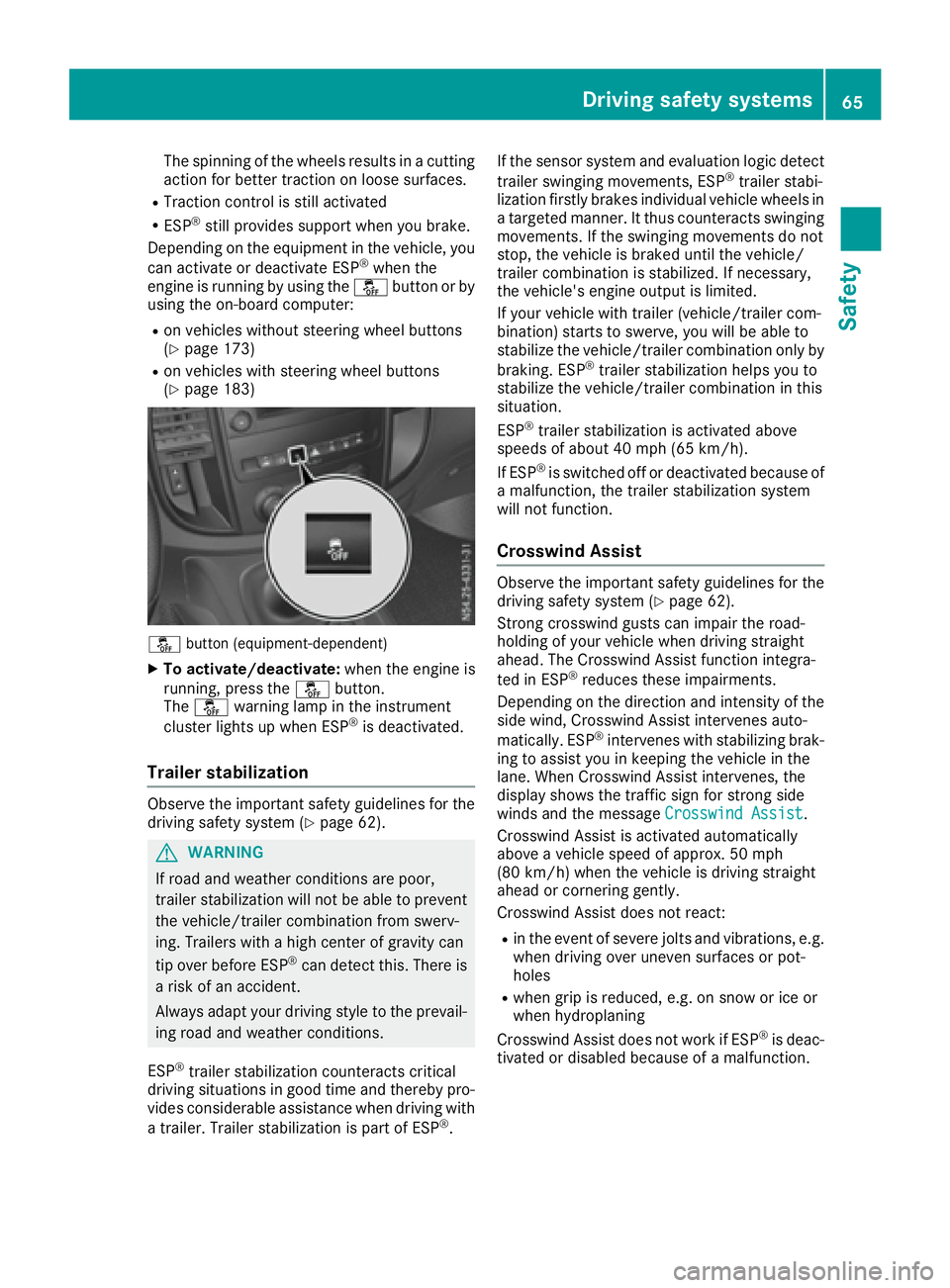
can activate or deactivate ESP
®when the
engine is runnin gbyusing the åbutton or by
using the on-board computer:
Ron vehicles without steerin gwheel buttons
(Ypage 173)
Ron vehicles with steerin gwheel buttons
(Ypage 183)
å button (equipment-dependent)
XTo activate/deactivate: when the engine is
running, press the åbutton.
The å warning lamp in the instrument
cluster lights up when ESP
®is deactivated.
Trailer stabilization
Observe the important safety guidelines for the
driving safety system (Ypage 62).
GWARNING
If road and weather conditions are poor,
trailer stabilization will not be able to prevent
the vehicle/trailer combination from swerv-
ing. Trailers with ahigh center of gravity can
tip over before ESP
®can detect this. There is
ar isk of an accident.
Always adapt your driving style to the prevail-
ing road and weather conditions.
ESP
®trailer stabilization counteracts critical
driving situations in good time and thereby pro- vides considerable assistance when driving with
at railer. Trailer stabilization is part of ESP
®. If the sensor system and evaluation logic detect
trailer swinging movements, ESP
®trailer stabi-
lization firstly brakes individual vehicle wheels in
at argeted manner .Itthus counteracts swinging
movements. If the swinging movements do not
stop, the vehicle is braked until the vehicle/
trailer combination is stabilized. If necessary,
the vehicle's engine output is limited.
If your vehicle with trailer (vehicle/trailer com-
bination) start stoswerve, you will be able to
stabilize the vehicle/trailer combination only by
braking. ESP
®trailer stabilization helps you to
stabilize the vehicle/trailer combination in this
situation.
ESP
®trailer stabilization is activated above
speeds of about 40 mph (65 km/h).
If ESP
®is switched off or deactivated because of
am alfunction, the trailer stabilization system
will not function.
Crosswind Assist
Observe the important safety guidelines for the
driving safety system (Ypage 62).
Strong crosswind gusts can impair the road-
holding of your vehicle when driving straight
ahead. The Crosswind Assist function integra-
ted in ESP
®reduces these impairments.
Dependin gonthe direction and intensity of the
side wind, Crosswind Assist intervenes auto-
matically. ESP
®intervenes with stabilizing brak-
ing to assist you in keeping the vehicle in the
lane. When Crosswind Assist intervenes, the
display shows the traffic sign for stron gside
winds and the message Crosswind Assist
.
Crosswind Assist is activated automatically
above avehicle speed of approx. 50 mph
(80 km/h) when the vehicle is driving straight
ahead or cornering gently.
Crosswind Assist does not react:
Rin the event of severe jolts and vibrations, e.g.
when driving over uneven surfaces or pot-
holes
Rwhen grip is reduced, e.g. on snow or ice or
when hydroplaning
Crosswind Assist does not work if ESP
®is deac-
tivated or disabled because of amalfunction.
Driving safety systems65
Safety
Z