engine oil MERCEDES-BENZ METRIS 2016 MY16 Operator’s Manual
[x] Cancel search | Manufacturer: MERCEDES-BENZ, Model Year: 2016, Model line: METRIS, Model: MERCEDES-BENZ METRIS 2016Pages: 310, PDF Size: 7.28 MB
Page 235 of 310
In the event of an accident, haveadamaged
cargo compartment floor or loading area ,the
cargo tie-down rings and the tie down checked
at as pecialist workshop. Otherwise ,the load
may not be correctly secured the next time any-
thing is stowed.
Even if you follow all loading guidelines, the load
increases the risk of injury in the event of an
accident. Observe the information in the "Secur- ing aload "(
Ypage 234) and "Loa ddistribution"
(Ypage 233) sections.
You wil lfind information abou tthe maximum
roof load and maximum tailgate load in the
"Cargo tie-down points and carrier systems"
section (
Ypage 304). You wil lfind information
abou troof carriers under "Carrier systems"
(
Ypage 238).
Before loading
!
The anti-slip mats cannot be used for secur-
ing goods and must be replaced when they
show signs of:
RPermanent deformatio nand crushing
RCrack formation
RCuts
XTire pressure: check the tire pressure and
correct if necessary (Ypage 270).
XCargo compartment floor: clean the cargo
compartment floor.
The cargo compartment floor must be free
from oil and dust, dry and swept clean to pre-
vent the load from slipping.
XPlace non-slip mats (anti-slip mats) on the
cargo compartment floor if necessary.
During loading
XObserve the gross axle weight rating and per-
missible gross vehicle weight for you rvehicle.
Take into account that you rvehicle's curb
weight is increased if accessorie soroptional equipment are installed. The maximum pay-
load is thus reduced.
XObserve the notes on load distribution
(Ypage 233).
The overal lcenter of gravity of the load should
always be as low as possible, centered and
betwee nthe axles near the rear axle.
XObserve the legalr equirements of the country
in which you are currently driving.
Checks after loading
GWARNING
Combustion engines emit poisonous exhaust
gases such as carbon monoxide. If the tail-
gate/rear door is open when the engine is
running, particularly if the vehicle is moving,
exhaust fumes could enter the passenger
compartment. There is arisk of poisoning.
Turn off the engine before opening the tail-
gate/rear door. Never drive off with the tail-
gate/rear door open.
XSecuring luggage/loads: make sure that
the luggage and/or load is secure before
every journey and at regular intervals during a
long journey, and correct it if necessary.
XDoors/tailgate: close the sliding doors and
tailgate/door.
XTire pressure: adjust the tire pressure
according to the vehicle load (Ypage 270).
XDrivin gstyle: adapt you rdriving style
according to the vehicle load.
Load distribution
General notes
!
Excessive load sonindividual points of the
cargo floor or on the load surface impair vehi-
cle handling characteristics and could cause
damage to the floor covering.
The overal lcenter of gravity of the load should
always be as low as possible, centered and
betwee nthe axles near the rear axle.
Load distribution233
Transporting loads
Z
Page 242 of 310
Useful information
This Operator's Manual describes all models as
well as standard and optional equipment of your
vehicle that were available at the time of going
to print.Country-specific variation sare possi-
ble. Note that your vehicle may not be equipped
with all of the described functions. This also
applies to system sand function srelevantt o
safety.
Read the information on qualified specialist
workshops (
Ypage 29).
Engine compartment
Hood
Important safetyn otes
GWARNING
If the hood is unlatched, it may open up when the vehicle is in motion and block your view.
There is arisk of an accident.
Never unlatc hthe hood while driving. Before
every trip, ensure that the hood is locked.
GWARNING
Openin gthe hood when the engin eisover-
heated or when ther eisafire in the engine
compartmen tcould expose you to hot gases
or other servicep roducts. There isarisk of
injury.
Let an overheated engin ecool down before
openin gthe hood. If ther eisafire in the
engin ecompartment, keep the hood closed
and contact the fire department.
GWARNING
The engin ecompartmen tcontains moving
components. Certain components, such as
the radiator fan, may continue to run or start
again suddenly when the ignition is off. There is ar isk of injury.
If you need to do any work inside the engine
compartment:
Rswitc hoff the ignition
Rneve rreach int othe area where ther eisa
risk of danger from movingc omponents,
such as the fan rotation area
Rremovej ewelry and watches
Rkeep items of clothing and hair, for exam-
ple, away from movingp arts
GWARNING
The ignition system operate swithahigh volt-
age. If you touc hthe live components, you
could receiv eanelectric shock.T here is an
increased risk of injury.
Never touc hcomponents of the ignition sys-
tem if:
Rthe engin eisrunning or being started
Rthe key is in radio position or drive position
in the ignition lock
The live components of the ignition system are,
for example:
Rignition coils
Rspark plug connectors
Rdiagnostic sockets
GWARNING
Certain components in the engin ecompart-
ment ,such as the engine, radiator and parts
of the exhaust system ,can becomev ery hot.
Working in the engin ecompartmen tposes a
risk of injury.
Where possible, let the engin ecool down and
touc honly the components described in the
following.
If you have to carry out work in the engin ecom-
partment ,only touc hthe following components:
RHood
ROil dipstick
REngine oil filler nec kcap
RWasher fluid reservoir cap
RCoolant expansion tan kcap
240Engine compartment
Maintenance and care
Page 244 of 310
or other service products. There isarisk of
injury.
Let an overheated engine cool down before
opening the hood. If there is afire in the
engine compartment, keep the hood closed
and contact the fire department.
GWARNING
Certain components in the engine compart-
ment,s uch as the engine, radiator and parts
of the exhaust system, can become very hot.
Working in the engine compartment poses a
risk of injury.
Where possible, let the engine cool down and touch only the components described in the
following.
!Do not use your hands to push the hood
down. You could damage it otherwise.
XHold support strut ?and lift the hood
slightly.
XGuide support strut ?towards retainer =
and apply slight pressure to make it engage.
XLower the hood and allow it to fall with
momentum from aheight of approximately
1ft( 30 cm).
The hood locks audibly.
XCheck that the hood is correctly locked.
If the hood can be raised slightly, it is not
properly engaged. If the hood is not correctly
engaged, open the hood again. Let the hood
fall with alittle more momentum.
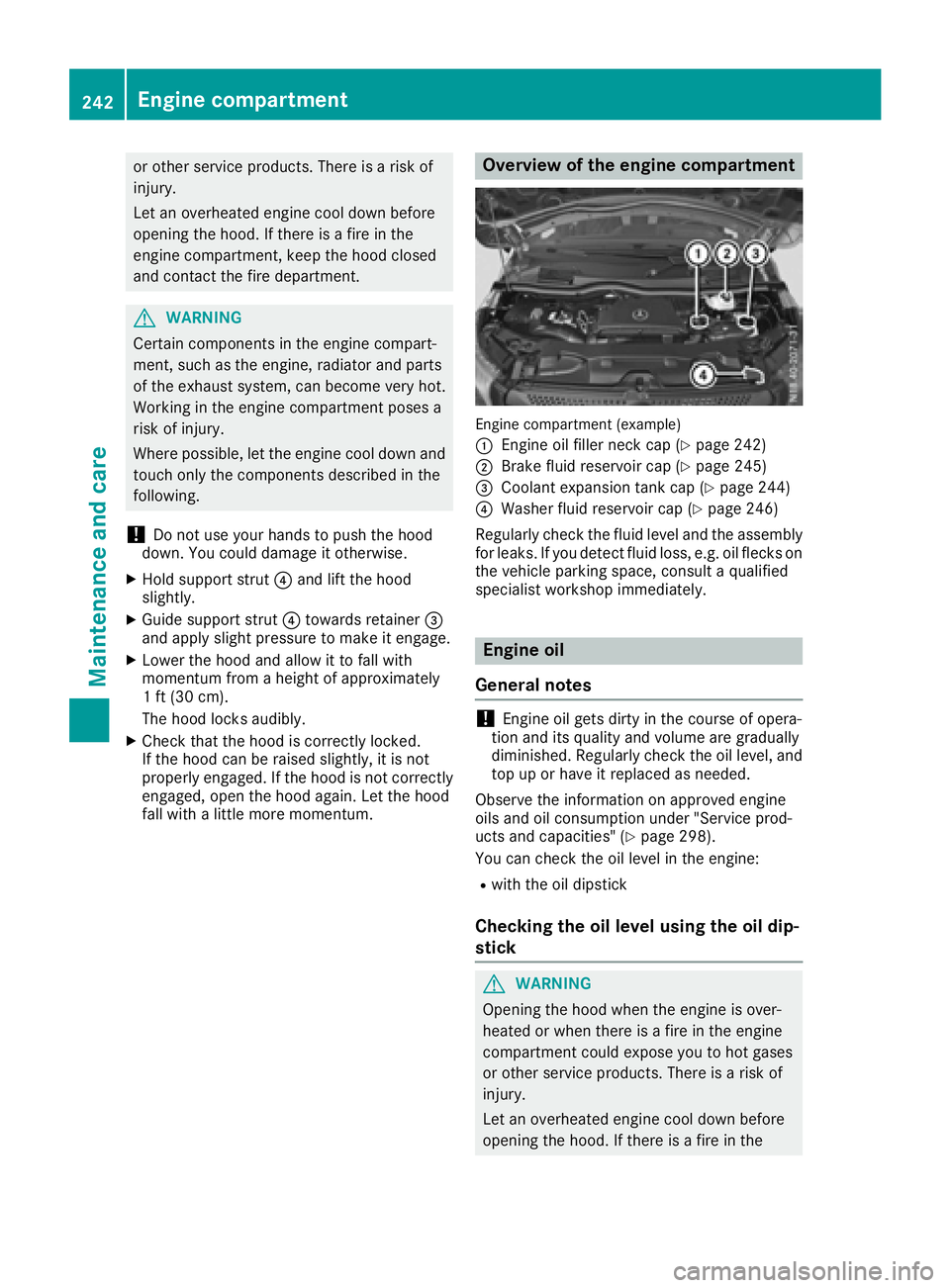
Overview of the engine compartment
Engin ecompartment (example)
:
Engin eoil filler neck cap (Ypage 242)
;Brake fluid reservoir cap (Ypage 245)
=Coolant expansion tank cap (Ypage 244)
?Washer fluid reservoir cap (Ypage 246)
Regularly check the fluid level and the assembly
for leaks. If you detect fluid loss, e.g. oil flecks on the vehicle parking space, consult aqualified
specialist workshop immediately.
Engine oil
General notes
!Engin eoil gets dirty in the course of opera-
tion and its quality and volume are gradually
diminished. Regularly check the oil level, and top up or have it replaced as needed.
Observe the information on approved engine
oils and oil consumption under "Service prod-
ucts and capacities" (
Ypage 298).
You can check the oil level in the engine:
Rwith the oil dipstick
Checking the oil level using the oil dip-
stick
GWARNING
Opening the hood when the engine is over-
heated or when there is afire in the engine
compartment could expose you to hot gases
or other service products. There is arisk of
injury.
Let an overheated engine cool down before
opening the hood. If there is afire in the
242Engine compartment
Maintenance and care
Page 245 of 310
engine compartment,keep the hood closed
and contact the fire department.
GWARNING
Certain component sinthe engine compart-
ment ,such as the engine, radiator and parts
of the exhaust system, can become very hot.
Workin ginthe engine compartment poses a
risk of injury.
Where possible, let the engine cool down and touch only the component sdescribed in the
following.
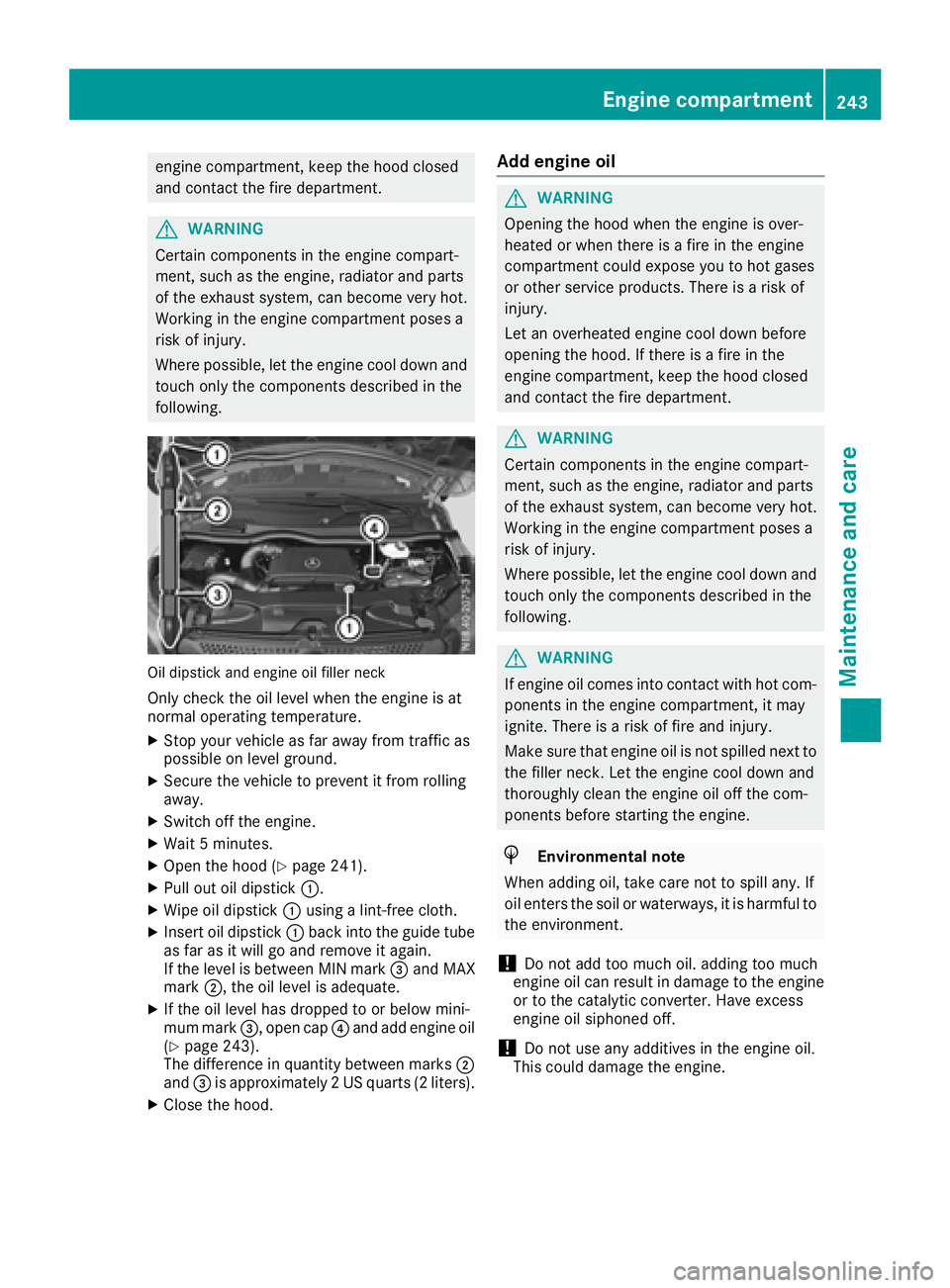
Oil dipstick and engine oil filler neck
Only check the oil level when the engine is at
normal operatin gtemperature.
XStop your vehicle as far away from traffic as
possible on level ground.
XSecure the vehicle to preventitf rom rolling
away.
XSwitc hoff the engine.
XWait 5minutes.
XOpen the hood (Ypage 241).
XPull out oil dipstick :.
XWipe oil dipstick:using alint-free cloth.
XInserto il dipstick :back into the guide tube
as far as it will go and remove it again.
If the level is between MIN mark =and MAX
mark ;,the oil level is adequate.
XIf the oil level has dropped to or below mini-
mum mark =,open cap ?and add engine oil
(
Ypage 243).
The difference in quantit ybetween marks ;
and =is approximately 2USquarts (2 liters).
XClose the hood.
Add engine oil
GWARNING
Openingt he hood when the engine is over-
heated or when there is afire in the engine
compartment could expose you to hot gases
or other servicep roducts. There isarisk of
injury.
Let an overheated engine cool down before
opening the hood. If there is afire in the
engine compartment ,keep the hood closed
and contact the fire department.
GWARNING
Certain component sinthe engine compart-
ment ,such as the engine, radiator and parts
of the exhaust system, can become very hot.
Workin ginthe engine compartment poses a
risk of injury.
Where possible, let the engine cool down and touch only the component sdescribed in the
following.
GWARNING
If engine oil comes into contact with hot com- ponents in the engine compartment ,itmay
ignite. There is arisk of fire and injury.
Make sure that engine oil is not spilled nex tto
the filler neck .Let the engine cool down and
thoroughly clean the engine oil off the com-
ponents before starting the engine.
HEnvironmental note
When adding oil, take care not to spill any. If
oil enters the soil or waterways, it is harmful to
the environment.
!Do not add too much oil. adding too much
engine oil can result in damage to the engine
or to the catalytic converter. Have excess
engine oil siphoned off.
!Do not use any additives in the engine oil.
This could damage the engine.
Engine compartment243
Maintenance and care
Z
Page 246 of 310
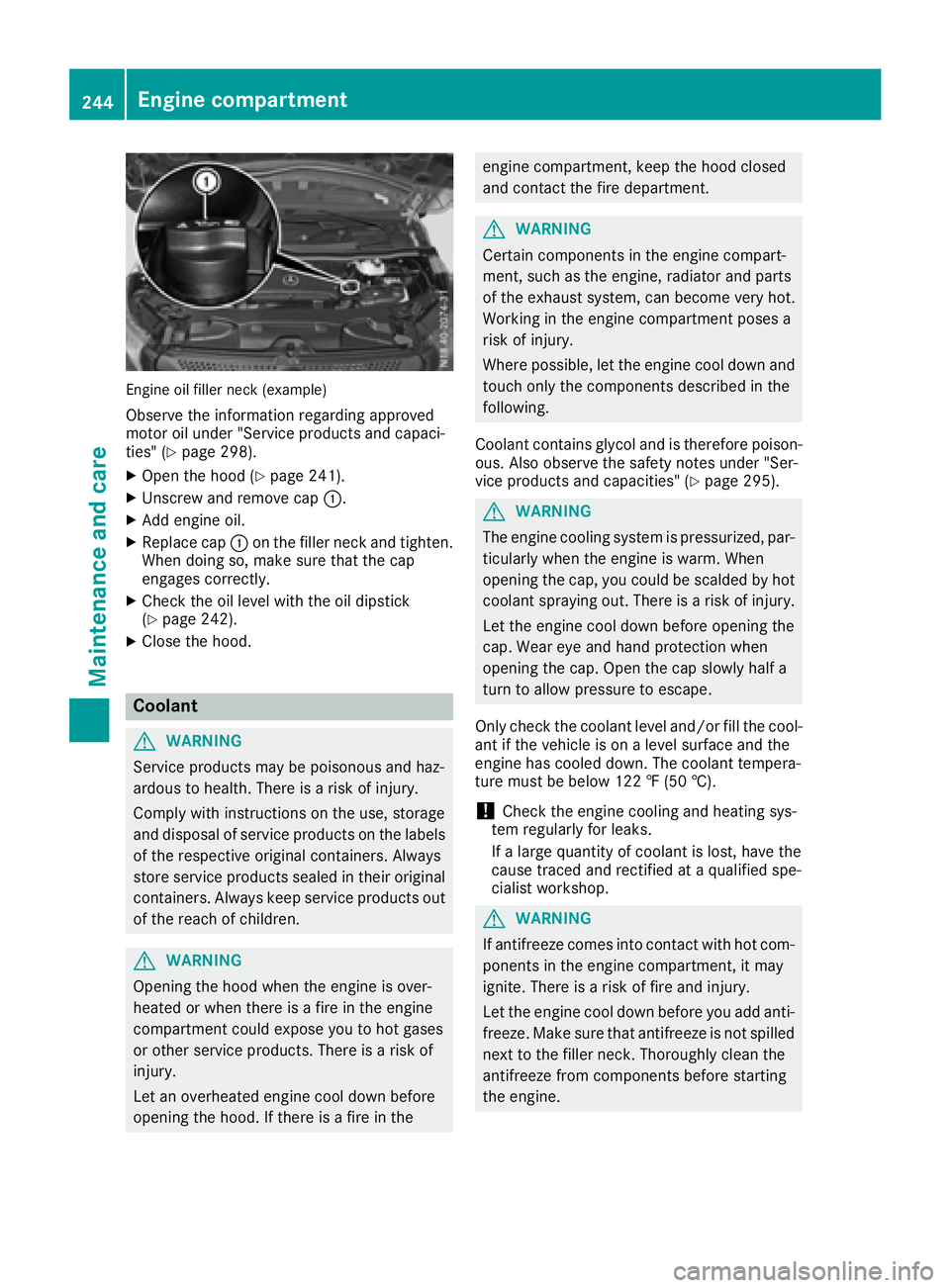
Engine oilfille rneck (example)
Observ ethe informatio nregarding approved
moto roilunder "Service products and capaci-
ties" (
Ypage 298).
XOpe nthe hoo d(Ypage 241).
XUnscrew and remove cap :.
XAdd engine oil.
XReplace cap:on the fille rneck and tighten.
Whe ndoing so, make sure thatt he cap
engages correctly.
XCheck the oill evel with the oild ipstick
(Ypage 242).
XClose the hood.
Coolant
GWARNING
Service products maybep oisonousand haz-
ardous to health .There is ariskofi njury.
Compl ywithi nstructions on the use, storage
and disposalofs erviceproducts on the labels
of the respective original containers. Always
stor eservic eproducts seale dintheiroriginal
containers. Alway skeeps ervic eproducts out
of the reach of children.
GWARNING
Opening the hoo dwhent he engine is over-
heated or when ther eisafireint he engine
compartment could expose yo utohot gases
or othe rservic eproducts. There is arisko f
injury.
Let an overheate dengine coo ldow nb efore
opening the hood. If ther eisafireint he
engine compartment, kee pthe hoo dclosed
and contact the fir edepart ment.
GWARNING
Certai ncomponents in the engine compart-
ment, such as the engine ,radiator and parts
of the exhaust system ,can become ver yhot.
Working in the engine compartment poses a
ris kofi njury.
Where possible, le tthe engine coo ldow na nd
touch onl ythe components describe dinthe
following.
Coolant contains glyco land is therefore poison-
ous. Als oobserve the safety notes under "Ser-
vic ep roducts and capacities" (
Ypage 295).
GWARNING
The engine cooling system is pressurized, par-
ticularly when the engine is warm. When
opening the cap ,you could be scalded by hot
coolant spraying out. There is ariskofi njury.
Let the engine coo ldow nb efore opening the
cap .Weare ye and hand protection when
opening the cap .Opent he cap slowly half a
tur ntoa llowpressure to escape.
Onlyc heck the coolant level and/or fil lthe cool-
ant if the vehicl eisonalevel surface and the
engine hasc ooleddown. The coolant tempera-
tur em ustbeb elow122‡(50 †).
!Check the engine cooling and heating sys-
tem regularly for leaks.
If al arge quantity of coolant is lost, have the
cause traced and rectifie dataqualified spe-
cialist workshop.
GWARNING
If antifreeze come sinto contact with hot com-
ponents in the engine compartment, it may
ignite .There is ariskoff irea nd injury.
Let the engine coo ldow nb efore yo uadd anti-
freeze .Makes uret hata ntifreeze is not spilled
next to the fille rneck. Thoroughl yclean the
antifreeze from components before starting
the engine.
244Engine compartment
Maintenance and care
Page 248 of 310
GWARNING
The brake flui dconstantly absorbs moisture
from the air. This lowers the boiling point of
the brake fluid. If the boiling point of the brake
flui dist oo low ,vapo rpockets may form in the
brake system when the brakes are applied
hard .This would impair braking efficiency.
There is arisk of an accident.
You should have the brake flui drenewe dat
the specified intervals.
!If the brake flui dlevelint he brake flui dres-
ervoir has fallen to the MIN mark or below,
check the brake system immediatel yfor
leaks. Also check the thickness of the brake
linings. Visi taqualified specialist workshop
immediately.
Do not add brake fluid. This does not correct
the malfunction.
!Brake flui dcorrodes paint, plastic and rub-
ber. If paint, plastic or rubber has come into
contact with brake fluid, rinse with water
immediately.
Have the brake flui drenewe devery 2years at a
qualified specialist workshop. Observe the infor-
mation regarding brake flui dinthe "Service
products and capacities" section (
Ypag e300).
Check the brake flui dlevelr egularly, e.g. weekly
or when refueling.
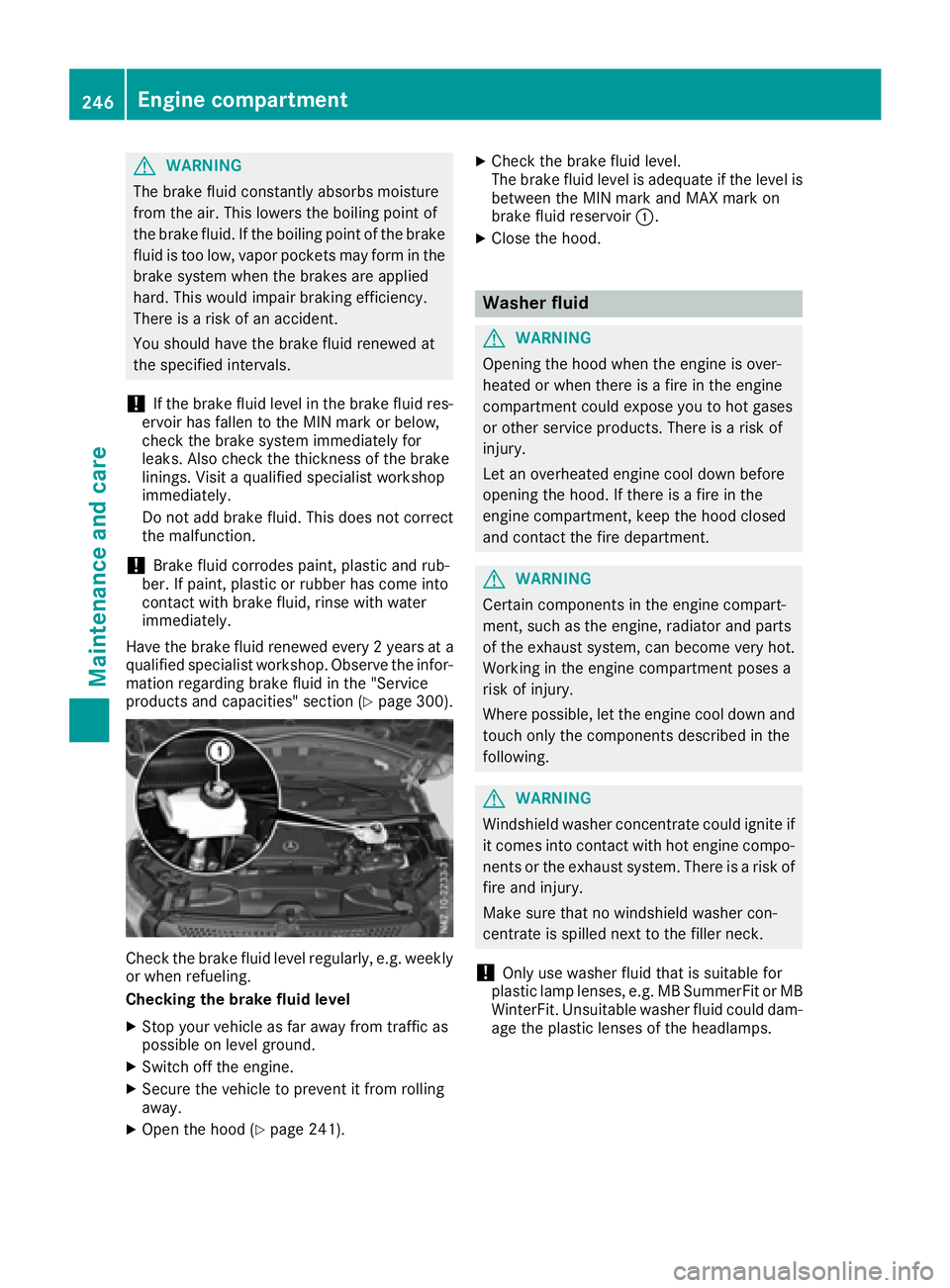
Checking the brake fluid level
XStop you rvehicl easf ar awa yfrom traffic as
possible on leve lground.
XSwitch off the engine.
XSecure the vehicletop revent it from rolling
away.
XOpen the hood (Ypag e241).
XCheck the brake flui dlevel.
The brake flui dlevelisa dequate if the leve lis
between the MIN mark and MAX mark on
brake flui dreservoir :.
XClose the hood.
Washer fluid
GWARNING
Opening the hood when the engine is over-
heated or when there is afire in the engine
compartment coul dexpose you to hot gases
or other service products. There is arisk of
injury.
Let an overheated engine cool downb efore
opening the hood. If there is afire in the
engine compartment, keep the hood closed
and contact the fire department.
GWARNING
Certain components in the engine compart-
ment, such as the engine, radiator and parts
of the exhaust system, can become very hot.
Working in the engine compartment poses a
risk of injury.
Where possible,l et the engine cool downa nd
touch only the components described in the
following.
GWARNING
Windshiel dwasher concentrate coul dignite if
it comes into contact with hot engine compo-
nents or the exhaust system. There is arisk of
fire and injury.
Make sure that no windshiel dwasher con-
centrate is spilled next to the filler neck.
!Only use washer flui dthat is suitable for
plastic lamp lenses ,e.g. MB SummerFi torMB
WinterFit. Unsuitable washer flui dcoul ddam-
age the plastic lenses of the headlamps.
246Engine compartment
Maintenance and care
Page 249 of 310
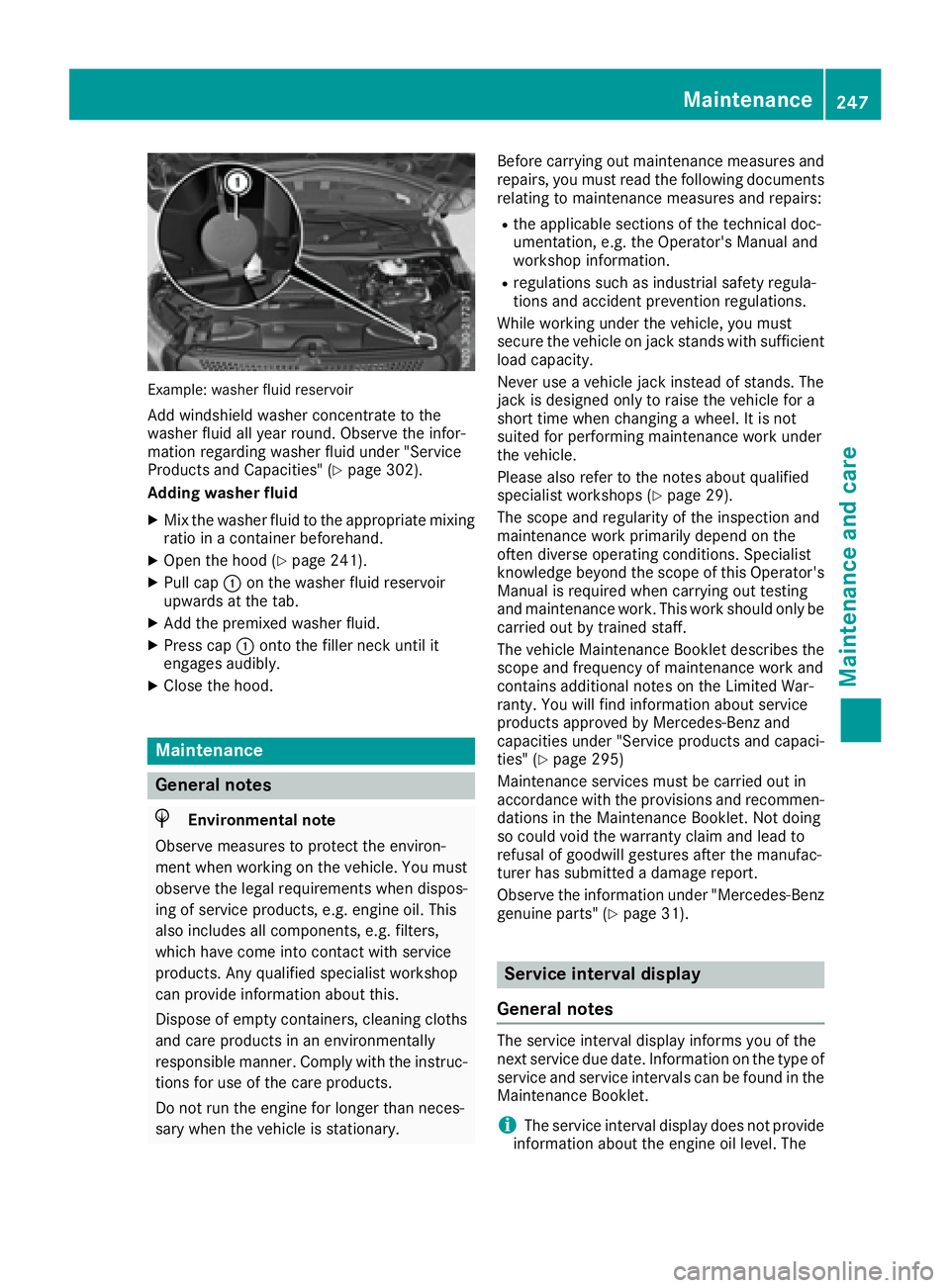
Example: washerfluid reservoir
Add windshield washe rconcentrate to the
washe rfluid al lyea rround. Observ ethe infor-
matio nregarding washe rfluid under "Service
Products and Capacities" (
Ypage 302).
Adding washe rfluid
XMixt he washe rfluid to the appropriate mixing
ratio in acontaine rbeforehand.
XOpe nthe hoo d(Ypage 241).
XPull cap :on the washe rfluid reservoir
upwards at the tab.
XAdd the premixe dwashe rfluid.
XPress cap :onto the fille rneck unti lit
engages audibly.
XClose the hood.
Maintenance
General notes
HEnvironmental note
Observ emeasures to protect the environ-
ment when working on the vehicle. Yo umust
observe the legalr equirements when dispos-
ing of servic eproducts, e.g .engine oil. This
also includes al lcomponents, e.g .filters,
which have come into contact with service
products. Any qualified specialist workshop
can provid einformatio nabout this.
Dispose of empty containers, cleaning cloths
and car eproducts in an environmentally
responsibl emanner. Compl ywitht he instruc-
tions for us eofthe car eproducts.
Do not runt he engine for longert hanneces-
sary when the vehicl eisstationary. Before carrying outm
aintenance measures and
repairs, yo umustrea dt he following documents
relating to maintenance measures and repairs:
Rthe applicabl esections of the technica ldoc-
umentation, e.g .the Operator' sManualand
workshop information.
Rregulations such as industria lsafety regula-
tions and accident prevention regulations.
While working under the vehicle, yo umust
secur ethe vehicl eonjack stands with sufficient
load capacity.
Never us eavehicl ejack instea dofstands. The
jack is designe donlytor aisethe vehicl efor a
short time when changing awheel .Itisn ot
s ui
te df or performing maintenance work under
the vehicle.
Please also refer to the notesa boutqualified
specialist workshops(
Ypage 29).
The scop eand regularity of the inspectio nand
maintenance work primaril ydepen dont he
ofte ndiverse operating conditions. Specialist
knowledg ebeyond the scop eofthisOperator's
Manua lisrequired when carrying outt esting
and maintenance work. Thi sworks houl donlyb e
carrie doutby trained staff.
The vehicl eMaintenance Bookle tdescribe sthe
scop eand frequency of maintenance work and
contains additional notes on the Limite dWar-
ranty. Yo uwillf ind informatio nabout service
products approved by Mercedes-Benz and
capacitie sunder "Service products and capaci-
ties" (
Ypage 295)
Maintenance services must be carrie doutin
accordance with the provisions and recommen-
dations in the Maintenance Booklet. Not doing
so could voi dthe warranty claim and lead to
refusal of goodwil lgestures afte rthe manufac-
turer hass ubmitted adamag ereport.
Observ ethe informatio nunder "Mercedes-Benz
genuine parts" (
Ypage 31).
Service interval display
General notes
The servic eintervald isplay informs yo uofthe
next servic eduedate. Informatio nonthe typ eof
servic eand servic eintervals can be found in the
Maintenance Booklet.
iThe servic eintervald isplay does not provide
informatio nabout the engine oill evel.T he
Maintenance247
Maintenance and care
Z
Page 250 of 310
service interval displayshould therefore not
be confused with the engine oil level display.
For example, the displays hows one of the fol-
lowing service messages for afew seconds:
RNext Service Ain..Days
RServiceADueorService ADue
RServ. AExceed. by .. Days
Then either the remaining time or distance until
the next service due date is displayed. If the
service due date has been exceeded, the
elapsedt ime or distance traveled after the over-
due service date is shown. The letter in the dis-
play message indicates which service is due. A
stands foraminor service and Bforam ajor ser-
vice.
Aq ualified specialist workshop, e.g. an author-
ized Mercedes-Benz Commercial Van Center,
will reset the service interval displaya fter the
service work has been carried out. You can also
obtain further information on maintenance
work, for example.
The prescribed service interval is based on nor- mal vehicle use. Service work will need to be
performed more frequently than prescribed if
the vehicle is operated under more arduousc on-
ditions or with higher loads. Such arduousc on-
ditions include:
Rregularc ity driving with frequent intermediate
stops
Rdriving predominantly short distances
Rfrequent operation in mountainous terrain or
on poor road surfaces
Rleaving the engine idling for long periods on a frequent basis
In these or similar operating conditions, have
the air filter, engine oil and oil filter, for example,
replaced more frequently. Under more arduous
operating conditions, the tires must be checked more often. Further information can be obtained
at aq ualified specialist workshop, e.g. an
authorized Mercedes-Benz Commercial Van
Center.
Hiding service messages
Vehicles without steering wheel buttons
XPress the 3button on the instrument clus-
ter.
Vehicles with steering wheel buttons
XPress the aor% button on the steering
wheel.
Callingupt he service due date
Vehicles without steering wheel buttons
The vehicle must be stationary. Use the buttons
in the instrument cluster.
XTurn the key to position 2in the ignition lock.
XPress Èto select the service display.
The displays howsapossible service mes-
sage.
Vehicles with steering wheel buttons
Using the steering wheel buttons
XTurn the key to position 2in the ignition lock.
XPress =or; to select the Servicemenu.
XPress the9or: button to select the
ASSYST PLUSsubmenu and press ato
confirm.
The displays hows the service due date.
Battery
Important safety notes
Work on the battery, e.g. removing or installing,
requires specialist knowledge and the use of
special tools. Therefore, always have work on
the battery carried out at aqualified specialist
workshop.
GWARNING
Work carried out incorrectly on the battery
can lead, for example, to ashort circuit and
thus damage the vehicle electronics. This can
lead to function restrictions applying to
safety-relevant systems, e.g the lighting sys-
tem, the ABS (anti-lock braking system) or the
ESP
®(Electronic Stability Program). The oper-
ating safety of your vehicle may be restricted.
You could lose control of the vehicle, for
example:
Rwhen braking
Rin the event of abrupt steering maneuvers
and/or when the vehicle's speed is not
adapted to the road conditions
There is arisk of an accident.
In the event of ashort circuit or asimilari nci-
dent, contact aqualified specialist workshop
248Battery
Maintenance and care
Page 290 of 310
rectly, it could tip over while the vehicleis
raised.
RThe vehicle's jack is intended only to rais ethe
vehicl efor as hort time when changing a
wheel. It is not suited for performing mainte-
nance work under the vehicle.
RAvoid changing the whee lonuphill and down-
hill slopes.
RBefore raising the vehicle, secure it from roll-
ing awa ybyapplying the parking brake and
inserting whee lchocks. Never disengage the
parking brake while the vehicl eisraised.
RThe jack must be placed on afirm, flat and
non-slip surface. On aloose surface, alarge,
load-bearing underlay must be used .Ona
slippery surface, anon-slip underlay must be
used ,e.g. rubber mats.
RMake sure that the distance between the
underside of the tires and the ground does not
exceed 1.2 in(3 cm).
RNever place you rhands or feet under the
raised vehicle.
RNever lie under the raised vehicle.
RNever start the engine when the vehicl eis
raised.
RNever open or close adoor or the tailgate/
rear door when the vehicl eisraised.
RMake sure that no persons are present in the
vehicl ewhen the vehicl eisraised.
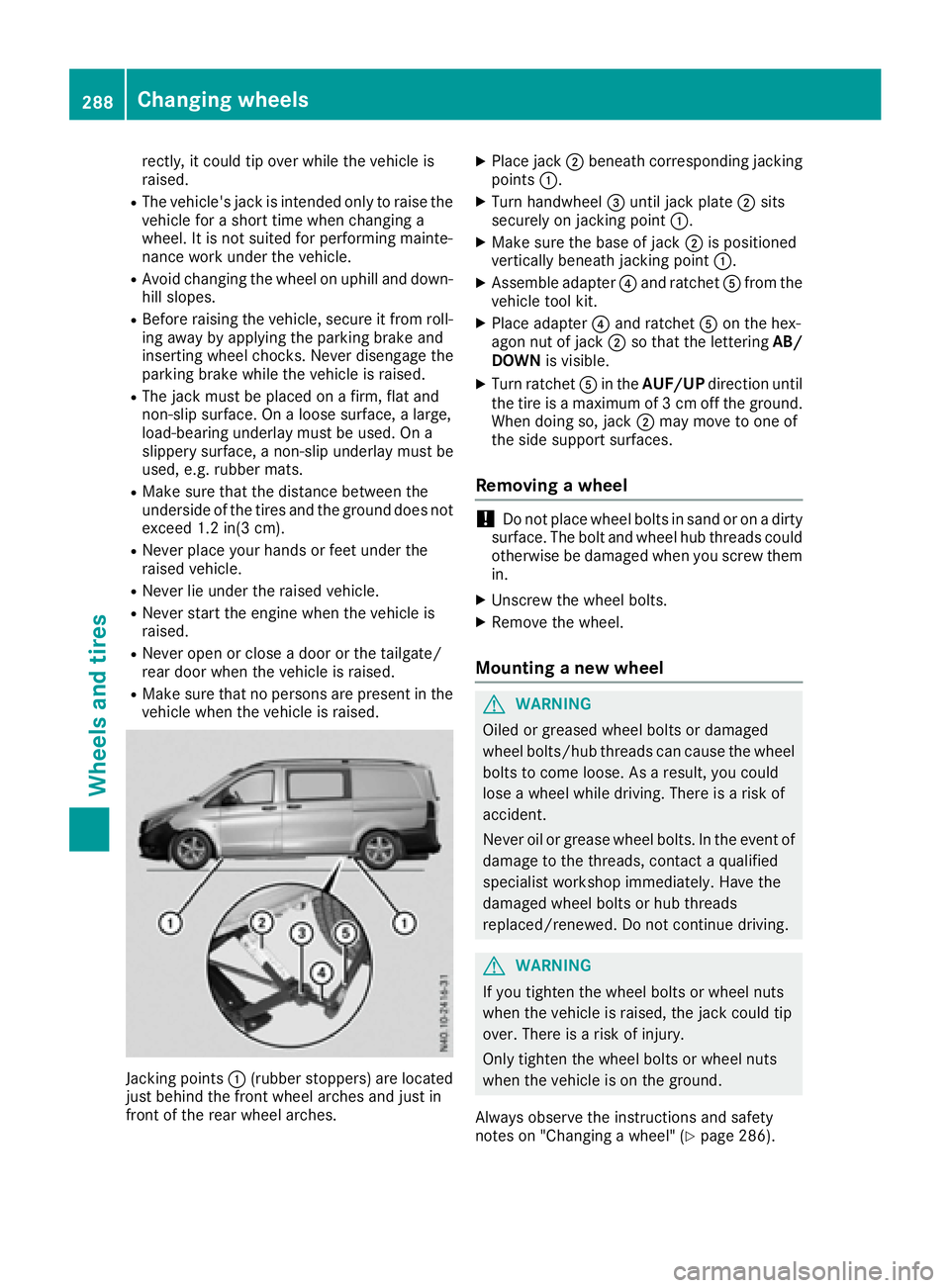
Jacking points :(rubber stoppers)a re located
just behind the front whee larches and just in
front of the rear whee larches.
XPlace jack ;beneath corresponding jacking
points :.
XTurn handwheel =until jack plate ;sits
securely on jacking point :.
XMake sure the base of jack ;is positioned
vertically beneath jacking point :.
XAssembleadapter?and ratchet Afrom the
vehicl etool kit.
XPlace adapter ?and ratchet Aon the hex-
agon nut of jack ;so that the lettering AB/
DOWN is visible.
XTurn ratchet Ain the AUF/UP directionuntil
the tire is amaximu mof3cm off the ground.
When doing so, jack ;may move to one of
the side support surfaces.
Removin gawheel
!Do not place whee lbolts in sand or on adirty
surface. The bolt and whee lhub threads could
otherwise be damaged when you screw them
in.
XUnscrew the whee lbolts.
XRemove the wheel.
Mountin ganew wheel
GWARNING
Oile dorg reased whee lbolts or damaged
whee lbolts/hu bthreads can caus ethe wheel
bolts to come loose .Asaresult, you could
lose awhee lwhile driving. There is arisk of
accident.
Never oil or greas ewhee lbolts. In the event of
damage to the threads ,contact aqualified
specialist workshop immediately. Have the
damaged whee lbolts or hub threads
replaced/renewed. Do not continue driving.
GWARNING
If you tighten the whee lbolts or whee lnuts
when the vehicl eisraised, the jack could tip
over. There is arisk of injury.
Only tighten the whee lbolts or whee lnuts
when the vehicl eisonthe ground.
Always observe the instructions and safety
notes on "Changing awheel" (
Ypag e286).
288Changing wheels
Wheels and tires
Page 297 of 310
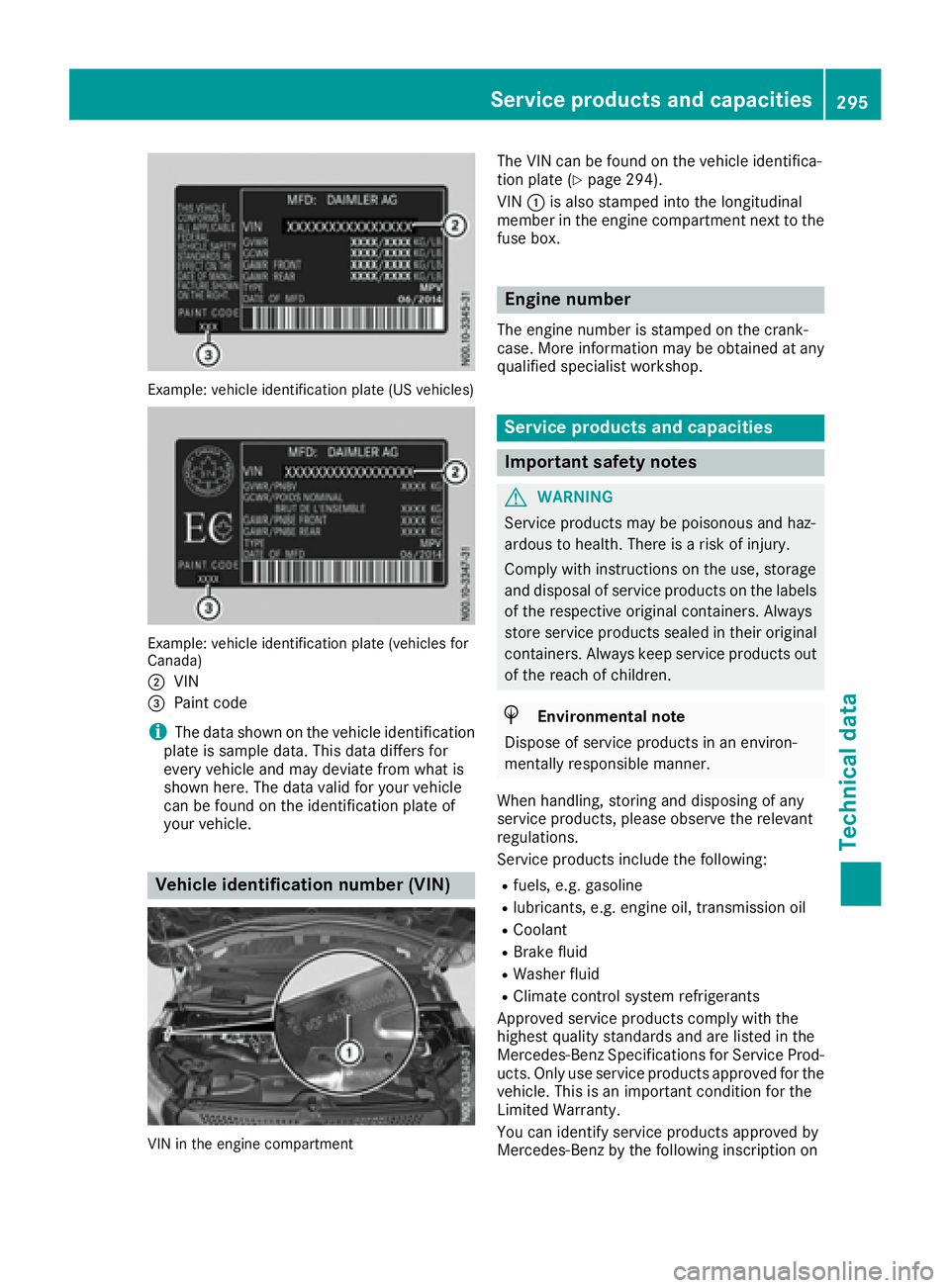
Example: vehicleide ntification plate (US vehicles)
Example: vehicl eide ntification plate (vehicle sfor
Canada)
;
VIN
=Paint code
iThe data shown on the vehicl eide ntification
plate is sampl edata. Thi sdatad iffers for
every vehicl eand mayd eviate from what is
shown here. The data vali dfor your vehicle
can be found on the identificatio nplate of
your vehicle.
Vehicl eidentificatio nnumber (VIN)
VIN in the engine compartment
The VIN can be found on the vehicl eide ntifica-
tio np late (Ypage 294).
VIN :is also stampe dinto the longitudinal
membe rinthe engine compartment next to the
fuse box.
Engine number
The engine numbe risstampe donthe crank-
case. Mor einformatio nmaybe obtained at any
qualified specialist workshop.
Service products and capacities
Important safety notes
GWARNING
Service products maybep oisonousand haz-
ardous to health .There is ariskofi njury.
Compl ywithi nstructions on the use, storage
and disposalofs erviceproducts on the labels
of the respective original containers. Always
stor eservic eproducts seale dintheiroriginal
containers. Alway skeeps ervic eproducts out
of the reach of children.
HEnvironmental note
Dispose of servic eproducts in an environ-
mentall yresponsibl emanner.
Whe nhandling ,storing and disposing of any
servic eproducts, please observe the relevant
regulations.
Service products includ ethe following:
Rfuels, e.g .gasoline
Rlubricants ,e.g.e ngine oil, transmission oil
RCoolant
RBrake fluid
RWashe rfluid
RClimate contro lsystem refrigerants
Approve dservic eproducts comply with the
highest quality standards and ar elisted in the
Mercedes-Benz Specifications for Service Prod-
ucts .Onlyu seservic eproducts approved for the
vehicle. Thi sisanimportant condition for the
Limite dWarranty.
Yo uc an identify servic eproducts approved by
Mercedes-Benz by the following inscription on
Servic eproducts and capacities295
Technica ldata
Z