heating MERCEDES-BENZ METRIS 2016 MY16 Operator’s Manual
[x] Cancel search | Manufacturer: MERCEDES-BENZ, Model Year: 2016, Model line: METRIS, Model: MERCEDES-BENZ METRIS 2016Pages: 310, PDF Size: 7.28 MB
Page 133 of 310
Problems with the transmission
ProblemPossible causes/consequences andMSolutions
The transmission is
locked in positionP.The vehicle electronics are malfunctioning.
XHave the vehicle electronics checked immediately at aqualified
specialist workshop.
The acceleration charac-
teristicsh ave deteriora-
ted noticeably.
The transmission does
not shift.The transmission is in emergency mode.
It is only possible to shift into second gear or reverse gear R.
XStop the vehicle.
XDepress the brake pedal.
XMove the selector lever to positionP.
XSwitch off the engine.
XWait at least 10 seconds before restarting the engine.
XDepress the brake pedal.
XMove the selector lever to positionDor R.
In position D,the transmission shifts into second gear; in position R,
the transmission shifts into reverse gear.
XHave the transmission checked immediately at aqualified specialist
workshop.
Refueling
Important safety notes
GWARNING
Fuel is highly flammable. Improper handling of
fuel creates arisk of fire and explosion.
Avoid fire, open flames, smoking and creating
sparks under all circumstances. Switch off the
engine and, if applicable, the auxiliary heating
before refueling.
GWARNING
Fuel is poisonous and hazardous to health.
There is arisk of injury.
You must make sure that fuel does not come into contact with your skin, eyes or clothing
and that it is not swallowed. Do not inhale fuel
vapors. Keep fuel away from children.
If you or others come into contact with fuel,
observe the following:
RWash away fuel from skin immediately
using soap and water.
RIf fuel comes into contact with your eyes,
immediately rinse them thoroughly with
clean water. Seek medical assistance with-
out delay.
RIf fuel is swallowed, seek medical assis-
tance without delay.Don ot induce vomit-
ing.
RImmediately change out of clothing which
has come into contact with fuel.
GWARNING
Electrostatic buildupc an create sparks and
ignite fuel vapors. There is arisk of fire and
explosion.
Always touch the vehicle body before opening
the fuel filler flap or touching the fuel pump
nozzle. Any existing electrostatic buildupi s
thereby discharged.
Refueling131
Driving and parking
Z
Page 138 of 310
Mercedes-Benzrecommends that you have the
maximum permissible speed programed at a
Mercedes-BenzC ommercial Van Center.
Before overtaking, take into consideration that
the engine speed limiter prevents the speed
increasing beyond the programed maximum
speed.
Driving abroad
Service
An extensive network of authorized Mercedes-
Benz Centers is also at your disposal when you
are traveling abroad. Nevertheless, please bear
in mind that service facilities or replacement
parts may not always be immediately available.
The relevant workshop directories are available
from any Mercedes-BenzC ommercial Van Cen-
ter.
Fuel
In some countries, only fuels with ahigher sulfur
content are available.
Unsuitable fuel can cause engine damage. You
will find information about fuel under "Service
products and capacities" (
Ypage 296).
Low-beam headlamps
General notes
When driving in countries in which traffic drives
on the opposite side of the road to the country
where the vehicle is registered, you must switch
the headlamps to symmetrical low beam. This
prevents oncomingt raffic from being blinded.
Symmetrical low beam does not illuminate as
large an area of the edge of the road.
Vehicles with halogen headlamps
The headlamps do not need to be switched to
symmetrical low beam. The legal requirements
of countries in which traffic drives on the oppo- site side of the road to the countryw here the
vehicle is registered are met without the need to
convert the headlamps.
Transport by rail
Transporting your vehicle by rail may be subject to certain restrictions or require special meas- ures to be taken in some countries due to vary-
ing tunnel heights and loading standards.
You can obtain information on this from any
Mercedes-BenzC
ommercial Van Center.
Brakes
Important safety notes
GWARNING
If you shift down on aslippery road surface in
an attempt to increase the engine's braking
effect,t he drive wheels could lose their grip.
There is an increased danger of skidding and
accidents.
Do not shift down for additional engine brak-
ing on aslippery road surface.
Downhill gradients
!Depressing the brake pedal constantly
results in excessive and premature wear to
the brake pads.
This also applies to automatic braking if you
have activated cruise control.
On long and steep downhill gradients, you
should change down to shift range 2or1 in
good time (
Ypage 128).
This should be observed in particular when driv-
ing with aladen vehicle and when towing a
trailer.
You thereby make use of the braking effect of
the engine and do not have to brake as often to
maintain the speed. This relieves the load on the
service brake and prevents the brakes from
overheating and wearing too quickly.
Heavy and light loads
GWARNING
If you rest your foot on the brake pedal while
driving, the braking system can overheat. This increases the stopping distance and can even
cause the braking system to fail. There is a
risk of an accident.
Never use the brake pedal as afootrest.N ever
depress the brake pedal and the accelerator
pedal at the same time.
136Driving tips
Driving and parking
Page 166 of 310
General notes
RObserve the legally prescribed maximum
speed for vehicle/trailer combinations in the
relevant country, state or Canadianprovince.
Before setting off, check the vehicle docu-
ments of the you rtraile rtof ind out the per-
missible maximu mspeed.
This reduces the risk of accidents.
RInstall only an approved traile rcoupling on
you rvehicle .Only use aballc oupling that is
approved for you rvehicle and Sprinter trailer
tow hitch. More information on the availabil-
ity, mounting and installation of the trailer
electrics is available at any qualified specialist
workshop.
RThe traile rcoupling is one of the most impor-
tant vehicle parts with regard to road safety.
Observe the notes on operation, care and
maintenance of the traile rtow hitch (see the
manufacturer's operating instructions).
RThe bumpers of you rvehicle are not suitable
for installing detachable traile rcouplings.
RDo not attach rented traile rtow hitches or
other detachable traile rtow hitches to the
bumper.
RMinimize the risk of damage to the bal lcou-
pling. If you do not require the bal lcoupling,
remove it from the bal lcoupling recess.
You wil lfind weight information under "Techni-
cal Data" (
Ypage 305).
The heigh tofthe bal lneck changes according to
the loadont he vehicle.Ifthis is case, use a
traile rwith aheight-adjustabl etraile rdrawbar.
Driving tips
The maximu mpermissibl espeed for vehicle/
traile rcombinatio ndepends on the type of
trailer. Before setting off, check the vehicle
documents of the you rtraile rtof ind out the
permissibl emaximu mspeed.O bserve the
legally prescribed maximu mspeed for vehicle/
traile rcombinations in the relevant country,
state or Canadianp rovince.
When towing atrailer, you rvehicle's handling
characteristics wil lbedifferent in comparison to
when driving withou tatraile rand it wil lcon-
sume more fuel.
On long and steep downhill gradients, select a
lower gear.
iThis also appliesifc ruise control is activa-
ted. This enables you to utilize the engine's braking
effect and you do not need to brake so heavily to
keep the correct speed.w
hich protects the
brake system and prevents the brakes from
overheating and wearing too quickly. If you need to brake additionally, to not depress the brake
pedalc onstantly, but periodically.
Observe the notes on ESP
®traile rstabilization
(Ypage 65).
Driving tips
If the traile rbegins to swing from side to side:
XDo not accelerate.
XDo not counter-steer.
XBrake if necessary.
iYou can reduce the risk of the traile rswing-
ing and rocking by retrofitting anti-roll bars or traile rstability programs. More information is
available from you rauthorized Sprinter
Dealer.
RMaintain agreater distance than you would
when driving withou ttowing atrailer.
RAvoid sudden braking. Apply the brakes gen-
tly at first to allow the traile rbrake to overrun.
Then, increase the brake force quickly.
RThe figures for the gradient climbing capabil-
ities from astandstill refer to sea level.W hen
driving in mountainou sareas, note that the
powe routpu toft he engine, and with it its
gradient climbing capability, decrease with
increasing altitude.
164Towing atrailer
Driving and parking
Page 232 of 310
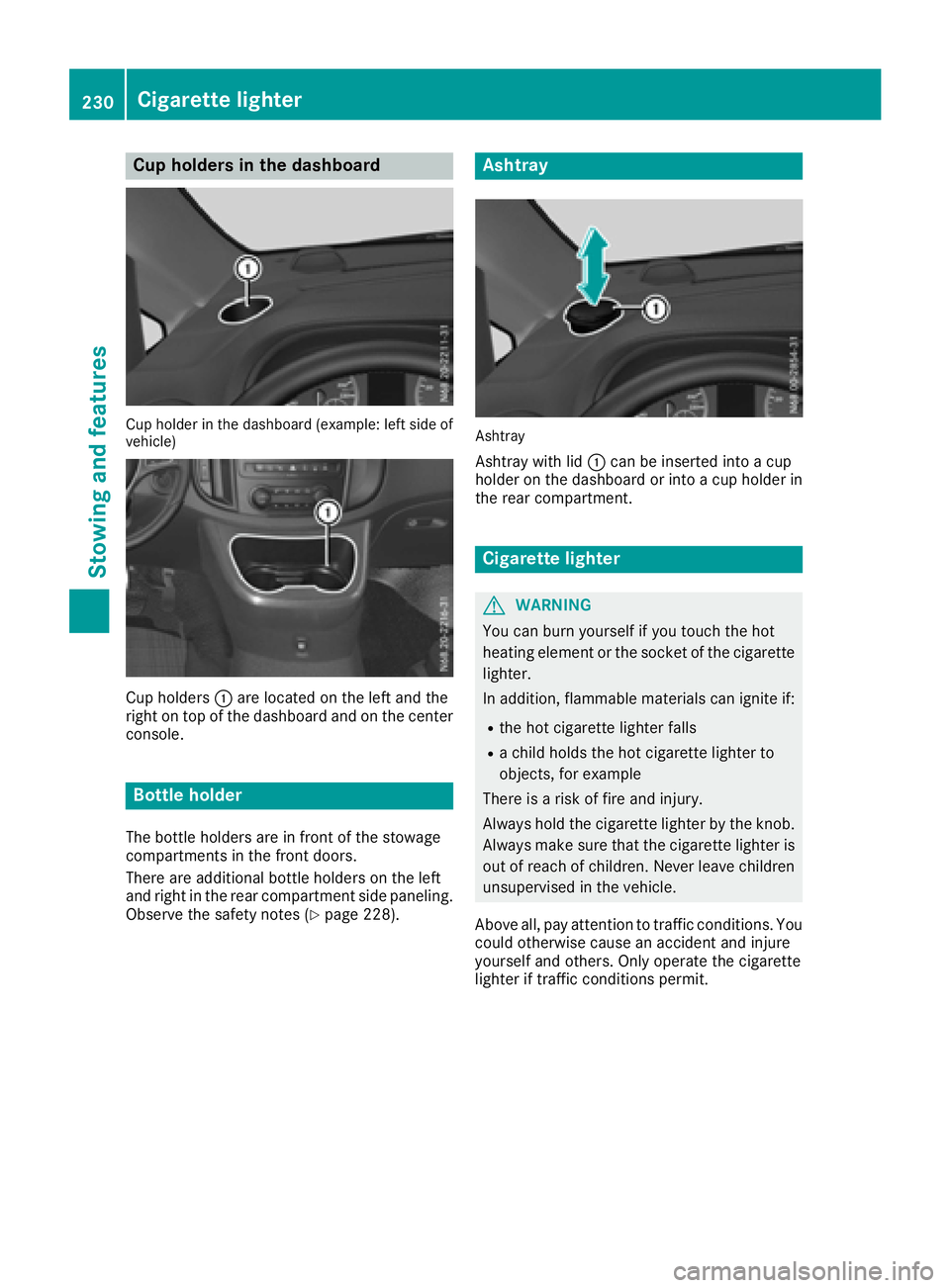
Cup holders in thedashboard
Cup holder in th edashboar d(example :left side of
vehicle )
Cup holders :are locate dontheleft and the
righ tont opof th edashboard and on th ecenter
console.
Bottle holder
The bottle holders are in frontoft hestowage
compartments in th efront doors.
Therea re additional bottle holders on th eleft
and righ tintherear compartmen tside paneling.
Observ ethe safety note s(
Ypage 228).
Ashtray
Ashtray
Ashtray withl id: can be inserted int oacup
holder on th edashboard or int oacup holderi n
th er ear compartment.
Cigarett elighter
GWARNING
You can burn yourself if you touch th ehot
heating elementort hesocke tofthecigarette
lighter.
In addition,f lammable materialsc an ignite if:
Rtheh ot cigarette lighter falls
Rachild holdst hehot cigarette lighter to
objects, for example
Thereisar iskoff irea nd injury.
Always hold th ecigarette lighter by th eknob.
Always mak esure that th ecigarette lighter is
out of reac hofchildren. Never leave children
unsupervised in th evehicle.
Above all, pay attentio ntotraffic conditions. You
coul dotherwise caus eanaccidenta nd injure
yourself and others. Only operate th ecigarette
lighter if traffic conditionsp ermit.
230Cigarettelighter
Stowing and features
Page 233 of 310
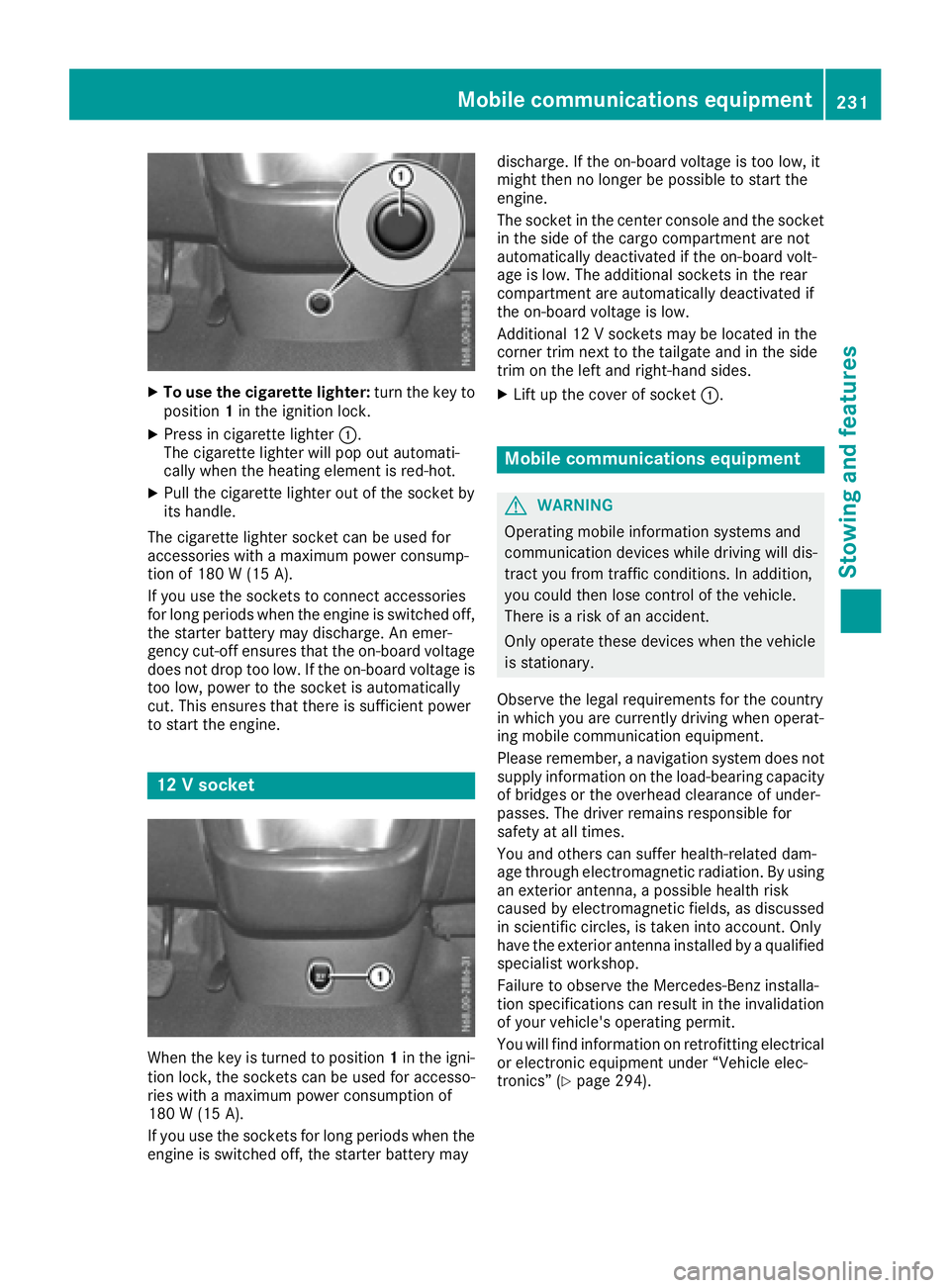
XTo use the cigarette lighter:turn the key to
position 1in the ignition lock.
XPress in cigarette lighter :.
The cigarette lighte rwillp op outa utomati-
cally when the heating element is red-hot.
XPull the cigarette lighte routof the socke tby
its handle.
The cigarette lighte rsocke tcan be used for
accessorie switham aximu mp ower consump-
tio no f180 W(15 A).
If yo uusethe sockets to connect accessories
for long periods when the engine is switched off, the starter battery may discharge .Anemer-
genc ycut-off ensures thatt he on-board voltage
does not dro ptoo low. If the on-board voltag eis
too low, powe rtothe socke tisa utomatically
cut. Thi sensures thatt hereiss ufficient power
to start the engine.
12 Vsocke t
Whenthe key is turne dtoposition 1in the igni-
tio nlock, the sockets can be used for accesso-
rie sw itham aximu mp ower consumption of
180 W(15 A) .
If yo uuse the sockets for long periods whe nthe
engine is switched off, the starter battery may discharge
.Ifthe on-board voltage is too low ,it
mightt hen no longe rbepossibl etostart the
engine.
The socket in the center console and the socket
in the side of the cargo compartment are not
automatically deactivated if the on-board volt-
age is low .The additiona lsockets in the rear
compartment are automatically deactivated if
the on-board voltage is low.
Additional 12 Vsockets may be located in the
corner trim next to the tailgate and in the side
trim on the left and right-hand sides.
XLift up the cover of socket :.
Mobile communications equipment
GWARNING
Operating mobile information systems and
communication devices while driving wil ldis-
tract you from traffic conditions. In addition,
you coul dthen lose control of the vehicle.
There is arisk of an accident.
Only operate these devices whe nthe vehicle
is stationary.
Observe the legal requirements for the country
in which you are currently driving whe noperat-
ing mobile communication equipment.
Please remember, anavigatio nsystem does not
supply information on the load-bearing capacity
of bridges or the overhead clearance of under-
passes. The drive rremains responsibl efor
safety at al ltimes.
You and others can suffe rhealth-related dam-
age throug helectromagneti cradiation. By using
an exterior antenna, apossibl ehealth risk
caused by electromagneti cfields, as discussed
in scientifi ccircles, is taken into account. Only
have the exterior antenna installed by aqualified
specialist workshop.
Failure to observe the Mercedes-Benz installa-
tion specifications can result in the invalidation of you rvehicle's operating permit.
You wil lfind information on retrofitting electrical
or electronic equipment unde r“Vehicle elec-
tronics” (
Ypag e294).
Mobile communications equipment231
Stowing and features
Z
Page 246 of 310
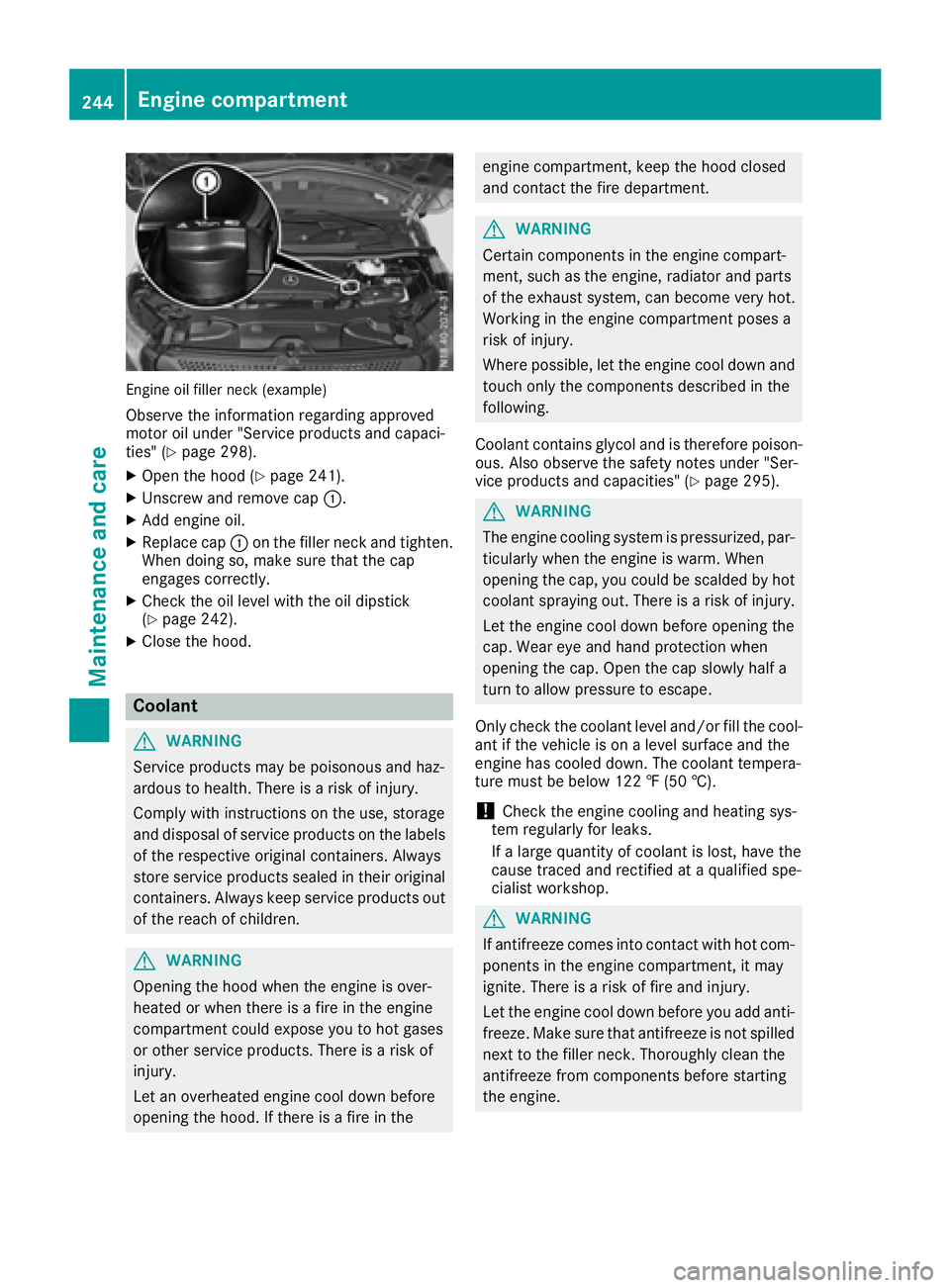
Engine oilfille rneck (example)
Observ ethe informatio nregarding approved
moto roilunder "Service products and capaci-
ties" (
Ypage 298).
XOpe nthe hoo d(Ypage 241).
XUnscrew and remove cap :.
XAdd engine oil.
XReplace cap:on the fille rneck and tighten.
Whe ndoing so, make sure thatt he cap
engages correctly.
XCheck the oill evel with the oild ipstick
(Ypage 242).
XClose the hood.
Coolant
GWARNING
Service products maybep oisonousand haz-
ardous to health .There is ariskofi njury.
Compl ywithi nstructions on the use, storage
and disposalofs erviceproducts on the labels
of the respective original containers. Always
stor eservic eproducts seale dintheiroriginal
containers. Alway skeeps ervic eproducts out
of the reach of children.
GWARNING
Opening the hoo dwhent he engine is over-
heated or when ther eisafireint he engine
compartment could expose yo utohot gases
or othe rservic eproducts. There is arisko f
injury.
Let an overheate dengine coo ldow nb efore
opening the hood. If ther eisafireint he
engine compartment, kee pthe hoo dclosed
and contact the fir edepart ment.
GWARNING
Certai ncomponents in the engine compart-
ment, such as the engine ,radiator and parts
of the exhaust system ,can become ver yhot.
Working in the engine compartment poses a
ris kofi njury.
Where possible, le tthe engine coo ldow na nd
touch onl ythe components describe dinthe
following.
Coolant contains glyco land is therefore poison-
ous. Als oobserve the safety notes under "Ser-
vic ep roducts and capacities" (
Ypage 295).
GWARNING
The engine cooling system is pressurized, par-
ticularly when the engine is warm. When
opening the cap ,you could be scalded by hot
coolant spraying out. There is ariskofi njury.
Let the engine coo ldow nb efore opening the
cap .Weare ye and hand protection when
opening the cap .Opent he cap slowly half a
tur ntoa llowpressure to escape.
Onlyc heck the coolant level and/or fil lthe cool-
ant if the vehicl eisonalevel surface and the
engine hasc ooleddown. The coolant tempera-
tur em ustbeb elow122‡(50 †).
!Check the engine cooling and heating sys-
tem regularly for leaks.
If al arge quantity of coolant is lost, have the
cause traced and rectifie dataqualified spe-
cialist workshop.
GWARNING
If antifreeze come sinto contact with hot com-
ponents in the engine compartment, it may
ignite .There is ariskoff irea nd injury.
Let the engine coo ldow nb efore yo uadd anti-
freeze .Makes uret hata ntifreeze is not spilled
next to the fille rneck. Thoroughl yclean the
antifreeze from components before starting
the engine.
244Engine compartment
Maintenance and care
Page 261 of 310
Cleaning thesteering wheel and selec-
tor lever
XThoroughlyw ipe withadamp cloth.
XVehicles with leather upholstery: after
cleaning, use leather car eagents that have
been recommended and approved by
Mercedes-Benz.
Cleaning th etrime lements
!Do no tuse solvent-based cleanin gagents
suchast ar remover, wheel cleaners, polishes
or waxes. Thereiso therwise ariskofd amag-
ing th esurface.
XWipe th etrime lements withad amp, lint-free
cloth ,e.g.am icrofiber cloth.
XHeavy soiling: use careproduct sand clean-
ing agents recommended and approved by
Mercedes-Benz.
Cleaning th eseat covers
!Do no tuse microfiber cloth stoclean genu-
ine leather or artificial leather covers.Ifu sed
often,am icrofiber cloth can damag ethe
cover.
!Clean:
Rartificial leather covers withac loth mois-
tene dwithas olution containing 1% deter-
gent, e.g .dish washingl iquid.
Rcloth covers witham icrofiber cloth mois-
tene dwithas olution containing 1% deter-
gent, e.g .dish washingl iquid. Wipe entire
seat sections carefull ytoa void leaving visi-
ble lines. Leavet heseat to dry afterwards.
Cleaning results dependont hetype of dirt
and how longith as been there.
Rgenuine leather covers carefull ywitha
damp cloth ,the nw ipe th ecovers down
withad ry cloth.Makes ure that th eleather
does no tbecome soaked. Otherwise, the
leather coul dbecome roug horcracked.
Only use leather car eagents that have
been tested and approved by Mercedes-
Benz. You can obtain these from aqualified
specialist workshop.
iPleasek eepinm indt hat:
Rleather covers are anatural product and ,as
such, are subject to anatural agingp roc-
ess.L eather may reac tdifferently (e.g. increased wrinkling
)tocertain environ-
mental influences (suchash igh humidity or
intense heat).
Rregular car eisessential to mak esure that
th ea ppearanc eand comfor tofthecovers
are retaine dovertime.
Cleaning th eseat belts
GWARNING
Seat beltsc an become severely weakened if
bleached or dyed. This coul dcaus ethe seat
beltstot earorf ail, for instance, in th eevent of
an accident. This posesani ncreased riskof
injury or fatal injury.
Never bleachord ye theseat belts.
!Do no tclean th eseat beltsu singchemical
cleanin gagents .Don otdry th eseat beltsb y
heating at temperatures above1 76‡(80 †)
or in direct sunlight.
Remove any stains or dirt immediately .This will
avoi dresidue or damage.
XUse clean, lukewarm water and soaps olution.
Cleaning the headliner and carpets
XHeadliner:if it is very dirty ,use asoft brus hor
dry shampoo.
XCarpets: use the carpe tand textile cleaning
agents recommended and approved by
Mercedes-Benz.
Care259
Maintenancea nd care
Z
Page 298 of 310
the containers: MB-Freigabe or MB-Approval
(e.g. MB-Freigabe or MB-Approval228.5)
Mor einformation can be obtained at any quali-
fie ds pecialis tworkshop.
Additives for approved service products ar enei-
therr equired nor permitted .Approved fuel addi-
tive sarethe exception. Additives can cause
engine damage and must therefore not be
adde dtot he service products.
The us eofadditivesisa lwaysthe responsibility
of the vehicl eoperator. The us eofadditivesm ay
resul tinthe restrictio norlossofy ourL imit ed
Warranty entitlements.
Fuel
Important safety notes
GWARNING
Fue lish ighl yf lammable. Improper handling of
fuel creates ariskoff irea nd explosion.
Avoi dfire, open flames ,smoking and creating
sparks under al lcircumstances .Switch off the
engine and ,ifapplicable, the auxiliary heating
befor erefueling.
GWARNING
Fue lisp oisonous and hazardous to health.
There is ariskofi njury.
Yo um ustm akes uret hatf ueldoe sn ot come
into contact with your skin, eyes or clothing
and thatiti snot swallowed. Do not inhal efue l
vapors. Kee pfuelawa yfromc hildren.
If yo uoro thers come into contact with fuel,
observe the following:
RWash away fuel froms kinimmediately
using soa pand water.
RIf fuel come sinto contact with your eyes,
immediatel yrinse themt horoughlywith
clean water. See kmedica lassis tance with-
ou td elay.
RIf fuel is swallowed, seek medica lassis -
tance withou tdelay. Do not induce vomit-
ing.
RImmediately change ou tofclothing which
hasc ome into contact with fuel. When handling
,storing and disposing of fuels,
please observe the relevant regulations.
Tank contents
Depending on equipment, the tota lcapacity of
the fuel tank mayv ary.
Totalcap acity18.5 US ga l(70.0 l)
of whic hreserve
fuelApprox. 3.2 US gal (12.0 l)
Gasoline
Fuel grade
!Do not use diesel to refuel vehicle swith a
gasoline engine. Do not switch on the ignition
if you accidentally refuel with the wrong fuel.
Otherwise, the fuel wil lenter the fuel system.
Even small amounts of the wrong fuel could
resul tind amage to the fuel system and the
engine. Notify aqualified specialist workshop
and have the fuel tank and fuel lines drained
completely.
!Only refuel using unleaded premiumg rade
gasoline with at least 91 AKI/95 RON.
!Only use the fuel recommended.O perating
the vehicle with other fuel scan leadtoe ngine
failure.
!Do not use the following:
RE85 (gasoline with 85% ethanol)
RE100 (100% ethanol)
RM15 (gasoline with 15% methanol)
RM30 (gasoline with 30% methanol)
RM85 (gasoline with 85% methanol)
RM100 (100% methanol)
RGasoline with metalliferous additives
RDiesel
Do not mix such fuel swith the fuel recom-
mended for you rvehicle.
!Filter the fuel beforet ransferring it to the
vehicle if you are refueling the vehicle from
barrels or containers.
This wil lprevent malfunctions in the fuel sys-
tem due to contaminated fuel.
iE10 fuel contains an admixture of up to 10%
bioethanol .Yourv ehicle is E10 compatible.
You can refue lyou rv ehicle with E10 fuel.
296Service products and capacities
Technical data
Page 300 of 310
The following components of the different vehi-
cle versions influence fuel consumption:
Rtire sizes, tire tread, tire pressure, tire condi-
tion
Rtransmission ratios for the drive assemblies
Radditional equipment (e.g. air-conditioning
system, auxiliary heating system)
For these reasons, the actual consumption fig-
ures for your vehicle may deviate from the con-
sumption figures determined according to EU
Directive 80/1268/EE C.
Detail sonfuelconsumption can be calle dupin
the on-board computer:
Ron vehicles withou tsteerin gwheel buttons
(Ypage 171)
Ron vehicles with steerin gwheel buttons
(Ypage 178)
Engine oil
General notes
When handling engine oil, observe the important
safety note sonserviceproducts (Ypage 295).
The quality of the engine oi lusedisofd ecisive
importance for the engine's functionality and
operating life. Mercedes-Benz continually
approves engine oils based on comple xexperi-
ments according to the current state of the art.
Therefore ,onlyM ercedes-Benz approved
engine oils maybeu sedinM ercedes-Benz
engines. Mercedes-Benz recommends having
the oi lchange dataq ualified specialis twork-
shop. Informatio
nabout approved engine oils can be
obtained:
Rfroma ny Mercedes-Benz Commercial Van
Center
Ron the Internet at
http://bevo.mercedes-benz.co mbyenter ing
th ed esignation ,e.g.2 29.5 .
Mercedes-Ben zapprova lisindicate dont heoil
container by th einscriptio n„MB-Freigabe “or
„MB Approval“ and th ecorre spondin gdesigna-
tion ,e.g.M B-Freig abe or MB Approval 229.5.
Designation softheapprove dengineo ils for
your vehicl e
MB-Freigabe or MB
Approval229.5
Mercedes-Ben zrecommends that you only use
approve dmulti-grade engin eoils of th eSAE
classe sSAE 0W-30 and SA E0W-40 or
SA E5 W-30 and SA E5W-40. These engin eoils
ensur eoptimum lubrication eve natveryl ow
outside temperatures (
Ypage 299).
Whe ntoppin gup, we recommen dthaty ou only
use engin eoil of th esam egrade (MB-Freigabe
or MB Approvaldesignation )and SA Eclass as
th eo il filled at th elast oil change.
iIf th eengineo ils listed in th etable are no t
available, you may add th efollowin gengine
oils until th enexto il change:
RMB-Freigabe or MB Approval 229.1, or
ACE AA3
This mus tonlybea dded once and th eamount
mus tnotbe greate rtha n1q t(1.0l ).
Subsequentl yhavet he engin eoil changed at
th ee arliest possibl eopportunity.
!Using engin eoils of another grade qualit yis
no tp ermitted.
Capacities
!Do no tadd to omucho il. addin gtoo muc h
engin eoil can result in damage to th eengine
or to th ecatalytic converter. Hav eexces s
engin eoil siphoned off .
Oil change includin goil filter
Engin eoilApprox. 2USgal
(7.75 l)
298Service products and capacities
Technical data
Page 304 of 310
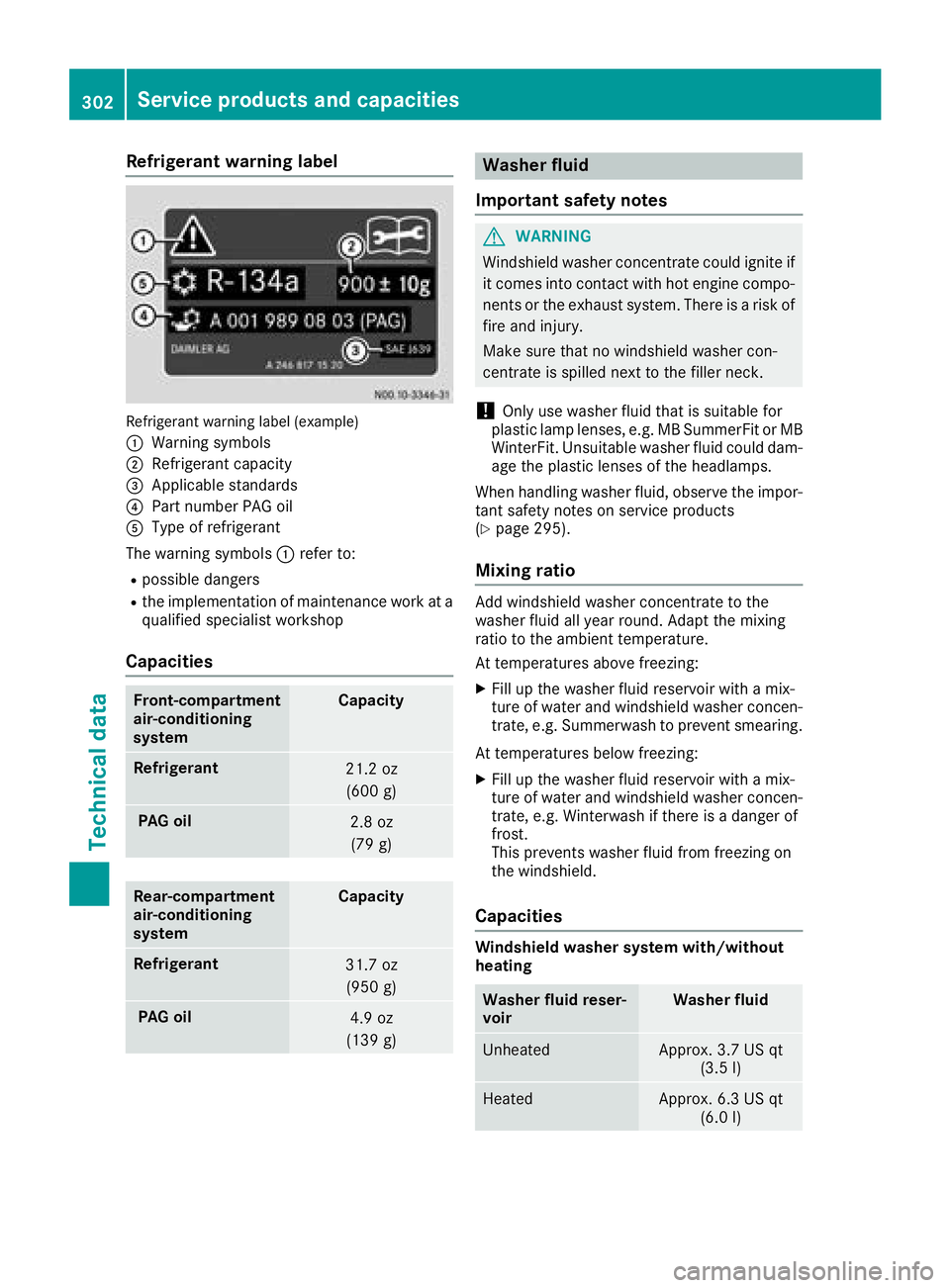
Refrigerant warninglabel
Refrigerant warning label (example)
:
Warning symbols
;Refrigerant capacity
=Applicabl estandards
?Part number PAG oil
AType of refrigerant
The warning symbols :refe rto:
Rpossible dangers
Rthe implementation of maintenance work at a
qualified specialist workshop
Capacities
Front-compartment
air-conditioning
systemCapacity
Refrigerant21.2 oz
(600 g)
PAGo il2.8 oz
(79 g)
Rear-compartment
air-conditioning
systemCapacity
Refrigerant31.7 oz
(950 g)
PAGo il4.9 oz
(139 g)
Washe rfluid
Important safety notes
GWARNING
Windshieldw asherc oncentrate could ignite if
it comesi nto contact with hot engine compo-
nents or the exhaus tsystem. There is arisko f
fire and injury.
Make sure that no windshield washerc on-
centrate is spilled next to the fille rneck.
!Only us ewasherf luid that is suitablef or
plasti clam plen ses, e.g. MB SummerFi torMB
WinterFit. Unsuitablew asherf luid could dam-
ag et he plasti clen ses of the headlamps.
Whe nhandling washerf luid,observe the impor-
tant safety notes on service products
(
Ypage 295).
Mixin gratio
Add windshield washerc oncentrate to the
washerf luid allyea rround. Adapt the mixing
rati otot he ambient temperature.
At temperatures above freezing:
XFil lupt he washerf luid reservoirw itham ix-
ture of water and windshield washerc oncen-
trate ,e.g. Summerwash to prevent smearing.
At temperatures below freezing:
XFil lupt he washerf luid reservoirw itham ix-
ture of water and windshield washerc oncen-
trate ,e.g. Winterwash if there is adanger of
frost.
Thisp revents washerf luid from freezing on
the windshield.
Capacities
Windshiel dwasher system with/without
heating
Washe rflui dr eser-
voirWashe rfluid
UnheatedApprox. 3.7 US qt
(3.5 l)
HeatedApprox. 6.3 US qt(6.0 l)
302Servic eproducts and capacities
Technical data