technical data MERCEDES-BENZ METRIS 2016 MY16 Operator’s Manual
[x] Cancel search | Manufacturer: MERCEDES-BENZ, Model Year: 2016, Model line: METRIS, Model: MERCEDES-BENZ METRIS 2016Pages: 310, PDF Size: 7.28 MB
Page 298 of 310
the containers: MB-Freigabe or MB-Approval
(e.g. MB-Freigabe or MB-Approval228.5)
Mor einformation can be obtained at any quali-
fie ds pecialis tworkshop.
Additives for approved service products ar enei-
therr equired nor permitted .Approved fuel addi-
tive sarethe exception. Additives can cause
engine damage and must therefore not be
adde dtot he service products.
The us eofadditivesisa lwaysthe responsibility
of the vehicl eoperator. The us eofadditivesm ay
resul tinthe restrictio norlossofy ourL imit ed
Warranty entitlements.
Fuel
Important safety notes
GWARNING
Fue lish ighl yf lammable. Improper handling of
fuel creates ariskoff irea nd explosion.
Avoi dfire, open flames ,smoking and creating
sparks under al lcircumstances .Switch off the
engine and ,ifapplicable, the auxiliary heating
befor erefueling.
GWARNING
Fue lisp oisonous and hazardous to health.
There is ariskofi njury.
Yo um ustm akes uret hatf ueldoe sn ot come
into contact with your skin, eyes or clothing
and thatiti snot swallowed. Do not inhal efue l
vapors. Kee pfuelawa yfromc hildren.
If yo uoro thers come into contact with fuel,
observe the following:
RWash away fuel froms kinimmediately
using soa pand water.
RIf fuel come sinto contact with your eyes,
immediatel yrinse themt horoughlywith
clean water. See kmedica lassis tance with-
ou td elay.
RIf fuel is swallowed, seek medica lassis -
tance withou tdelay. Do not induce vomit-
ing.
RImmediately change ou tofclothing which
hasc ome into contact with fuel. When handling
,storing and disposing of fuels,
please observe the relevant regulations.
Tank contents
Depending on equipment, the tota lcapacity of
the fuel tank mayv ary.
Totalcap acity18.5 US ga l(70.0 l)
of whic hreserve
fuelApprox. 3.2 US gal (12.0 l)
Gasoline
Fuel grade
!Do not use diesel to refuel vehicle swith a
gasoline engine. Do not switch on the ignition
if you accidentally refuel with the wrong fuel.
Otherwise, the fuel wil lenter the fuel system.
Even small amounts of the wrong fuel could
resul tind amage to the fuel system and the
engine. Notify aqualified specialist workshop
and have the fuel tank and fuel lines drained
completely.
!Only refuel using unleaded premiumg rade
gasoline with at least 91 AKI/95 RON.
!Only use the fuel recommended.O perating
the vehicle with other fuel scan leadtoe ngine
failure.
!Do not use the following:
RE85 (gasoline with 85% ethanol)
RE100 (100% ethanol)
RM15 (gasoline with 15% methanol)
RM30 (gasoline with 30% methanol)
RM85 (gasoline with 85% methanol)
RM100 (100% methanol)
RGasoline with metalliferous additives
RDiesel
Do not mix such fuel swith the fuel recom-
mended for you rvehicle.
!Filter the fuel beforet ransferring it to the
vehicle if you are refueling the vehicle from
barrels or containers.
This wil lprevent malfunctions in the fuel sys-
tem due to contaminated fuel.
iE10 fuel contains an admixture of up to 10%
bioethanol .Yourv ehicle is E10 compatible.
You can refue lyou rv ehicle with E10 fuel.
296Service products and capacities
Technical data
Page 299 of 310
iYou will generally findinformation about the
fuel grade on the filling pump. If there is no
identification on the filling pump, consult a
gas station attendant.
As atemporary measure, if the recommended
fuel is not available, you may also use regular
unleaded gasolinew ith an octane ratingof
87 AKI/91R ON. This may reduce the engine's
performance and increase fuel consumption.
Avoid drivingatf ull throttle and sudden accel-
eration. Never refuel using fuel with alower
AKI/RON rating.
iIn some countries, the available gasoline
may not be sufficiently low in sulfur. This fuel
can temporarily produceu npleasantodors,
especially on shortj ourneys. The odors are
reduce dassoon as sulfur-free fuel (sulfur
conten t<10 ppm) is used again for refueling.
For more information about refueling
(
Ypage 131).
Fuel additives
!Operating the engin ewith subsequently
added fuel additives can cause engin edam-
age. Do not mix fuel additives with fuel. This
does not include additives for the removal and
prevention of deposits. Gasoline can only be
mixe dwith additives recommended by
Mercedes-Benz. Follow the instructions in the
productd escription .You can findf urther
information on recommended additives in any
Mercedes-Ben zCommercial Van Center.
Mercedes-Ben zrecommends using brand-name
fuels with additives.
If you use fuels without these additives for along
period of time, depositsc an form.This primarily
formsont he inlet valve and in the combustion
chamber.
In some countries, the available fuel grade may
be inadequate. Residue could build up in the fuel
injection syste masaresult.Int his case, in con-
sultation with aMercedes-Ben zCommercial
Van Center, the fuel should be mixe dwith the
cleaning additiv
erecommen ded
by Mercedes-
Benz. You must observet he notes and mixing
ratio sindicated on the container.
Do not add other fuel additives to the fuel. This
resultsinu nnecessary cost sand can damage
the engine.
Information on fuel consumption
HEnvironmental note
CO
2(carbo ndioxide )isthe gas which scien-
tist sbelieve to be principally responsible for
global warming( the greenhouse effect). Your
vehicle's CO
2emissions are directly related to
fuel consumption and therefore dependo n:
Refficient use of the fuel by the engine
Rdrivingstyle
Rother non-technical factors, such as envi-
ronmental influences, road condition sor
traffic flow
You can minimize your vehicle's CO
2emis-
sionsbyd rivingcarefully and havingits erv-
iced regularly.
Only for certain countries: the respectiv ecur-
rentc onsumption and emissionv alues of your
vehicle can be foundint he COC papers (EC
CERTIFICATE OF CONFORMITY). These docu-
ments are supplied when the vehicle is deliv-
ered.
Consumption figures were foundint he currently
valid respectiv eversion:
Rfor vehicles up to and including the Euro 4
standard accordingtoEUD irective
80/1268/EEC
Rfor vehicles from the Euro 5standar daccord-
ing to regulation (EC )no. 715/2007
Rfor vehicles fromt he Euro6standard accord-
ing to regulation (EC )no. 595/2009
Fue lconsumption depends on:
Rthe vehicl eversion
Rthe style of driving
Rthe operating conditions
Rthe typ eorquality of the fuel used
The vehicl ewillu se mor efuelthanu sualin the
following situations:
Rat ver ylow outside temperatures
Rin city traffic
Rdurin gshort journeys
Ron mountainou sterrain
Rwhen towing atrailer
Observe the advic einthe "Protectio no
fthe
environment" sectio ntokeepf uelconsumption
lo w(
Ypage 27).
Service products and capacities297
Technica ldata
Z
Page 300 of 310
The following components of the different vehi-
cle versions influence fuel consumption:
Rtire sizes, tire tread, tire pressure, tire condi-
tion
Rtransmission ratios for the drive assemblies
Radditional equipment (e.g. air-conditioning
system, auxiliary heating system)
For these reasons, the actual consumption fig-
ures for your vehicle may deviate from the con-
sumption figures determined according to EU
Directive 80/1268/EE C.
Detail sonfuelconsumption can be calle dupin
the on-board computer:
Ron vehicles withou tsteerin gwheel buttons
(Ypage 171)
Ron vehicles with steerin gwheel buttons
(Ypage 178)
Engine oil
General notes
When handling engine oil, observe the important
safety note sonserviceproducts (Ypage 295).
The quality of the engine oi lusedisofd ecisive
importance for the engine's functionality and
operating life. Mercedes-Benz continually
approves engine oils based on comple xexperi-
ments according to the current state of the art.
Therefore ,onlyM ercedes-Benz approved
engine oils maybeu sedinM ercedes-Benz
engines. Mercedes-Benz recommends having
the oi lchange dataq ualified specialis twork-
shop. Informatio
nabout approved engine oils can be
obtained:
Rfroma ny Mercedes-Benz Commercial Van
Center
Ron the Internet at
http://bevo.mercedes-benz.co mbyenter ing
th ed esignation ,e.g.2 29.5 .
Mercedes-Ben zapprova lisindicate dont heoil
container by th einscriptio n„MB-Freigabe “or
„MB Approval“ and th ecorre spondin gdesigna-
tion ,e.g.M B-Freig abe or MB Approval 229.5.
Designation softheapprove dengineo ils for
your vehicl e
MB-Freigabe or MB
Approval229.5
Mercedes-Ben zrecommends that you only use
approve dmulti-grade engin eoils of th eSAE
classe sSAE 0W-30 and SA E0W-40 or
SA E5 W-30 and SA E5W-40. These engin eoils
ensur eoptimum lubrication eve natveryl ow
outside temperatures (
Ypage 299).
Whe ntoppin gup, we recommen dthaty ou only
use engin eoil of th esam egrade (MB-Freigabe
or MB Approvaldesignation )and SA Eclass as
th eo il filled at th elast oil change.
iIf th eengineo ils listed in th etable are no t
available, you may add th efollowin gengine
oils until th enexto il change:
RMB-Freigabe or MB Approval 229.1, or
ACE AA3
This mus tonlybea dded once and th eamount
mus tnotbe greate rtha n1q t(1.0l ).
Subsequentl yhavet he engin eoil changed at
th ee arliest possibl eopportunity.
!Using engin eoils of another grade qualit yis
no tp ermitted.
Capacities
!Do no tadd to omucho il. addin gtoo muc h
engin eoil can result in damage to th eengine
or to th ecatalytic converter. Hav eexces s
engin eoil siphoned off .
Oil change includin goil filter
Engin eoilApprox. 2USgal
(7.75 l)
298Service products and capacities
Technical data
Page 301 of 310
Additives
!Do notuse any additive sintheengin eoil.
This could damag ethe engine.
Engineo il viscosity
!If theSAE viscosit yclassoft heengin eoil
used does no tcover th eoutside temperature
range in whic hyou are operating th evehicle,
it mus tbechanged in goo dtime, in particular
before th ecolds eason commences. Using an
engin eoil that does no thavea dequate tem-
peratur echaracteristics can lead to engin e
damage.
The temperature range information of th eSAE
classification always refers to that of fresh oil.
The temperature characteristics of th eengine
oil may deteriorat esignificantly due to agin g
in use, especially at low outside tempera-
tures.
We recommen dthaty ou chang ethe engin e
oil before th ecolds eason commences. Use
an approve dengineo il of th especifie dSAE
class.
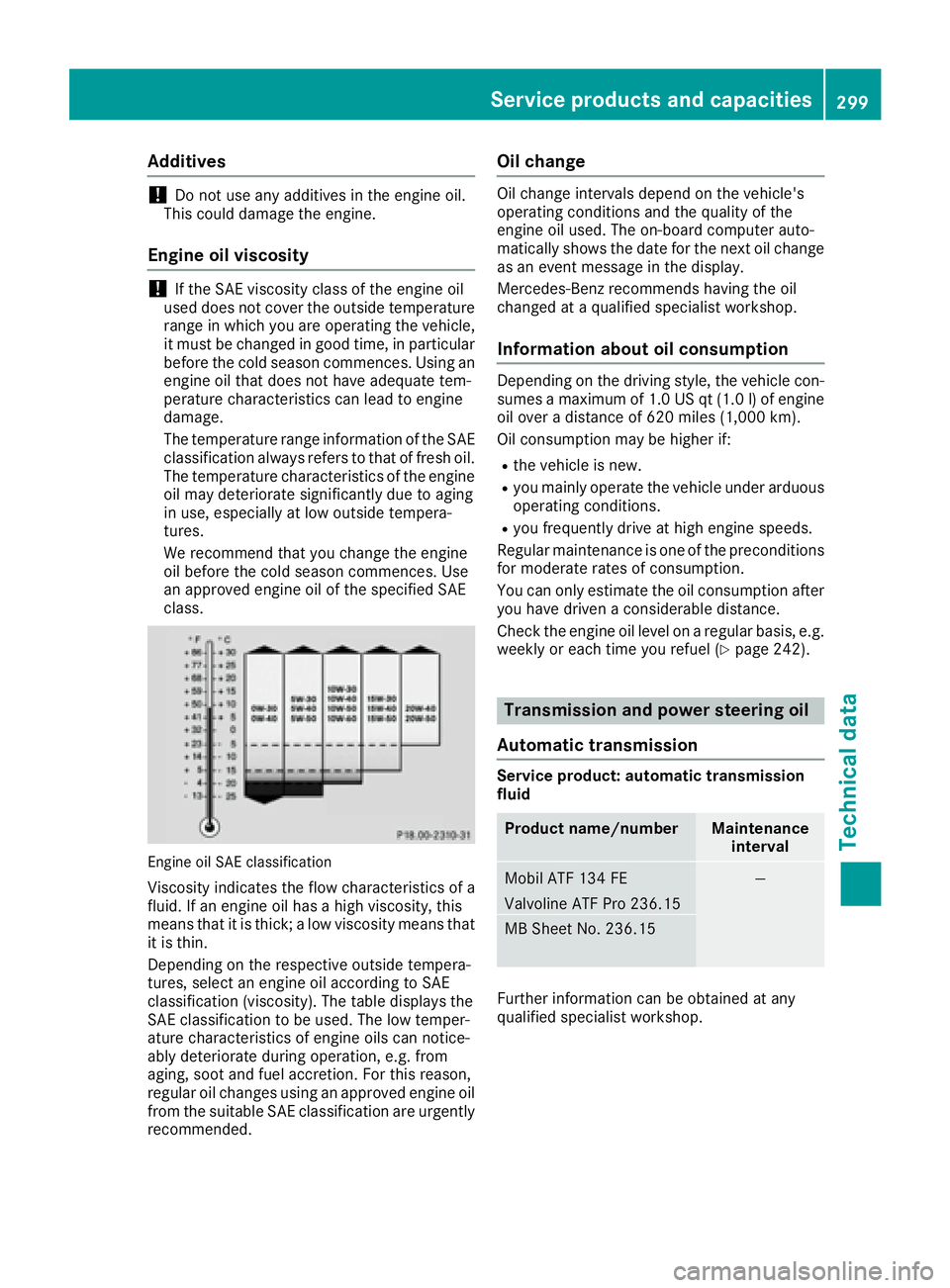
Engin eoil SA Eclassification
Viscosit yindicates th eflowc haracteristics of a
fluid .Ifane ngineo il has ahigh viscosity, this
mean stha titi sthick ;al ow viscosit ymean stha t
it is thin.
Dependin gontherespective outside tempera-
tures, select an engin eoil according to SA E
classification (viscosity). The table displays th e
SA Ec lassification to be used .The low temper-
atur echaracteristics of engin eoils can notice -
ably deteriorat eduring operation ,e.g.f ro m
aging, soo tand fuel accretion .For this reason ,
regular oil changes usin ganapprove dengineo il
from th esuitable SA Eclassification are urgently
recommended.
Oil change
Oil chang eintervals depend on th evehicle's
operating condition sand th equalit yoft he
engin eoil used .The on-board computer auto -
matically shows th edatef or th enexto il chang e
as an event message in th edisplay.
Mercedes-Benz recommends having th eoil
changed at aqualified specialist workshop .
Information abou toil consump tion
Dependin gonthedrivin gstyle, th evehicl econ-
sumes amaximum of 1. 0USqt(1.0l )ofe ngine
oil over adistance of 620 miles (1,000 km).
Oil consumption may be higher if:
Rthe vehicle is new.
Ryou mainly operate the vehicle under arduous
operating conditions.
Ryou frequently drive at high engine speeds.
Regularm aintenance is one of the preconditions
for moderate rates of consumption.
You can only estimate the oil consumption after
you have driven aconsiderable distance.
Check the engine oil level on aregular basis, e.g.
weekly or each time you refuel (
Ypage 242).
Transmission and power steering oil
Automatic transmission
Service product: automatic transmission
fluid
Product name/numberMaintenance interval
Mobil ATF 134 FE
Valvoline ATF Pro 236.15—
MB Sheet No. 236.15
Further information can be obtained at any
qualified specialist workshop.
Service products and capacities299
Technical data
Z
Page 302 of 310
Rear axle
Serviceproduct: transmission oil
Product name/numberMaintenance
interval
Mobilub eFE 75-W-85
Mobilube FE Plus NG
MB Shee tNo. 235.7—
Further information can be obtained at any
qualified specialist workshop.
Brake fluid
GWARNING
The brake fluid constantly absorbsm oisture
from the air. Thi slowers the boiling point of
the brake fluid .Ifthe boiling point of the brake
fluid is too low, vapor pockets may form in the
brake system when the brakes are applied
hard. Thi swould impai rbraking efficiency.
There is ariskofana ccident.
Yo us houl dhavet he brake fluid renewe dat
the specified intervals.
!Brake fluid corrodes paint, plastic and rub-
ber .Ifp aint, plastic or rubber hasc ome into
contact with brake fluid ,rins ew ithw ater
immediately.
Whe nhandling, storing and disposing of brake
fluid ,pleas eobserve the relevant regulations
and the important safety notes for service prod-
ucts (
Ypage 295).
Overap eriodoft ime,the brake fluid absorbs
moistur efrom the air. Thi sreduce sits boiling
point.
Have the brake fluid renewe devery 2years at a
qualified specialist workshop.
iThere is usuall yanotice in the engine com-
partment to remind yo uwhent he next brake
fluid change is due.
Use only approved brake fluid sthat comply with
the Mercedes-Benz Specifications for Service
Products. Alway scheck for the identification
DOT 4plus.
Information abouta pproved brake fluid scan be
obtained:
Rat any qualified specialist workshop
Ron the Interne tat
http://bevo.merced es-benz.com.
Coolant
Important safety notes
GWARNING
If antifreezec omes intocontac twithh ot com-
ponents in th eenginec ompartment, it may
ignite .Thereisar iskoff irea nd injury.
Let th eenginec ooldown before you add anti-
freeze. Makes ure that antifreezeisn otspilled
next to th efille rneck. Thoroughlyc lean the
antifreezef romc omponents before starting
th ee ngine.
!Takec aren otto spill any coolant on painted
surfaces .You coul dotherwise damag ethe
paintwork.
When handling, storin gand disposingofc oolant
and antifreeze, please observ ethe relevan treg-
ulationsa nd theimportant safety note sfor ser-
vic ep roduct s(
Ypage 295).
Coolan tadditive with corrosion and
antifreeze protection
!Use only approved antifreeze/corrosion
inhibitor that complies withMBS pecification
300Service products and capacities
Technical data
for Service Products, Sheet Number 325.
Using other, non-approved antifreeze/corro-
sion inhibitors may causedamage to the cool-
ant system and reduce the engine' sservice
life
Page 303 of 310
.
The coolant is amixture of water and antifreeze
and corrosion inhibitor. It performs the following
tasks:
Rcorrosion protection
Rantifreeze protection
Rraises the boiling point
When the vehicl eisfirst delivered, it is filled with
ac oolant mixture that ensure sadequate anti-
freeze and corrosion protection. Coolant must
remai ninthe engine cooling system all year
round to ensure anti-corrosion protection and a
higher boiling point, even in countries with high
outside temperatures.
To prevent damage to the engine cooling sys-
tem, use only approved antifreeze and corrosion
inhibitor that complies with the Mercedes-Benz Specifications for Service Products.
Mercedes-Benz recommends an antifreeze and
corrosion inhibitor that meets the requirements
in the Mercedes-Benz Specifications for Service
Products Sheet Number 325.
Check the antifreeze/corrosio ninhibitor con-
centration in the coolant every six months.
The percentag eofcorrosion inhibitor/anti-
freeze additive in the engine cooling system
should:
Rbe at least 50%. This way, the engine cooling
system is protected against freezing downt o
approximately -35 ‡(-37 †).
Rnot exceed 55% (antifreeze protection down
to -49 ‡[-45 †]) .Otherwise, hea twilln ot be
dissipated as effectively.
If ther ehasbeen coolant loss, do not refill only
with water. If the vehicl ehaslost coolant, add
equa lparts water and antifreeze/corrosion
inhibitor. The water used as part of the coolant
mixture must fulfil lcertain requirements; these
are usuall yfulfille dbyd rinking water. If the
water quality is not sufficient, yo umusttrea tthe
water.
Mor einformatio ncan be obtaine datany qual i-
fi eds p
ecialist workshop.
Servic eproduct: coolant
Productn ame/number
Zerex G40-91, The Valvoline Company
MB SheetNo. 325.5
Maintenance interval
Hav ethe coolant renewe devery 15 years .
Capacities
Engine coolin gsystem
CoolantApprox. 11 US qt
(10.4l)
Clim ate control systemr efrigerants
Important safety notes
The climate control system of you rvehicle is fil-
led with the refrigerant R ‑134a.
The warning label for the refrigerant being used
can be found on the radiator cross member.
!Only the refrigerant R ‑134a and the PAG oil
approved by Mercedes-Benz may be used.
The approved PAG oil may not be mixed with
any other PAG oil that is not approved for
R-134a refrigerant. Otherwise ,the climate
control system may be damaged.
Maintenance work such as adding refrigerant or
replacing components may only be carried out
by aq ualified specialist workshop. All applicable
regulations thereto and the SAE standard J639
need to be respected.
All work on the climate control system should
always be carried out at qualified specialist
workshop.
Service products and capacities301
Technical data
Z
Page 304 of 310
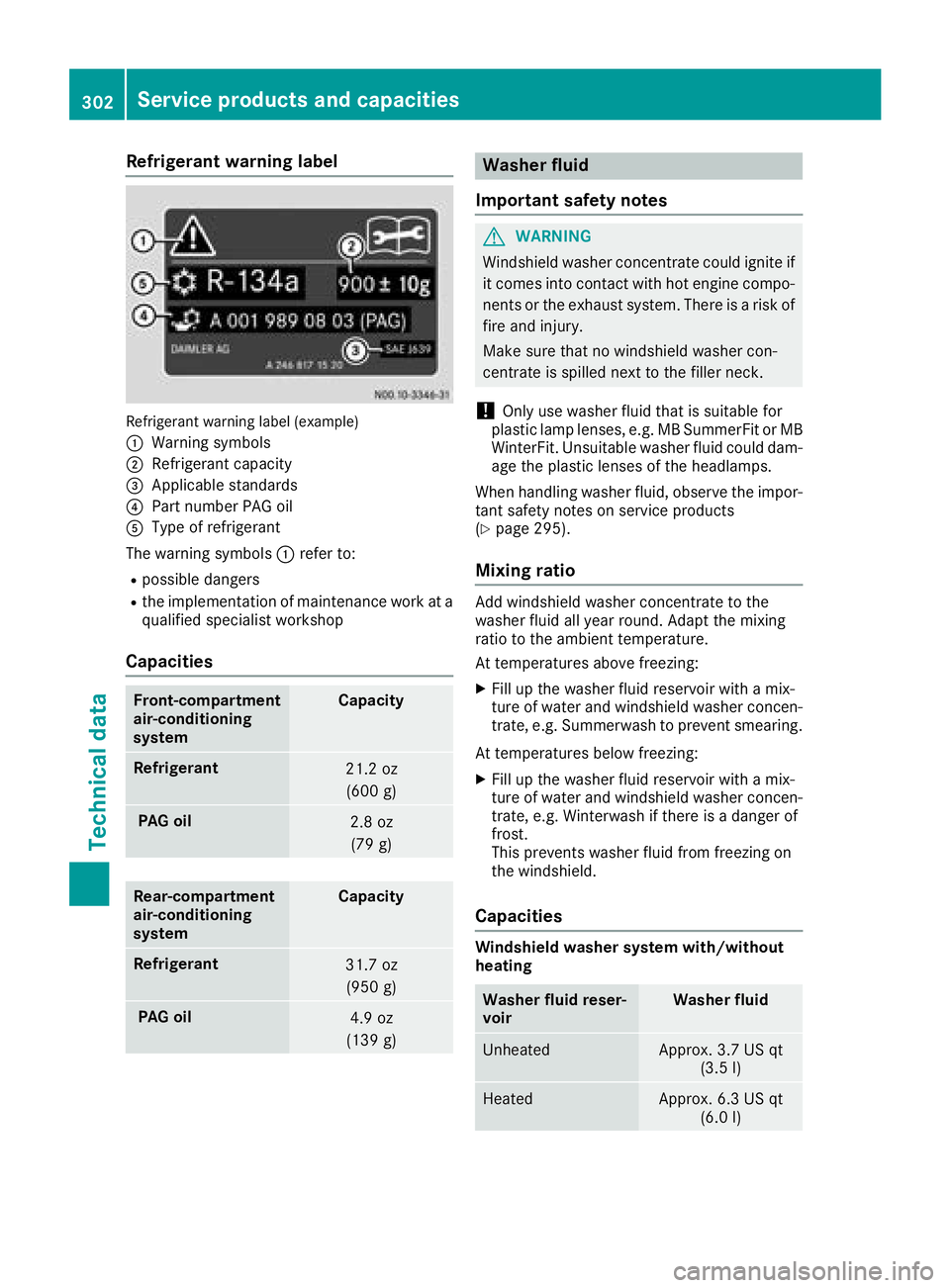
Refrigerant warninglabel
Refrigerant warning label (example)
:
Warning symbols
;Refrigerant capacity
=Applicabl estandards
?Part number PAG oil
AType of refrigerant
The warning symbols :refe rto:
Rpossible dangers
Rthe implementation of maintenance work at a
qualified specialist workshop
Capacities
Front-compartment
air-conditioning
systemCapacity
Refrigerant21.2 oz
(600 g)
PAGo il2.8 oz
(79 g)
Rear-compartment
air-conditioning
systemCapacity
Refrigerant31.7 oz
(950 g)
PAGo il4.9 oz
(139 g)
Washe rfluid
Important safety notes
GWARNING
Windshieldw asherc oncentrate could ignite if
it comesi nto contact with hot engine compo-
nents or the exhaus tsystem. There is arisko f
fire and injury.
Make sure that no windshield washerc on-
centrate is spilled next to the fille rneck.
!Only us ewasherf luid that is suitablef or
plasti clam plen ses, e.g. MB SummerFi torMB
WinterFit. Unsuitablew asherf luid could dam-
ag et he plasti clen ses of the headlamps.
Whe nhandling washerf luid,observe the impor-
tant safety notes on service products
(
Ypage 295).
Mixin gratio
Add windshield washerc oncentrate to the
washerf luid allyea rround. Adapt the mixing
rati otot he ambient temperature.
At temperatures above freezing:
XFil lupt he washerf luid reservoirw itham ix-
ture of water and windshield washerc oncen-
trate ,e.g. Summerwash to prevent smearing.
At temperatures below freezing:
XFil lupt he washerf luid reservoirw itham ix-
ture of water and windshield washerc oncen-
trate ,e.g. Winterwash if there is adanger of
frost.
Thisp revents washerf luid from freezing on
the windshield.
Capacities
Windshiel dwasher system with/without
heating
Washe rflui dr eser-
voirWashe rfluid
UnheatedApprox. 3.7 US qt
(3.5 l)
HeatedApprox. 6.3 US qt(6.0 l)
302Servic eproducts and capacities
Technical data
Page 305 of 310
Vehicledata
General notes
The following section contains important tech-
nica ldataf or your vehicle. Additionalv ehicle-
specifi cand equipment-dependent technical
data, such as vehicl eweigh ts, can be found in
your vehicl eregistration papers.
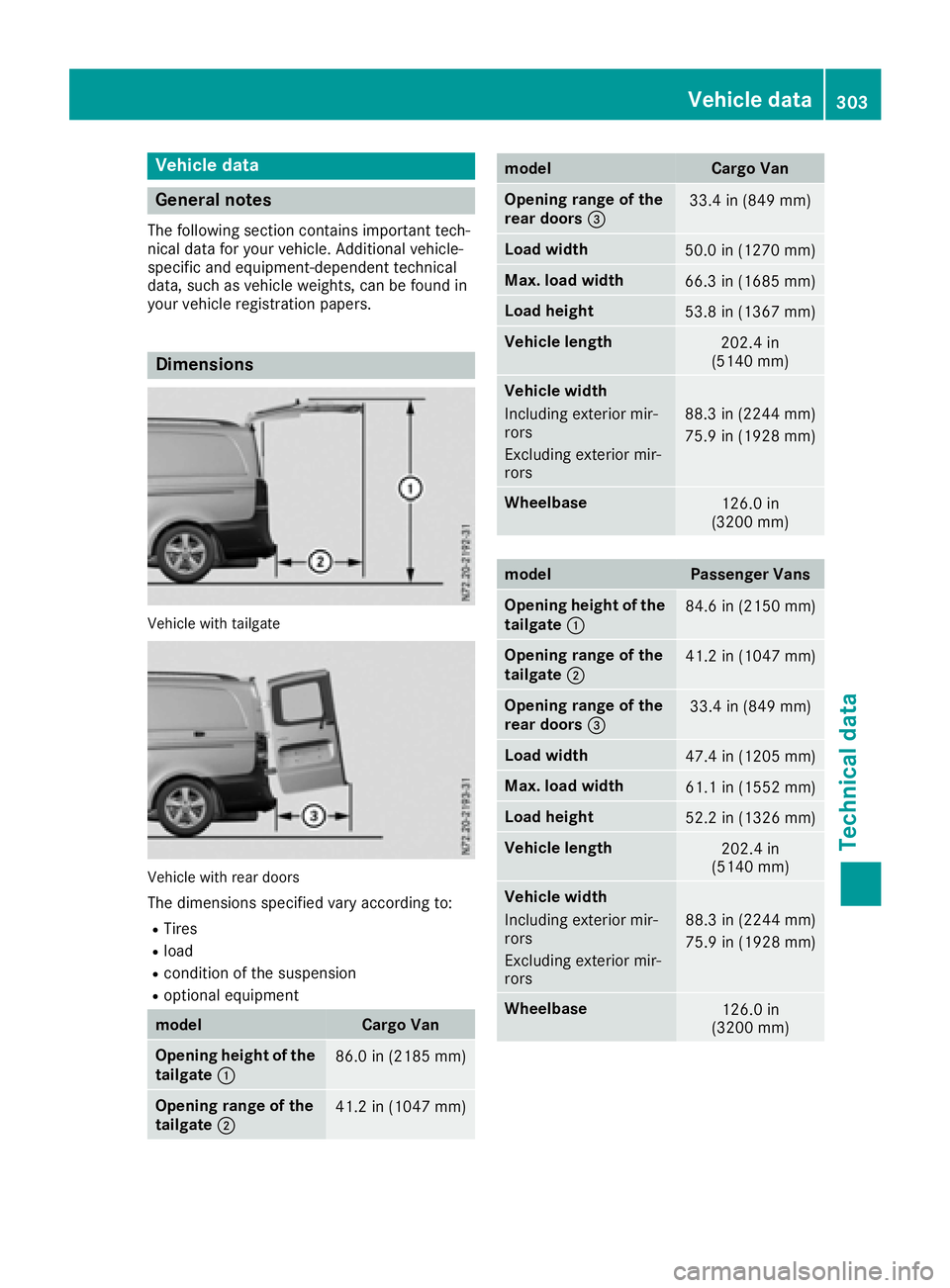
Dimensions
Vehicl ewitht ailgate
Vehicl ewithr eard oors
The dimensions specified var yaccording to:
RTires
Rload
Rcondition of the suspension
Roptional equipment
modelCarg oVan
Opening height of the
tailgate :86.0 in (2185 mm)
Opening rang eofthe
tailgate ;41.2 in (1047 mm)
modelCargoVan
Opening rang eofthe
rear doors =33.4 in (849 mm)
Load width50.0 in (1270 mm)
Max. load width66.3 in (1685 mm)
Load height53.8 in (1367 mm)
Vehiclelengt h202.4 in
(514 0mm)
Vehicl ewidth
Including exterio rmir-
rors
Excluding exterio rmir-
rors
88.3 in (2244 mm)
75.9 in (1928 mm)
Wheelbase126.0 in
(320 0mm)
modelPassenger Vans
Opening height of the
tailgate :84.6 in (2150 mm)
Opening rang eofthe
tailgate ;41.2 in (1047 mm)
Opening rang eofthe
rear doors =33.4 in (849 mm)
Load width47.4 in (1205 mm)
Max. load width61.1 in (1552 mm)
Load height52.2 in (1326 mm)
Vehiclelengt h202.4 in
(514 0mm)
Vehicl ewidth
Including exterio rmir-
rors
Excluding exterio rmir-
rors
88.3 in (2244 mm)
75.9 in (1928 mm)
Wheelbase126.0 in
(320 0mm)
Vehicl edata303
Technica ldata
Z
Page 306 of 310
Cargo tie-down points and carriersys-
tems
Cargo tie-down points
General notes
!Observ ethe informatio nonthemaximum
loadingc apacity of th eindividua lcargo tie-
down points.
If you use several cargo tie-down points to
secure aload, you must always tak ethe max-
imum loadingc apacity of theweakest cargo
tie-down pointi ntoa ccount.
If you brak ehard ,for example ,the forces act-
ing coul dbeuptos everal times th eweight
force of th eload. Always use multiple cargo
tie-down points in order to distribut ethe force
absorption.L oad theanchorages evenly.
You will fin dadditional informatio nabout cargo
tie-down points and cargo tie-down rings in the
"Securin gloads"s ection(
Ypage 234).
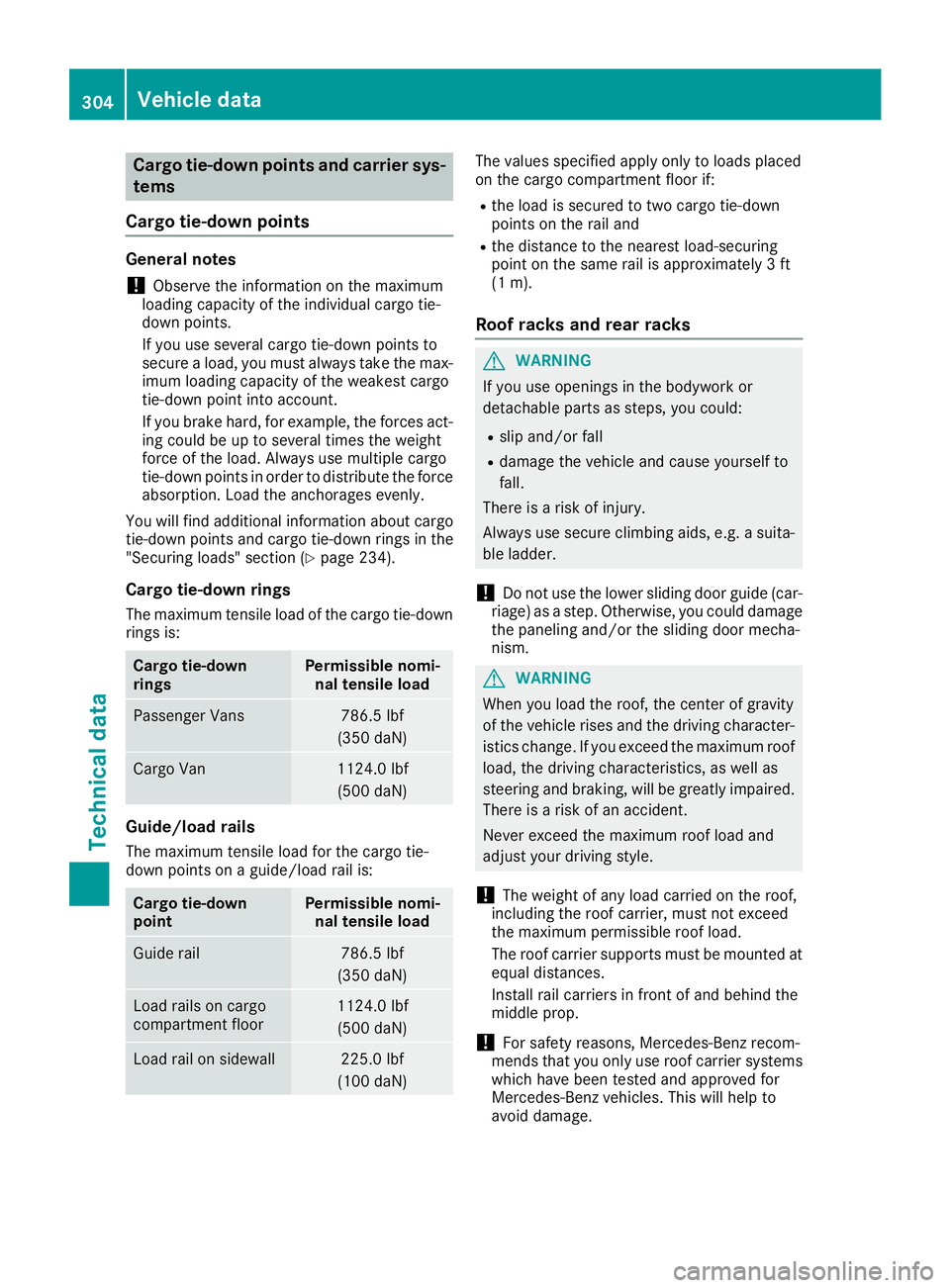
Cargo tie-down rings
The maximum tensile load of th ecargo tie-down
rings is:
Cargo tie-down
ringsPermissible nomi- nal tensile load
Passenger Vans786. 5lbf
(35 0daN)
Cargo Van1124.0 lbf
(50 0daN)
Guide/load rails
The maximum tensile load for th ecargo tie-
down points on aguide/load rail is:
Cargo tie-down
pointPermissible nomi-
nal tensile load
Guide rail786. 5lbf
(35 0daN)
Load rails on cargo
compartmen tfloor1124.0 lbf
(50 0daN)
Load rail on sidewall225. 0lbf
(10 0daN)
The values specifie dapply only to loads placed
on th ecargo compartmen tfloo rif:
Rth el oad is secured to two cargo tie-down
points on th erail and
Rthed istanc etotheneares tload-securing
pointont hesame rail is approximately 3ft
(1 m).
Roo fracks and rear racks
GWARNING
If yo uuseopenings in the bodywork or
detachabl eparts as steps, yo ucould:
Rslipa nd/or fall
Rdamag ethe vehicl eand cause yourselft o
fall.
There is ariskofi njury.
Alway susesecure climbing aids, e.g. asuita-
bl el adde r.
!Do not us ethe lowe rsliding doo rguide (car-
riage) as astep .Otherwise, yo ucould damage
the paneling and/or the sliding doo rmecha-
nism.
GWARNING
Whe nyou load the roof, the center of gravity
of the vehicl erises and the driving character-
istics change. If yo uexcee dthe maximum roof
load ,the driving characteristics, as well as
steering and braking, will be greatl yimpaired.
There is ariskofana ccident.
Neve rexcee dthe maximum roo floa da nd
adjust your driving style.
!The weight of any load carrie donthe roof,
including the roo fcarrier, mus tnot exceed
the maximum permissible roo fload.
The roo fcarrie rsuppo rts mus tbem ounted at
equal distances.
Install rai lcarriers in front of and behind the
middl eprop.
!For safety reasons,M ercedes-Benz recom-
mend sthat yo uonly us eroofcarrie rsystems
which have bee nteste dand approved for
Mercedes-Benz vehicles. Thi swillh elpt o
avoid damage.
304Vehicl edata
Technical data
Page 307 of 310
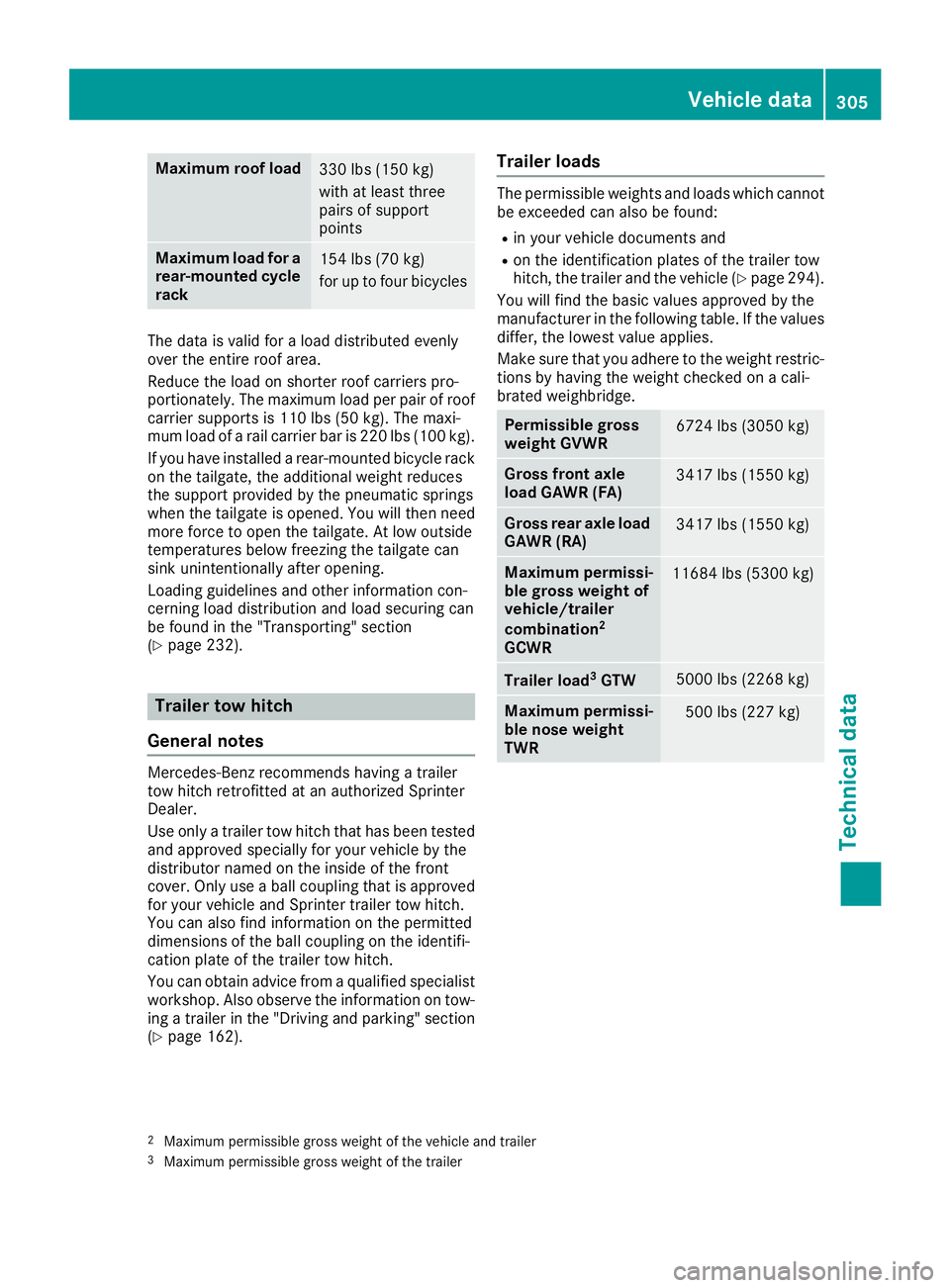
Maximum roof load330 lbs (150 kg)
with at least three
pairs of support
points
Maximum load for a
rear-mounted cycle
rack154 lbs (70 kg)
for up to four bicycles
The data is validfor aloadd istributed evenly
over the entire roof area.
Reduce the loa donshorter roof carriers pro-
portionately. The maximu mloadp er pai rofroof
carrie rsupports is 110 lbs (50 kg) .The maxi-
mum loa dofarail carrie rbar is 220 lbs (100 kg).
If you have installed arear-mounted bicycle rack
on the tailgate, the additiona lweight reduces
the support provided by the pneumatic springs
when the tailgate is opened.Y ou willthen need
more force to open the tailgate. At low outside
temperatures belowf reezing the tailgate can
sink unintentionally after opening.
Loading guidelines and other information con-
cerning loa ddistribution and loads ecuring can
be found in the "Transporting" section
(
Ypag e232).
Trailer tow hitch
General notes
Mercedes-Benz recommends having atrailer
tow hitch retrofitted at an authorized Sprinter
Dealer.
Use only atrailer tow hitch that has been tested
and approved specially for you rvehicl ebyt he
distributor named on the insid eofthe front
cover. Only use aballc oupling that is approved
for you rvehicl eand Sprinter trailer tow hitch.
You can als ofind information on the permitted
dimensions of the bal lcoupling on the identifi-
cation plate of the trailer tow hitch.
You can obtai nadvice from aqualified specialist
workshop .Also observe the information on tow-
ing atrailer in the "Driving and parking" section
(
Ypag e162).
Trailer loads
The permissible weights and loads which cannot
be exceededc an alsobefound:
Rin you rvehicl edocuments and
Ron the identification plates of the trailer tow
hitch, the trailer and the vehicl e(Ypage294).
You wil lfind the basi cvalues approved by the
manufacturer in the following table .Ifthe values
differ, the lowest valu eapplies.
Make sure that you adhere to the weight restric-
tions by having the weight checked on acali-
brated weighbridge.
Permissible gross
weight GVWR6724 lbs (3050 kg)
Gross front axle
load GAWR (FA)3417 lbs (1550 kg)
Gross rear axle load
GAWR (RA)3417 lbs (1550 kg)
Maximum permissi-
ble gross weight of
vehicle/trailer
combination
2
GCWR
11684 lbs (5300 kg)
Trailer load3GTW5000 lbs (2268 kg)
Maximum permissi-
ble nose weight
TWR500 lbs (227 kg)
2Maximu mpermissibleg ross weight of the vehiclea nd trailer3Maximumpermissibl egross weight of the trailer
Vehicle data305
Technical data
Z