tires MERCEDES-BENZ METRIS 2016 MY16 Operator’s Manual
[x] Cancel search | Manufacturer: MERCEDES-BENZ, Model Year: 2016, Model line: METRIS, Model: MERCEDES-BENZ METRIS 2016Pages: 310, PDF Size: 7.28 MB
Page 283 of 310
Vehicleidentificatio nplate
Even if yo uhavec alculate dthe totall oadc are-
fully ,you shoul dstillm ake sure thatt he permis-
sibl egross weight and the gross axl eweigh trat-
ing of your vehicl eare not exceeded .Thisd ata
can be found on the vehicl eide ntificatio nplate
on the B-pillar of your vehicl e(
Ypage 294).
Permissibl egross vehicle weight: the gross
weight of the vehicle, al loccupants, load and
traile rload/n oseweight (i fappli cable) must not
exceed the permissibl egross vehicl eweigh t.
Gros saxlew eightrating: the maximu mper-
missibl eloa dt hatc an be carrie dbyone axle
(front or rea raxle).
To ensure thaty ourvehicl edoesn ot exceed the
maximu mpermissibl evalue s(gros sv ehicle
weight and maximu mgross axl eweigh trating),
have your loaded vehicl e(including driver, occu-
pants, load ,and ful ltraile rloa difa pplicable)
weighed on asuitabl evehicl eweigh bridge.
Trailer load/noseweight
The traile rload/n oseweight affects the gross
weight of the vehicle. If atraile risa ttached, the
traile rload/n oseweight is included in the load
along with occupants and luggage. The trailer
load/noseweight is usuall yapproximately1 0%
of the gross weight of the traile rand its load.
What yous hould knowabout wheels
and tires
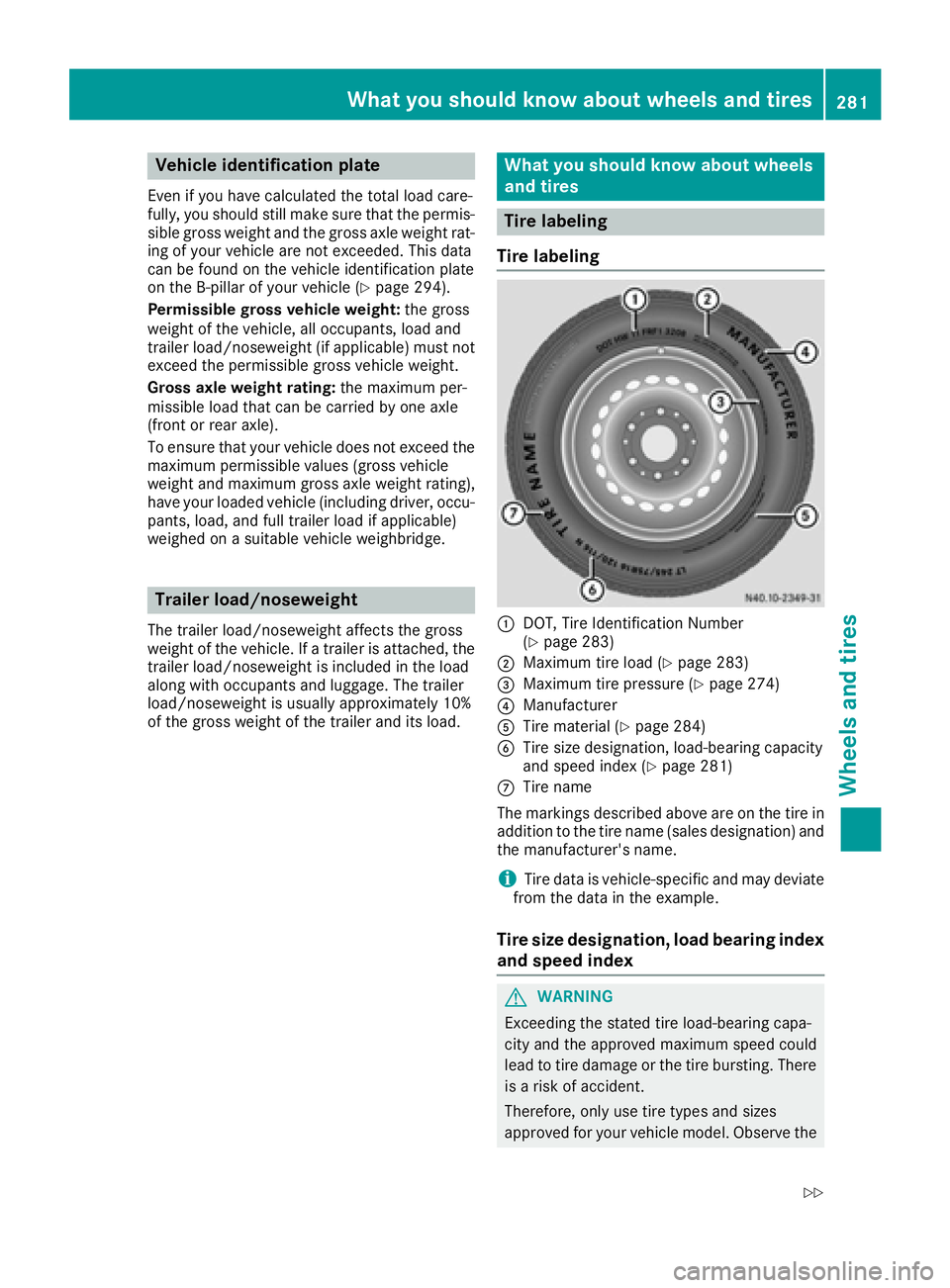
Tire labeling
Tire labeling
:DOT, Tire Identification Number
(Ypage 283)
;Maximu mtire load (Ypage 283)
=Maximu mtire pressure (Ypage 274)
?Manufacturer
ATire material (Ypage 284)
BTire size designation, load-bearing capacity
and speed index (Ypage 281)
CTire name
The marking sdescribe dabove are on the tire in
additio ntothe tire nam e(sale sdesig nation) and
the manufacturer' sname.
iTire data is vehicle-specific and mayd eviate
from the data in the example.
Tire size designation ,loa db earin gind ex
and speed index
GWARNING
Exceeding the stated tire load-bearing capa-
city and the approved maximu mspeed could
lead to tire damage or the tire bursting. There is ar iskofa ccident.
Therefore, onlyu setire types and sizes
approved for your vehicl emodel .Observe the
What yous hould knowa bout wheels and tires281
Wheelsand tires
Z
Page 284 of 310
tire load rating and speedrating required for
your vehicle.
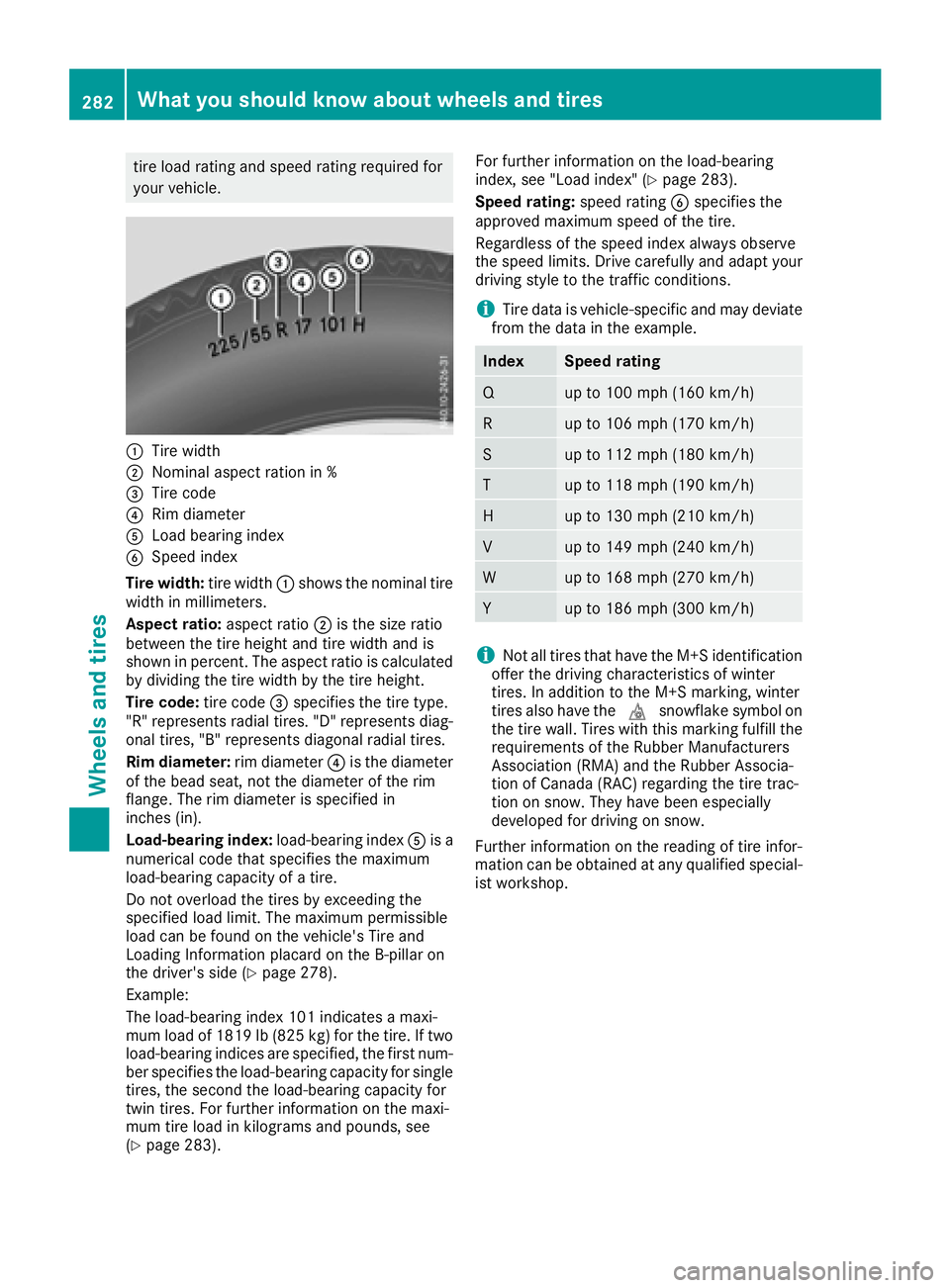
:Tire width
;Nomina laspec trationin%
=Tire code
?Ri md iame ter
ALoadbeari ng index
BSpeed index
Tire width: tire width:shows the nominal tire
width in millimeters.
Aspec tratio: aspect ratio ;is the size ratio
between the tire height and tire width and is
shown in percent. The aspect ratio is calculated
by dividing the tire width by the tire height.
Tire code: tire code=specifie sthe tire type.
"R "r epresents radial tires. "D" represents diag-
ona ltires, "B" represents diagona lradial tires.
Rim diameter: rim diameter?is the diameter
of the bead seat, not the diamete rofthe rim
flange .The rim diamete risspecifie din
inches (in).
Load-bearing index: load-bearing indexAis a
numerical cod ethats pecifie sthe maximum
load-bearing capacity of atire.
Do not overload the tire sbyexceeding the
specifie dloa dlimit .The maximum permissible
load can be found on the vehicle' sTirea nd
Loading Informatio nplacard on the B-pillar on
the driver's side (
Ypage 278).
Example:
The load-bearing index 101 indicates amaxi-
muml oado f1819 lb (825 kg )for the tire .Iftwo
load-bearing indice sarespecified, the first num-
be rspe cifie sthe lo ad-b
earing capacity for single
ti
res, the second the load-bearing capacity for
twi ntires. For furthe rinformation on the maxi-
mumt ire load in kilograms and pounds, see
(
Ypage 283). For furthe
rinformation on the load-bearing
index, see" Loadindex" (
Ypage 283).
Speed rating: speedrating Bspecifie sthe
approved maximum spee dofthe tire.
Regardles softhe spee dindex always observe
the spee dlimit s. Drive carefull yand adap tyou r
drivin gstyle to the trafficc onditions.
iTire data is vehicle-specific and mayd eviate
fromt he data in the example.
IndexSpeed rating
Qup to 100 mph (16 0km/h)
Rup to 106 mph (17 0km/h)
Sup to 112 mph (18 0km/h)
Tup to 118 mph (19 0km/h)
Hup to 130 mph (21 0km/h)
Vup to 149 mph (24 0km/h)
Wup to 168 mph (27 0km/h)
Yup to 186 mph (30 0km/h)
iNot al ltire sthath avet he M+S identification
offer the drivin gcharacteristics of winter
tires. In additio ntothe M+S marking, winter
tire salsoh avet he i snowflake symbo lon
the tire wall .Tires with thism arking fulfill the
requirements of the Rubber Manufacturers
Associatio n(RM A) and the Rubber Associa-
tio nofC anad a( RA C) regarding the tire trac-
tio nons now. They have been especially
developed for drivin gonsnow.
Furtheri nformation on the reading of tire infor-
matio ncan be obtained at any qualified special-
is tw orkshop.
282What yous hould knowabout wheels an dtires
Wheel sand tires
Page 285 of 310
Load index
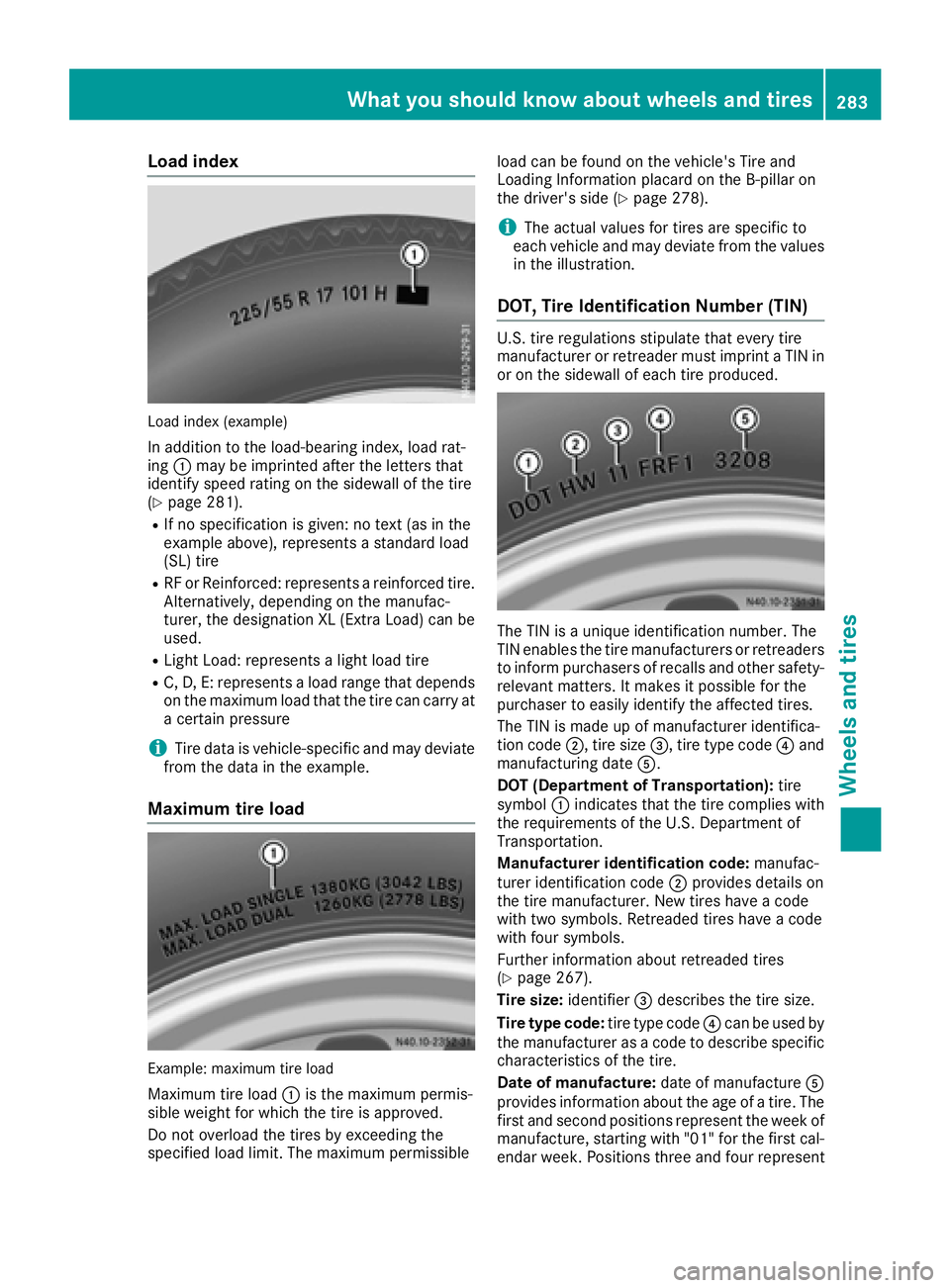
Load index(example)
In addition to th eload-bearin gindex, load rat-
ing :may be imprinted after th eletter sthat
identif yspeed rating on th esidewall of th etire
(
Ypage 281).
RIf no specificatio nisgiven: no tex t(as in the
example above), represents astandar dload
(SL )tire
RRF or Reinforced: represents areinforced tire.
Alternatively, depending on th emanufac-
turer, th edesignation XL (Extr aLoad) can be
used.
RLightL oad: represents alight load tire
RC, D, E: represents aload range that depends
on th emaximum load that th etirec an carry at
ac ertain pressure
iTire data is vehicle-specific and may deviate
fro mt hedata in th eexample.
Maximum tir eload
Example: maximum tir eload
Maximum tir eload :is th emaximum permis-
sible weight for whicht hetireisa pproved.
Do not overload th etires by exceedingt he
specified load limit.T he maximum permissible load can be foun
donthevehicle's Tire and
LoadingI nformation placar dontheB-pillar on
th ed river' sside (
Ypage 278).
iThe actual values for tires are specific to
each vehicle and may deviat efromt hevalues
in th eillustration.
DOT, Tir eIdentification Number (TIN)
U.S. tir eregulations stipulatet hate veryt ire
manufacturer or retreaderm ust imprintaTIN in
or on th esidewall of each tir eproduced.
The TIN is aunique identification number. The
TIN enables th etirem anufacturers or retreaders
to inform purchasersofr ecalls and other safety-
relevant matters. It makes it possible for the
purchaser to easily identif ythe affected tires.
The TIN is made up of manufacturer identifica-
tio nc ode ;,t ires ize =,t iret ype code ?and
manufacturing date A.
DOT (Departmen tofTransportation): tire
symbol :indicates that th etirec omplies with
th er equirements of th eU.S.D epartmento f
Transportation.
Manufacturer identification code: manufac-
turer identification code ;provides details on
th et irem anufacturer. New tires have acode
with two symbols. Retreaded tires have acode
with four symbols.
Further informatio nabout retreadedt ires
(
Ypage 267).
Tir es ize: identifier =describes th etires ize.
Tir etyp ec ode: tiret ype code ?can be used by
th em anufacturer as acodetod escribe specific
characteristic softhetire.
Dat eofm anufacture: date of manufacture A
provides informatio nabout th eage of atire. The
first and second positionsr epresenttheweek of
manufacture, starting with "01 "for th efirst cal-
endar week.P ositionsthree and four represent
What you should know aboutw heels and tires283
Wheels and tires
Z
Page 286 of 310
the year of manufacture. For example,atire that
is marked with "3208" wa smanufactured in
week 32 in 2008.
iTire data is vehicle-specific and mayd eviate
fromt he data in the example.
Tire characteristics
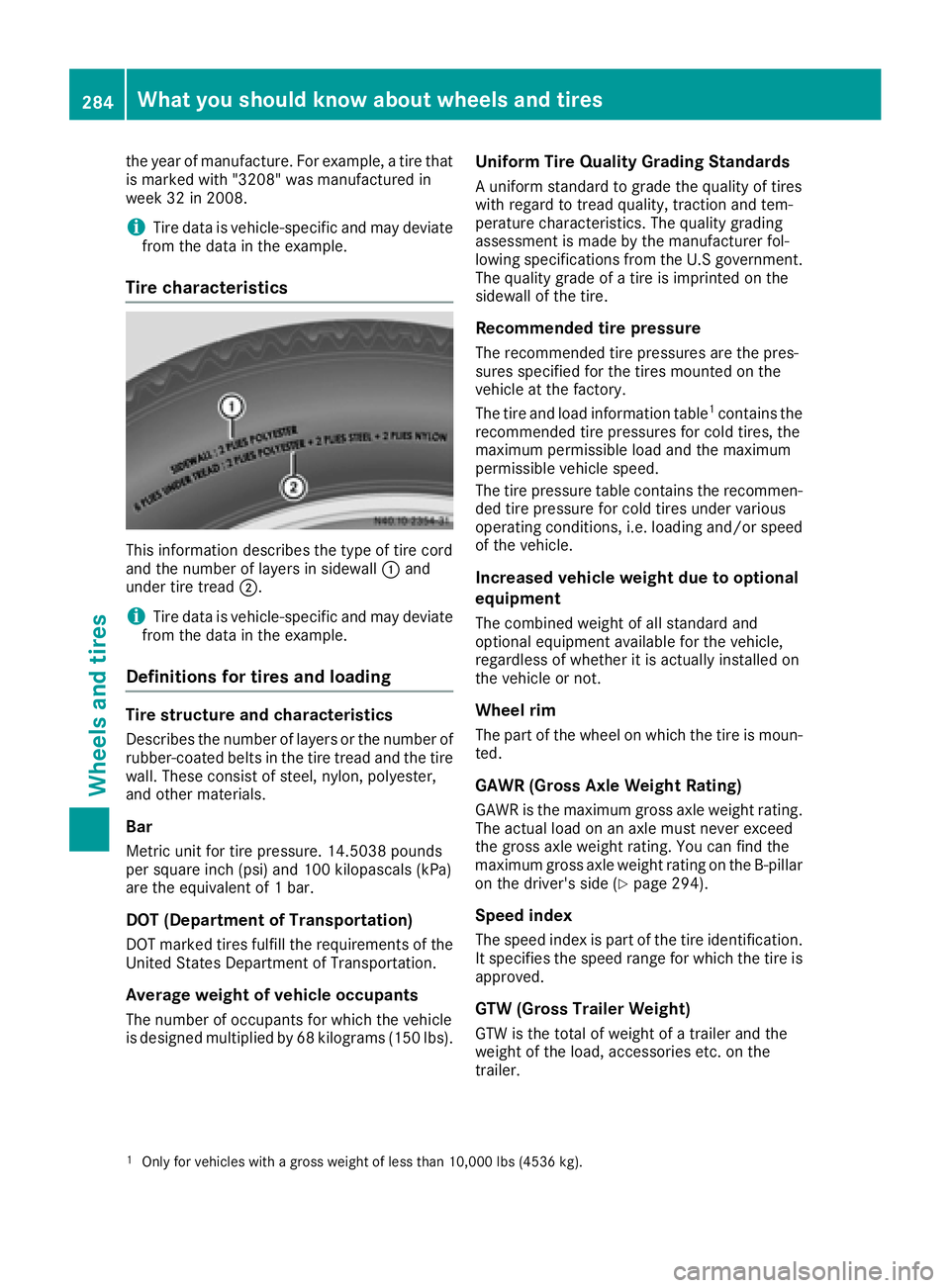
Thisinformation describe sthe typ eoftire cord
and the numbe roflayersins idewall :and
under tire tread ;.
iTire data is vehicle-specific and mayd eviate
fromt he data in the example.
Definition sfor tire sand loading
Tire structure and characteristics
Describe sthe numbe roflayer sort he numbe rof
rubber-coated belts in the tire trea dand the tire
wall .These consis tofsteel,nylon, polyester,
and othe rmaterials.
Bar
Metric uni tfor tire pressure. 14.5038 pounds
pe rs quare inch (psi)a nd 100 kilopascal s(kPa)
ar et he equivalent of 1bar.
DO T(De partmen tofTransportation)
DOT marked tire sfulfill the requirements of the
United State sDepartment of Transportation.
Averag eweigh tofv ehicle occupants
The numbe rofoccupants for which the vehicle
is designe dmultiplie dby68k ilograms (15 0lbs).
Uniform Tire Quality Grading Standards
Au nifor mstandard to grade the quality of tires
with regar dtotreadquali ty,t ractio nand tem-
peratur echaracteristics .The qualit ygrading
assessment is made by the manufacturer fol-
lowing specifications fromt he U.S government.
The quality grade of atire is imprinted on the
sidewall of the tire.
Recommende dtire pressure
The recommended tire pressures ar ethe pres-
sures specifie dfor the tire smounted on the
vehicl eatthe factory.
The tire and load information table
1contains the
recommende dtire pressures for col dtires, the
maximum permissibl eloa da nd the maximum
permis sibleve
hiclespeed.
The tire pressure table contains the recommen-
de dt ire pressure for col dtiresu nder various
operating conditions ,i.e .loadi ng and/or speed
of the vehicle.
Increase dvehicle weight due to optional
equipment
The combine dweigh tofa llstandard and
optional equipment availabl efor the vehicle,
regardles sofwhether it is actually installe don
the vehicl eornot.
Wheel rim
The part of the whee lonwhich the tire is moun-
ted.
GAWR (Gros sAxleW eight Rating)
GAWRisthe maximum gross axl eweigh trating.
The actual load on an axl emustn eve rexceed
the gross axl eweigh trating .You can fin dthe
maximum gross axl eweigh trating on the B-pillar
on the driver's side (
Ypage 294).
Speed index
The spee dindex is part of the tire identification.
It specifie sthe spee drange for which the tire is
approved.
GTW (Gros sTrailer Weight)
GTWist he tota lofweightofat railer and the
weight of the load ,accessorie setc. on the
trailer.
1Onl yfor vehicles with agross weight of less tha n10,000 lb s(4536 kg).
284What yous hould knowabout wheels an dtires
Wheel sand tires
Page 287 of 310
GVW (Gross VehicleWeight)
The gross vehicle weight includes the weight of
the vehicle including fuel ,tools, spare wheel,
accessories installed, occupants, luggage and
the drawbar noseweight if applicable. The gross
vehicle weight must never exceed the permissi-
ble gross weight (GVWR) specified on the
B-pilla ronthe driver's side (
Ypage 294).
GVWR (Gross Vehicl eWeight Rating)
The GVWR is the maximu mpermitted gross
weight of the full yladen vehicle (weight of the
vehicle including all accessories, occupants,
fuel ,luggage and the drawbar noseweight if
applicable).T he permissibleg ross weight is
specified on the vehicle identification plate on
the B-pilla ronthe driver's side (
Ypage 294).
Maximum weight of the laden vehicle
The maximu mweight is the sum of:
Rthe curb weight of the vehicle
Rthe weight of the accessories
Rthe loadl imit
Rthe weight of the factory installed optional
equipment
Kilopascal (kPa)
Metric unit for tire pressure. 6.9 kPa are the
equivalent of 1psi.A nother tire pressure unit is
bar. 100 kilopascals (kPa) are the equivalent of
1b ar.
Load index
In addition to the loadb earing index,aload
index can be stamped onto the sidewal lofthe
tire. It specifies the load-bearing capacity of the
tire more precisely.
Curb weight
The weight of avehicle with standard equipment
including the maximu mfilling capacity of fuel,
oil, and coolant. It also includes the air-condi-
tioning system and optional equipment if these
are installed on the vehicle ,but does not include
passengers or luggage.
Maximum tire load
The maximu mtire loadink ilograms or pounds is
the maximu mweight for which atire is
approved.
Maximum permissiblet ire pressure
Maximumpermissiblet ire pressure for one tire.
Maximum load on one tire
Maximumloadono ne tire. This is calculated by
dividing
the maximu maxle loadofo ne axle by
two.
PSI (Pounds per square inch)
Standard unit of measurement for tire pressure.
Aspec tratio
Relationshi pbetwee ntire heighta nd width in
percent.
Tire pressure
Pressure inside the tire applying an outward
force to every square inch of the tire's surface.
Tire pressure is specified in pounds per square
inch (psi), in kilopascal (kPa) or in bar. Tire pres-
sure shoul donly be corrected when the tires are
cold.
Col dtire pressure
The tires are cold:
Rif the vehicle has been parked for at least
three hours withou tdirect sunlight on the
tires, and
Rif the vehicle has not been driven further than
1m ile (1.6 km)
Tire tread
The part of the tire that comes into contact with
the road.
Tire bead
The tire beade nsures that the tire sits securely
on the wheel. There are severals teel wiresinthe
beadtop revent the tire from coming loose from
the whee lrim.
Sidewall
The part of the tire betwee nthe tread and the
tire bead.
Weight of optional extras
The combined weight of those optional extras
that weigh more than the replaced standard
parts and more than 2.3 kg (5 lbs). These
optional extras, such as high-performance
brakes, aroof rack or ahigh-performance bat-
tery, are not included in the curb weight and the weight of the accessories.
What you shouldk now about wheels and tires285
Wheelsand tires
Z
Page 288 of 310
TIN (Tire IdentificationNumber)
Auniqu eide ntificatio nnumbe rwhich can be
used by atire manufacturer to identify tires, for
exampl efor ap roduct recall ,and thusi dentify
the purchasers. The TIN is compose dofthe
manufacturer identificatio ncode, tire size, tire
model cod eand manufacturing date.
Load bearin gind ex
The load bearing index (als oloa dindex) is acode
thatc ontains the maximu mloadb eari ng capa-
city of atire.
Traction
Tractio nist he resul toffrictio nbetween the tires
and the roa dsurface.
TWR (permissibl etrailer drawbar load)
The TWRist he maximumpermissibl eweigh t
thatm ayact on the ball coupling of the trailer
tow hitch.
Wea rind icator
Narrowb ars( tread wear bars) thata redistrib-
ute doverthe tire tread. If the tire trea dislevel
with the bars, the wear limit of áin (1.6 mm)
hasb eenr eached.
Distribution of the vehicle occupants
The distributio nofvehicleoccupants ove rdes-
ignate dseatp osit ions in avehicle.
Maximum permissible payload weight
Nomina lloa da nd goods/luggage load plus
68 kg (150 lb s)multiplie dbythe number of
seats in the vehicle.
Changing wheels
Rotating the wheels
GWARNING
Interchanging the front and rear wheels may
severelyi mpair the driving characteristics if
the wheels or tires have different dimensions. The whee lbrakes or suspension components
may als obedamaged. There is arisk of acci-
dent.
Rotate front and rear wheels only if the wheels and tires are of the same dimensions.
!On vehicles equippedw ithatire pressure
monitor, electronic components are located
in the wheel.
Tire-mounting tools should not be used near
the valve .This could damage the electronic
components.
Only have tires changed at aqualified spe-
cialist workshop.
Always observe the instructions and safety
notes under "Mounting awheel" (
Ypage 287).
The wea rpatterns on the front and rear tires
differ, depending on the operating conditions.
Rotate the wheels before aclear wea rpattern
has formed on the tires. Front tires typically
wea rmore on the shoulders and the rear tires in
the center.
If you rvehicle's tire configuration allows, you
can rotate the wheels according to the intervals
in the tire manufacturer's warranty book in your
vehicled ocuments. If no warranty book is avail-
able, the tires should be rotated every 3,000 to
6,000 mile s(5,000 to 10,000 km) or earlier if
tire wea rrequires. Do not change the direction
of rotation.
Clean the contact surfaces of the whee land the
brake disc thoroughly every time awheelisr ota-
ted. Avoid oily or greas ycleaning agents.
Check the tire pressure and reactivate the tire
pressure monitor if necessary.
Directio nofrotation
Tires with aspecified directio nofrotation have
additional benefits, e.g. if there is arisk of hydro-
planing. You wil lonly gai nthese benefits if the
correct directio nofrotation is observed.
An arrow on the sidewal lofthe tire indicates its
correct directio nofrotation.
You may mount aspare whee lagainst the direc-
tion of rotation. Observe the time restriction on
use as wel lasthe speed limitation specified on
the spare wheel.
Storing wheels
Store wheels that are not being used in acool,
dry and preferably dark place. Protect the tires
from contact with oil, greas eand fuel.
286Changing wheels
Wheel sand tires
Page 289 of 310
Mountingawheel
Vehicle preparation
XStop the vehicleasf ar awayaspossible from
traffic and on alevel, firm and non-slip sur-
face.
XIf you rvehicl eposesar isk to approaching
traffic, switch on the hazar dwarning lamps.
XApply the parking brake.
XTurn the front wheels to the straight-ahead
position.
XShift the transmission to position P.
XSwitch off the engine.
XPassengers should leave the vehicle. Make
sure that the passengers are not endangered
as they do so.
XMake sure that no one is near the dange rarea
while the whee lisbeing changed .Anyone
who is not directly assisting in the wheel
change should, for example, stand behind the
barrier.
XPlace the warning triangl eorwarning lamp at
as uitable distance.
Observe the lega lrequirements on the cor-
rect use of the warning triangl eorwarning
lamp for the country in which you are cur-
rently driving
XSecure the vehicletop revent it from rolling
away.
Observe the safety notes on parking under
"Driving and parking" (
Ypag e132)
XOn level terrain: place chocks or other suit-
abl eo bjects under the front and rear of the
whee lthat is diagonally opposite the whee lto
be changed.
XOn slight inclines: place chocks or other
suitable objects under the wheels on the front and rear axle sopposite the whee ltobe
changed.
XIf included in the vehiclee quipment, take the
tire-changing tool kit out of the vehiclet ool kit
(
Ypag e260).
Apart from some country-specific variants,
vehicles are not equipped with tire-changing
tools. Some tools for changing awhee lare
specific to the vehicle. Consult aqualified
specialist worksho pfor more information on
which tools are required to perform awheel
change on you rv
ehi cle.
XIf included in the vehiclee quipment, remove
the spare whee lfrom the spare whee lbracket (
Ypag
e292) .Observe the safety notes listed
under "Spare wheel" (Ypag e291).
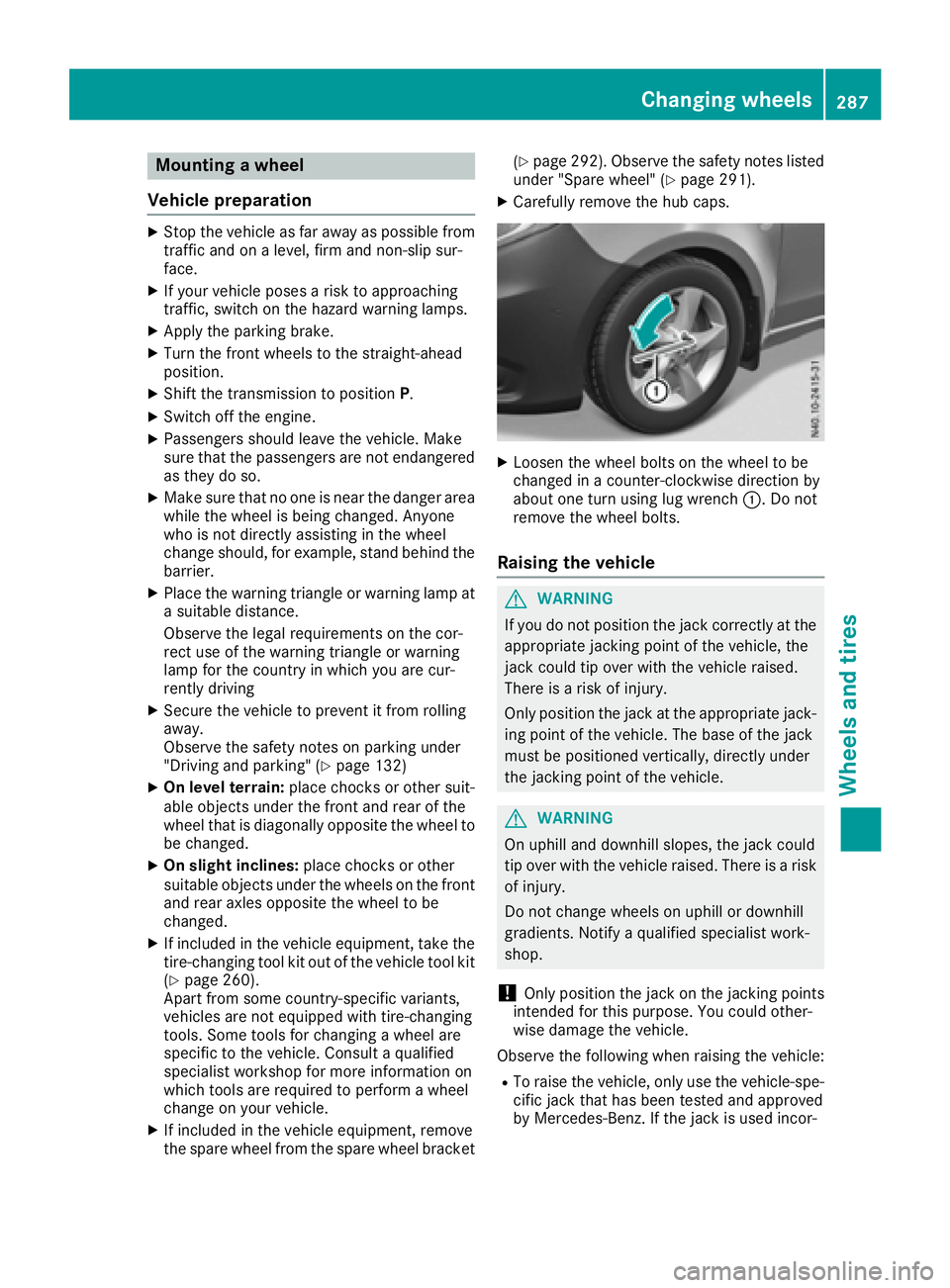
XCarefully remove the hub caps.
XLoosen the whee lbolts on the whee ltobe
changed in acounter-clockwise direction by
about one turn using lug wrench :.Donot
remove the whee lbolts.
Raisingt he vehicle
GWARNING
If you do not position the jack correctly at the
appropriate jacking point of the vehicle, the
jack coul dtip over with the vehicler aised.
There is arisk of injury.
Only position the jack at the appropriate jack-
ing point of the vehicle. The bas eofthe jack
must be positioned vertically,d irectly under
the jacking point of the vehicle.
GWARNING
On uphill and downhill slopes, the jack could
tip over with the vehicler aised. There isarisk
of injury.
Do not change wheels on uphill or downhill
gradients. Notify aqualified specialist work-
shop.
!Only position the jack on the jacking points
intended for this purpose. You coul dother-
wis edamage the vehicle.
Observe the following when raising the vehicle:
RTo rais ethe vehicle, only use the vehicle-spe-
cific jack that has been tested and approved
by Mercedes-Benz. If the jack is use dincor-
Changing wheels287
Wheels and tires
Z
Page 290 of 310
rectly, it could tip over while the vehicleis
raised.
RThe vehicle's jack is intended only to rais ethe
vehicl efor as hort time when changing a
wheel. It is not suited for performing mainte-
nance work under the vehicle.
RAvoid changing the whee lonuphill and down-
hill slopes.
RBefore raising the vehicle, secure it from roll-
ing awa ybyapplying the parking brake and
inserting whee lchocks. Never disengage the
parking brake while the vehicl eisraised.
RThe jack must be placed on afirm, flat and
non-slip surface. On aloose surface, alarge,
load-bearing underlay must be used .Ona
slippery surface, anon-slip underlay must be
used ,e.g. rubber mats.
RMake sure that the distance between the
underside of the tires and the ground does not
exceed 1.2 in(3 cm).
RNever place you rhands or feet under the
raised vehicle.
RNever lie under the raised vehicle.
RNever start the engine when the vehicl eis
raised.
RNever open or close adoor or the tailgate/
rear door when the vehicl eisraised.
RMake sure that no persons are present in the
vehicl ewhen the vehicl eisraised.
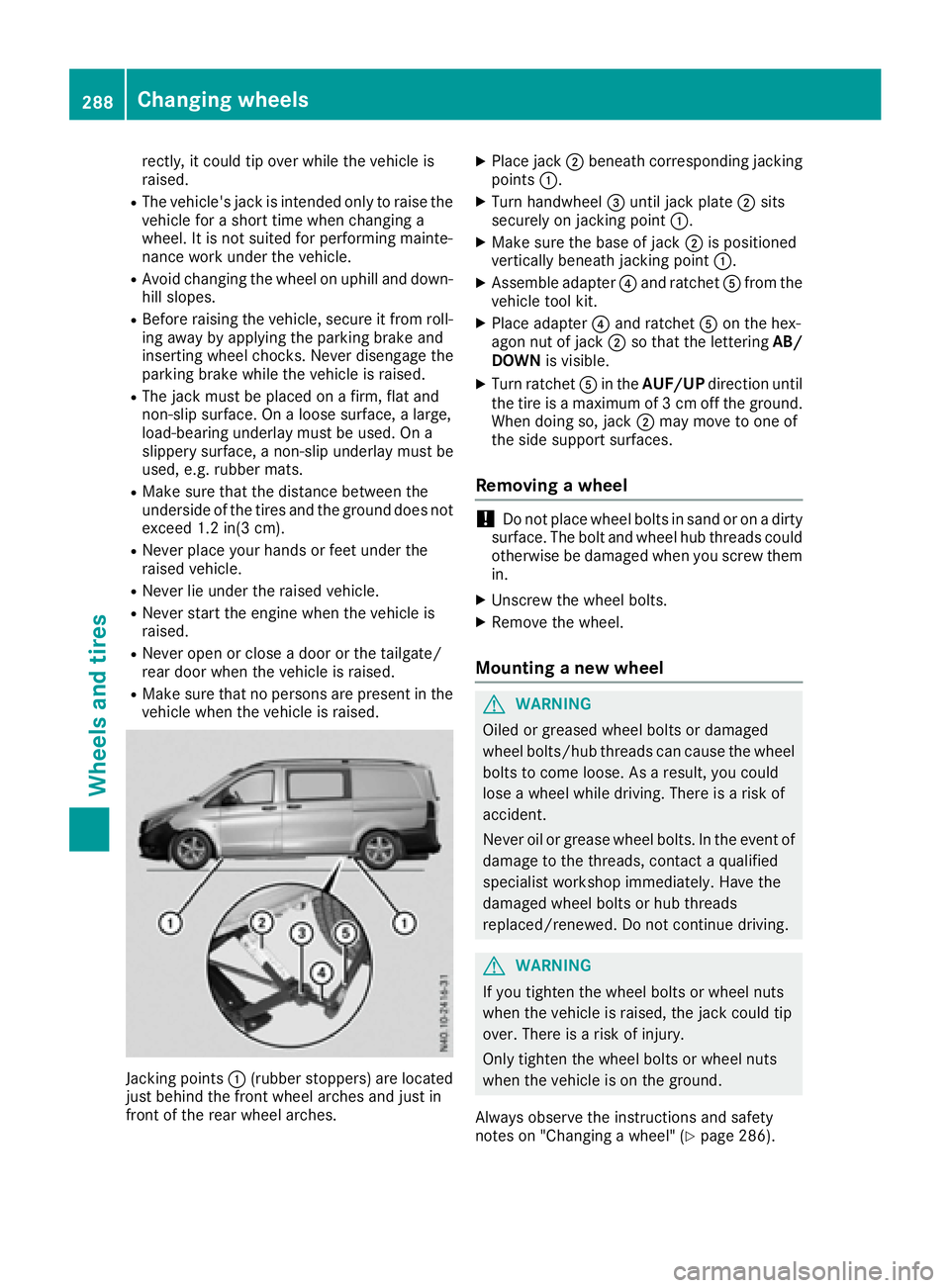
Jacking points :(rubber stoppers)a re located
just behind the front whee larches and just in
front of the rear whee larches.
XPlace jack ;beneath corresponding jacking
points :.
XTurn handwheel =until jack plate ;sits
securely on jacking point :.
XMake sure the base of jack ;is positioned
vertically beneath jacking point :.
XAssembleadapter?and ratchet Afrom the
vehicl etool kit.
XPlace adapter ?and ratchet Aon the hex-
agon nut of jack ;so that the lettering AB/
DOWN is visible.
XTurn ratchet Ain the AUF/UP directionuntil
the tire is amaximu mof3cm off the ground.
When doing so, jack ;may move to one of
the side support surfaces.
Removin gawheel
!Do not place whee lbolts in sand or on adirty
surface. The bolt and whee lhub threads could
otherwise be damaged when you screw them
in.
XUnscrew the whee lbolts.
XRemove the wheel.
Mountin ganew wheel
GWARNING
Oile dorg reased whee lbolts or damaged
whee lbolts/hu bthreads can caus ethe wheel
bolts to come loose .Asaresult, you could
lose awhee lwhile driving. There is arisk of
accident.
Never oil or greas ewhee lbolts. In the event of
damage to the threads ,contact aqualified
specialist workshop immediately. Have the
damaged whee lbolts or hub threads
replaced/renewed. Do not continue driving.
GWARNING
If you tighten the whee lbolts or whee lnuts
when the vehicl eisraised, the jack could tip
over. There is arisk of injury.
Only tighten the whee lbolts or whee lnuts
when the vehicl eisonthe ground.
Always observe the instructions and safety
notes on "Changing awheel" (
Ypag e286).
288Changing wheels
Wheels and tires
Page 291 of 310
Only use wheel bolts that have been designed
for the wheel and the vehicle. For safety rea-
sons, Mercedes-Benz recommends that you
only use wheel bolts which have been approved
for Mercedes-Benz vehicles and the respective
wheel.
!On vehicles equipped withatire pressure
monitor, electronic componentsa re located
in the wheel.
Tire-mounting tools should not be used near
the valve. This could damage the electronic
components.
Only have tires changed at aqualified spe-
cialist workshop.
XCleant he wheel and wheel hub contact sur-
faces.
XSlide the new wheel onto the wheel hub and
push it on.
XScrew in the wheel bolts and tighten them
lightly.
Lowering the vehicle
GWARNING
The wheels could work loose if the wheel nuts and bolts are not tightened to the specified
tightening torque. There is arisk of accident.
Have the tightening torque immediately
checked at aqualified specialist workshop
after awheel is changed.
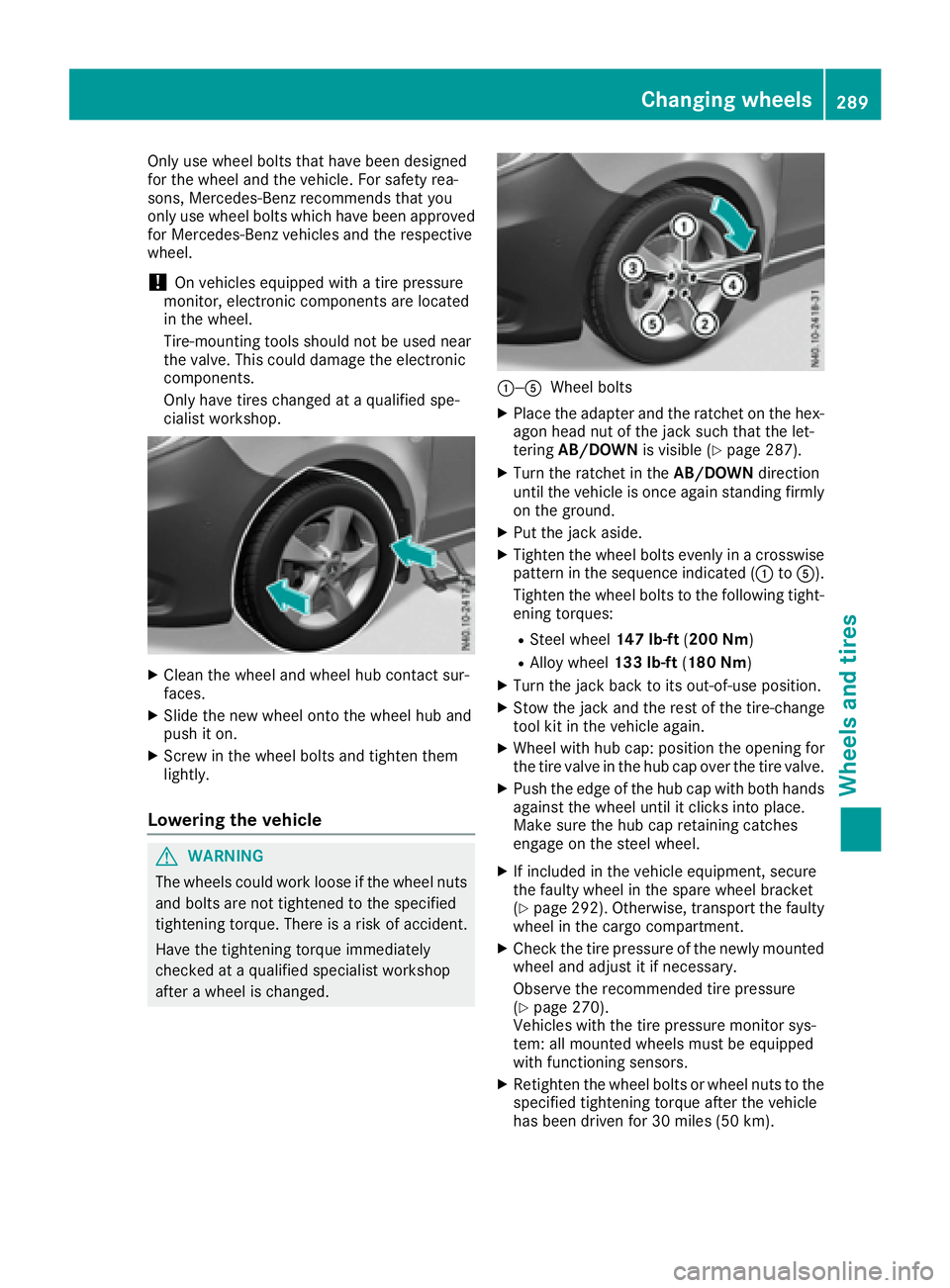
:—AWheel bolts
XPlace the adapter and the ratchet on the hex-
agon head nut of the jack such that the let-
tering AB/DOWN is visible (
Ypage 287).
XTurn the ratchet in the AB/DOWNdirection
until the vehicle is once agains tanding firmly
on the ground.
XPut the jack aside.
XTighten the wheel bolts evenly in acrosswise
pattern in the sequence indicated (: toA).
Tighten the wheel bolts to the following tight-
ening torques:
RSteel wheel 147 lb-ft(200 Nm)
RAlloy wheel 133 lb-ft(180 Nm)
XTurn the jack back to its out-of-use position.
XStow the jack and the rest of the tire-change
tool kit in the vehicle again.
XWheel with hub cap: position the opening for
the tire valve in the hub cap over the tire valve.
XPush the edge of the hub cap with both hands
against the wheel until it clicks into place.
Make sure the hub cap retaining catches
engage on the steel wheel.
XIf included in the vehicle equipment, secure
the faulty wheel in the spare wheel bracket
(
Ypage 292). Otherwise, transport the faulty
wheel in the cargo compartment.
XCheck the tire pressure of the newly mounted
wheel and adjust it if necessary.
Observe the recommended tire pressure
(
Ypage 270).
Vehicles with the tire pressure monitor sys-
tem: all mounted wheels must be equipped
with functionings ensors.
XRetighten the wheel bolts or wheel nuts to the
specified tightening torque after the vehicle
has been driven for 30 miles (50 km).
Changing wheels289
Wheels and tires
Z
Page 292 of 310
When usingawheel/spare wheel with anew or
newly painted wheel rim, have the wheel bolts/
nuts retightened again after approximately 600
to 3,000 miles (1,000 to 5,000 km). Observe the
specified tightening torque.
Wheel and tirec ombination
General notes
!
Retreaded tires are neither tested nor rec-
ommended by Mercedes-Benz,s ince previ-
ous damage cannot alwaysbed etected on
retreaded tires. As aresult, Mercedes-Benz
cannot guarantee vehicle safety if retreaded
tires are mounted. Do not mount used tires if you have no information about their previous
usage.
!For safety reasons, Mercedes-Benz recom-
mends that you only use tires, wheels and
accessories which have been specially
approved by Mercedes-Benz for your vehicle.
These tires have been specially adapted for
use with the driving safety systems, such as
ABS or ESP
®.
Only use tires, wheels or accessories tested
and approved by Mercedes-Benz .Certain
characteristics, e.g. handling, vehicle noise
emissions or fuel consumption, may other-
wise be adversely affected. In addition, when
driving with aload, tire dimension variations
could cause the tires to come into contact
with the bodywork and axle components. This
could result in damage to the tires or the vehi-
cle.
Mercedes-Benz acceptsnol iability for dam-
age resulting from the use of tires, wheels or
accessories other than those tested and
approved.
Further information on wheels, tires and
approved combinations can be obtained from
any qualified specialist workshop.
!Large wheels: the lower the section width
for acertain wheel size, the lower the ride
comfort is on poor road surfaces. Roll comfort and suspension comfort are reduced and the
risk of damage to the wheels and tires as a
result of driving over obstacles increases.
You will find atable with the recommended tire
pressures for various vehicle loads on the inside
of your vehicle's fuel filler flap or under "Tire
pressure tables" (
Ypage 278). You can find fur- ther information under "Tire pressure"
(
Ypage 270).
Check tire pressures regularly and only when
the tires are cold.
Notes on the vehicle equipment –alwayse quip
the vehicle:
Rwith tires of the same size across an axle
(left/right)
Rwith the same type of tires on all wheels at a
given time (summer tires, winter tires)
iNot all wheel/tire combinations can be
installed at the factory in all coun tries.
290Wheel and tirecombination
Wheels and tires