radiator MERCEDES-BENZ METRIS 2016 MY16 Operator’s Manual
[x] Cancel search | Manufacturer: MERCEDES-BENZ, Model Year: 2016, Model line: METRIS, Model: MERCEDES-BENZ METRIS 2016Pages: 310, PDF Size: 7.28 MB
Page 14 of 310
Display messages(vehicle with-
ou tsteering whee lbuttons )........... 195
Replacing bulb s............................. 100
Switching on/of f.............................. 94
Hil lstart assist .................................. 122
Hood
Closing ........................................... 241
Displa ymessages (vehicle with
steering wheelb uttons) ................. 218
Displa ymessages (vehicle with-
outs teering wheelb uttons) ........... 201
Important safety notes .................. 240
Opening ......................................... 241
Hydroplaning ..................................... 137
I
Immobilizer.......................................... 66
Indicator lamps
see Warning and indicator lamps
Indicators
see Turn signals
Insect protection on the radiator ...... 31
Instrument cluster
Buttons (vehicle withou tsteering
wheelb uttons) ............................... 170
Overview (vehicle with steering
wheelb uttons) ................................. 37
Overview (vehicle withou tsteer-
ing wheelb uttons) ........................... 35
Warning and indicator lamps
(vehicle with steering wheelb ut-
tons) ................................................ 38
Warning and indicator lamps
(vehicle withou tsteering wheel
buttons) ........................................... 36
Instrument cluste rlighting .............. 168
Interior lighting
Automati ccontrol ............................ 95
Delayed switch-off (on-board
computer) ...................................... 187
Genera lnotes .................................. 95
Manua lcontrol ................................. 96
Note sonc hanging bulb s................. 96
Overview .......................................... 95
Reading lamp ................................... 95
Rear interio rlight in the gra bhan-
dl e. ................................................... 96 Replacing bulb
s............................... 96
Switching the cargo compartment
lighting on/off( cargo compart-
ment) ............................................... 96
Switching the cargo compartment
lighting on/of f(dash board ).............. 96
Switching the rea rcompartment
lighting on centrall y......................... 96
J
Jack
Holde rinthe cargo compartment .. 262
Jacking points ................................ 287
Scopeoft ire-changing tool s.......... 260
Storage location ............................ 260
Stowag ecompartment in the rea r..2 60
Stowag espace in the cargo com-
partment ........................................ 261
Using ............................................. 287
Jump starting (engine) ......................262
K
Key
Display messages (vehicle with
steering wheel buttons) ................. 218
Display messages (vehicle with-
out steering wheel buttons) ........... 201
Position in the ignition lock ............ 120
Kickdown ...........................................1 29
L
Lamps
Display messages (vehicle with-
out steering wheel buttons) ........... 194
see Warning and indicator lamps
Lane detection (automatic)
see Lane Keeping Assist
Lane Keepin gAssist
Activating/deactivating ................. 148
Display message ............................ 214
Function/informatio n.................... 147
Setting sensitivity (on-board com- puter) ............................................. 184
Setting the sensitivity .................... 148
12Index
Page 18 of 310
Parking brakeDisplay message (vehicle with
steering wheel buttons) ................. 207
Display message (vehicle without
steering wheel buttons) ................. 193
Notes/function .............................. 133
Warning lamp ................................. 133
Parking lamps
Changing bulbs .............................. 100
PARKTRONIC
Deactivating/activating ................. 152
Display messages .......................... 213
Driving system ...............................1 50
Function/notes .............................1 50
Important safety notes .................. 150
Problem (malfunction) ................... 154
Range of the sensors ..................... 151
Roll-back warning .......................... 152
Trailer towing ................................. 153
Warning displa y............................. 152
PASSENGER AI RBAG OFF
Indicato rlam p.................................. 44
Passenger compartmenta ir-condi-
tioning system
see Climate control
Passenger compartmenth eating
see Climate control
Pets in the vehicle ............................... 62
Plasti ctrim (cleaning instruc-
tions) .................................................. 258
Powe rwashers .................................. 255
Powe rwindows
see Sid ewindows
Preparin gfor ajourney
Checks in the vehicl e..................... 120
Visua lcheck of the vehicl eexte-
rio r................................................. 120
Program selecto rbutton .................. 129
Protectio nagainst theft
see ATA (Anti-Theft Alarm system)
Protectio nofthe environment
Genera lnotes .................................. 27
Pulling away
Automati ctransmissio n................. 121
Hil lstart assis t............................... 122Q
QR code
Rescuec ard ..................................... 32
Qualified specialist workshop ........... 29
R
Radiatorcover ..................................... 31
Radio
Selecting astation ......................... 180
see separate operating instructions
Radio-wave reception/transmis-
sion in the vehicle
Declaration of conformity ................ 29
Rain sensor
Setting the sensitivity .................... 101
Setting the sensitivity (vehicle
with steering wheelb uttons) ......... 187
Setting the sensitivity (vehicle
withou tsteering wheelb uttons) .... 174
Reading lamp ....................................... 95
Rear benchs eat
EASY-ENTRY/EXIT feature ............... 86
Genera lnotes .................................. 85
Installation options .......................... 85
Removing/installing (standard
rea rbench seat) ............................... 87
Seata nchorage ................................ 85
Seatr ails .......................................... 85
Seating variants ............................... 85
Rear compartment
Activating/deactivating climate
control ........................................... 110
Seating variants ............................... 85
Setting the ai rvents ...................... 117
Setting the temperature ................ 112
Switching the interio rlighting on/
off .................................................... 96
Rear door
Displa ymessages (vehicle with
steering wheelb uttons) ................. 218
Displa ymessages (vehicle with-
outs teering wheelb uttons) ........... 200
Important safety notes .................... 78
Indicato rlam p................................ 227
Opening at an angle of 180° or
270° ................................................ 79
16Index
Page 26 of 310
Mountingawheel .......................... 287
Removing awheel .......................... 288
Removing and mounting the spare
wheel ............................................. 292
Snow chains ..................................2 70
Storing ...........................................2 86
Tightening torque. .......................... 289
Wheels ize/tire size ....................... 290
Windo wcurtain air bag
Display message (vehicle with
steering wheel buttons) ................. 208
Display message (vehicle without
steering wheel buttons) ................. 194
Operation ......................................... 50
Windows
see Side windows
Windshield
Cleaning ......................................... 256
Defrosting ...................................... 114
Windshiel dwashe rfluid
Adding ...........................................2 46
Windshiel dwiper
Setting the sensitivity of the rain
sensor (vehicle with steering
wheel buttons) ............................... 187
Setting the sensitivity of the rain
sensor (vehicle without steering
wheel buttons) ............................... 174
Windshiel dwiper
see Windshield
Windshiel dwipers
Problem (malfunction) ................... 106
Rea rwindow wiper ........................ 102
Replacing the wiper blades ............ 103
Switching on/off ........................... 101
Winte rdriving
Slippery road surfaces ................... 138
Snow chains .................................. 270
Winte roperation
General notes ................................ 269
Radiator cover ................................. 31
Winte rtires
M+S tires ....................................... 269
Setting alimit speed. .....................1 35
Wiper blades
Cleaning ......................................... 256
Important safety notes .................. 103
Replacing (rearw indow) ................ 104 Replacing (windshield).
.................. 103
Service indica tor ............................ 103
Wo rk
shop
see Qualifie dspecialist workshop
24Index
Page 33 of 310
Please observe the information concerning
Mercedes-Benz Genuine Parts (Ypage 31).
You can obtain further information from any
Mercedes-Benz Commercial Van Center.
GWARNING
The function of systems or components can
be affected by conversions or modifications
to the vehicle. They might not function prop-
erly anymore and/or jeopardize the opera-
tional safety of the vehicle. There is an
increased risk of an accident and injury.
Conversion sormodification sshould always
be carried out at qualified specialist work-
shop.
If you inten dtomake modification stoyour vehi-
cle, we strongly recommend that you contact
the distributor named on the inside of the front
cover. There you will receive all the necessary
information and acharge may be levied.
You alone accept the responsibility if body man-
ufacturers or dealers make modification sthat
affect the final certification of the engine, the
vehicle or the equipment. This also applies to
the identification and documentation of modifi-
cation stothe affected vehicle components.
You are responsible for certification and confir-
mation that:
Rall the applicable standards and regulations
that are affected by the vehicle modification
are met
Rthe modified vehicle fulfills the vehicle safety standards and emissions laws and regula-
tions
Rthe modification sorinstallation of accesso-
ries does not affect the safety of the vehicle
We are not responsible for the final certification,
product liability or warranty claims which result
from the modifications. This applies to:
Rthe modified components ,assemblies or sys-
tems
Rany resulting noncompliance with any of the
emissions laws and regulations or the motor
vehicle safety standards
Rany consequences arising from the changes
that make the vehicle less safe or even render it defective
We do not assume responsibility as the final-
stage manufacturer or for the consequential
product liability.
Notes on the radiator
Even seemingly small changes to the vehicle,
such as attaching aradiator trim for winter driv-
ing, is not permitted. Do not cover up the radi-
ator. Do not use thermal mats, insect protection
covers or anything similar.
Otherwise, the values of the diagnostic system
may be affected. Some of these values are
legally prescribed and must alwaysbec orrect.
Genuine Mercedes-Benz parts
!
Air bags and Emergency TensioningD evi-
ces, as well as control units and sensors for
these restraint systems, may be installed in
the following areas of your vehicle:
Rdoors
Rdoor pillars
Rdoor sills
Rseats
Rcockpit
Rinstrument cluster
Rcenter console
Do not install accessories such as audio sys-
tems in these areas. Do not carry out repairs or welding. You could impair the operating
efficiency of the restraint systems.
Have aftermarket accessories installed at a
qualified specialist workshop.
HEnvironmenta lnote
We supply reconditioned assemblies and
parts which are of the same quality as new
parts. The same New Vehicle Limited War-
rantya pplies as for new parts.
The operating safety of the vehicle could be
jeopardized if you use parts, tires and wheels as
well as accessories relevant to safety which
have not been approved by Mercedes-Benz.T his
could lead to malfunctions in safety-relevant
systems, e.g. the brake system. Only use genu-
ine Mercedes-Benz parts or parts of equal qual-
ity. Only use tires, wheels and accessories that
have been specifically approved for your vehi-
cle.
Introduction31
Z
Page 199 of 310
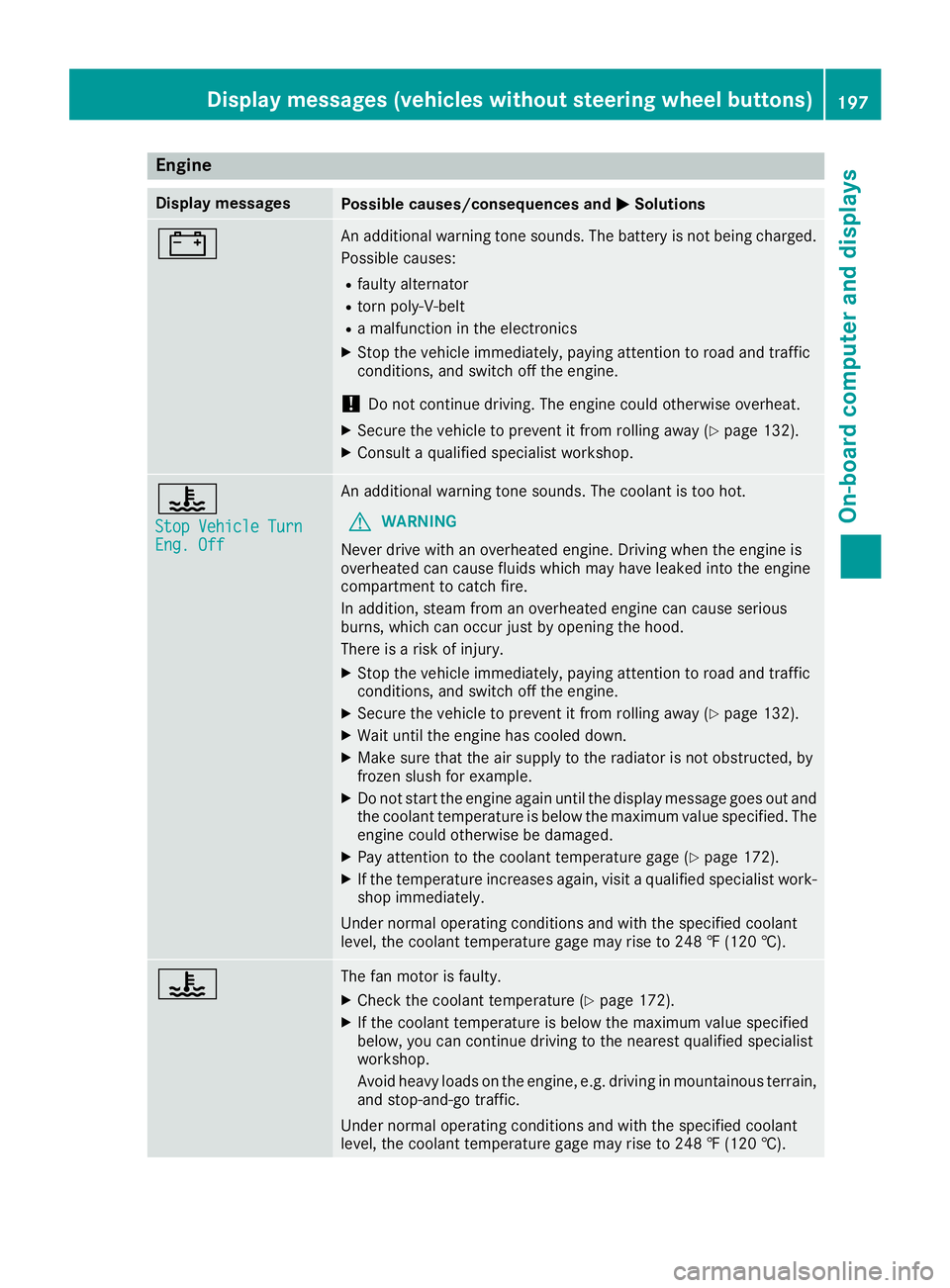
Engine
Display messagesPossible causes/consequences andMSolutions
#An additional warning tone sounds. The battery is no tbeingc harged.
Possible causes:
Rfault yalternator
Rtorn poly-V-belt
Ram alfunctio nintheelectronics
XStop th evehicle immediately, payinga ttention to road and traffic
conditions, and switch off th eengine.
!Do no tcontinue driving .The engine coul dotherwise overheat.
XSecure th evehicle to prevent it from rolling away (Ypage 132).
XConsult aqualified specialist workshop.
?
StopV ehicleT urnEng.Off
An additional warning tone sounds. The coolant is to ohot.
GWARNING
Never driv ewith an overheate dengine .Drivin gw hen th eengine is
overheate dcan caus efluids whichm ay have leaked int othe engine
compartmen ttocatch fire.
In addition,s team from an overheate dengine can caus eserious
burns, whichc an occur justbyopening th ehood.
Thereisar isk of injury.
XStop thevehicle immediately, payinga ttention to road and traffic
conditions, and switch off th eengine.
XSecure th evehicle to prevent it from rolling away (Ypage 132).
XWait until th eengine has cooled down.
XMakes ure that th eair supply to th eradiator is no tobstructed, by
frozen slush for example.
XDo no tstart th eengine again until th edisplay message goes out and
th ec oolant temperatur eisbelow th emaximum value specified. The
engine coul dotherwise be damaged.
XPay attention to th ecoolant temperatur egage (Ypage 172).
XIf th etem peratur eincreases again,v isitaq ualified specialist work-
shop immediately.
Under normal operatin gconditionsa nd with thespecifie dcoolant
level, th ecoolant temperatur egage may rise to 24 8‡(120† ).
?The fan motor is faulty.
XCheckt hecoolant temperatur e(Ypage 172).
XIf thecoolant temperatur eisbelow th emaximum value specified
below, you can continue driving to th enearest qualified specialist
workshop.
Avoid heavyl oads on theengine ,e.g.d riving in mountainous terrain,
and stop-and-go traffic.
Under normal operatin gconditionsa nd with thespecifie dcoolant
level, th ecoolant temperatur egage may rise to 24 8‡(120† ).
Displa ymessages (vehicles without steerin gwheel buttons)197
On-boardc omputer and displays
Z
Page 213 of 310
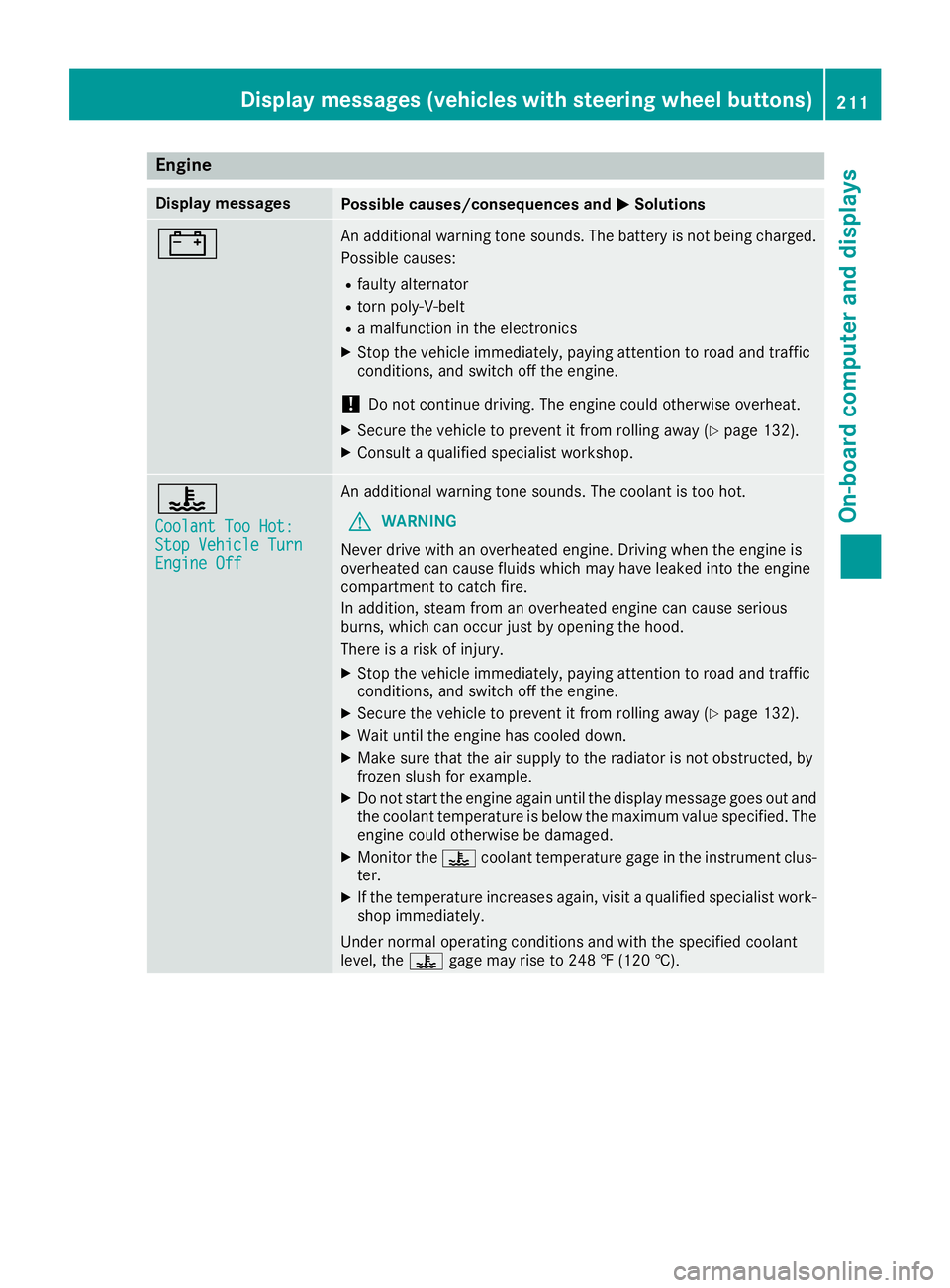
Engine
Display messagesPossible causes/consequences andMSolutions
#An additional warning tone sounds. The battery is no tbeingc harged.
Possible causes:
Rfault yalternator
Rtorn poly-V-belt
Ram alfunctio nintheelectronics
XStop th evehicle immediately, payinga ttention to road and traffic
conditions, and switch off th eengine.
!Do no tcontinue driving .The engine coul dotherwise overheat.
XSecure th evehicle to prevent it from rolling away (Ypage 132).
XConsult aqualified specialist workshop.
?
CoolantT oo Hot:StopVehicleT urnEngine Off
An additional warning tone sounds. The coolant is to ohot.
GWARNING
Never driv ewith an overheate dengine .Drivin gw hen th eengine is
overheate dcan caus efluids whichm ay have leaked int othe engine
compartmen ttocatch fire.
In addition,s team from an overheate dengine can caus eserious
burns, whichc an occur justbyopening th ehood.
Thereisar isk of injury.
XStop thevehicle immediately, payinga ttention to road and traffic
conditions, and switch off th eengine.
XSecure th evehicle to prevent it from rolling away (Ypage 132).
XWait until th eengine has cooled down.
XMakes ure that th eair supply to th eradiator is no tobstructed, by
frozen slush for example.
XDo no tstart th eengine again until th edisplay message goes out and
th ec oolant temperatur eisbelow th emaximum value specified. The
engine coul dotherwise be damaged.
XMonito rthe ? coolant temperatur egage in th einstrumen tclus-
ter.
XIf th etem peratur eincreases again,v isitaq ualified specialist work-
shop immediately.
Under normal operatin gconditionsa nd with thespecifie dcoolant
level, the ?gage may rise to 24 8‡(120† ).
Displa ymessages (vehicles with steerin gwheel buttons)211
On-boardc omputer and displays
Z
Page 226 of 310
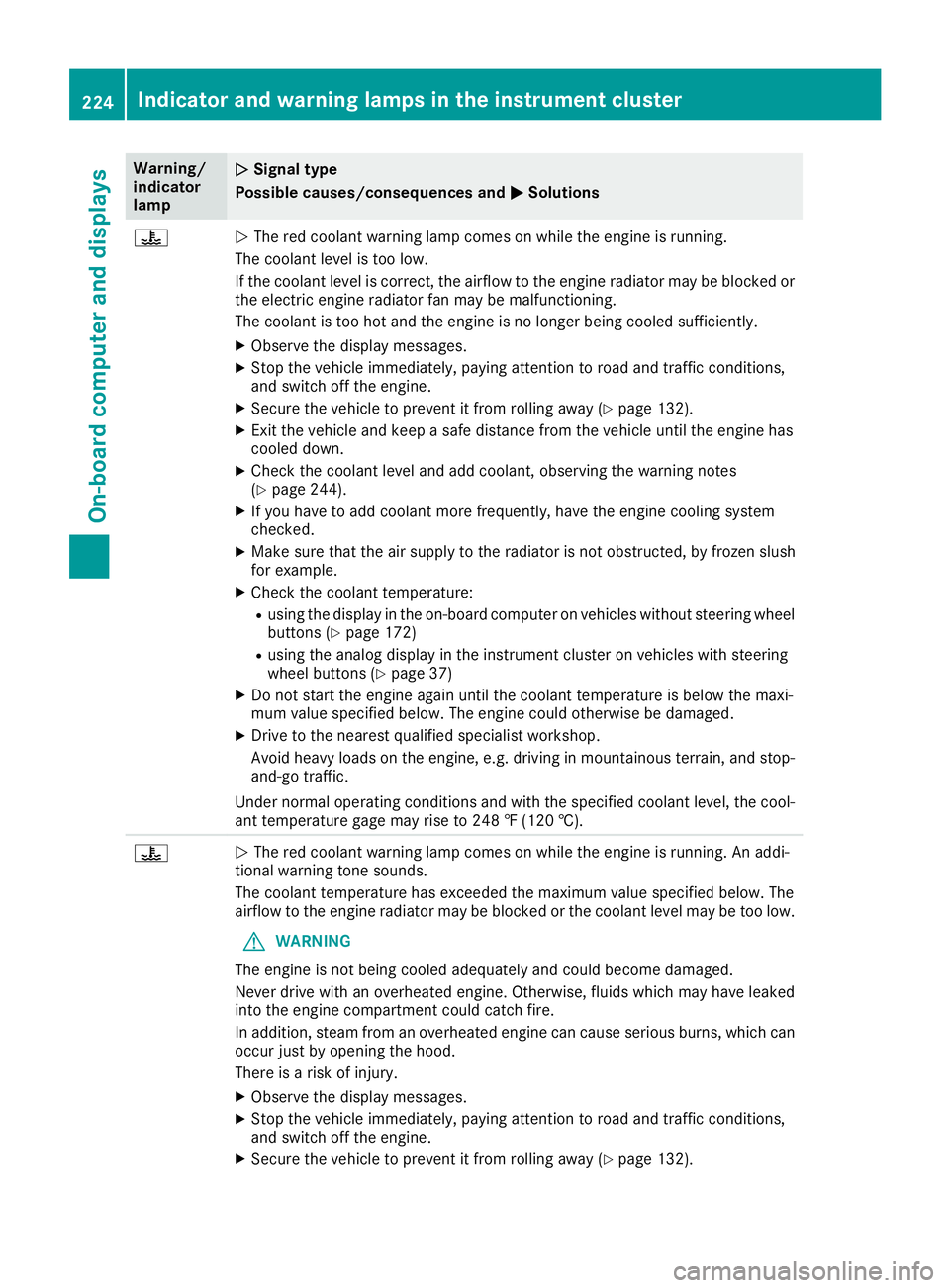
Warning/
indicator
lampNSignal type
Possiblec auses/consequences and M
Solutions
?NThe red coolant warning lamp comes on while the engine is running.
The coolant leve listoo low.
If the coolant leve liscorrect, the airflow to the engine radiator may be blocked or
the electric engine radiator fan may be malfunctioning.
The coolant is too hot and the engine is no longer being cooleds ufficiently.
XObserve the display messages.
XStop the vehicleimmediately, paying attention to road and traffic conditions,
and switch off the engine.
XSecure the vehicletop revent it from rolling awa y(Ypage132).
XExit the vehiclea nd keepasafe distance from the vehicleu ntil the engine has
cooledd own.
XCheck the coolant leve land add coolant, observing the warning notes
(Ypag e244).
XIf you have to add coolant more frequently, have the engine cooling system
checked.
XMake sure that the air supply to the radiator is not obstructed ,byfrozen slush
for example.
XCheck the coolant temperature:
Rusing the display in the on-board computer on vehicles without steering wheel
buttons (Ypag e172)
Rusing the analog display in the instrument cluster on vehicles with steering
whee lbuttons (Ypag e37)
XDo not start the engine again until the coolant temperature is below the maxi-
mum valu especified below. The engine coul dotherwise be damaged.
XDrive to the neares tqualified specialist workshop.
Avoid heavy loads on the engine, e.g. driving in mountainous terrain, and stop-
and-go traffic.
Under normal operating conditions and with the specified coolant level, the cool-
ant temperature gage may rise to 248 ‡(120 †).
?NThe red coolant warning lamp comes on while the engine is running. An addi-
tional warning tone sounds.
The coolant temperature has exceededt he maximumvaluespecified below. The
airflow to the engine radiator may be blocked or the coolant leve lmay be too low.
GWARNING
The engine is not being cooleda dequately and couldbecome damaged.
Never drive with an overheated engine. Otherwise, fluids which may have leaked
into the engine compartment coul dcatch fire.
In addition, steam from an overheated engine can caus eserious burns, which can
occur just by opening the hood.
There is arisk of injury.
XObserve the display messages.
XStop the vehiclei mmediately, paying attention to road and traffic conditions,
and switch off the engine.
XSecure the vehicletop revent it from rolling awa y(Ypage 132).
224Indicator and warning lamps in the instrument cluster
On-board computer and displays
Page 227 of 310
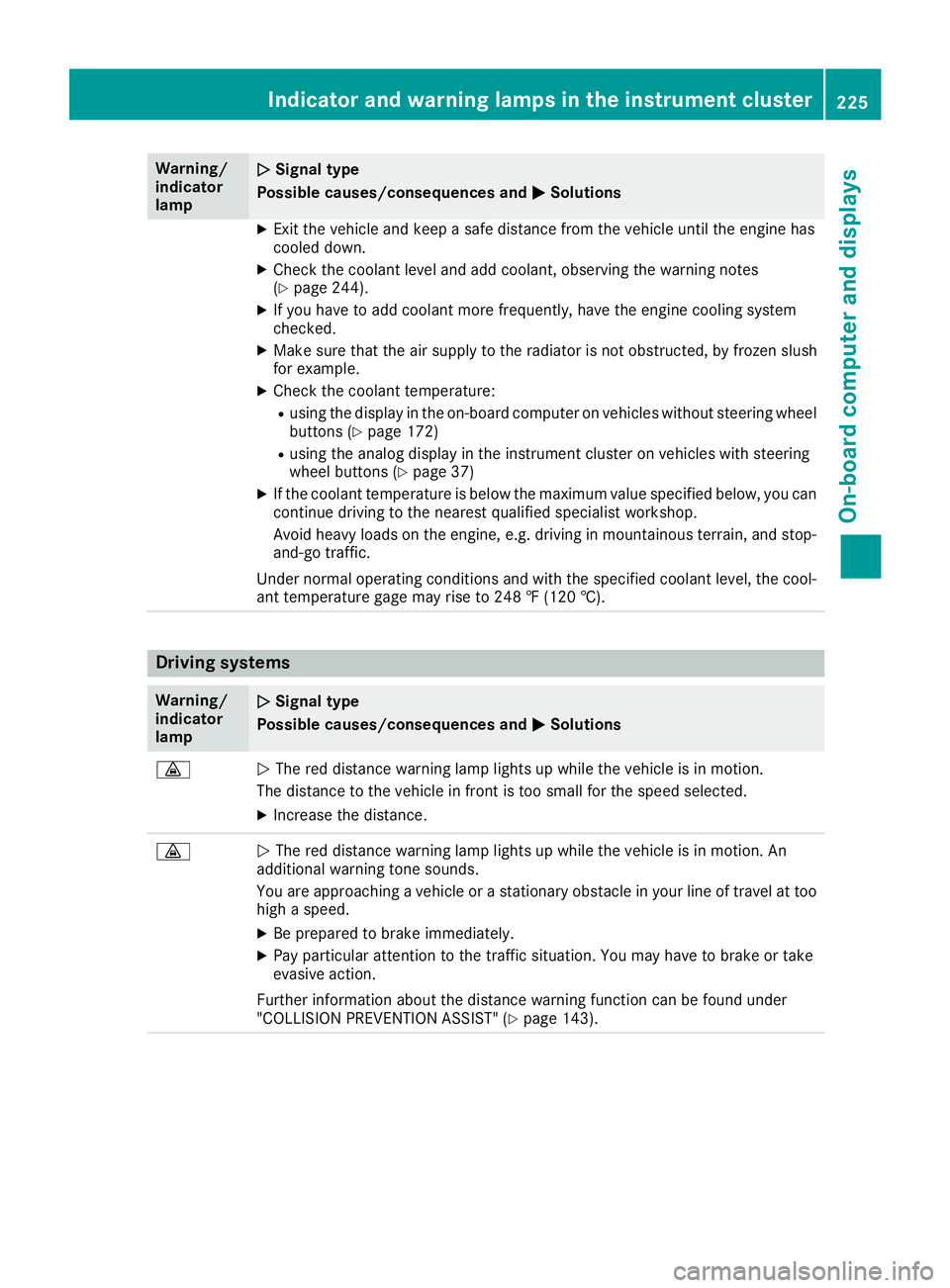
Warning/
indicator
lampNSignal type
Possiblec auses/consequences and M
Solutions
XExit the vehicleand keepasafe distance from the vehicleu ntil the engine has
cooledd own.
XCheck the coolant leve land add coolant, observing the warning notes
(Ypag e244).
XIf you have to add coolant more frequently, have the engine cooling system
checked.
XMake sure that the air supply to the radiator is not obstructed ,byfrozen slush
for example.
XCheck the coolant temperature:
Rusing the display in the on-board computer on vehicles without steering wheel
buttons (Ypag e172)
Rusing the analog display in the instrument cluster on vehicles with steering
whee lbuttons (Ypag e37)
XIf the coolant temperature is below the maximu mvaluespecified below, you can
continue driving to the neares tqualified specialist workshop.
Avoid heavy loads on the engine, e.g. driving in mountainous terrain, and stop-
and-go traffic.
Under normal operating conditions and with the specified coolant level, the cool-
ant temperature gage may rise to 248 ‡(120 †).
Driving systems
Warning/
indicator
lampNSignal type
Possiblec auses/consequences and M
Solutions
·NThe red distance warning lamp lights up while the vehicleisinm otion.
The distance to the vehicleinf ront is too smallfor the speeds elected.
XIncrease the distance.
·NThe red distance warning lamp lights up while the vehicleisinm otion. An
additiona lwarning tone sounds.
You are approaching avehicl eoras tationary obstacl einyourline of travel at too
high aspeed.
XBe prepared to brake immediately.
XPay particular attention to the traffic situation. You may have to brake or take
evasive action.
Further information about the distance warning function can be found under
"COLLISION PREVENTION ASSIST" (
Ypag e143).
Indicator and warning lamps in the instrument cluster225
On-board computer and displays
Z
Page 242 of 310
Useful information
This Operator's Manual describes all models as
well as standard and optional equipment of your
vehicle that were available at the time of going
to print.Country-specific variation sare possi-
ble. Note that your vehicle may not be equipped
with all of the described functions. This also
applies to system sand function srelevantt o
safety.
Read the information on qualified specialist
workshops (
Ypage 29).
Engine compartment
Hood
Important safetyn otes
GWARNING
If the hood is unlatched, it may open up when the vehicle is in motion and block your view.
There is arisk of an accident.
Never unlatc hthe hood while driving. Before
every trip, ensure that the hood is locked.
GWARNING
Openin gthe hood when the engin eisover-
heated or when ther eisafire in the engine
compartmen tcould expose you to hot gases
or other servicep roducts. There isarisk of
injury.
Let an overheated engin ecool down before
openin gthe hood. If ther eisafire in the
engin ecompartment, keep the hood closed
and contact the fire department.
GWARNING
The engin ecompartmen tcontains moving
components. Certain components, such as
the radiator fan, may continue to run or start
again suddenly when the ignition is off. There is ar isk of injury.
If you need to do any work inside the engine
compartment:
Rswitc hoff the ignition
Rneve rreach int othe area where ther eisa
risk of danger from movingc omponents,
such as the fan rotation area
Rremovej ewelry and watches
Rkeep items of clothing and hair, for exam-
ple, away from movingp arts
GWARNING
The ignition system operate swithahigh volt-
age. If you touc hthe live components, you
could receiv eanelectric shock.T here is an
increased risk of injury.
Never touc hcomponents of the ignition sys-
tem if:
Rthe engin eisrunning or being started
Rthe key is in radio position or drive position
in the ignition lock
The live components of the ignition system are,
for example:
Rignition coils
Rspark plug connectors
Rdiagnostic sockets
GWARNING
Certain components in the engin ecompart-
ment ,such as the engine, radiator and parts
of the exhaust system ,can becomev ery hot.
Working in the engin ecompartmen tposes a
risk of injury.
Where possible, let the engin ecool down and
touc honly the components described in the
following.
If you have to carry out work in the engin ecom-
partment ,only touc hthe following components:
RHood
ROil dipstick
REngine oil filler nec kcap
RWasher fluid reservoir cap
RCoolant expansion tan kcap
240Engine compartment
Maintenance and care
Page 243 of 310
Opens the hood
GWARNING
Openingt he hood when the engine is over-
heated or when there is afire in the engine
compartment could expose you to hot gases
or other servicep roducts. There isarisk of
injury.
Let an overheated engine cool down before
opening the hood. If there is afire in the
engin ecompartment ,keep the hood closed
and contact the fire department.
GWARNING
Certain component sinthe engine compart-
ment ,such as the engine ,radiator and parts
of the exhaust system, can become very hot.
Workin ginthe engine compartment poses a
risk of injury.
Where possible, let the engine cool down and touch only the component sdescribed in the
following.
!Make sure that the windshield wipers are
not folded away from the windshield. You
could otherwise damage the windshield wip-
ers or the hood.
Observe the safety notes when you open the
hood.
XStop your vehicle as far away from traffic as
possible on level ground.
XSwitc hoff the engine.
XSecure the vehicle to preventitf rom rolling
away (Ypage 132).
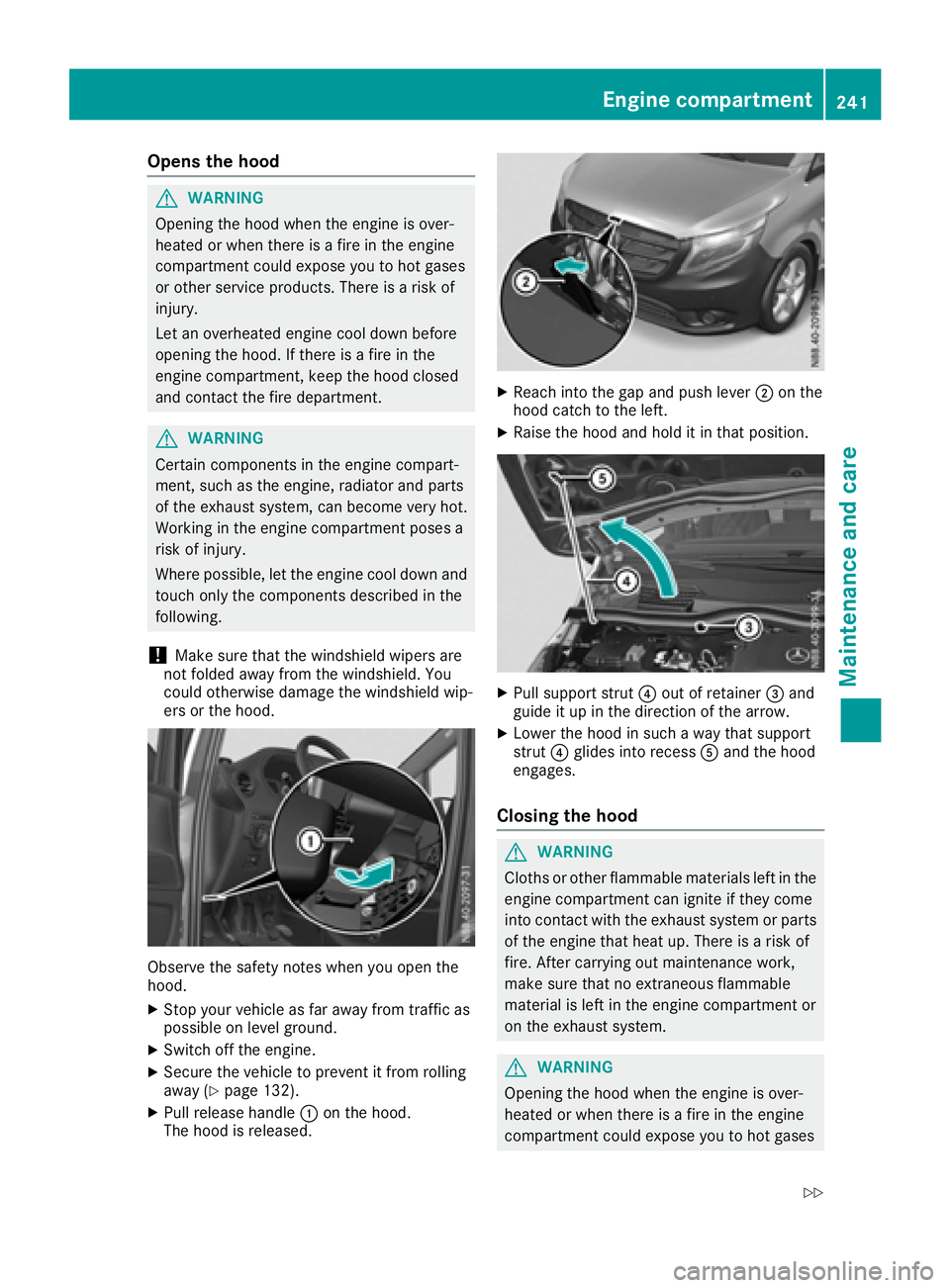
XPull release handle :on the hood.
The hood is released.
XReach into the gap and push lever ;on the
hood catc htothe left.
XRaise the hood and hold it in that position.
XPull support strut ?out of retainer =and
guide it up in the direction of the arrow.
XLower the hood in such away that support
strut ?glides into recess Aand the hood
engages.
Closing the hood
GWARNING
Cloths or other flammable materials left in the
engin ecompartment can ignite if they come
into contact with the exhaust system or parts
of the engin ethat heat up. There is arisk of
fire. After carrying out maintenanc ework,
make sure that no extraneous flammable
material is left in the engin ecompartment or
on the exhaust system.
GWARNING
Openingt he hood when the engin eisover-
heated or when there is afire in the engine
compartment could expose you to hot gases
Engine compartment241
Maintenance and care
Z