ECU MERCEDES-BENZ METRIS 2017 MY17 Operator’s Manual
[x] Cancel search | Manufacturer: MERCEDES-BENZ, Model Year: 2017, Model line: METRIS, Model: MERCEDES-BENZ METRIS 2017Pages: 318, PDF Size: 5.01 MB
Page 300 of 318
rectly, it could tip over while the vehicle is
raised.
RThe vehicle's jack is intended only to raise the
vehicle for a short time when changing a
wheel. It is not suited for performing mainte-
nance work under the vehicle.
RAvoid changing the wheel on uphill and down-
hill slopes.
RBefore raising the vehicle, secure it from roll-
ing away by applying the parking brake and
inserting wheel chocks. Never disengage the
parking brake while the vehicle is raised.
RThe jack must be placed on a firm, flat and
non-slip surface. On a loose surface, a large,
load-bearing underlay must be used. On a
slippery surface, a non-slip underlay must be
used, e.g. rubber mats.
RMake sure that the distance between the
underside of the tires and the ground does not
exceed 1.2 in(3 cm).
RNever place your hands or feet under the
raised vehicle.
RNever lie under the raised vehicle.
RNever start the engine when the vehicle is
raised.
RNever open or close a door or the tailgate/
door when the vehicle is raised.
RMake sure that no persons are present in the
vehicle when the vehicle is raised.
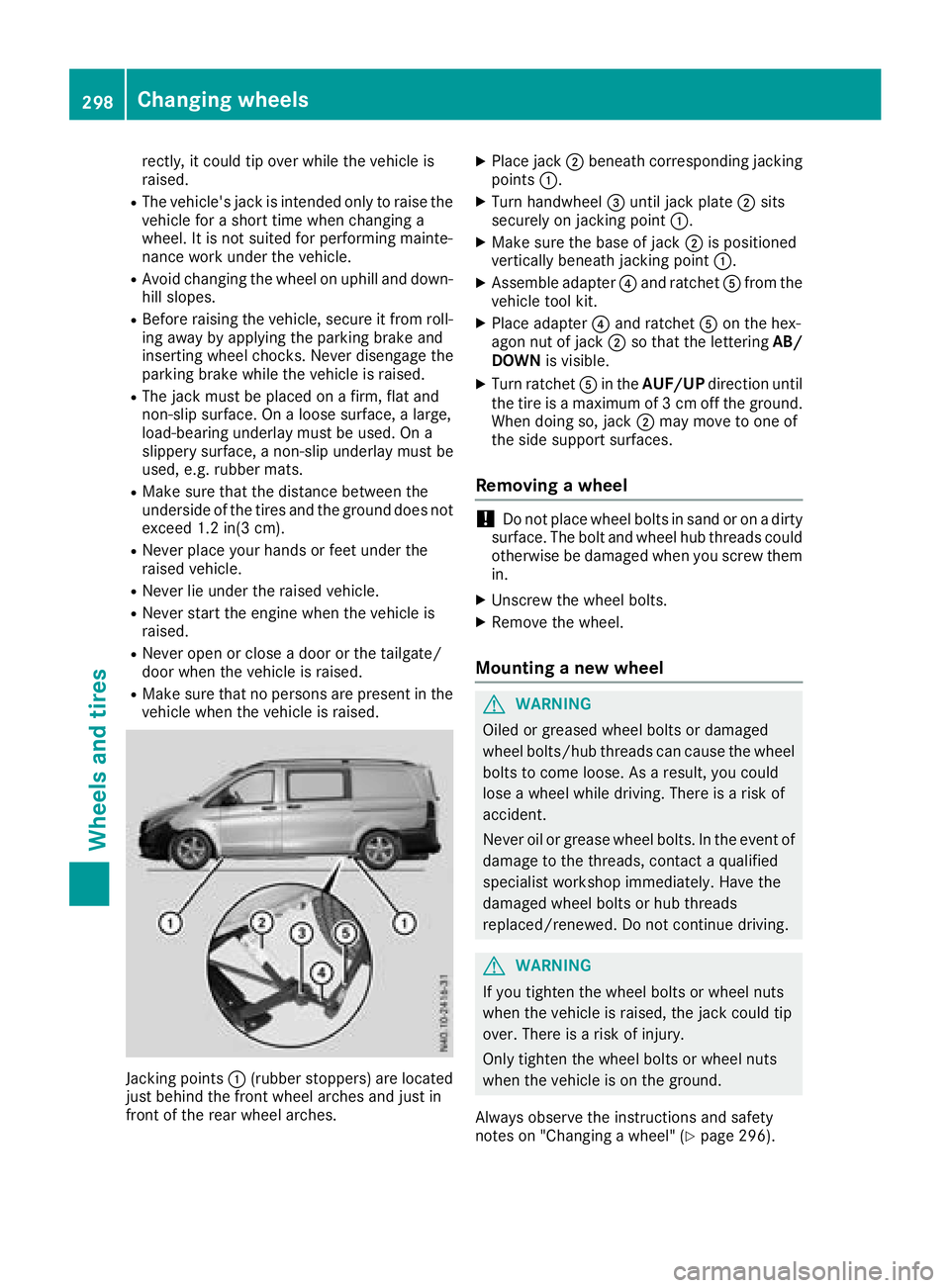
Jacking points :(rubber stoppers) are located
just behind the front wheel arches and just in
front of the rear wheel arches.
XPlace jack ;beneath corresponding jacking
points :.
XTurn handwheel =until jack plate ;sits
securely on jacking point :.
XMake sure the base of jack ;is positioned
vertically beneath jacking point :.
XAssemble adapter?and ratchet Afrom the
vehicle tool kit.
XPlace adapter ?and ratchet Aon the hex-
agon nut of jack ;so that the lettering AB/
DOWN is visible.
XTurn ratchet Ain the AUF/UP direction until
the tire is a maximum of 3 cm off the ground.
When doing so, jack ;may move to one of
the side support surfaces.
Removing a wheel
!Do not place wheel bolts in sand or on a dirty
surface. The bolt and wheel hub threads could
otherwise be damaged when you screw them
in.
XUnscrew the wheel bolts.
XRemove the wheel.
Mounting a new wheel
GWARNING
Oiled or greased wheel bolts or damaged
wheel bolts/hub threads can cause the wheel bolts to come loose. As a result, you could
lose a wheel while driving. There is a risk of
accident.
Never oil or grease wheel bolts. In the event of
damage to the threads, contact a qualified
specialist workshop immediately. Have the
damaged wheel bolts or hub threads
replaced/renewed. Do not continue driving.
GWARNING
If you tighten the wheel bolts or wheel nuts
when the vehicle is raised, the jack could tip
over. There is a risk of injury.
Only tighten the wheel bolts or wheel nuts
when the vehicle is on the ground.
Always observe the instructions and safety
notes on "Changing a wheel" (
Ypage 296).
298Changing wheels
Wheels and tires
Page 301 of 318
Only use wheel bolts that have been designed
for the wheel and the vehicle. For safety rea-
sons, Mercedes-Benz recommends that you
only use wheel bolts which have been approved
for Mercedes-Benz vehicles and the respective
wheel.
!On vehicles equipped with a tire pressure
monitor, electronic components are located
in the wheel.
Tire-mounting tools should not be used near
the valve. This could damage the electronic
components.
Only have tires changed at a qualified spe-
cialist workshop.
XClean the wheel and wheel hub contact sur-
faces.
XSlide the new wheel onto the wheel hub and
push it on.
XScrew in the wheel bolts and tighten them
lightly.
Lowering the vehicle
GWARNING
The wheels could work loose if the wheel nuts and bolts are not tightened to the specified
tightening torque. There is a risk of accident.
Have the tightening torque immediately
checked at a qualified specialist workshop
after a wheel is changed.
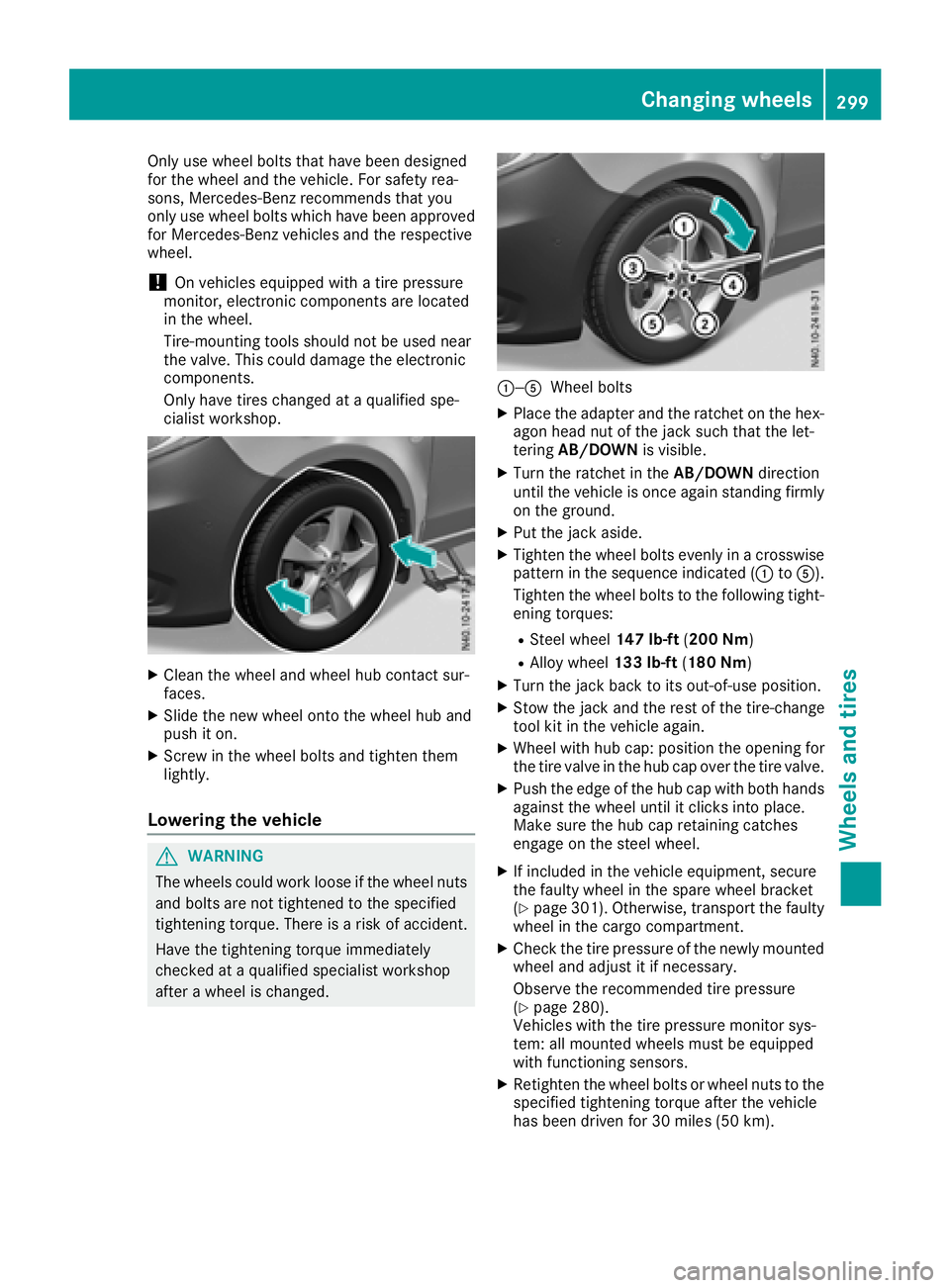
:—AWheel bolts
XPlace the adapter and the ratchet on the hex-
agon head nut of the jack such that the let-
tering AB/DOWN is visible.
XTurn the ratchet in the AB/DOWNdirection
until the vehicle is once again standing firmly
on the ground.
XPut the jack aside.
XTighten the wheel bolts evenly in a crosswise
pattern in the sequence indicated (: toA).
Tighten the wheel bolts to the following tight-
ening torques:
RSteel wheel 147 lb-ft(200 Nm)
RAlloy wheel 133 lb-ft(180 Nm)
XTurn the jack back to its out-of-use position.
XStow the jack and the rest of the tire-change
tool kit in the vehicle again.
XWheel with hub cap: position the opening for
the tire valve in the hub cap over the tire valve.
XPush the edge of the hub cap with both hands
against the wheel until it clicks into place.
Make sure the hub cap retaining catches
engage on the steel wheel.
XIf included in the vehicle equipment, secure
the faulty wheel in the spare wheel bracket
(
Ypage 301). Otherwise, transport the faulty
wheel in the cargo compartment.
XCheck the tire pressure of the newly mounted
wheel and adjust it if necessary.
Observe the recommended tire pressure
(
Ypage 280).
Vehicles with the tire pressure monitor sys-
tem: all mounted wheels must be equipped
with functioning sensors.
XRetighten the wheel bolts or wheel nuts to the
specified tightening torque after the vehicle
has been driven for 30 miles (50 km).
Changing wheels299
Wheels and tires
Z
Page 304 of 318
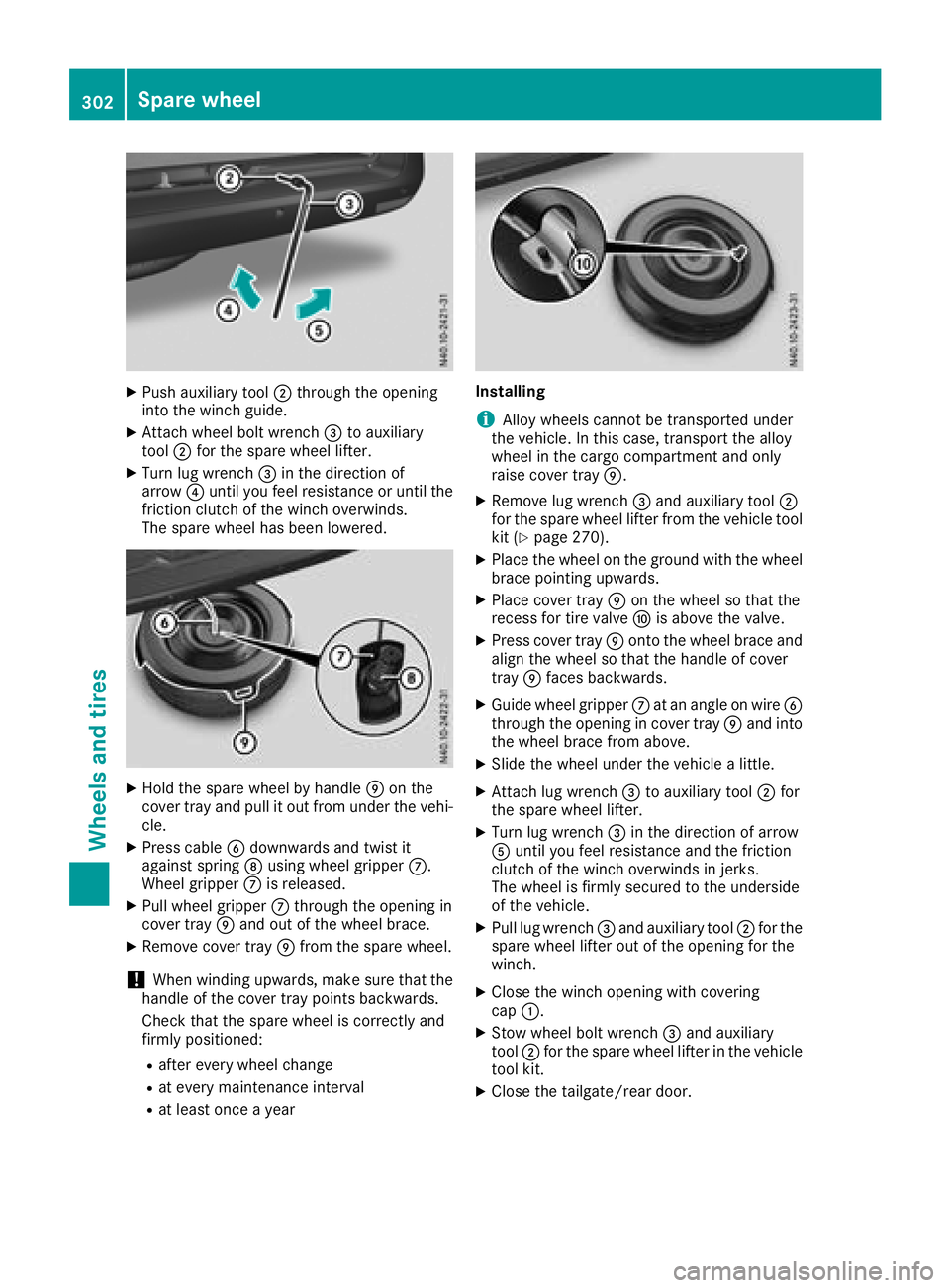
XPush auxiliary tool;through the opening
into the winch guide.
XAttach wheel bolt wrench =to auxiliary
tool ;for the spare wheel lifter.
XTurn lug wrench =in the direction of
arrow ?until you feel resistance or until the
friction clutch of the winch overwinds.
The spare wheel has been lowered.
XHold the spare wheel by handle Eon the
cover tray and pull it out from under the vehi-
cle.
XPress cable Bdownwards and twist it
against spring Dusing wheel gripper C.
Wheel gripper Cis released.
XPull wheel gripper Cthrough the opening in
cover tray Eand out of the wheel brace.
XRemove cover tray Efrom the spare wheel.
!When winding upwards, make sure that the
handle of the cover tray points backwards.
Check that the spare wheel is correctly and
firmly positioned:
Rafter every wheel change
Rat every maintenance interval
Rat least once a year
Installing
iAlloy wheels cannot be transported under
the vehicle. In this case, transport the alloy
wheel in the cargo compartment and only
raise cover tray E.
XRemove lug wrench =and auxiliary tool ;
for the spare wheel lifter from the vehicle tool
kit (
Ypage 270).
XPlace the wheel on the ground with the wheel brace pointing upwards.
XPlace cover tray Eon the wheel so that the
recess for tire valve Fis above the valve.
XPress cover tray Eonto the wheel brace and
align the wheel so that the handle of cover
tray Efaces backwards.
XGuide wheel gripper Cat an angle on wire B
through the opening in cover tray Eand into
the wheel brace from above.
XSlide the wheel under the vehicle a little.
XAttach lug wrench =to auxiliary tool ;for
the spare wheel lifter.
XTurn lug wrench =in the direction of arrow
A until you feel resistance and the friction
clutch of the winch overwinds in jerks.
The wheel is firmly secured to the underside
of the vehicle.
XPull lug wrench =and auxiliary tool ;for the
spare wheel lifter out of the opening for the
winch.
XClose the winch opening with covering
cap :.
XStow wheel bolt wrench =and auxiliary
tool ;for the spare wheel lifter in the vehicle
tool kit.
XClose the tailgate/rear door.
302Spare wheel
Wheels and tires
Page 314 of 318
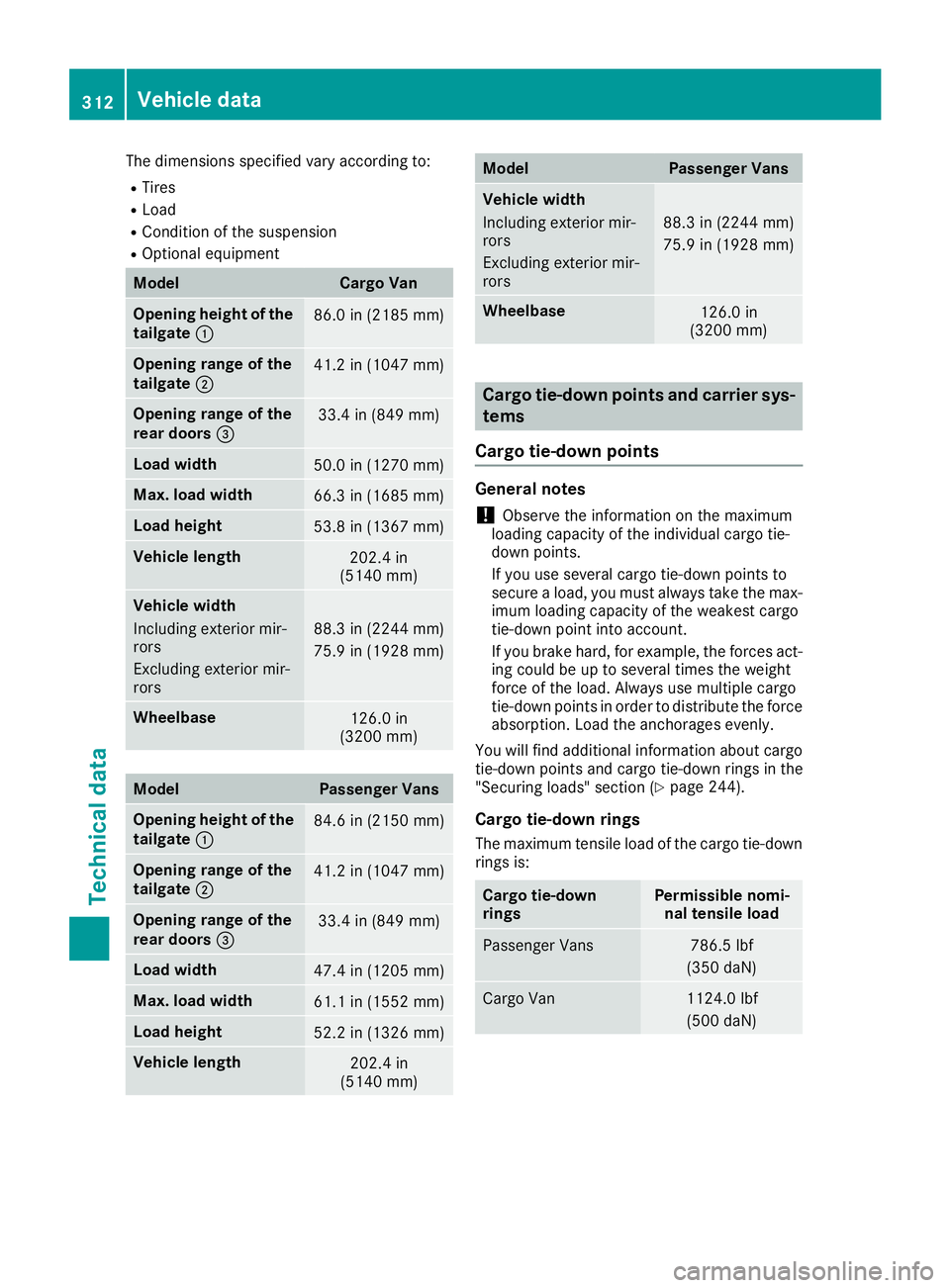
The dimensions specified vary according to:
RTires
RLoad
RCondition of the suspension
ROptional equipment
ModelCargo Van
Opening height of the
tailgate:86.0 in (2185 mm)
Opening range of the
tailgate;41.2 in (1047 mm)
Opening range of the
rear doors =33.4 in (849 mm)
Load width50.0 in (1270 mm)
Max. load width66.3 in (1685 mm)
Load height53.8 in (1367 mm)
Vehicle length202.4 in
(5140 mm)
Vehicle width
Including exterior mir-
rors
Excluding exterior mir-
rors
88.3 in (2244 mm)
75.9 in (1928 mm)
Wheelbase126.0 in
(3200 mm)
ModelPassenger Vans
Opening height of the
tailgate :84.6 in (2150 mm)
Opening range of the
tailgate;41.2 in (1047 mm)
Opening range of the
rear doors =33.4 in (849 mm)
Load width47.4 in (1205 mm)
Max. load width61.1 in (1552 mm)
Load height52.2 in (1326 mm)
Vehicle length202.4 in
(5140 mm)
ModelPassenger Vans
Vehicle width
Including exterior mir-
rors
Excluding exterior mir-
rors
88.3 in (2244 mm)
75.9 in (1928 mm)
Wheelbase126.0 in
(3200 mm)
Cargo tie-down points and carrier sys-
tems
Cargo tie-down points
General notes
!Observe the information on the maximum
loading capacity of the individual cargo tie-
down points.
If you use several cargo tie-down points to
secure a load, you must always take the max-
imum loading capacity of the weakest cargo
tie-down point into account.
If you brake hard, for example, the forces act-
ing could be up to several times the weight
force of the load. Always use multiple cargo
tie-down points in order to distribute the force absorption. Load the anchorages evenly.
You will find additional information about cargo
tie-down points and cargo tie-down rings in the
"Securing loads" section (
Ypage 244).
Cargo tie-down rings
The maximum tensile load of the cargo tie-down
rings is:
Cargo tie-down
ringsPermissible nomi- nal tensile load
Passenger Vans786.5 lbf
(350 daN)
Cargo Van1124.0 lbf (500 daN)
312Vehicle data
Technical data
Page 315 of 318
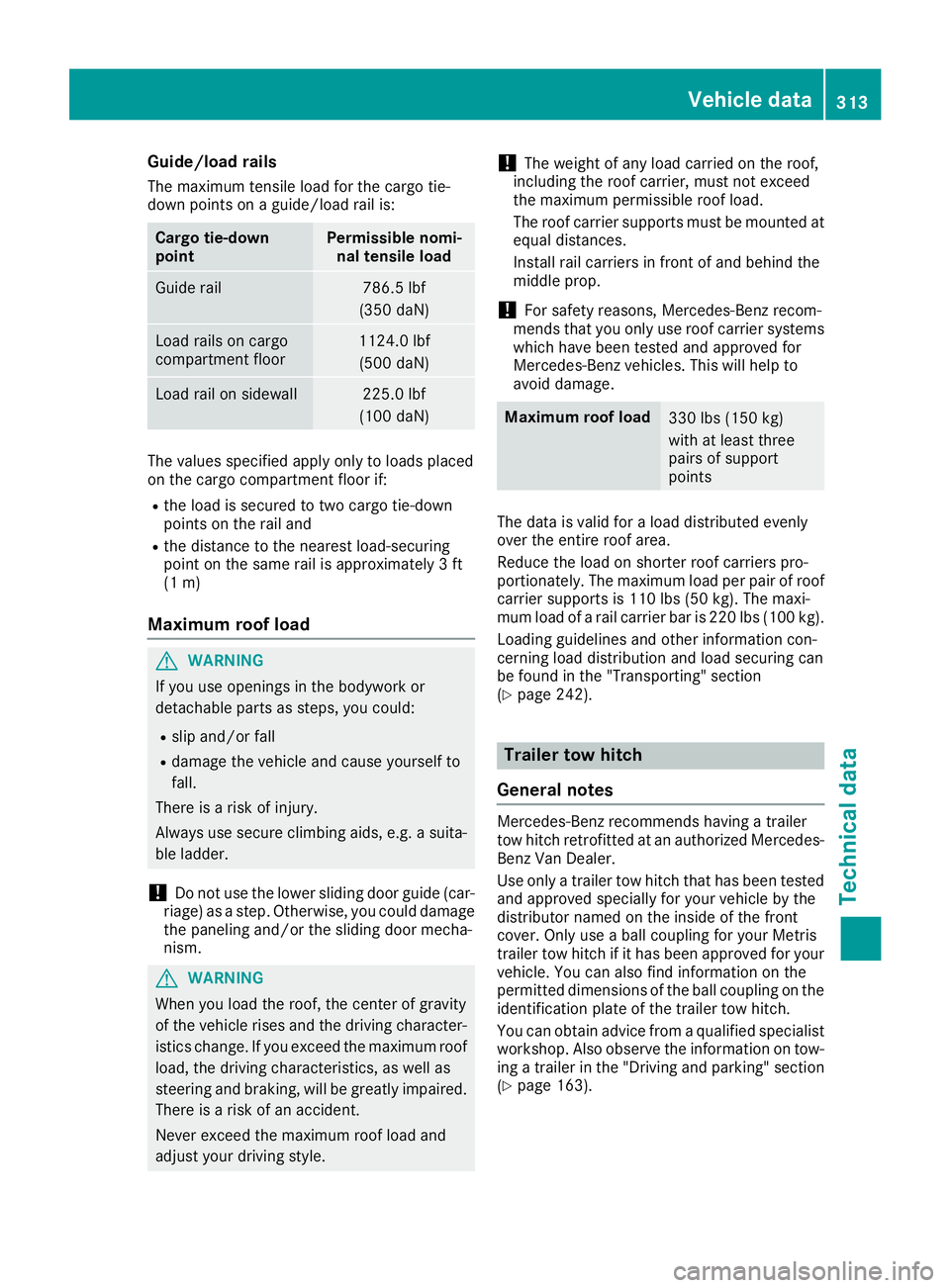
Guide/load rails
The maximum tensile load for the cargo tie-
down points on a guide/load rail is:
Cargo tie-down
pointPermissible nomi-nal tensile load
Guide rail786.5 lbf
(350 daN)
Load rails on cargo
compartment floor1124.0 lbf (500 daN)
Load rail on sidewall225.0 lbf
(100 daN)
The values specified apply only to loads placed
on the cargo compartment floor if:
Rthe load is secured to two cargo tie-down
points on the rail and
Rthe distance to the nearest load-securing
point on the same rail is approximately 3 ft
(1 m)
Maximum roof load
GWARNING
If you use openings in the bodywork or
detachable parts as steps, you could:
Rslip and/or fall
Rdamage the vehicle and cause yourself to
fall.
There is a risk of injury.
Always use secure climbing aids, e.g. a suita-
ble ladder.
!Do not use the lower sliding door guide (car-
riage) as a step. Otherwise, you could damage
the paneling and/or the sliding door mecha-
nism.
GWARNING
When you load the roof, the center of gravity
of the vehicle rises and the driving character-
istics change. If you exceed the maximum roof
load, the driving characteristics, as well as
steering and braking, will be greatly impaired.
There is a risk of an accident.
Never exceed the maximum roof load and
adjust your driving style.
!The weight of any load carried on the roof,
including the roof carrier, must not exceed
the maximum permissible roof load.
The roof carrier supports must be mounted at
equal distances.
Install rail carriers in front of and behind the
middle prop.
!For safety reasons, Mercedes-Benz recom-
mends that you only use roof carrier systems
which have been tested and approved for
Mercedes-Benz vehicles. This will help to
avoid damage.
Maximum roof load330 lbs (150 kg)
with at least three
pairs of support
points
The data is valid for a load distributed evenly
over the entire roof area.
Reduce the load on shorter roof carriers pro-
portionately. The maximum load per pair of roof
carrier supports is 110 lbs (50 kg). The maxi-
mum load of a rail carrier bar is 220 lbs (100 kg).
Loading guidelines and other information con-
cerning load distribution and load securing can
be found in the "Transporting" section
(
Ypage 242).
Trailer tow hitch
General notes
Mercedes-Benz recommends having a trailer
tow hitch retrofitted at an authorized Mercedes-
Benz Van Dealer.
Use only a trailer tow hitch that has been tested
and approved specially for your vehicle by the
distributor named on the inside of the front
cover. Only use a ball coupling for your Metris
trailer tow hitch if it has been approved for your
vehicle. You can also find information on the
permitted dimensions of the ball coupling on the
identification plate of the trailer tow hitch.
You can obtain advice from a qualified specialist
workshop. Also observe the information on tow-
ing a trailer in the "Driving and parking" section
(
Ypage 163).
Vehicle data313
Technical data
Z