tire type MERCEDES-BENZ METRIS 2017 MY17 Operator’s Manual
[x] Cancel search | Manufacturer: MERCEDES-BENZ, Model Year: 2017, Model line: METRIS, Model: MERCEDES-BENZ METRIS 2017Pages: 318, PDF Size: 5.01 MB
Page 280 of 318
Regular wheel and tire checks
GWARNING
Damaged tires can cause tire inflation pres-
sure loss. As a result, you could lose control of
your vehicle. There is a risk of accident.
Check the tires regularly for signs of damage
and replace any damaged tires immediately.
Check the wheels and tires of your vehicle for
damage regularly, i.e. at least every two weeks,
as well as after driving off-road or on rough
roads. Damaged wheels can cause a loss of tire
pressure. Pay particular attention to damage
such as:
Rcuts in the tires
Rpunctures
Rtears in the tires
Rbulges on tires
Rdeformation or severe corrosion on wheels
Regularly check the tire tread depth and the
condition of the tread across the whole width of
the tire (
Ypage 278). If necessary, turn the
front wheels to full lock in order to inspect the
inner side of the tire surface.
All wheels must have a valve cap to protect the valve against dirt and moisture. Do not install
anything onto the valve other than the standard
valve cap or other valve caps approved for your vehicle by dealers listed on the inside of the
front cover. Do not install any other valve caps
or systems, e.g. tire pressure monitor systems.
Regularly check the pressure of all the tires,
particularly prior to long trips. Adjust the tire
pressure if ne
cessary (Ypage 280).
The service life of tires depends on various fac-
tors, including the following:
Rdriving style
Rtire pressure
Rmileage
Tire tread
GWARNING
Insufficient tire tread will reduce tire traction.
The tire is no longer able to dissipate water.
This means that on wet road surfaces, the risk
of hydroplaning increases, in particular where
speed is not adapted to suit the driving con-
ditions. There is a risk of accident.
If the tire pressure is too high or too low, tires may exhibit different levels of wear at differ-
ent locations on the tire tread. Thus, you
should regularly check the tread depth and
the condition of the tread across the entire
width of all tires.
Minimum tire tread depth for:
RSummer tires: âin (3 mm)
RM+S tires: ãin (4 mm)
For safety reasons, replace the tires before
the legally prescribed limit for the minimum
tire tread depth is reached.
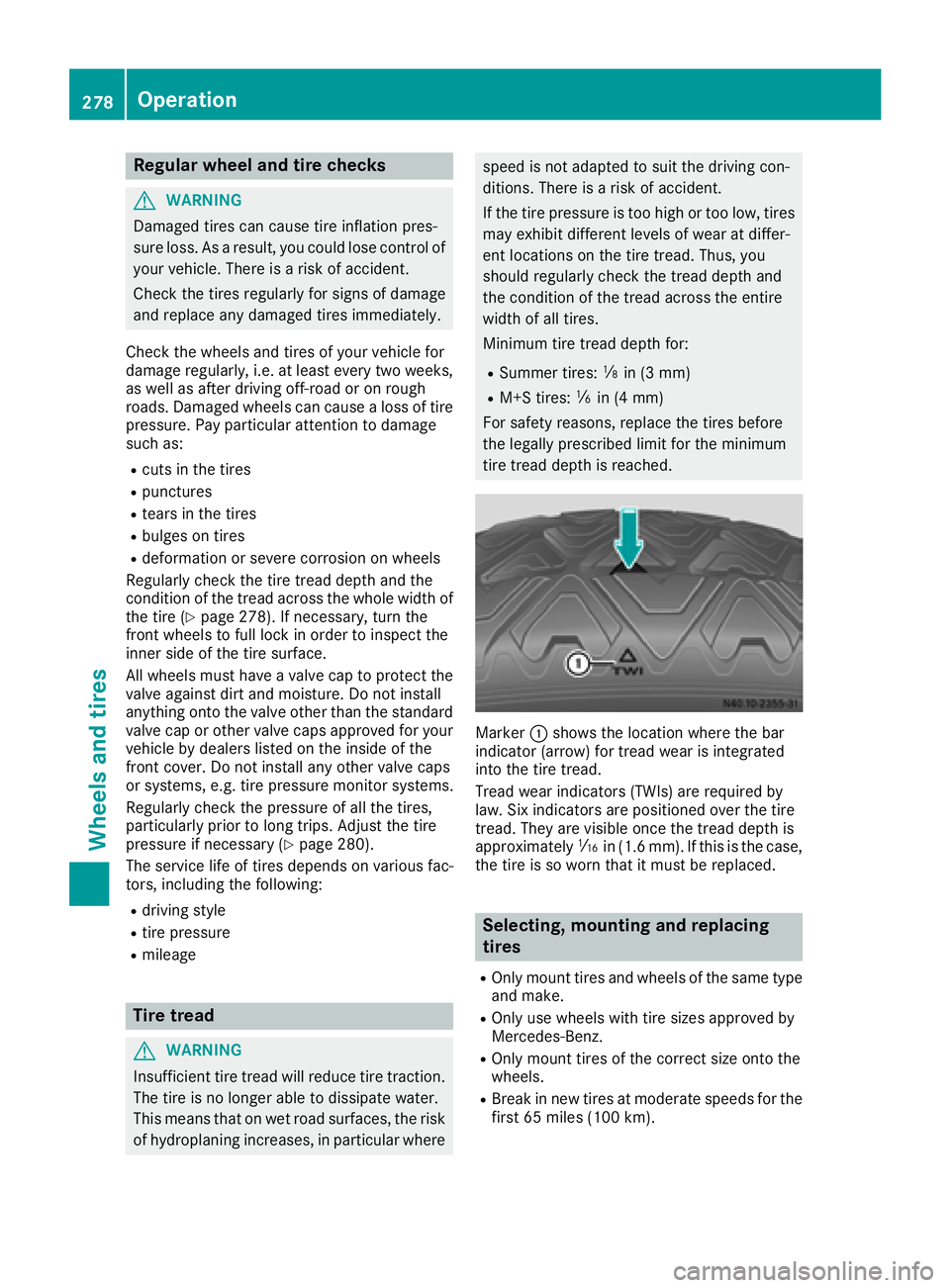
Marker :shows the location where the bar
indicator (arrow) for tread wear is integrated
into the tire tread.
Tread wear indicators (TWIs) are required by
law. Six indicators are positioned over the tire
tread. They are visible once the tread depth is
approximately áin (1.6 mm). If this is the case,
the tire is so worn that it must be replaced.
Selecting, mounting and replacing
tires
ROnly mount tires and wheels of the same type
and make.
ROnly use wheels with tire sizes approved by
Mercedes-Benz.
ROnly mount tires of the correct size onto the
wheels.
RBreak in new tires at moderate speeds for the
first 65 miles (100 km).
278Operation
Wheels and tires
Page 281 of 318
RDo not drive with tires which have too little
tread depth, as this significantly reduces the
traction on wet roads (hydroplaning).
RReplace the tires after six years at the latest,
regardless of wear. This also applies to the
spare wheel.
Operation in winter
General notes
Have your vehicle winterproofed at a qualified
specialist workshop at the onset of winter.
Only use wheels with tire sizes approved by
Mercedes-Benz.
Prior to the onset of winter, ensure that snow
chains are stowed in the vehicle (
Ypage 280).
Snow chains cannot be mounted on all wheel/
tire combinations. Observe the restrictions on
the use of snow chains under "Wheel/tire com-
binations" (
Ypage 300).
Also observe the notes in the "Changing a
wheel" section (
Ypage 296).
Driving with summer tires
At temperatures below 45 ‡ (+7 †), summer
tires lose elasticity and therefore traction and
braking power. Change the tires on your vehicle
to M+S tire s. Usingsu mmer tires at very cold
temperatures could cause tears to form,
thereby damaging the tires permanently.
Mercedes-Benz cannot accept responsibility for
this type of damage.
M+S tires
GWARNING
Wheel and tire dimensions as well as the type of tire can vary between the spare wheel and
the wheel to be replaced. When the spare
wheel is mounted, driving characteristics may be severely affected. There is a risk of an acci-
dent.
In order to reduce risks:
Ryou should therefore adapt your driving
style and drive carefully.
Rnever mount more than one spare wheel
that differs from the wheel to be replaced.
Ronly use a spare wheel that differs from the
wheel to be replaced for a short time.
Rhave a spare wheel that differs from the
wheel that has been changed replaced at
the nearest qualified specialist workshop.
You must observe the correct wheel and
tire dimensions as well as the wheel type.
GWARNING
M+S tires with a tire tread depth of less than
ã in (4 mm) are not suitable for use in winter
and do not provide sufficient traction. There is
a risk of an accident.
M+S tires with a tread depth of less than ãin
(4 mm) must be replaced immediately.
Use winter tires or all-season tires at tempera-
tures below 45 ‡ (+7 †). Both types of tire are
identified by the M+S marking.
Only winter tires bearing the isnowflake
symbol in addition to the M+S marking provide
the best possible grip in wintry road conditions.
Only these tires will allow driving safety systems
such as ABS and ESP
®to function optimally in
winter. These tires have been developed specif-
ically for driving in snow.
For safe driving, use M+S tires of the same make
and tread pattern on all wheels.
Always observe the maximum permissible
speed specified for the M+S tires you have
mounted.
If you mount M+S tires that have a lower maxi-
mum permissible speed than the maximum
design speed of the vehicle, affix a correspond- ing warning label in the driver's field of vision.
You can obtain this at a qualified specialist work-
shop.
Once you have mounted the winter tires:
XCheck the tire pressure (Ypage 280).
XRestart the tire pressure monitor
(Ypage 287).
Operation in winter279
Wheels and tires
Z
Page 282 of 318
Snow chains
GWARNING
If snow chains are installed to the front
wheels, they may drag against the vehicle
body or chassis components. This could
cause damage to the vehicle or the tires.
There is a risk of an accident.
To avoid hazardous situations:
Rnever install snow chains to the front
wheels
Ralways install snow chains in pairs to the
rear wheels.
GWARNING
If you drive too fast with snow chains moun-
ted, they may snap. As a result, you could
injure others and damage the vehicle. There is
a risk of an accident.
Observe the maximum permissible speed for
operation with snow chains.
Observe the country-specific laws and regula-
tions for operation with snow chains.
!Check the snow chains for damage before
mounting them. Damaged or worn snow
chains may snap and damage the following
components:
Rwheel
Rwheel housing
Rwheel suspension
For this reason, you must use only snow
chains that are free of defects. Observe the
manufacturer's mounting instructions.
!Vehicles with steel wheels: if you mount
snow chains on steel wheels, you may dam-
age the hub caps. Remove the hub caps from
the relevant wheels before mounting the
snow chains.
Snow chains increase traction on roads in wintry conditions.
For safety reasons, Mercedes-Benz recom-
mends that you only use snow chains or traction
aids which have been approved for Mercedes-
Benz vehicles. The snow chains or traction aids
must be of class U or meet the SAE type U
specification. Information about snow chains can be obtained
from any Mercedes-Benz Commercial Van Cen-
ter.
When mounting snow chains, please bear the
following points in mind:
RSnow chains cannot be mounted on all
wheel/tire combinations. When mounting the
snow chains, note the permissible tire and
snow chain dimensions. Observe the restric-
tions on the use of snow chains under
"Wheel/tire combinations" (
Ypage 300).
RMount snow chains only in pairs and only to
the rear wheels. Observe the manufacturer's
mounting instructions.
ROnly use snow chains when the road is cov-
ered by a layer of snow. Remove the snow
chains as soon as possible when you come to
a road that is not snow-covered.
RThe use of snow chains may be restricted by
local regulations. Observe the appropriate
regulations before mounting snow chains.
RWhen driving with snow chains installed, do
not exceed the maximum permissible speed
of 30 mph (50 km/h).
RCheck the tension of the chains after a dis-
tance of approximately 0.5 miles (1.0 km).
You may wish to deactivate ESP
®when pulling
away with snow chains installed (Ypage 66).
This allows the wheels to spin in a controlled
manner, achieving an increased driving force
(cut
ting action).
Tire pressure
Tire pressure specifications
Important safety notes
GWARNING
Underinflated or overinflated tires pose the
following risks:
Rthe tires may burst, especially as the load
and vehicle speed increase.
Rthe tires may wear excessively and/or
unevenly, which may greatly impair tire
traction.
Rthe driving characteristics, as well as steer-
ing and braking, may be greatly impaired.
There is a risk of an accident.
280Tire pressure
Wheels and tires
Page 286 of 318
Maximum tire pressures
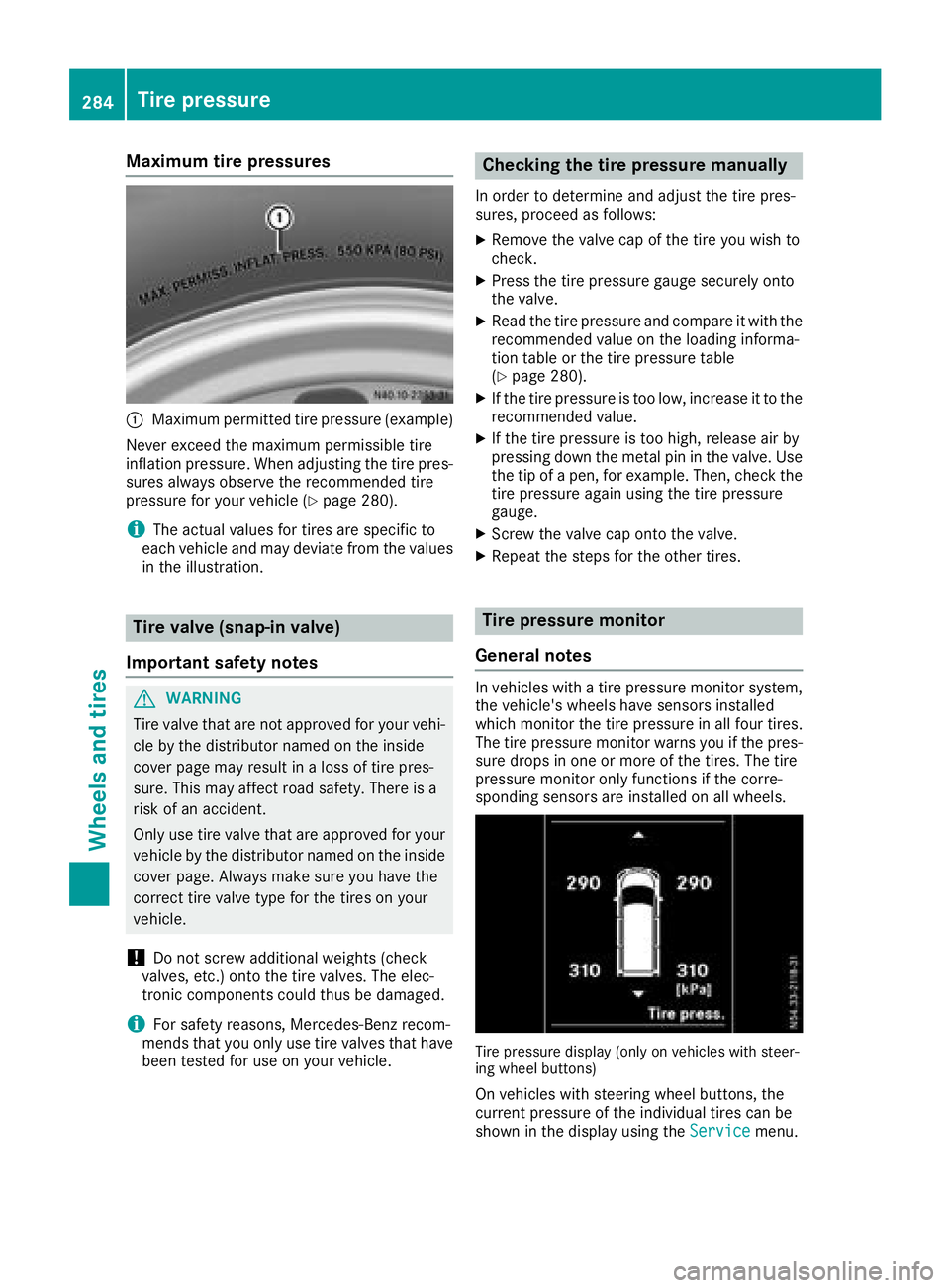
:Maximum permitted tire pressure (example)
Never exceed the maximum permissible tire
inflation pressure. When adjusting the tire pres-
sures always observe the recommended tire
pressure for your vehicle (
Ypage 280).
iThe actual values for tires are specific to
each vehicle and may deviate from the values
in the illustration.
Tire valve (snap-in valve)
Important safety notes
GWARNING
Tire valve that are not approved for your vehi-
cle by the distributor named on the inside
cover page may result in a loss of tire pres-
sure. This may affect road safety. There is a
risk of an accident.
Only use tire valve that are approved for your
vehicle by the distributor named on the inside
cover page. Always make sure you have the
correct tire valve type for the tires on your
vehicle.
!Do not screw additional weights (check
valves, etc.) onto the tire valves. The elec-
tronic components could thus be damaged.
iFor safety reasons, Mercedes-Benz recom-
mends that you only use tire valves that have been tested for use on your vehicle.
Checking the tire pressure manually
In order to determine and adjust the tire pres-
sures, proceed as follows:
XRemove the valve cap of the tire you wish to
check.
XPress the tire pressure gauge securely onto
the valve.
XRead the tire pressure and compare it with the
recommended value on the loading informa-
tion table or the tire pressure table
(
Ypage 280).
XIf the tire pressure is too low, increase it to the
recommended value.
XIf the tire pressure is too high, release air by
pressing down the metal pin in the valve. Use
the tip of a pen, for example. Then, check the
tire pressure again using the tire pressure
gauge.
XScrew the valve cap onto the valve.
XRepeat the steps for the other tires.
Tire pressure monitor
General notes
In vehicles with a tire pressure monitor system,
the vehicle's wheels have sensors installed
which monitor the tire pressure in all four tires.
The tire pressure monitor warns you if the pres- sure drops in one or more of the tires. The tire
pressure monitor only functions if the corre-
sponding sensors are installed on all wheels.
Tire pressure display (only on vehicles with steer-
ing wheel buttons)
On vehicles with steering wheel buttons, the
current pressure of the individual tires can be
shown in the display using the Service
menu.
284Tire pressure
Wheels and tires
Page 293 of 318
Vehicle identification plate
Even if you have calculated the total load care-
fully, you should still make sure that the permis-
sible gross weight and the gross axle weight rat-
ing of your vehicle are not exceeded. This data
can be found on the vehicle identification plate
on the B-pillar of your vehicle (
Ypage 303).
Permissible gross vehicle weight: the gross
weight of the vehicle, all occupants, load and
trailer load/noseweight (if applicable) must not
exceed the permissible gross vehicle weight.
Gross axle weight rating: the maximum per-
missible load that can be carried by one axle
(front or rear axle).
To ensure that your vehicle does not exceed the
maximum permissible values (gross vehicle
weight and maximum gross axle weight rating),
have your loaded vehicle (including driver, occu-
pants, load, and full trailer load if applicable)
weighed on a suitable vehicle weighbridge.
Trailer load/noseweight
The trailer load/noseweight affects the gross
weight of the vehicle. If a trailer is attached, the trailer load/noseweight is included in the load
along with occupants and luggage. The trailer
load/noseweight is usually approximately 10%
of the gross weight of the trailer and its load.
What you should know about wheels
and tires
Tire labeling
Tire labeling
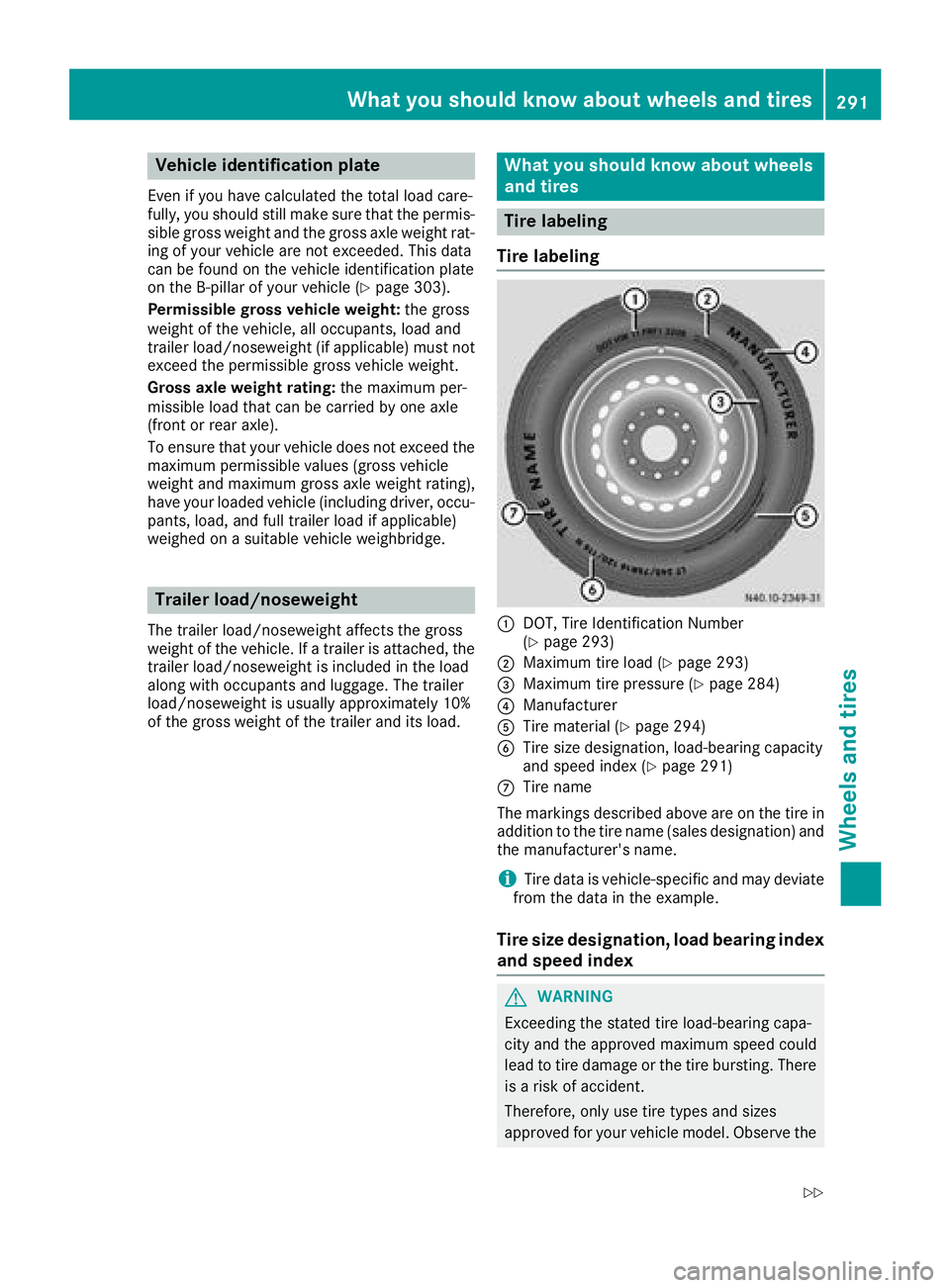
:DOT, Tire Identification Number
(Ypage 293)
;Maximum tire load (Ypage 293)
=Maximum tire pressure (Ypage 284)
?Manufacturer
ATire material (Ypage 294)
BTire size designation, load-bearing capacity
and speed index (Ypage 291)
CTire name
The markings described above are on the tire in
addition to the tire name (sales designation) and
the manufacturer's name.
iTire data is vehicle-specific and may deviate
from the data in the example.
Tire size designation, load bearing index
and speed index
GWARNING
Exceeding the stated tire load-bearing capa-
city and the approved maximum speed could
lead to tire damage or the tire bursting. There is a risk of accident.
Therefore, only use tire types and sizes
approved for your vehicle model. Observe the
What you should know about wheels and tires291
Wheels and tires
Z
Page 294 of 318
tire load rating and speed rating required for
your vehicle.
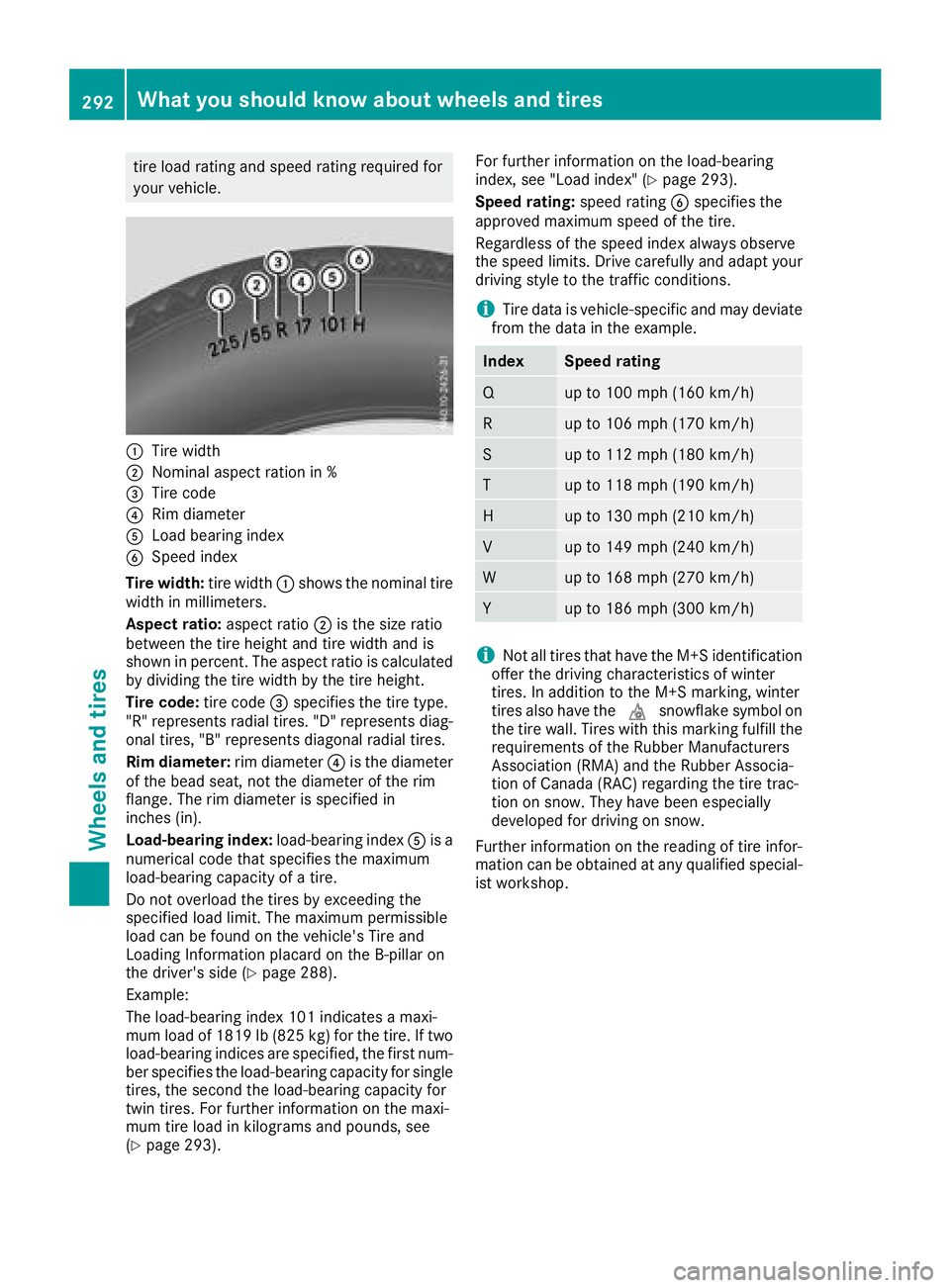
:Tire width
;Nominal aspect ration in %
=Tire code
?Rim diameter
ALoad bearing index
BSpeed index
Tire width: tire width:shows the nominal tire
width in millimeters.
Aspect ratio: aspect ratio;is the size ratio
between the tire height and tire width and is
shown in percent. The aspect ratio is calculated
by dividing the tire width by the tire height.
Tire code: tire code=specifies the tire type.
"R" represents radial tires. "D" represents diag-
onal tires, "B" represents diagonal radial tires.
Rim diameter: rim diameter?is the diameter
of the bead seat, not the diameter of the rim
flange. The rim diameter is specified in
inches (in).
Load-bearing index: load-bearing indexAis a
numerical code that specifies the maximum
load-bearing capacity of a tire.
Do not overload the tires by exceeding the
specified load limit. The maximum permissible
load can be found on the vehicle's Tire and
Loading Information placard on the B-pillar on
the driver's side (
Ypage 288).
Example:
The load-bearing index 101 indicates a maxi-
mum load of 1819 lb (825 kg) for the tire. If two load-bearing indices are specified, the first num-
ber specifie s th
e load-bearing capacity for single
tires, the second the load-bearing capacity for
twin tires. For further information on the maxi-
mum tire load in kilograms and pounds, see
(
Ypage 293). For further information on the load-bearing
index, see "Load index" (
Ypage 293).
Speed rating: speed ratingBspecifies the
approved maximum speed of the tire.
Regardless of the speed index always observe
the speed limits. Drive carefully and adapt your
driving style to the traffic conditions.
iTire data is vehicle-specific and may deviate
from the data in the example.
IndexSpeed rating
Qup to 100 mph (160 km/h)
Rup to 106 mph (170 km/h)
Sup to 112 mph (180 km/h)
Tup to 118 mph (190 km/h)
Hup to 130 mph (210 km/h)
Vup to 149 mph (240 km/h)
Wup to 168 mph (270 km/h)
Yup to 186 mph (300 km/h)
iNot all tires that have the M+S identification
offer the driving characteristics of winter
tires. In addition to the M+S marking, winter
tires also have the isnowflake symbol on
the tire wall. Tires with this marking fulfill the
requirements of the Rubber Manufacturers
Association (RMA) and the Rubber Associa-
tion of Canada (RAC) regarding the tire trac-
tion on snow. They have been especially
developed for driving on snow.
Further information on the reading of tire infor-
mation can be obtained at any qualified special-
ist workshop.
292What you should know about wheels and tires
Wheels and tires
Page 295 of 318
Load index
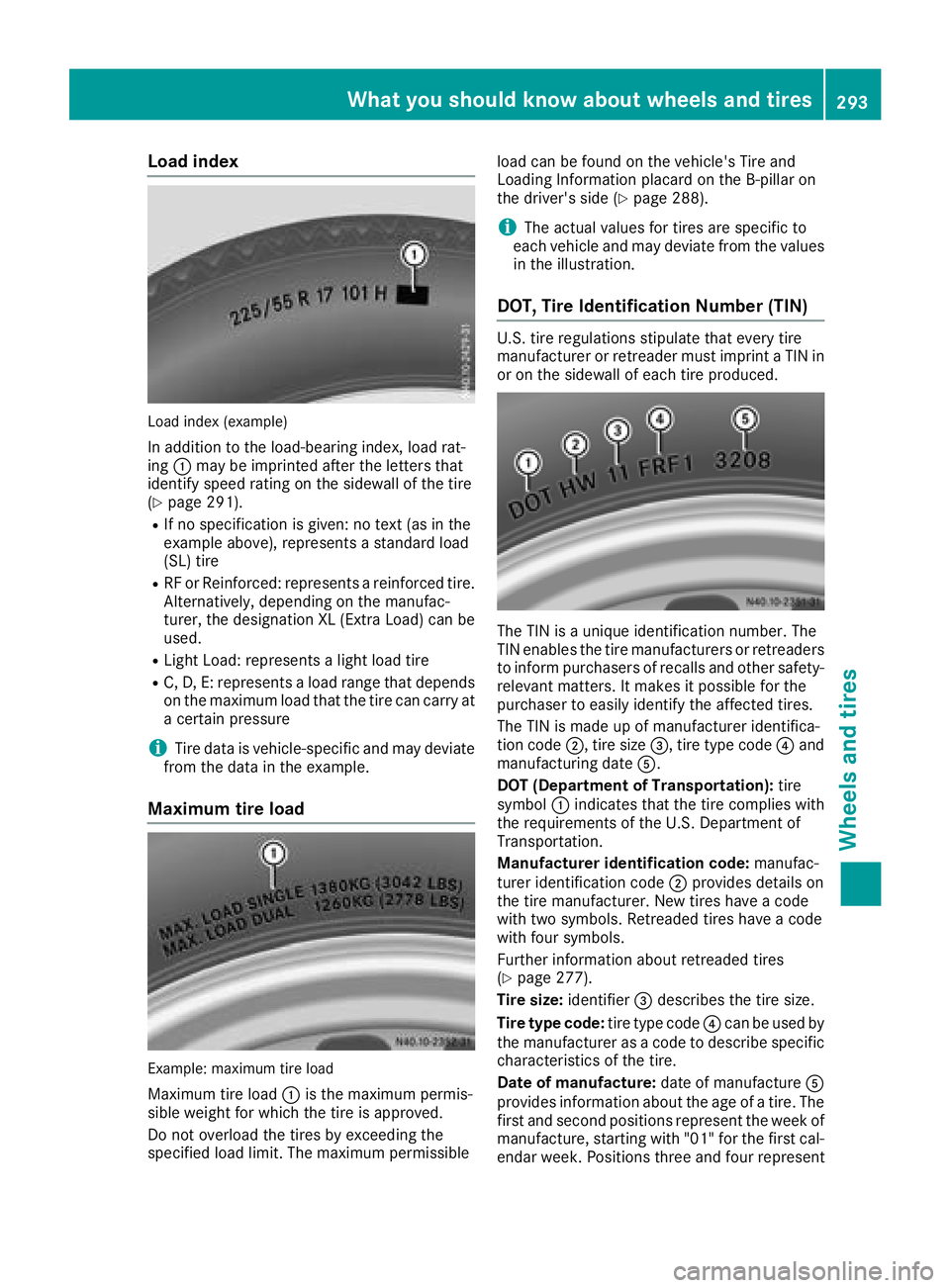
Load index (example)
In addition to the load-bearing index, load rat-
ing:may be imprinted after the letters that
identify speed rating on the sidewall of the tire
(
Ypage 291).
RIf no specification is given: no text (as in the
example above), represents a standard load
(SL) tire
RRF or Reinforced: represents a reinforced tire.
Alternatively, depending on the manufac-
turer, the designation XL (Extra Load) can be
used.
RLight Load: represents a light load tire
RC, D, E: represents a load range that depends
on the maximum load that the tire can carry at
a certain pressure
iTire data is vehicle-specific and may deviate
from the data in the example.
Maximum tire load
Example: maximum tire load
Maximum tire load :is the maximum permis-
sible weight for which the tire is approved.
Do not overload the tires by exceeding the
specified load limit. The maximum permissible load can be found on the vehicle's Tire and
Loading Information placard on the B-pillar on
the driver's side (
Ypage 288).
iThe actual values for tires are specific to
each vehicle and may deviate from the values
in the illustration.
DOT, Tire Identification Number (TIN)
U.S. tire regulations stipulate that every tire
manufacturer or retreader must imprint a TIN in
or on the sidewall of each tire produced.
The TIN is a unique identification number. The
TIN enables the tire manufacturers or retreaders
to inform purchasers of recalls and other safety-
relevant matters. It makes it possible for the
purchaser to easily identify the affected tires.
The TIN is made up of manufacturer identifica-
tion code ;, tire size =, tire type code ?and
manufacturing date A.
DOT (Department of Transportation): tire
symbol :indicates that the tire complies with
the requirements of the U.S. Department of
Transportation.
Manufacturer identification code: manufac-
turer identification code ;provides details on
the tire manufacturer. New tires have a code
with two symbols. Retreaded tires have a code
with four symbols.
Further information about retreaded tires
(
Ypage 277).
Tire size: identifier=describes the tire size.
Tire type code: tire type code?can be used by
the manufacturer as a code to describe specific
characteristics of the tire.
Date of manufacture: date of manufactureA
provides information about the age of a tire. The first and second positions represent the week of
manufacture, starting with "01" for the first cal-
endar week. Positions three and four represent
What you should know about wheels and tires293
Wheels and tires
Z
Page 296 of 318
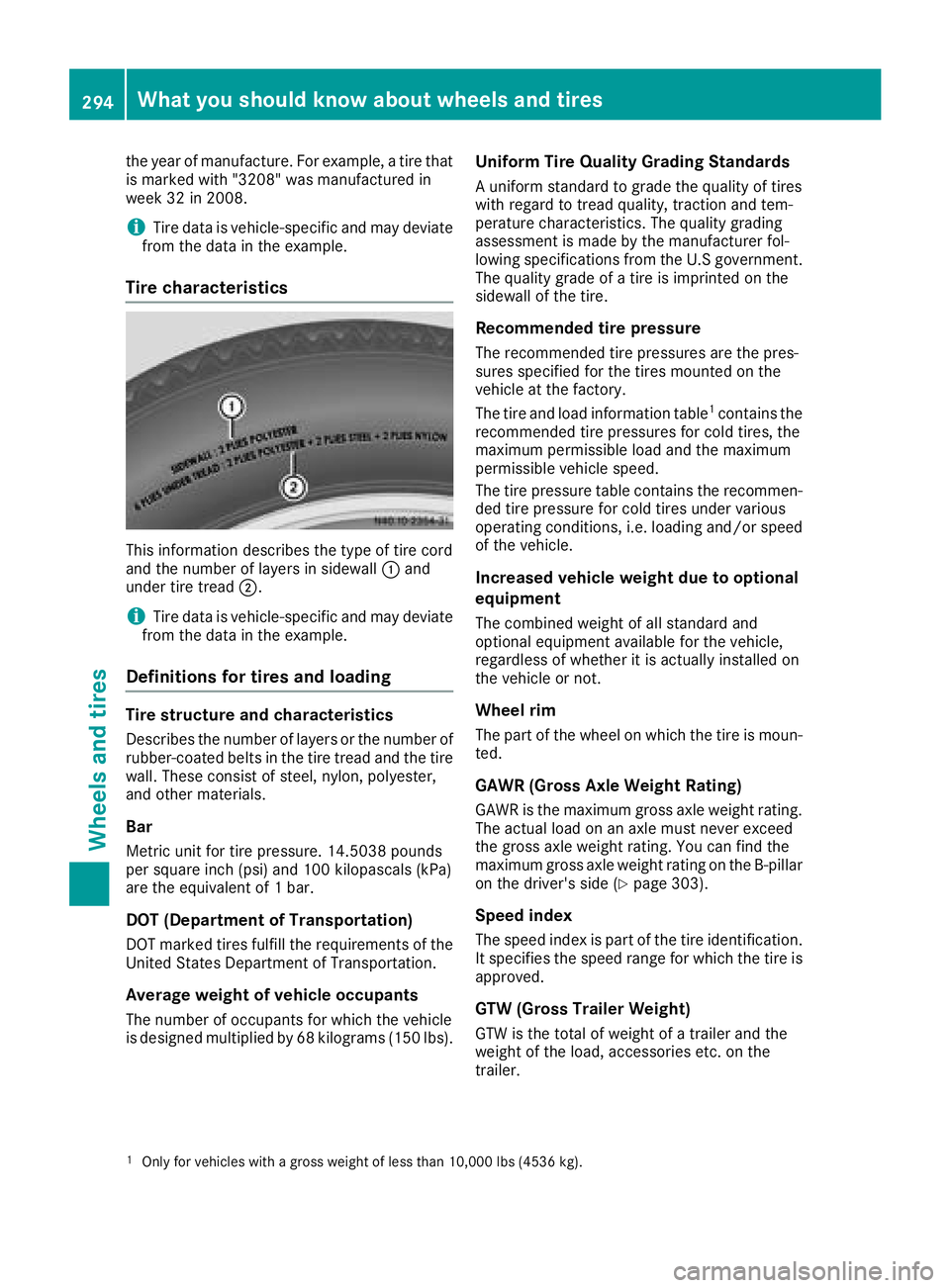
the year of manufacture. For example, a tire that
is marked with "3208" was manufactured in
week 32 in 2008.
iTire data is vehicle-specific and may deviate
from the data in the example.
Tire characteristics
This information describes the type of tire cord
and the number of layers in sidewall :and
under tire tread ;.
iTire data is vehicle-specific and may deviate
from the data in the example.
Definitions for tires and loading
Tire structure and characteristics
Describes the number of layers or the number of
rubber-coated belts in the tire tread and the tire
wall. These consist of steel, nylon, polyester,
and other materials.
Bar
Metric unit for tire pressure. 14.5038 pounds
per square inch (psi) and 100 kilopascals (kPa)
are the equivalent of 1 bar.
DOT (Department of Transportation)
DOT marked tires fulfill the requirements of the
United States Department of Transportation.
Average weight of vehicle occupants
The number of occupants for which the vehicle
is designed multiplied by 68 kilograms (150 lbs).
Uniform Tire Quality Grading Standards
A uniform standard to grade the quality of tires
with regard to tread quality, traction and tem-
perature characteristics. The quality grading
assessment is made by the manufacturer fol-
lowing specifications from the U.S government.
The quality grade of a tire is imprinted on the
sidewall of the tire.
Recommended tire pressure
The recommended tire pressures are the pres-
sures specified for the tires mounted on the
vehicle at the factory.
The tire and load information table
1contains the
recommended tire pressures for cold tires, the
maximum permissible load and the maximu
m
permissible vehicle speed.
The tire pressure table contains the recommen-
ded tire pressure for cold tires under various
operating conditions, i.e. loading and/or speed
of the vehicle.
Increased vehicle weight due to optional
equipment
The combined weight of all standard and
optional equipment available for the vehicle,
regardless of whether it is actually installed on
the vehicle or not.
Wheel rim
The part of the wheel on which the tire is moun-
ted.
GAWR (Gross Axle Weight Rating)
GAWR is the maximum gross axle weight rating.
The actual load on an axle must never exceed
the gross axle weight rating. You can find the
maximum gross axle weight rating on the B-pillar
on the driver's side (
Ypage 303).
Speed index
The speed index is part of the tire identification. It specifies the speed range for which the tire is
approved.
GTW (Gross Trailer Weight)
GTW is the total of weight of a trailer and the
weight of the load, accessories etc. on the
trailer.
1Only for vehicles with a gross weight of less than 10,000 lbs (4536 kg).
294What you should know about wheels and tires
Wheels and tires
Page 302 of 318
When using a wheel/spare wheel with a new or
newly painted wheel rim, have the wheel bolts/
nuts retightened again after approximately 600
to 3,000 miles (1,000 to 5,000 km). Observe the
specified tightening torque.
Wheel and tire combination
General notes
!
Retreaded tires are neither tested nor rec-
ommended by Mercedes-Benz, since previ-
ous damage cannot always be detected on
retreaded tires. As a result, Mercedes-Benz
cannot guarantee vehicle safety if retreaded
tires are mounted. Do not mount used tires if you have no information about their previous
usage.
!For safety reasons, Mercedes-Benz recom-
mends that you only use tires, wheels and
accessories which have been specially
approved by Mercedes-Benz for your vehicle.
These tires have been specially adapted for
use with the driving safety systems, such as
ABS or ESP
®.
Only use tires, wheels or accessories tested
and approved by Mercedes-Benz. Certain
characteristics, e.g. handling, vehicle noise
emissions or fuel consumption, may other-
wise be adversely affected. In addition, when
driving with a load, tire dimension variations
could cause the tires to come into contact
with the bodywork and axle components. This could result in damage to the tires or the vehi-
cle.
Mercedes-Benz accepts no liability for dam-
age resulting from the use of tires, wheels or
accessories other than those tested and
approved.
Further information on wheels, tires and
approved combinations can be obtained from
any qualified specialist workshop.
!Large wheels: the lower the section width
for a certain wheel size, the lower the ride
comfort is on poor road surfaces. Roll comfort and suspension comfort are reduced and the
risk of damage to the wheels and tires as a
result of driving over obstacles increases.
You will find a table with the recommended tire
pressures for various vehicle loads on the inside
of your vehicle's fuel filler flap or under "Tire
pressure tables" (
Ypage 288). You can find fur-
ther information under "Tire pressure"
(
Ypage 280).
Check tire pressures regularly and only when
the tires are cold.
Notes on the vehicle equipment – always equip
the vehicle:
Rwith tires of the same size across an axle
(left/right)
Rwith the same type of tires on all wheels at a
given time (summer tires, winter tires)
iNot all wheel/tire combinations can be
installed at the factory in all countries.
Tires
R 17
TiresSteel wheels
225/55 R17 RF (XL) 101V6.5 J x 17 H2 ET 50
225/55 R17 RF (XL) 101H6.5 J x 17 H2 ET 50
R 17
TiresAlloy wheels
225/55 R17 RF (XL) 101V7 J x 17 H2 ET 51
225/55 R17 RF (XL) 101H7 J x 17 H2 ET 51
300Wheel and tire combination
Wheels and tires
Page 303 of 318
Spare wheel
Important safety notes
GWARNING
Wheel and tire dimensions as well as the type of tire can vary between the spare wheel and
the wheel to be replaced. When the spare
wheel is mounted, driving characteristics may be severely affected. There is a risk of an acci-
dent.
In order to reduce risks:
Ryou should therefore adapt your driving
style and drive carefully.
Rnever mount more than one spare wheel
that differs from the wheel to be replaced.
Ronly use a spare wheel that differs from the
wheel to be replaced for a short time.
Rdo not deactivate ESP®.
Rhave a spare wheel that differs from the
wheel that has been changed replaced at
the nearest qualified specialist workshop.
You must observe the correct wheel and
tire dimensions as well as the wheel type.
When using a spare wheel of a different size, do
not exceed the maximum permissible speed of
50 mph (80 km/h).
General notes
The procedure for mounting the spare wheel is
described in "Mounting a wheel" (Ypage 297).
The following should be checked regularly, par-
ticularly prior to long journeys:
Rthe tire pressure of the spare wheel, which
should then be corrected if necessary
(
Ypage 280)
Rthe fastenings of the spare wheel bracket
The spare wheel is located either in the left rear
compartment or in a spare wheel bracket under
the vehicle.
Replace the tires after six years at the latest,
regardless of wear. This also applies to the spare
wheel.
Vehicles with tire pressure monitor: the
spare wheel is not equipped with a sensor for
monitoring tire pressure. If you have installed a spare wheel, the tire pressure monitor will not
function for this wheel. The system may con-
tinue to show the tire pressure of the wheel that
has been removed for a few minutes. The value
displayed for the position where the spare wheel
is installed is not the same as the current tire
pressure of the spare wheel.
When you are driving with the spare wheel
mounted, the tire pressure monitor cannot func-
tion reliably. Only restart the tire pressure mon- itor when the defective wheel has been replaced
with a new wheel and sensor.
More Information can be found under "Tire pres-
sure monitor" (
Ypage 284).
Removing and installing the spare
wheel
Spare wheel under the rear of the vehi-
cle
Removing
XTake the lug wrench and auxiliary tool for the
spare wheel lifter out of the vehicle tool kit
(
Ypage 270).
XOpen the tailgate/rear door.
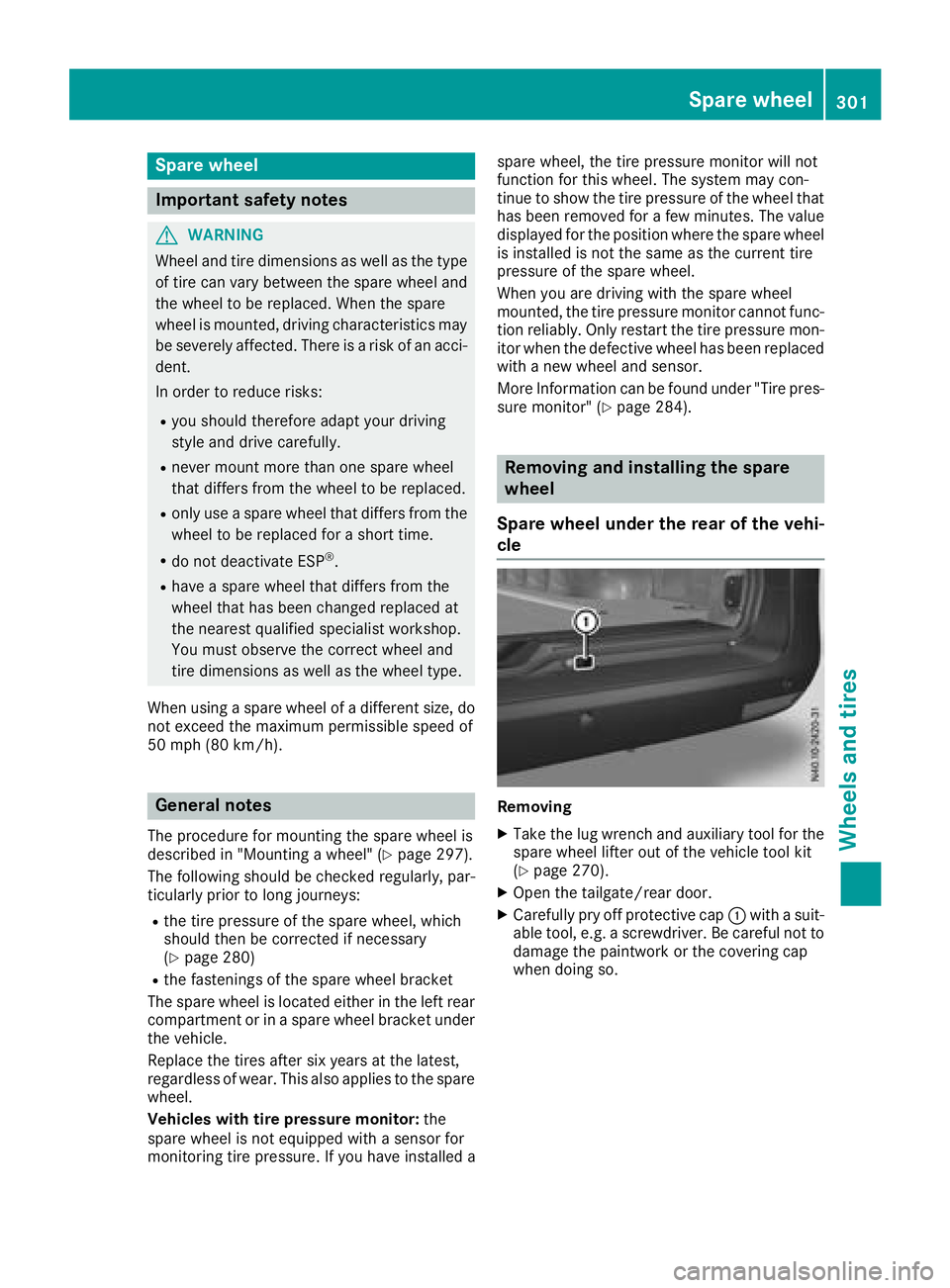
XCarefully pry off protective cap :with a suit-
able tool, e.g. a screwdriver. Be careful not to
damage the paintwork or the covering cap
when doing so.
Spare wheel301
Wheels and tires
Z