flat tire MERCEDES-BENZ METRIS 2018 MY18 Operator’s Manual
[x] Cancel search | Manufacturer: MERCEDES-BENZ, Model Year: 2018, Model line: METRIS, Model: MERCEDES-BENZ METRIS 2018Pages: 318, PDF Size: 5.07 MB
Page 5 of 318
Indicator and warning lamps in the
instrument cluster ............................... 221
Multimedia systems in brief............232
Introduction .........................................2 32
Audio 15 .............................................. 234
Stowing and features .......................240
Useful information ............................... 240
Stowage spaces and stowage com-
partments ............................................ 240
Sun visors ............................................ 241
Cup holder ...........................................2 41
Bottle holder ........................................ 242
Ashtray ................................................ 242
Cigarette lighter ................................... 242
12 V socket ......................................... 243
Mobile communications equipment ..... 243
Transporting loads ............................244
Useful information ............................... 244
Loading guidelines ............................... 244
Load distribution ................................. 245
Securing loads ..................................... 246
Lashing straps ..................................... 247
Securing loads ..................................... 249
Carrier systems ................................... 250
Maintenance and care ......................252
Useful information ............................... 252
Engine compartment ........................... 252
Maintenance ........................................ 259
Battery ................................................. 260
Care ..................................................... 265
Breakdown assistance .....................272
Useful information ............................... 272
Where will I find...? .............................. 272
Flat tire ................................................ 274
Jump-starting ....................................... 274
Tow-starting and towing away ............. 276
Electrical fuses ....................................2 78
Wheels and tires............................... 279
Useful information ............................... 279 Important safety notes ........................ 279
Operation ............................................ 279
Operation in winter .............................. 281
Tire pressure ....................................... 282
Loading the vehicle .............................. 290
What you should know about wheels
and tires .............................................. 293
Changing wheels ................................. 298
Wheel and tire combination ................. 302
Spare wheel ......................................... 303
Technical data
................................... 305
Useful information ............................... 305
Vehicle electronics .............................. 305
Identification plates .............................3 05
Service products and capacities .......... 306
Vehicle data ......................................... 313
Contents3
Page 14 of 318
Oil level (note) ...............................254
Viscosity ........................................ 310
Equipment and conversions
see Vehicle bodies
ESC (Electronic Stability Control)
see ESP
®(Electronic Stability Program)
ESP®(Electronic Stability Pro-
gram)
Activating/deactivating (vehicle
with steering wheel buttons) ......... 186
Activating/deactivating (vehicle
without steering wheel buttons) .... 176
Crosswind Assist .............................6 7
Deactivating/activating ................... 66
Display message (vehicle with
steering wheel buttons) ................. 210
Display message (vehicle without
steering wheel buttons) ................. 196
Function/notes ................................ 65
Important safety information ........... 66
Trailer stabilization ........................... 67
Warning lamp ................................. 224
Exhaust check ................................... 138
Exterior lighting
see Lights
Exterior mirrors
Adjusting ......................................... 94
Out of position (troubleshooting) ..... 94
Eyeglasses compartment ................. 240
F
First-aid kit......................................... 274
Flat tire
Changing a wheel/mounting the
spare wheel ................................... 299
Fogged-up windows
see Climate control
Frequencies
Mobile phone ................................. 305
Two-way radio ................................ 305
Front fog lamps
Changing bulbs .............................. 102
Display messages (vehicle with
steering wheel buttons) ................. 213
Display messages (vehicle with-
out steering wheel buttons) ........... 199
Switching on/off .............................. 97 Front-passenger seat
see Seats
Fuel
Additives (gasoline) ........................ 308
Consumption information .............. 308
Consumption statistics (vehicle
with steering wheel buttons) ......... 181
Consumption statistics (vehicle
without steering wheel buttons) .... 174
Displaying the current consump-
tion (vehicle with steering wheel
buttons) ......................................... 180
Displaying the current consump-
tion (vehicle without steering
wheel buttons) ............................... 175
Displaying the range (vehicle with
steering wheel buttons) ................. 180
Displaying the range (vehicle with-
out steering wheel buttons) ........... 175
Driving abroad ............................... 139
Driving tips .................................... 138
Fuel content display (vehicle with-
out steering wheel buttons) ........... 173
Fuel gauge (vehicle with steering
wheel buttons) ................................. 39
Grade (gasoline) ............................ 307
Important safety notes .................. 307
Problem (malfunction) ................... 135
Refueling ........................................ 134
Tank content/reserve fuel ............. 307
Fuel content
Display (vehicle without steering
wheel buttons) ............................... 173
F
uel level
Gauge (vehicle with steering
wheel buttons) ................................. 39
Fuel tank
Problem (malfunction) ................... 135
Fuel tank
see Fuel tank
Fuel tank reserve level
Display messages (vehicle with
steering wheel buttons) ................. 215
Display messages (vehicle with-
out steering wheel buttons) ........... 201
Fuses .................................................. 278
12Index
Page 54 of 318
If the belt tongue is engaged in the belt buckle,
the side impact air bag on the front-passenger
side deploys if an appropriate accident situation
occurs. In this case, deployment is independent
of whether the front-passenger seat is occupied
or not.
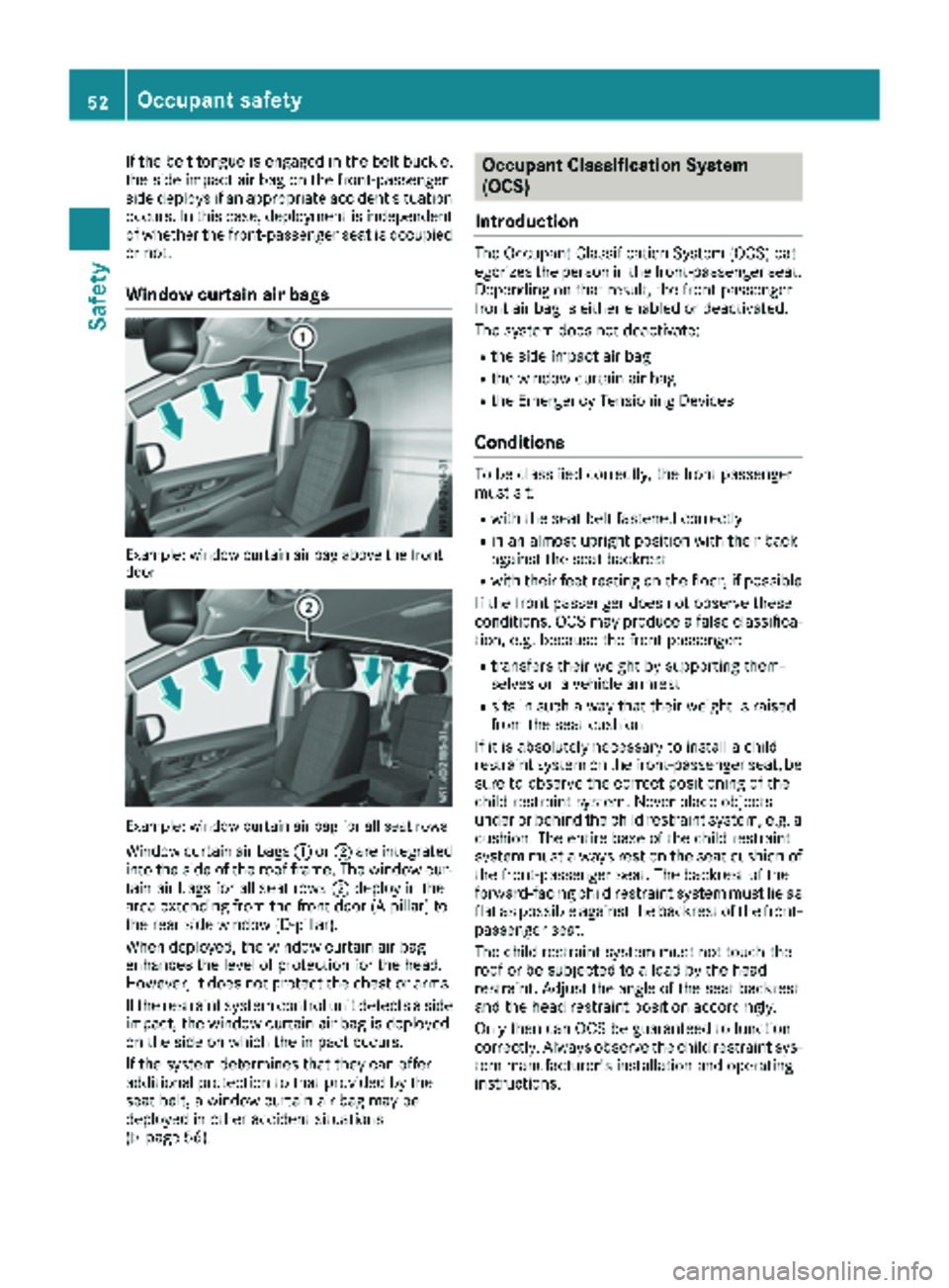
Window curtain air bags
Example: window curtain air bag above the front
door
Example: window curtain air bag for all seat rows
Window curtain air bags:or; are integrated
into the side of the roof frame. The window cur-
tain air bags for all seat rows ;deploy in the
area extending from the front door (A-pillar) to
the rear side window (D-pillar).
When deployed, the window curtain air bag
enhances the level of protection for the head.
However, it does not protect the chest or arms.
If the restraint system control unit detects a side
impact, the window curtain air bag is deployed
on the side on which the impact occurs.
If the system determines that they can offer
additional protection to that provided by the
seat belt, a window curtain air bag may be
deployed in other accident situations
(
Ypage 56).
Occupant Classification System
(OCS)
Introduction
The Occupant Classification System (OCS) cat-
egorizes the person in the front-passenger seat.
Depending on that result, the front-passenger
front air bag is either enabled or deactivated.
The system does not deactivate:
Rthe side impact air bag
Rthe window curtain air bag
Rthe Emergency Tensioning Devices
Conditions
To be classified correctly, the front passenger
must sit:
Rwith the seat belt fastened correctly
Rin an almost upright position with their back
against the seat backrest
Rwith their feet resting on the floor, if possible
If the front passenger does not observe these
conditions, OCS may produce a false classifica-
tion, e.g. because the front passenger:
Rtransfers their weight by supporting them-
selves on a vehicle armrest
Rsits in such a way that their weight is raised
from the seat cushion
If it is absolutely necessary to install a child
restraint system on the front-passenger seat, be
sure to observe the correct positioning of the
child restraint system. Never place objects
under or behind the child restraint system, e.g. a
cushion. The entire base of the child restraint
system must always rest on the seat cushion of the front-passenger seat. The backrest of the
forward-facing child restraint system must lie as
flat as possible against the backrest of the front-
passenger seat.
The child restraint system must not touch the
roof or be subjected to a load by the head
restraint. Adjust the angle of the seat backrest
and the head restraint position accordingly.
Only then can OCS be guaranteed to function
correctly. Always observe the child restraint sys-
tem manufacturer's installation and operating
instructions.
52Occupant safety
Safety
Page 58 of 318
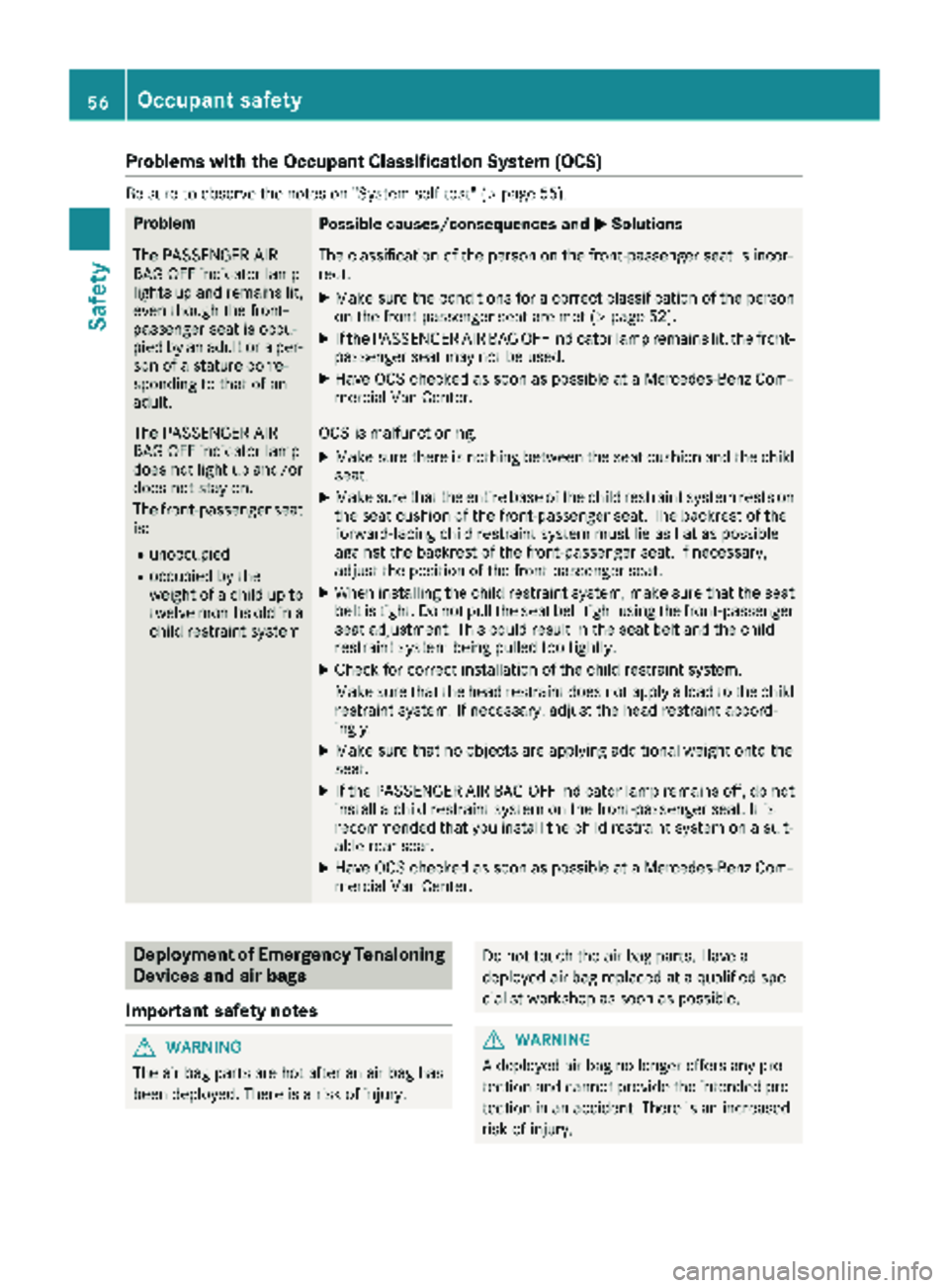
Problems with the Occupant Classification System (OCS)
Be sure to observe the notes on "System self-test" (Ypage 55).
ProblemPossible causes/consequences andMSolutions
The PASSENGER AIR
BAG OFF indicator lamp
lights up and remains lit,
even though the front-
passenger seat is occu-
pied by an adult or a per-
son of a stature corre-
sponding to that of an
adult.The classification of the person on the front-passenger seat is incor-
rect.
XMake sure the conditions for a correct classification of the person
on the front-passenger seat are met (Ypage 52).
XIf the PASSENGER AIR BAG OFF indicator lamp remains lit, the front-
passenger seat may not be used.
XHave OCS checked as soon as possible at a Mercedes-Benz Com-
mercial Van Center.
The PASSENGER AIR
BAG OFF indicator lamp
does not light up and/or
does not stay on.
The front-passenger seat
is:
Runoccupied
Roccupied by the
weight of a child up to
twelve months old in a
child restraint system
OCS is malfunctioning.
XMake sure there is nothing between the seat cushion and the child
seat.
XMake sure that the entire base of the child restraint system rests on
the seat cushion of the front-passenger seat. The backrest of the
forward-facing child restraint system must lie as flat as possible
against the backrest of the front-passenger seat. If necessary,
adjust the position of the front-passenger seat.
XWhen installing the child restraint system, make sure that the seat belt is tight. Do not pull the seat belt tight using the front-passenger
seat adjustment. This could result in the seat belt and the child
restraint system being pulled too tightly.
XCheck for correct installation of the child restraint system.
Make sure that the head restraint does not apply a load to the child
restraint system. If necessary, adjust the head restraint accord-
ingly.
XMake sure that no objects are applying additional weight onto the
seat.
XIf the PASSENGER AIR BAG OFF indicator lamp remains off, do not
install a child restraint system on the front-passenger seat. It is
recommended that you install the child restraint system on a suit-
able rear seat.
XHave OCS checked as soon as possible at a Mercedes-Benz Com-
mercial Van Center.
Deployment of Emergency Tensioning
Devices and air bags
Important safety notes
GWARNING
The air bag parts are hot after an air bag has
been deployed. There is a risk of injury.
Do not touch the air bag parts. Have a
deployed air bag replaced at a qualified spe-
cialist workshop as soon as possible.
GWARNING
A deployed air bag no longer offers any pro-
tection and cannot provide the intended pro-
tection in an accident. There is an increased
risk of injury.
56Occupant safety
Safety
Page 64 of 318
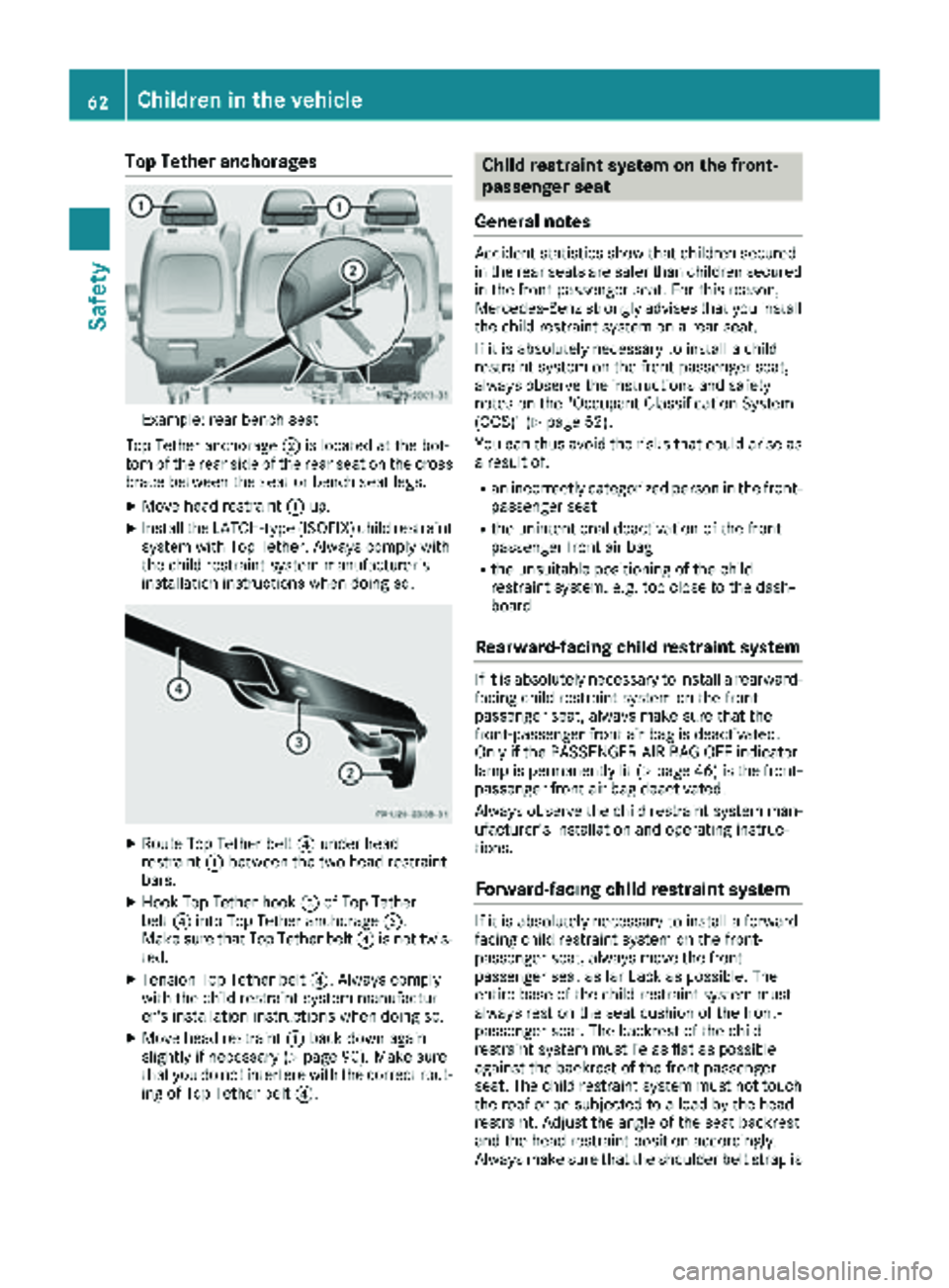
Top Tether anchorages
Example: rear bench seat
Top Tether anchorage ;is located at the bot-
tom of the rear side of the rear seat on the cross
brace between the seat or bench seat legs.
XMove head restraint :up.
XInstall the LATCH-type (ISOFIX) child restraint
system with Top Tether. Always comply with
the child restraint system manufacturer's
installation instructions when doing so.
XRoute Top Tether belt ?under head
restraint :between the two head restraint
bars.
XHook Top Tether hook =of Top Tether
belt ?into Top Tether anchorage ;.
Make sure that Top Tether belt ?is not twis-
ted.
XTension Top Tether belt ?. Always comply
with the child restraint system manufactur-
er's installation instructions when doing so.
XMove head restraint :back down again
slightly if necessary (Ypage 90). Make sure
that you do not interfere with the correct rout-
ing of Top Tether belt ?.
Child restraint system on the front-
passenger seat
General notes
Accident statistics show that children secured
in the rear seats are safer than children secured
in the front-passenger seat. For this reason,
Mercedes-Benz strongly advises that you install
the child restraint system on a rear seat.
If it is absolutely necessary to install a child
restraint system on the front-passenger seat,
always observe the instructions and safety
notes on the "Occupant Classification System
(OCS)" (
Ypage 52).
You can thus avoid the risks that could arise as a result of:
Ran incorrectly categorized person in the front-
passenger seat
Rthe unintentional deactivation of the front-
passenger front air bag
Rthe unsuitable positioning of the child
restraint system, e.g. too close to the dash-
board
Rearward-facing child restraint system
If it is absolutely necessary to install a rearward-
facing child restraint system on the front-
passenger seat, always make sure that the
front-passenger front air bag is deactivated.
Only if the PASSENGER AIR BAG OFF indicator
lamp is permanently lit (
Ypage 46 )is the front-
passenger front air bag deactivated.
Always observe the child restraint system man-
ufacturer's installation and operating instruc-
tions.
Forward-facing child restraint system
If it is absolutely necessary to install a forward-
facing child restraint system on the front-
passenger seat, always move the front-
passenger seat as far back as possible. The
entire base of the child restraint system must
always rest on the seat cushion of the front-
passenger seat. The backrest of the child
restraint system must lie as flat as possible
against the backrest of the front-passenger
seat. The child restraint system must not touch
the roof or be subjected to a load by the head
restraint. Adjust the angle of the seat backrest
and the head restraint position accordingly.
Always make sure that the shoulder belt strap is
62Children in the vehicle
Safety
Page 140 of 318
Always use the hands-free system for telephon-
ing while driving. Only use the telephone if road
traffic conditions permit. If this is not the case,
pull over to a safe location before using the tele-
phone.
Bear in mind that at a speed of just 30 mph
(approximately 50 km/h), your vehicle is cov-
ering a distance of 44 fee t(approximately 14 m)
every second.
Drive sensibly – save fuel
In order to save fuel, observe the following tips:
XThe tires should always be inflated to the rec-
ommended tire pressure.
XRemove unnecessary loads.
XRemove roof carriers when they are not nee-
ded.
XWarm up the engine at low engine speeds.
XAvoid frequent acceleration or braking.
XHave all maintenance work carried out as
indicated by the service intervals in the Main-
tenance Booklet or by the service interval dis-
play.
Fuel consumption also increases when driving in cold weather, in stop-start traffic and in moun-
tainous terrain.
Overrun cutoff
If you are in overrun mode and take your foot off
the accelerator pedal, the fuel supply is cut off
when the engine speed is out of the idle speed
control range.
Drinking and driving
GWARNING
Drinking and driving and/or taking drugs and driving are very dangerous combinations.
Even a small amount of alcohol or drugs can
affect your reflexes, perceptions and judg-
ment.
The possibility of a serious or even fatal acci-
dent is greatly increased when you drink or
take drugs and drive.
Do not drink or take drugs and drive or allow
anyone to drive who has been drinking or tak-
ing drugs.
Emission control
GWARNING
Combustion engines emit poisonous exhaust
gases such as carbon monoxide. Inhaling
these exhaust gases leads to poisoning. There
is a risk of fatal injury. Therefore never leave
the engine running in enclosed spaces with-
out sufficient ventilation.
Certain engine systems are designed to keep
the level of poisonous substances in exhaust
fumes within legal limits.
These systems only work optimally if they are
maintained exactly in accordance with the man-
ufacturer's specifications. Any work on the
engine should therefore be carried out by quali-
fied and authorized Mercedes-Benz technicians.
The engine settings must not be changed under
any circumstances. In addition, all specific
maintenance work must be carried out at regu-
lar intervals and in accordance with the service
requirements of the dealer listed here on the
inside title page. Details can be found in the
Maintenance Booklet.
Speed limiter
GWARNING
Exceeding the stated tire load-bearing capa-
city and the approved maximum speed could
lead to tire damage or the tire bursting. There is a risk of accident.
Therefore, only use tire types and sizes
approved for your vehicle model. Observe the
tire load rating and speed rating required for
your vehicle.
As the driver, you must be aware of the maxi-
mum design speed of the vehicle and the maxi- mum permissible speed based on the tires (tire
and tire pressure). In particular, also observe the tire approval regulations for each country.
You must not exceed the speed limit for the tires
indicated by the speed rating. The speed rating
is stated in the tire tables (
Ypage 302).
You can permanently limit the permissible max-
imum speed of your vehicle, e.g. for driving on
winter tires.
138Driving tips
Driving and parking
Page 205 of 318
Tires
Display messagesPossible causes/consequences andMSolutions
Correct Tire Pres‐sureThe tire pressure is too low in at least one of the tires, or the tire
pressure difference between the wheels is too great.
XCheck the tire pressure at the next opportunity (Ypage 286).
XIf necessary, correct the tire pressure.
XRestart the tire pressure monitor (Ypage 289).
CheckTirePressureSoonAn additional warning tone sounds.
The tire pressure in one or more tires has dropped significantly.
GWARNING
Tire pressure that are too low pose the following hazards:
RThe tires may burst, especially as the load and vehicle speed
increase.
RThe tires may wear excessively and/or unevenly, which may greatly
impair tire traction.
RThe handling as well as steering and braking characteristics may be severely affected.
There is a risk of an accident.
XStop the vehicle without making any sudden steering or braking
maneuvers. Pay attention to the traffic conditions while doing so.
XSecure the vehicle to prevent it from rolling away (Ypage 135).
XCheck the tires and, if necessary, change the wheel (Ypage 298).
XCheck the tire pressure (Ypage 286).
XIf necessary, correct the tire pressure.
Caution! Tire Mal‐func.
The tire pressure in one or more tires has dropped suddenly.
GWARNING
Driving with a flat tire poses a risk of the following hazards:
RA flat tire affects the ability to steer or brake the vehicle.
RYou could then lose control of the vehicle.
RContinued driving with a flat tire will cause excessive heat build-up
and possibly a fire.
There is a risk of an accident.
XStop the vehicle without making any sudden steering or braking
maneuvers. Pay attention to the traffic conditions while doing so.
XSecure the vehicle to prevent it from rolling away (Ypage 135).
XCheck the tires and, if necessary, change the wheel (Ypage 298).
Displa y messages (vehicles without steering wheelbu ttons)203
On-board computer and displays
Z
Page 221 of 318
Tires
Display messagesPossible causes/consequences andMSolutions
AdjustTirePressureThe tire pressure is too low in at least one of the tires, or the tire
pressure difference between the wheels is too great.
XCheck the tire pressure at the next opportunity (Ypage 286).
XIf necessary, correct the tire pressure.
XRestart the tire pressure monitor (Ypage 289).
Check TiresAn additional warning tone sounds.
The tire pressure in one or more tires has dropped significantly. The
display shows the wheel position.
GWARNING
Underinflated tires pose the following risks:
RThe tires may burst, especially as the load and vehicle speed
increase.
RThe tires may wear excessively and/or unevenly, which may greatly
impair tire traction.
RThe handling as well as steering and braking characteristics may be
severely affected.
There is a risk of an accident.
XStop the vehicle without making any sudden steering or braking
maneuvers. Pay attention to the traffic conditions while doing so.
XSecure the vehicle to prevent it from rolling away (Ypage 135).
XCheck the tires and, if necessary, change the wheel (Ypage 298).
XCheck the tire pressure (Ypage 286).
XIf necessary, correct the tire pressure.
Warning Tire Mal‐functionThe tire pressure in one or more tires has dropped suddenly. The dis-
play shows the wheel position.
GWARNING
Driving with a flat tire poses a risk of the following hazards:
RA flat tire affects the ability to steer or brake the vehicle.
RYou could then lose control of the vehicle.
RContinued driving with a flat tire will cause excessive heat build-up
and possibly a fire.
There is a risk of an accident.
XStop the vehicle without making any sudden steering or braking
maneuvers. Pay attention to the traffic conditions while doing so.
XSecure the vehicle to prevent it from rolling away (Ypage 135).
XCheck the tires and, if necessary, change the wheel (Ypage 298).
Tire Pressure Moni‐tor CurrentlyUnavailable
Due to a source of radio interference, no signals can be received from
the wheel sensors. The tire pressure monitor is temporarily malfunc-
tioning.
The tire pressure monitor restarts automatically as soon as the prob-
lem has been solved.
Displa y messages (vehicles withsteering whee lbu ttons)219
On-board computer and displays
Z
Page 232 of 318
Tires
Warning/
indicator
lampNSignal type
Possible causes/consequences and M
Solutions
hNThe yellow tire pressure monitor warning lamp (pressure loss/malfunction) is lit.
The tire pressure monitor has detected a loss of pressure in at least one of the tires.
GWARNING
Underinflated tires pose the following risks:
RThe tires may burst, especially as the load and vehicle speed increase.
RThe tires may wear excessively and/or unevenly, which may greatly impair tire traction.
RThe handling as well as steering and braking characteristics may be severely
affected.
There is a risk of an accident.
XStop the vehicle without making any sudden steering or braking maneuvers. Pay
attention to the traffic conditions while doing so.
XSecure the vehicle to prevent it from rolling away (Ypage 135).
XObserve the display messages.
XCheck the tires and, if necessary, change the wheel (Ypage 298).
XCheck the tire pressure.
You can check the tire pressure electronically on vehicles with steering wheel
buttons (
Ypage 286).
XIf necessary, correct the tire pressure.
hN The yellow tire pressure monitor (pressure loss/malfunction) warning lamp
flashes for approximately one minute and then remains lit.
The tire pressure monitor is malfunctioning.
GWARNING
The system may not be able to detect or signal low tire pressure as intended.
There is a risk of an accident.
XObserve the display messages.
XVisit a qualified specialist workshop.
230Indicator and warninglamps in the instrument cluster
On-board computer and displays
Page 276 of 318
XTo remove tools:release clamping strap ;.
XRemove tool holder cover :
XCarefully pull the tool kit and jack out of the
tool holder.
XTo stow tools:before stowing, wind the jack
to the fully closed position and place it so that
the hand wheel is facing forwards and the
plate is facing inwards.
XPlace the jack and vehicle tool kit into the tool
holder.
XReplace tool holder cover :.
XTighten clamping strap;.
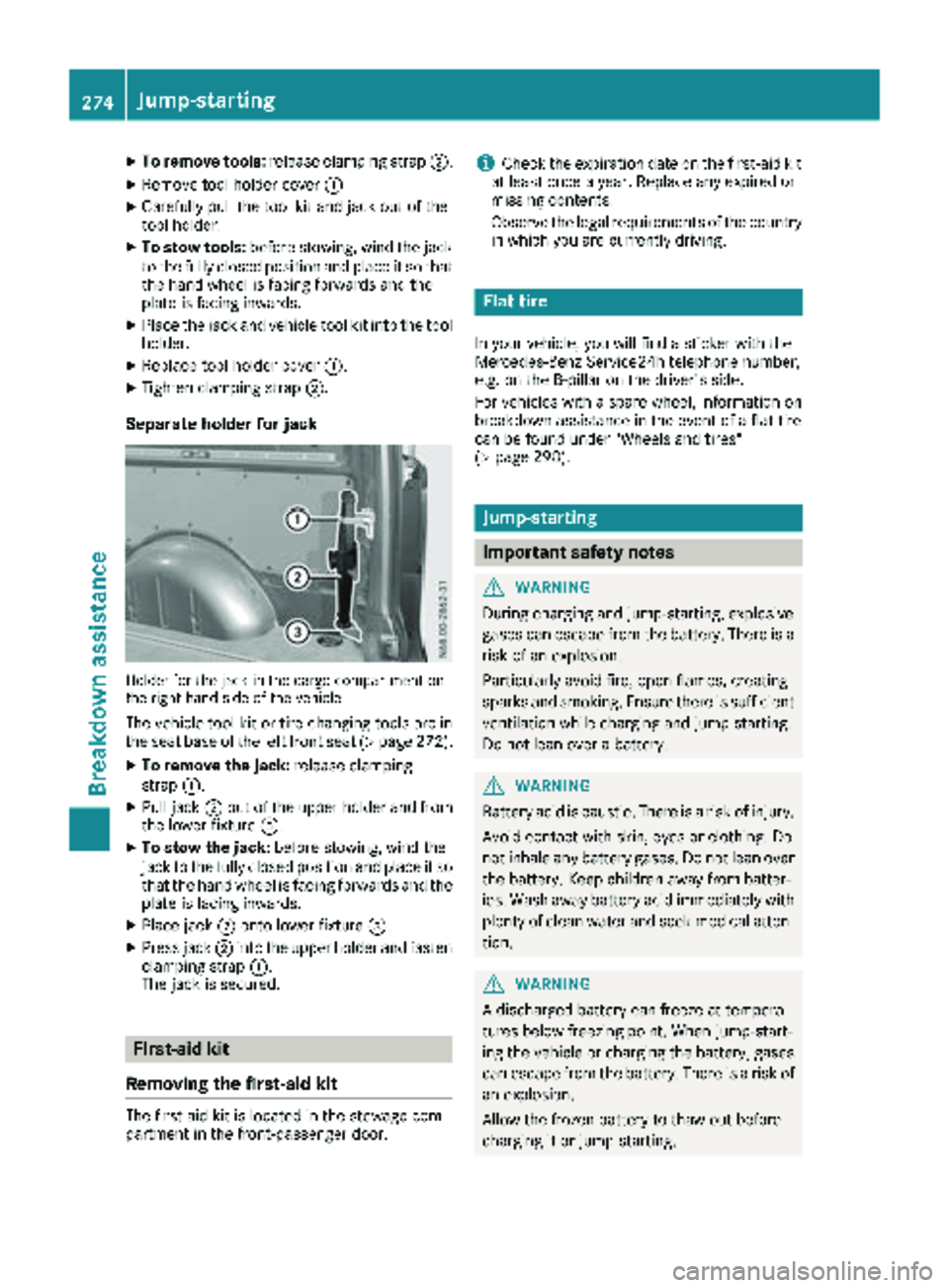
Separate holder for jack
Holder for the jack in the cargo compartment on
the right-hand side of the vehicle
The vehicle tool kit or tire-changing tools are in
the seat base of the left front seat (Ypage 272).
XTo remove the jack:release clamping
strap :.
XPull jack ;out of the upper holder and from
the lower fixture =.
XTo stow the jack: before stowing, wind the
jack to the fully closed position and place it so
that the hand wheel is facing forwards and the plate is facing inwards.
XPlace jack ;onto lower fixture =.
XPress jack;into the upper holder and fasten
clamping strap :.
The jack is secured.
First-aid kit
Removing the first-aid kit
The first-aid kit is located in the stowage com-
partment in the front-passenger door.
iCheck the expiration date on the first-aid kit
at least once a year. Replace any expired or
missing contents.
Observe the legal requirements of the country
in which you are currently driving.
Flat tire
In your vehicle, you will find a sticker with the
Mercedes-Benz Service24h telephone number,
e.g. on the B-pillar on the driver's side.
For vehicles with a spare wheel, information on
breakdown assistance in the event of a flat tire
can be found under "Wheels and tires"
(
Ypage 298).
Jump-starting
Important safety notes
GWARNING
During charging and jump-starting, explosive
gases can escape from the battery. There is a risk of an explosion.
Particularly avoid fire, open flames, creating
sparks and smoking. Ensure there is sufficient
ventilation while charging and jump-starting.
Do not lean over a battery.
GWARNING
Battery acid is caustic. There is a risk of injury.
Avoid contact with skin, eyes or clothing. Do
not inhale any battery gases. Do not lean over
the battery. Keep children away from batter-
ies. Wash away battery acid immediately with
plenty of clean water and seek medical atten-
tion.
GWARNING
A discharged battery can freeze at tempera-
tures below freezing point. When jump-start-
ing the vehicle or charging the battery, gases can escape from the battery. There is a risk of
an explosion.
Allow the frozen battery to thaw out before
charging it or jump-starting.
274Jump-starting
Breakdo wn assis tance