fuel cap MERCEDES-BENZ METRIS 2019 MY19 Operator’s Manual
[x] Cancel search | Manufacturer: MERCEDES-BENZ, Model Year: 2019, Model line: METRIS, Model: MERCEDES-BENZ METRIS 2019Pages: 318, PDF Size: 5.07 MB
Page 285 of 318
Follow recommended tire inflation pressures
and check the pressure of all the tires includ-
ing the spare wheel:
Rmonthly, at least
Rif the load changes
Rbefore beginning a long journey
Runder different operating conditions, e.g.
off-road driving
If necessary, correct the tire pressure.
GWARNING
If you fit unsuitable accessories onto tire
valves, the tire valves may be overloaded and
malfunction, which can cause tire pressure
loss. Due to their design, retrofitted tire pres- sure monitors keep the tire valve open. This
can also result in tire pressure loss. There is a
risk of an accident.
Only screw the standard valve cap or other
valve caps approved by Mercedes-Benz for
your vehicle onto the tire valve.
!The pressure difference between tires on
any one axle must be no greater than 10 kPa
(0.1 bar/1.5 psi).
iThe specifications shown on the sample Tire
and Loading Information placard and tire
pressure table are examples. Tire pressure
data are vehicle-specific and may deviate
from the data illustrated here. The tire pres-
sure specifications that are valid for your vehi-
cle can be found on the Tire and Loading
Information placard and the tire pressure
table on the vehicle.
HEnvironmental note
Check the tire pressure regularly, at least
every 14 days.
General notes
You will find information on tire pressure for the vehicle's factory-mounted tires on the plates
described here.
The recommended tire pressure for various
operating conditions can be found on the Tire
and Loading Information placard on the B-pillar
on the driver's side of the vehicle or on the tire
pressure table inside the fuel filler flap. Further information on tire pressure can be
obtained at a qualified specialist workshop.
Tire and Loading Information placard
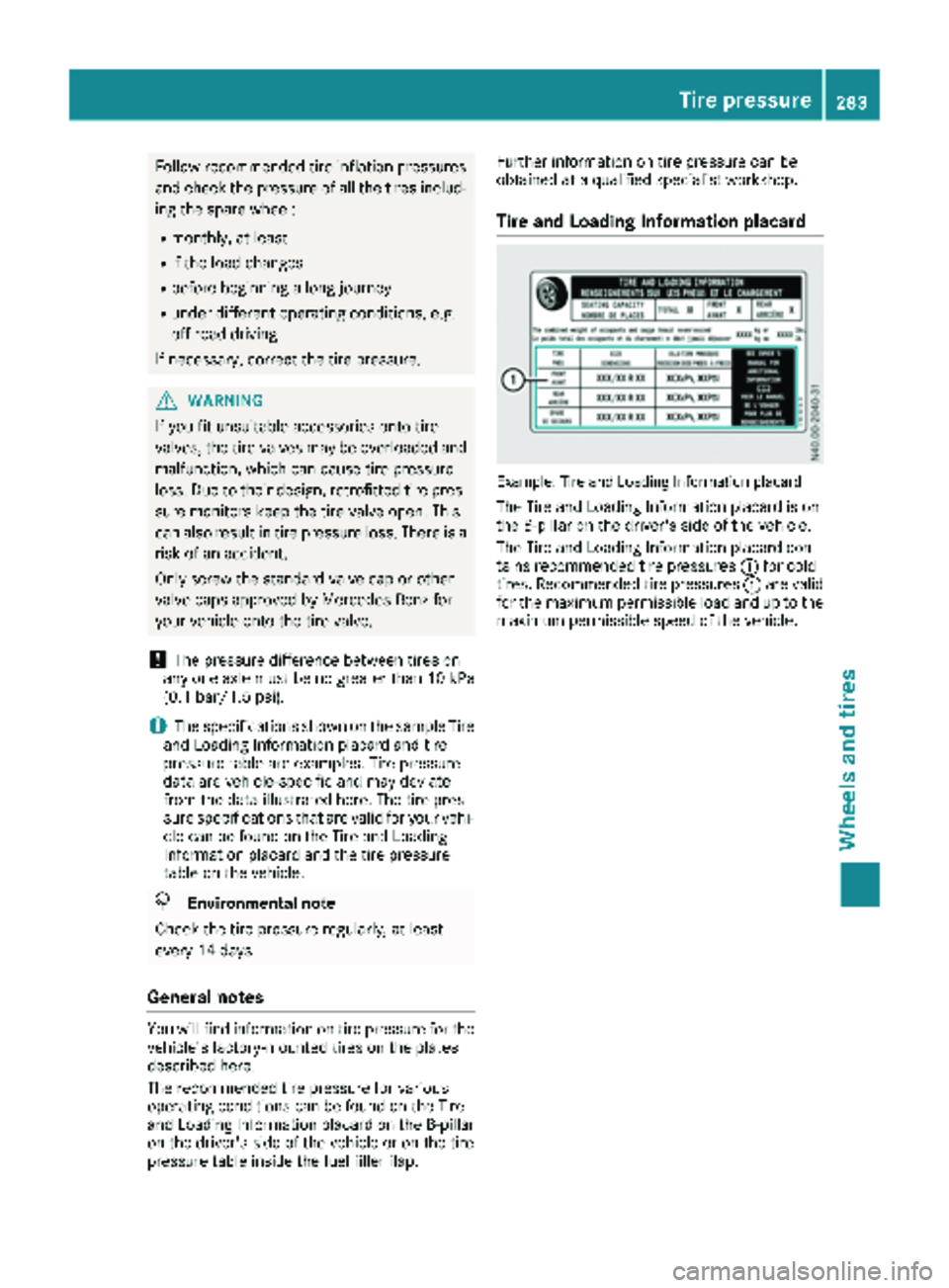
Example: Tire and Loading Information placard
The Tire and Loading Information placard is on
the B-pillar on the driver's side of the vehicle.
The Tire and Loading Information placard con-
tains recommended tire pressures
:for cold
tires. Recommended tire pressures :are valid
for the maximum permissible load and up to the
maximum permissible speed of the vehicle.
Tire pressure283
Wheels and tires
Z
Page 299 of 318
GVW (Gross Vehicle Weight)
The gross vehicle weight includes the weight of
the vehicle including fuel, tools, spare wheel,
accessories installed, occupants, luggage and
the drawbar noseweight if applicable. The gross
vehicle weight must never exceed the permissi-
ble gross weight (GVWR) specified on the
B-pillar on the driver's side (
Ypage 305).
GVWR (Gross Vehicle Weight Rating)
The GVWR is the maximum permitted gross
weight of the fully laden vehicle (weight of the
vehicle including all accessories, occupants,
fuel, luggage and the drawbar noseweight if
applicable). The permissible gross weight is
specified on the vehicle identification plate on
the B-pillar on the driver's side (
Ypage 305).
Maximum weight of the laden vehicle
The maximum weight is the sum of:
Rthe curb weight of the vehicle
Rthe weight of the accessories
Rthe load limit
Rthe weight of the factory installed optional
equipment
Kilopascal (kPa)
Metric unit for tire pressure. 6.9 kPa are the
equivalent of 1 psi. Another tire pressure unit is
bar. 100 kilopascals (kPa) are the equivalent of
1 bar.
Load index
In addition to the load bearing index, a load
index can be stamped onto the sidewall of the
tire. It specifies the load-bearing capacity of the
tire more precisely.
Curb weight
The weight of a vehicle with standard equipment
including the maximum filling capacity of fuel,
oil, and coolant. It also includes the air-condi-
tioning system and optional equipment if these
are installed on the vehicle, but does not include
passengers or luggage.
Maximum tire load
The maximum tire load in kilograms or pounds is
the maximum weight for which a tire is
approved.
Maximum permissible tire pressure
Maximum permissible tire pressure for one tire.
Maximum load on one tire
Maximum load on one tire. This is calculated by
dividing the maximum axle load of one axle by
two.
PSI (Pounds per square inch)
Standard unit of measurement for tire pressure.
Aspect ratio
Relationship between tire height and width in
percent.
Tire pressure
Pressure inside the tire applying an outward
force to every square inch of the tire's surface.
Tire pressure is specified in pounds per square
inch (psi), in kilopascal (kPa) or in bar. Tire pres-
sure should only be corrected when the tires are
cold.
Cold tire pressure
The tires are cold:
Rif the vehicle has been parked for at least
three hours without direct sunlight on the
tires, and
Rif the vehicle has not been driven further than
1 mile (1.6 km)
Tire tread
The part of the tire that comes into contact with
the road.
Tire bead
The tire bead ensures that the tire sits securely
on the wheel. There are several steel wires in the bead to prevent the tire from coming loose from
the wheel rim.
Sidewall
The part of the tire between the tread and the
tire bead.
Weight of optional extras
The combined weight of those optional extras
that weigh more than the replaced standard
parts and more than 2.3 kg (5 lbs). These
optional extras, such as high-performance
brakes, a roof rack or a high-performance bat-
tery, are not included in the curb weight and theweight of the accessories.
What you should know about wheels and tires297
Wheels and tires
Z
Page 300 of 318
TIN (Tire Identification Number)
A unique identification number which can be
used by a tire manufacturer to identify tires, for
example for a product recall, and thus identify
the purchasers. The TIN is composed of the
manufacturer identification code, tire size, tire
model code and manufacturing date.
Load bearing index
The load bearing index (also load index) is a code
that contains the maximum load bearing capa-
city of a tire.
Traction
Traction is the result of friction between the tires
and the road surface.
TWR (permissible trailer drawbar load)
The TWR is the maximum permissible weight
that may act on the ball coupling of the trailer
tow hitch.
Wear indicator
Narrow bars (tread wear bars) that are distrib-
uted over the tire tread. If the tire tread is level
with the bars, the wear limit of áin (1.6 mm)
has been reached.
Distribution of the vehicle occupants
The distribution of vehicle occupants over des-
ignated seat positions in a vehicle.
Maximum permissible payload weight
Nominal load and goods/luggage load plus
68 kg (150 lb s)multiplied by the number of
seats in the vehicle.
Changing wheels
Rotating the wheels
GWARNING
Interchanging the front and rear wheels may
severely impair the driving characteristics if
the wheels or tires have different dimensions. The wheel brakes or suspension components
may also be damaged. There is a risk of acci-
dent.
Rotate front and rear wheels only if the wheels and tires are of the same dimensions.
!On vehicles equipped with a tire pressure
monitor, electronic components are located
in the wheel.
Tire-mounting tools should not be used near
the valve. This could damage the electronic
components.
Only have tires changed at a qualified spe-
cialist workshop.
Always observe the instructions and safety
notes under "Mounting a wheel" (
Ypage 299).
The wear patterns on the front and rear tires
differ, depending on the operating conditions.
Rotate the wheels before a clear wear pattern
has formed on the tires. Front tires typically
wear more on the shoulders and the rear tires in the center.
If your vehicle's tire configuration allows, you
can rotate the tires according to the intervals in
the tire manufacturer's warranty book in your
vehicle documents. If no warranty book is avail-
able, the tires should be rotated every 3,000 to
6,000 miles (5,000 to 10,000 km) or earlier if
tire wear requires. Do not change the direction
of rotation.
Clean the contact surfaces of the wheel and the
brake disc thoroughly every time a wheel is rota-
ted. Avoid oily or greasy cleaning agents.
Check the tire pressure and reactivate the tire
pressure monitor if necessary.
Direction of rotation
Tires with a specified direction of rotation have
additional benefits, e.g. if there is a risk of hydro-
planing. You will only gain these benefits if the
correct direction of rotation is observed.
An arrow on the sidewall of the tire indicates its
correct direction of rotation.
You may mount a spare wheel against the direc-tion of rotation. Observe the time restriction on
use as well as the speed limitation specified on
the spare wheel.
Storing wheels
Store wheels that are not being used in a cool,
dry and preferably dark place. Protect the tires
from contact with oil, grease and fuel.
298Changing wheels
Wheels and tires
Page 308 of 318
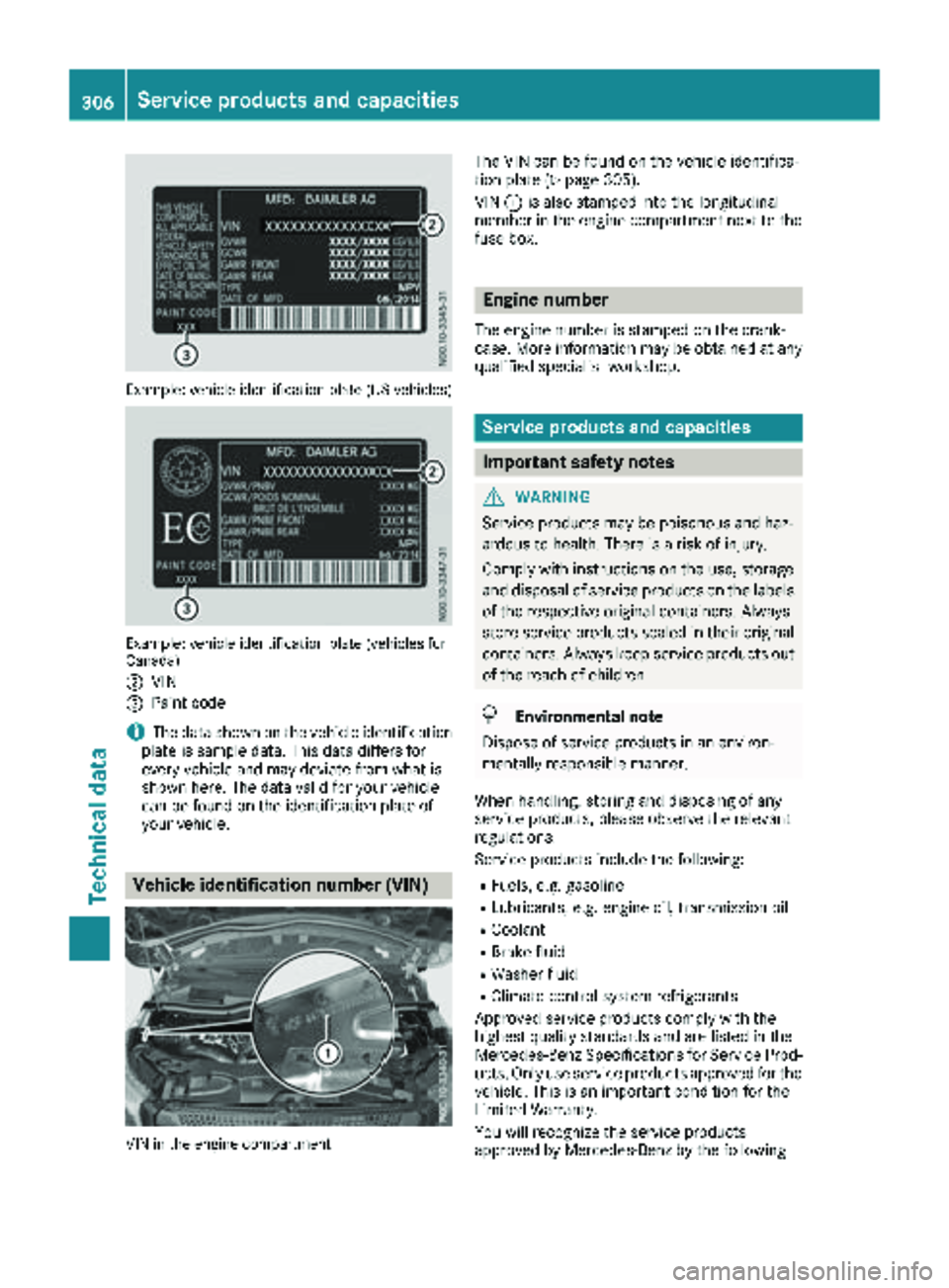
Example: vehicle identification plate (US vehicles)
Example: vehicle identification plate (vehicles for
Canada)
;
VIN
=Paint code
iThe data shown on the vehicle identification
plate is sample data. This data differs for
every vehicle and may deviate from what is
shown here. The data valid for your vehicle
can be found on the identification plate of
your vehicle.
Vehicle identification number (VIN)
VIN in the engine compartment
The VIN can be found on the vehicle identifica-
tion plate (Ypage 305).
VIN :is also stamped into the longitudinal
member in the engine compartment next to the
fuse box.
Engine number
The engine number is stamped on the crank-
case. More information may be obtained at any
qualified specialist workshop.
Service products and capacities
Important safety notes
GWARNING
Service products may be poisonous and haz-
ardous to health. There is a risk of injury.
Comply with instructions on the use, storage
and disposal of service products on the labels
of the respective original containers. Always
store service products sealed in their original
containers. Always keep service products out
of the reach of children.
HEnvironmental note
Dispose of service products in an environ-
mentally responsible manner.
When handling, storing and disposing of any
service products, please observe the relevant
regulations.
Service products include the following:
RFuels, e.g. gasoline
RLubricants, e.g. engine oil, transmission oil
RCoolant
RBrake fluid
RWasher fluid
RClimate control system refrigerants
Approved service products comply with the
highest quality standards and are listed in the
Mercedes-Benz Specifications for Service Prod-
ucts. Only use service products approved for the
vehicle. This is an important condition for the
Limited Warranty.
You will recognize the service products
approved by Mercedes-Benz by the following
306Service products and capacities
Technical data
Page 309 of 318
inscription on the containers: MB-Freigabe or
MB-Approval (e.g. MB-Freigabe or MB-Approval
228.5).
You can obtain further information at a qualified
specialist workshop.
Additives for approved service products are nei-
ther required nor permitted. Approved fuel addi-
tives are the exception. Additives can cause
engine damage and must therefore not be
added to the service products.
The use of additives is always the responsibility
of the vehicle operator. The use of additives may
result in the restriction or loss of your Limited
Warranty entitlements.
Fuel
Important safety notes
GWARNING
Fuel is highly flammable. Improper handling of
fuel creates a risk of fire and explosion.
Avoid fire, open flames, smoking and creating
sparks under all circumstances. Switch off the
engine and, if applicable, the auxiliary heating
before refueling.
GWARNING
Fuel is poisonous and hazardous to health.
There is a risk of injury.
You must make sure that fuel does not come into contact with your skin, eyes or clothing
and that it is not swallowed. Do not inhale fuel
vapors. Keep fuel away from children.
If you or others come into contact with fuel,
observe the following:
RWash away fuel from skin immediately
using soap and water.
RIf fuel comes into contact with your eyes,
immediately rinse them thoroughly with
clean water. Seek medical assistance with-
out delay.
RIf fuel is swallowed, seek medical assis-
tance without delay. Do not induce vomit-
ing.
RImmediately change out of clothing which
has come into contact with fuel. When handling, storing and disposing of fuels,
please observe the relevant regulations.
Tank contents
Depending on equipment, the total capacity of
the fuel tank may vary.
Total capacity18.5 US gal (70.0 l)
of which reserve
fuelApprox. 3.2 US gal
(12.0 l)
Gasoline
Fuel grade
!Do not use diesel to refuel vehicles with a
gasoline engine. Do not switch on the ignition
if you accidentally refuel with the wrong fuel.
Otherwise, the fuel will enter the fuel system.
Even small amounts of the wrong fuel could
result in damage to the fuel system and the
engine. Notify a qualified specialist workshop
and have the fuel tank and fuel lines drained
completely.
!Only refuel using unleaded premium grade
gasoline with at least 91 AK I/95 RON.
!Only use the fuel recommended. Operating
the vehicle with other fuels can lead to dam-
age to the fuel system, engine and exhaust
system.
!Do not use the following:
RE15 (gasoline with 15% ethanol)
RE85 (gasoline with 85% ethanol)
RE100 (100% ethanol)
RM15 (gasoline with 15% methanol)
RM30 (gasoline with 30% methanol)
RM85 (gasoline with 85% methanol)
RM100 (100% methanol)
RGasoline with metalliferous additives
RDiesel
Do not mix such fuels with the fuel recom-
mended for your vehicle.
!Filter the fuel before transferring it to the
vehicle if you are refueling the vehicle from
barrels or containers.
This will prevent malfunctions in the fuel sys-
tem due to contaminated fuel.
Service products and capacities307
Technical data
Z
Page 310 of 318
iE10 fuel contains an admixture of up to 10%
bioethanol. Your vehicle is E10 compatible.
You can refuel your vehicle with E10 fuel.
iUsually you will find information about the
fuel grade on the filling pump. If there is no
identification on the filling pump, consult a
gas station attendant.
If the recommended fuel is not available, you
may as a one-off measure use regular unleaded
gasoline with an octane rating of 87 AKI/
91 RON. Be aware that your vehicle is not cer-
tified with regular unleaded gasoline with an
octane rating of 87 AKI/91 RON and that usage
of this fuel may reduce the engine's output and
increase fuel consumption. Avoid driving at full
throttle and sudden acceleration. Never refuel
using gasoline with a lower AKI/RON rating.
iIn some countries, the available gasoline
may not be sufficiently low in sulfur. This fuel can temporarily produce unpleasant odors,
especially on short journeys. The odors are
reduced as soon as sulfur-free fuel (sulfur
content < 10 ppm) is used again for refueling.
For more information about refueling
(
Ypage 134).
Fuel additives
!Operating the engine with subsequently
added fuel additives can cause engine dam-
age. Do not mix fuel additives with fuel. This
does not include additives for the removal and
prevention of deposits. Gasoline can only be
mixed with additives recommended by
Mercedes-Benz. Follow the instructions in the
product description. You can find further
information on recommended additives in any
Mercedes-Benz Commercial Van Center.
Mercedes-Benz recommends using brand-name
fuels with additives.
If you use fuels without these additives for a long
period of time, deposits can form. This primarily
forms on the inlet valve and in the combustion
chamber.
In some countries, the available fuel grade may
be inadequate. Residue could build up in the fuel
injection system as a result. In this case, in con-
sultation with a Mercedes-Benz Commercial
Van Center, the fuel should be mixed with the
cleaning additive recommended by Mercedes-
Benz. You must observe the notes and mixing
ratios indicated on the container. Do not add other fuel additives to the fuel. This
results in unnecessary costs and can damage
the engine.
Information on fuel consumption
HEnvironmental note
CO
2(carbon dioxide) is the gas which scien-
tists believe to be principally responsible for
global warming (the greenhouse effect). Your
vehicle's CO
2emissions are directly related to
fuel consumption and therefore depend on:
Refficient use of the fuel by the engine
Rdriving style
Rother non-technical factors, such as envi-
ronmental influences, road conditions or
traffic flow
You can minimize your vehicle's CO
2emis-
sions by driving carefully and having it serv-
iced regularly.
Only for certain countries: the respective cur-
rent consumption and emission values of your
vehicle can be found in the COC papers (EC
CERTIFICATE OF CONFORMITY). These docu-
ments are supplied when the vehicle is deliv-
ered.
Consumption figures were found in the currently
valid respective version:
Rfor vehicles with exhaust gas standard Euro 6
as per directive (EC) no. 715/2007
Rfor vehicles with exhaust gas standard EURO
VI as per directive (EC) no. 595/2009
Fuel consumption depends on:
Rthe vehicle version
Rthe style of driving
Rthe operating conditions
Rthe type or quality of the fuel used
The vehicle will use mor e fu
el than usual in the
following situations:
Rat very low outside temperatures
Rin city traffic
Rduring short journeys
Ron mountainous terrain
Rwhen towing a trailer
Observe the advice in the "Protection of the
environment" section to keep fuel consumption low (
Ypage 29).
308Service products and capacities
Technical data
Page 311 of 318
The following components of the different vehi-
cle versions influence fuel consumption:
Rtire sizes, tire tread, tire pressure, tire condi-
tion
Rtransmission ratios for the drive assemblies
Radditional equipment (e.g. air-conditioning
system, auxiliary heating system)
For these reasons, the actual consumption fig-
ures for your vehicle may deviate from the con-
sumption figures determined according to EU
Directive 80/1268/EE C.
Details on fuel consumption can be called up in
the on-board computer:
Ron vehicles without steering wheel buttons
(Ypage 174)
Ron vehicles with steering wheel buttons
(Ypage 181)
Engine oil
General notes
When handling engine oil, observe the important
safety notes on operating fluids (Ypage 306).
The quality of the engine oil used is of decisive
importance for the engine's functionality and
operating life. Mercedes-Benz continually
approves engine oils based on complex experi-
ments according to the current state of the art. Therefore, only Mercedes-Benz approved
engine oils may be used in Mercedes-Benz
engines. Mercedes-Benz recommends having
the oil changed at a qualified specialist work-
shop. Information about engine oils approved by
Mercedes-Benz can be obtained:
Rfrom any Mercedes-Benz Commercial Van
Center
Ron the Internet at
http://bevo.mercedes-benz.co
mbyenterin g
th edesignation ,e.g. 229.5.
Mercedes-Ben zapprova lis indicate don th eoil
container by th einscription „MB-Freigabe “or
„MB Approval“ and th ecorrespondin gdesigna-
tion ,e.g. MB-Freigabe or MB Approval 229.5.
Designation sof th eapprove dengin eoils for
your vehicl e
MB-Freigabe or MB
Approval229.5
Mercedes-Ben zrecommends that you only use
approve dmultigrade engin eoils of th eSA E
classe sSA E0W-30 and SA E0W-40 or
SA E5W-30 and SA E5W-40. These engin eoils
ensur eoptimum lubrication eve nat ver ylow
outside temperatures (
Ypage 310).
Whe ntoppin gup, we recommen dthat you only
use engin eoil of th esam egrade (MB-Freigabe
or MB Approval designation )and SA Eclass as
th eoil filled at th elast oil change.
iIf th eengin eoils listed in th etable are no t
available, you may add th efollowin gengin e
oils until th enext oil change:
RMB-Freigabe or MB Approval 229.1, or
ACE AA3
This mus tonly be added once and th eamount
mus tno tbe greate rthan 1qt (1. 0l).
Subsequentl yhav eth eengin eoil changed at
th eearliest possibl eopportunity.
!Using engin eoils of another grade qualit yis
no tpermitted.
Capacities
!Do no tadd to omuc hoil. addin gto omuc h
engin eoil can result in damage to th eengin e
or to th ecatalytic converter. Hav eexcess
engin eoil siphoned off .
Oil change includin goil filter
Engin eoilApprox. 2US gal
(7.75 l)
Service products and capacities309
Technical data
Z
Page 312 of 318
Additives
!Do notuse any additive sin th eengin eoil.
This could damag eth eengine.
Engine oil viscosity
!If th eSA Eviscosit yclas sof th eengin eoil
used does no tcover th eoutside temperature
range in whic hyou are operating th evehicle,
it mus tbe changed in goo dtime, in particular
before th ecold season commences. Using an
engin eoil that does no thav eadequate tem-
peratur echaracteristics can lead to engin e
damage.
The temperature range information of th eSA E
classification always refers to that of fresh oil.
The temperature characteristics of th eengin e
oil may deteriorat esignificantly due to agin g
in use, especially at low outside tempera-
tures.
We recommen dthat you chang eth eengin e
oil before th ecold season commences. Use
an approve dengin eoil of th especifie dSA E
class.
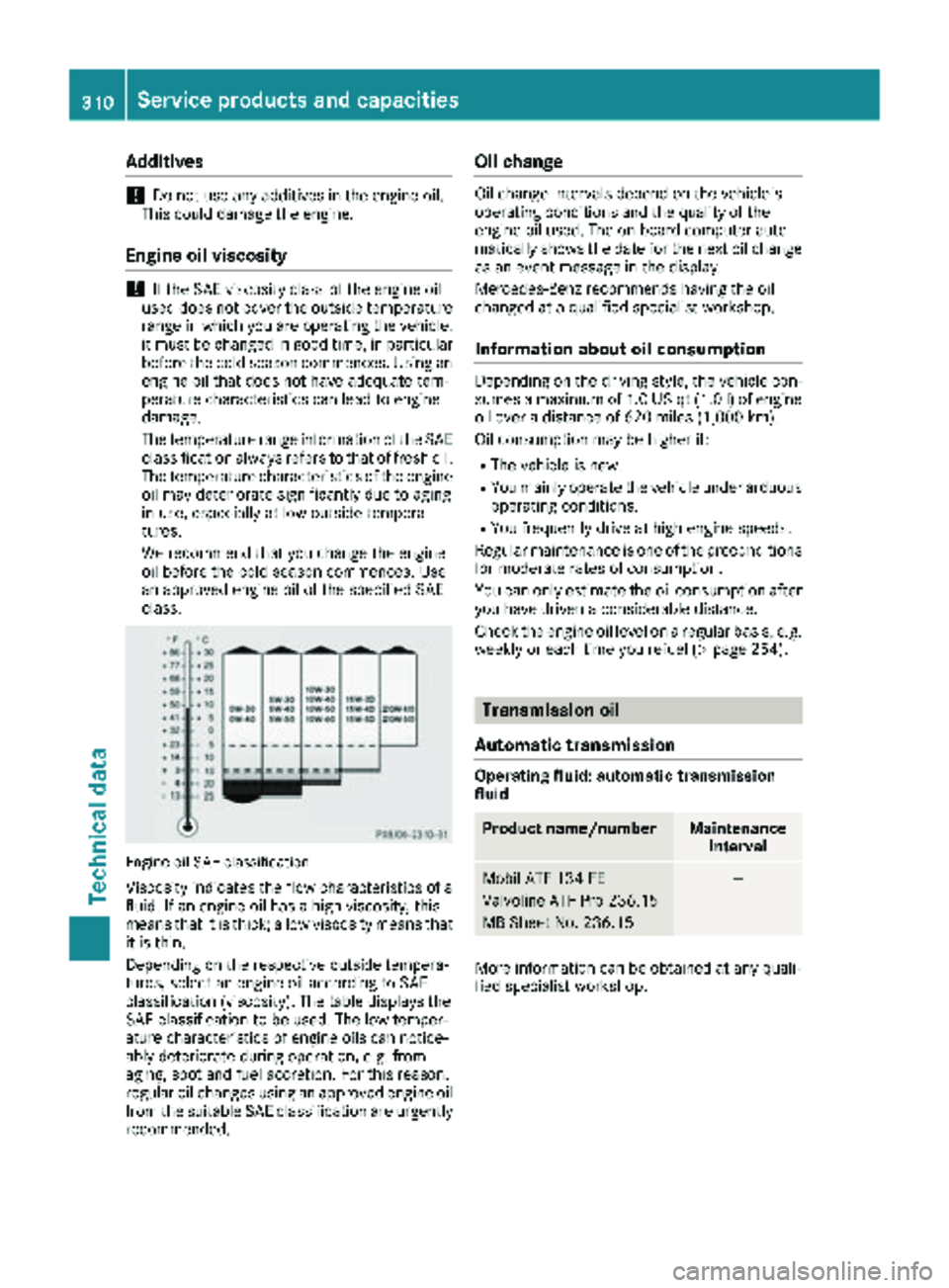
Engin eoil SA Eclassification
Viscosit yindicates th eflo wcharacteristics of a
fluid .If an engin eoil has ahigh viscosity, this
mean sthat it is thick ; alow viscosit ymean sthat
it is thin.
Dependin gon th erespective outside tempera-
tures, select an engin eoil according to SA E
classification (viscosity). The table displays th e
SA Eclassification to be used .The low temper-
atur echaracteristics of engin eoils can notice -
ably deteriorat eduring operation ,e.g. from
aging, soo tand fuel accretion .Fo rthis reason ,
regular oil changes usin gan approve dengin eoil
from th esuitable SA Eclassification are urgently
recommended.
Oil change
Oil chang eintervals depend on th evehicle's
operating condition sand th equalit yof th e
engin eoil used .The on-board computer auto -
matically shows th edat efor th enext oil chang e
as an event message in th edisplay.
Mercedes-Benz recommends having th eoil
changed at aqualified specialist workshop .
Information about oil consump tion
Dependin gon th edrivin gstyle, th evehicl econ-
sumes amaximum of 1. 0US qt (1. 0l)of engine
oil over a distance of 620 miles (1,000 km).
Oil consumption may be higher if:
RThe vehicle is new.
RYou mainly operate the vehicle under arduous
operating conditions.
RYou frequently drive at high engine speeds.
Regular maintenance is one of the preconditions
for moderate rates of consumption.
You can only estimate the oil consumption after
you have driven a considerable distance.
Check the engine oil level on a regular basis, e.g.
weekly or each time you refuel (
Ypage 254).
Transmission oil
Automatic transmission
Operating fluid: automatic transmission
fluid
Product name/numberMaintenance interval
Mobil ATF 134 FE
Valvoline ATF Pro 236.15
MB Sheet No. 236.15—
More information can be obtained at any quali-
fied specialist workshop.
310Service products and capacities
Technical data