tailgate MERCEDES-BENZ ML SUV 2008 User Guide
[x] Cancel search | Manufacturer: MERCEDES-BENZ, Model Year: 2008, Model line: ML SUV, Model: MERCEDES-BENZ ML SUV 2008Pages: 381, PDF Size: 7.18 MB
Page 73 of 381
Opening and closing
70
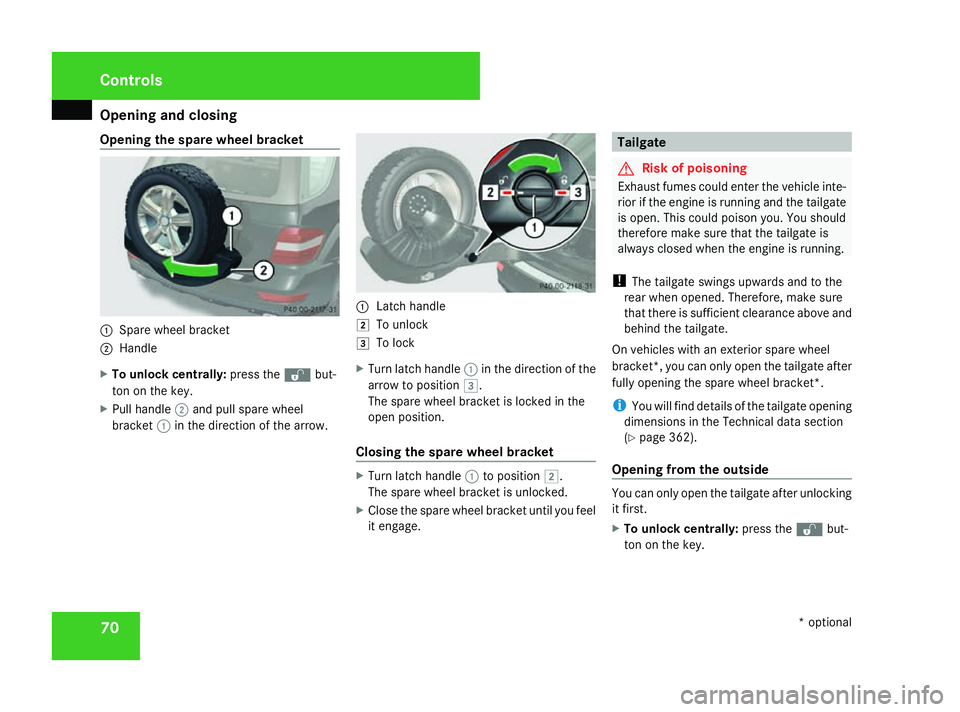
Opening the spare wheel bracket
1
Spare wheel bracket
2 Handle
X To unlock centrally: press theŒbut-
ton on the key.
X Pull handle 2and pull spare wheel
bracket 1in the direction of the arrow. 1
Latch handle
% To unlock
& To lock
X Turn latch handle 1in the direction of the
arrow to position &.
The spare wheel bracket is locked in the
open position.
Closing the spare wheel bracket X
Turn latch handle 1to position %.
The spare wheel bracket is unlocked.
X Close the spare wheel bracket until you feel
it engage. Tailgate
G
Risk of poisoning
Exhaust fumes could enter the vehicle inte-
rior if the engine is running and the tailgate
is open. This could poison you. You should
therefore make sure that the tailgate is
always closed when the engine is running.
! The tailgate swings upwards and to the
rear when opened. Therefore, make sure
that there is sufficient clearance above and
behind the tailgate.
On vehicles with an exterior spare wheel
bracket*, you can only open the tailgate after
fully opening the spare wheel bracket*.
i You will find details of the tailgate opening
dimensions in the Technical data section
(Y page 362).
Opening from the outside You can only open the tailgate after unlocking
it first.
X
To unlock centrally: press thekbut-
ton on the key. Controls
* optional
164_AKB; 5; 5, en-GB
wobuchh,
Version: 2.10.6 2008-05-11T11:55:12+02:00 - Seite 70Dateiname: 6515_4293_02_buchblock.pdf; preflight
Page 74 of 381
Opening and closing
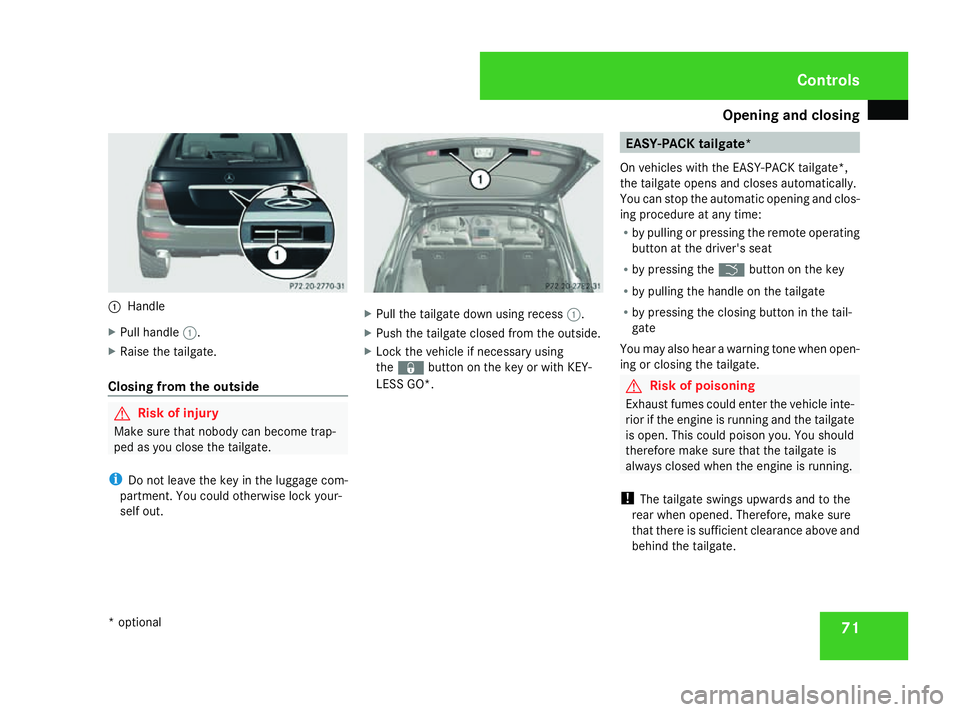
711
Handle
X Pull handle 1.
X Raise the tailgate.
Closing from the outside G
Risk of injury
Make sure that nobody can become trap-
ped as you close the tailgate.
i Do not leave the key in the luggage com-
partment. You could otherwise lock your-
self out. X
Pull the tailgate down using recess 1.
X Push the tailgate closed from the outside.
X Lock the vehicle if necessary using
the j button on the key or with KEY-
LESS GO*. EASY-PACK tailgate*
On vehicles with the EASY-PACK tailgate*,
the tailgate opens and closes automatically.
You can stop the automatic opening and clos-
ing procedure at any time:
R by pulling or pressing the remote operating
button at the driver's seat
R by pressing the ibutton on the key
R by pulling the handle on the tailgate
R by pressing the closing button in the tail-
gate
You may also hear a warning tone when open-
ing or closing the tailgate. G
Risk of poisoning
Exhaust fumes could enter the vehicle inte-
rior if the engine is running and the tailgate
is open. This could poison you. You should
therefore make sure that the tailgate is
always closed when the engine is running.
! The tailgate swings upwards and to the
rear when opened. Therefore, make sure
that there is sufficient clearance above and
behind the tailgate. Controls
* optional
164_AKB; 5; 5, en-GB
wobuchh,
Version: 2.10.6 2008-05-11T11:55:12+02:00 - Seite 71 ZDateiname: 6515_4293_02_buchblock.pdf; preflight
Page 75 of 381
Opening and closing
72
Opening from the outside You can only open the tailgate after unlocking
it first.
X To unlock centrally: press thekbut-
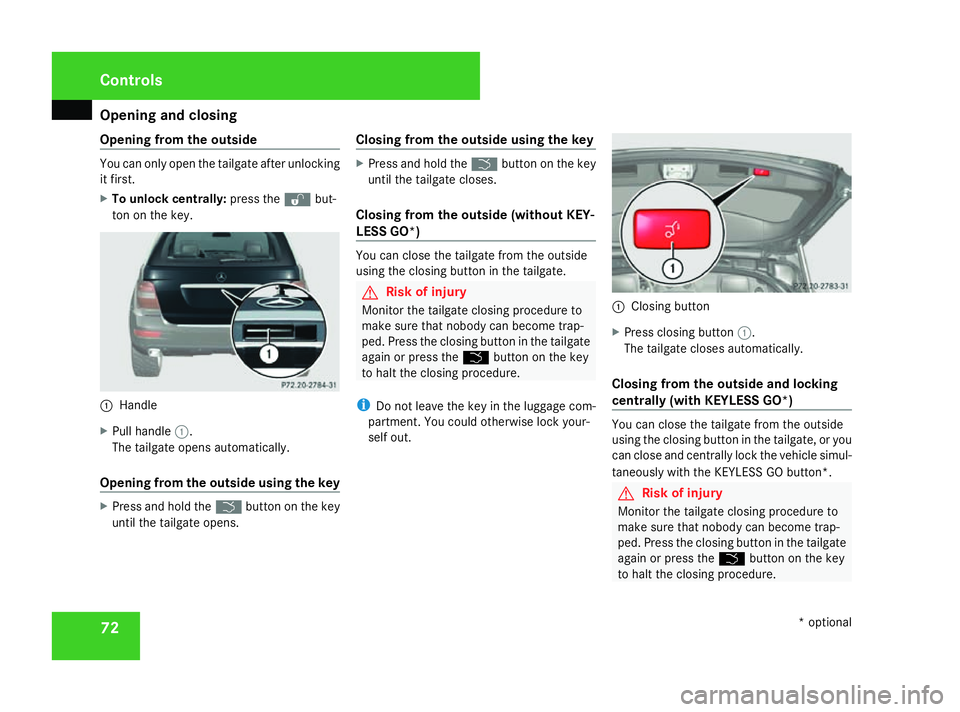
ton on the key. 1
Handle
X Pull handle 1.
The tailgate opens automatically.
Opening from the outside using the key X
Press and hold the ibutton on the key
until the tailgate opens. Closing from the outside using the key X
Press and hold the ibutton on the key
until the tailgate closes.
Closing from the outside (without KEY-
LESS GO*) You can close the tailgate from the outside
using the closing button in the tailgate.
G
Risk of injury
Monitor the tailgate closing procedure to
make sure that nobody can become trap-
ped. Press the closing button in the tailgate
again or press the ibutton on the key
to halt the closing procedure.
i Do not leave the key in the luggage com-
partment. You could otherwise lock your-
self out. 1
Closing button
X Press closing button 1.
The tailgate closes automatically.
Closing from the outside and locking
centrally (with KEYLESS GO*) You can close the tailgate from the outside
using the closing button in the tailgate, or you
can close and centrally lock the vehicle simul-
taneously with the KEYLESS GO button*.
G
Risk of injury
Monitor the tailgate closing procedure to
make sure that nobody can become trap-
ped. Press the closing button in the tailgate
again or press the ibutton on the key
to halt the closing procedure. Controls
* optional
164_AKB; 5; 5, en-GB
wobuchh,
Version: 2.10.6 2008-05-11T11:55:12+02:00 - Seite 72Dateiname: 6515_4293_02_buchblock.pdf; preflight
Page 76 of 381
Opening and closing
73
i
Do not leave the key in the luggage com-
partment. You could otherwise lock your-
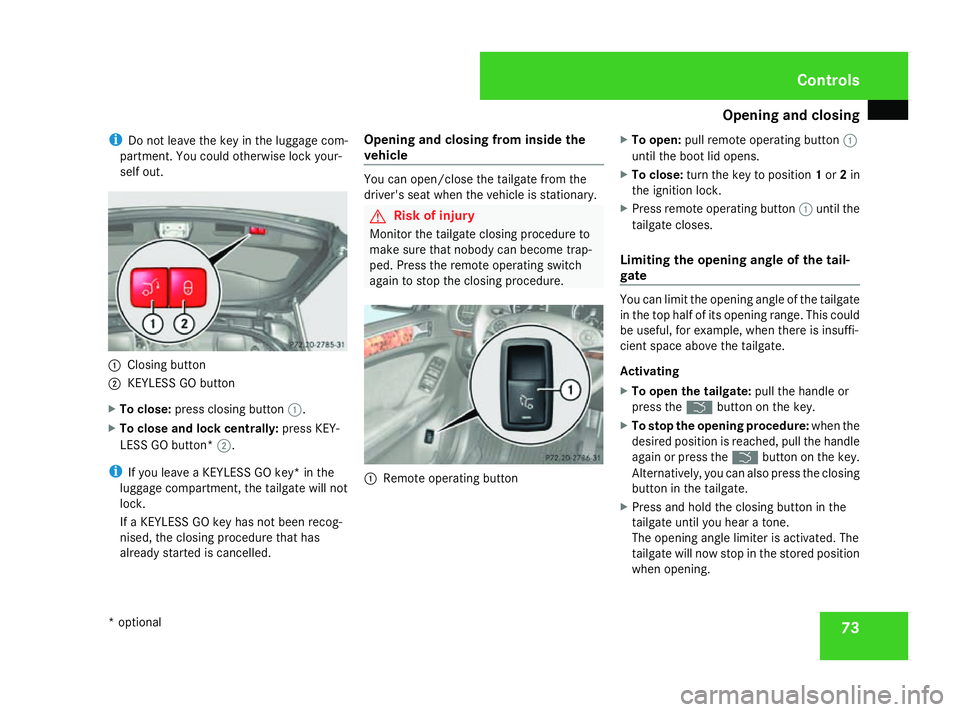
self out. 1
Closing button
2 KEYLESS GO button
X To close: press closing button 1.
X To close and lock centrally: press KEY-
LESS GO button* 2.
i If you leave a KEYLESS GO key* in the
luggage compartment, the tailgate will not
lock.
If a KEYLESS GO key has not been recog-
nised, the closing procedure that has
already started is cancelled. Opening and closing from inside the
vehicle You can open/close the tailgate from the
driver's seat when the vehicle is stationary.
G
Risk of injury
Monitor the tailgate closing procedure to
make sure that nobody can become trap-
ped. Press the remote operating switch
again to stop the closing procedure. 1
Remote operating button X
To open: pull remote operating button 1
until the boot lid opens.
X To close: turn the key to position 1or 2in
the ignition lock.
X Press remote operating button 1until the
tailgate closes.
Limiting the opening angle of the tail-
gate You can limit the opening angle of the tailgate
in the top half of its opening range. This could
be useful, for example, when there is insuffi-
cient space above the tailgate.
Activating
X
To open the tailgate: pull the handle or
press the ibutton on the key.
X To stop the opening procedure: when the
desired position is reached, pull the handle
again or press the ibutton on the key.
Alternatively, you can also press the closing
button in the tailgate.
X Press and hold the closing button in the
tailgate until you hear a tone.
The opening angle limiter is activated. The
tailgate will now stop in the stored position
when opening. Controls
* optional
164_AKB; 5; 5, en-GB
wobuchh,
Version: 2.10.6 2008-05-11T11:55:12+02:00 - Seite 73 ZDateiname: 6515_4293_02_buchblock.pdf; preflight
Page 77 of 381
Opening and closing
74
Deactivating
X
Press and hold the closing button in the
tailgate until you hear two short tones. Automatic locking feature
The vehicle will lock automatically once you
have pulled away.
You can switch off the automatic locking
function via the on-board computer
(Y page 132).
i The vehicle is locked automatically when
the ignition is switched on and the wheels
begin to turn. There is therefore a risk of
being locked out when the vehicle is being
pushed or tested on a dynamometer. Locking/unlocking the vehicle from
the inside
You can centrally lock or unlock the vehicle
from the inside. This feature may be useful if,
for example, you wish to unlock the
passenger door from the inside or lock the
vehicle before you pull away. G
Risk of accident
Do not leave children unsupervised in the
vehicle. They could open a door from the
inside – even if it is locked – and thereby
endanger themselves and others.
i You cannot unlock the vehicle centrally
from the inside if the vehicle has been
locked with the key or the KEYLESS GO
key*.
i It is only possible to lock the vehicle cen-
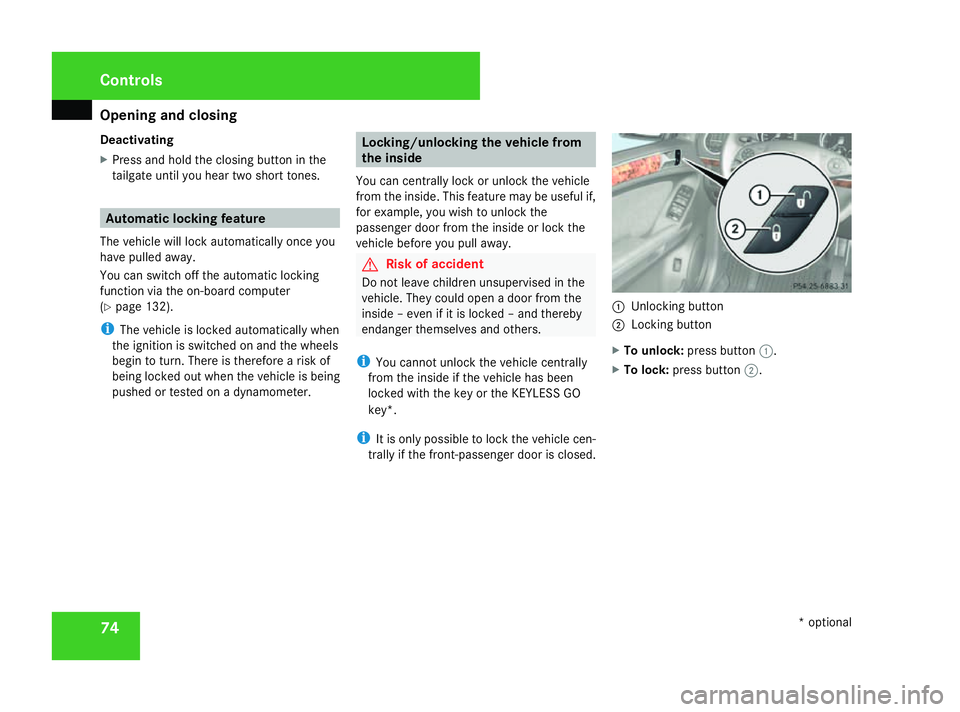
trally if the front-passenger door is closed. 1
Unlocking button
2 Locking button
X To unlock: press button 1.
X To lock: press button 2. Controls
* optional
164_AKB; 5; 5, en-GB
wobuchh,
Version: 2.10.6 2008-05-11T11:55:12+02:00 - Seite 74Dateiname: 6515_4293_02_buchblock.pdf; preflight
Page 170 of 381
Driving sys
tems 167
i
Vehicles without the Off-Road Pro engi-
neering package *that, in addition to Park-
tronic, are also fitted with auxiliary heat-
ing* do not have a Parktronic button.
If Parktronic is activated and you come so
close to an obstacle that three or more indi-
cator segments light up, you will see the
following message in the display: X
To deactivate: press theæorç
button.
The message disappears automatically within
ten seconds. If six segments light up, the
message remains on the display. You see the
message until the èor· buttons are
pressed, or the clearance is increased and
only two segments are then lit. If you come
close to the obstacle again, the message
reappears. Trailer towing* Parktronic is deactivated for the rear area
when you establish an electrical connection
between your vehicle and a trailer.
!
Remove the detachable trailer coupling if
it is no longer required. Parktronic meas-
ures the minimum detection range to an
obstacle from the bumper, not the ball cou-
pling. Reversing camera*
The reversing camera is an optical aid. It
shows the area behind your vehicle in the
COMAND APS display. G
Risk of injury
Make sure that no persons or animals are
in the manoeuvring range. Otherwise, they
could be injured.
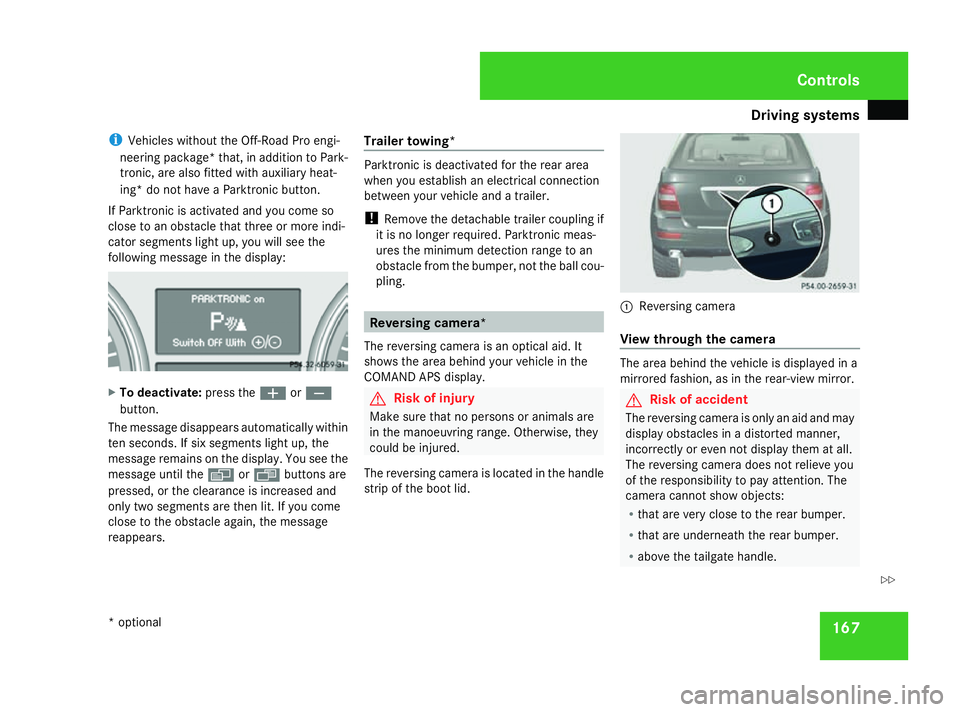
The reversing camera is located in the handle
strip of the boot lid. 1
Reversing camera
View through the camera The area behind the vehicle is displayed in a
mirrored fashion, as in the rear-view mirror.
G
Risk of accident
The reversing camera is only an aid and may
display obstacles in a distorted manner,
incorrectly or even not display them at all.
The reversing camera does not relieve you
of the responsibility to pay attention. The
camera cannot show objects:
R that are very close to the rear bumper.
R that are underneath the rear bumper.
R above the tailgate handle. Controls
* optional
164_AKB; 5; 5, en-GB
wobuchh,
Version: 2.10.6 2008-05-11T11:55:12+02:00 - Seite 167 ZDateiname: 6515_4293_02_buchblock.pdf; preflight
Page 171 of 381
Driving sys
tems 168 You are always responsible for safety and
must continue to pay attention to your
immediate surroundings when parking and
manoeuvring. This applies to the areas
behind, in front of and next to the vehicle.
You could otherwise endanger yourself and
others. G
Risk of accident
Under the following circumstances, the
reversing camera will not function, or func-
tion in a limited manner:
R if the tailgate is open.
R in heavy rain, snow or fog. R
at night or in very dark places.
R if the camera is exposed to very bright
white light.
R if the area is lit by fluorescent light (the
display may flicker).
R if there is a sudden change in tempera-
ture, e.g. when driving into a heated
garage in winter.
R if the camera lens is dirty or obstructed.
R if the rear of your vehicle is damaged.
Have the camera position and setting
checked at a qualified specialist work- shop in this case. Mercedes-Benz recom-
mends that you use a Mercedes-Benz
Service Centre for this purpose.
Do not use the reversing camera in these
types of situation. You could otherwise
injure others or damage objects and your
vehicle while you are parking.
Activating the reversing camera X
Make sure that the key is in position 2in
the ignition lock.
X Engage reverse gear.
The area behind the vehicle is shown in the
COMAND APS display. Controls
164_AKB; 5; 5, en-GB
wobuchh
,V ersion: 2.10.6
2008-05-11T11:55:12+02:00 - Seite 168 Dateiname: 6515_4293_02_buchblock.pdf; preflight
Page 194 of 381
Loading and stowing
191roof load of 100 kg. Always adapt your driv-
ing style to the prevailing road, traffic and
weather conditions and drive with particu-
lar care if the roof is laden.
! Mercedes-Benz recommends that you
only use roof rack systems which have
been tested and approved for Mercedes-
Benz vehicles. This helps to prevent dam-
age to the vehicle.
Position the load on the roof rack in such a
way that the vehicle will not sustain dam-
age even when it is in motion.
Depending on the vehicle's equipment,
make sure that you can:
R raise the sliding/tilting sunroof* fully
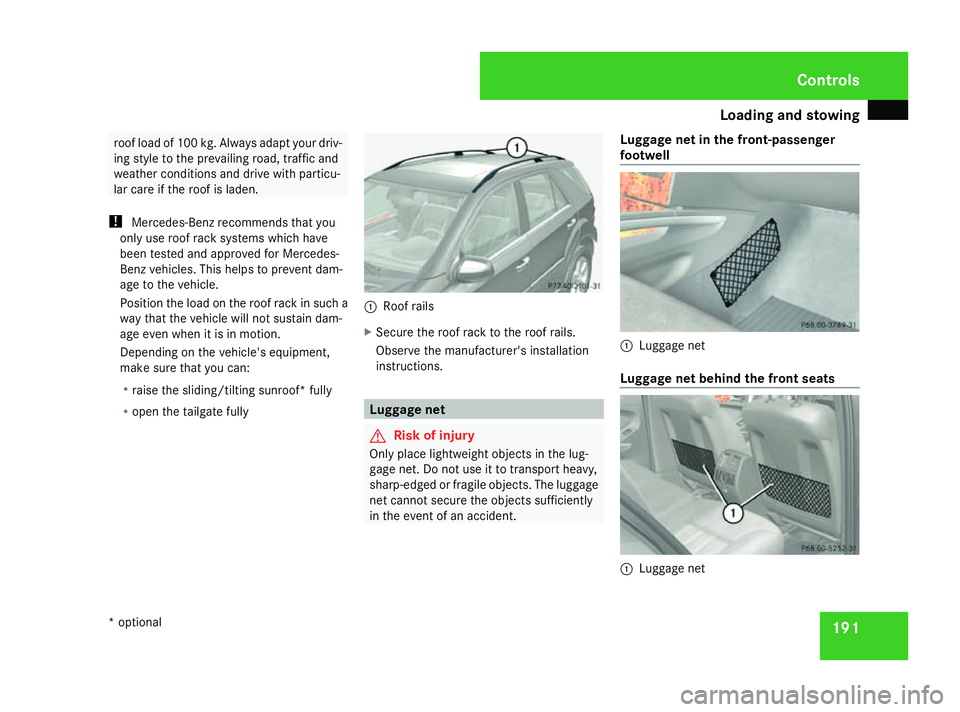
R open the tailgate fully 1
Roof rails
X Secure the roof rack to the roof rails.
Observe the manufacturer's installation
instructions. Luggage net
G
Risk of injury
Only place lightweight objects in the lug-
gage net. Do not use it to transport heavy,
sharp-edged or fragile objects. The luggage
net cannot secure the objects sufficiently
in the event of an accident. Luggage net in the front-passenger
footwell
1
Luggage net
Luggage net behind the front seats 1
Luggage net Controls
* optional
164_AKB; 5; 5, en-GB
wobuchh,
Version: 2.10.6 2008-05-11T11:55:12+02:00 - Seite 191 ZDateiname: 6515_4293_02_buchblock.pdf; preflight
Page 195 of 381
Loading and stowing
192 Loading guidelines
G
Risk of injury
Secure and position the load as described
in the loading guidelines.
Otherwise, vehicle occupants could
be injured by the load being thrown around
in the event of sharp braking, a sudden
change in direction or an accident. This also
applies to seats which have been removed.
You will find further information in the
"Securing a load" section.
Even if you follow all the loading guidelines,
the load will increase the risk of injury in the
event of an accident. G
Risk of poisoning
Keep the tailgate closed when the engine is
running. Otherwise, you could be poisoned
by exhaust fumes entering the vehicle.
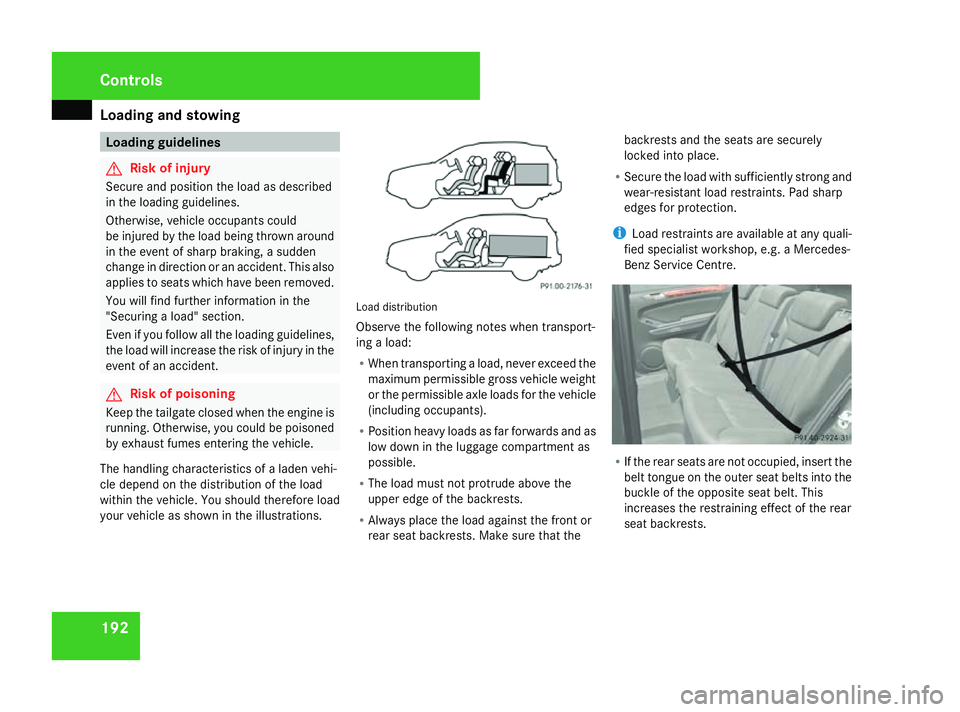
The handling characteristics of a laden vehi-
cle depend on the distribution of the load
within the vehicle. You should therefore load
your vehicle as shown in the illustrations. Load distribution
Observe the following notes when transport-
ing a load:
R
When transporting a load, never exceed the
maximum permissible gross vehicle weight
or the permissible axle loads for the vehicle
(including occupants).
R Position heavy loads as far forwards and as
low down in the luggage compartment as
possible.
R The load must not protrude above the
upper edge of the backrests.
R Always place the load against the front or
rear seat backrests. Make sure that the backrests and the seats are securely
locked into place.
R Secure the load with sufficiently strong and
wear-resistant load restraints. Pad sharp
edges for protection.
i Load restraints are available at any quali-
fied specialist workshop, e.g. a Mercedes-
Benz Service Centre. R
If the rear seats are not occupied, insert the
belt tongue on the outer seat belts into the
buckle of the opposite seat belt. This
increases the restraining effect of the rear
seat backrests. Controls
164_AKB; 5; 5, en-GB
wobuchh,
Version: 2.10.6 2008-05-11T11:55:12+02:00 - Seite 192Dateiname: 6515_4293_02_buchblock.pdf; preflight
Page 197 of 381
Loading and stowing
194
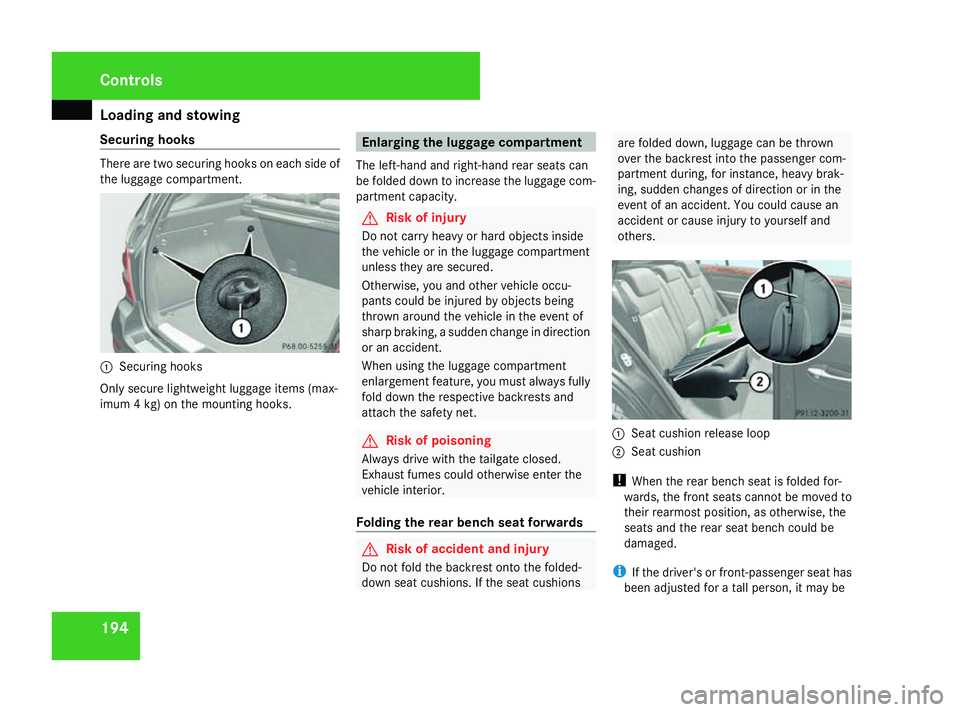
Securing hooks There are two securing hooks on each side of
the luggage compartment. 1
Securing hooks
Only secure lightweight luggage items (max-
imum 4 kg) on the mounting hooks. Enlarging the luggage compartment
The left-hand and right-hand rear seats can
be folded down to increase the luggage com-
partment capacity. G
Risk of injury
Do not carry heavy or hard objects inside
the vehicle or in the luggage compartment
unless they are secured.
Otherwise, you and other vehicle occu-
pants could be injured by objects being
thrown around the vehicle in the event of
sharp braking, a sudden change in direction
or an accident.
When using the luggage compartment
enlargement feature, you must always fully
fold down the respective backrests and
attach the safety net. G
Risk of poisoning
Always drive with the tailgate closed.
Exhaust fumes could otherwise enter the
vehicle interior.
Folding the rear bench seat forwards G
Risk of accident and injury
Do not fold the backrest onto the folded-
down seat cushions. If the seat cushions are folded down, luggage can be thrown
over the backrest into the passenger com-
partment during, for instance, heavy brak-
ing, sudden changes of direction or in the
event of an accident. You could cause an
accident or cause injury to yourself and
others.
1
Seat cushion release loop
2 Seat cushion
! When the rear bench seat is folded for-
wards, the front seats cannot be moved to
their rearmost position, as otherwise, the
seats and the rear seat bench could be
damaged.
i If the driver's or front-passenger seat has
been adjusted for a tall person, it may be Controls
164_AKB; 5; 5, en-GB
wobuchh,
Version: 2.10.6 2008-05-11T11:55:12+02:00 - Seite 194Dateiname: 6515_4293_02_buchblock.pdf; preflight