technical data MERCEDES-BENZ ML SUV 2008 User Guide
[x] Cancel search | Manufacturer: MERCEDES-BENZ, Model Year: 2008, Model line: ML SUV, Model: MERCEDES-BENZ ML SUV 2008Pages: 381, PDF Size: 7.18 MB
Page 21 of 381
Operating safety
18
It is advisable to register your vehicle with a
Mercedes-Benz Service Centre.
Inform Mercedes-Benz as soon as possible
about any change in address or vehicle own-
ership. Correct use
Observe the following information when using
your vehicle:
R The safety notes in this manual
R The "Technical data" section in this manual
R national road traffic regulations
R national road traffic licensing regulations G
Risk of injury
Various warning stickers are affixed to your
vehicle. Their purpose is to draw your atten-
tion, and the attention of others, to various
dangers. Therefore, do not remove any
warning stickers unless the sticker clearly
states that you may do so.
If you remove the warning stickers, you or
others could be injured by failing to recog-
nise certain dangers. Introduction
164_AKB; 5; 5, en-GB
wobuchh,
Version: 2.10.6 2008-05-11T11:55:12+02:00 - Seite 18Dateiname: 6515_4293_02_buchblock.pdf; preflight
Page 73 of 381
Opening and closing
70
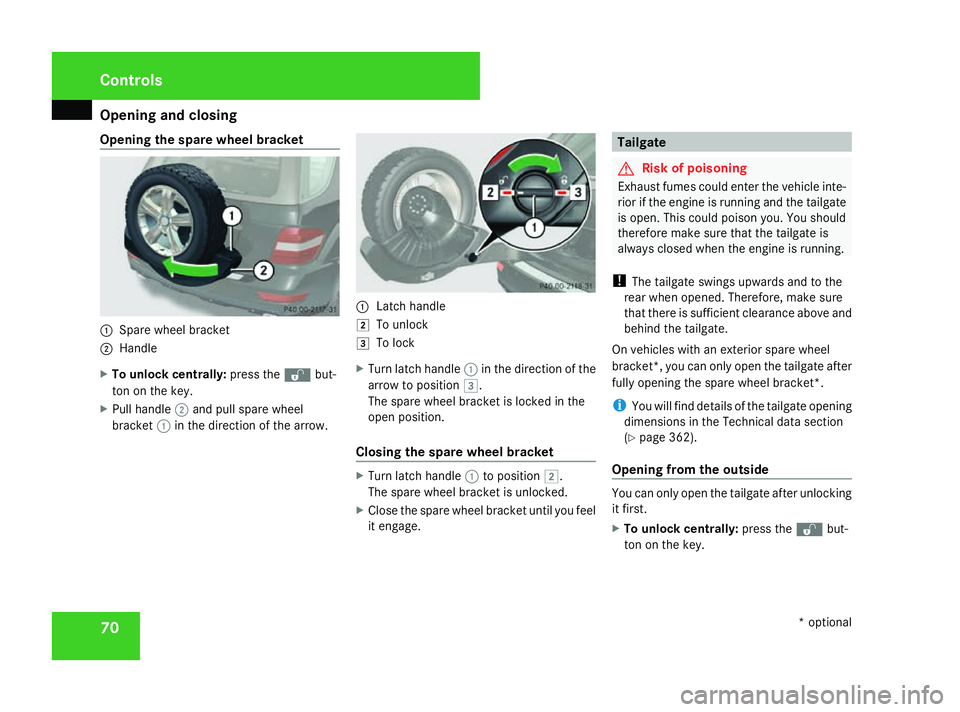
Opening the spare wheel bracket
1
Spare wheel bracket
2 Handle
X To unlock centrally: press theŒbut-
ton on the key.
X Pull handle 2and pull spare wheel
bracket 1in the direction of the arrow. 1
Latch handle
% To unlock
& To lock
X Turn latch handle 1in the direction of the
arrow to position &.
The spare wheel bracket is locked in the
open position.
Closing the spare wheel bracket X
Turn latch handle 1to position %.
The spare wheel bracket is unlocked.
X Close the spare wheel bracket until you feel
it engage. Tailgate
G
Risk of poisoning
Exhaust fumes could enter the vehicle inte-
rior if the engine is running and the tailgate
is open. This could poison you. You should
therefore make sure that the tailgate is
always closed when the engine is running.
! The tailgate swings upwards and to the
rear when opened. Therefore, make sure
that there is sufficient clearance above and
behind the tailgate.
On vehicles with an exterior spare wheel
bracket*, you can only open the tailgate after
fully opening the spare wheel bracket*.
i You will find details of the tailgate opening
dimensions in the Technical data section
(Y page 362).
Opening from the outside You can only open the tailgate after unlocking
it first.
X
To unlock centrally: press thekbut-
ton on the key. Controls
* optional
164_AKB; 5; 5, en-GB
wobuchh,
Version: 2.10.6 2008-05-11T11:55:12+02:00 - Seite 70Dateiname: 6515_4293_02_buchblock.pdf; preflight
Page 223 of 381
Engine compartment
220 Make sure that the windscreen wipers are
switched off and that the key has been
pulled out of the ignition lock before open-
ing the bonnet.
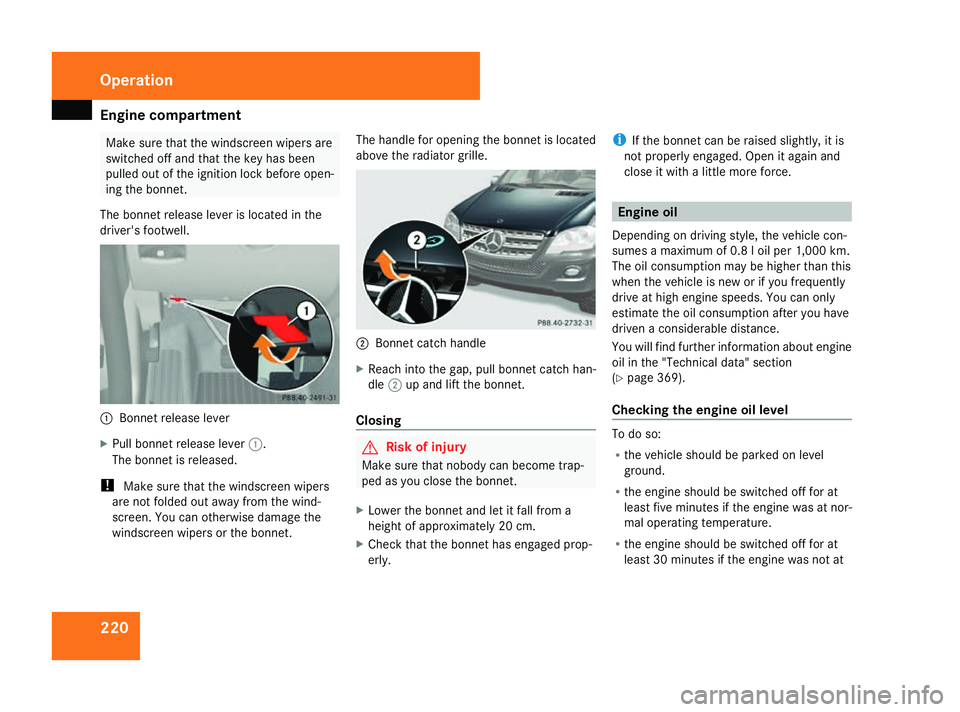
The bonnet release lever is located in the
driver's footwell. 1
Bonnet release lever
X Pull bonnet release lever 1.
The bonnet is released.
! Make sure that the windscreen wipers
are not folded out away from the wind-
screen. You can otherwise damage the
windscreen wipers or the bonnet. The handle for opening the bonnet is located
above the radiator grille.
2
Bonnet catch handle
X Reach into the gap, pull bonnet catch han-
dle 2up and lift the bonnet.
Closing G
Risk of injury
Make sure that nobody can become trap-
ped as you close the bonnet.
X Lower the bonnet and let it fall from a
height of approximately 20 cm.
X Check that the bonnet has engaged prop-
erly. i
If the bonnet can be raised slightly, it is
not properly engaged. Open it again and
close it with a little more force. Engine oil
Depending on driving style, the vehicle con-
sumes a maximum of 0.8 l oil per 1,000 km.
The oil consumption may be higher than this
when the vehicle is new or if you frequently
drive at high engine speeds. You can only
estimate the oil consumption after you have
driven a considerable distance.
You will find further information about engine
oil in the "Technical data" section
(Y page 369).
Checking the engine oil level To do so:
R
the vehicle should be parked on level
ground.
R the engine should be switched off for at
least five minutes if the engine was at nor-
mal operating temperature.
R the engine should be switched off for at
least 30 minutes if the engine was not at Operation
164_AKB; 5; 5, en-GB
wobuchh,
Version: 2.10.6 2008-05-11T11:55:12+02:00 - Seite 220Dateiname: 6515_4293_02_buchblock.pdf; preflight
Page 226 of 381
Engine compartment
223Coolant
G
Risk of injury
The cooling system is pressurised. There-
fore, only unscrew the cap once the engine
has cooled down. The coolant temperature
gauge must display less than 70 °C. You
could otherwise be scalded by escaping hot
coolant.
Coolant consists of water and antifreeze/cor-
rosion inhibitor. Only check the coolant level
when the vehicle is on a level surface and the
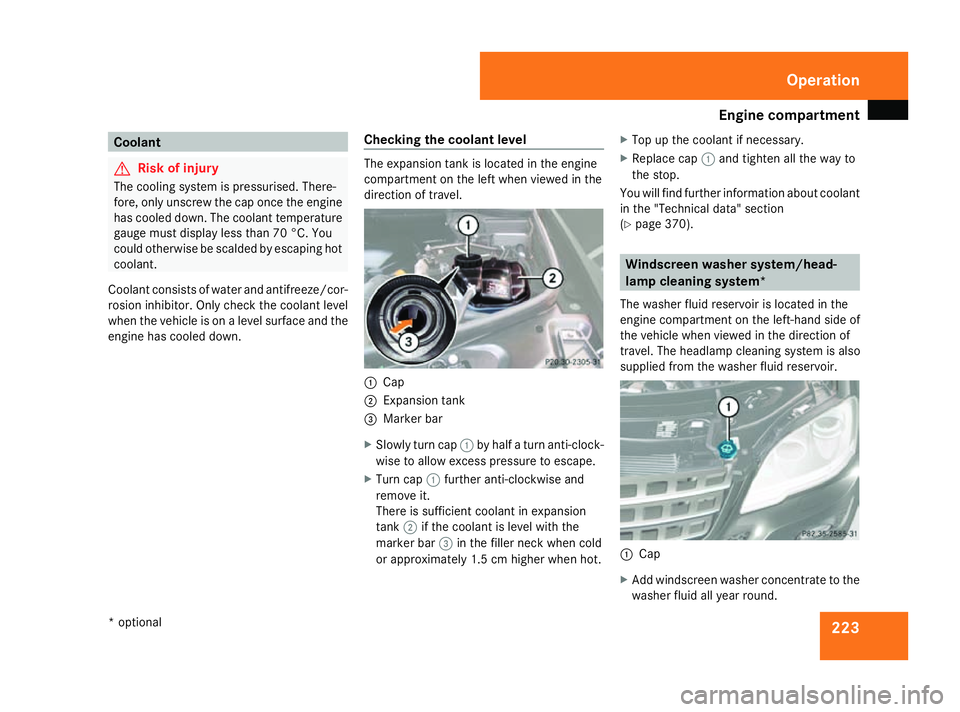
engine has cooled down. Checking the coolant level The expansion tank is located in the engine
compartment on the left when viewed in the
direction of travel. 1
Cap
2 Expansion tank
3 Marker bar
X Slowly turn cap 1by half a turn anti-clock-
wise to allow excess pressure to escape.
X Turn cap 1further anti-clockwise and
remove it.
There is sufficient coolant in expansion
tank 2if the coolant is level with the
marker bar 3in the filler neck when cold
or approximately 1.5 cm higher when hot. X
Top up the coolant if necessary.
X Replace cap 1and tighten all the way to
the stop.
You will find further information about coolant
in the "Technical data" section
(Y page 370). Windscreen washer system/head-
lamp cleaning system*
The washer fluid reservoir is located in the
engine compartment on the left-hand side of
the vehicle when viewed in the direction of
travel. The headlamp cleaning system is also
supplied from the washer fluid reservoir. 1
Cap
X Add windscreen washer concentrate to the
washer fluid all year round. Operation
* optional
164_AKB; 5; 5, en-GB
wobuchh,
Version: 2.10.6 2008-05-11T11:55:12+02:00 - Seite 223 ZDateiname: 6515_4293_02_buchblock.pdf; preflight
Page 229 of 381
Tyres and wheels
226
i
You may fit a spare tyre* against the
direction of rotation. MOExtended run-flat system*
The MOExtended run-flat system allows you
to continue driving the vehicle even when one
or more tyres lose all air pressure.
The MOExtended run-flat system may only be
used in conjunction with the tyre pressure
loss warning system or the tyre pressure
monitor* and on wheels specifically tested by
Mercedes-Benz.
i Vehicles with MOExtended run-flat sys-
tem are not equipped with the TIREFIT
kit* 24
.
It is therefore recommended to additionally
equip your vehicle with the TIREFIT kit*
when fitting tyres that do not feature run-
flat properties, e.g. winter tyres.
i A TIREFIT kit* is available from any quali-
fied specialist workshop, e.g. a Mercedes-
Benz Service Centre. You will find notes on driving with a flat tyre
in the "Practical advice" section
(Y
page 333). Tyre tread
G
Risk of accident
Bear in mind that:
R tyre grip decreases rapidly on wet roads
when the tread depth is less than 3 mm.
You should thus replace tyres that have
insufficient tread.
R winter tyres should be replaced when the
tread depth is 4 mm or less because oth-
erwise they no longer provide adequate
grip.
R the tread on a tyre may not wear evenly.
You should thus regularly check the tread
depth and the condition of the tread
across the entire width of all tyres. If nec-
essary, turn the steering wheel so that
you can see the tyre tread more easily.
You could otherwise lose control of the
vehicle and cause an accident due to the
reduced grip of the tyres on the road. Tyre pressures
i You will find a table of tyre pressures for
various operating conditions on the inside
of your vehicle's fuel filler flap
(Y page 216).
The valid value for the spare wheel* is sta-
ted on the spare wheel and in the technical
data section. G
Risk of accident
Tyre pressure that is either too high or too
low has a negative effect on the vehicle’s
driving safety, which could lead you to
cause an accident. You should therefore
regularly check the pressure of all your
tyres (including the spare tyre*), particu-
larly prior to long trips, and correct the
pressure as necessary.
To test tyre pressure, use a suitable pressure
gauge. The outer appearance of a tyre does
not permit any reliable conclusion about the
tyre pressure. On vehicles fitted with the elec-
tronic tyre pressure monitor*, the tyre pres-
sure can be checked in the on-board com-
puter.
24 Only for certain countries Operation
* optional
164_AKB; 5; 5, en-GB
wobuchh
,V ersion: 2.10.6
2008-05-11T11:55:12+02:00 - Seite 226 Dateiname: 6515_4293_02_buchblock.pdf; preflight
Page 246 of 381
Trailer towing*
243
X
Close the doors and tailgate.
X Secure the trailer against rolling away. G
Risk of injury
The vehicle is lowered as soon as you dis-
connect the trailer cable. Make sure that
nobody is in the vicinity of the wheel arch
or the underbody. You could otherwise trap
yourself or others.
As soon as you decouple the trailer, the
unladen vehicle rises slightly. Make sure
that you or others are not injured in the
process.
X Remove the trailer cable and decouple the
trailer.
X Switch off the engine. Notes on towing a trailer
G
Risk of accident
When reversing the vehicle towards the
trailer, make sure there is nobody between
the trailer and the vehicle.
Couple and uncouple the trailer carefully. If
you do not couple the trailer to the towing
vehicle correctly, the trailer could become
detached.
Make sure that the following values are not
exceeded:
R The permitted trailer drawbar nose-
weight
R The permitted trailer load
R The permitted rear axle load of the towing
vehicle
R The maximum permissible gross vehicle
weight of both the towing vehicle and the
trailer
You will find the applicable permissible val-
ues which must not be exceeded in the
vehicle documents.
You will find the values approved by the
manufacturer on the vehicle identification
plates and those for the towing vehicle in
the "Technical data" section. You will find installation dimensions and loads
in the "Technical data" section
(Y page 365).
The maximum permissible trailer drawbar
noseweight on the ball coupling is 140 kg.
However, the actual noseweight must not
exceed the value given on the trailer coupling
and trailer identification plates. The lowest
weight applies.
! Use a noseweight as close as possible to
the maximum permissible noseweight. Do
not use a noseweight of less than 50 kg,
otherwise the trailer may come loose.
Bear in mind that the payload and the rear
axle load are reduced by the actual nose-
weight.
i On vehicles without level control, the
height of the ball coupling will alter accord-
ing to the load placed on the vehicle. In this
case, you should use a trailer with a height-
adjustable drawbar.
Driving tips i
Observe the notes on ESP ®
trailer stabi-
lisation (Y page 59).
In Germany, the maximum permitted speed
for vehicle/trailer combinations is 80 km/h. Operation
* optional
164_AKB; 5; 5, en-GB
wobuchh
,V ersion: 2.10.6
2008-05-11T11:55:12+02:00 - Seite 243 ZDateiname: 6515_4293_02_buchblock.pdf; preflight
Page 350 of 381
347
Notes on the technical data
.............348
Genuine Mercedes-Benz parts .........348
Vehicle electronics ...........................349
Vehicle identification plates ............350
Engine ................................................ 352
Performance ...................................... 353
Tyres and wheels .............................. 354
Vehicle dimensions ..........................361
Vehicle weights ................................. 363
Trailer coupling* ............................... 365
Service products and capacities .....366
Frequencies for garage door open-
ers* .................................................... 373 Technical data
164_AKB; 5; 5, en-GB
wobuchh,
Version: 2.10.6
2008-05-11T11:55:12+02:00 - Seite 347 Dateiname: 6515_4293_02_buchblock.pdf; preflight
Page 351 of 381
Genuine Mercedes-Benz parts
348 Notes on the technical data
i The technical data was determined in
accordance with EU directives. All data
applies to the vehicle's standard equip-
ment. The data may therefore differ for
vehicles with optional equipment. You can
obtain further information from a
Mercedes-Benz Service Centre. Genuine Mercedes-Benz parts
Mercedes-Benz tests genuine parts and con-
version parts and accessories which have
been specifically approved for your vehicle for
their reliability, safety and suitability. Despite
ongoing market research, Mercedes-Benz is
unable to evaluate other parts. Mercedes-
Benz therefore accepts no responsibility for
the use of such parts in Mercedes-Benz vehi-
cles, even if they have been independently or
officially approved.
In Germany and some other countries, certain
parts are only officially approved for installa-
tion or modification if they comply with legal
requirements. All genuine Mercedes-Benz
parts meet this requirement. The use of non-
approved parts may invalidate the vehicle's
general operating permit. This is the case if:
R they cause a change of the vehicle type
from that for which the vehicle's general
operating permit was granted
R other road users could be endangered
R the emission or noise levels are adversely
affected
The use of non-approved parts could affect
your vehicle's operating safety. Mercedes-
Benz therefore recommends genuine Mercedes-Benz parts and conversion parts
and accessories that have been approved for
your vehicle. H
Environmental note
Daimler also supplies reconditioned
assemblies and parts which are of the same
quality as new parts. These parts have the
same warranty as new parts.
Genuine Mercedes-Benz parts and approved
conversion parts and accessories are availa-
ble from Mercedes-Benz Service Centres.
There, you can also receive advice about tech-
nical modifications and have the parts pro-
fessionally fitted.
Always quote the vehicle identification num-
ber and the engine number when ordering
genuine parts. You will find these numbers on
the vehicle data card in the Service Booklet
or on your vehicle's identification plates
(Y page 350). Technical data
164_AKB; 5; 5, en-GB
wobuchh,
Version: 2.10.6 2008-05-11T11:55:12+02:00 - Seite 348Dateiname: 6515_4293_02_buchblock.pdf; preflight
Page 352 of 381
Vehicle electronics
349Vehicle electronics
Tampering with the engine electron-
ics
G
Risk of accident
Only have work on the engine electronics
and related components carried out at a
qualified specialist workshop which has the
necessary specialist knowledge and tools
to carry out the work required. Mercedes-
Benz recommends that you use a
Mercedes-Benz Service Centre for this pur-
pose. In particular, work relevant to safety
or on safety-related systems must be car-
ried out at a qualified specialist workshop.
The vehicle's roadworthiness could other-
wise be affected.
! Only have work done on the engine elec-
tronics and its associated parts, such as
control units, sensors and connector leads,
carried out at a qualified specialist work-
shop, e.g. a Mercedes-Benz Service
Centre. Otherwise, vehicle components
may wear more quickly and your vehicle's
warranty and operating permit may be inva-
lidated. Retrofitting electrical and electronic
equipment
Electrical and electronic equipment can jeop-
ardise the operating safety of your vehicle. If
equipment of this kind is retrofitted, it must
be type-approved and bear the emark. The
e mark may be obtained from the equipment
manufacturer or an authorised testing centre.
! Damage or consequential damage arising
from fitting equipment not approved
by Mercedes-Benz is not covered by the
Mercedes-Benz warranty.
If you wish to install two-way radios in the
vehicle, you must obtain formal approval.
Mercedes-Benz approves the installation of
two-way radios if such equipment is installed
professionally and a low-reflection exterior
aerial is used.
The transmission output of the two-way radio
must not exceed the maximum transmission
outputs listed. G
Risk of accident
Two-way radios may interfere with the vehi-
cle electronics and thereby jeopardise the
operational safety of the vehicle and your
own safety if: R
they do not have an exterior aerial
R the exterior aerial is not a low-reflection
aerial
R the exterior aerial has been fitted incor-
rectly G
Risk of injury
Excessive electromagnetic radiation may
also cause damage to your health and the
health of others. Using an exterior aerial
takes into account current scientific dis-
cussions relating to the possible health haz-
ards that may result from electromagnetic
fields.
For this reason, only have the exterior aerial
fitted at a qualified specialist workshop
which has the necessary specialist knowl-
edge and tools to carry out the work
required. Mercedes-Benz recommends
that you use a Mercedes-Benz Service
Centre for this purpose. In particular, work
relevant to safety or on safety-related sys-
tems must be carried out at a qualified
specialist workshop.
i Mercedes-Benz recommends the use of
an approved exterior aerial. This ensures
optimal reception quality for mobile tele- Technical data
164_AKB; 5; 5, en-GB
wobuchh
,V ersion: 2.10.6
2008-05-11T11:55:12+02:00 - Seite 349 ZDateiname: 6515_4293_02_buchblock.pdf; preflight
Page 353 of 381
Vehicle identification plates
350phones/wireless devices in the vehicle.
This also ensures that interference
between these devices and the vehicle's
electronics is kept to a minimum. If instal-
led, the exterior aerial conducts the elec-
tromagnetic fields transmitted by a mobile
phone to the exterior of the vehicle. Frequency range Maximum trans-
mission output
(watts)
Short wave
(< 50 MHz) 100
4 m waveband 20
2 m waveband 50
70 cm waveband 35
25 cm waveband 10
!
If electrical or electronic equipment
which does not comply with the above
installation conditions is operated inside
the vehicle, the vehicle's operating permit
may be invalidated (EU Directive
95/54/EC) - Automotive EMC directive) Vehicle identification plates
Vehicle identification plate with vehi-
cle identification number (VIN) and
paint code number
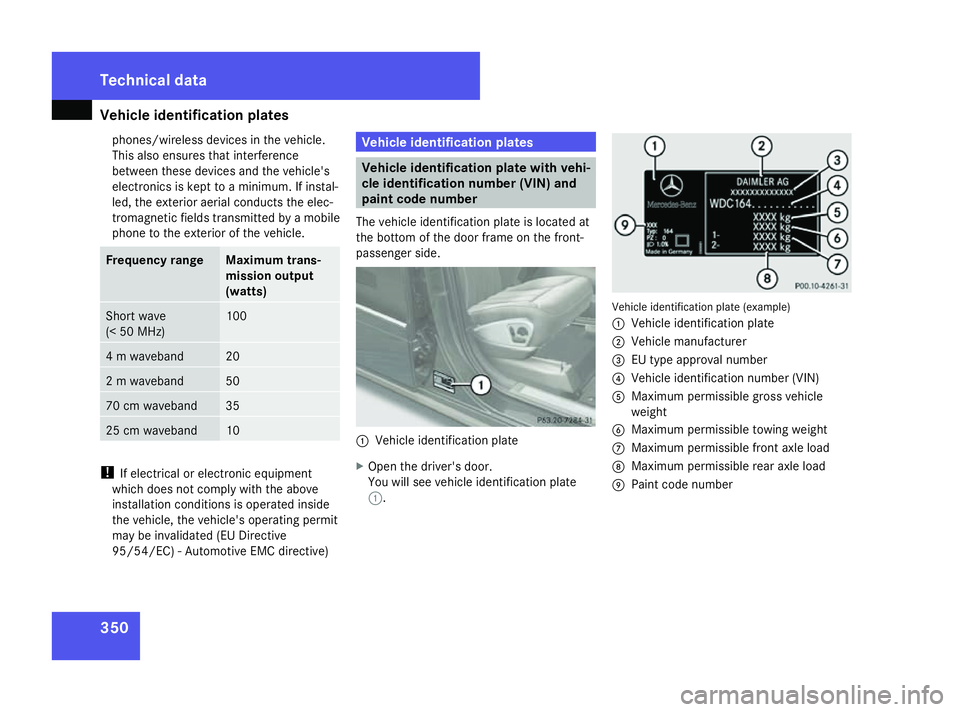
The vehicle identification plate is located at
the bottom of the door frame on the front-
passenger side. 1
Vehicle identification plate
X Open the driver's door.
You will see vehicle identification plate
1. Vehicle identification plate (example)
1
Vehicle identification plate
2 Vehicle manufacturer
3 EU type approval number
4 Vehicle identification number (VIN)
5 Maximum permissible gross vehicle
weight
6 Maximum permissible towing weight
7 Maximum permissible front axle load
8 Maximum permissible rear axle load
9 Paint code number Technical data
164_AKB; 5; 5, en-GB
wobuchh
,V ersion: 2.10.6
2008-05-11T11:55:12+02:00 - Seite 350 Dateiname: 6515_4293_02_buchblock.pdf; preflight