keyless MERCEDES-BENZ ML SUV 2008 Owner's Guide
[x] Cancel search | Manufacturer: MERCEDES-BENZ, Model Year: 2008, Model line: ML SUV, Model: MERCEDES-BENZ ML SUV 2008Pages: 381, PDF Size: 7.18 MB
Page 284 of 381
Display
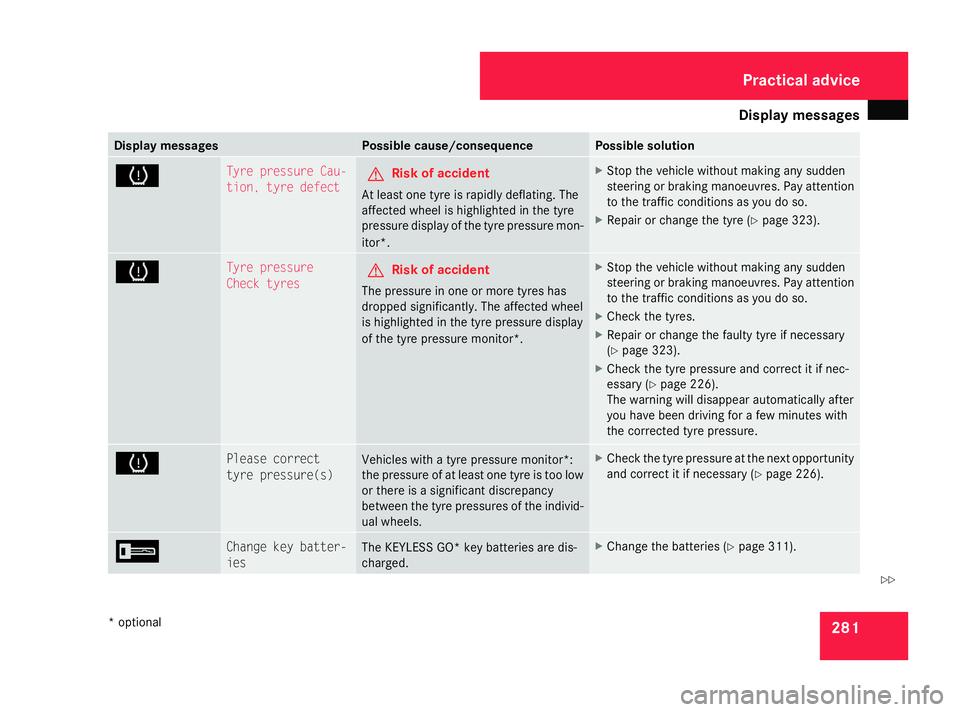
messages 281Display messages Possible cause/consequence Possible solution
H Tyre pressure Cau-
tion, tyre defect G
Risk of accident
At least one tyre is rapidly deflating. The
affected wheel is highlighted in the tyre
pressure display of the tyre pressure mon-
itor*. X
Stop the vehicle without making any sudden
steering or braking manoeuvres. Pay attention
to the traffic conditions as you do so.
X Repair or change the tyre (Y page 323).H Tyre pressure
Check tyres G
Risk of accident
The pressure in one or more tyres has
dropped significantly. The affected wheel
is highlighted in the tyre pressure display
of the tyre pressure monitor*. X
Stop the vehicle without making any sudden
steering or braking manoeuvres. Pay attention
to the traffic conditions as you do so.
X Check the tyres.
X Repair or change the faulty tyre if necessary
(Y page 323).
X Check the tyre pressure and correct it if nec-
essary (Y page 226).
The warning will disappear automatically after
you have been driving for a few minutes with
the corrected tyre pressure. H Please correct
tyre pressure(s) Vehicles with a tyre pressure monitor*:
the pressure of at least one tyre is too low
or there is a significant discrepancy
between the tyre pressures of the individ-
ual wheels. X
Check the tyre pressure at the next opportunity
and correct it if necessary ( Ypage 226). I Change key batter-
ies The KEYLESS GO* key batteries are dis-
charged. X
Change the batteries (Y page 311). Practical advi
ce
* optional
164_AKB; 5; 5, en-GB
wobuchh,
Version: 2.10.6 2008-05-11T11:55:12+02:00 - Seite 281 ZDateiname: 6515_4293_02_buchblock.pdf; preflight
Page 285 of 381
Display
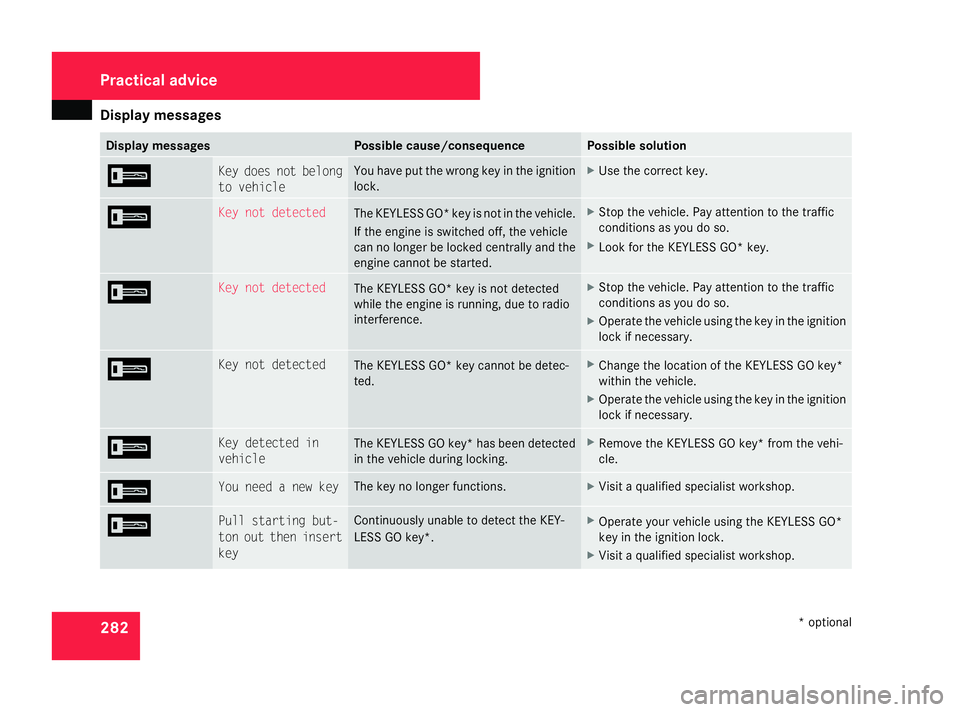
messages 282 Display messages Possible cause/consequence Possible solution
I Key does not belong
to vehicle You have put the wrong key in the ignition
lock. X
Use the correct key. I Key not detected
The KEYLESS GO* key is not in the vehicle.
If the engine is switched off, the vehicle
can no longer be locked centrally and the
engine cannot be started. X
Stop the vehicle. Pay attention to the traffic
conditions as you do so.
X Look for the KEYLESS GO *key. I Key not detected
The KEYLESS GO* key is not detected
while the engine is running, due to radio
interference. X
Stop the vehicle. Pay attention to the traffic
conditions as you do so.
X Operate the vehicle using the key in the ignition
lock if necessary. I Key not detected
The KEYLESS GO* key cannot be detec-
ted. X
Change the location of the KEYLESS GO key*
within the vehicle.
X Operate the vehicle using the key in the ignition
lock if necessary. I Key detected in
vehicle
The KEYLESS GO key* has been detected
in the vehicle during locking. X
Remove the KEYLESS GO key* from the vehi-
cle. I You need a new key The key no longer functions. X
Visit a qualified specialist workshop. I Pull starting but-
ton out then insert
key Continuously unable to detect the KEY-
LESS GO key*. X
Operate your vehicle using the KEYLESS GO*
key in the ignition lock.
X Visit a qualified specialist workshop. Practical advice
* optional
164_AKB; 5; 5, en-GB
wobuchh
,V ersion: 2.10.6
2008-05-11T11:55:12+02:00 - Seite 282 Dateiname: 6515_4293_02_buchblock.pdf; preflight
Page 298 of 381
Troubleshooting
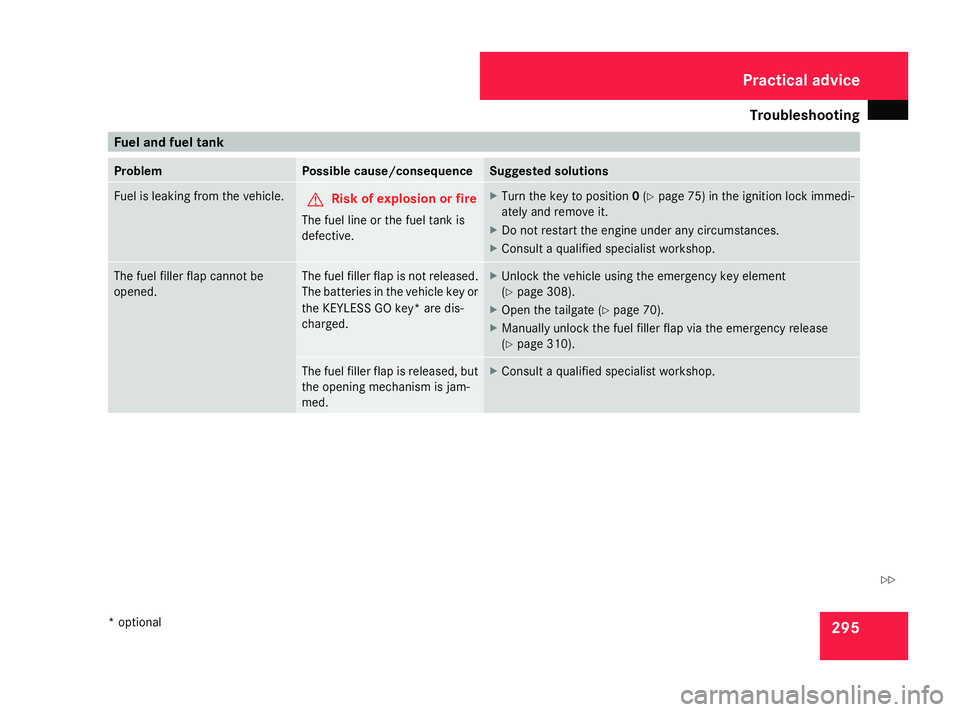
295Fuel and fuel tank
Problem Possible cause/consequence Suggested solutions
Fuel is leaking from the vehicle.
G
Risk of explosion or fire
The fuel line or the fuel tank is
defective. X
Turn the key to position 0(Y page 75) in the ignition lock immedi-
ately and remove it.
X Do not restart the engine under any circumstances.
X Consult a qualified specialist workshop. The fuel filler flap cannot be
opened. The fuel filler flap is not released.
The batteries in the vehicle key or
the KEYLESS GO key
* are dis-
charged. X
Unlock the vehicle using the emergency key element
(Y page 308).
X Open the tailgate (Y page 70).
X Manually unlock the fuel filler flap via the emergency release
(Y page 310). The fuel filler flap is released, but
the opening mechanism is jam-
med. X
Consult a qualified specialist workshop. Practical advice
* optional
164_AKB; 5; 5, en-GB
wobuchh,
Version: 2.10.6 2008-05-11T11:55:12+02:00 - Seite 295 ZDateiname: 6515_4293_02_buchblock.pdf; preflight
Page 308 of 381
Troubleshooting
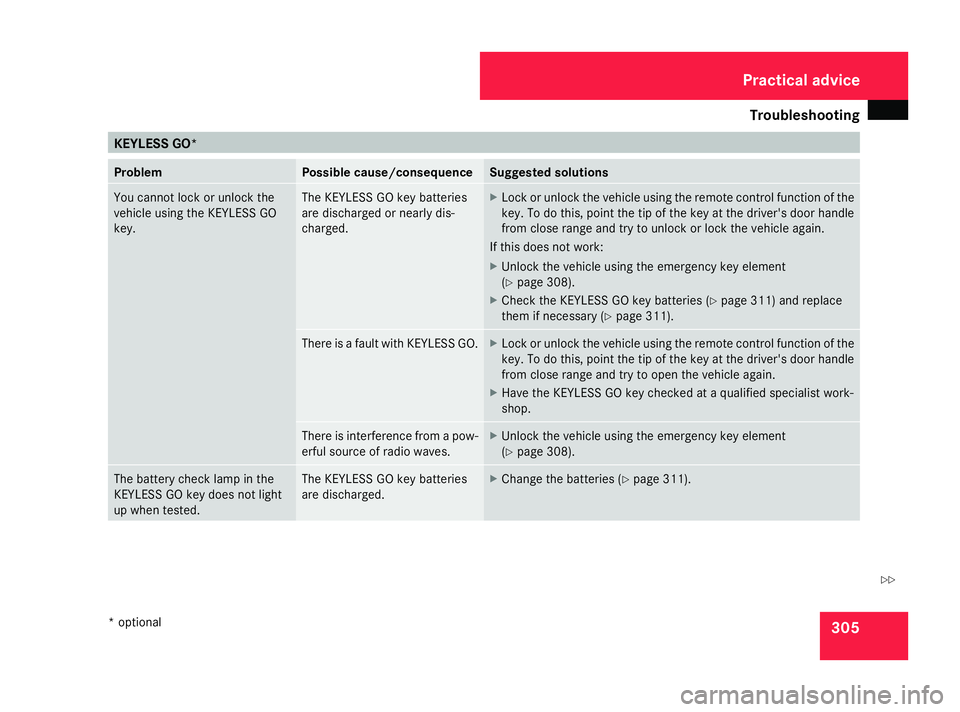
305KEYLESS GO*
Problem Possible cause/consequence Suggested solutions
You cannot lock or unlock the
vehicle using the KEYLESS GO
key. The KEYLESS GO key batteries
are discharged or nearly dis-
charged. X
Lock or unlock the vehicle using the remote control function of the
key. To do this, point the tip of the key at the driver's door handle
from close range and try to unlock or lock the vehicle again.
If this does not work:
X Unlock the vehicle using the emergency key element
(Y page 308).
X Check the KEYLESS GO key batteries (Y page 311) and replace
them if necessary (Y page 311). There is a fault with KEYLESS GO. X
Lock or unlock the vehicle using the remote control function of the
key. To do this, point the tip of the key at the driver's door handle
from close range and try to open the vehicle again.
X Have the KEYLESS GO key checked at a qualified specialist work-
shop. There is interference from a pow-
erful source of radio waves. X
Unlock the vehicle using the emergency key element
(Y page 308). The battery check lamp in the
KEYLESS GO key does not light
up when tested. The KEYLESS GO key batteries
are discharged. X
Change the batteries (Y page 311). Practical advice
* optional
164_AKB; 5; 5, en-GB
wobuchh
,V ersion: 2.10.6
2008-05-11T11:55:12+02:00 - Seite 305 ZDateiname: 6515_4293_02_buchblock.pdf; preflight
Page 309 of 381
Troubleshooting
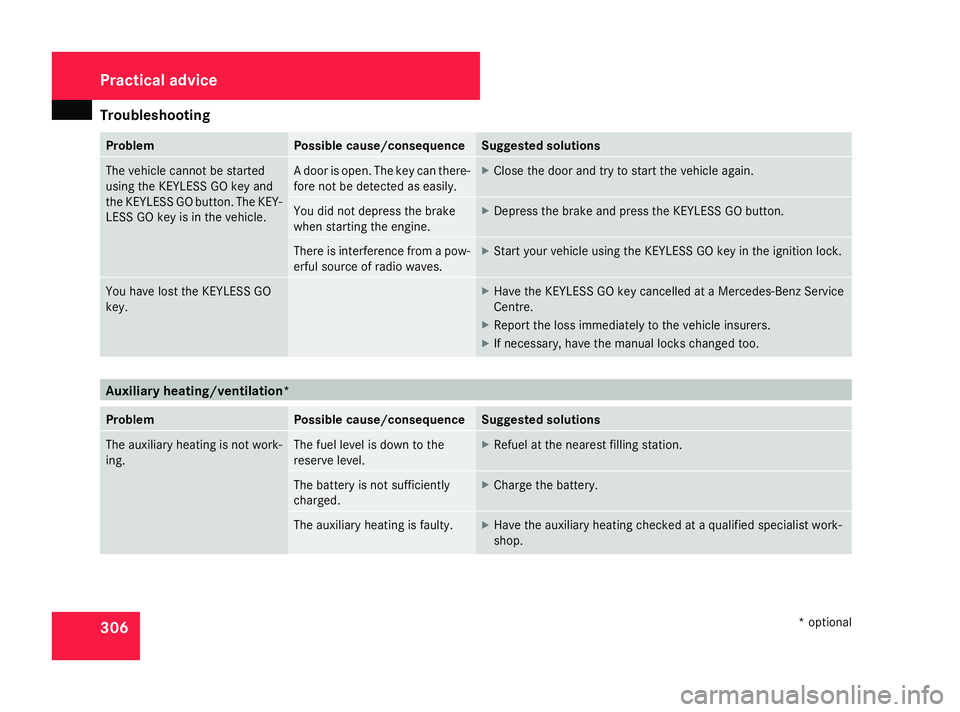
306 Problem Possible cause/consequence Suggested solutions
The vehicle cannot be started
using the KEYLESS GO key and
the KEYLESS GO button. The KEY-
LESS GO key is in the vehicle. A door is open. The key can there-
fore not be detected as easily. X
Close the door and try to start the vehicle again. You did not depress the brake
when starting the engine. X
Depress the brake and press the KEYLESS GO button. There is interference from a pow-
erful source of radio waves. X
Start your vehicle using the KEYLESS GO key in the ignition lock. You have lost the KEYLESS GO
key. X
Have the KEYLESS GO key cancelled at a Mercedes-Benz Service
Centre.
X Report the loss immediately to the vehicle insurers.
X If necessary, have the manual locks changed too. Auxiliary heating/ventilation*
Problem Possible cause/consequence Suggested solutions
The auxiliary heating is not work-
ing. The fuel level is down to the
reserve level. X
Refuel at the nearest filling station. The battery is not sufficiently
charged. X
Charge the battery. The auxiliary heating is faulty. X
Have the auxiliary heating checked at a qualified specialist work-
shop. Practical advice
* optional
164_AKB; 5; 5, en-GB
wobuchh
,V ersion: 2.10.6
2008-05-11T11:55:12+02:00 - Seite 306 Dateiname: 6515_4293_02_buchblock.pdf; preflight
Page 311 of 381
Locking/unlocking in an emergency
308 Locking/unlocking in an emergency
Emergency key
If the vehicle can no longer be unlocked or
locked with the key or the KEYLESS GO
key*, use the emergency key element.
If you use the emergency key element to
unlock and open the driver's door, the anti-
theft alarm system* will be triggered
(Y page 62).
There are several ways to turn off the alarm:
X Press the korj button on the key.
or
X Insert the key into the ignition lock.
or
X Press the KEYLESS GO button* in the igni-
tion lock. The KEYLESS GO key* must be in
the vehicle.
or
X Lock or unlock the vehicle using KEYLESS
GO*. The KEYLESS GO key* must be out-
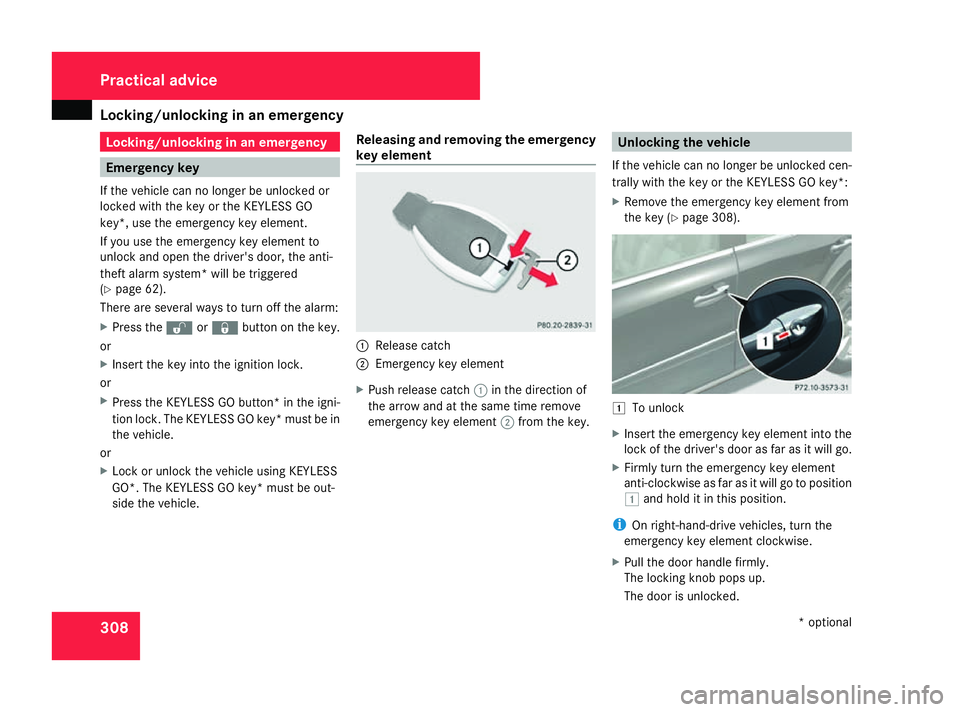
side the vehicle. Releasing and removing the emergency
key element
1
Release catch
2 Emergency key element
X Push release catch 1in the direction of
the arrow and at the same time remove
emergency key element 2from the key. Unlocking the vehicle
If the vehicle can no longer be unlocked cen-
trally with the key or the KEYLESS GO key*:
X Remove the emergency key element from
the key (Y page 308). $
To unlock
X Insert the emergency key element into the
lock of the driver's door as far as it will go.
X Firmly turn the emergency key element
anti-clockwise as far as it will go to position
$ and hold it in this position.
i On right-hand-drive vehicles, turn the
emergency key element clockwise.
X Pull the door handle firmly.
The locking knob pops up.
The door is unlocked. Practical advice
* optional
164_AKB; 5; 5, en-GB
wobuchh, Version: 2.10.6 2008-05-11T11:55:12+02:00 - Seite 308Dateiname: 6515_4293_02_buchblock.pdf; preflight
Page 312 of 381
Locking/unlocking in an emergency
309
X
Turn the emergency key element back and
remove it.
X Pull the door handle again. Locking the vehicle
If the vehicle can no longer be locked cen-
trally with the key or the KEYLESS GO key*:
X Close the front-passenger door, the rear
door on the front-passenger side and the
tailgate.
X Open the driver's door and the rear door on
the driver's side.
X Press the locking button on the driver's
door (Y page 74).
The locking knobs in the front-passenger
door and in the rear doors drop down.
X Press the locking knobs in the front-
passenger and rear doors down manually if
necessary.
X Exit the vehicle.
X Close the driver's door.
X Enter the vehicle through the rear door on
the driver's side.
X Push the locking pin in the driver's door
down from the inside.
X Exit the vehicle. i
Ensure that you have the vehicle key on
your person and that it is not left in the
vehicle, as the vehicle will be locked after
the next step.
X Close the rear door on the driver's side.
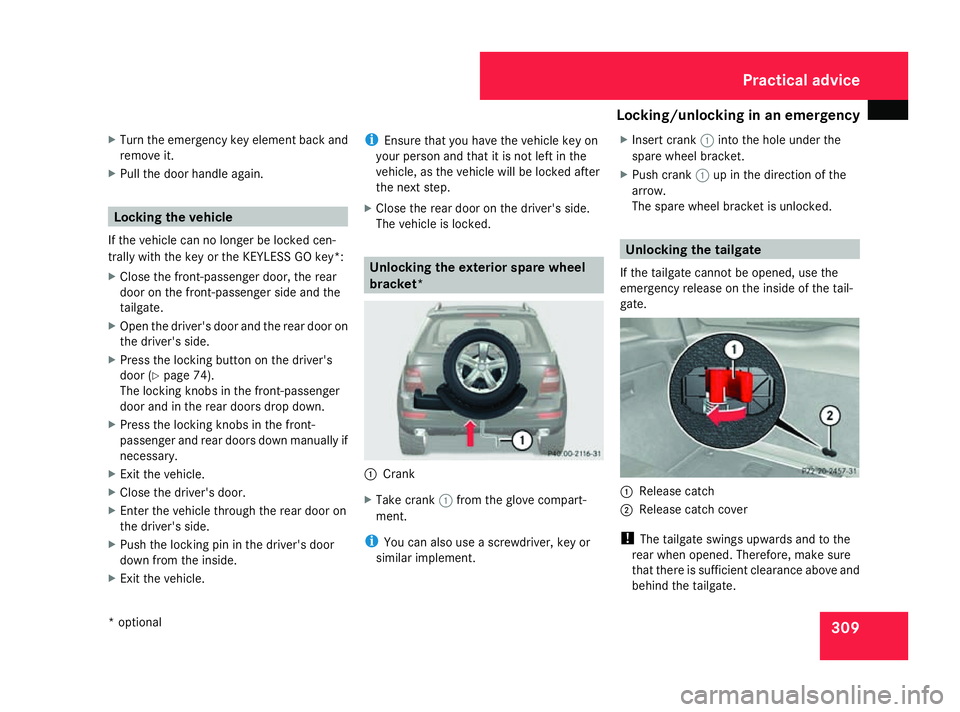
The vehicle is locked. Unlocking the exterior spare wheel
bracket*
1
Crank
X Take crank 1from the glove compart-
ment.
i You can also use a screwdriver, key or
similar implement. X
Insert crank 1into the hole under the
spare wheel bracket.
X Push crank 1up in the direction of the
arrow.
The spare wheel bracket is unlocked. Unlocking the tailgate
If the tailgate cannot be opened, use the
emergency release on the inside of the tail-
gate. 1
Release catch
2 Release catch cover
! The tailgate swings upwards and to the
rear when opened. Therefore, make sure
that there is sufficient clearance above and
behind the tailgate. Practical advice
* optional
164_AKB; 5; 5, en-GB
wobuchh,
Version: 2.10.6 2008-05-11T11:55:12+02:00 - Seite 309 ZDateiname: 6515_4293_02_buchblock.pdf; preflight
Page 314 of 381
Changing the batteries
3111
To move forwards
2 To push down
3 To push back
X Move the top of the head restraint cushion
forwards in the direction of arrow 1.
X Push the head restraint cushion down in
the direction of arrow 2as far as it will go.
X Push the head restraint cushion firmly
backwards in the direction of arrow 3until
it engages.
X Repeat this procedure for the second head
restraint. Changing the batteries
Notes
It is advisable to have the batteries replaced
at a qualified specialist workshop, e.g. at a
Mercedes-Benz Service Centre. G
Risk of poisoning
Batteries contain toxic and caustic sub-
stances. For this reason, keep batteries
away from children.
If a battery is swallowed, consult a doctor
immediately. H
Environmental note
Do not dispose of batteries with the house-
hold rubbish. They contain highly toxic sub-
stances.
Take discharged batteries to a qualified
specialist workshop, e.g. a Mercedes-Benz
Service Centre, or to a special collection
point for old batteries. Key or KEYLESS GO key*
Checking the batteries X
Press the jork button.
The batteries are in order if the battery
charge indicator lamp lights up briefly.
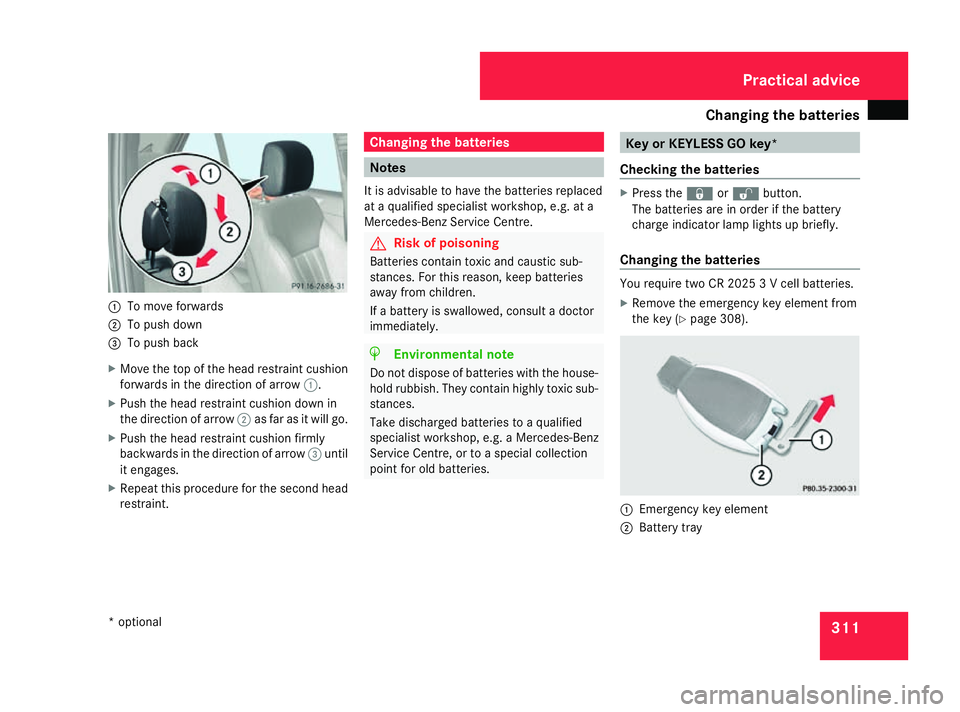
Changing the batteries You require two CR 2025 3 V cell batteries.
X
Remove the emergency key element from
the key (Y page 308). 1
Emergency key element
2 Battery tray Practical advice
* optional
164_AKB; 5; 5, en-GB
wobuchh,
Version: 2.10.6 2008-05-11T11:55:12+02:00 - Seite 311 ZDateiname: 6515_4293_02_buchblock.pdf; preflight
Page 326 of 381
Flat tyre
323Flat tyre
Flat tyre equipment variants
Your vehicle may be equipped with:
R a TIREFIT kit (Y page 255)
R a "Minispare" emergency spare
wheel* (Y page 256)
R a collapsible emergency spare
wheel* (Y page 258)
R a spare wheel* (Y page 256)
R the MOExtended run-flat sys-
tem* (Y page 333) Preparing the vehicle
i Vehicle preparation is not necessary on
vehicles with MOE tyres*.
X Make sure that highway level* is selec-
ted 37
(Y page 158).
X Stop your vehicle as far away from traffic
as possible on solid, non-slippery, level
ground.
X Switch on the hazard warning lamps. X
Firmly depress the parking brake.
X Move the selector lever to P.
X All occupants must get out of the vehicle.
Make sure that they are not endangered as
they do so.
X Make sure that no one is near the danger
area whilst a wheel is being changed. Any-
one who is not directly assisting in the
wheel change should, for example, stand
behind the barrier.
X Switch off the engine.
Vehicles without KEYLESS GO* X
Remove the key from the ignition lock.
Vehicles with KEYLESS GO* X
Open the driver's door.
The on-board electronics have status 0,
which is the same as the key having been
removed.
X Vehicles with the AIRMATIC package* and
the Off-Road Pro engineering package*:
Remove the KEYLESS GO button from the
ignition lock. For all vehicles X
Get out of the vehicle.
X Close the driver's door.
X Place the warning triangle ( Ypage 254) at
a suitable distance. Observe legal require-
ments.
i To operate the electric air-pump, you can
use the power socket in the luggage com-
partment (Y page 205) or rear compart-
ment (Y page 205), even when the ignition
is switched off. For example, to use TIREFIT
or to inflate the collapsible emergency
spare wheel*.
An emergency cut-off ensures that the on-
board voltage does not drop too low. If the
on-board voltage is too low, power to the
sockets is automatically cut-off. This
ensures that there is sufficient power to
start the engine.
37 Not on steel-sprung vehicles. Practical advice
* optional
164_AKB; 5; 5, en-GB
wobuchh,
Version: 2.10.6 2008-05-11T11:55:12+02:00 - Seite 323 ZDateiname: 6515_4293_02_buchblock.pdf; preflight
Page 334 of 381
Flat tyre
331G
Risk of injury
Comply with the manufacturer’s safety
instructions on the sticker on the electric
air pump.
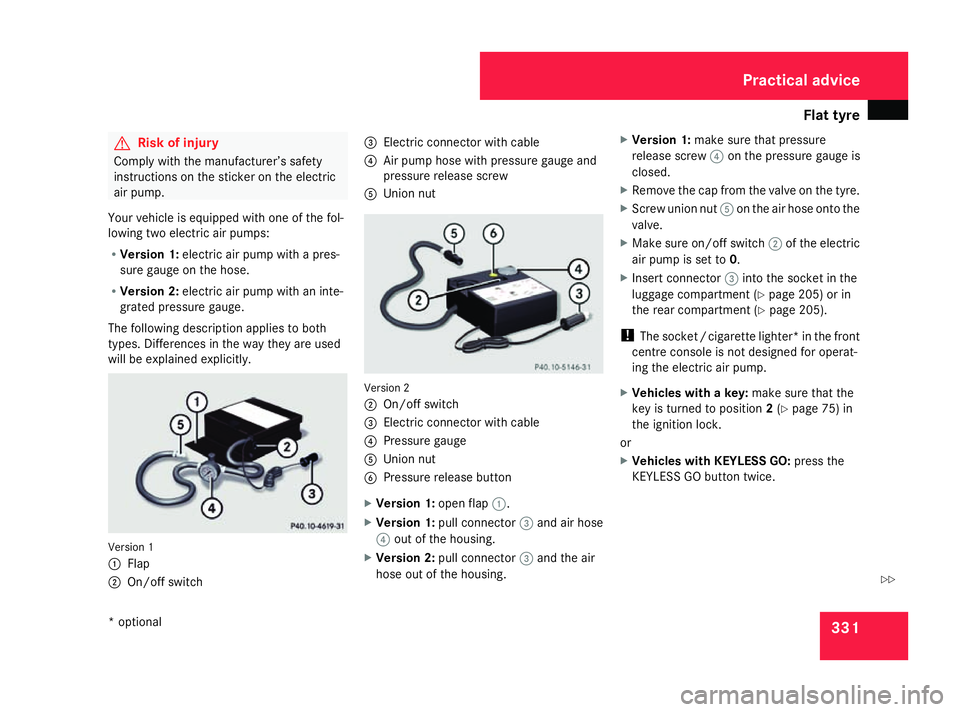
Your vehicle is equipped with one of the fol-
lowing two electric air pumps:
R Version 1: electric air pump with a pres-
sure gauge on the hose.
R Version 2: electric air pump with an inte-
grated pressure gauge.
The following description applies to both
types. Differences in the way they are used
will be explained explicitly. Version 1
1
Flap
2 On/off switch 3
Electric connector with cable
4 Air pump hose with pressure gauge and
pressure release screw
5 Union nut Version 2
2
On/off switch
3 Electric connector with cable
4 Pressure gauge
5 Union nut
6 Pressure release button
X Version 1: open flap1.
X Version 1: pull connector 3and air hose
4 out of the housing.
X Version 2: pull connector 3and the air
hose out of the housing. X
Version 1: make sure that pressure
release screw 4on the pressure gauge is
closed.
X Remove the cap from the valve on the tyre.
X Screw union nut 5on the air hose onto the
valve.
X Make sure on/off switch 2of the electric
air pump is set to 0.
X Insert connector 3into the socket in the
luggage compartment (Y page 205) or in
the rear compartment (Y page 205).
! The socket /cigarette lighter *in the front
centre console is not designed for operat-
ing the electric air pump.
X Vehicles with a key: make sure that the
key is turned to position 2(Y page 75) in
the ignition lock.
or
X Vehicles with KEYLESS GO: press the
KEYLESS GO button twice. Practical advice
* optional
164_AKB; 5; 5, en-GB
wobuchh
, Version: 2.10.6 2008-05-11T11:55:12+02:00 - Seite 331 ZDateiname: 6515_4293_02_buchblock.pdf; preflight