climate control MERCEDES-BENZ ML500 1997 Complete Owner's Manual
[x] Cancel search | Manufacturer: MERCEDES-BENZ, Model Year: 1997, Model line: ML500, Model: MERCEDES-BENZ ML500 1997Pages: 4133, PDF Size: 88.89 MB
Page 565 of 4133
98
Climate control
Te ch n ica l
data
Instruments
and controls Operation
Driving Instrument
cluster display Practical hints Car care Index
Climate control
Page 566 of 4133

99
Climate control
Te ch n ica l
data
Instruments
and controls Operation
Driving Instrument
cluster display Practical hints Car care Index
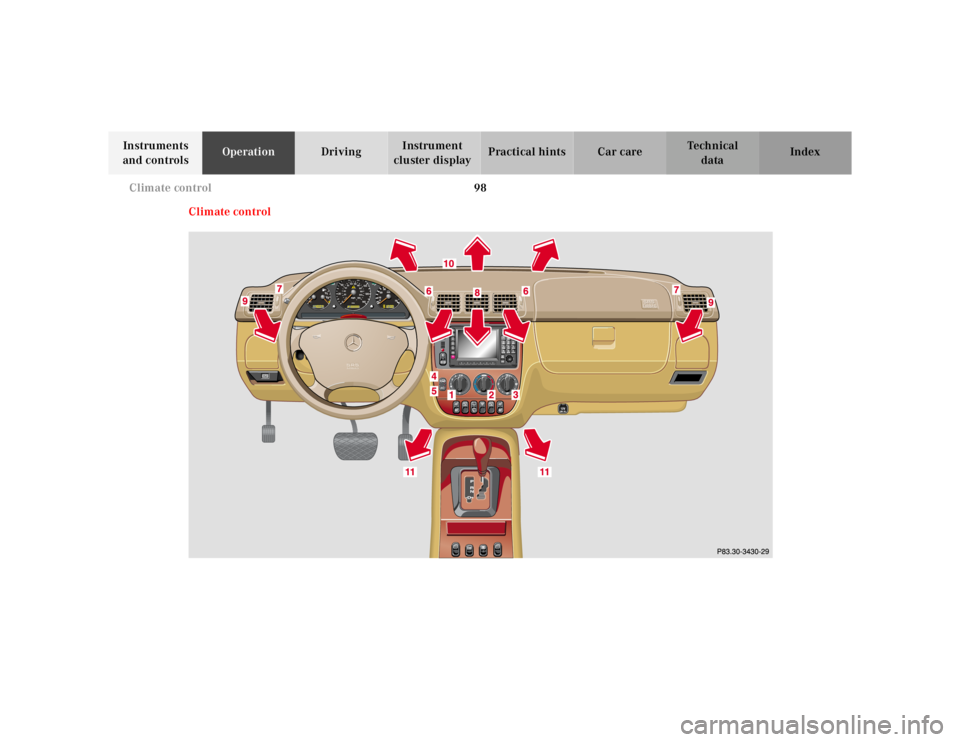
1
Air volume control switch
2 Temperature selector switch
3 Air distribution switch
4 Air recirculation
5 Air conditioning mode
6 Air volume control for center air outlets,
turn wheel up to open.
7 Air volume control for side air outlet,
turn wheel up to open.
8 Center air outlets, adjustable
9 Side air outlets, adjustable
10 Windshield air outlets
11 Floor outlets
The air conditioning mode only operates with the œ
button pushed, the air volume control switch set to
position 1 to 4, and the engine running. To quickly cool down the passenger compartment, turn
temperature selector switch fully to the left to
position O. Turn temperature selector to maintain
desired temperature.
The air conditioning mode removes considerable
moisture from the air during operation in the cooling
mode. It is normal for water to drip on the ground
through ducts in the underbody.
Important!
This vehicle is equipped with an air conditioner system
that uses R–134a (HFC: hydrof luorocarbon) as a
refrigerant. Repairs should always be performed by a
qualified technician, and refrigerant should be collected
in a recovery system for recycling.
Note:
For the air flow-through system to function properly, the
air vents, located in the left and right side rear
passenger compartment trim panel covers, should be
ke pt un obst ru cte d .
Page 567 of 4133
100
Climate control
Te ch n ica l
data
Instruments
and controls Operation
Driving Instrument
cluster display Practical hints Car care Index
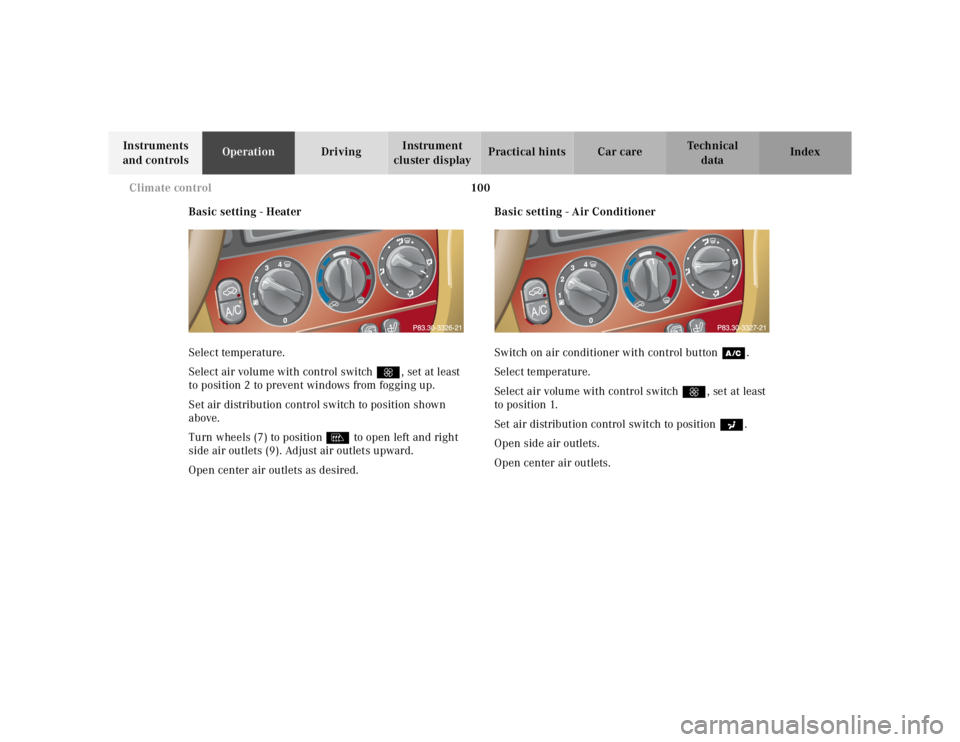
Basic setting - Heater
Select temperature.
Select air volume with control switch Q, set at least
to position 2 to prevent windows from fogging up.
Set air distribution control switch to position shown
above.
Turn wheels (7) to position l to open left and right
side air outlets (9). Adjust air outlets upward.
Open center air outlets as desired. Basic setting - Air Conditioner
Switch on air conditioner with control button œ.
Select temperature.
Select air volume with control switch Q, set at least
to position 1.
Set air distribution control switch to position a.
Open side air outlets.
Open center air outlets.
Page 568 of 4133
101
Climate control
Te ch n ica l
data
Instruments
and controls Operation
Driving Instrument
cluster display Practical hints Car care Index
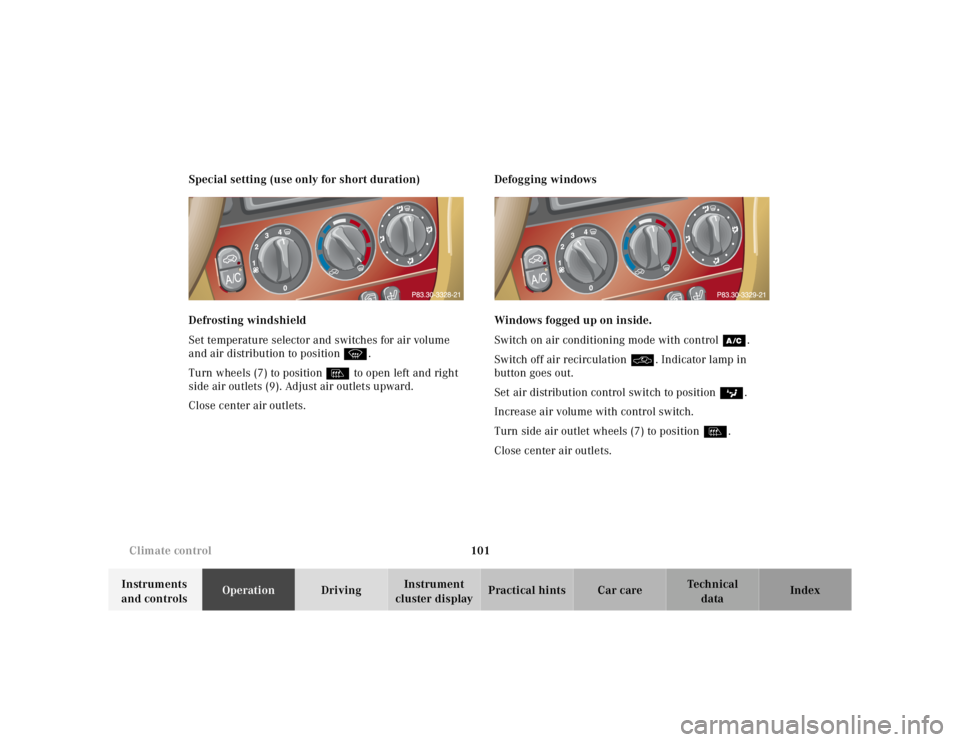
Special setting (use only for short duration)
Defrosting windshield
Set temperature selector and switches for air volume
and air distribution to position P.
Turn wheels (7) to position l to open left and right
side air outlets (9). Adjust air outlets upward.
Close center air outlets. Defogging windows
Windows fogged up on inside.
Switch on air conditioning mode with control œ.
Switch off air recirculation O. Indicator lamp in
button goes out.
Set air distribution control switch to position c.
Increase air volume with control switch.
Turn side air outlet wheels (7) to position l.
Close center air outlets.
Page 569 of 4133
102
Climate control
Te ch n ica l
data
Instruments
and controls Operation
Driving Instrument
cluster display Practical hints Car care Index
Windshield fogged up on outside.
Switch on wiper motor.
Set air distribution control switch to position d
or a .
Dust filter
Nearly all dust particles and pollen are filtered out
before outside air enters the passenger compartment
through the air distribution system.
Note:
Keep the air intake grille in front of windshield free of
snow and debris.
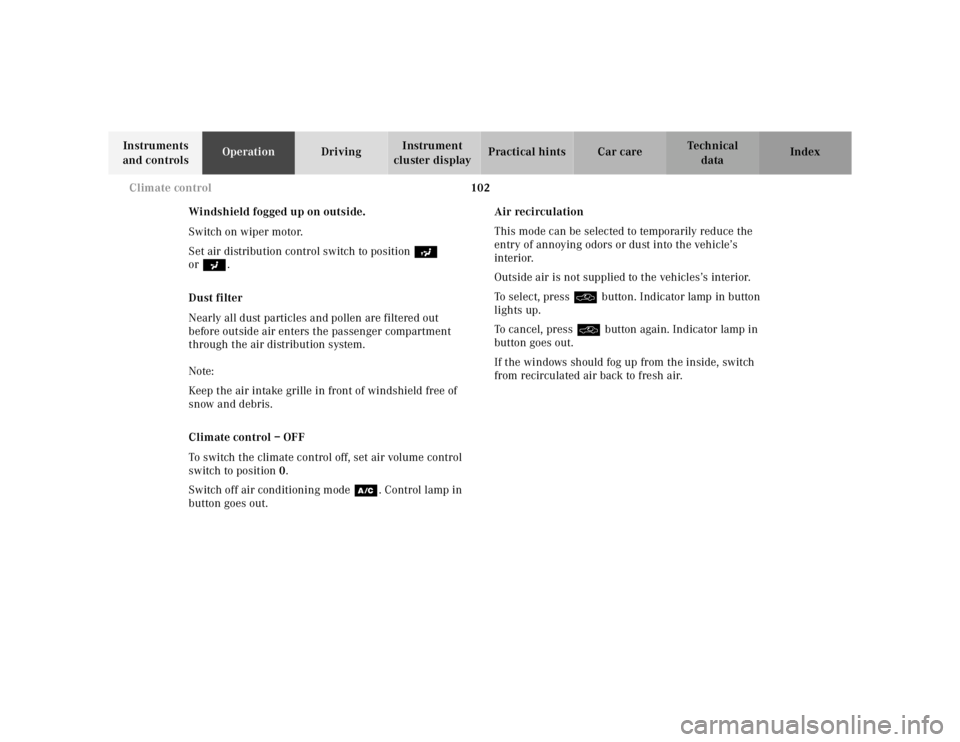
Climate control – OFF
To switch the climate control off, set air volume control
switch to position 0.
Switch off air conditioning mode œ. Control lamp in
button goes out. Air recirculation
This mode can be selected to temporarily reduce the
entry of annoying odors or dust into the vehicle’s
interior.
Outside air is not supplied to the vehicles’s interior.
To select, press O button. Indicator lamp in button
lights up.
To cancel, press O button again. Indicator lamp in
button goes out.
If the windows should fog up from the inside, switch
from recirculated air back to fresh air.
Page 570 of 4133
103
Climate control
Te ch n ica l
data
Instruments
and controls Operation
Driving Instrument
cluster display Practical hints Car care Index
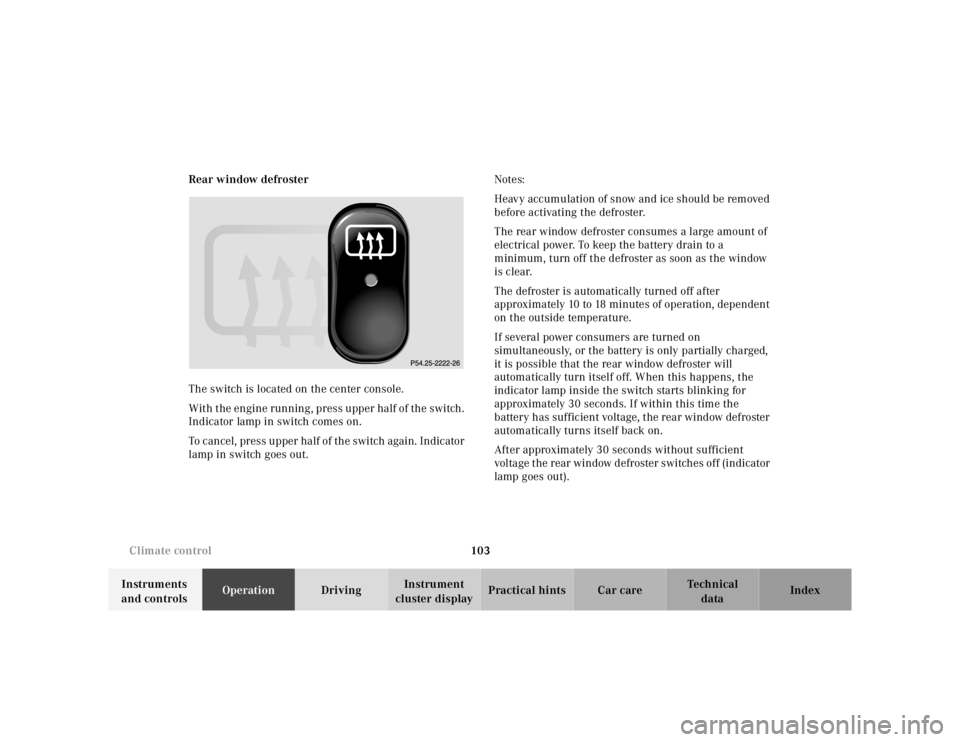
Rear window defroster
The switch is located on the center console.
With the engine running, press upper half of the switch.
Indicator lamp in switch comes on.
To cancel, press upper half of the switch again. Indicator
lamp in switch goes out. Notes:
Heavy accumulation of snow and ice should be removed
before activating the defroster.
The rear window defroster consumes a large amount of
electrical power. To keep the battery drain to a
minimum, turn off the defroster as soon as the window
is clear.
The defroster is automatically turned off after
approximately 10 to 18 minutes of operation, dependent
on the outside temperature.
If several power consumers are turned on
simultaneously, or the battery is only partially charged,
it is possible that the rear window defroster will
automatically turn itself off. When this happens, the
indicator lamp inside the switch starts blinking for
approximately 30 seconds. If within this time the
battery has sufficient voltage, the rear window defroster
automatically turns itself back on.
After approximately 30 seconds without sufficient
voltage the rear window defroster switches off (indicator
lamp goes out).
Page 654 of 4133
187
Driving instructions
Te ch n ica l
data
Instruments
and controls Operation
Driving Instrument
cluster display Practical hints Car care Index
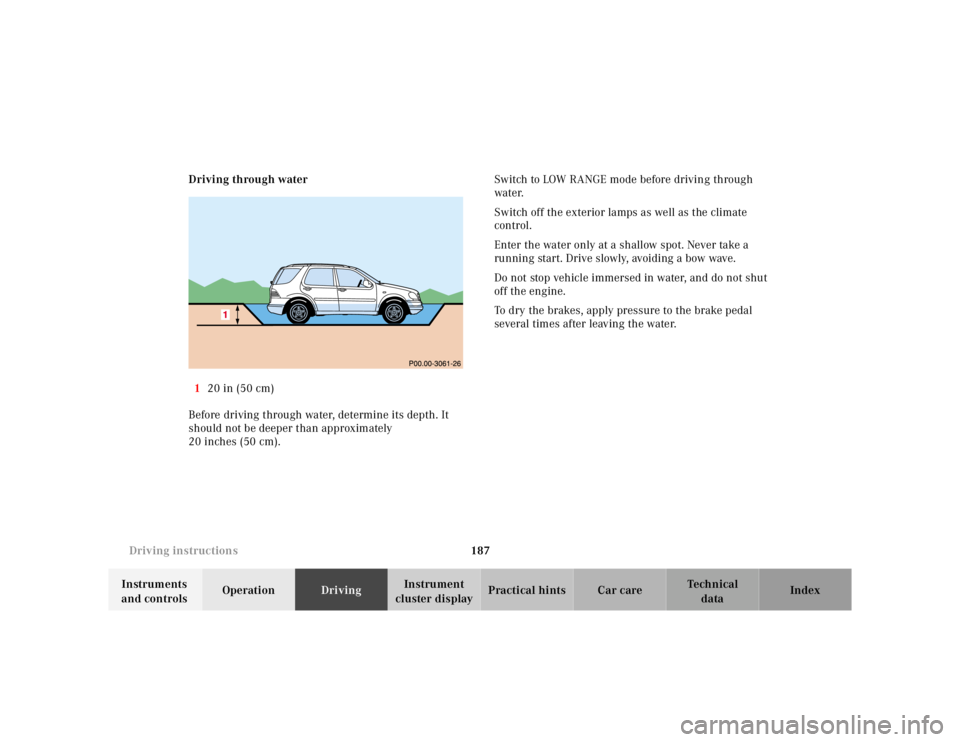
Driving through water
1 20 in (50 cm)
Before driving through water, determine its depth. It
should not be deeper than approximately
20 inches (50 cm). Switch to LOW RANGE mode before driving through
water.
Switch off the exterior lamps as well as the climate
control.
Enter the water only at a shallow spot. Never take a
running start. Drive slowly, avoiding a bow wave.
Do not stop vehicle immersed in water, and do not shut
off the engine.
To dry the brakes, apply pressure to the brake pedal
several times after leaving the water.
Page 662 of 4133
195
Driving instructions
Te ch n ica l
data
Instruments
and controls Operation
Driving Instrument
cluster display Practical hints Car care Index
At very steep inclines, not manageable with selector
lever in position “1”, switch transfer case to LOW
RANGE, see page 209 for instructions on how to engage
LOW RANGE.
When going down a long hill, shift into a lower gear and
use the engine’s braking effect. Avoid riding the brakes,
thus overheating the vehicle and trailer brakes.
If the engine coolant rises to an extremely high
temperature (coolant temperature needle approaching
the red zone) when the air conditioner is on, turn off the
air conditioner. Engine coolant heat can be additionally
vented by opening the windows, switching the climate
control fan speed to high and setting the temperature
control to the maximum hot position.
Extreme care must be exercised since your vehicle with
a trailer will require additional passing distance ahead
than when driving without a trailer. Because your
vehicle and trailer is longer than your vehicle alone, you
will also need to go much farther ahead of the passed
vehicle before you can return to your lane. Parking
Wa r n i n g !
To reduce the risk of personal injury, or damage to
the vehicle powertrain, as a result of vehicle/trailer
movement, always:1. Keep right foot on brake pedal.2. Shift gear selector lever to position “N”.3. Have a second person place wheel chocks on
downhill side of left and right trailer wheels.4. Slowly release brake pedal and let vehicle and trailer roll into chocks until stopped.5. Firmly depress parking brake pedal.6. Move gear selector lever to position “P”.7. On inclines turn front wheels towards the road curb.
Page 746 of 4133

279
Cleaning and care of the vehicle
Te ch n ica l
data
Instruments
and controls Operation Driving
Instrument
cluster display Practical hints
Car care Index
Scratches, corrosive deposits, corrosion or damage due
to negligent or incorrect care cannot always be removed
or repaired with the car-care products recommended
here. In such cases it is best to seek aid at your
authorized Mercedes-Benz Light Truck Center.
The following topics deal with the cleaning and care of
your vehicle and give important “how-to” information as
well as references to Mercedes-Benz approved car-care
products.
Additional information can be found in the booklet titled
“Vehicle Care Guide”.
Power washer
When using a power washer for cleaning the vehicle
always observe manufacturers’ operating instructions.
Caution!
Never use a round nozzle to power wash tires. The
intense jet of water can result in damage to the tire.
Always replace a damaged tire.
Always keep the jet of water moving across the surface.
Do not aim directly at electrical parts, electrical
connectors, seals, or other rubber parts. Ta r st a in s
Quickly remove tar stains before they dry and become
more difficult to remove. A tar remover is
recommended.
Paintwork, painted body components
Mercedes-Benz approved Paint Care should be applied
when water drops on the paint surface do not “bead up”,
normally in 3 to 5 months, depending on climate and
washing detergent used.
Mercedes-Benz approved Paint Cleaner should be
applied if paint surface shows signs of dirt embedding
(i.e. loss of gloss).
Do not apply any of these products or wax if your
vehicle is parked in the sun or if the hood is still hot.
Use the appropriate MB-Touch-Up Stick for quick and
provisional repairs of minor paint damage (i.e. chips
from stones, vehicle doors etc.).
Page 765 of 4133
298
Consumer information
Te ch n ica l
data
Instruments
and controls Operation Driving
Instrument
cluster display Practical hints Car care Index
Consumer information
This has been prepared as required of all manufactures
of passenger cars under Title 49, Code of U.S. Federal
Regulations, Part 575 pursuant to the “National Traffic
and Motor Vehicle Safety Act of 1966”.
Uniform tire quality grading
Quality grades can be found where applicable on the
tire sidewall between tread shoulder and maximum
section width. For example:
All passenger vehicle tires must conform to federal
safety requirements in addition to these grades. Treadwear
The treadwear grade is a comparative rating based on
the wear rate of the tire when tested under controlled
conditions on a specified government test course. For
example, a tire graded 150 would wear one and one-half
(1
1/2) times as well on the government course as a tire
graded 100. The relative performance of tires depends
upon the actual conditions of their use, however, and
may depart significantly from the norm due to
variations in driving habits, service practices and
differences in road characteristics and climate.
Traction
The traction grades, from highest to lowest are AA, A, B,
and C. Those grades represent the tire’s ability to stop
on wet pavement as measured under controlled
conditions on specified government test surfaces of
asphalt and concrete. A tire marked C may have poor
traction performance.
Tread wear 200 Traction AA Temperature A
Wa r n i n g !
The traction grade assigned to this tire is based on
straight ahead braking traction tests, and does not
include acceleration, cornering, hydroplaning, or
peak traction characteristics.