lock MERCEDES-BENZ ML550 2010 W164 User Guide
[x] Cancel search | Manufacturer: MERCEDES-BENZ, Model Year: 2010, Model line: ML550, Model: MERCEDES-BENZ ML550 2010 W164Pages: 368, PDF Size: 9.09 MB
Page 19 of 368
Capacities fuels, coolants,
lubricants etc. ................................ 356
Coolant .......................................... 362
Engine oil additives ........................359
Engine oils ..................................... 359
Fuel requirements .......................... 360
Gasoline additives .......................... 361
Identification labels .......................346
Premium unleaded gasoline ...........360
Rims and tires ................................ 352
Spare wheel ................................... 356
Vehicle specification ML 350 ......... 348
Vehicle specification
ML 350 4MATIC ............................. 349
Vehicle specification
ML 350 BlueTEC 4MATIC ...............348
Vehicle specification
ML 550 4MATIC ............................. 350
Vehicle specification ML 63 AMG ..351
Washer and headlamp cleaning
system ................................... 358, 364
Technical data (dimensions)
see Vehicle specification
Technical data (electrical system)
see Vehicle specification
Technical data (engine)
see Vehicle specification
Technical data (weights)
see Vehicle specification
Tele Aid ............................................... 199
Emergency calls ............................. 200
Information button .........................202
Initiating an emergency call
manually ........................................ 201
Messages in the multifunction
display ........................................... 285
Remote door unlock ......................203
Roadside Assistance button ..........201
Search & Send ............................... 203
SOS button .................................... 201
Stolen Vehicle Recovery Services ..204
System self-test ............................. 199
Telephone ............................................. 30
Answering/ending a call ................140
Hands-free microphone ...................33
Menu ............................................. 139
Operation ....................................... 139Phone book .................................... 140
Redialing ........................................ 141
Temperature
Interior temperature ..............170, 179
Outside .................................. 123, 131
Tether anchorage points
see Children in the vehicle
Tie-down rings ................................... 188
Tightening torque
Wheels ........................................... 330
Time setting ....................................... 132
TIN (Tire Identification Number) ...... 241
Tire and Loading Information
placard ............................................... 227
Tire and loading terminology ........... 239
TIREFIT ............................................... 320
Tire Identification Number see TIN
Tire inflation pressure
Checking ........................................ 221
Important notes on ........................220
Label on the inside of fuel filler
flap ................................................ 220
Placard on driver’s door B-pillar .....227
Tire labeling ....................................... 235
Tire load rating .................................. 240
Tire ply composition and material
used .................................................... 241
Tire pressure loss warning system . 222
Tire repair kit see TIREFIT
Tires ........................................... 218, 352
Advanced Tire Pressure
Monitoring System (Advanced
TPMS) ............................................ 223
Air pressure ................................... 219
Care and maintenance ...................232
Cleaning ......................................... 233
Direction of rotation, spinning .......231
Important notes on tire inflation
pressure ........................................ 220
Inflation pressure ........................... 221
Information placard .......................227
Inspection ...................................... 232
Labeling ......................................... 235
Load index ............................. 236, 240
Load rating .................................... 240Index17164_AKB; 7; 31, en-USd2ureepe,Version: 2.11.8.12009-09-11T12:07:36+02:00 - Seite 17
Page 20 of 368
Messages in the multifunction
display ................................... 281, 296
MOExtended .................................. 352
Ply composition and material
used ............................................... 241
Problems under-/overinflation ......221
Retreads ........................................ 218
Rims and tires (technical data) ......352
Rotation ......................................... 234
Service life ..................................... 232
Sizes .............................................. 352
Snow chains .................................. 243
Speed rating .......................... 237, 241
Storing ........................................... 233
Temperature .......................... 220, 234
Terminology ................................... 239
TIREFIT (tire repair kit) ...................320
Tire Identification Number .............241
Tire pressure loss warning system . 222
TPMS low tire pressure/
malfunction telltale ........................304
Traction ................................. 233, 241
Tread ............................................. 242
Tread depth ........................... 232, 242
Treadwear ...................................... 233
Treadwear indicators .............232, 242
Vehicle maximum load on ..............242
Wear pattern .................................. 234
Winter tires ............................ 242, 352
Tire speed rating ....................... 237, 241
Tongue Weight Rating see TWR
Top tether
see Children in the vehicle
Total load limit ................................... 241
Towing
Towing eye bolt .............................. 339
Trailer .................................... 113, 254
Vehicle ........................................... 338
Towing eye bolt ................................. 339
Traction ...................................... 233, 241
Trailer towing ............................ 113, 254
Coupling a trailer ........................... 255
Decoupling ..................................... 257
Electrical connections .................... 254
Towing ........................................... 256
Trailer hitch ................................... 254
Weights and ratings .......................254Transfer case ..................................... 117
Transmission see Automatic transmission
Transmission fluid level .................... 216
Transmission gear selector lever see Gear selector lever
Transmission positions .................... 112
Traveling abroad ............................... 257
Tread (tires) ....................................... 242
Tread depth (tires) .................... 232, 242
Treadwear .......................................... 233
Treadwear indicators (tires) .... 232, 242
Trip computer menu ......................... 138
Trip odometer, resetting ................... 118
Turning off the engine ...................... 108
Turn signals ......................................... 95
Cleaning lenses ............................. 263
Indicator lamps ................................ 28
Messages in the multifunction
display ........................................... 296
TWR (Tongue Weight Rating) ........... 242
U
Uniform Tire Quality Grading
Standards .................................. 233, 242
Units
Selecting digital speedometer
display mode ................................. 131
Selecting speedometer/
odometer display mode .................131
Unleaded gasoline, premium ........... 360
Unlocking the vehicle
KEYLESS-GO .................................... 71
Manually ........................................ 306
SmartKey ......................................... 70
Upholstery, cleaning ......................... 265
Useful features .................................. 194
V
Vehicle
Battery ........................................... 334
Care ............................................... 260
Control system .............................. 119
Identification Number (VIN) ...........346
Locking/unlocking ........................... 70
Lowering (wheel change) ...............329
18Index164_AKB; 7; 31, en-USd2ureepe,Version: 2.11.8.12009-09-11T12:07:36+02:00 - Seite 18
Page 21 of 368
Modifications and alterations,
Operating safety .............................. 23
Towing ........................................... 338
Unlocking/locking manually ..........306
Vehicle configuration menu ............. 137
Vehicle dimensions see Vehicle specification
Vehicle Identification Number
(VIN) ................................................... 346
Vehicle jack see Jack
Vehicle level control
see Air suspension program
Vehicle lighting .................................... 92
Vehicle loading
Cargo tie-down rings ...................... 188
Cargo volume, expanding ..............189
Carriers .......................................... 187
Instructions .................................... 186
Load limit ....................................... 228
Terminology ................................... 239
Vehicle maximum load on the tire ... 242
Vehicle specification
ML 350 .......................................... 348
ML 350 4MATIC ............................. 349
ML 350 BlueTEC 4MATIC ...............348
ML 550 4MATIC ............................. 350
ML 63 AMG ................................... 351
Vehicle status message memory .... 128
Vehicle tool kit .................................. 268
Vehicle washing see Vehicle care
Vehicle weights
see Vehicle specification
W
Warning lamps see Lamps, Indicator and warning
Warning sounds
Distance warning function .............151
Distronic ........................................ 146
Driver’s or passenger’s seat belt .....51
Parking brake ................................ 284
Parktronic system ..........................163
Seat belt telltale ............................ 300
Warranty coverage ............................ 346
Washer and headlamp cleaning
system ................................................ 364
Washer fluid
Messages in the multifunction
display ........................................... 288
Mixing ratio .................................... 364
Refilling .......................................... 217
Washing the vehicle .......................... 260
Wear pattern (tires) .......................... 234
Weights (vehicle) see Vehicle specification
Wheel
Changing ....................................... 319
Removing ....................................... 327
Spare ............................................. 319
Tightening torque ........................... 330
Wheels, sizes ..................................... 352
Wheels, Tires and .............................. 218
Window curtain air bags ..................... 41
Windows see Power windows
Windows, cleaning ............................ 264
Windshield
Cleaning wiper blades .................... 264
Infrared reflecting ..........................208
Washer fluid ................................... 364
Wipers ............................................. 98
Windshield wipers
Replacing wiper blades ..................318
Winter cover .............................. 214, 242
Winter driving
Instructions .................................... 243
Radiator cover ............................... 242
Snow chains .................................. 243
Tires ............................................... 242
Winter tires ................................ 242, 352
Wood trims, cleaning ........................ 266Index19164_AKB; 7; 31, en-USd2ureepe,Version: 2.11.8.12009-09-11T12:07:36+02:00 - Seite 19
Page 28 of 368
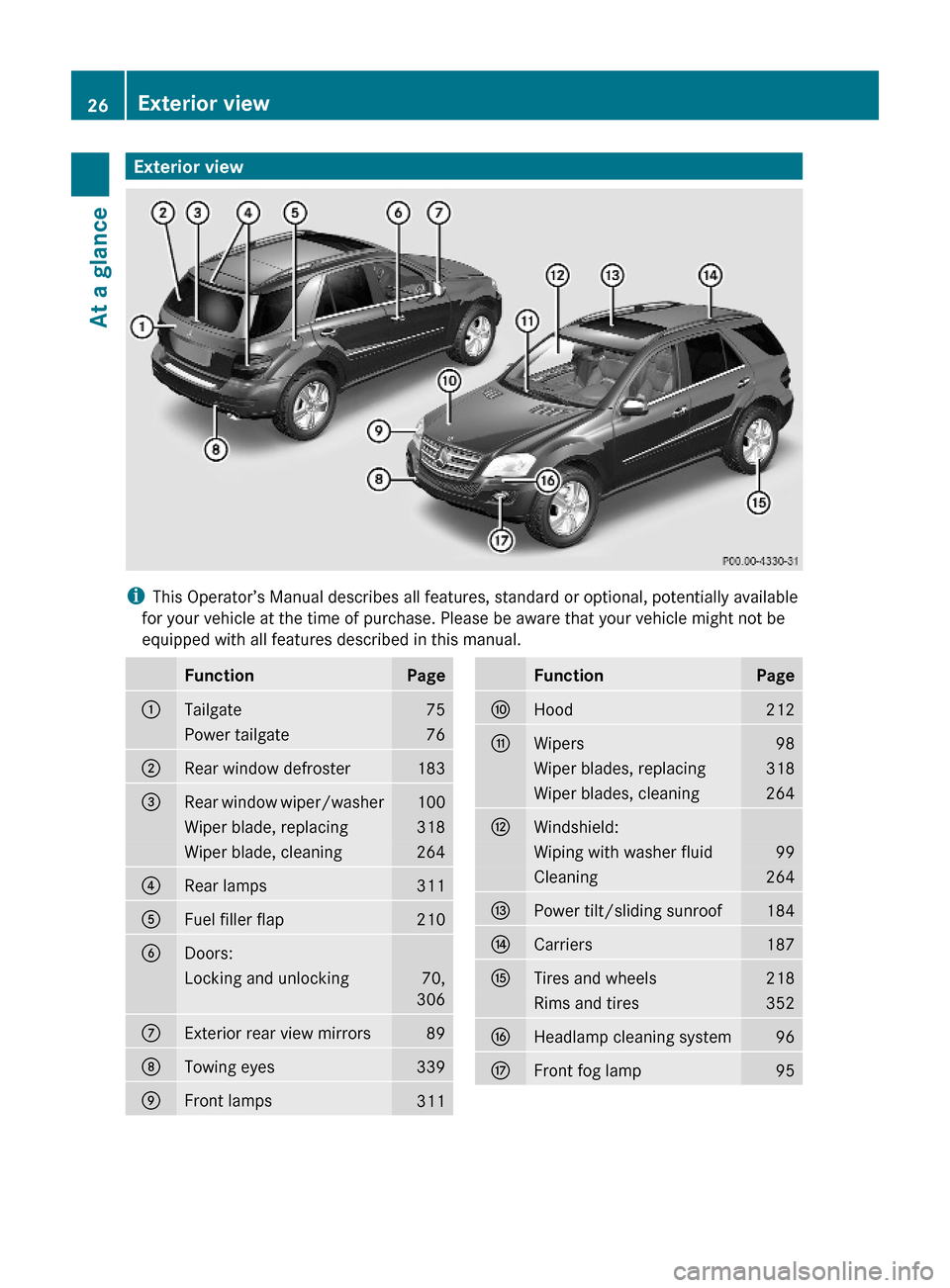
Exterior view
iThis Operator’s Manual describes all features, standard or optional, potentially available
for your vehicle at the time of purchase. Please be aware that your vehicle might not be
equipped with all features described in this manual.
FunctionPage:Tailgate75Power tailgate76;Rear window defroster183=Rear window wiper/washer100Wiper blade, replacing318Wiper blade, cleaning264?Rear lamps311AFuel filler flap210BDoors:Locking and unlocking70,
306
CExterior rear view mirrors89DTowing eyes339EFront lamps311FunctionPageFHood212GWipers98Wiper blades, replacing318Wiper blades, cleaning264HWindshield:Wiping with washer fluid99Cleaning264IPower tilt/sliding sunroof184JCarriers187KTires and wheels218Rims and tires352LHeadlamp cleaning system96MFront fog lamp9526Exterior viewAt a glance
164_AKB; 7; 31, en-USd2ureepe,Version: 2.11.8.12009-09-11T12:07:36+02:00 - Seite 26
Page 29 of 368
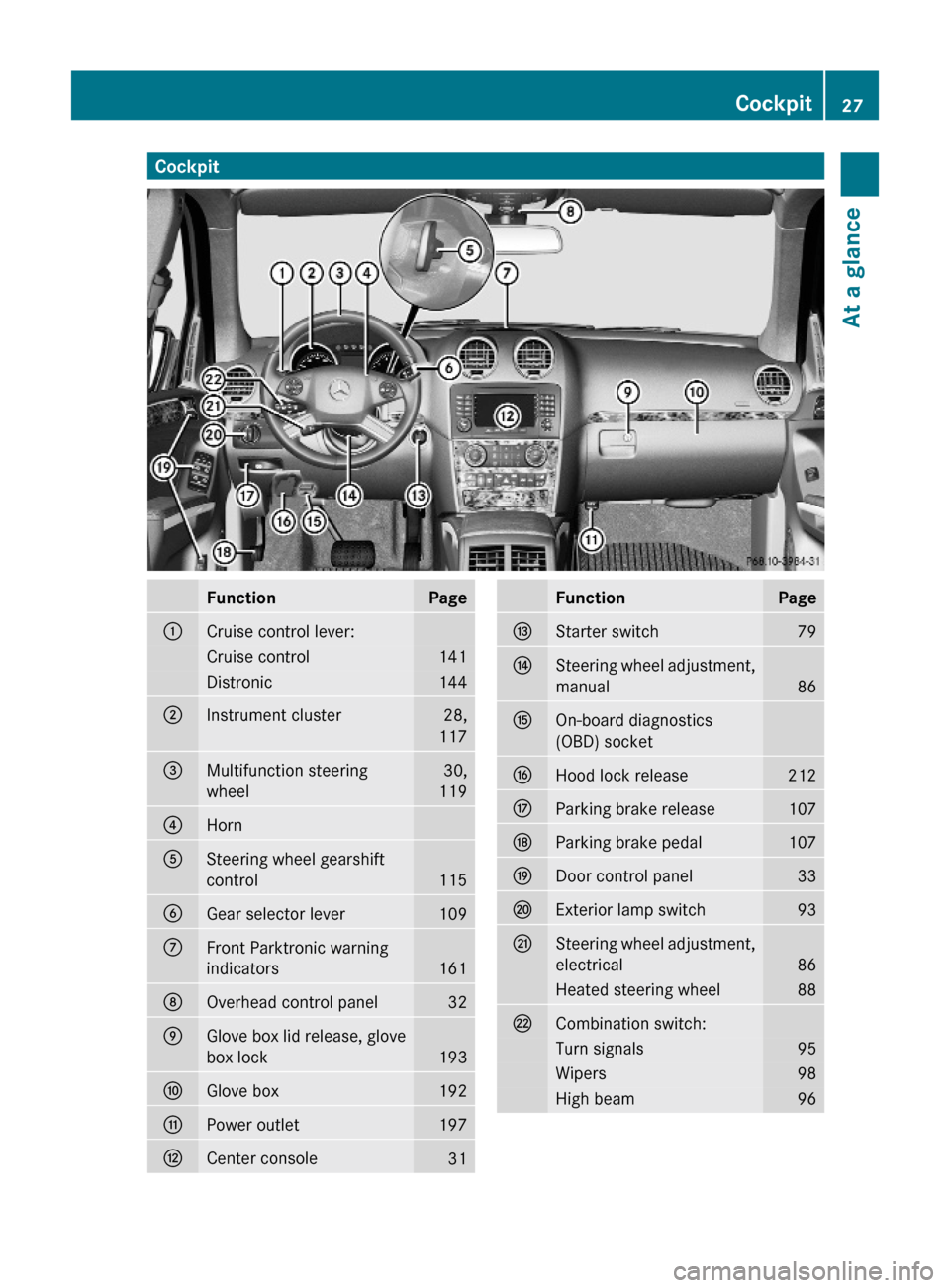
CockpitFunctionPage:Cruise control lever:Cruise control141Distronic144;Instrument cluster28,
117
=Multifunction steering
wheel
30,
119
?Horn ASteering wheel gearshift
control115
BGear selector lever109CFront Parktronic warning
indicators 161
DOverhead control panel32EGlove box lid release, glove
box lock193
FGlove box192GPower outlet197HCenter console31FunctionPageIStarter switch79JSteering wheel adjustment,
manual86
KOn-board diagnostics
(OBD) socket
LHood lock release212MParking brake release107NParking brake pedal107ODoor control panel33PExterior lamp switch93QSteering wheel adjustment,
electrical86
Heated steering wheel88RCombination switch:Turn signals95Wipers98High beam96Cockpit27At a glance164_AKB; 7; 31, en-USd2ureepe,Version: 2.11.8.12009-09-11T12:07:36+02:00 - Seite 27Z
Page 30 of 368
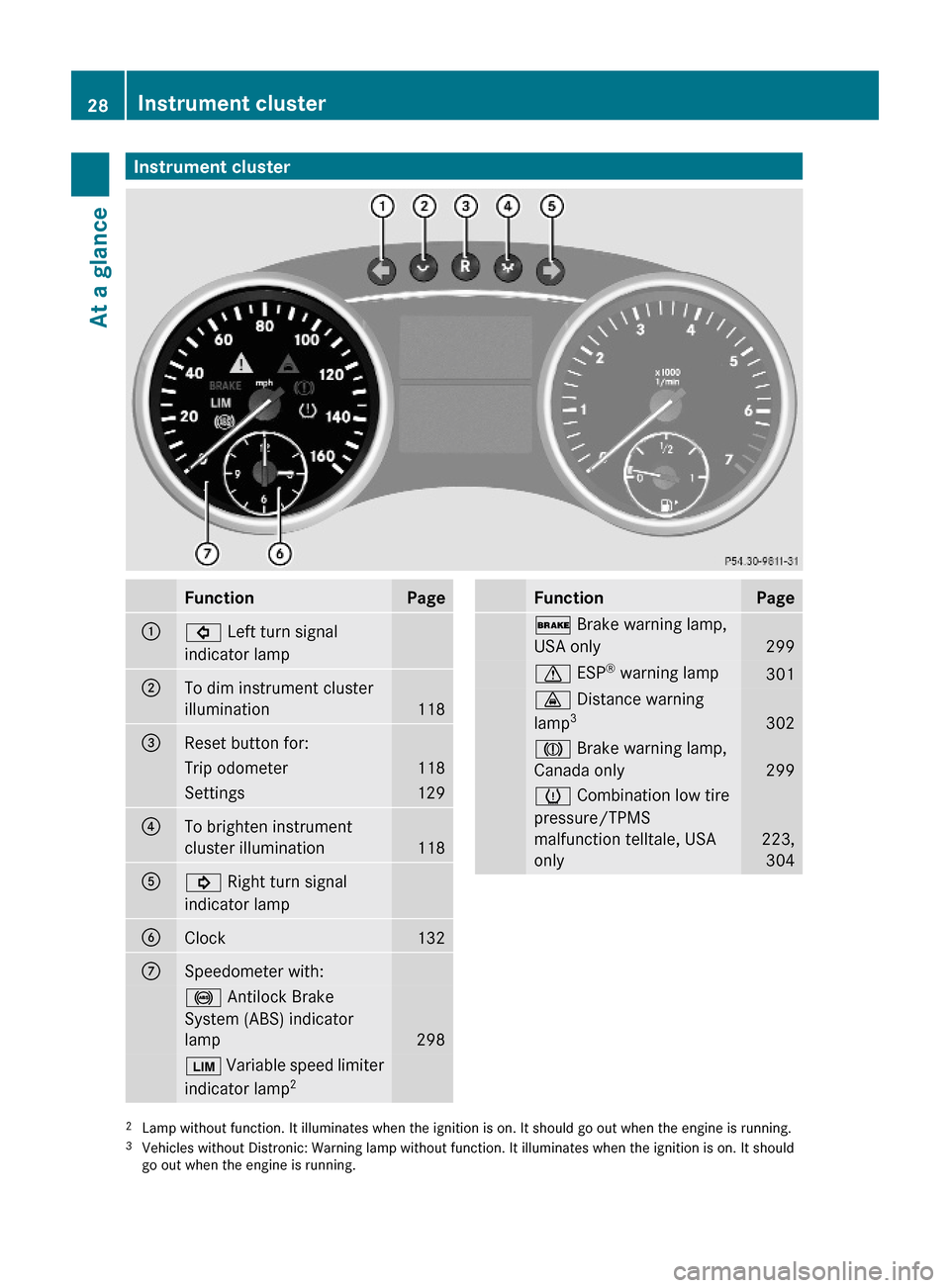
Instrument clusterFunctionPage:# Left turn signal
indicator lamp
;To dim instrument cluster
illumination118
=Reset button for: Trip odometer118Settings129?To brighten instrument
cluster illumination118
A! Right turn signal
indicator lamp
BClock 132CSpeedometer with: ! Antilock Brake
System (ABS) indicator
lamp 298
È Variable speed limiter
indicator lamp2FunctionPage$ Brake warning lamp,
USA only 299
d ESP® warning lamp 301· Distance warning
lamp3302
J Brake warning lamp,
Canada only299
h Combination low tire
pressure/TPMS
malfunction telltale, USA
only
223,
304
2Lamp without function. It illuminates when the ignition is on. It should go out when the engine is running.3Vehicles without Distronic: Warning lamp without function. It illuminates when the ignition is on. It shouldgo out when the engine is running.
28Instrument clusterAt a glance
164_AKB; 7; 31, en-USd2ureepe,Version: 2.11.8.12009-09-11T12:07:36+02:00 - Seite 28
Page 35 of 368
FunctionPageHHands-free microphone for
Tele Aid (emergency call
system), telephone and
Voice Control System, see
separate operating
instructions
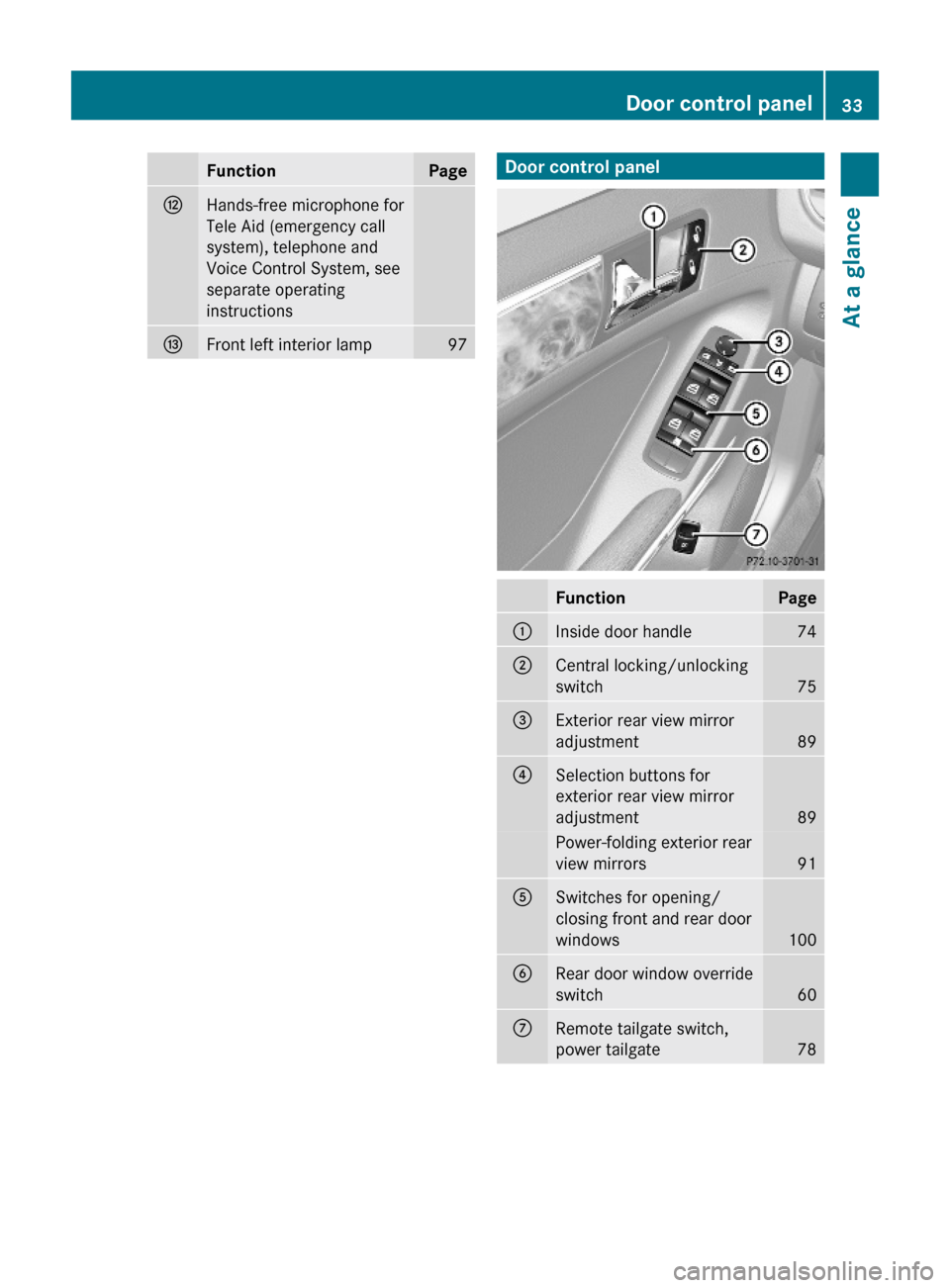
IFront left interior lamp97Door control panelFunctionPage:Inside door handle 74;Central locking/unlocking
switch75
=Exterior rear view mirror
adjustment89
?Selection buttons for
exterior rear view mirror
adjustment89
Power-folding exterior rear
view mirrors91
ASwitches for opening/
closing front and rear door
windows100
BRear door window override
switch60
CRemote tailgate switch,
power tailgate78
Door control panel33At a glance164_AKB; 7; 31, en-USd2ureepe,Version: 2.11.8.12009-09-11T12:07:36+02:00 - Seite 33Z
Page 55 of 368
The PRE-SAFE®
system takes preventive
measures to better protect the occupants
from the possibility of personal injuries in the
following hazardous situations:
R emergency braking maneuvers with the
Brake Assist System (BAS) ( Y page 63)
activated
R critical dynamic driving situations, e.g.
when the vehicle has been caused to
understeer or oversteer because it has
exceeded its physical limitations or in case
of evasive steering maneuvers at speeds
above approximately 85 mph (140 km/h)
PRE-SAFE ®
takes the following measures
when it is activated:
R The front seat belts are pre-tensioned
automatically.
R Vehicles with front passenger seat memory
function: If the passenger seat is in an
unfavorable position, the seat will be
adjusted to a position that seeks to better
protect the occupant.
R If the vehicle is in a critical dynamic driving
situation, the door windows close, except
for a minimal gap that remains open.
R Vehicles with power tilt/sliding sunroof: If
the vehicle is in a critical dynamic driving
situation, the tilt/sliding sunroof also
closes, except for a minimal gap that
remains open.
If the closing procedure of any of these
elements is blocked, it will stop and open
slightly.
Once the hazardous situation no longer exists
and an accident has been avoided, the seat
belt pre-tensioning is deactivated. All of the
PRE-SAFE ®
settings can be re-adjusted
following the critical driving event.
If the seat belts do not release:XAdjust the seat backrest or seat slightly to
the rear until the seat belt tension is
reduced.
The locking mechanism releases.! When moving the seats, make sure there
are no items in the footwell or behind the
seats. Otherwise, you could damage the
seats and/or the items.
For information on the seat belt adjustment
function as an integrated comfort feature of
PRE-SAFE ®
, see ( Y page 51).
NECK-PRO active front head
restraints
The NECK-PRO active front head restraints
are intended to offer the driver and front
passenger increased protection from
whiplash-type injuries. In the event of a rear-
end collision, the NECK-PRO active front head
restraints on the front seats are designed to
move forward in the direction of travel. They
thus provide the head with increased support
earlier on in the collision sequence. The
NECK-PRO active front head restraints will
move forward whether the seats are occupied
or not.
GWarning!
Do not attach any objects (e.g. hangers) to the
head restraint posts. Otherwise, the NECK-
PRO active front head restraints may not be
able to function properly or offer the intended
degree of protection they were designed for
in the event of a rear-end collision.
GWarning!
Only use seat or head restraint covers which
have been tested and approved by Mercedes-
Benz for your vehicle model.
Using other seat or head restraint covers may
interfere with or prevent the activation of the
NECK-PRO active front head restraints and/
or the deployment of the front side impact air
bags.
Contact an authorized Mercedes-Benz Center
for availability.
When the NECK-PRO active front head
restraints have been triggered in an accident,
the NECK-PRO active front head restraints
Occupant safety53Safety and security164_AKB; 7; 31, en-USd2ureepe,Version: 2.11.8.12009-09-11T12:07:36+02:00 - Seite 53Z
Page 57 of 368
Make sure:
R The seat belt is always fitted snugly.
R Adjust the seat belt so that the shoulder
section is located as close as possible to
the middle of the shoulder.
R Place the lap portion of the seat belt as low
as possible on your hips.
Seat and head restraintGObserve Safety notes, see page 81.XPosition seat = and head restraint
properly. See ( Y page 82) for seat and
head restraint adjustment.
Observe the following points:
R Always be in a properly seated position.
R The position should be as far rearward from
the front air bag in the steering wheel as
possible, while still permitting proper
operation of vehicle controls.
R Adjust the seat to a comfortable seating
position that still allows you to reach the
accelerator/brake pedal safely.
R The seat must be adjusted so that you can
correctly fasten and position your seat belt.
R The seat backrest must be in a position that
is as nearly upright as possible.
R Adjust the seat cushion so that the front
edge of the seat cushion lightly supports
your legs.
R Adjust the head restraint so that it is as
close to the head as possible and the
center of the head restraint supports the
back of the head at eye level.
R Never place hands under the seat or near
any moving parts while the seat is being
adjusted.
Children in the vehicle
Safety notes
If an infant or child is traveling with you in the
vehicle:
XSecure the child using an infant or child
restraint appropriate to the age and size of
the child.XMake sure the infant or child is properly
secured at all times while the vehicle is in
motion.GWarning!
When leaving the vehicle, always remove the
SmartKey from the starter switch. Always
take the SmartKey with you and lock the
vehicle. Do not leave children unattended in
the vehicle, even if they are secured in a child
restraint system, or with access to an
unlocked vehicle. A child’s unsupervised
access to a vehicle could result in an accident
and/or serious personal injury. The children
could
R injure themselves on parts of the vehicle
R be seriously or fatally injured through
excessive exposure to extreme heat or cold
R injure themselves or cause an accident with
vehicle equipment that can be operated
even if the SmartKey is removed from the
starter switch or removed from the vehicle,
such as seat adjustment, steering wheel
adjustment, or the memory function
If children open a door, they could injure other
persons or get out of the vehicle and injure
themselves or be injured by following traffic.
Do not expose the child restraint system to
direct sunlight. The child restraint system’s
metal parts, for example, could become very
hot, and the child could be burned by these
parts.
GWarning!
Do not carry heavy or hard objects in the
passenger or cargo compartment unless they
are firmly secured in place.
Occupant safety55Safety and security164_AKB; 7; 31, en-USd2ureepe,Version: 2.11.8.12009-09-11T12:07:36+02:00 - Seite 55Z
Page 58 of 368
Unsecured or improperly positioned cargo
increases a child’s risk of injury in the event
of
R strong braking maneuvers
R sudden changes of direction
R an accident
Infant and child restraint systemsGObserve Safety notes, see page 55.
We recommend all infants and children be
properly restrained at all times while the
vehicle is in motion.
Canada only:
Only use a BabySmart™ compatible child
restraint for the front passenger seat in this
vehicle.
All lap/shoulder belts except the driver’s seat
belt have special seat belt retractors for
secure fastening of child restraints.
To fasten a child restraint, follow the child
restraint manufacturer’s instructions for
mounting.
To activate the special seat belt retractor:
XPull the shoulder belt out completely and
let it retract.
During seat belt retraction, a ratcheting
sound can be heard to indicate that the
special seat belt retractor is activated.
The seat belt is now locked.XPush down on child restraint to take up any
slack.
To deactivate the special seat belt retractor:
XRelease the seat belt buckle and let the
seat belt retract completely.
The seat belt can then again be used in the
usual manner.
To deactivate the special seat belt retractor
for the front passenger seat, the front
passenger seat must be in the most backward
position.
GWarning!
Never release the seat belt buckle while the
vehicle is in motion, since the special seat belt
retractor will be deactivated.
i Information on child seats with mounting
fittings for tether anchorages
( Y page 58).
For information on LATCH-type child seat
anchors ( Y page 59).
The use of infant or child restraints is required
by law in all 50 states, the District of
Columbia, the U.S. territories and all
Canadian provinces.
Infants and small children should be seated
in an appropriate infant or child restraint
system. They must be properly secured in
accordance with the manufacturer’s
instructions for the child restraint. All infant
or child restraint systems must comply with
U.S. Federal Motor Vehicle Safety Standards
213 and 225 and Canadian Motor Vehicle
Safety Standards 213 and 210.2.
A statement by the child restraint
manufacturer of compliance with these
standards can be found on the instruction
label on the restraint and in the instruction
manual provided with the restraint.
When using any infant restraint, toddler
restraint, or booster seat, make sure to
carefully read and follow all manufacturer’s
instructions for installation and use.
Please read and observe warning labels
affixed to the inside of the vehicle and to
infant or child restraints.
GWarning!
According to accident statistics, children are
safer when properly restrained in the rear
seating positions than in the front seating
position. Thus, we strongly recommend that
children be placed in the rear seats whenever
possible. Regardless of seating position,
children 12 years old and under must be
seated and properly secured in an appropriate
56Occupant safetySafety and security
164_AKB; 7; 31, en-USd2ureepe,Version: 2.11.8.12009-09-11T12:07:36+02:00 - Seite 56