belt MERCEDES-BENZ R-Class 2012 W251 Owner's Manual
[x] Cancel search | Manufacturer: MERCEDES-BENZ, Model Year: 2012, Model line: R-Class, Model: MERCEDES-BENZ R-Class 2012 W251Pages: 368, PDF Size: 15.19 MB
Page 7 of 368
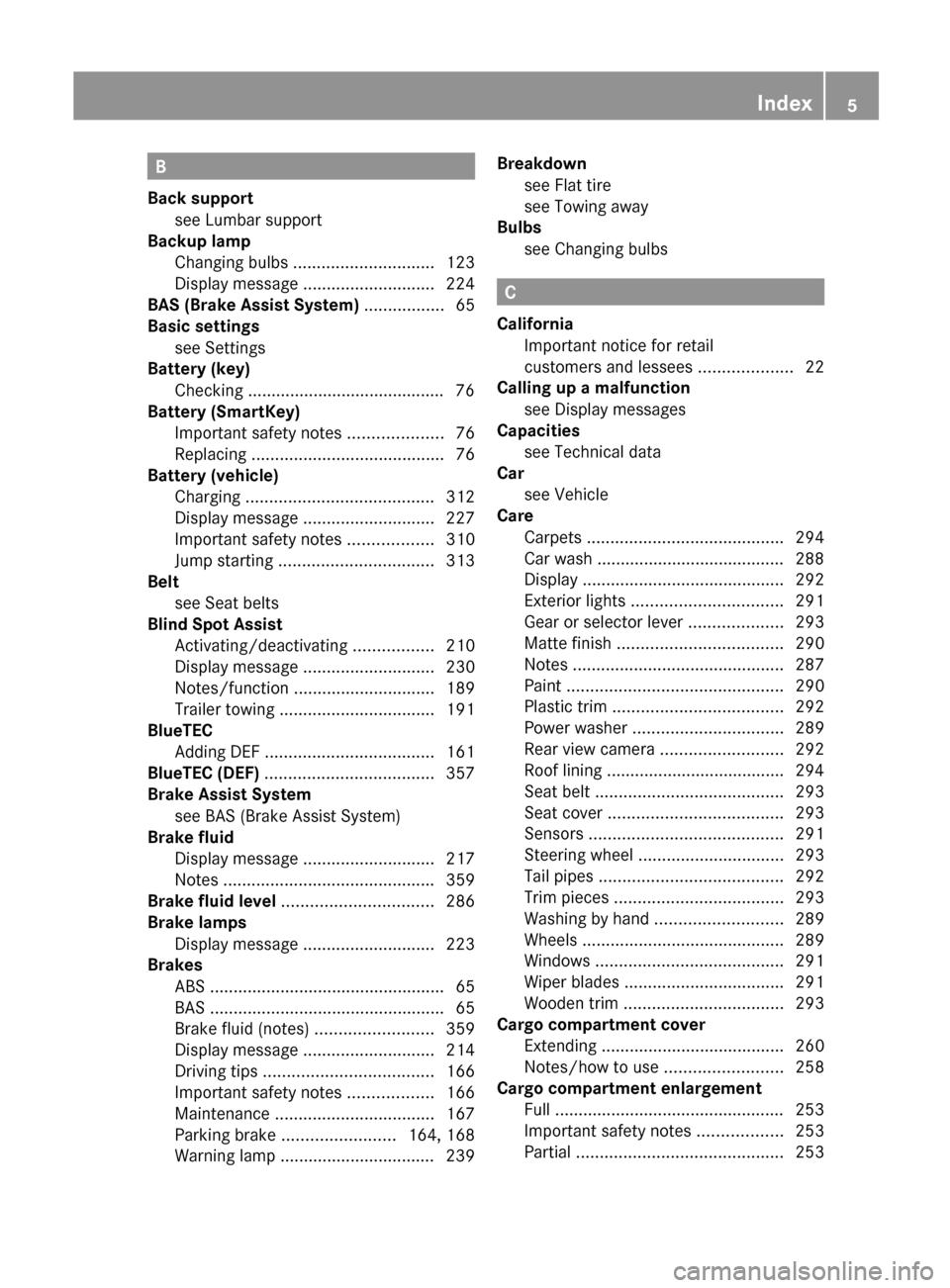
B
Back support see Lumbar support
Backup lamp
Changing bulbs .............................. 123
Display message ............................ 224
BAS (Brake Assist System) ................. 65
Basic settings see Settings
Battery (key)
Checking .......................................... 76
Battery (SmartKey)
Important safety notes ....................76
Replacing ......................................... 76
Battery (vehicle)
Charging ........................................ 312
Display message ............................ 227
Important safety notes ..................310
Jump starting ................................. 313
Belt
see Seat belts
Blind Spot Assist
Activating/deactivating .................210
Display message ............................ 230
Notes/function .............................. 189
Trailer towing ................................. 191
BlueTEC
Adding DEF .................................... 161
BlueTEC (DEF) .................................... 357
Brake Assist System see BAS (Brake Assist System)
Brake fluid
Display message ............................ 217
Notes ............................................. 359
Brake fluid level ................................ 286
Brake lamps Display message ............................ 223
Brakes
ABS .................................................. 65
BAS .................................................. 65
Brake fluid (notes) .........................359
Display message ............................ 214
Driving tips .................................... 166
Important safety notes ..................166
Maintenance .................................. 167
Parking brake ........................ 164, 168
Warning lamp ................................. 239Breakdown
see Flat tire
see Towing away
Bulbs
see Changing bulbs
C
California Important notice for retail
customers and lessees ....................22
Calling up a malfunction
see Display messages
Capacities
see Technical data
Car
see Vehicle
Care
Carpets .......................................... 294
Car wash ........................................ 288
Display ........................................... 292
Exterior lights ................................ 291
Gear or selector lever ....................293
Matte finish ................................... 290
Notes ............................................. 287
Paint .............................................. 290
Plastic trim .................................... 292
Power washer ................................ 289
Rear view camera .......................... 292
Roof lining ...................................... 294
Seat belt ........................................ 293
Seat cover ..................................... 293
Sensors ......................................... 291
Steering wheel ............................... 293
Tail pipes ....................................... 292
Trim pieces .................................... 293
Washing by hand ........................... 289
Wheels ........................................... 289
Windows ........................................ 291
Wiper blades .................................. 291
Wooden trim .................................. 293
Cargo compartment cover
Extending ....................................... 260
Notes/how to use .........................258
Cargo compartment enlargement
Full ................................................. 253
Important safety notes ..................253
Partial ............................................ 253
Index5
Page 8 of 368
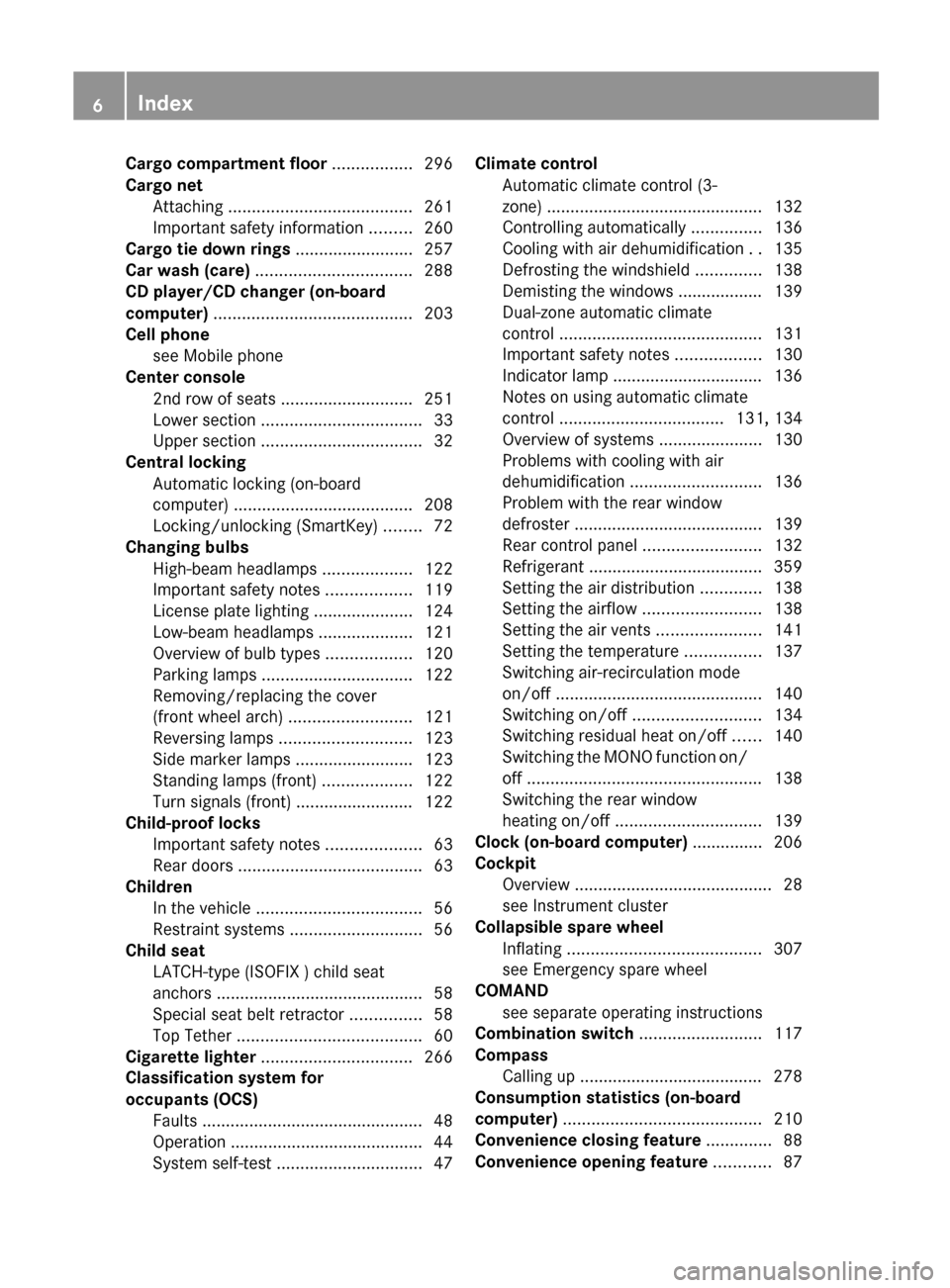
Cargo compartment floor ................. 296
Cargo net Attaching ....................................... 261
Important safety information .........260
Cargo tie down rings ......................... 257
Car wash (care) ................................. 288
CD player/CD changer (on-board
computer) .......................................... 203
Cell phone see Mobile phone
Center console
2nd row of seats ............................ 251
Lower section .................................. 33
Upper section .................................. 32
Central locking
Automatic locking (on-board
computer) ...................................... 208
Locking/unlocking (SmartKey) ........72
Changing bulbs
High-beam headlamps ...................122
Important safety notes ..................119
License plate lighting .....................124
Low-beam headlamps ....................121
Overview of bulb types ..................120
Parking lamps ................................ 122
Removing/replacing the cover
(front wheel arch) .......................... 121
Reversing lamps ............................ 123
Side marker lamps .........................123
Standing lamps (front) ...................122
Turn signals (front) ......................... 122
Child-proof locks
Important safety notes ....................63
Rear doors ....................................... 63
Children
In the vehicle ................................... 56
Restraint systems ............................ 56
Child seat
LATCH-type (ISOFIX ) child seat
anchors ............................................ 58
Special seat belt retractor ...............58
Top Tether ....................................... 60
Cigarette lighter ................................ 266
Classification system for
occupants (OCS) Faults ............................................... 48
Operation ......................................... 44
System self-test ............................... 47Climate control
Automatic climate control (3-
zone) .............................................. 132
Controlling automatically ...............136
Cooling with air dehumidification ..135
Defrosting the windshield ..............138
Demisting the windows .................. 139
Dual-zone automatic climate
control ........................................... 131
Important safety notes ..................130
Indicator lamp ................................ 136
Notes on using automatic climate
control ................................... 131, 134
Overview of systems ......................130
Problems with cooling with air
dehumidification ............................ 136
Problem with the rear window
defroster ........................................ 139
Rear control panel .........................132
Refrigerant ..................................... 359
Setting the air distribution .............138
Setting the airflow .........................138
Setting the air vents ......................141
Setting the temperature ................137
Switching air-recirculation mode
on/off ............................................ 140
Switching on/off ........................... 134
Switching residual heat on/off ......140
Switching the MONO function on/
off .................................................. 138
Switching the rear window
heating on/off ............................... 139
Clock (on-board computer) ............... 206
Cockpit Overview .......................................... 28
see Instrument cluster
Collapsible spare wheel
Inflating ......................................... 307
see Emergency spare wheel
COMAND
see separate operating instructions
Combination switch .......................... 117
Compass Calling up ....................................... 278
Consumption statistics (on-board
computer) .......................................... 210
Convenience closing feature .............. 88
Convenience opening feature ............ 876Index
Page 17 of 368
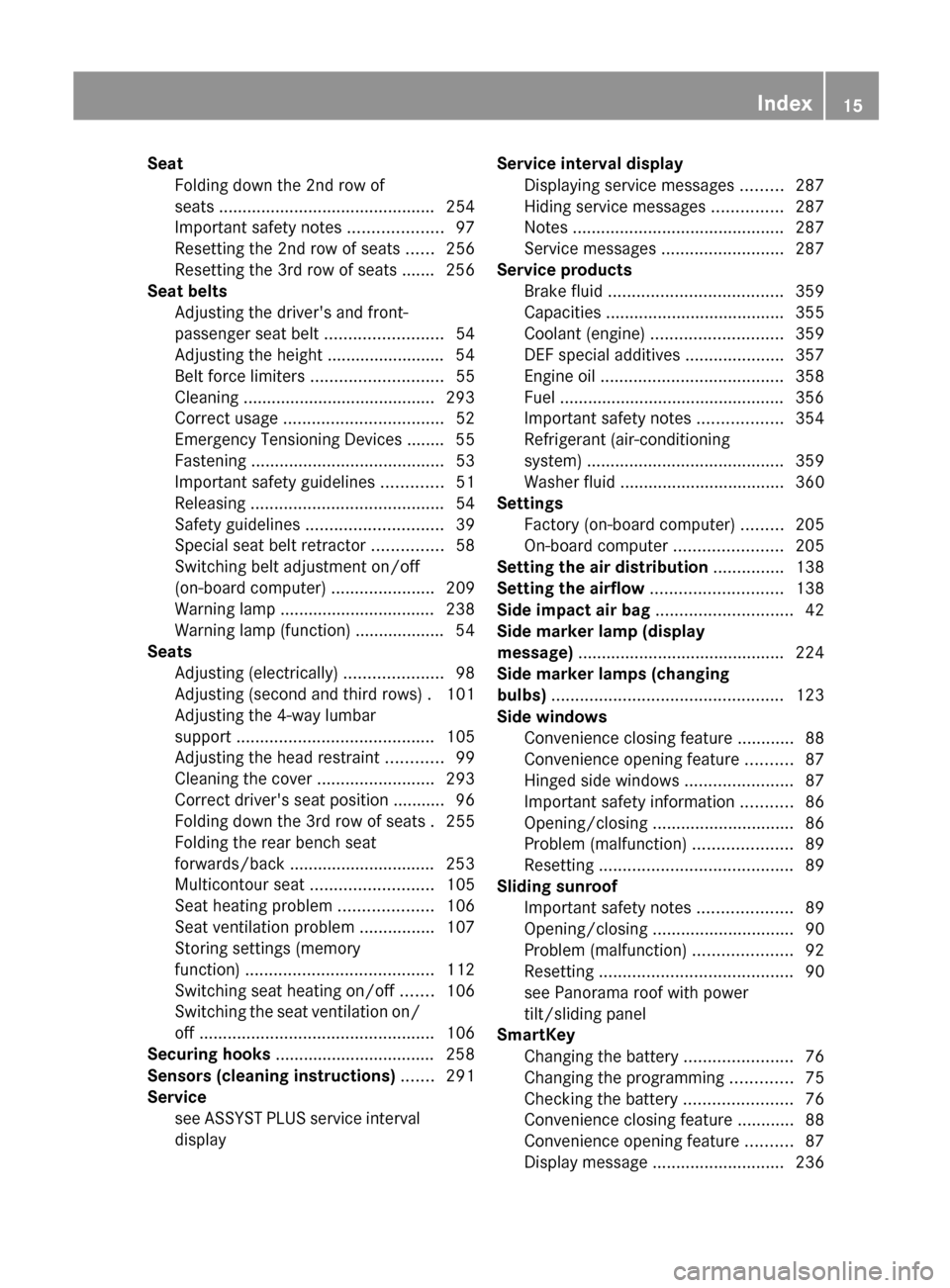
SeatFolding down the 2nd row of
seats .............................................. 254
Important safety notes ....................97
Resetting the 2nd row of seats ......256
Resetting the 3rd row of seats ....... 256
Seat belts
Adjusting the driver's and front-
passenger seat belt .........................54
Adjusting the height ......................... 54
Belt force limiters ............................ 55
Cleaning ......................................... 293
Correct usage .................................. 52
Emergency Tensioning Devices ........ 55
Fastening ......................................... 53
Important safety guidelines .............51
Releasing ......................................... 54
Safety guidelines ............................. 39
Special seat belt retractor ...............58
Switching belt adjustment on/off
(on-board computer) ......................209
Warning lamp ................................. 238
Warning lamp (function) ................... 54
Seats
Adjusting (electrically) .....................98
Adjusting (second and third rows) . 101
Adjusting the 4-way lumbar
support .......................................... 105
Adjusting the head restraint ............99
Cleaning the cover .........................293
Correct driver's seat position ........... 96
Folding down the 3rd row of seats . 255
Folding the rear bench seat
forwards/back ............................... 253
Multicontour seat .......................... 105
Seat heating problem ....................106
Seat ventilation problem ................107
Storing settings (memory
function) ........................................ 112
Switching seat heating on/off .......106
Switching the seat ventilation on/
off .................................................. 106
Securing hooks .................................. 258
Sensors (cleaning instructions) ....... 291
Service see ASSYST PLUS service interval
display Service interval display
Displaying service messages .........287
Hiding service messages ...............287
Notes ............................................. 287
Service messages ..........................287
Service products
Brake fluid ..................................... 359
Capacities ...................................... 355
Coolant (engine) ............................ 359
DEF special additives .....................357
Engine oil ....................................... 358
Fuel ................................................ 356
Important safety notes ..................354
Refrigerant (air-conditioning
system) .......................................... 359
Washer fluid ................................... 360
Settings
Factory (on-board computer) .........205
On-board computer .......................205
Setting the air distribution ............... 138
Setting the airflow ............................ 138
Side impact air bag ............................. 42
Side marker lamp (display
message) ............................................ 224
Side marker lamps (changing
bulbs) ................................................. 123
Side windows Convenience closing feature ............88
Convenience opening feature ..........87
Hinged side windows .......................87
Important safety information ...........86
Opening/closing .............................. 86
Problem (malfunction) .....................89
Resetting ......................................... 89
Sliding sunroof
Important safety notes ....................89
Opening/closing .............................. 90
Problem (malfunction) .....................92
Resetting ......................................... 90
see Panorama roof with power
tilt/sliding panel
SmartKey
Changing the battery .......................76
Changing the programming .............75
Checking the battery .......................76
Convenience closing feature ............88
Convenience opening feature ..........87
Display message ............................ 236Index15
Page 21 of 368
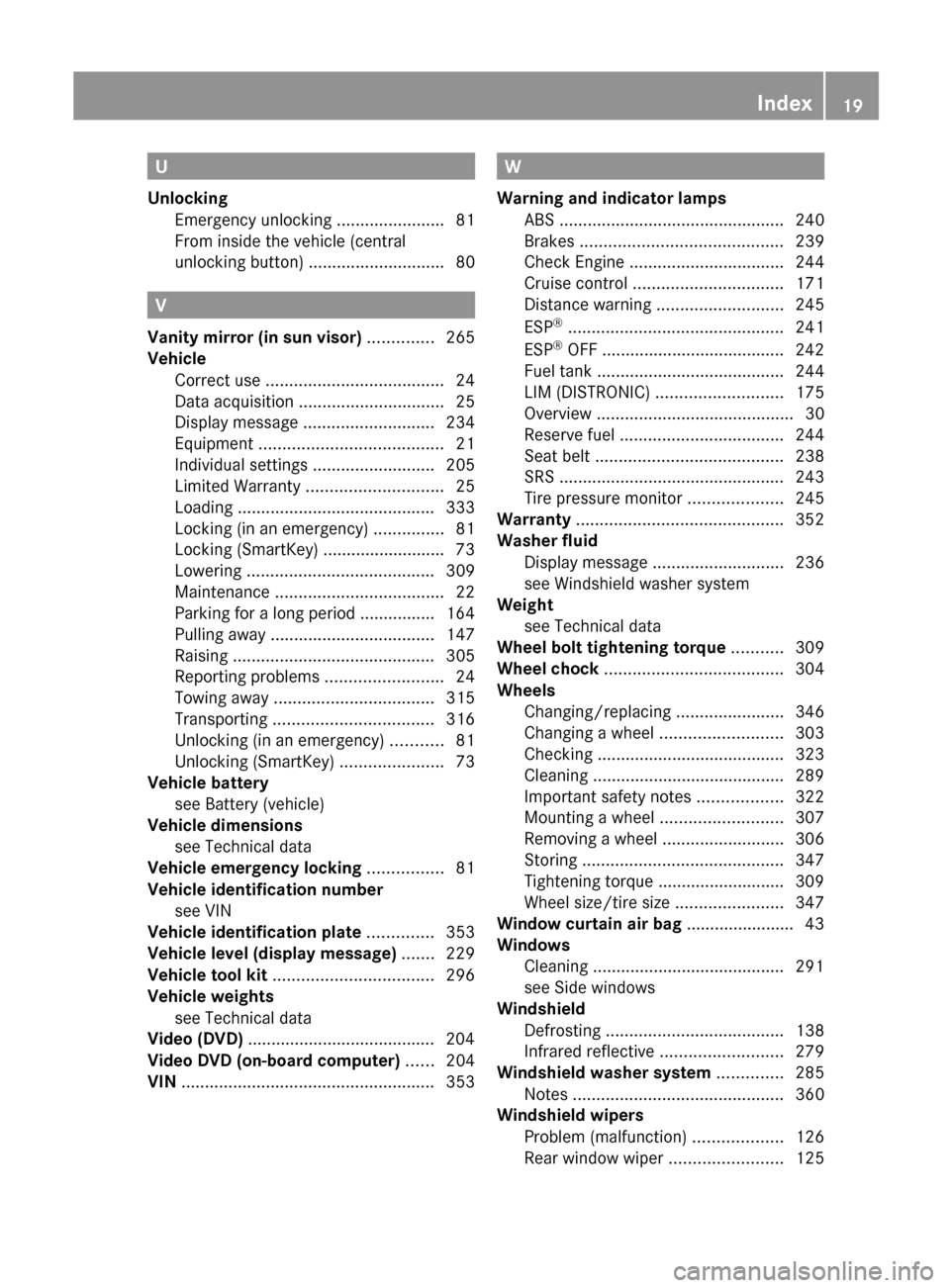
U
Unlocking Emergency unlocking .......................81
From inside the vehicle (central
unlocking button) ............................. 80
V
Vanity mirror (in sun visor) .............. 265
Vehicle Correct use ...................................... 24
Data acquisition ............................... 25
Display message ............................ 234
Equipment ....................................... 21
Individual settings ..........................205
Limited Warranty ............................. 25
Loading .......................................... 333
Locking (in an emergency) ...............81
Locking (SmartKey) .......................... 73
Lowering ........................................ 309
Maintenance .................................... 22
Parking for a long period ................ 164
Pulling away ................................... 147
Raising ........................................... 305
Reporting problems .........................24
Towing away .................................. 315
Transporting .................................. 316
Unlocking (in an emergency) ...........81
Unlocking (SmartKey) ......................73
Vehicle battery
see Battery (vehicle)
Vehicle dimensions
see Technical data
Vehicle emergency locking ................ 81
Vehicle identification number see VIN
Vehicle identification plate .............. 353
Vehicle level (display message) ....... 229
Vehicle tool kit .................................. 296
Vehicle weights see Technical data
Video (DVD) ........................................ 204
Video DVD (on-board computer) ...... 204
VIN ...................................................... 353
W
Warning and indicator lamps ABS ................................................ 240
Brakes ........................................... 239
Check Engine ................................. 244
Cruise control ................................ 171
Distance warning ........................... 245
ESP ®
.............................................. 241
ESP ®
OFF ....................................... 242
Fuel tank ........................................ 244
LIM (DISTRONIC) ........................... 175
Overview .......................................... 30
Reserve fuel ................................... 244
Seat belt ........................................ 238
SRS ................................................ 243
Tire pressure monitor ....................245
Warranty ............................................ 352
Washer fluid Display message ............................ 236
see Windshield washer system
Weight
see Technical data
Wheel bolt tightening torque ........... 309
Wheel chock ...................................... 304
Wheels Changing/replacing .......................346
Changing a wheel .......................... 303
Checking ........................................ 323
Cleaning ......................................... 289
Important safety notes ..................322
Mounting a wheel .......................... 307
Removing a wheel ..........................306
Storing ........................................... 347
Tightening torque ........................... 309
Wheel size/tire size .......................347
Window curtain air bag ....................... 43
Windows Cleaning ......................................... 291
see Side windows
Windshield
Defrosting ...................................... 138
Infrared reflective .......................... 279
Windshield washer system .............. 285
Notes ............................................. 360
Windshield wipers
Problem (malfunction) ...................126
Rear window wiper ........................125Index19
Page 32 of 368
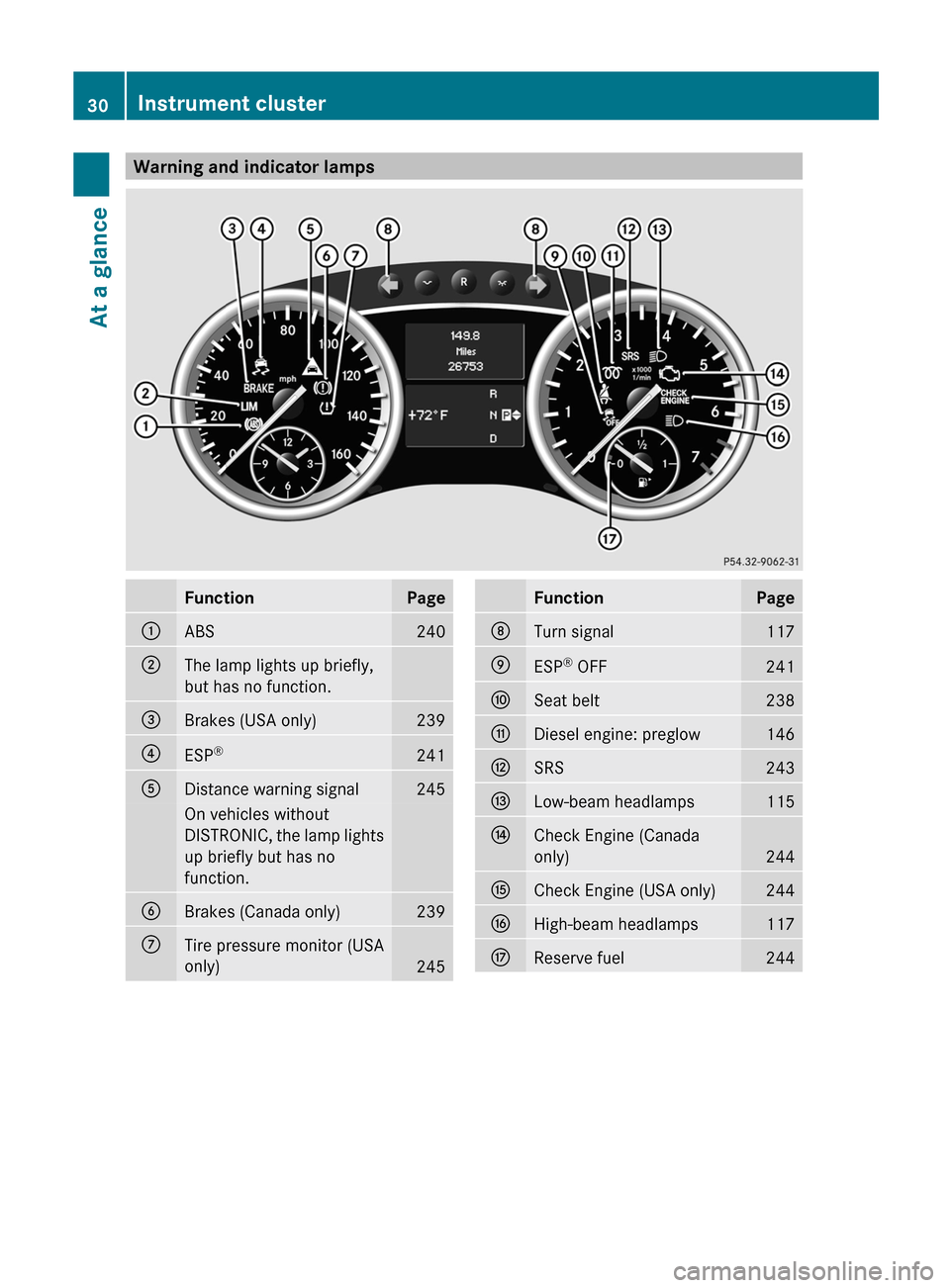
Warning and indicator lampsFunctionPage:ABS240;The lamp lights up briefly,
but has no function.=Brakes (USA only)239?ESP ®241ADistance warning signal245On vehicles without
DISTRONIC, the lamp lights
up briefly but has no
function.BBrakes (Canada only)239CTire pressure monitor (USA
only)
245
FunctionPageDTurn signal117EESP ®
OFF241FSeat belt238GDiesel engine: preglow146HSRS243ILow-beam headlamps115JCheck Engine (Canada
only)
244
KCheck Engine (USA only)244LHigh-beam headlamps117MReserve fuel24430Instrument clusterAt a glance
Page 40 of 368
Useful information
i This Operator's Manual describes all
models and all standard and optional
equipment of your vehicle available at the
time of publication of the Operator's
Manual. Country-specific differences are
possible. Please note that your vehicle may
not be equipped with all features
described. This also applies to safety-
related systems and functions.
i Please read the information on qualified
specialist workshops ( Y page 24).
Occupant safety
Overview of occupant safety
In this section, you will learn the most
important facts about the restraint system
components of the vehicle.
The restraint system consists of:
R seat belts
R child restraint systems
R LATCH-type (ISOFIX) child seat anchors
Additional protection is provided by:
R SRS (Supplemental Restraint System)
R NECK-PRO head restraints/NECK-PRO
luxury head restraints
R PRE-SAFE ®
R Air bag system components with:
- PASSENGER AIR BAG OFF indicator lamp
- front-passenger seat with Occupant
Classification System (OCS)
The different air bag systems work
independently of each other. The protective
functions of the system work in conjunction
with each other. Not all air bags are deployed
in an accident.
GWARNING
Modifications to or work improperly
conducted on restraint system components
or their wiring, as well as tampering with
interconnected electronic systems, can lead
to the restraint systems no longer functioning
as intended.
Air bags or Emergency Tensioning Devices
(ETDs), for example, could deploy
inadvertently or fail to deploy in accidents
although the deceleration threshold for air
bag deployment is exceeded. Therefore,
never modify the restraint systems. Do not
tamper with electronic components or their
software.
i See "Children in the vehicle"
( Y page 56) for more information on
infants and children traveling with you in
the vehicle and restraints for infants and
children.
SRS (Supplemental Restraint System)
Introduction
SRS consists of:
R the + SRS warning lamp
R air bags
R air bag control unit (with crash sensors)
R Emergency Tensioning Devices
R belt force limiters
SRS reduces the risk of occupants coming
into contact with the vehicle's interior in the
event of an accident. It can also reduce the
effect of the forces to which occupants are
subjected during an accident.
SRS warning lamps
SRS functions are checked regularly when
you switch on the ignition and when the
engine is running. Therefore, malfunctions
can be detected in good time.
The + SRS warning lamp in the instrument
cluster lights up when the ignition is switched
on. It goes out no later than a few seconds
after the engine is started.
38Occupant safetySafety
Page 41 of 368
The SRS components are in operational
readiness when the + SRS warning lamp
is not lit while the engine is running .GWARNING
The SRS self-check has detected a
malfunction if the + SRS warning lamp:
R does not come on at all
R fails to go out approximately 4 seconds
after the engine was started
R comes on after the engine was started or
while driving
For your safety, Mercedes-Benz strongly
recommends that you have the system
checked as soon as possible at an authorized
Mercedes-Benz Center. Otherwise the SRS
may not be activated when it is needed in an
accident, which could result in serious or fatal
injury. The SRS might also deploy
unexpectedly and unnecessarily which could
also result in injury.
In addition, improper work on the SRS creates
a risk of rendering the SRS inoperative or
causing unintended air bag deployment. Work
on the SRS must therefore only be performed
by qualified technicians. Contact an
authorized Mercedes-Benz Center.
If it is necessary to modify an air bag system
to accommodate a person with disabilities,
contact an authorized Mercedes-Benz Center
for details. USA only: Call our Customer
Assistance Center at 1-800-FOR-MERCedes
(1-800-367-6372) for details.
Safety guidelines for seat belts,
Emergency Tensioning Devices (ETDs)
and air bags
GWARNING
R Damaged seat belts or seat belts that have
been subjected to stress in an accident
must be replaced. Their anchoring points
must also be checked. Only use seat belts
installed or supplied by an authorized
Mercedes-Benz Center.
R Air bags and pyrotechnic Emergency
Tensioning Devices (ETDs) contain
perchlorate material, which may require
special handling and regard for the
environment. Check your national disposal
guidelines. California residents, see
www.dtsc.ca.gov/HazardousWaste/
Perchlorate/index.cfm .
R Air bags and ETDs are designed to function
on a one-time-only basis. An air bag or ETD
that has deployed must be replaced. PRE-
SAFE ®
has electrically operated reversible
belt tensioners in addition to the
pyrotechnic ETDs.
R Do not pass seat belts over sharp edges.
They could tear.
R Do not make any modification that could
change the effectiveness of the seat belts.
R Do not bleach or dye seat belts as this may
severely weaken them. In a crash they may
not be able to provide adequate protection.
R No modifications of any kind may be made
to any components or wiring of the SRS.
R Do not change or remove any component
or part of the SRS.
R Do not install additional trim material, seat
covers, badges, etc. to the:
- padded steering wheel boss
- front-passenger air bag cover
- outer side of front seat bolsters
- outer side of the seat bolsters of the rear
bench seat backrest
- roof lining trim
R Do not install additional electrical/
electronic equipment on or near SRS
components and wiring.
R Keep area between air bags and occupants
free of objects (e.g. packages, purses,
umbrellas, etc.).
R Do not hang items such as coat hangers
from the coat hooks or handles over the
door. These items may be thrown around inOccupant safety39SafetyZ
Page 42 of 368
the vehicle and cause head and other
injuries when the window curtain air bag is
deployed.
R Air bag system components will be hot after
an air bag has inflated. Do not touch them.
R Never place your feet on the instrument
panel, dashboard, or on the seat. Always
keep both feet on the floor in front of the
seat.
R Improper repair work on the SRS creates a
risk of rendering the SRS inoperative or
causing unintended air bag deployment.
Work on the SRS must therefore only be
performed by qualified technicians.
Contact an authorized Mercedes-Benz
Center.
R For your protection and the protection of
others, when scrapping the air bag unit or
ETD, our safety instructions must be
followed. These instructions are available
from any authorized Mercedes-Benz
Center.
R Given the considerable deployment speed,
required inflation volume, and the material
of the air bags, there is the possibility of
abrasions or other, potentially more serious
injuries resulting from air bag deployment.
If you sell your vehicle, Mercedes-Benz
strongly recommends that you inform the
subsequent owner that the vehicle is
equipped with SRS. Also, refer them to the
applicable section in the Operator's Manual.Air bags
Important safety notesGWARNING
Air bags are designed to reduce the incidence
of injuries and fatalities in certain situations:
R frontal impacts (driver's and front-
passenger front air bags)
R side impacts (side impact air bags and
window curtain air bags)
R rollover (window curtain air bags)
However, no system available today can
completely eliminate injuries and fatalities.
When the air bags are deployed, a small
amount of powder is released. The powder
generally does not constitute a health hazard
and does not indicate that there is a fire in the
vehicle. In order to prevent potential
breathing difficulties, you should leave the
vehicle as soon as it is safe to do so. If you
have any breathing difficulty but cannot get
out of the vehicle after the air bag inflates,
then get fresh air by opening a window or
door.
GWARNING
To reduce the risk of injuries during front air
bag inflation, the driver and front-passenger
must always be seated correctly and have
their seat belts fastened accordingly.
For maximum protection in the event of a
collision, you must always be in the normal
seat position with your back against the
backrest. Fasten your seat belt and make sure
that it is correctly positioned on your body.
40Occupant safetySafety
Page 43 of 368
Since the air bag inflates with considerable
speed and force, a proper seating position
and correct positioning of the hands on the
steering wheel will help to keep you at a safe
distance from the air bag. Occupants who are
not wearing their seat belt, are not seated
properly or are too close to the air bag can be
seriously injured or killed by an air bag as it
inflates with great force instantaneously:
R Sit with the seat belt properly fastened in a
position that is as upright as possible with
your back against the seat backrest.
R Move the driver's seat as far back as
possible, still permitting proper operation
of vehicle controls. The distance from the
center of the driver's chest to the center of
the air bag cover on the steering wheel
must be at least 10 inches (25 cm) or more.
You should be able to accomplish this by
adjusting the seat and steering wheel. If
you have any difficulties, please contact an
authorized Mercedes-Benz Center.
R Do not lean your head or chest close to the
steering wheel or dashboard.
R Only hold the steering wheel by the rim.
Placing hands and arms inside the rim can
increase the risk and potential severity of
hand/arm injury when the driver front air
bag inflates.
R Adjust the front-passenger seat as far back
as possible from the dashboard when the
seat is occupied.
R Occupants, especially children, should
never place their bodies or lean their heads
in the area of the door where the side
impact air bag inflates. This could result in
serious injuries or death should the side
impact air bag be deployed. Always sit as
upright as possible, wear the seat belt
properly and use an appropriately sized
child restraint, infant restraint or booster
seat recommended for the size and weight
of the child.
Failure to follow these instructions can result
in severe injuries to you or other occupants.If you sell your vehicle, it is important that you
make the buyer aware of this safety
information. Be sure to give the buyer this
Operator's Manual.GWARNING
Accident research shows that the safest place
for children in an automobile is in a rear seat.
A side impact air bag related injury may occur
if occupants, especially children, are not
properly seated or restrained when next to a
side impact air bag which needs to deploy
rapidly in a side impact in order to do its job.
To help avoid the possibility of injury, please
follow these guidelines:
(1)Always sit as upright as possible
and use the seat belts properly.
Make sure that children 12 years
old and under use an appropriately
sized child restraint, infant
restraint, or booster seat
recommended for the size and
weight of the child.(2)Always wear seat belts properly.
The air bags are only deployed if the air bag
control unit detects the need for deployment.
Only in the event of such a situation will they
provide their supplemental protection.
The driver and passenger should always wear
their seat belts. Otherwise, it is not possible
for the air bags to provide their supplemental
protection.
In the event of other types of impacts and
impacts below air bag deployment
thresholds, the air bags will not deploy. The
driver and passengers will then be protected
to the extent possible by a properly fastened
seat belt. A properly fastened seat belt is also
needed to provide the best possible
protection in a rollover.
Air bags provide additional protection; they
are not, however, a substitute for seat belts.
All vehicle occupants must fasten their seat
belts regardless of whether your vehicle is
equipped with air bags or not.
Occupant safety41SafetyZ
Page 44 of 368
It is important for your safety and that of your
passenger to have deployed air bags replaced
and to have any malfunctioning air bags
repaired. This will help to make sure the air
bags continue to perform their protective
function for the vehicle occupants in the
event of a crash.
Front air bags
The front air bags increase protection for the
driver's and front-passenger's head and
chest.
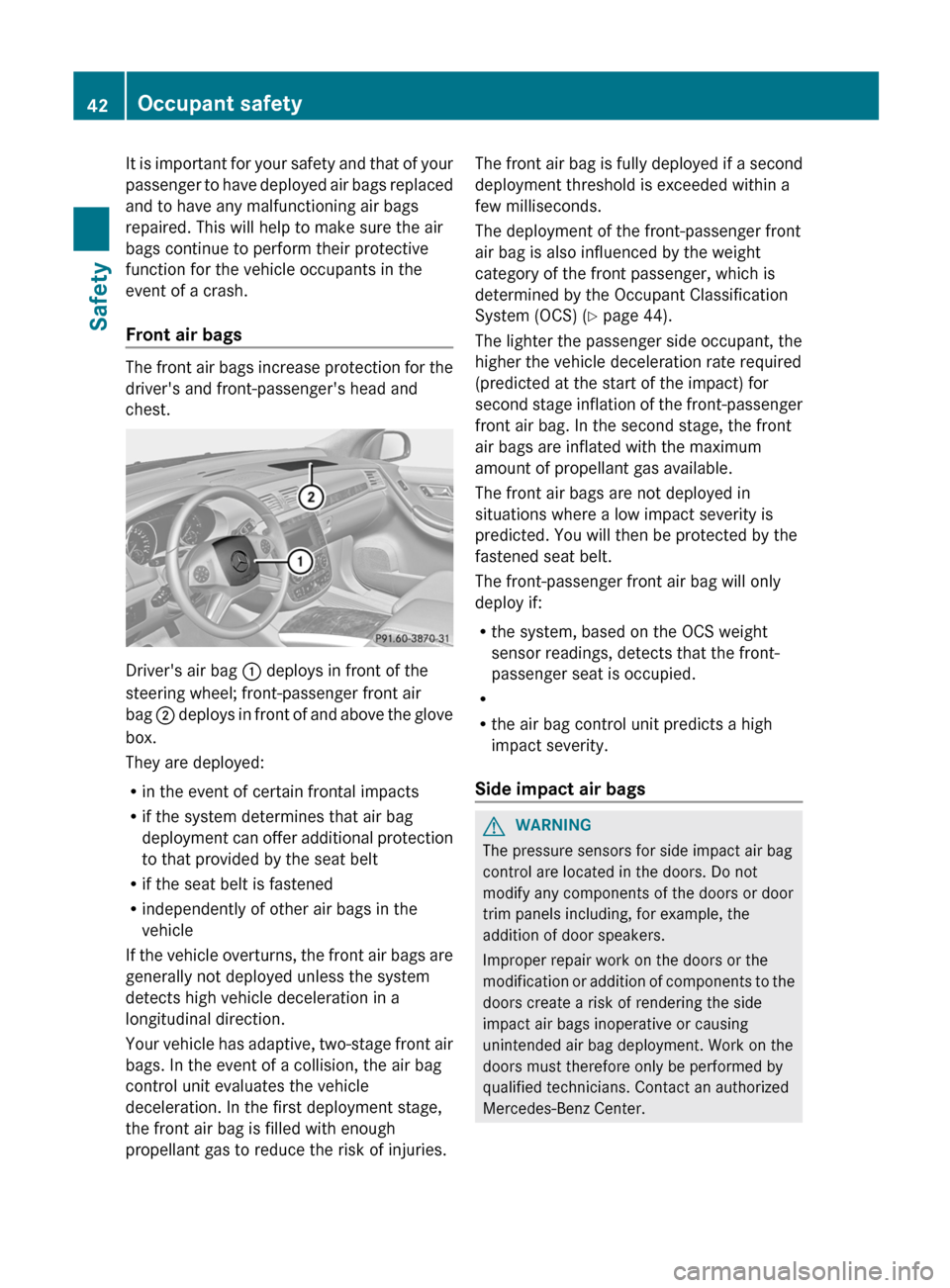
Driver's air bag : deploys in front of the
steering wheel; front-passenger front air
bag ; deploys in front of and above the glove
box.
They are deployed:
R in the event of certain frontal impacts
R if the system determines that air bag
deployment can offer additional protection
to that provided by the seat belt
R if the seat belt is fastened
R independently of other air bags in the
vehicle
If the vehicle overturns, the front air bags are
generally not deployed unless the system
detects high vehicle deceleration in a
longitudinal direction.
Your vehicle has adaptive, two-stage front air
bags. In the event of a collision, the air bag
control unit evaluates the vehicle
deceleration. In the first deployment stage,
the front air bag is filled with enough
propellant gas to reduce the risk of injuries.
The front air bag is fully deployed if a second
deployment threshold is exceeded within a
few milliseconds.
The deployment of the front-passenger front
air bag is also influenced by the weight
category of the front passenger, which is
determined by the Occupant Classification
System (OCS) ( Y page 44).
The lighter the passenger side occupant, the
higher the vehicle deceleration rate required
(predicted at the start of the impact) for
second stage inflation of the front-passenger
front air bag. In the second stage, the front
air bags are inflated with the maximum
amount of propellant gas available.
The front air bags are not deployed in
situations where a low impact severity is
predicted. You will then be protected by the
fastened seat belt.
The front-passenger front air bag will only
deploy if:
R the system, based on the OCS weight
sensor readings, detects that the front-
passenger seat is occupied.
R
R the air bag control unit predicts a high
impact severity.
Side impact air bagsGWARNING
The pressure sensors for side impact air bag
control are located in the doors. Do not
modify any components of the doors or door
trim panels including, for example, the
addition of door speakers.
Improper repair work on the doors or the
modification or addition of components to the
doors create a risk of rendering the side
impact air bags inoperative or causing
unintended air bag deployment. Work on the
doors must therefore only be performed by
qualified technicians. Contact an authorized
Mercedes-Benz Center.
42Occupant safetySafety