winter tires MERCEDES-BENZ R-CLASS FAMILY TOURER 2012 User Guide
[x] Cancel search | Manufacturer: MERCEDES-BENZ, Model Year: 2012, Model line: R-CLASS FAMILY TOURER, Model: MERCEDES-BENZ R-CLASS FAMILY TOURER 2012Pages: 368, PDF Size: 29.05 MB
Page 325 of 368
Notes on regularly inspecting wheels
and tiresGWARNING
Regularly check the tires for damage.
Damaged tires can cause tire inflation
pressure loss. As a result, you could lose
control of your vehicle.
Worn, old tires can cause accidents. If the tire
tread is worn to minimum tread depth, or if
the tires have sustained damage, replace
them.
R Regularly check the wheels and tires of
your vehicle for damage (e.g. cuts,
punctures, tears, bulges on tires and
deformation or cracks or severe corrosion
on wheels) at least once a month, as well
as after driving off-road or on rough roads.
Damaged wheels can cause a loss of tire
pressure.
R Regularly check the tire tread depth and
the condition of the tread across the whole
width of the tire (Y page 323). If necessary,
turn the front wheels to full lock in order to
inspect the inner side of the tire surface.
R All wheels must have a valve cap to protect
the valve against dirt and moisture. Do not
mount anything onto the valve (such as tire
pressure monitoring systems) other than
the standard valve cap or other valve caps
approved by Mercedes-Benz for your
vehicle.
R Regularly check the pressure of all the tires
including the emergency spare wheel or the
spare wheel, particularly prior to long trips,
and correct the pressure as necessary
( Y page 325).
Tire tread
GWARNING
Although the applicable federal motor vehicle
safety laws consider a tire to be worn when
the tread wear indicators (TWI) become
visible at approximately 1
/ 16 in (1.6 mm), we
recommend that you do not allow your tires
to wear down to that level. As tread depth
approaches 1
/ 8 in (3 mm), the adhesion
properties on a wet road are sharply reduced.
Depending upon the weather and/or road
surface (conditions), the tire traction varies
widely.
Do not use tires that are excessively worn as
the tire traction on wet road surfaces
decreases significantly when the tread depth
is less than 1
/ 8 inch (3 mm).
Tread wear indicators (TWI) are required by
law. Six indicators are positioned over the tire
tread. They are visible as soon as a tread
depth of approx. 1
/ 16 inch (1.6 mm) is
reached. If this is the case, the tire is so worn
that it must be replaced.
The recommended tread depth for summer
tires is at least 1
/ 8 inch (3 mm). The
recommended tread depth for winter tires is
at least 1
/ 6 inch (4 mm).
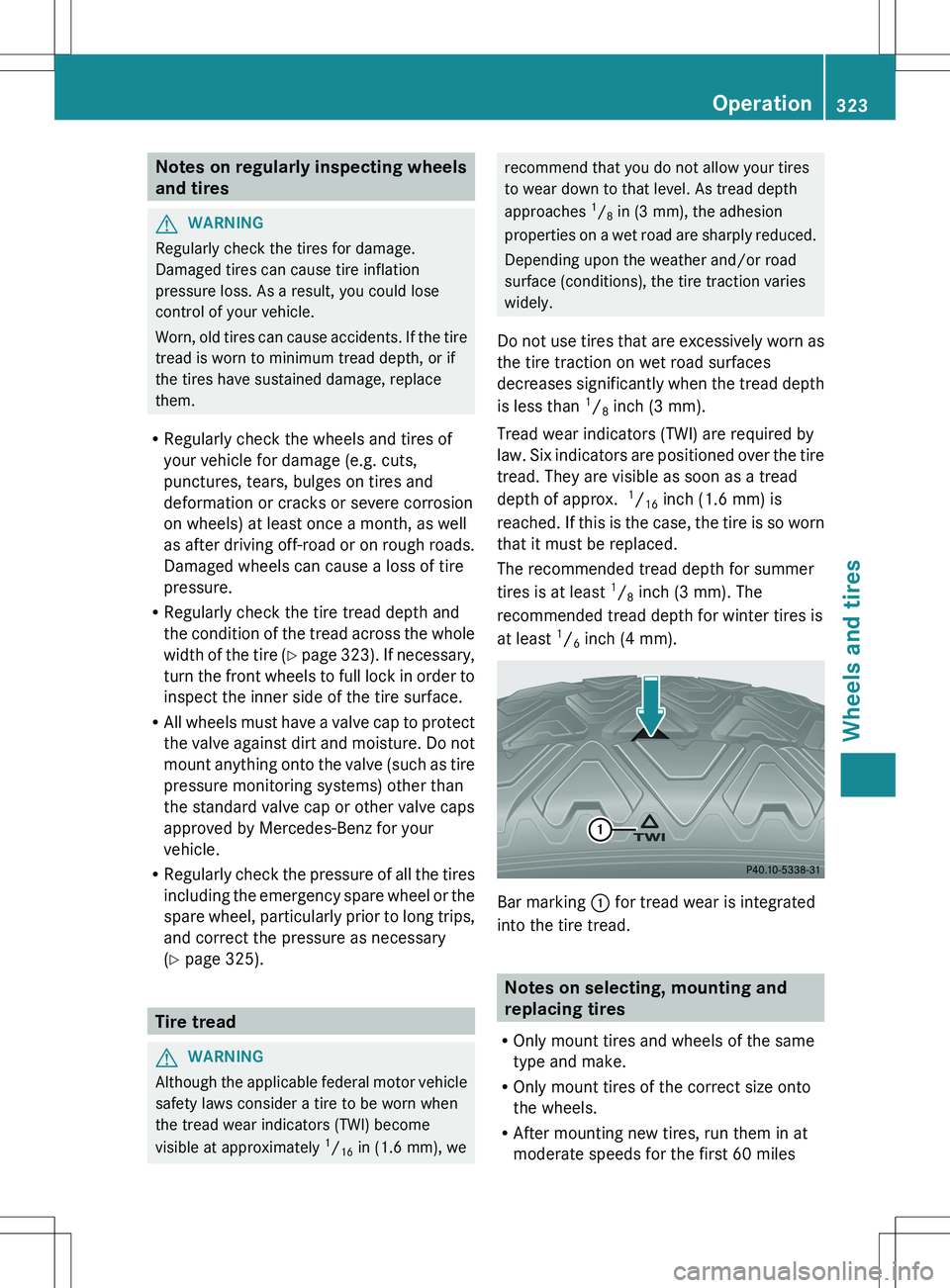
Bar marking
: for tread wear is integrated
into the tire tread.
Notes on selecting, mounting and
replacing tires
R Only mount tires and wheels of the same
type and make.
R Only mount tires of the correct size onto
the wheels.
R After mounting new tires, run them in at
moderate speeds for the first 60 miles
Operation323Wheels and tiresZ
Page 326 of 368
(100 km) as they only reach their full
performance after this distance.
R Do not use tires that are excessively worn
as the tire traction on wet road surfaces
decreases significantly when the tread
depth is less than 1
/ 8 inch (3 mm).
R Replace the tires after six years at the
latest, regardless of wear. This also applies
to the emergency spare wheel/spare
wheel.
The service life of tires depends on the
following factors amongst other things:
R driving style
R tire pressure
R mileage
MOExtended tires (tires with run-flat
properties)
MOExtended tires (tires with run-flat
properties) allow you to continue driving your
vehicle even if one or more tires are entirely
deflated.
MOExtended tires may be used only in
conjunction with the activated tire pressure
loss warning system or the activated tire
pressure monitoring system and only on
wheels specifically tested by Mercedes-Benz.
i Vehicles equipped with MOExtended tires
are not equipped with a TIREFIT kit at the
factory. It is therefore recommended that
you additionally equip your vehicle with a
TIREFIT kit if you mount tires that do not
feature run-flat properties, e.g. winter tires.
A TIREFIT kit can be obtained from an
authorized Mercedes-Benz Center.
You will find notes on driving with a flat tire in
the "Breakdown assistance" section
( Y page 309).
Winter operation
Please bear the following in mind
At the onset of winter, have your vehicle
winterproofed at a qualified specialist
workshop, e.g. at an authorized Mercedes-
Benz Center.
Observe the notes in the "Changing a wheel"
section ( Y page 346).
Driving with summer tires
At temperatures below 45 ‡ (+7 †), the
elasticity of summer tires and therefore also
traction and braking capability are reduced
considerably — equip your vehicle with
M+S tires. Using summer tires at very cold
temperatures could cause tears to form,
thereby damaging the tires permanently.
Mercedes-Benz cannot accept responsibility
for this type of damage.
M+S tires
At temperatures below 45 ‡(+7 †), use
winter tires or all-season tires. Both types of
tire are identified by the M+S marking.
Only winter tires bearing the i snowflake
symbol in addition to the M+S marking
provide the best possible grip in wintry road
conditions. Only these tires will allow driving
safety systems such as ABS and ESP ®
to
function optimally in winter, as these tires
have been designed specifically for driving on
snow.
Use M+S tires of the same make and tread on
all wheels to maintain safe handling
characteristics.
GWARNING
M+S tires with a tread depth of less than 1
/ 6
inch (4 mm) must be replaced immediately.
They are no longer suitable for use in winter.
324Winter operationWheels and tires
Page 327 of 368
Always observe the maximum permissible
speed specified for the M+S tires you have
mounted.
Once you have mounted the winter tires:XCheck the tire pressures ( Y page 329).XRestart the tire pressure monitor
( Y page 331).GWARNING
If you use your spare wheel when M+S tires
are mounted on the other wheels, be aware
that the difference in tire characteristics
impairs cornering ability and reduces driving
stability. Adapt your driving style accordingly.
Have the spare wheel replaced by a normal
wheel with an M+S tire at the nearest
Mercedes-Benz Center.
Snow chains
For safety reasons, Mercedes-Benz
recommends that you only use snow chains
which have been specially approved for your
vehicle by Mercedes-Benz, or are of a
corresponding standard of quality.
! Vehicles with the Adaptive Damping
System (ADS): do not drive in ADS SPORT
mode if snow chains have been mounted.
The vehicle may otherwise be damaged.
! There is not enough space for snow
chains on some wheel sizes. Observe the
information under "Tires and wheels" in the
"Technical Data" section to avoid damage
to the vehicle or the wheels.
R Only use snow chains when driving on
roads completely covered by snow. Do not
exceed the maximum permissible speed of
30 mph (50 km/h). Remove the snow
chains as soon as possible when you are no
longer driving on snow-covered roads.
R Local regulations may restrict the use of
snow chains. Applicable regulations must
be observed if you wish to mount snow
chains.
R Snow chains must not be mounted on
emergency spare wheels.
If you intend to mount snow chains, please
bear the following points in mind:
R you may not attach snow chains to all
wheel-tire combinations; see the
information under "Wheel and tire
combinations" in the "Wheels and tires"
section.
R mount snow chains only in pairs and only
to the rear wheels. Observe the
manufacturer's installation instructions.
! If snow chains are mounted on the front
wheels, the snow chains could grind
against the bodywork or components of the
chassis. This could result in damage to the
vehicle or the tires.
! Vehicles with steel wheels: if you wish
to install snow chains to steel wheels, make
sure that you remove the respective
wheels' hubcaps first. The hubcaps may
otherwise be damaged.
i You may wish to deactivate
ESP ®
(Y page 66) when pulling away with
snow chains mounted. This way you can
allow the wheels to spin in a controlled
manner, achieving an increased driving
force (cutting action).
Tire pressure
Tire pressure specifications
GWARNING
Follow recommended tire inflation pressures.
Do not underinflate tires. Underinflated tires
wear excessively and/or unevenly, adversely
affect handling and fuel economy, and are
more likely to fail from being overheated.
Do not overinflate tires. Overinflated tires can
adversely affect handling and ride comfort,
wear unevenly, increase stopping distance,
Tire pressure325Wheels and tiresZ
Page 341 of 368
You should pay special attention to road
conditions when temperatures are around
the freezing point.
Mercedes-Benz recommends a minimum tire
tread depth of 1
/ 6 in (4 mm) for all four winter
tires ( Y page 169) to maintain normal driving
characteristics in winter. Winter tires can
reduce the braking distance on snow covered
surfaces in comparison to summer tires.
Stopping distance, however, is still
considerably greater than when the road is
not covered with ice or snow. Take
appropriate care when driving.
! Avoid wheelspin. This can lead to damage
to the drive train.
Temperature
GWARNING
The temperature grade for this tire is
established for a tire that is properly inflated
and not overloaded. Excessive speed,
underinflation, or excessive loading, either
separately or in combination, can cause
excessive heat build-up and possible tire
failure.
The temperature grades are A (the highest),
B, and C. These represent the tire's
resistance to the generation of heat and its
ability to dissipate heat when tested under
controlled conditions on a specified indoor
laboratory test wheel. Sustained high
temperature can cause the material of the tire
to degenerate and reduce tire life, and
excessive temperature can lead to sudden
tire failure. The grade C corresponds to a level
of performance which all passenger car tires
must meet under the Federal Motor Vehicle
Safety Standard No. 109. Grades B and A
represent higher levels of performance on the
laboratory test wheel than the minimum
required by law.
Tire labeling
Tire labeling overview
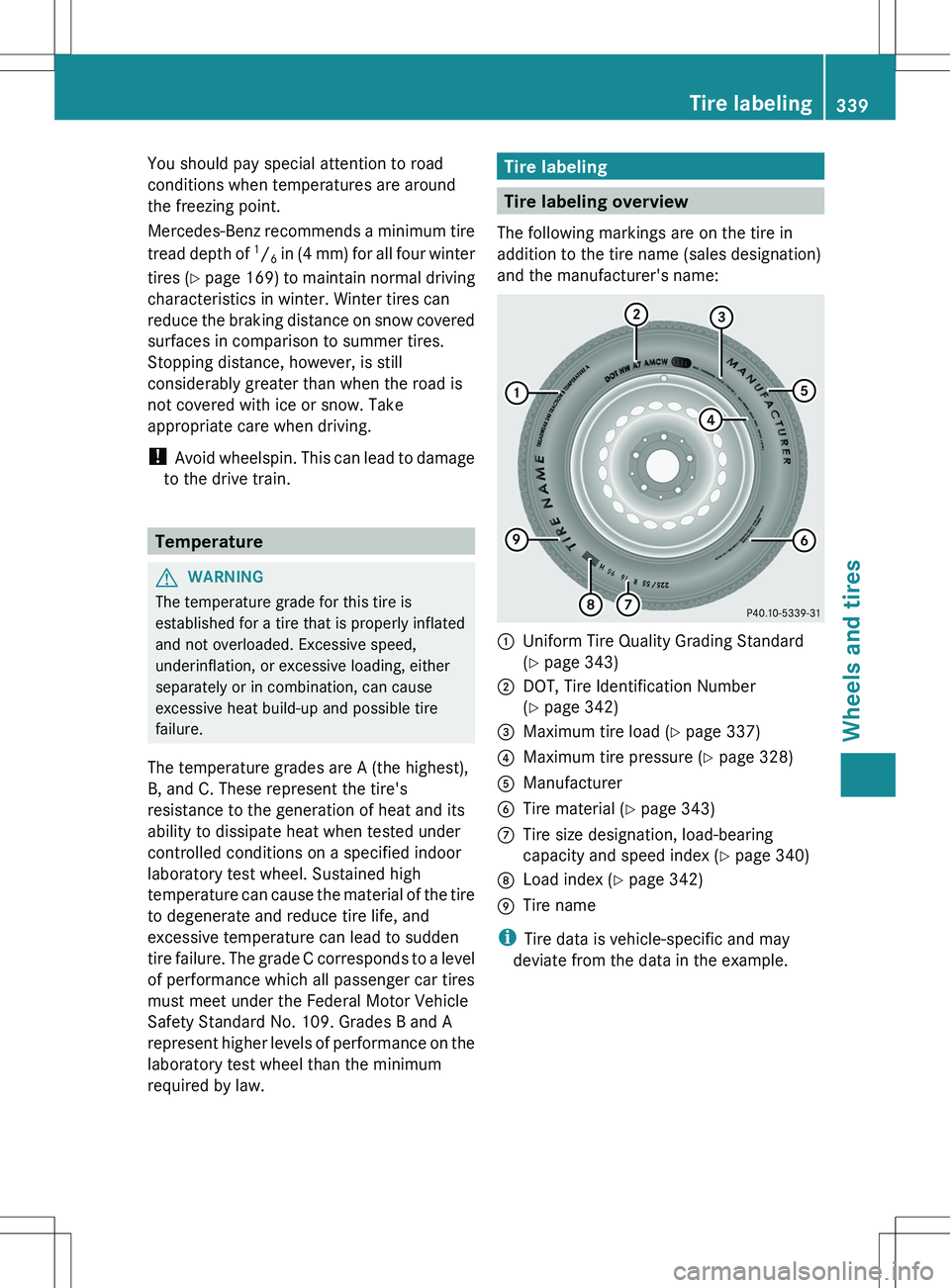
The following markings are on the tire in
addition to the tire name (sales designation)
and the manufacturer's name:
:Uniform Tire Quality Grading Standard
( Y page 343);DOT, Tire Identification Number
( Y page 342)=Maximum tire load ( Y page 337)?Maximum tire pressure ( Y page 328)AManufacturerBTire material ( Y page 343)CTire size designation, load-bearing
capacity and speed index ( Y page 340)DLoad index ( Y page 342)ETire name
i
Tire data is vehicle-specific and may
deviate from the data in the example.
Tire labeling339Wheels and tiresZ
Page 343 of 368
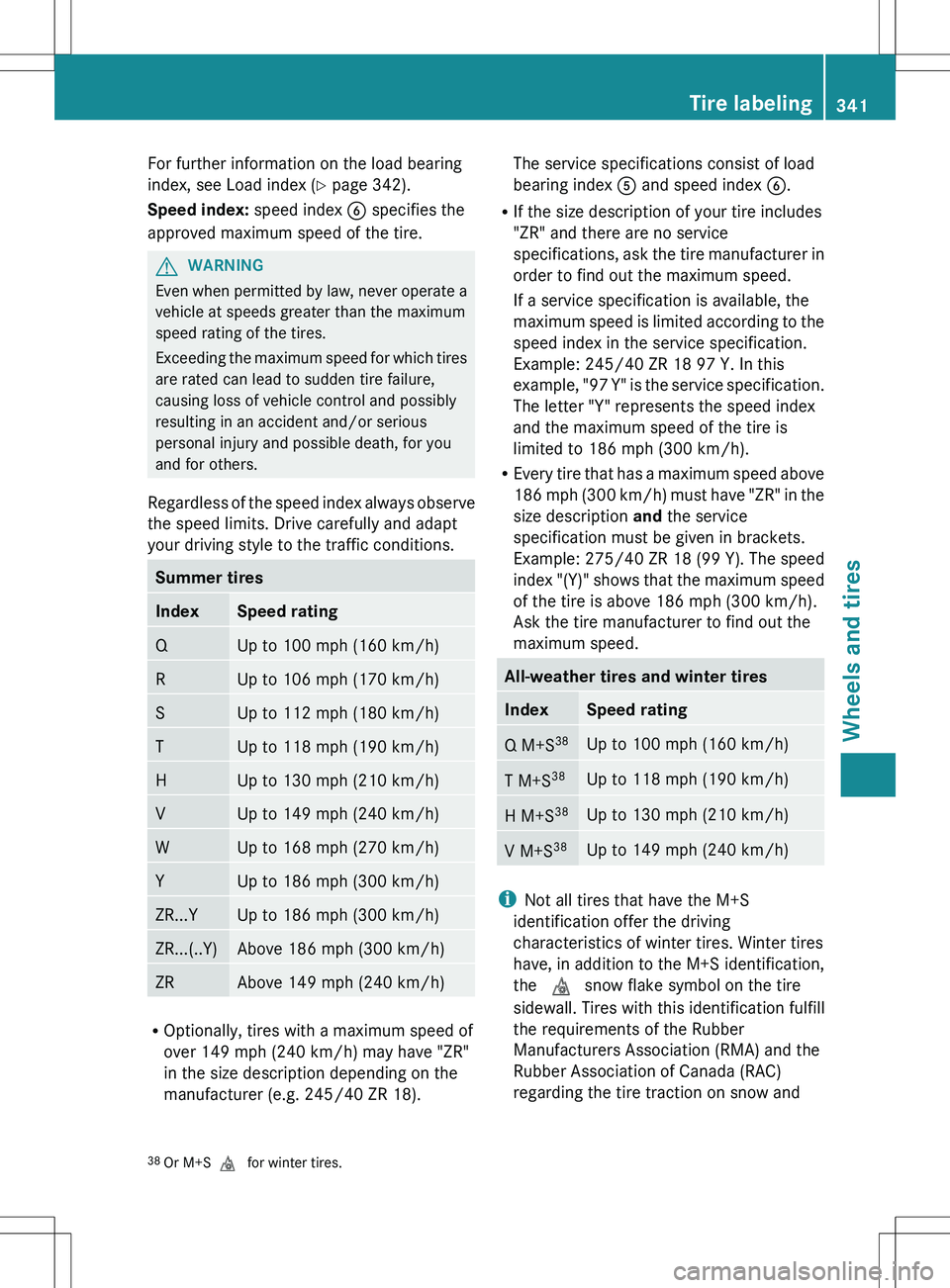
For further information on the load bearing
index, see Load index ( Y page 342).
Speed index: speed index B specifies the
approved maximum speed of the tire.GWARNING
Even when permitted by law, never operate a
vehicle at speeds greater than the maximum
speed rating of the tires.
Exceeding the maximum speed for which tires
are rated can lead to sudden tire failure,
causing loss of vehicle control and possibly
resulting in an accident and/or serious
personal injury and possible death, for you
and for others.
Regardless of the speed index always observe
the speed limits. Drive carefully and adapt
your driving style to the traffic conditions.
Summer tiresIndexSpeed ratingQUp to 100 mph (160 km/h)RUp to 106 mph (170 km/h)SUp to 112 mph (180 km/h)TUp to 118 mph (190 km/h)HUp to 130 mph (210 km/h)VUp to 149 mph (240 km/h)WUp to 168 mph (270 km/h)YUp to 186 mph (300 km/h)ZR...YUp to 186 mph (300 km/h)ZR...(..Y)Above 186 mph (300 km/h)ZRAbove 149 mph (240 km/h)
R Optionally, tires with a maximum speed of
over 149 mph (240 km/h) may have "ZR"
in the size description depending on the
manufacturer (e.g. 245/40 ZR 18).
The service specifications consist of load
bearing index A and speed index B.
R If the size description of your tire includes
"ZR" and there are no service
specifications, ask the tire manufacturer in
order to find out the maximum speed.
If a service specification is available, the
maximum speed is limited according to the
speed index in the service specification.
Example: 245/40 ZR 18 97 Y. In this
example, "97 Y" is the service specification.
The letter "Y" represents the speed index
and the maximum speed of the tire is
limited to 186 mph (300 km/h).
R Every tire that has a maximum speed above
186 mph (300 km/h) must have "ZR" in the
size description and the service
specification must be given in brackets.
Example: 275/40 ZR 18 (99 Y). The speed
index "(Y)" shows that the maximum speed
of the tire is above 186 mph (300 km/h).
Ask the tire manufacturer to find out the
maximum speed.All-weather tires and winter tiresIndexSpeed ratingQ M+S 38Up to 100 mph (160 km/h)T M+S38Up to 118 mph (190 km/h)H M+S 38Up to 130 mph (210 km/h)V M+S38Up to 149 mph (240 km/h)
i
Not all tires that have the M+S
identification offer the driving
characteristics of winter tires. Winter tires
have, in addition to the M+S identification,
the i snow flake symbol on the tire
sidewall. Tires with this identification fulfill
the requirements of the Rubber
Manufacturers Association (RMA) and the
Rubber Association of Canada (RAC)
regarding the tire traction on snow and
38 Or M+S i for winter tires.Tire labeling341Wheels and tiresZ
Page 349 of 368
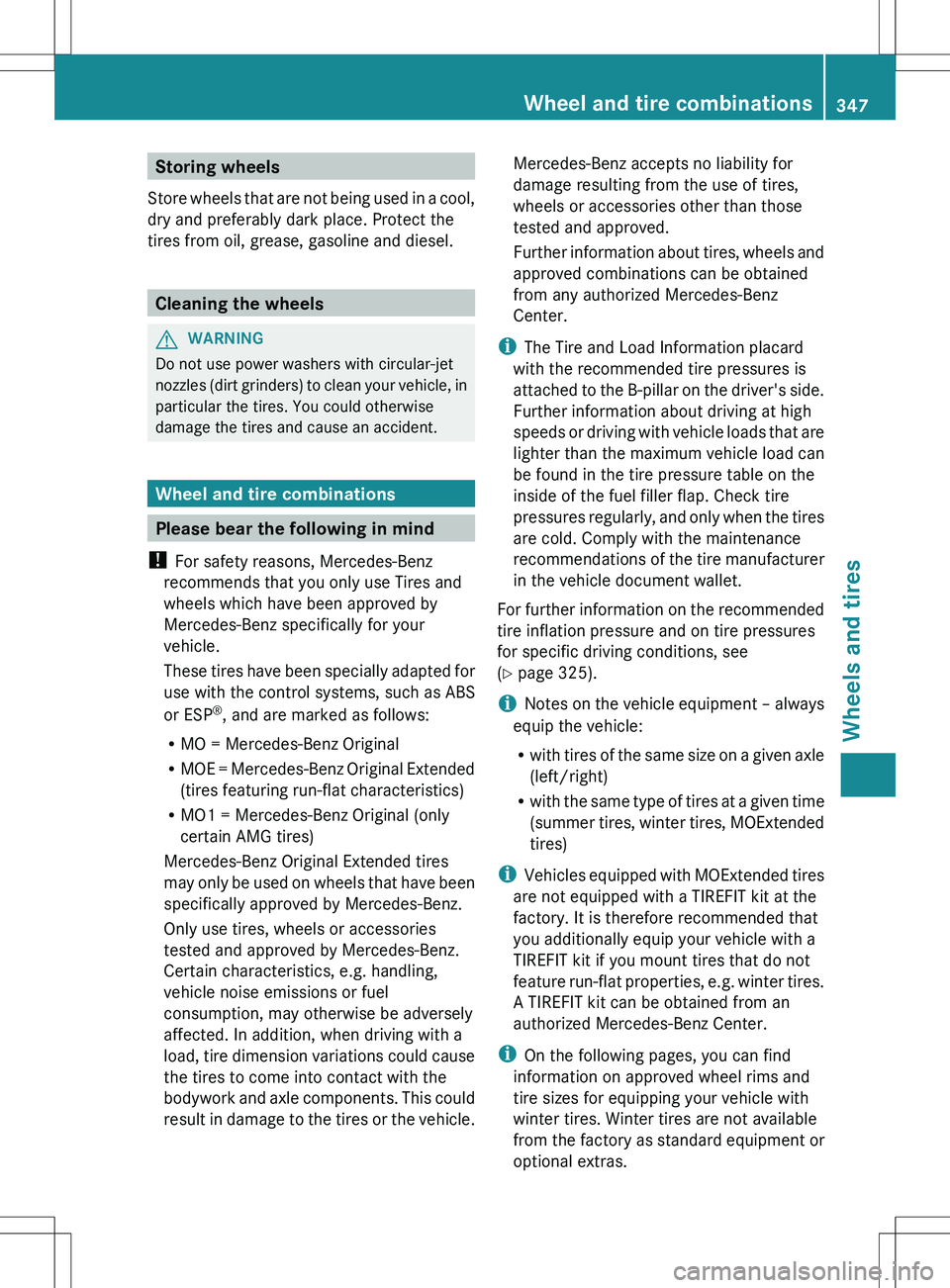
Storing wheels
Store wheels that are not being used in a cool,
dry and preferably dark place. Protect the
tires from oil, grease, gasoline and diesel.
Cleaning the wheels
GWARNING
Do not use power washers with circular-jet
nozzles (dirt grinders) to clean your vehicle, in
particular the tires. You could otherwise
damage the tires and cause an accident.
Wheel and tire combinations
Please bear the following in mind
! For safety reasons, Mercedes-Benz
recommends that you only use Tires and
wheels which have been approved by
Mercedes-Benz specifically for your
vehicle.
These tires have been specially adapted for
use with the control systems, such as ABS
or ESP ®
, and are marked as follows:
R MO = Mercedes-Benz Original
R MOE = Mercedes-Benz Original Extended
(tires featuring run-flat characteristics)
R MO1 = Mercedes-Benz Original (only
certain AMG tires)
Mercedes-Benz Original Extended tires
may only be used on wheels that have been
specifically approved by Mercedes-Benz.
Only use tires, wheels or accessories
tested and approved by Mercedes-Benz.
Certain characteristics, e.g. handling,
vehicle noise emissions or fuel
consumption, may otherwise be adversely
affected. In addition, when driving with a
load, tire dimension variations could cause
the tires to come into contact with the
bodywork and axle components. This could
result in damage to the tires or the vehicle.
Mercedes-Benz accepts no liability for
damage resulting from the use of tires,
wheels or accessories other than those
tested and approved.
Further information about tires, wheels and
approved combinations can be obtained
from any authorized Mercedes-Benz
Center.
i The Tire and Load Information placard
with the recommended tire pressures is
attached to the B-pillar on the driver's side.
Further information about driving at high
speeds or driving with vehicle loads that are
lighter than the maximum vehicle load can
be found in the tire pressure table on the
inside of the fuel filler flap. Check tire
pressures regularly, and only when the tires
are cold. Comply with the maintenance
recommendations of the tire manufacturer
in the vehicle document wallet.
For further information on the recommended
tire inflation pressure and on tire pressures
for specific driving conditions, see
( Y page 325).
i Notes on the vehicle equipment – always
equip the vehicle:
R with tires of the same size on a given axle
(left/right)
R with the same type of tires at a given time
(summer tires, winter tires, MOExtended
tires)
i Vehicles equipped with MOExtended tires
are not equipped with a TIREFIT kit at the
factory. It is therefore recommended that
you additionally equip your vehicle with a
TIREFIT kit if you mount tires that do not
feature run-flat properties, e.g. winter tires.
A TIREFIT kit can be obtained from an
authorized Mercedes-Benz Center.
i On the following pages, you can find
information on approved wheel rims and
tire sizes for equipping your vehicle with
winter tires. Winter tires are not available
from the factory as standard equipment or
optional extras.Wheel and tire combinations347Wheels and tiresZ
Page 350 of 368
If you want to equip your vehicle with
approved winter tires, it may be necessary
to obtain wheel rims in the corresponding
size, as the size of the approved winter tires
may differ from the standard tires. This is
dependent on the model and the
equipment installed at the factory.
The tires and wheel rims, as well as further
information, can be obtained at a qualified
specialist workshop, e.g. at an authorized
Mercedes-Benz Center.
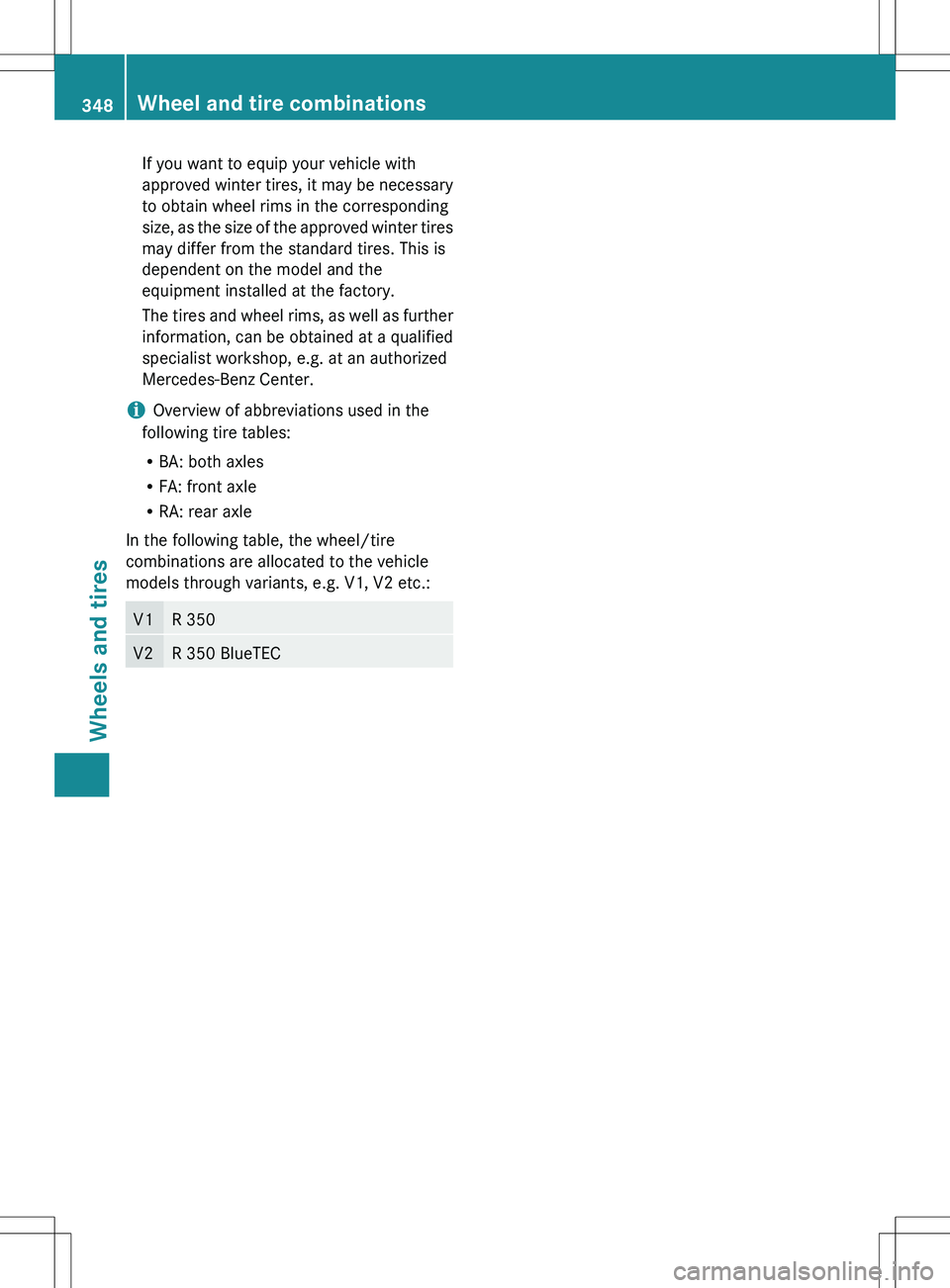
i Overview of abbreviations used in the
following tire tables:
R BA: both axles
R FA: front axle
R RA: rear axle
In the following table, the wheel/tire
combinations are allocated to the vehicle
models through variants, e.g. V1, V2 etc.:V1R 350V2R 350 BlueTEC348Wheel and tire combinationsWheels and tires
Page 351 of 368
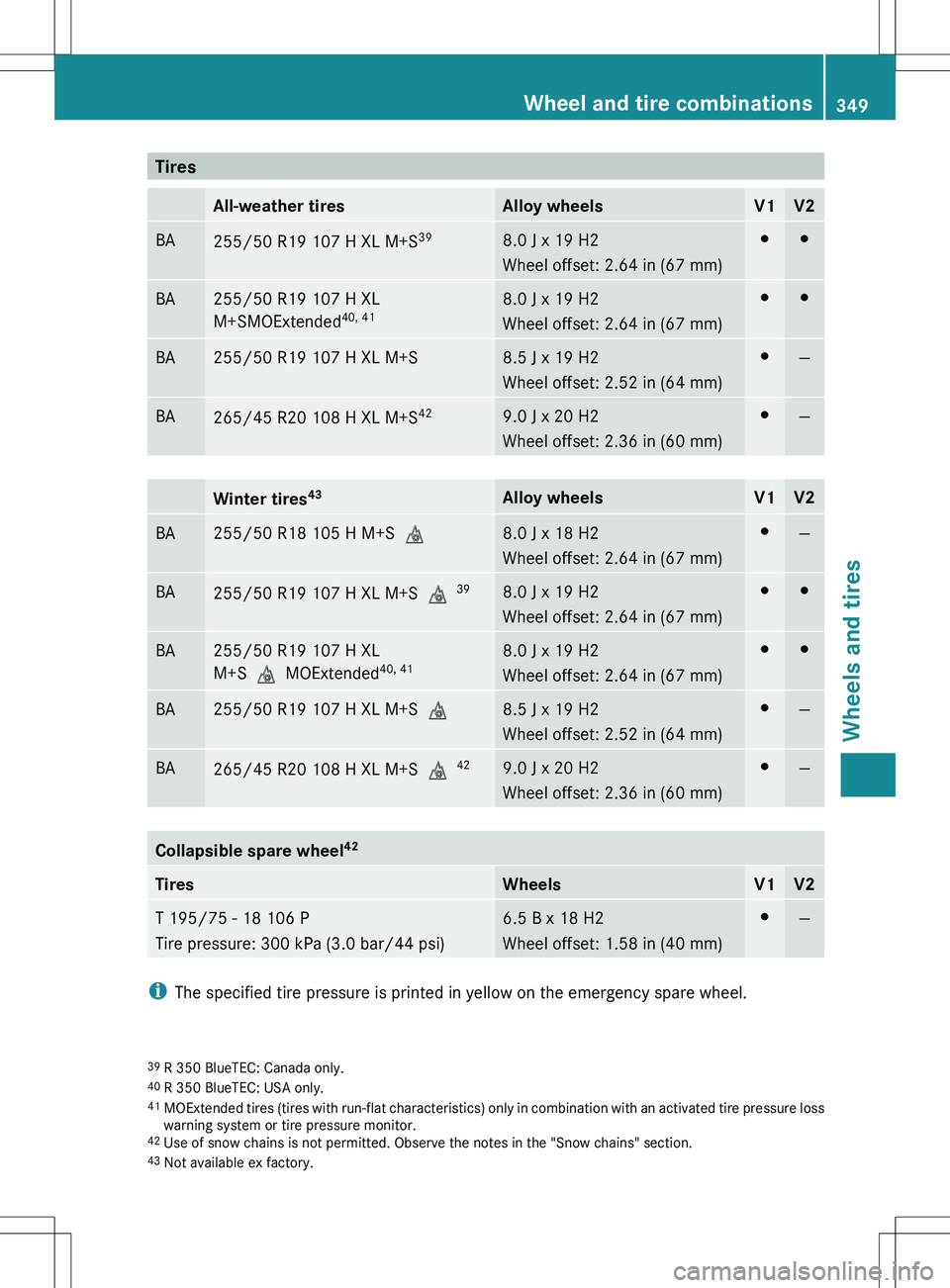
TiresAll-weather tiresAlloy wheelsV1V2BA255/50 R19 107 H XL M+S398.0 J x 19 H2
Wheel offset: 2.64 in (67 mm)##BA255/50 R19 107 H XL
M+SMOExtended 40, 418.0 J x 19 H2
Wheel offset: 2.64 in (67 mm)##BA255/50 R19 107 H XL M+S8.5 J x 19 H2
Wheel offset: 2.52 in (64 mm)#—BA265/45 R20 108 H XL M+S 429.0 J x 20 H2
Wheel offset: 2.36 in (60 mm)#—Winter tires 43Alloy wheelsV1V2BA255/50 R18 105 H M+S
i8.0 J x 18 H2
Wheel offset: 2.64 in (67 mm)#—BA255/50 R19 107 H XL M+S i398.0 J x 19 H2
Wheel offset: 2.64 in (67 mm)##BA255/50 R19 107 H XL
M+S i MOExtended 40, 418.0 J x 19 H2
Wheel offset: 2.64 in (67 mm)##BA255/50 R19 107 H XL M+S i8.5 J x 19 H2
Wheel offset: 2.52 in (64 mm)#—BA265/45 R20 108 H XL M+S i429.0 J x 20 H2
Wheel offset: 2.36 in (60 mm)#—Collapsible spare wheel 42TiresWheelsV1V2T 195/75 - 18 106 P
Tire pressure: 300 kPa (3.0 bar/44 psi)6.5 B x 18 H2
Wheel offset: 1.58 in (40 mm)#—
i The specified tire pressure is printed in yellow on the emergency spare wheel.
39
R 350 BlueTEC: Canada only.
40 R 350 BlueTEC: USA only.
41 MOExtended tires (tires with run-flat characteristics) only in combination with an activated tire pressure loss
warning system or tire pressure monitor.
42 Use of snow chains is not permitted. Observe the notes in the "Snow chains" section.
43 Not available ex factory.Wheel and tire combinations349Wheels and tiresZ