light MERCEDES-BENZ R-CLASS FAMILY TOURER 2013 User Guide
[x] Cancel search | Manufacturer: MERCEDES-BENZ, Model Year: 2013, Model line: R-CLASS FAMILY TOURER, Model: MERCEDES-BENZ R-CLASS FAMILY TOURER 2013Pages: 364, PDF Size: 28.68 MB
Page 21 of 364
TIN (Tire Identification Number)
(definition
)..................................... 333
Tire bead( definition) ...................... 333
Tire pressure (definition) ................333
Tire pressures (recommended )...... 332
Tire size (data) ............................... 339
Tire size designation, load-bearing
capacity, speed rating .................... 328
Tire tread ....................................... 313
Tire tread (definition) .....................333
Total load limit (definition) .............334
Traction ......................................... 327
Traction (definition) .......................334
Trea dwear ..................................... 327
TWR (permissible trailer drawbar
noseweight) (definition) .................334
Uniform Tire Quality Grading
Standard s...................................... 326
Uniform Tire Quality Grading
Standard s(definition) .................... 332
Unladen weight (definition) ............333
Wea rindicato r(definition) .............334
Whee lrim (definition ).................... 332
see Flat tire
Top Tether ............................................ 64
Towing Important safety guidelines ...........306
Installing the towing eye ................307
Removing the towing eye. ..............307
Towing atrailer
Cleaning the trailer tow hitch ......... 294
Coupling up atrailer ...................... 194
Decoupling atrailer ....................... 196
Driving tips .................................... 193
ESP ®
(Electronic Stability
Program) .......................................... 70
Important safety notes ..................193
Lights displaym essage.................. 221
Power supply ................................. 197
Shift range ..................................... 157
Towing away
With both axles on the ground .......307
Tow-starting
Emergency engine starting ............308
Important safety notes ..................306
Trailer coupling
see Towing atrailer Trailer loads and drawbar
noseweights
...................................... 196
Trailer towing Blind Spot Assist ............................ 193
PARKTRONI C................................. 188
Permissible trailer loads and
drawbarn oseweights ..................... 196
Transfer case ..................................... 160
Transmission see Automatic transmission
Transporting the vehicle ..................308
Trim pieces (cleaning instructions) .295
Trip computer (on-board
computer) .......................................... 211
Trip odometer Calling up ....................................... 203
Resetting (on-board computer) ......212
Trunk
see Tailgate
Turn signals
Changing bulbs (front) ...................128
Display message ............................ 222
Switching on/off ........................... 123
TWR (Tongue Weight Rating)
(definition) ......................................... 334
Type identification plate see Vehicle identification plate U
Unlocking Emergency unlocking .......................84
From inside the vehicle (central
unlocking button) ............................. 83 V
Vanity mirror (in the sun visor) ........267
Vehicle Correct use ...................................... 24
Data acquisition ............................... 25
Display message ............................ 234
Equipment ....................................... 21
Individua lsettings .......................... 206
Limited Warranty ............................. 25
Loading .......................................... 323
Locking (in an emergency) ...............84
Locking (SmartKey) .......................... 77 18
Index
Page 34 of 364
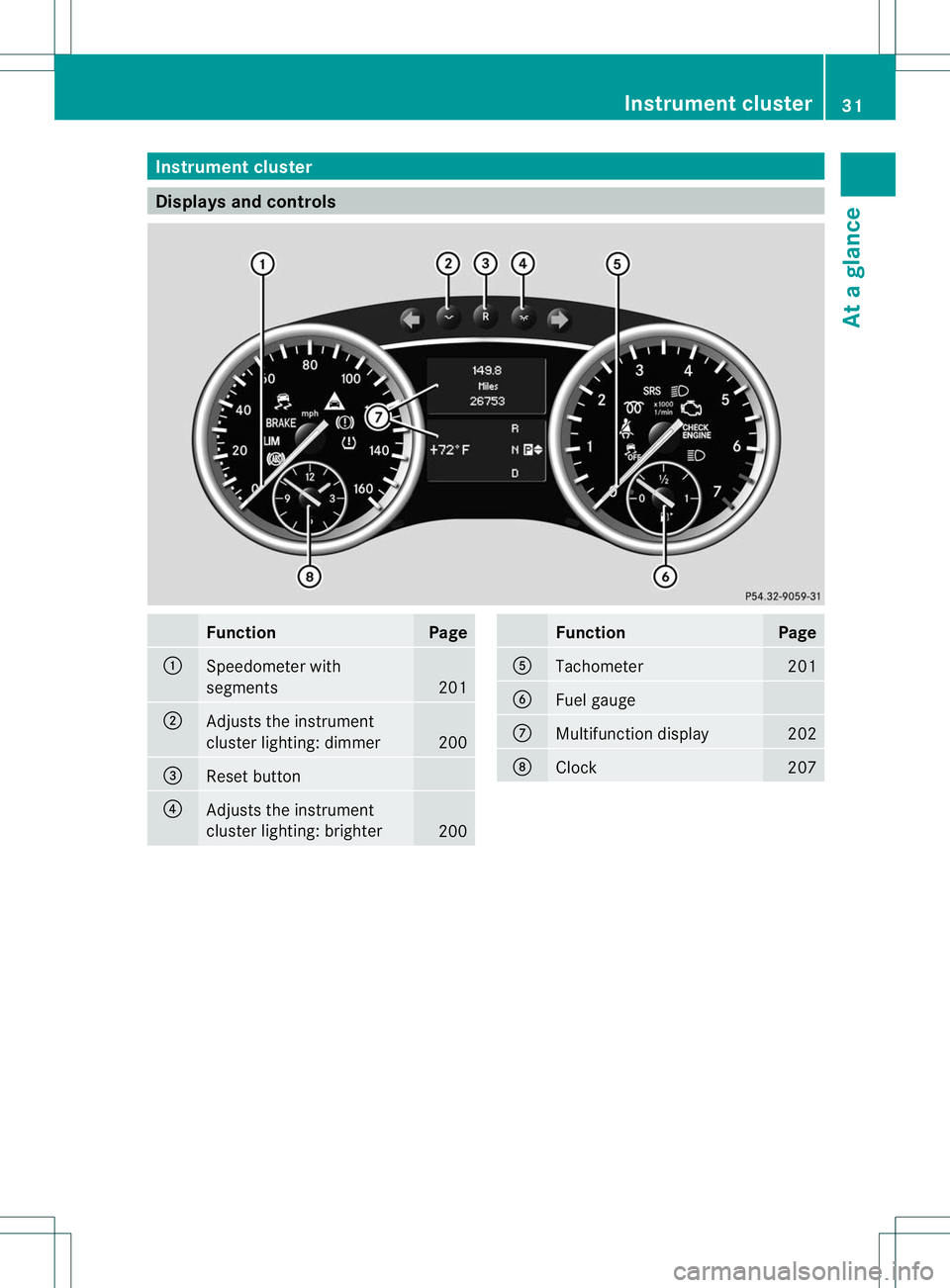
Instrumen
tcluster Displays and controls
Function Page
:
Speedometer with
segments
201
;
Adjusts the instrument
cluster lighting: dimmer
200
=
Reset button
?
Adjusts the instrument
cluster lighting: brighter
200 Function Page
A
Tachometer 201
B
Fuel gauge
C
Multifunction display 202
D
Clock 207Instrument cluster
31At a glance
Page 35 of 364
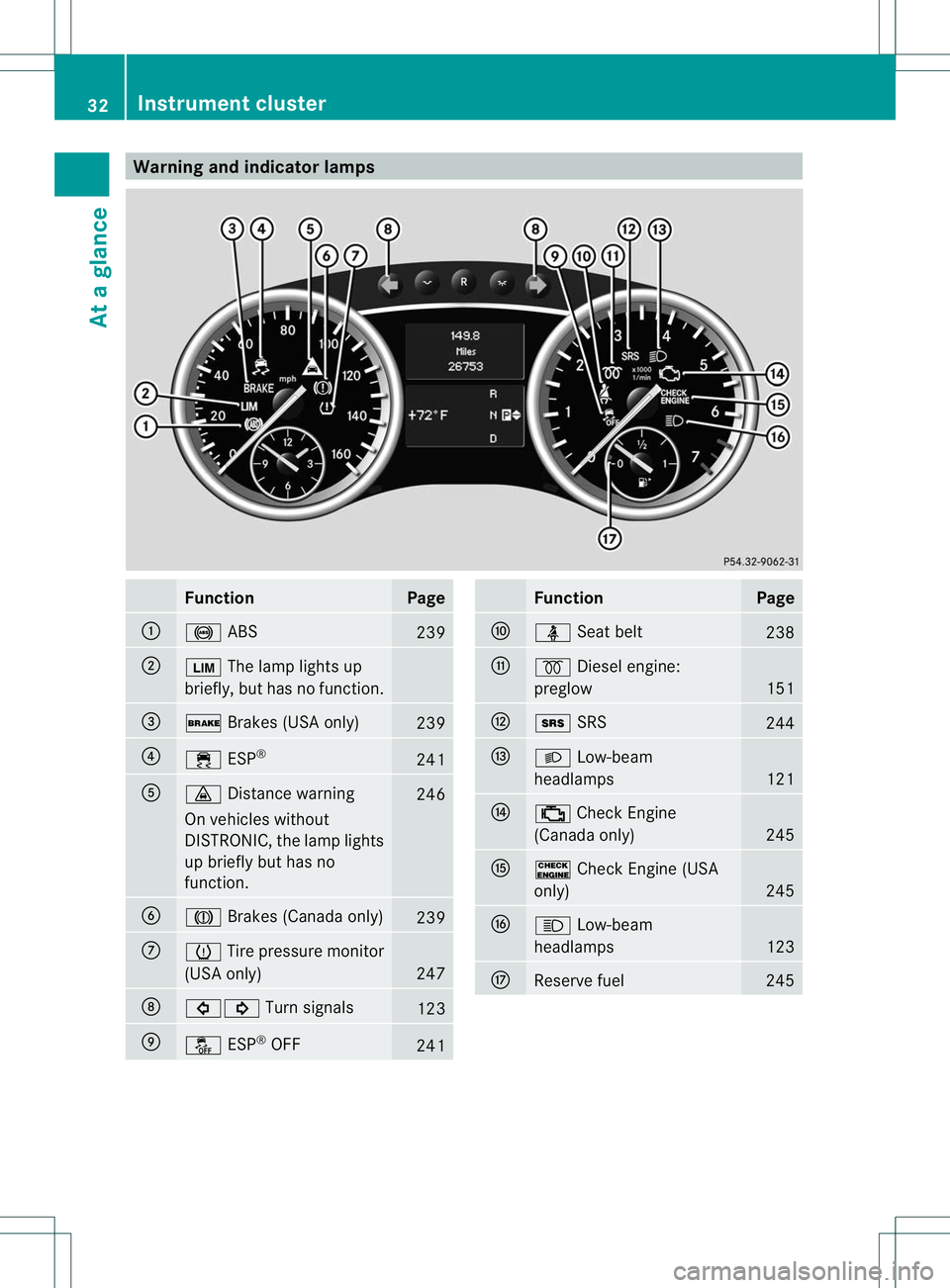
Warning and indicator lamps
Function Page
:
!
ABS 239
;
È
The lamp lights up
briefly, but has no function. =
$
Brakes (USA only) 239
?
÷
ESP® 241
A
·
Distance warning 246
On vehicles without
DISTRONIC, the lamp lights
up briefly but has no
function.
B
J
Brakes (Canada only) 239
C
h
Tire pressure monitor
(USA only) 247
D
#!
Turn signals 123
E
å
ESP®
OFF 241 Function Page
F
ü
Seat belt 238
G
%
Diesel engine:
preglow 151
H
+
SRS 244
I
L
Low-beam
headlamps 121
J
;
Check Engine
(Canada only) 245
K
!
Check Engine (USA
only) 245
L
K
Low-beam
headlamps 123
M
Reserve fuel 24532
Instrument clusterAt a glance
Page 38 of 364
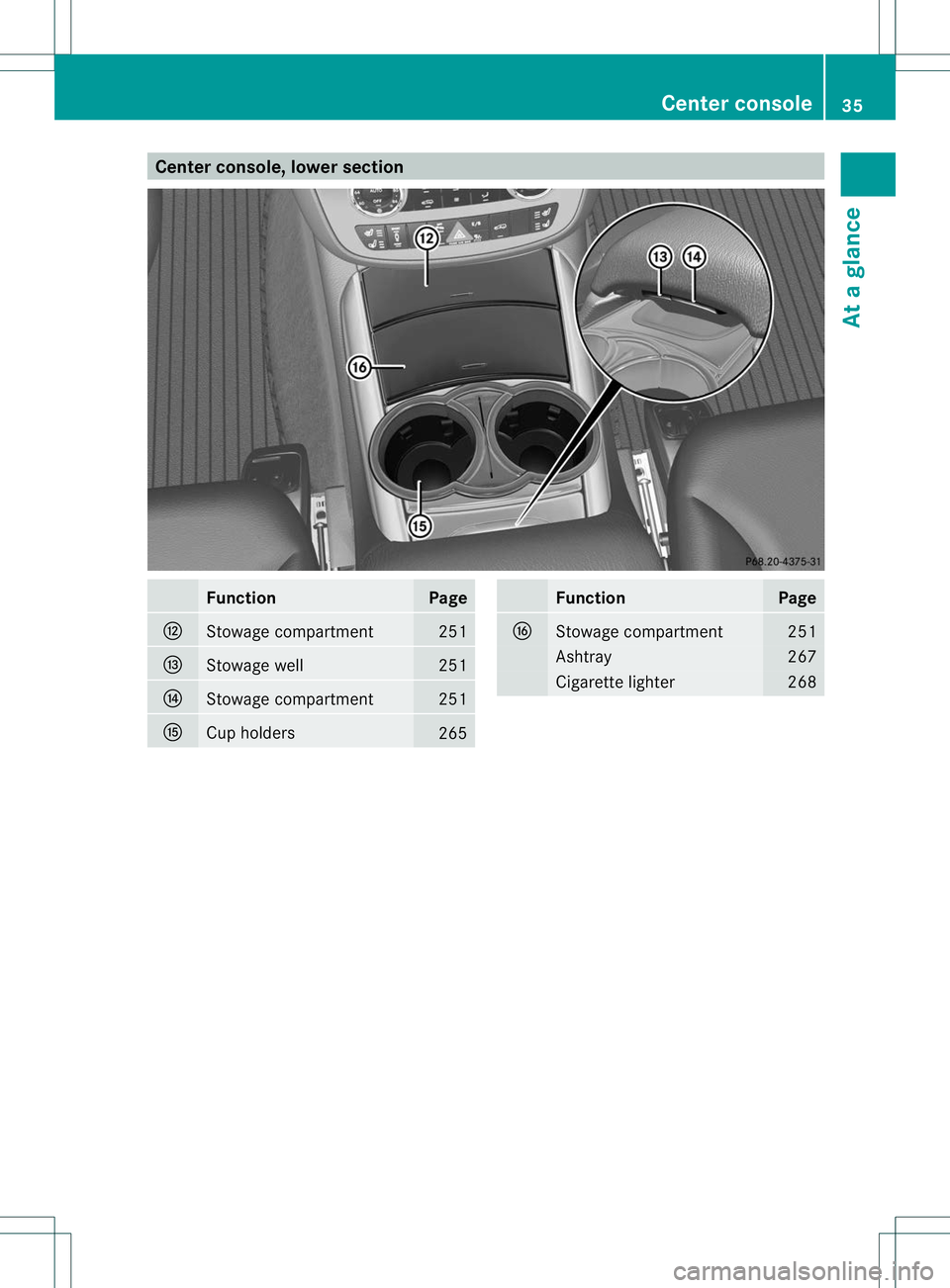
Center console, lower section
Function Page
H
Stowage compartment 251
I
Stowage well 251
J
Stowage compartment 251
K
Cup holders
265 Function Page
L
Stowage compartment 251
Ashtray 267
Cigarette lighter 268Center console
35At a glance
Page 39 of 364
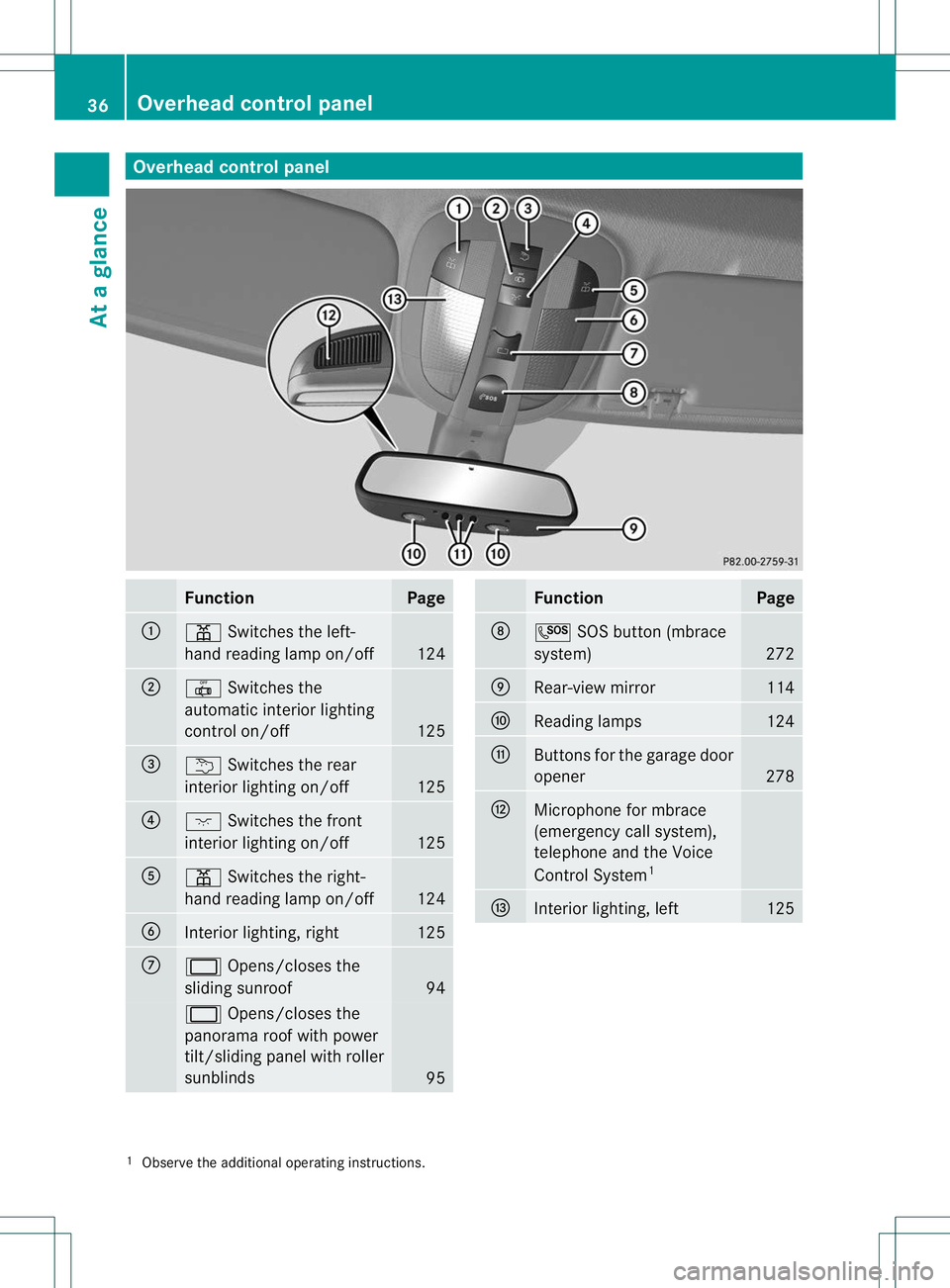
Overhea
dcontrol panel Function Page
:
p
Switches the left-
hand reading lamp on/off 124
;
|
Switches the
automatic interio rlighting
control on/off 125
=
u
Switches the rear
interior lighting on/off 125
?
c
Switches the front
interior lighting on/off 125
A
p
Switches the right-
hand reading lamp on/off 124
B
Interior lighting, right 125
C
2
Opens/closes the
sliding sunroof 94
2
Opens/closes the
panorama roof with power
tilt/sliding panel with roller
sunblinds 95 Function Page
D
G
SOS button (mbrace
system) 272
E
Rear-view mirror 114
F
Reading lamps 124
G
Buttons for the garage door
opener
278
H
Microphone for mbrace
(emergency call system),
telephone and the Voice
Control System
1 I
Interior lighting, left 125
1
Observe the additional operating instructions. 36
Overhead control panelAt a glance
Page 43 of 364
Useful information
i This Operator's Manual describes all
models and all standard and optional
equipment of your vehicle available at the
time of publication of the Operator's
Manual. Country-specific differences are
possible. Please note that your vehicle may
not be equipped with all features
described. This also applies to safety-
related systems and functions.
i Read the information on qualified
specialist workshops: (Y page 24).Panic alarm
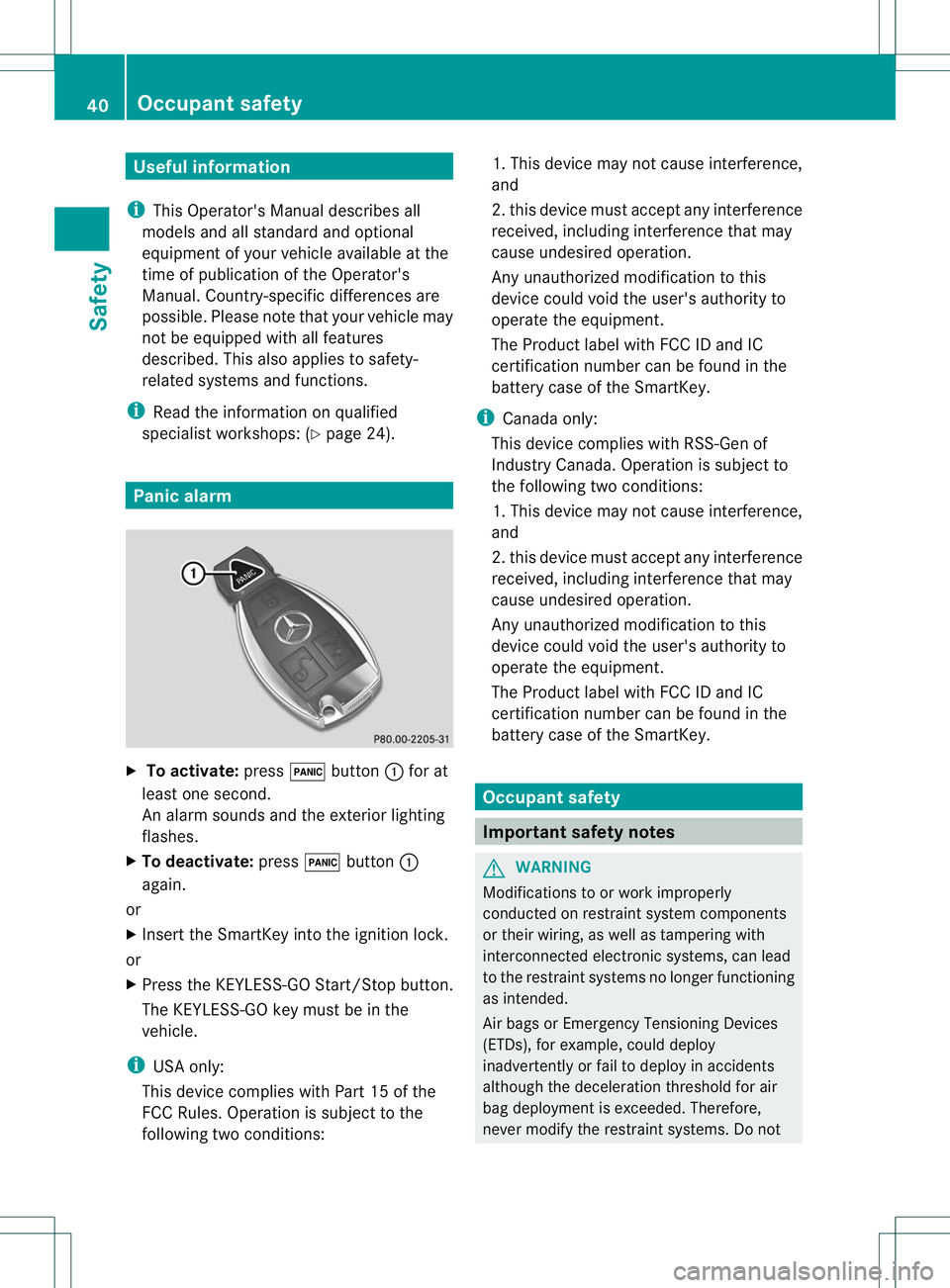
X
To activate: press!button :for at
least one second.
An alarm sounds and the exterior lighting
flashes.
X To deactivate: press!button :
again.
or
X Insert the SmartKey into the ignition lock.
or
X Press the KEYLESS-GO Start/Stop button.
The KEYLESS-GO key must be in the
vehicle.
i USA only:
This device complies with Part 15 of the
FCC Rules. Operation is subjec tto the
following two conditions: 1. This device may not cause interference,
and
2. this device must accept any interference
received, including interference that may
cause undesired operation.
Any unauthorized modification to this
device could void the user's authority to
operate the equipment.
The Product label with FCC ID and IC
certification number can be found in the
battery case of the SmartKey.
i Canada only:
This device complies with RSS-Gen of
Industry Canada. Operation is subject to
the following two conditions:
1. This device may not cause interference,
and
2. this device must accept any interference
received, including interference that may
cause undesired operation.
Any unauthorized modification to this
device could void the user's authority to
operate the equipment.
The Product label with FCC ID and IC
certification number can be found in the
battery case of the SmartKey. Occupant safety
Important safety notes
G
WARNING
Modifications to or work improperly
conducted on restraint system components
or their wiring, as well as tampering with
interconnected electronic systems, can lead
to the restraint systems no longer functioning
as intended.
Air bags or Emergency Tensioning Devices
(ETDs), for example, could deploy
inadvertently or fail to deploy in accidents
although the deceleration threshold for air
bag deployment is exceeded. Therefore,
never modify the restraint systems. Do not 40
Occupant safetySafety
Page 44 of 364
tamper with electronic components or their
software.
In this section, you will lear nthe most
important facts about the restraint system
components of the vehicle.
The restraint system consists of:
R seat belts
R child restraint systems
R LATCH-type (ISOFIX) child seat anchors
Additional protection is provided by:
R SRS (Supplemental Restraint System)
R NECK-PRO head restraints/NECK-PRO
luxury head restraints
R PRE-SAFE ®
R air bag system components with:
-PASSENGER AIR BAG OFF indicator lamp
- front-passenger seat with Occupant
Classification System (OCS)
The different air bag systems work
independently of each other. The protective
functions of the system work in conjunction
with each other. Not all air bags are always
deployed in an accident.
i See "Children in the vehicle" for
information on infants and children
traveling with you in the vehicle restraint
systems for infants and children
(Y page 60). SRS (Supplemental Restraint System)
Introduction SRS consists of:
R
+ SRS warning lamp
R Air bags
R The air bag control unit with crash sensors
R Emergency Tensioning Devices
R Belt force limiters
SRS reduces the risk of occupants coming
into contact with the vehicle's interior in the
event of an accident. It can also reduce the effect of the forces to which occupants are
subjected during an accident.
SRS warning lamp G
WARNING
The SRS self-check has detected a
malfunction if the +SRS warning lamp:
R does not come on at all
R fails to go out approximately 4seconds
after the engine was started
R comes on after the engine was started or
while driving
For your safety, Mercedes-Benz strongly
recommends that you have the system
checked as soon as possible at an authorized
Mercedes-Benz Center .Otherwise the SRS
may not be activated when it is needed in an
accident, which could resul tinserious or fatal
injury. The SRS might also deploy
unexpectedly and unnecessarily which could
also result in injury.
In addition, improper work on the SRS creates
a risk of rendering the SRS inoperative or
causing unintended air bag deployment. Work
on the SRS must therefore only be performed
by qualified technicians. Contac tan
authorized Mercedes-Ben zCenter.
If it is necessary to modify an air bag system
to accommodate a person with disabilities,
contact an authorized Mercedes-Benz Center
for details. USA only: Call our Customer
Assistance Center at 1-800-FOR-MERCedes
(1-800-367-6372) for details.
SRS functions are checked regularly when
you switch on the ignition and when the
engine is running. Therefore, malfunctions
can be detected in good time.
The + SRS warning lamp in the instrument
cluster lights up when the ignition is switched
on. It goes out no later than a few seconds
after the engine is started.
The SRS components are in operational
readiness when the +SRS warning lamp
goes out while the engine is running. Occupant safety
41Safety Z
Page 47 of 364
If you sell yourv
ehicle, it is important that you
make the buyer aware of this safety
information. Be sure to give the buyer this
Operator's Manual. G
WARNING
Accident research shows that the safest place
for children in an automobile is in a rear seat.
As ide impact air bag related injury may occur
if occupants, especially children, are not
properly seated or restraine dwhen next to a
side impact air bag which needs to deploy
rapidly in a side impact in order to do its job.
To help avoid the possibility of injury, please
follow these guidelines:
(1) Always sit as upright as possible and use the seat belts properly.
Make sure that children 12 years
old and under use an appropriately
sized child restraint, infant
restraint, or booster seat
recommended for the size and
weight of the child.
(2) Always wear seat belts properly.
If the air bags are deployed, you will hear a
bang, and a small amount of powder may also
be released. Only in rare cases will the bang
affect your hearing. The powder that is
released generally does not constitute a
health hazard. The +SRS warning lamp
lights up.
The air bags are deployed if the air bag control
unit detects the need for deployment.O nly in
the event of such a situatio nwill the air bags
provide their supplemental protection.
If the drive rand front passenge rdo not wear
their seat belts, it is not possible for the air
bags to provide their supplemental
protection.
In the event of other types of impacts and
impacts below air bag deployment
thresholds, the air bags will not deploy. The
driver and passengers will then be protected
to the extentp ossible by a properly fastened
seat belt. Aproperly fastened seat belti s alsoneeded to provide the best possible
protection in a rollover.
Air bags provide additional protection; they
are not, however, a substitute for seat belts.
All vehicle occupants must fasten their seat
belts regardless of whether your vehicle is
equipped with air bags or not.
It is important for your safety and that of your
passengers to have deployed air bags
replaced and to have any malfunctioning air
bags repaired. This will help to make sure the
air bags continue to perform their protective
function for the vehicle occupants in the
event of a crash.
Front air bags
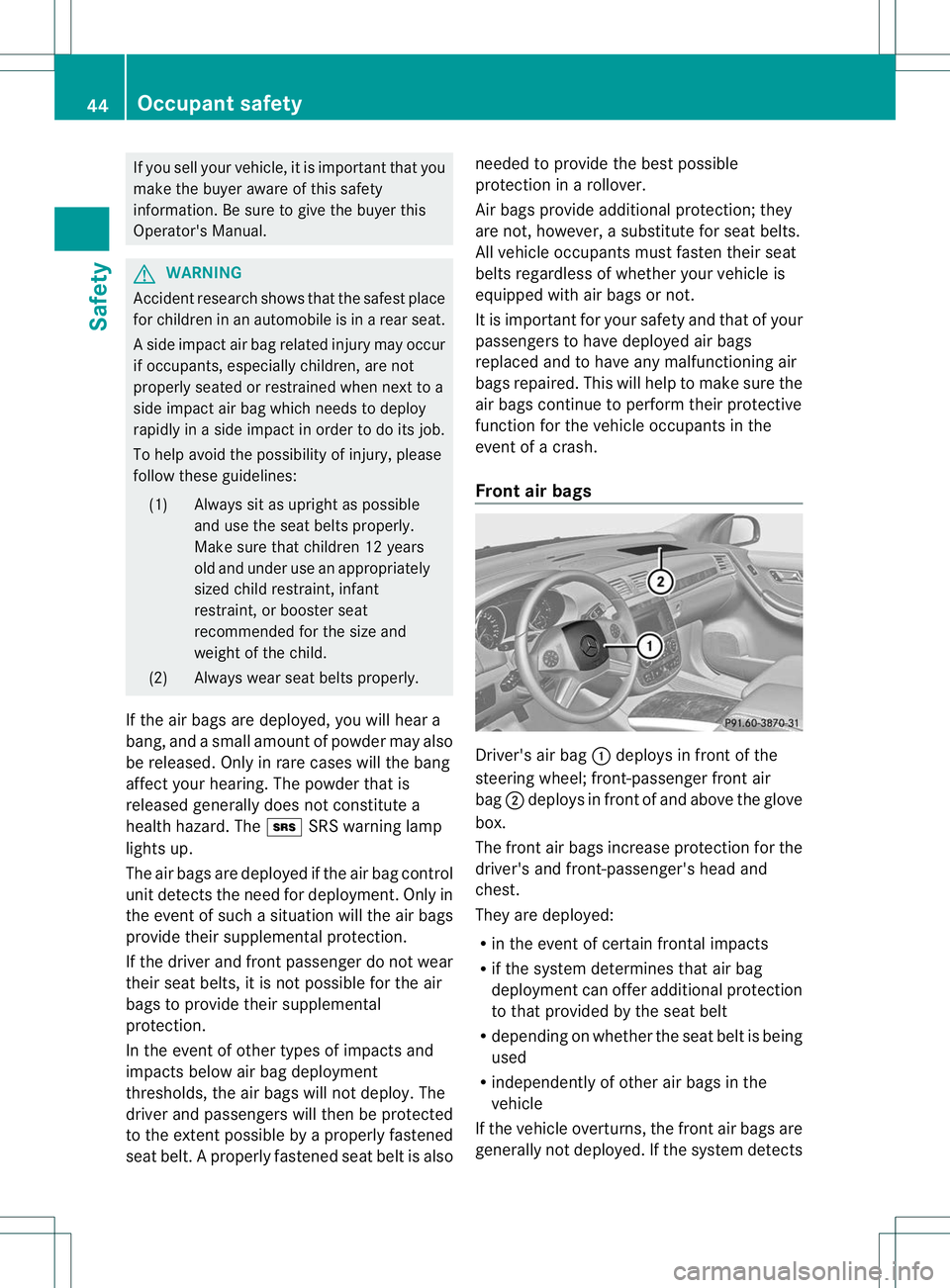
Driver's air bag
:deploys in front of the
steering wheel; front-passenger front air
bag ;deploys in front of and above the glove
box.
The front air bags increase protection for the
driver's and front-passenger's head and
chest.
They are deployed:
R in the event of certain frontal impacts
R if the system determines that air bag
deployment can offer additional protection
to that provided by the seat belt
R depending on whether the seat belt is being
used
R independently of other air bags in the
vehicle
If the vehicle overturns, the front air bags are
generally not deployed. If the system detects 44
Occupant safetySafety
Page 48 of 364
high vehicle deceleration in
alongitudinal
direction, the front air bags are deployed.
Your vehicle has adaptive, two-stage front air
bags. In the event of a collision, the air bag
control unit evaluates the vehicle
deceleration. In the first deployment stage,
the front air bag is filled with enough
propellant gas to reduce the risk of injuries.
The front air bag is fully deployed if a second
deployment threshold is exceeded within a
few milliseconds.
The deployment of front-passenger front air
bag ;is also influenced by the weight
category of the front passenger, which is
determined by the Occupant Classification
System (OCS) (Y page 46).
The lighter the passenger side occupant, the
higher the vehicle deceleration rate required
(predicted at the start of the impact) for
second-stage inflation of the front-passenger
front air bag. In the second stage, the front
air bags are inflated with the maximum
amount of propellant gas available.
The front air bags are not deployed in
situations where a low impact severity is
predicted. You will then be protected by the
fastened seat belt.
Front-passenger front air bag ;will only
deploy if:
R the system, based on the OCS weight
sensor readings, has detected that the
front-passenger seat is occupied.
R the 42 indicator lamp on the
center console is not lit (Y page 46).
R the air bag control unit predicts a high
impact severity.
Side impact air bags G
WARNING
Only use seat covers which have been tested
and approved by Mercedes-Benz for your
vehicle model. Using other seat covers may
interfere with or prevent the deployment of
the side impact air bags. Contact an authorized Mercedes-Benz Center for
availability.
G
WARNING
The pressure sensors for side impact air bag
control are located in the doors. Do not
modify any components of the doors or door
trim panels including, for example, the
addition of door speakers.
Improper repair work on the doors or the
modification or addition of components to the
doors create a risk of rendering the side
impact air bags inoperative or causing
unintended air bag deployment. Work on the
doors must therefore only be performed by
qualified technicians. Contact an authorized
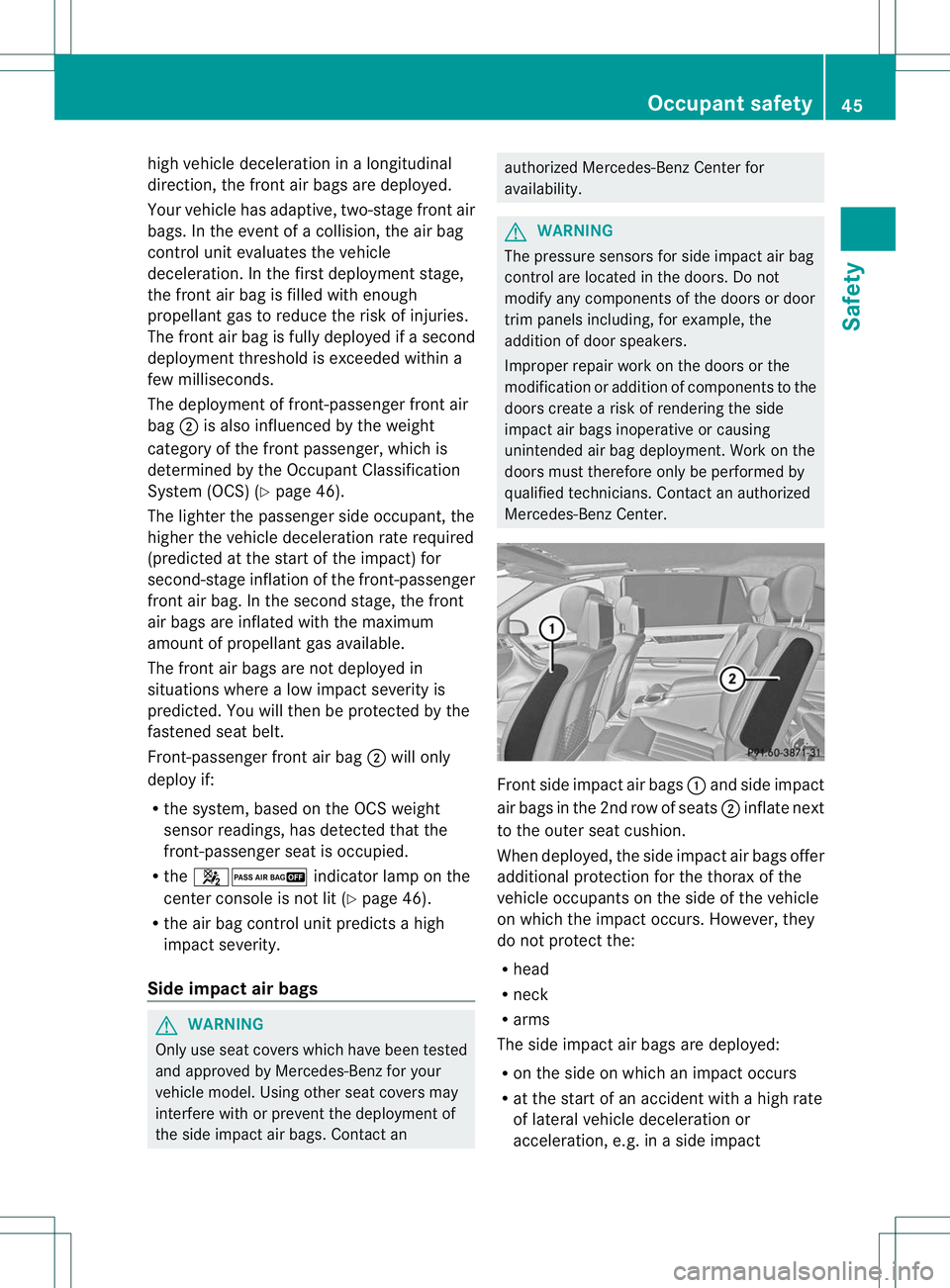
Mercedes-Benz Center. Fronts
ide impac tair bags :and side impact
air bags in the 2nd row of seats ;inflate next
to the outer seat cushion.
When deployed, the side impac tair bags offer
additional protection for the thorax of the
vehicle occupants on the side of the vehicle
on which the impac toccurs .However, they
do not protect the:
R head
R neck
R arms
The side impact air bags are deployed:
R on the side on which an impact occurs
R at the start of an accident with a high rate
of lateral vehicle deceleration or
acceleration, e.g. in aside impact Occupant safety
45Safety Z
Page 51 of 364
Children can be killed or seriously injured by
an inflating air bag. Note the following
important information when circumstances
require you to place a child in the front-
passenger seat:
R
Your vehicle is equipped with air bag
technology designed to deactivate the
front-passenger fronta ir bag in your vehicle
when the system senses the weight of a
typical 12-month-old child or less along
with the weight of a standard appropriate
child restraint on the front-passenge rseat.
R Ac hild in a rear-facing child restraint on the
front-passenger seat will be seriously
injured or even killed if the front-passenger
front air bag inflates in a collision which
could occur under some circumstances,
even with the air bag technology installed
in your vehicle. The only means to eliminate
this risk completely is never to place a child
in a rear-facing child restraint in the front-
passenger seat. We therefore strongly
recommend that you always place a child
in a rear-facing child restraint on the rear
seat.
R If you install a rear-facing child restraint on
the front-passenger seat, make sure the
42 indicator lamp is
illuminated, indicating that the front-
passenger front air bag is deactivated.
Should the 42 indicator lamp
not illuminate or go out while the restraint
is installed, please check installation.
Periodically check the 42
indicator lamp while driving to make sure
the 42 indicator lamp is
illuminated. If the 42indicator
lamp goes out or remains out, do not
transport a child on the front-passenger
seat until the system has been repaired.
Ac hild in a rear-facing child restraint on the
front-passenger seat will be seriously
injured or even killed if the front-passenger
front air bag inflates. R
If you place a child in a forward-facing child
restraint on the front-passenger seat:
-move the seat as far back as possible
- use the proper child restraint
recommended for the age, size and
weight of the child
- secure child restraint with the vehicle's
seat belt according to the child seat
manufacturer's instructions
R For children larger than a typical 12-month-
old child, the front-passenger front air bag
can be activated or deactivated. G
WARNING
If the red +SRS warning lamp in the
instrument cluster and the 42
indicator lamp light up simultaneously, OCS is
malfunctioning. The front-passenger air bag is
deactivated in this case. Have the system
checked as soon as possible by qualified
technicians. Consult an authorized Mercedes-
Benz Center.
Only have the seat repaired at an authorized
Mercedes-Benz Center.
In order to ensure correct operation of the air
bag system and OCS:
R do not place any objects with a total weight
of more than 4.4 lb (2kg) in the parcel net
on the back of the front-passenger seat.
OC Sm ay otherwise be unable to correctly
assess the occupant's weigh tcategory.
R do no tplace any object sunde rorn ear the
front-passenger seat.
R do not hang or fasten any objects on the
seats.
R do not store any objects, such as books,
between the front-passenger seat and the
center console or the front-passenger door.
R do not slide the front-passenger seat
backwards against any hard objects.
R sit with the seat belt fastened correctly and
in a position that is as upright as possible
with your back against the backrest. 48
Occupant safetySafety