automatic transmission MERCEDES-BENZ S CLASS 2000 User Guide
[x] Cancel search | Manufacturer: MERCEDES-BENZ, Model Year: 2000, Model line: S CLASS, Model: MERCEDES-BENZ S CLASS 2000Pages: 421, PDF Size: 20.37 MB
Page 241 of 421
238 Automatic transmission
Te ch n ica l
data Instruments
and controlsOperationDrivingInstrument
cluster displayPractical hints Car care Index
Press and hold selector lever in the æ direction:
The transmission will shift from the current gear
directly to gear range “D”.
Important!
With transmission in gear range “D”, “4” or “3”,
upshifting from 1st to 2nd to 3rd gear is delayed
depending on vehicle speed and engine temperature.
This allows the catalytic converter to heat up more
quickly to operating temperatures.
During the brief warm-up period this delayed upshift
and increased engine noise might be perceived as a
malfunction. However, neither the engine nor
transmission are negatively affected by this mode of
operation.The delayed upshift is effective with vehicle speeds
below 31 mph (50 km/h) at partial throttle and engine
temperatures below 95°F (35°C).
To avoid overrevving the engine when the selector lever
is moved to a lower gear range, the transmission will not
shift to a lower gear, if the engine’s revolutions per
minute limit would be exceeded. In this case there will
be no downshift, even when the vehicle speed reaches
the engine’s rpm limit of that gear, e.g. by applying the
service brakes.
To prevent the engine from laboring at low RPM when
driving uphill gradients or with your vehicle heavily
loaded, the automatic transmission will downshift when
necessary to maintain engine RPM within the best
torque range.
Wa r n i n g !
On slippery road surfaces, never downshift in order
to obtain braking action. This could result in drive
wheel slip and reduced vehicle control. Your
vehicle’s ABS will not prevent this type of loss of
control.
Page 242 of 421
239 Automatic transmission
Te ch n ica l
data Instruments
and controlsOperationDrivingInstrument
cluster displayPractical hints Car care Index Gear ranges:
Upshift through 4th gear only. Suitable for
performance driving.
Upshift through 3rd gear only. Suitable for
moderately steep hills. Since the transmission
does not shift higher than 3rd gear, this gear
selection will allow use of the engine’s braking
power downhill.Upshift through 2nd gear only. For driving in
mountainous regions or under extreme operating
conditions. This gear selection will allow use of
the engine’s braking power when descending
steep grades.
Use this position, which makes maximum use of
the engine’s braking effect, while descending
very steep or lengthy downgrades and only at
speeds below 40 mph (60 km/h).
Page 243 of 421
240 Automatic transmission
Te ch n ica l
data Instruments
and controlsOperationDrivingInstrument
cluster displayPractical hints Car care Index
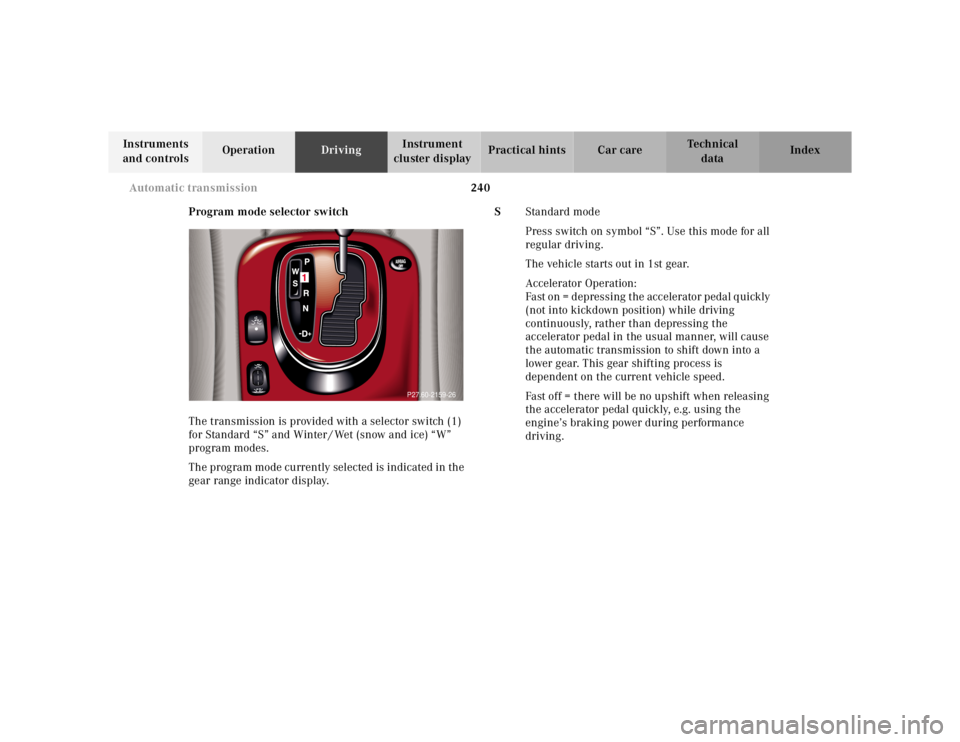
Program mode selector switch
The transmission is provided with a selector switch (1)
for Standard “S” and Winter / Wet (snow and ice) “W”
program modes.
The program mode currently selected is indicated in the
gear range indicator display.SStandard mode
Press switch on symbol “S”. Use this mode for all
regular driving.
The vehicle starts out in 1st gear.
Accelerator Operation:
Fast on = depressing the accelerator pedal quickly
(not into kickdown position) while driving
continuously, rather than depressing the
accelerator pedal in the usual manner, will cause
the automatic transmission to shift down into a
lower gear. This gear shifting process is
dependent on the current vehicle speed.
Fast off = there will be no upshift when releasing
the accelerator pedal quickly, e.g. using the
engine’s braking power during performance
driving.
P27.60-2159-26
Page 244 of 421
241 Automatic transmission
Te ch n ica l
data Instruments
and controlsOperationDrivingInstrument
cluster displayPractical hints Car care Index WWinter / Wet (snow and ice) mode
Press switch on symbol “W”. The vehicle starts
out in 2nd gear, except with selector lever in 1st
gear, or with accelerator pedal in kick-down
position.
The “W” mode helps to improve traction and
driving stability of the vehicle.
The gear shifting process occurs at lower vehicle
and engine speeds than in the “S” program mode.
Caution!
Never change the program mode when the selector lever
is out of position “P”. It could result in a change of
driving characteristics for which you may not be
prepared.
Important!
Always be certain of the program mode selected since
the vehicle driving characteristics change with the
selection of the program mode.
Dependent on the program mode selector switch
position “S” or “W” and the gear selector lever in
position “R”, the ratio of power transmission changes.Emergency operation
(Limp home mode)
If vehicle acceleration worsens or the transmission no
longer shifts, the transmission is most likely operating
in Limp Home Mode which engages when there is a
malfunction of the transmission. This condition may be
accompanied by the “CHECK ENGINE” malfunction
indicator lamp in the instrument cluster coming on.
In this mode only the 2nd gear or reverse gear can be
activated.
To engage 2nd gear or reverse:
1. Sto p t h e v e h i c l e .
2. Move selector lever to position “P”.
3. Turn off the engine.
4. Wait approximately 10 seconds.
5. Restart the engine.
6. Move selector lever to position “D” (for 2nd gear), or
move selector lever to position “R” (for reverse gear).
Have the transmission checked at your authorized
Mercedes-Benz Center as soon as possible.
Page 258 of 421
255 Driving systems
Te ch n ica l
data Instruments
and controlsOperationDrivingInstrument
cluster displayPractical hints Car care IndexNotes:
If the engine does not brake the vehicle sufficiently
while driving on a downgrade, the speed you set on the
cruise control may be exceeded. In this case the
automatic transmission shifts down (max. to 3rd gear)
to maintain the set cruise control speed by using the
engine’s braking power.
As soon as the grade eases, the automatic transmission
shifts up again dependent on the selector lever position.
Nevertheless, in some cases you may have to step on the
brake pedal to slow down. In this case the cruise control
is switched off.
Use the lever to resume the previously set speed.
The “CRUISE CONTROL - - -” message is displayed on
the multifunction display when any attempt is made to
store speeds below 25 mph (40 km / h) or when an
attempt is made to recall a speed when no speed has
been stored – the cruise control remains switched off.
See malfunction and warning messages on page 303 if
the cruise control has a malfunction.
Wa r n i n g !
Only use the cruise control if the traffic and
weather conditions make it advisable to travel at a
steady speed.• The use of cruise control can be dangerous on
winding roads or in heavy traffic because
conditions do not allow safe driving at a steady
speed.
• The use of cruise control can be dangerous on
slippery roads. Rapid changes in tire adhesion
can result in wheel spin and loss of control.The “Resume” function should only be operated if
the driver is fully aware of the previously set speed
and wishes to resume this particular preset speed.
Page 266 of 421
263 Driving systems
Te ch n ica l
data Instruments
and controlsOperationDrivingInstrument
cluster displayPractical hints Car care Index The distance warning sound continues until the driver
activates the brake pedal, or the preset distance is
obtained. As soon as the preset distance is obtained, the
distance warning lamp goes out.Caution!
If the driver’s foot is not fully removed from the
accelerator pedal, the Distronic control system will be
overridden and it will not regulate the preset vehicle
speed and following distance. The vehicle speed and
following distance is determined only by the accelerator
pedal position.
Distronic works on steep uphill and downhill gradients
by downshifting gears and applying the brakes to
maintain the speed selected by the driver. The
transmission will upshift again once the gradient evens
out.
The speed can be increased (e.g. for passing) by using
the accelerator. After the accelerator is released, the
previously set speed will be resumed automatically.
Distronic is deactivated if a vehicle in front causes your
vehicle to slow down to less than approximately 25 mph
(Canada: 30 km/h). A signal sounds and the message
“DTR OFF” appears for 5 seconds in the multifunction
display.
Wa r n i n g !
A continuous warning sounds and the distance
warning lamp in the speedometer dial is
illuminated if the Distronic system calculates that
the distance to the vehicle ahead and your vehicle’s
current speed indicate that Distronic will not be
capable of slowing the vehicle sufficiently to
maintain the preset following distance, which
creates a danger of a collision.Immediately brake the vehicle to increase the
distance to the vehicle in front of you. The warning
sound is intended as a final caution that you have
not interceded with your own braking inputs to
avoid a potentially dangerous situation. Do not wait
for the operation of the warning signal to intercede
with your own braking as that will result in
potentially dangerous emergency braking which
will not always result an impact being avoided.Tailgating increases the risk of an accident.
Page 303 of 421
300 Malfunction and indicator lamps
Te ch n ica l
data Instruments
and controlsOperation DrivingInstrument
cluster displayPractical hints Car care Index
ABS malfunction indicator lamp
The ABS malfunction indicator lamp in the
instrument cluster comes on with the
electronic key in starter switch position 2
and should go out with the engine running.
When the ABS malfunction indicator lamp symbol and
warning in the instrument cluster remains illuminated
while the engine is running, it indicates that the ABS
has detected a malfunction and has switched off. In this
case, the brake system functions in the usual manner,
but without antilock assistance.
A malfunctioning ABS control unit can possibly affect
the operation of other systems (e.g. Parktronic,
Navigation, Automatic transmission). Be guided
accordingly with respect to the use of those systems and
have the system checked at your authorized
Mercedes-Benz Center as soon as possible.With the ABS malfunctioning, the BAS and ESP are also
switched off. The malfunction indicator lamps and
malfunction messages in the multifunction display
come on with the engine running.
If the charging voltage falls below 10 volts, the
malfunction indicator lamp comes on and the ABS is
switched off. When the voltage is above this value again,
the malfunction indicator lamp should go out and the
ABS is operational.
Have the system checked at your authorized
Mercedes-Benz Center as soon as possible.
See page 272 for notes on antilock brake system (ABS).
ABS
Page 330 of 421
327 Contents - Practical hints
Te ch n ica l
data Instruments
and controlsOperation DrivingInstrument
cluster displayPractical hintsCar care Index
Practical hintsFirst aid kit .....................................328
Stowing things in the vehicle ......328
Fuses ................................................329
Hood ................................................. 331
Checking engine oil level .............334
Automatic transmission
fluid level ...................................335
Active body control
(ABC) fluid level ........................335
Coolant level ...................................336
Adding coolant ...........................336
Windshield and
headlamp washer system ........337Windshield and
headlamp washer fluid
mixing ratio ................................ 337
Spare wheel, vehicle tools,
storage compartment ............... 338
Vehicle jack .................................... 339
Wheels ............................................ 340
Tire Replacement ....................... 340
Rotating wheels ......................... 341
Spare wheel .................................... 341
Changing wheels ........................... 343
Tire inflation pressure ................. 348
Battery ............................................. 349
Jump starting ................................. 351
Towing the vehicle ........................ 353Exterior lamps ................................356
Headlamp assembly ...................357
Taillamp assemblies ..................360
Trunk lamp .....................................362
Changing batteries in the
electronic main key ..................363
Synchronizing
remote control ............................365
Changing batteries in the
KEYLESS-GO-card .....................366
Emergency engine
shut-down ..................................368
Fuel filler flap,
manual release ..........................368
Emergency operation of
sliding/pop-up roof ...................369
Replacing wiper blades .................370
Roof rack ......................................... 371
Page 338 of 421
335 Engine compartment
Te ch n ica l
data Instruments
and controlsOperation DrivingInstrument
cluster displayPractical hintsCar care Index The engine oil level can be checked by either the oil
dipstick or via the multifunction display in the
instrument cluster, see page 154.
Wipe the oil dipstick clean prior to checking the engine
oil level. Fully insert dipstick in tube, and remove after
three seconds to obtain accurate reading.
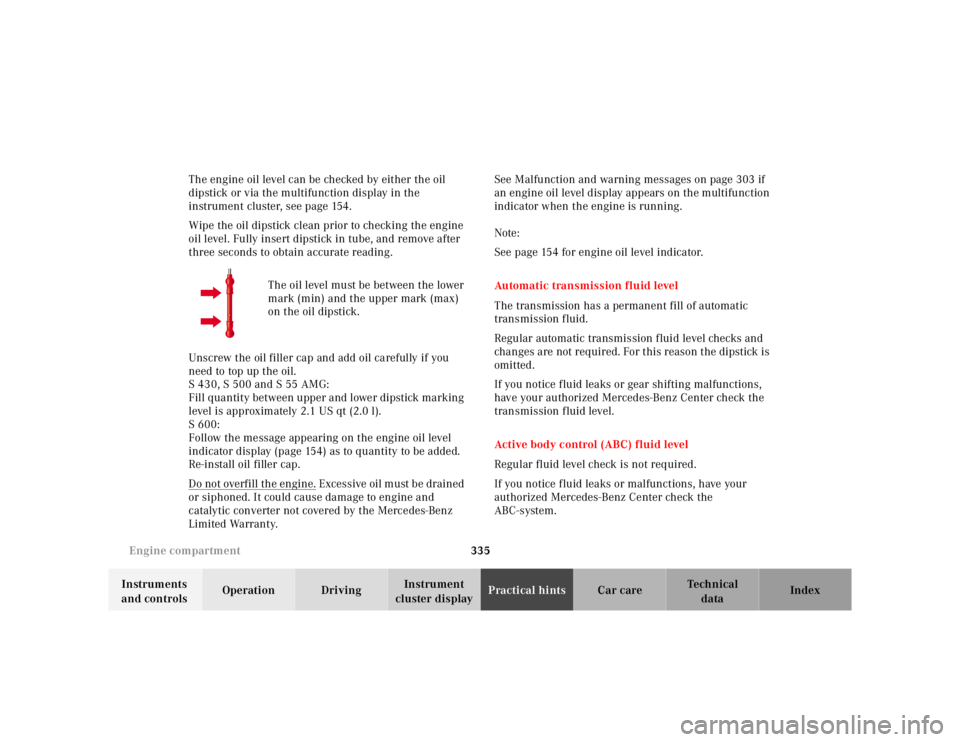
The oil level must be between the lower
mark (min) and the upper mark (max)
on the oil dipstick.
Unscrew the oil filler cap and add oil carefully if you
need to top up the oil.
S 430, S 500 and S 55 AMG:
Fill quantity between upper and lower dipstick marking
level is approximately 2.1 US qt (2.0 l).
S 600:
Follow the message appearing on the engine oil level
indicator display (page 154) as to quantity to be added.
Re-install oil filler cap.
Do not overfill the engine.
Excessive oil must be drained
or siphoned. It could cause damage to engine and
catalytic converter not covered by the Mercedes-Benz
Limited Warranty.See Malfunction and warning messages on page 303 if
an engine oil level display appears on the multifunction
indicator when the engine is running.
Note:
See page 154 for engine oil level indicator.
Automatic transmission fluid level
The transmission has a permanent fill of automatic
transmission fluid.
Regular automatic transmission fluid level checks and
changes are not required. For this reason the dipstick is
omitted.
If you notice fluid leaks or gear shifting malfunctions,
have your authorized Mercedes-Benz Center check the
transmission fluid level.
Active body control (ABC) fluid level
Regular fluid level check is not required.
If you notice fluid leaks or malfunctions, have your
authorized Mercedes-Benz Center check the
ABC-system.
Page 397 of 421
394 Fuels, coolants, lubricants etc. - capacities
Te ch n ica l
data Instruments
and controlsOperation DrivingInstrument
cluster displayPractical hints Car care Index
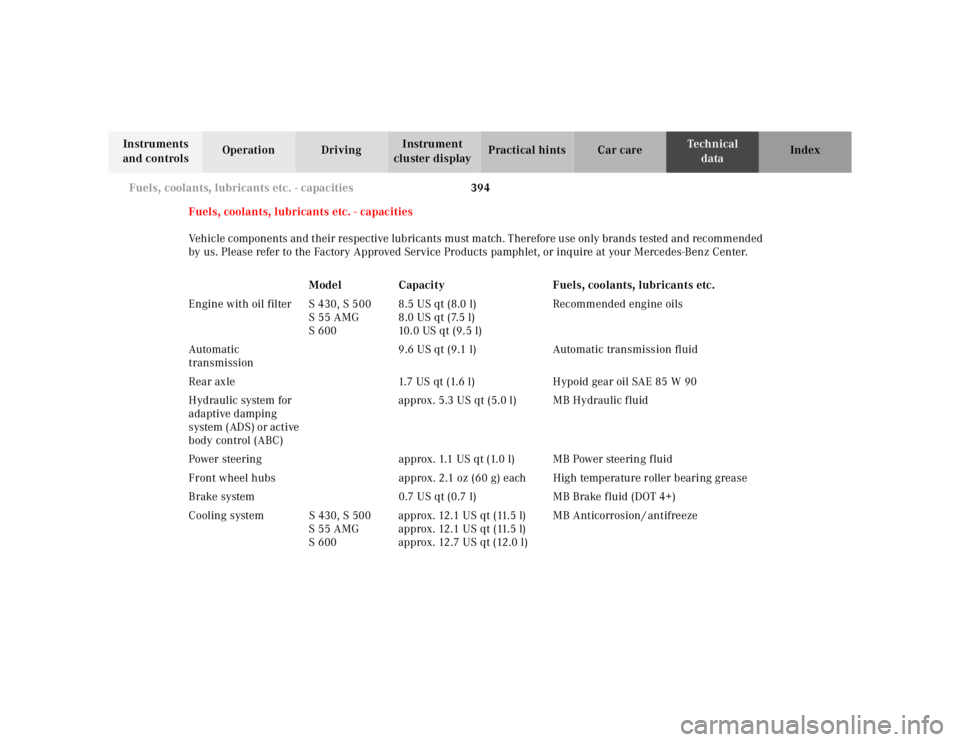
Fuels, coolants, lubricants etc. - capacities
Vehicle components and their respective lubricants must match. Therefore use only brands tested and recommended
by us. Please refer to the Factory Approved Service Products pamphlet, or inquire at your Mercedes-Benz Center.
Model Capacity Fuels, coolants, lubricants etc.
Engine with oil filter S 430, S 500
S 55 AMG
S 6008.5 US qt (8.0 l)
8.0 US qt (7.5 l)
10.0 US qt (9.5 l)Recommended engine oils
Automatic
transmission9.6 US qt (9.1 l) Automatic transmission fluid
Rear axle 1.7 US qt (1.6 l) Hypoid gear oil SAE 85 W 90
Hydraulic system for
adaptive damping
system (ADS) or active
body control (ABC)approx. 5.3 US qt (5.0 l) MB Hydraulic f luid
Power steering approx. 1.1 US qt (1.0 l) MB Power steering fluid
Front wheel hubs approx. 2.1 oz (60 g) each High temperature roller bearing grease
Brake system 0.7 US qt (0.7 l) MB Brake fluid (DOT 4+)
Cooling system S 430, S 500
S 55 AMG
S 600approx. 12.1 US qt (11.5 l)
approx. 12.1 US qt (11.5 l)
approx. 12.7 US qt (12.0 l)MB Anticorrosion / antifreeze