instrument cluster MERCEDES-BENZ S-Class 2013 W221 Owner's Manual
[x] Cancel search | Manufacturer: MERCEDES-BENZ, Model Year: 2013, Model line: S-Class, Model: MERCEDES-BENZ S-Class 2013 W221Pages: 542, PDF Size: 7.97 MB
Page 10 of 542
Child seat
LATCH-type (ISOFIX) child seat
anchor s............................................ 68
Specia lseat belt retractor ...............68
Top Tether ....................................... 69
Cigarette lighter ................................ 446
Cleaning Mirro rturn signal ........................... 474
Climate control
Automatic climate control .............295
COMAND ....................................... 269
Controlling automatically ...............297
Controlling centrally (COMAND) ....272
Cooling with aird ehumidification..297
Cooling with aird ehumidification
(COMAND )..................................... 271
Defrosting the windows .................300
Defrosting the windshield ..............300
Important safety notes ..................294
Indicator lamp ................................ 297
Mai nm enu .................................... .271
Maximum cooling .......................... 300
Notes on using automatic climate
control ........................................... 296
Overview of systems ......................294
Problems with cooling with air
dehumidification ............................ 297
Problem with the rear window
defroster ........................................ 301
Rear compartment (COMAND) ......273
Rea rcontrol panel ......................... 295
Setting the aird istribution.............299
Setting the airflow .........................299
Setting the airflow (COMAND) .......273
Setting the airv ents...................... 302
Setting the footwell temperature
(COMAND) ..................................... 272
Setting the temperature ................298
Switching air-recirculation mode
on/off ............................................ 301
Switching on/off ........................... 296
Switching residual hea ton/off ......302
Switching the rear window
defroster on/off ............................ 301
Coat hooks ......................................... 440
Cockpit Overview .......................................... 36
see Instrument cluster Color, setting (TV, video)
..................244
COMAND At a glance (overview) .................... 122
Back button ................................... 123
Basi cfunction s.............................. 137
Components .................................. 122
Display ........................................... 125
Exampl eofoperation ..................... 132
Function buttons ........................... 123
Menu overview .............................. 125
Remote control .............................. 129
Switching on/off ........................... 137
System settings ............................. 147
COMAND controller ...........................122
COMAND display Cleaning instructions .....................129
Folding in and swiveling .................128
Setting ........................................... 147
COMAND operating system .............. 122
Combination switch ..........................283
Compass function ............................. 192
Conference connection ..................... 205
Consumption statistics (on-board
computer) .......................................... 378
Contrast, setting (TV, video) ............244
Convenience closing feature ..............97
Convenience opening feature ............96
Convenience telephone Importing contacts ........................208
Convenience telephony ....................197
Introduction ................................... 197
Coolan t(engine)
Checkin gthe level ......................... 467
Display message ............................ 408
Filling capacity ............................... 536
Notes ............................................. 536
Temperature (on-board computer) .381
Temperature gauge ........................ 374
Cooling
see Climate control
Copy protection (CD/DVD) ...............234
Cornering light function Display message ............................ 405
Function/notes ............................. 284
Cruise control
Cruise control leve r....................... 335
Deactivating ................................... 336 8
Index
Page 15 of 542
Opening/closing the garage door
..459
Programming (button in the rear-
view mirror) ................................... 457
Gear indicator (on-board
computer) .......................................... 381
Gear or selector lever (cleaning
guidelines) ......................................... 476
Genuine Mercedes-Benz parts .........528
Glove box ........................................... 438
GPS reception .................................... 155
Gracenote Media Database ..............231 H
Handbrake see Parking brake
Harman/kardon ®
Logic 7 ®
surround sound system see Surround sound (harman/
kardon ®
surround sound system)
Hazard warning lamps ......................283
HD Radio™ ......................................... 219
Heading up (navigation) ...................188
Headlamp cleaning system Notes ............................................. 537
Headlamps
Adding fluid to cleaning system .....468
Cleaning system (function) ............282
Fogging up ..................................... 285
see Automatic headlamp mode
Headphones
Changing batteries ........................251
Function overview ..........................146
Indicator lamp ................................ 147
Selecting ascree n......................... 146
Switching on/off ........................... 146
Head restraints
Adjusting ....................................... 110
Adjusting (electrically). ..................110
Adjusting (rear) .............................. 111
NECK-PR O..................................... 110
NECK-PR Oluxur y........................... 110
see NECK-PRO head restraints/
NECK-PRO luxury head restraints
Heating
see Climate control High-beam headlamps
Changing bulbs (vehicles with
halogen daytime running lamps) ....288
Changing bulbs (vehicles with LED
daylight lamps) .............................. 288
Display message ............................ 406
Switching Adaptive Highbeam
Assist on/off ................................. 284
Switching on/off ........................... 283
Hill start assist .................................. 310
HOLD function Display message ............................ 415
Function/notes ............................. 346
Home
see Home address
Home address
Entering and saving .......................160
Selecting from the destination
memory ......................................... 163
Hood
Closing .......................................... .463
Display message ............................ 423
Opening ......................................... 462
Hydroplaning ..................................... 333 I
Ignition lock see Key positions
Immobilizer .......................................... 79
In-car hotspot see separate operating instructions
Incident (traffic report) .....................178
Indicator lamps see Warning and indicator lamps
Indicators
see Turn signals
Insectp rotection on the radiator ....463
Instrument cluster Overview .......................................... 37
Warning and indicator lamps ...........38
Instrument lighting
see Instrument cluster lighting
Interface (USB, iPod ®
)
see Medi aInterface
Interior lighting ......................... 267, 285
Ambient light (COMAND) ...............268
Automatic control ..........................286 Index
13
Page 24 of 542
Sound settings
Balance and fader ..........................139
Calling up the sound menu ............139
Rear Seat Entertainment System ...253
Surround sound ............................. 140
Treble and bas s............................. 139
Spare wheel
Notes/data .................................... 524
Storage location ............................ 478
see Emergency spare wheel
Specialist workshop ............................ 31
Speech control see Voice Control System
Speed, controlling
see Cruise control
Speedometer
Activating/deactivating the
additional speedometer .................388
Digita l............................................ 378
In the Instrument cluster .................37
Selecting the unit of
measurement ................................ 388
see Instrument cluster
SPLITVIEW ......................................... 126
SRS (Supplemental Restraint
System)
Display message ............................ 400
Introduction ..................................... 48
Warning lamp ................................. 433
Warning lamp (function) ................... 48
Standing lamps
Display message ............................ 407
Switching on/off ........................... 280
Starting (engine) ................................ 308
Station memory ................................. 217
Steering (display message) ..............424
Steering wheel Adjusting (electrically). ..................114
Button overview ............................... 39
Buttons (on-board
computer) ...................................... 375
Cleaning ......................................... 476
Important safety notes ..................114
Paddle shifters ............................... 318
Steering wheel heating ..................114
Storing settings (memory
function) ........................................ 118Steering wheel heating
Switching on/off ........................... 114
Steering wheel paddle shifters ........318
Stop function Audi oDVD ..................................... 228
Rear Seat Entertainment System ...260
Video DVD ..................................... 247
Stopwatch (RACETIMER) ................... 382
Storing stations Manually ........................................ 217
Storing stations (radio)
Automatically ................................. 217
Stowage areas ................................... 438
Stowage compartments Armrest (under) ............................. 439
Cuph olders ................................... 443
Door ............................................... 439
Eyeglasses compartment ...............439
Glove box ...................................... .438
Important safety information .........438
Parce lnet ...................................... 441
Rea r............................................... 440
Rear seat backrest ......................... 440
Rea rseats (between) .....................440
Stowage well ..................................... 442
Stowage well beneath the trunk
floor .................................................... 442
Summer opening see Convenience opening feature
Summer tires ..................................... 500
Sun visor ............................................ 444
Supplemental Restraint System see SRS (Supplemental Restraint
System)
Surround sound
see 3D sound (Harman Kardon ®
surround sound system)
Surround sound (harman/
kardon ®
surround sound system)
Notes ............................................. 140
Switching on/off ........................... 140
Suspension tuning
Active Body Control .......................349
AIRMATIC ...................................... 348
Switching air-recirculation mode
on/off ................................................. 30122
Index
Page 38 of 542
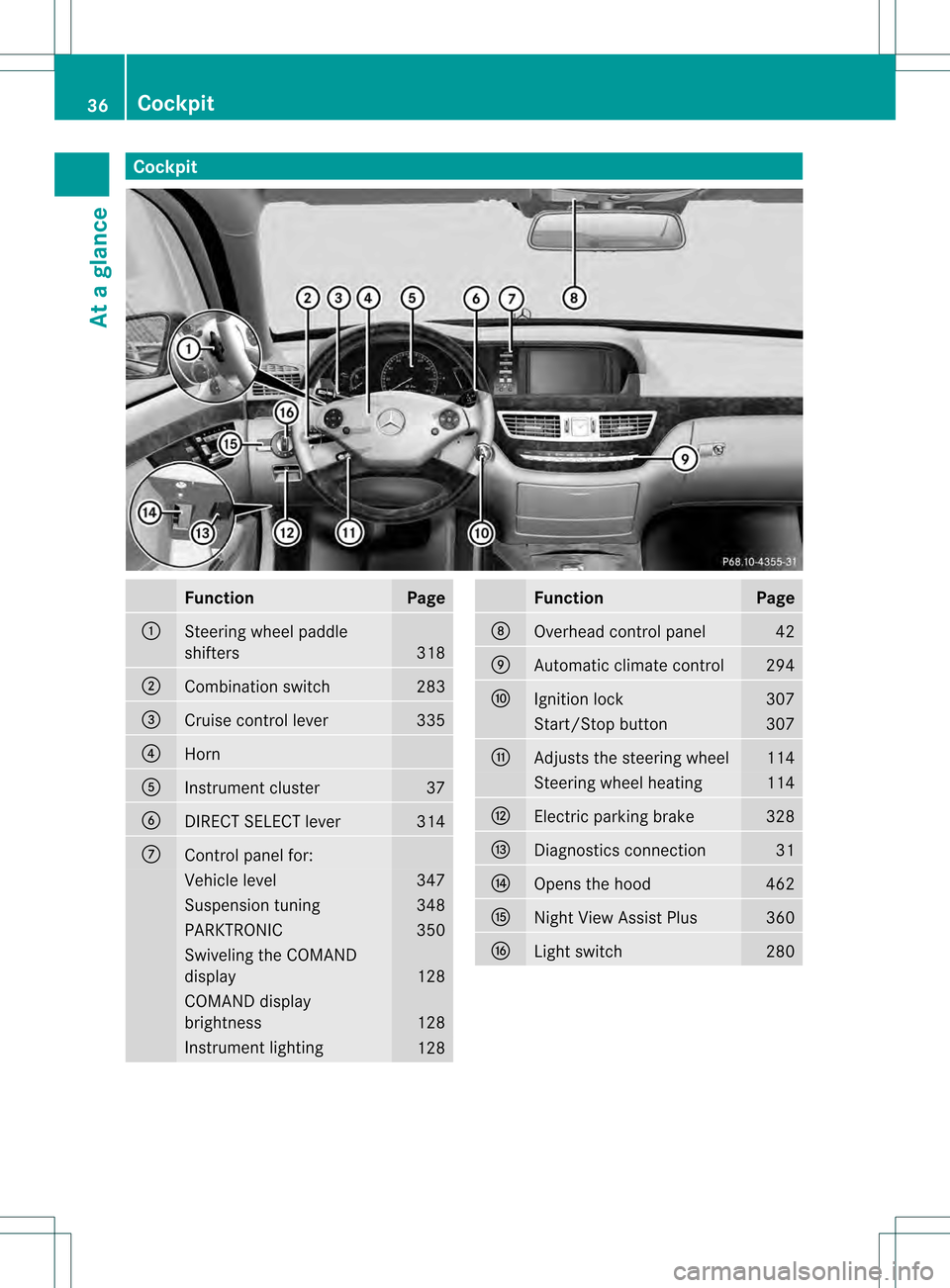
Cockpit
Function Page
0002
Steering wheel paddle
shifters
318
0003
Combination switch 283
0026
Cruise control lever 335
0025
Horn
0023
Instrument cluster 37
0024
DIRECT SELECT lever 314
0014
Control panel for:
Vehicle level 347
Suspension tuning 348
PARKTRONIC 350
Swiveling the COMAND
display
128
COMAND display
brightness
128
Instrument lighting
128 Function Page
0015
Overhead control panel 42
0016
Automatic climate control 294
0017
Ignition lock 307
Start/Stop button 307
0018
Adjusts the steering wheel 114
Steering wheel heating 114
001C
Electric parking brake 328
001D
Diagnostics connection 31
001E
Opens the hood 462
001F
Nigh
tView Assist Plus 360
0021
Light switch 28036
CockpitAt a glance
Page 39 of 542

Instrumen
tcluster Displays
Function Page
0002
Coolant temperature 374
0003
Fuel gauge
0026
PARKTRONIC 350
0025
Multifunction display 376
Speedometer
0023
Transmission position 316
0024
Tachometer 375
0014
Drive program 317
0015
Parking Guidance
353 Function Page
0016
Unit of measurement for
the speedometer
388
0017
Outside temperature 375
0018
Additional speedometer 388
001C
HOLD function 346
0001
PRE-SAFE ®
Brake 77
001D
Adaptive Highbeam Assist 284
Lane Keeping Assist or
Active Lane Keeping Assist 365,
369 ATTENTION ASSIST 359Instrument cluster
37At a glance
Page 40 of 542

Warning and indicator lamps
Function Page
0002
Turn signal 283
0003
Electric parking brake (red) 427
0005
(USA only) 000A
(Canada only) 0026
Electric parking brake
(yellow)
427
0005
(USA only) 000A
(Canada only) 0025
Seat belt 426
0023
ESP
® 430
0024
Distance warning 435
0014
Brakes 427
000F
(USA only) 0006
(Canada only) Function Page
0015
ESP
®
OFF 430
0016
Tire pressure monitor 436
0017
Diesel engine: preglow 309
0018
Check engine 434
001C
ABS 428
001D
SRS 433
001E
High-beam headlamps 283
001F
Reserve fuel 43438
Instrument clusterAt a glance
Page 50 of 542
Useful information
i This Operator's Manual describes all
models and all standard and optional
equipment of your vehicle available at the
time of publication of the Operator's
Manual. Country-specific differences are
possible. Please note that your vehicle may
not be equipped with all features
described. This also applies to safety-
related systems and functions.
i Please read the information on qualified
specialist workshops (Y page 31).Occupant safety
Overview of occupant safety
In this section, you will learn the most
important facts about the restraint system
components of the vehicle.
The restraint system consists of:
R seat belts
R child restraint systems
R LATCH-type (ISOFIX) child seat anchors
Additional protection is provided by:
R SRS (Supplemental Restrain tSystem)
R NECK-PRO head restraints/NECK-PRO
luxury head restraints
R PRE-SAFE ®
R Airb ag system component swith:
- PASSENGER AI RBAG OFF indicator lamp
- front-passenge rseat with Occupant
Classification System (OCS)
The differen tair bag systems work
independently of each other. The protective
functions of the system work in conjunction
with each other. Not all air bags are deployed
in an accident. G
WARNING
Modifications to or work improperly
conducted on restraint system components
or their wiring, as well as tampering with interconnected electronic systems, can lead
to the restraint systems no longer functioning
as intended.
Air bags or Emergency Tensioning Devices
(ETDs), for example, could deploy
inadvertently or fail to deploy in accidents
although the deceleration threshold for air
bag deploymen tis exceeded. Therefore,
never modify the restraint systems. Do not
tamper with electronic components or their
software.
i See "Children in the vehicle"
(Y page 66) for more information on
infants and children traveling with you in
the vehicle and restraints for infants and
children. SRS (Supplemental Restraint System)
Introduction SRS consists of:
R
the 001A SRS warning lamp
R air bags
R air bag control unit (with crash sensors)
R Emergency Tensioning Devices
R belt force limiters
SRS reduces the risk of occupants coming
into contact with the vehicle's interior in the
event of an accident. It can also reduce the
effect of the forces to which occupants are
subjected during an accident.
SRS warning lamp SRS functions are checked regularly when
you switch on the ignition and when the
engine is running. Therefore, malfunctions
can be detected in good time.
The
001A SRS warning lamp in the instrument
cluster lights up when the ignition is switched
on. It goes out no later than a few seconds
after the engine is started. 48
Occupant safetySafety
Page 58 of 542
with the weight of a standard appropriate
child restrain
tonthe front-passenger seat.
R Ac hild in a rear-facing child restraint on the
front-passenger seat will be seriously
injured or even killed if the front-passenger
front air bag inflates in a collision which
could occur under some circumstances,
even with the air bag technology installed
in your vehicle. The only means to eliminate
this risk completely is never to place a child
in a rear-facing child restraint in the front-
passenger seat. We therefore strongly
recommend that you always place a child
in a rear-facing child restraint on the rear
seat.
R If you install a rear-facing child restraint on
the front-passenger seat, make sure the
00170016 indicator lamp is
illuminated, indicating that the front-
passenger front air bag is deactivated.
Should the 00170016 indicator lamp
not illuminate or go out while the restraint
is installed, please check installation.
Periodically check the 00170016
indicator lamp while driving to make sure
the 00170016 indicator lamp is
illuminated. If the 00170016indicator
lamp goes out or remains out, do not
transport a child on the front-passenger
seat until the system has been repaired.
Ac hild in a rear-facing child restraint on the
front-passenger seat will be seriously
injured or even killed if the front-passenger
front air bag inflates.
R If you place a child in a forward-facing child
restraint on the front-passenger seat:
- move the seat as far back as possible
- use the proper child restraint
recommended for the age, size and
weight of the child
- secure child restraint with the vehicle's
seat belt according to the child seat
manufacturer's instructions
R For children larger than a typical 12-month-
old child, the front-passenger front air bag
can be activated or deactivated. If the driver's air bag deploys, this does not
mean that the front-passenger front air bag
will also deploy.
The OCS may have detected that the seat:
R
is either empty or occupied by a person
with a weight up to that of a typical twelve-
month-old child seated in astandard child
restraint
R is occupied by a small individual, such as a
young teenager or a small adult
R is occupied by a child in a child restraint
system, whose weight is greate rthan that
of a typical twelve-month-old child.
These are examples of when the OCS
deactivates the front-passenger front air bag.
Deactivation takes place although the
collision fulfills the criteria for deploying the
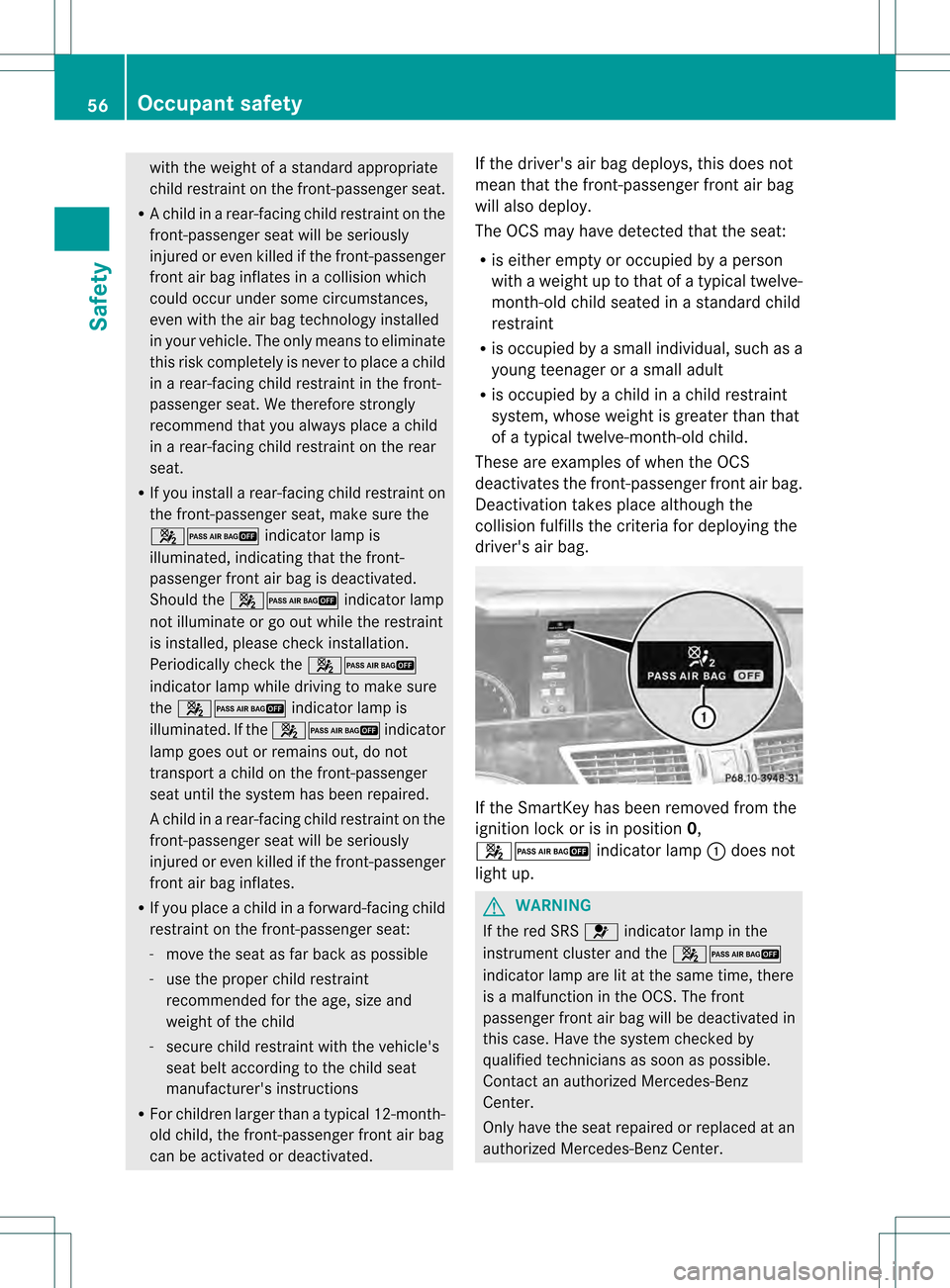
driver's air bag. If the SmartKey has been removed from the
ignition lock or is in position
0,
00170016 indicator lamp0002does not
light up. G
WARNING
If the red SRS 001Aindicator lamp in the
instrument cluster and the 00170016
indicator lamp are lit at the same time, there
is a malfunction in the OCS. The front
passenger front air bag will be deactivated in
this case. Have the system checked by
qualified technicians as soon as possible.
Contact an authorized Mercedes-Benz
Center.
Only have the seat repaired or replaced at an
authorized Mercedes-Ben zCenter. 56
Occupant safetySafety
Page 67 of 542
If after six seconds the driver's or front-
passenger seat belt is not fastened and the
doors are closed, the 001Bseat belt warning
lamp will remainl it:
R until the driver's or front passenger's seat
belt is fastened
R once the vehicle has exceeded a speed of
15 mph (25 km/h), in addition a warning
tone will sound with increasing intensity for
up to 60 seconds or until the driver's or
front-passenger seat belt is fastened.
If the drive rorfront passenger unfastens their
seat beltd uring the journey, the 001Bseat
belt warning lamp lights up and the warning
tone sounds again.
The warning tone ceases after 60 seconds
eve nift he driver or front passenger has still
not fastened their seat belt. The 001Bseat
belt warning lamp stops flashing, but remains
lit.
After the vehicle has come to a stop, the
warning tone will be reactivated and the
001B seat belt warning lamp will flash again
once the vehicle has exceeded a speed of
15 mph (25 km/h).
The 001B seat belt warning lamp will not go
out until:
R both the driver and the front passenger
have fastened their seat belts.
or
R the vehicle is stationary and a door is open.
i For more information on the 001Bseat
belt warning lamp, see "Warning and
indicator lamps in the instrument cluster,
seat belt" (Y page 426).
Emergency Tensioning Devices, belt
force limiters The front seat belts and the outer seat belts
in the rear are equipped with ETDs and seat
belt force limiters.
The ETDs tighten the seat belts in an accident,
pulling them close against the body. The ETDs do not correct incorrect seat
positions or incorrectly fastened seat belts.
The ETDs do not pull vehicle occupants back
towards the backrest.
Seat belt force limiters, when triggered, help
to reduce the peak force exerted by the seat
belt on the vehicle occupant.
The seat belt force limiters for the front seats
are synchronized with the front air bags.
These take on a part of the deceleration force.
Thus, the force exerted on the occupant is
distributed over a greater area.
The ETDs can only be activated when:
R
the ignition is switched on.
R the restraint systems are operational; see
"SRS warning lamp" (Y page 48).
R the belt tongue is engaged in the buckle on
each of the lap-shoulder belts in the front.
R the front-passenger seat is occupied and
the belt tongue is engaged in the buckle on
the front-passenger side.
The ETDs on the outside seats in the rear
compartmenta re triggered independently of
the lock status of the seat belts.
The ETDs are triggered depending on the type
and severity of an accident:
R if, in the event of a head-on or rear-end
collision, the vehicle decelerates or
accelerates rapidly in a longitudinal
direction during the initia lstages of the
impact
R if, in the event of a side impact, on the side
opposite the impact the vehicle
decelerates or accelerates rapidly in a
lateral direction
R if, in certai nsituations where the vehicle
overturns, the system determines that it
can provide additional protection
If the air bags are deployed, you will hear a
bang, and a small amoun tofpowder may also
be released. Only in rare cases will the bang
affect your hearing. The powder that is
released generally does not constitute a
health hazard. The 001ASRS warning lamp
lights up. Occupant safety
65Safety Z
Page 75 of 542
R
ADAPTIVE BRAKE
R PRE-SAFE ®
Brake Important safety notes
G
WARNING
HYBRID vehicles: It is imperative tha tyou read
the HYBRID Supplemental Operating
Instructions included in your vehicle literature
portfolio. You may otherwise not receive all
necessary safety information and warning for
the operation of your vehicle.
If you fail to adapt your driving style or
become distracted, the driving safety
systems can neither reduce the risk of
accident nor override the laws of physics.
Driving safety systems are merely aids
designed to assist driving. You are
responsible for the distance to the vehicle in
front, for vehicle speed and for braking in
good time. Always adapt your driving style to
suit the prevailing road and weather
conditions and maintain asafe distance from
the vehicle in front. Drive carefully.
i The driving safety systems described only
work as effectively as possible when there
is adequate contact between the tires and
the road surface. Pay particular attention
to the informatio nregarding tires,
recommended minimum tire tread depths
etc.int he "Wheels and tires" section
(Y page 498).
In wintry driving conditions, always use
winter tires (M+S tires) and if necessary,
snow chains. Only in this way will the
driving safety systems described in this
section work as effectively as possible. ABS (Anti-lockB
raking System)
Important safety notes i
Observe the "Important safety notes"
sectio n(Ypage 73). G
WARNING
If ABSi s faulty, the wheels could lock when
braking. The steerability and braking
characteristics may be severely impaired.
Additionally, further driving safety systems
are deactivated. There is an increased danger
of skidding and accidents.
Drive on carefully. Have ABS checked
immediately at a qualified specialist
workshop.
When ABS is malfunctioning, other systems,
including driving safety systems, will also
become inoperative. Observe the information
on the ABS warning lamp (Y page 428) and
display messages which may be shown in the
instrument cluster (Y page 391).
ABS regulates brake pressure in such a way
that the wheels do not lock when you brake.
This allows you to continue steering the
vehicle when braking.
ABS works from a speed of about 5 mph
(8 km/h) upwards, regardless of road-surface
conditions. ABS works on slippery surfaces,
even if you only brake gently.
The 0015 warning lamp in the instrument
cluster lights up when the ignition is switched
on. It goes out when the engine is running.
Braking: X
If ABS intervenes: continue to depress the
brake pedal vigorously until the braking
situation is over.
X To make a full brake application:
depress the brake pedal with full force.
If ABS intervenes when braking, you will feel
a pulsing in the brake pedal.
The pulsating brake pedal can be an
indication of hazardous road conditions and
functions as a reminder to take extra care
while driving. Driving safety systems
73Safety Z