engine MERCEDES-BENZ S-Class 2014 W222 User Guide
[x] Cancel search | Manufacturer: MERCEDES-BENZ, Model Year: 2014, Model line: S-Class, Model: MERCEDES-BENZ S-Class 2014 W222Pages: 434, PDF Size: 29.51 MB
Page 20 of 434
Cup holders
................................... 322
Door ............................................... 318
Eyeglasses compartment ...............317
Glove box ...................................... .317
Important safety information .........316
Rear ............................................... 318
Rear seat backrest ......................... 319
Stowage net ................................... 320
Under driver's seat/front-
passenger seat .............................. 318
Stowage net ....................................... 320
Stowage space Folding table .................................. 319
Parcel net retainers .......................320
Securing a loa d.............................. 320
Stowage well beneath the trunk
floor .................................................... 320
Summer tires In winter ........................................ 386
Sun visor ............................................ 324
Supplemental restraint system see SRS (Supplemental Restraint
System)
Suspension tuning
Active Body Control .......................214
AIRMATIC ...................................... 217
SETUP (on-board computer) ..........264
Switching air-recirculation mode
on/off ................................................. 163T
Tachometer ........................................ 248
Tail lamps Display message ............................ 281
see Lights
Tank content
Fuel gauge ....................................... 33
Technical data
Capacities ...................................... 423
Information .................................... 422
Tires/wheels ................................. 413
Vehicle data ................................... 429
Telephone
Accepting a call ............................. 257
Display message ............................ 300
Introduction ................................... 257
Menu (on-board computer) ............257 Number from the phone book .......
.257
Redialing ........................................ 258
Rejecting/ending a call .................257
Temperature
Coolant .......................................... 259
Engine oil (on-board computer) ...... 264
Outside temperature ..................... .248
Setting (climate control) ................159
Theft deterrent systems
ATA (Anti-Theft Alarm system) .........81
Immobilizer ...................................... 80
TIREFIT kit .......................................... 366
Tire pressure Calling up (on-board computer) .....391
Checking manually ........................390
Display message ............................ 295
Important safety notes ..................391
Maximum ....................................... 390
Notes ............................................. 389
Not reached (TIREFIT) ....................368
Reached (TIREFIT) ..........................368
Recommended ............................... 387
Tire pressure loss warning
system
General notes ................................ 394
Important safety notes ..................394
Restarting ...................................... 394
Tire pressure monitoring system
Checking the tire pressure
electronically ................................. 392
Function/notes ............................. 391
General notes ................................ 391
Important safety notes ..................391
Restarting ...................................... 393
Warning lamp ................................. 312
Warning message .......................... 393
Tires
Aspect ratio (definition) .................406
Average weight of the vehicle
occupants (definition) ....................405
Bar (definition) ............................... 404
Changing a wheel .......................... 407
Characteristics .............................. 404
Checking ........................................ 385
Definition of terms .........................404
Direction of rotatio n...................... 407
Display message ............................ 29518
Index
Page 21 of 434
Distribution of the vehicle
occupants (definition)
....................407
DOT, Tire Identification Number
(TIN) .............................................. .404
DOT (Department of
Transportation) (definition) ............405
GAWR (Gross Axle Weight Rating)
(definition) ..................................... 405
GVW (Gross Vehicle Weight)
(definition) ..................................... 405
GVWR (Gross Vehicle Weight
Rating) (definition) .........................405
Important safety notes ..................384
Increased vehicle weight due to
optional equipment (definition) ......405
Kilopascal (kPa) (definition) ...........405
Labeling (overview )........................ 401
Load bearing index (definition) ......406
Load index ..................................... 403
Load index (definition) ...................405
Maximum loaded vehicle weight
(definition) ..................................... 405
Maximum load on a tire (definition) 406
Maximum permissible tire
pressure (definition) ....................... 406
Maximum tire loa d......................... 403
Maximum tire load (definition) .......406
MOExtended tires ..........................386
Optional equipment weight
(definition) ..................................... 406
PSI (pounds per square inch)
(definition) ..................................... 406
Replacing ....................................... 407
Service life ..................................... 386
Sidewall (definition) .......................406
Speed rating (definition) ................405
Storing ........................................... 407
Structure and characteristics
(definition) ..................................... 404
Summer tires in winter ..................386
Temperature .................................. 400
TIN (Tire Identification Number)
(definition) ..................................... 406
Tire bead (definition) ......................406
Tire pressure (definition) ................406
Tire pressures (recommended )...... 405
Tire size (data) ............................... 413Tire size designation, load-bearing
capacity, speed rating .................... 401
Tire tread
....................................... 385
Tire tread (definition) .....................406
Total load limit (definition) .............407
Traction ......................................... 400
Traction (definition) .......................406
Tread wea r..................................... 400
Uniform Tire Quality Grading
Standards ...................................... 399
Uniform Tire Quality Grading
Standards (definition) ....................405
Unladen weight (definition) ............406
Wear indicator (definition) .............406
Wheel and tire combination ...........415
Wheel rim (definition) ....................405
see Flat tire
Top Tether ............................................ 68
Towing Important safety guidelines ...........376
Installing the towing eye ................377
Notes for 4MATIC vehicles ............378
Removing the towing eye ...............377
With the rear axle raised ................377
Towing away
With both axles on the ground .......377
Towing eye ......................................... 364
Tow-starting Emergency engine starting ............378
Important safety notes ..................376
Transfer case ..................................... 187
Transmission see Automatic transmission
Transporting the vehicle ..................378
Trim pieces (cleaning instructions) .360
Trip computer (on-board computer) 251
Trip meter see Trip odometer
Trip odometer
Calling up ....................................... 250
Resetting (on-board computer) ......252
Trunk
Emergency release ..........................98
Important safety notes ....................93
Locking separately ...........................97
Opening/closing (automatically
from inside) ...................................... 97 Index
19
Page 22 of 434
Opening/closing (automatically
from outside)
................................... 94
Opening/closing (from outside,
HANDS-FREE ACCESS) ....................95
Opening/closing (manually from
outside) ............................................ 94
Power closing .................................. 92
Trunk lid
Display message ............................ 298
Obstacle recognition ........................93
Opening/closing .............................. 93
Opening dimensions ......................429
Trunk load (maximum) ......................429
Turn signals Display message ............................ 280
Switching on/off ........................... 140
Two-way radio
Windshield (infrared reflective) ......345
Type identification plate
see Vehicle identification plate U
Unlocking Emergency unlocking .......................92
From inside the vehicle (central
unlocking button) ............................. 91V
Vanity mirror (in the sun visor) ........324
Vehicle Correct use ...................................... 27
Data acquisition ............................... 28
Display message ............................ 297
Equipment ....................................... 23
Individual settings ..........................259
Limited Warranty ............................. 28
Loading .......................................... 395
Locking (in an emergency) ...............93
Locking (SmartKey) .......................... 85
Lowering ........................................ 412
Maintenance .................................... 24
Operating safety .............................. 25
Parking for a long period ................ 193
Pulling away ................................... 174
Raising ........................................... 409
Reporting problems .........................27Securing from rolling away
............408
Towing away .................................. 376
Transporting .................................. 378
Unlocking (in an emergency) ...........92
Unlocking (SmartKey) ......................85
Vehicle data ................................... 429
Vehicle data
Roof load (maximum )..................... 429
Trunk load (maximum )................... 429
Vehicle dimensions ...........................429
Vehicle emergency locking ................93
Vehicle identification number see VIN
Vehicle identification plate ..............422
Vehicle level Active Body Control (ABC) .............214
Display message .................... 287, 288
Vehicle maintenance
see ASSYST PLUS
Vehicle tool kit .................................. 364
Video Operating the DVD ......................... 256
VIN ...................................................... 422 W
Warning and indicator lamps ABS ................................................ 304
Brakes ........................................... 303
Check Engine ................................. 308
Coolant .......................................... 309
Distance warning ........................... 311
ESP ®
.............................................. 305
ESP ®
OFF ....................................... 306
Fuel tank ........................................ 308
Overview .......................................... 34
Parking brake ................................ 307
PASSENGER AIRBAG OFF ................51
Reserve fuel ................................... 308
Seat belt ........................................ 302
SRS ................................................ 307
Steering ......................................... 313
Tire pressure monitor ....................312
Warranty .............................................. 23
Washer fluid Display message ............................ 300
Wheel and tire combination
see Tires 20
Index
Page 24 of 434
Protection of the environment
General notes
H
Environmental note
Daimler's declared policy is one of
comprehensive environmental protection.
The objectives are for the natural resources
that form the basis of our existence on this
planet to be used sparingly and in a manner
that takes the requirements of both nature
and humanity into account.
You too can help to protect the environment
by operating your vehicle in an
environmentally responsible manner.
Fuel consumption and the rate of engine,
transmission, brake and tire wear are affected
by these factors:
R operating conditions of your vehicle
R your personal driving style
You can influence both factors. You should
bear the following in mind:
Operating conditions:
R avoid short trips as these increase fuel
consumption.
R always make sure that the tire pressures
are correct.
R do not carry any unnecessary weight.
R remove roof racks once you no longer need
them.
R a regularly serviced vehicle will contribute
to environmental protection. You should
therefore adhere to the service intervals.
R always have service work carried out at a
qualified specialist workshop.
Personal driving style:
R do not depress the accelerator pedal when
starting the engine.
R do not warm up the engine when the vehicle
is stationary.
R drive carefully and maintain a safe distance
from the vehicle in front.
R avoid frequent, sudden acceleration and
braking. R
change gear in good time and use each gear
only up to 00C3of its maximum engine speed.
R switch off the engine in stationary traffic.
R keep an eye on the vehicle's fuel
consumption. H
Environmental note
Have a defective high-voltage battery
disposed of in an environmentally-
responsible manner. Contact a qualified
specialist workshop which has the necessary
specialist knowledge and tools to carry out
the work required. Mercedes-Benz
recommends that you use an authorized
Mercedes-Benz Center for this purpose. Environmental concerns and
recommendations
Wherever the operating instructions require
you to dispose of materials, first try to
regenerate or re-use them. Observe the
relevant environmental rules and regulations
when disposing of materials. In this way you
will help to protect the environment. Genuine Mercedes-Benz parts
H
Environmental note
Daimler AG also supplies reconditioned major
assemblies and parts which are of the same
quality as new parts. They are covered by the
same Limited Warranty entitlements as new
parts.
! Air bags and Emergency Tensioning
Devices, as well as control units and
sensors for these restraint systems, may be
installed in the following areas of your
vehicle:
R doors
R door pillars
R door sills
R seats 22
Introduction
Page 27 of 434
If you have purchased a used car, please send
us the "Notification of Used Car Purchase" in
the Service and Guarantee booklet or simply
call the Mercedes-Benz Customer Assistance
Center (USA) at the hotline number
1-800-FOR-MERCedes(1-800-367-6372) or
Customer Service (Canada) at
1-800-387-0100. Vehicle operation outside the USA
and Canada
If you plan to operate your vehicle in foreign
countries, please be aware that:
R service facilities or replacement parts may
not be readily available.
R unleaded fuel for vehicles with a catalytic
converter may not be available. Leaded fuel
may cause damage to the catalytic
converter.
R the fuel may have a considerably lower
octane rating. Unsuitable fuel can cause
engine damage.
Some Mercedes-Benz models are available
for delivery in Europe through our European
Delivery Program. For details, consult an
authorized Mercedes-Benz Center or write to
one of the following addresses.
In the USA
Mercedes-Benz USA, LLC
European Delivery Department
One Mercedes Drive
Montvale, NJ 07645-0350
In Canada
Mercedes-Benz Canada, Inc.
European Delivery Department
98 Vanderhoof Avenue
Toronto, Ontario M4G 4C9 Operating safety
Important safety notes
G
WARNING
If you do not have the prescribed service/
maintenance work or any required repairs
carried out, this can result in malfunctions or
system failures. There is a risk of an accident.
Always have the prescribed service/
maintenance work as well as any required
repairs carried out at a qualified specialist
workshop. G
WARNING
If you switch off the ignition while driving,
safety-relevant functions are only available
with limitations, or not at all. This could affect,
for example, the power steering and the brake
boosting effect. You will require considerably
more effort to steer and brake. There is a risk
of an accident.
Do not switch off the ignition while driving. G
WARNING
Flammable material such as leaves, grass or
twigs may ignite if they come into contact with
hot parts of the exhaust system. There is a
risk of fire.
When driving off road or on unpaved roads,
check the vehicle's underside regularly. In
particular, remove parts of plants or other
flammable materials which have become
trapped. In the case of damage, contact a
qualified specialist workshop. G
WARNING
Modifications to electronic components, their
software as well as wiring can impair their
function and/or the function of other
networked components. In particular,
systems relevant to safety could also be
affected. As a result, these may no longer
function as intended and/or jeopardize the
operating safety of the vehicle. There is an
increased risk of an accident and injury. Introduction
25 Z
Page 28 of 434
Never tamper with the wiring as well as
electronic components or their software. You
should have all work to electrical and
electronic equipment carried out at a qualified
specialist workshop.
If you make any changes to the vehicle
electronics, the general operating permit is
rendered invalid.
! There is a risk of damage to the vehicle if:
R the vehicle becomes stuck, e.g. on a high
curb or an unpaved road
R you drive too fast over an obstacle, e.g.
a curb or a hole in the road
R a heavy object strikes the undercarriage
or parts of the chassis
In situations like this, the body, the
undercarriage, chassis parts, wheels or
tires could be damaged without the
damage being visible. Components
damaged in this way can unexpectedly fail
or, in the case of an accident, no longer
withstand the strain they are designed to.
In such situations, have the vehicle
checked and repaired immediately at a
qualified specialist workshop. If on
continuing your journey you notice that
driving safety is impaired, pull over and
stop the vehicle immediately, paying
attention to road and traffic conditions. In
such cases, visit a qualified specialist
workshop. Declarations of conformity
Vehicle components which receive
and/or transmit radio waves USA:
"The wireless devices of this vehicle
comply with Part 15 of the FCC Rules.
Operation is subject to the following two
conditions: 1) These devices may not cause
harmful interference, and 2) These devices
must accept any interference received,
including interference that may cause
undesired operation. Changes or modifications not expressly approved by the
party responsible for compliance could void
the user’s authority to operate the
equipment."
Canada:
"The wireless devices of this vehicle
comply with Industry Canada license-exempt
RSS standard(s). Operation is subject to the
following two conditions: (1) These devices
may not cause interference, and (2) These
devices must accept any interference,
including interference that may cause
undesired operation of the device." Diagnostics connection
The diagnostics connection is only intended
for the connection of diagnostic equipment at
a qualified specialist workshop. G
WARNING
If you connect equipment to the diagnostics
connection in the vehicle, it may affect the
operation of the vehicle systems. As a result,
the operating safety of the vehicle could be
affected. There is a risk of an accident.
Do not connect any equipment to a
diagnostics connection in the vehicle. G
WARNING
Objects in the driver's footwell can restrict the
pedal travel or obstruct a depressed pedal.
The operating and road safety of the vehicle
is jeopardized. There is a risk of an accident.
Make sure that all objects in the vehicle are
stowed correctly, and that they cannot enter
the driver's footwell. Install the floormats
securely and as specified in order to ensure
sufficient clearance for the pedals. Do not use
loose floormats and do not place floormats on
top of one another.
! If the engine is switched off and
equipment on the diagnostics connection
is used, the starter battery may discharge.
Connecting equipment to the diagnostics
connection can lead to emissions monitoring
information being reset, for example. This 26
Introduction
Page 30 of 434
Limited Warranty
! Follow the instructions in this manual
about the proper operation of your vehicle
as well as about possible vehicle damage.
Damage to your vehicle that arises from
culpable contraventions against these
instructions is not covered either by the
Mercedes-Benz Limited Warranty or by the
New or Used-Vehicle Warranty. Data stored in the vehicle
Data recording
This vehicle is capable of recording diagnostic
information relating to vehicle operation,
malfunctions, and user settings. This may
include information about the performance or
status of various systems, including but not
limited to, engine, throttle, steering or brake
systems, that is stored and can be read out
with suitable devices, particularly when the
vehicle is serviced. The data obtained is used
to properly diagnose and service your vehicle
or to further optimize and develop vehicle
functions. COMAND/mbrace
If the vehicle is equipped with COMAND or
mbrace, additional data about the vehicle’s
operation, the use of the vehicle in certain
situations, and the location of the vehicle may
be compiled through COMAND or the mbrace
system.
For additional information please refer to the
COMAND User Manual and/or the mbrace
Terms and Conditions. Event data recorders
This vehicle is equipped with an event data
recorder (EDR). The main purpose of an EDR
is to record data that will assist in
understanding how a vehicle’s systems
performed in certain crash or near crash-like situations, such as during air bag deployment
or when hitting a road obstacle. The EDR is
designed to record data related to vehicle
dynamics and safety systems for a short
period of time, typically 30 seconds or less.
The EDR in this vehicle is designed to record
such data as:
R how various systems in your vehicle are
operating
R whether or not the driver and passenger
seat belts are fastened
R how far (if at all) the driver is depressing the
accelerator and/or brake pedal and
R how fast the vehicle is traveling
This data can help provide a better
understanding of the circumstances in which
crashes and injuries occur. NOTE: EDR data
is recorded by your vehicle only if a non-trivial
crash situation occurs; no data is recorded by
the EDR under normal driving conditions and
no personal data (e.g., name, gender, age,
and crash location) are recorded. However,
other parties, such as law enforcement, can
combine the EDR data with the type of
personal identification data routinely
acquired during a crash investigation.
To read data recorded by an EDR, special
equipment is required, and access to the
vehicle or the EDR is needed. In addition to
the vehicle manufacturer, other parties that
have the special equipment, such as law
enforcement, can read the information by
accessing the vehicle or the EDR.
EDR data may be used in civil and criminal
matters as a tool in accident reconstruction,
accident claims, and vehicle safety. Since the
Crash Data Retrieval CDR tool that is used to
extract data from the EDR is commercially
available, Mercedes-Benz USA, LLC
("MBUSA") expressly disclaims any and all
liability arising from the extraction of this
information by unauthorized Mercedes-Benz
personnel.
MBUSA will not share EDR data with others
without the consent of the vehicle owners or,
if the vehicle is leased, without the consent 28
Introduction
Page 36 of 434
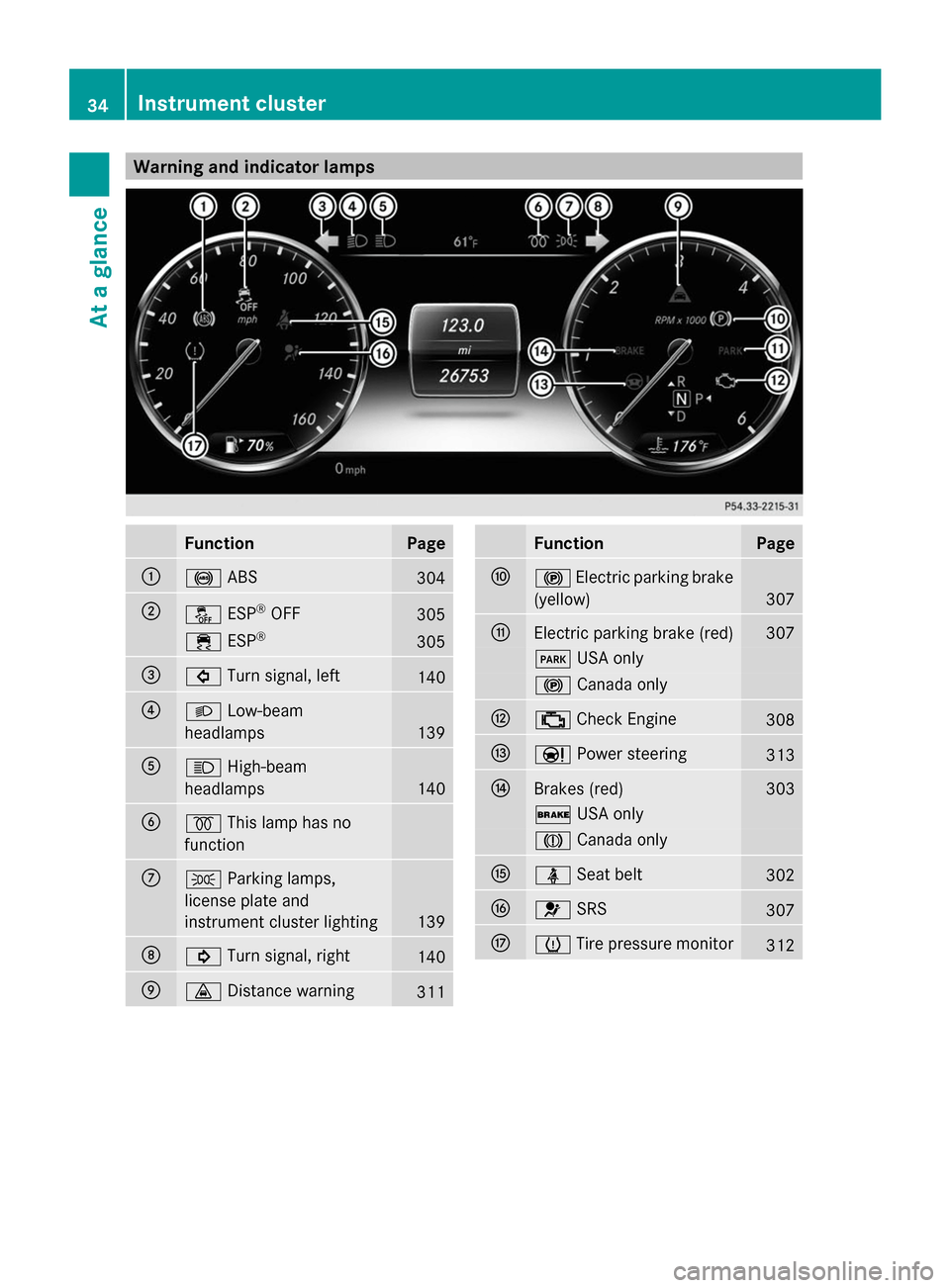
Warning and indicator lamps
Function Page
0043
0025
ABS 304
0044
00BB
ESP®
OFF 305
00E5
ESP® 305
0087
003E
Turn signal, left 140
0085
0058
Low-beam
headlamps 139
0083
0057
High-beam
headlamps 140
0084
0028
This lamp has no
function 006B
0060
Parking lamps,
license plate and
instrument cluster lighting 139
006C
003D
Turn signal, right 140
006D
00BA
Distance warning 311 Function Page
006E
0024
Electric parking brake
(yellow) 307
006F
Electric parking brake (red) 307
0049
USA only 0024
Canada only 0070
00B9
Check Engine 308
0071
00CC
Power steering 313
0072
Brakes (red) 303
0027
USA only 004D
Canada only 0073
00E9
Seat belt 302
0074
0075
SRS 307
0075
0077
Tire pressure monitor 31234
Instrument clusterAt a glance
Page 47 of 434
SRS (Supplemental Restraint System)
Introduction SRS consists of:
R
The 0075 SRS warning lamp
R Air bags
R The air bag control unit with crash sensors
R Emergency Tensioning Devices
R Seat belt force limiter
SRS reduces the risk of occupants coming
into contact with the vehicle's interior in the
event of an accident. It can also reduce the
effect of the forces to which occupants are
subjected during an accident.
SRS warning lamp G
WARNING
If SRS is malfunctioning, child restraint
system components may be triggered
unintentionally or might not be triggered at all
in the event of an accident with a high rate of
vehicle deceleration. There is an increased
risk of injury, possibly even fatal.
Have SRS checked and repaired immediately
at a qualified specialist workshop.
SRS functions are checked regularly when
you switch on the ignition and when the
engine is running. Therefore, malfunctions
can be detected in good time.
The 0075 SRS warning lamp in the instrument
cluster lights up when the ignition is switched
on. It goes out no later than a few seconds
after the engine is started.
The SRS components are in operational
readiness when the 0075SRS indicator lamp
goes out while the engine is running. There is a malfunction if:
R
the 0075 SRS warning lamp does not light
up when the ignition is switched on
R the engine is running and the 0075SRS
warning lamp does not go out after a few
seconds
R the engine is running and the 0075SRS
warning lamp lights up again
Safety guidelines for seat belts,
Emergency Tensioning Devices (ETDs)
and air bags G
WARNING
R Damaged seat belts or seat belts that have
been subjected to stress in an accident
must be replaced. Their anchoring points
must also be checked. Only use seat belts
installed or supplied by an authorized
Mercedes-Benz Center.
R Air bags and pyrotechnic Emergency
Tensioning Devices (ETDs) contain
perchlorate material, which may require
special handling and regard for the
environment. Check your national disposal
guidelines. California residents, see
www.dtsc.ca.gov/HazardousWaste/
Perchlorate/index.cfm .
R Air bags and ETDs are designed to function
on a one-time-only basis. An air bag or ETD
that has deployed must be replaced. PRE-
SAFE ®
has electrically operated reversible
belt tensioners in addition to the
pyrotechnic ETDs.
R Do not pass seat belts over sharp edges.
They could tear.
R Do not make any modification that could
change the effectiveness of the seat belts.
R Do not bleach or dye seat belts as this may
severely weaken them. In a crash they may
not be able to provide adequate protection.
R No modifications of any kind may be made
to any components or wiring of the SRS.
R Do not change or remove any component
or part of the SRS. Occupant safety
45Safety
Z
Page 53 of 434
Window curtain air bags will not deploy in the
event of impacts which do not exceed the
system's preset deployment thresholds for
vehicle acceleration/deceleration. You will
then be protected by the fastened seat belt.
Cushion air bags i
Observe the "Important safety notes"
section (Y page 46).
i When installing a child restraint system,
please observe the "Child restraint
systems" section (Y page 63). G
WARNING
If a child restraint system is installed and the
seat backrest is reclined too far backwards,
the cushion air bag may deploy by mistake in
the event of an accident. There is an increased
risk of injury.
When using a child restraint system, always
ensure that the seat is correctly adjusted and
that the backrest is almost vertical.
The rear reclining seat is equipped with a
cushion air bag. If the seat backrest is
reclined, the cushion air bag can provide
additional occupant protection in the event of
a frontal collision. When triggered, the
cushion air bag deploys under the seat
cushion. This helps prevent the occupant
from slipping off the seat cushion. Occupant Classification System
(OCS)
Method of operation G
WARNING
If the 00730074 indicator lamp illuminates
when an adult or someone larger than a small
individual is in the front passenger seat, have
the front passenger reposition himself or
herself in the seat until the 00730074
indicator lamp goes out.
In the event of a collision, the air bag control
unit will not allow front passenger front air bag deployment when the OCS has classified the
front passenger seat occupant as weighing as
much as or less than a typical 12-month-old
child in a standard child restraint or if the front
passenger seat is classified as being empty.
When the OCS senses that the front
passenger seat occupant is classified as
being up to or less than the weight of a typical
12-month-old child in a standard child
restraint, the
00730074indicator lamp will
illuminate when the engine is started and
remain illuminated. This indicates that the
front passenger front air bag is deactivated.
When the OCS senses that the front
passenger seat is classified as being empty,
the 00730074 indicator lamp will illuminate
when the engine is started and remain
illuminated. This indicates that the front
passenger front air bag is deactivated.
When the OCS senses that the front
passenger seat occupant is classified as
being heavier than the weight of a typical 12-
month-old child seated in a standard child
restraint or as being a small individual (such
as a young teenager or a small adult), the
00730074 indicator lamp will illuminate for
approximately 6 seconds when the engine is
started. Depending on occupant weight
sensor readings from the seat, it will then
remain illuminated or go out. With the
00730074 indicator lamp illuminated, the
front passenger front air bag is deactivated.
With the 00730074 indicator lamp out, the
front passenger front air bag is activated.
When the OCS senses that the front
passenger seat occupant is classified as an
adult or someone larger than a small
individual, the 00730074indicator lamp will
illuminate for approximately six seconds
when the engine is started and then go out.
This indicates that the front passenger front
air bag is activated.
If the 00730074 indicator lamp is illuminated,
the front passenger front air bag is
deactivated and will not be deployed. Occupant safety
51Safety
Z