lock MERCEDES-BENZ S-Class 2014 W222 User Guide
[x] Cancel search | Manufacturer: MERCEDES-BENZ, Model Year: 2014, Model line: S-Class, Model: MERCEDES-BENZ S-Class 2014 W222Pages: 434, PDF Size: 29.51 MB
Page 22 of 434
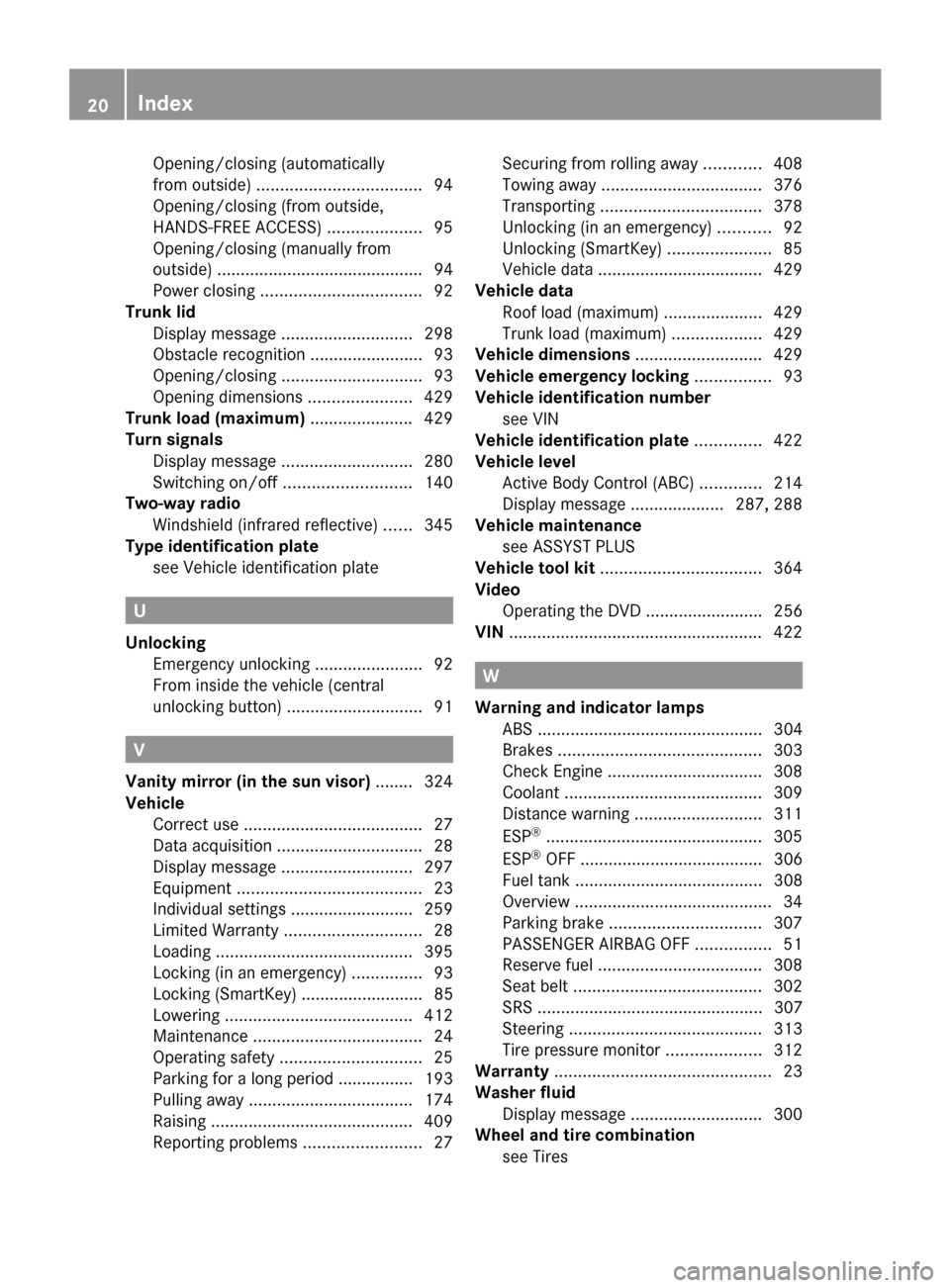
Opening/closing (automatically
from outside)
................................... 94
Opening/closing (from outside,
HANDS-FREE ACCESS) ....................95
Opening/closing (manually from
outside) ............................................ 94
Power closing .................................. 92
Trunk lid
Display message ............................ 298
Obstacle recognition ........................93
Opening/closing .............................. 93
Opening dimensions ......................429
Trunk load (maximum) ......................429
Turn signals Display message ............................ 280
Switching on/off ........................... 140
Two-way radio
Windshield (infrared reflective) ......345
Type identification plate
see Vehicle identification plate U
Unlocking Emergency unlocking .......................92
From inside the vehicle (central
unlocking button) ............................. 91V
Vanity mirror (in the sun visor) ........324
Vehicle Correct use ...................................... 27
Data acquisition ............................... 28
Display message ............................ 297
Equipment ....................................... 23
Individual settings ..........................259
Limited Warranty ............................. 28
Loading .......................................... 395
Locking (in an emergency) ...............93
Locking (SmartKey) .......................... 85
Lowering ........................................ 412
Maintenance .................................... 24
Operating safety .............................. 25
Parking for a long period ................ 193
Pulling away ................................... 174
Raising ........................................... 409
Reporting problems .........................27Securing from rolling away
............408
Towing away .................................. 376
Transporting .................................. 378
Unlocking (in an emergency) ...........92
Unlocking (SmartKey) ......................85
Vehicle data ................................... 429
Vehicle data
Roof load (maximum )..................... 429
Trunk load (maximum )................... 429
Vehicle dimensions ...........................429
Vehicle emergency locking ................93
Vehicle identification number see VIN
Vehicle identification plate ..............422
Vehicle level Active Body Control (ABC) .............214
Display message .................... 287, 288
Vehicle maintenance
see ASSYST PLUS
Vehicle tool kit .................................. 364
Video Operating the DVD ......................... 256
VIN ...................................................... 422 W
Warning and indicator lamps ABS ................................................ 304
Brakes ........................................... 303
Check Engine ................................. 308
Coolant .......................................... 309
Distance warning ........................... 311
ESP ®
.............................................. 305
ESP ®
OFF ....................................... 306
Fuel tank ........................................ 308
Overview .......................................... 34
Parking brake ................................ 307
PASSENGER AIRBAG OFF ................51
Reserve fuel ................................... 308
Seat belt ........................................ 302
SRS ................................................ 307
Steering ......................................... 313
Tire pressure monitor ....................312
Warranty .............................................. 23
Washer fluid Display message ............................ 300
Wheel and tire combination
see Tires 20
Index
Page 34 of 434
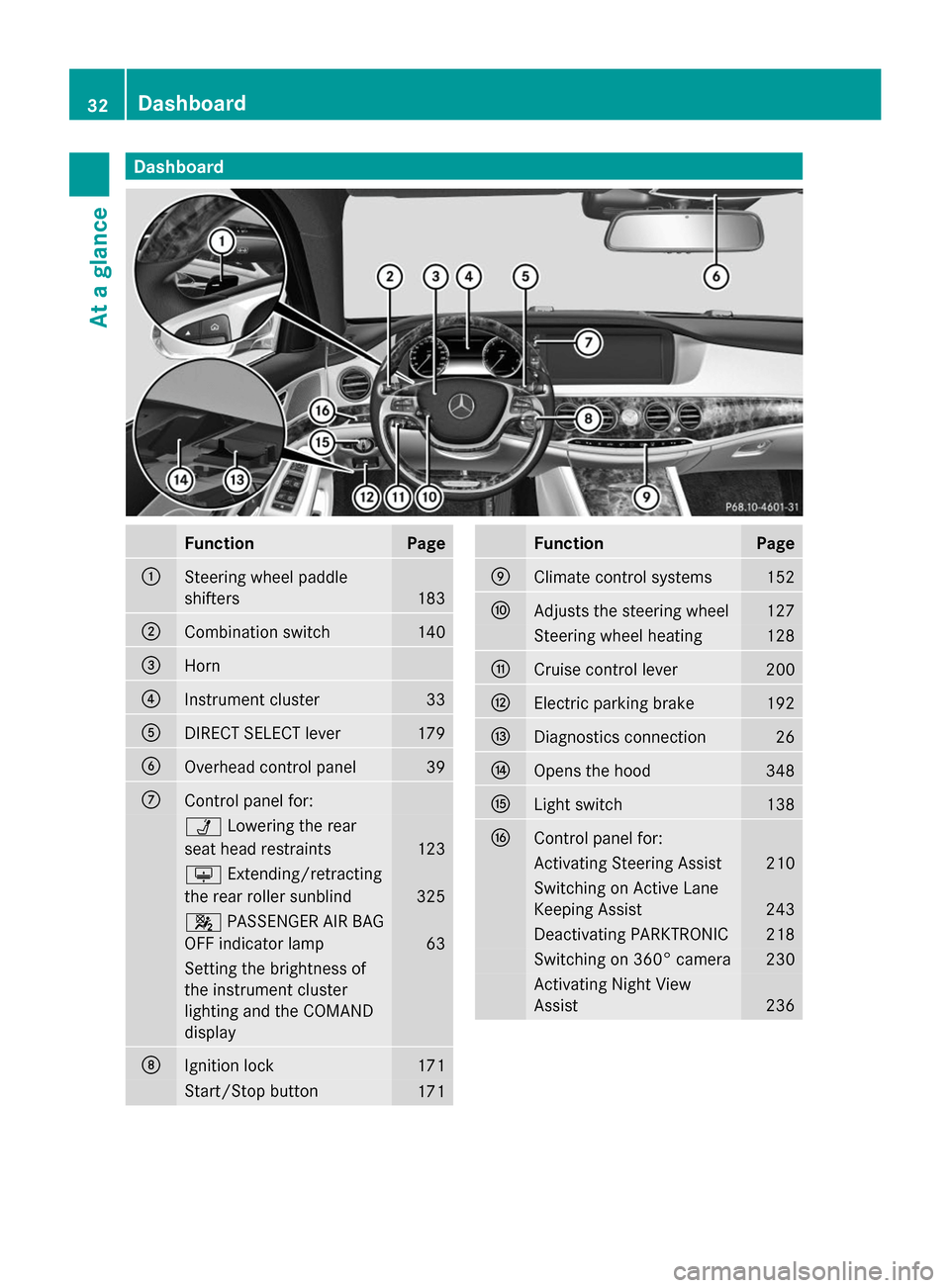
Dashboard
Function Page
0043
Steering wheel paddle
shifters
183
0044
Combination switch 140
0087
Horn
0085
Instrument cluster 33
0083
DIRECT SELECT lever 179
0084
Overhead control panel 39
006B
Control panel for:
00CA
Lowering the rear
seat head restraints 123
0094
Extending/retracting
the rear roller sunblind 325
0073
PASSENGER AIR BAG
OFF indicator lamp 63
Setting the brightness of
the instrument cluster
lighting and the COMAND
display 006C
Ignition lock 171
Start/Stop button
171 Function Page
006D
Climate control systems 152
006E
Adjusts the steering wheel 127
Steering wheel heating 128
006F
Cruise control lever 200
0070
Electric parking brake 192
0071
Diagnostics connection 26
0072
Opens the hood 348
0073
Light switch 138
0074
Control panel for:
Activating Steering Assist 210
Switching on Active Lane
Keeping Assist 243
Deactivating PARKTRONIC 218
Switching on 360° camera 230
Activating Night View
Assist 23632
Dashboa
rdAt a glance
Page 42 of 434
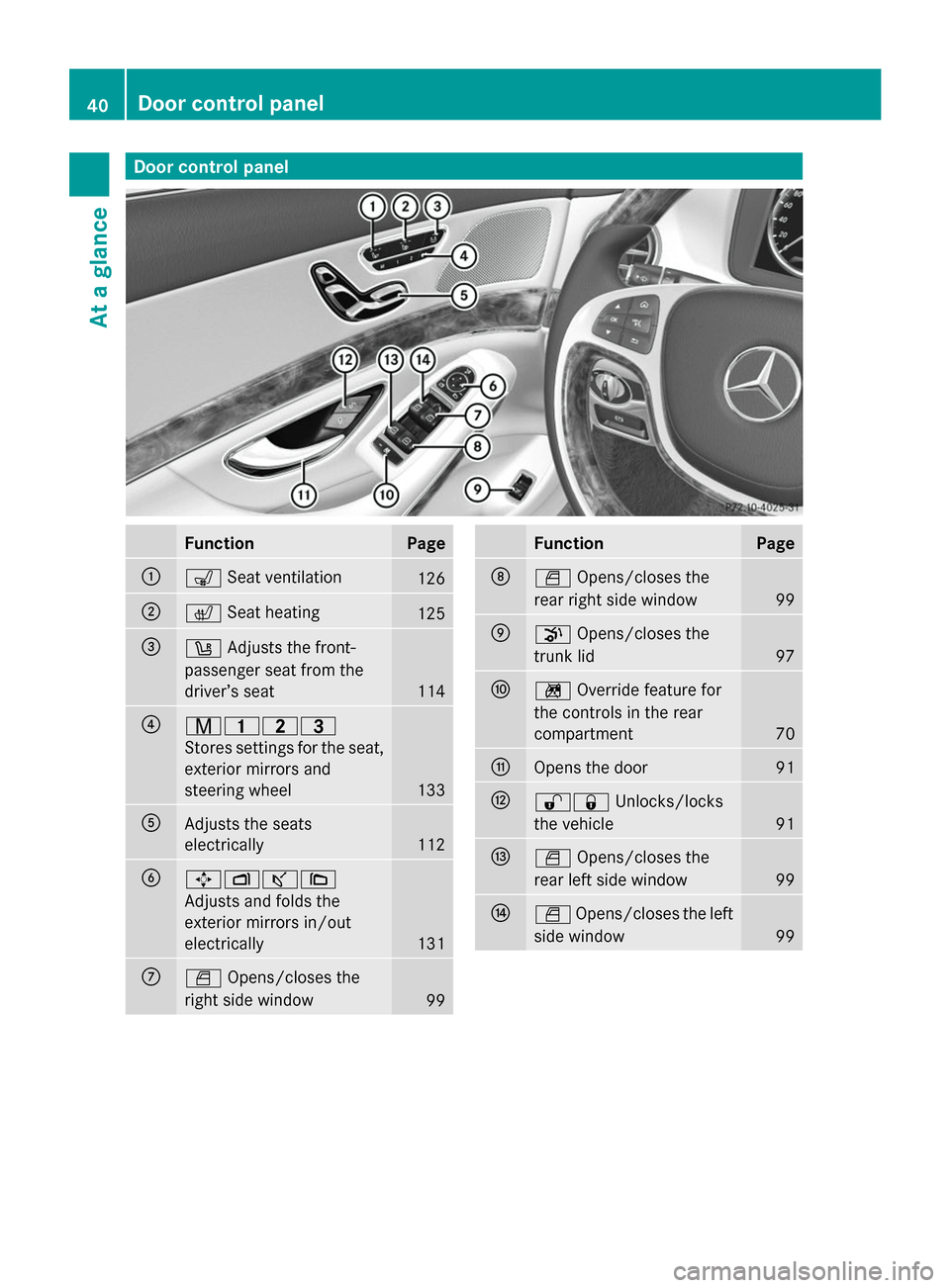
Door control panel
Function Page
0043
008E
Seat ventilation 126
0044
0072
Seat heating 125
0087
0096
Adjusts the front-
passenger seat from the
driver’s seat 114
0085
008D00370038
Stores settings for the seat,
exterior mirrors and
steering wheel
133
0083
Adjusts the seats
electrically
112
0084
0062007000AD
Adjusts and folds the
exterior mirrors in/out
electrically
131
006B
0062
Opens/closes the
right side window 99 Function Page
006C
0062
Opens/closes the
rear right side window 99
006D
008B
Opens/closes the
trunk lid 97
006E
0089
Override feature for
the controls in the rear
compartment 70
006F
Opens the door 91
0070
00360037
Unlocks/locks
the vehicle 91
0071
0062
Opens/closes the
rear left side window 99
0072
0062
Opens/closes the left
side window 9940
Door cont
rol panelAt a glance
Page 45 of 434
Useful information
..............................44
Panic alarm .......................................... 44
Occupant safety .................................. 44
Children in the vehicle ........................63
Driving safety systems .......................70
Theft deterrent locking system .........80 43Safety
Page 55 of 434
R
If you place a child in a forward-facing child
restraint on the front-passenger seat:
- move the seat as far back as possible
- use the proper child restraint
recommended for the age, size and
weight of the child
- secure child restraint with the vehicle's
seat belt according to the child seat
manufacturer's instructions
R For children larger than the typical 12-
month-old child, the front-passenger front
air bag may or may not be activated. G
WARNING
If the red 0075SRS warning lamp in the
instrument cluster and the 00730074
indicator lamp light up simultaneously, the
OCS is malfunctioning. The front passenger
front air bag will be deactivated in this case.
Have the system checked by qualified
technicians as soon as possible. Contact an
authorized Mercedes-Benz Center.
Only have the seat repaired or replaced at an
authorized Mercedes-Benz Center.
In order to ensure proper operation of the air
bag system and OCS:
R Sit with the seat belt properly fastened in a
position that is as upright as possible with
your back against the seat backrest.
R When seated, a passenger should not
position him/herself in such a way as to
cause the passenger's weight to be lifted
from the seat cushion as this may result in
the OCS being unable to correctly
approximate the passenger's weight
category.
R Read and observe all warnings in this
chapter. 0043
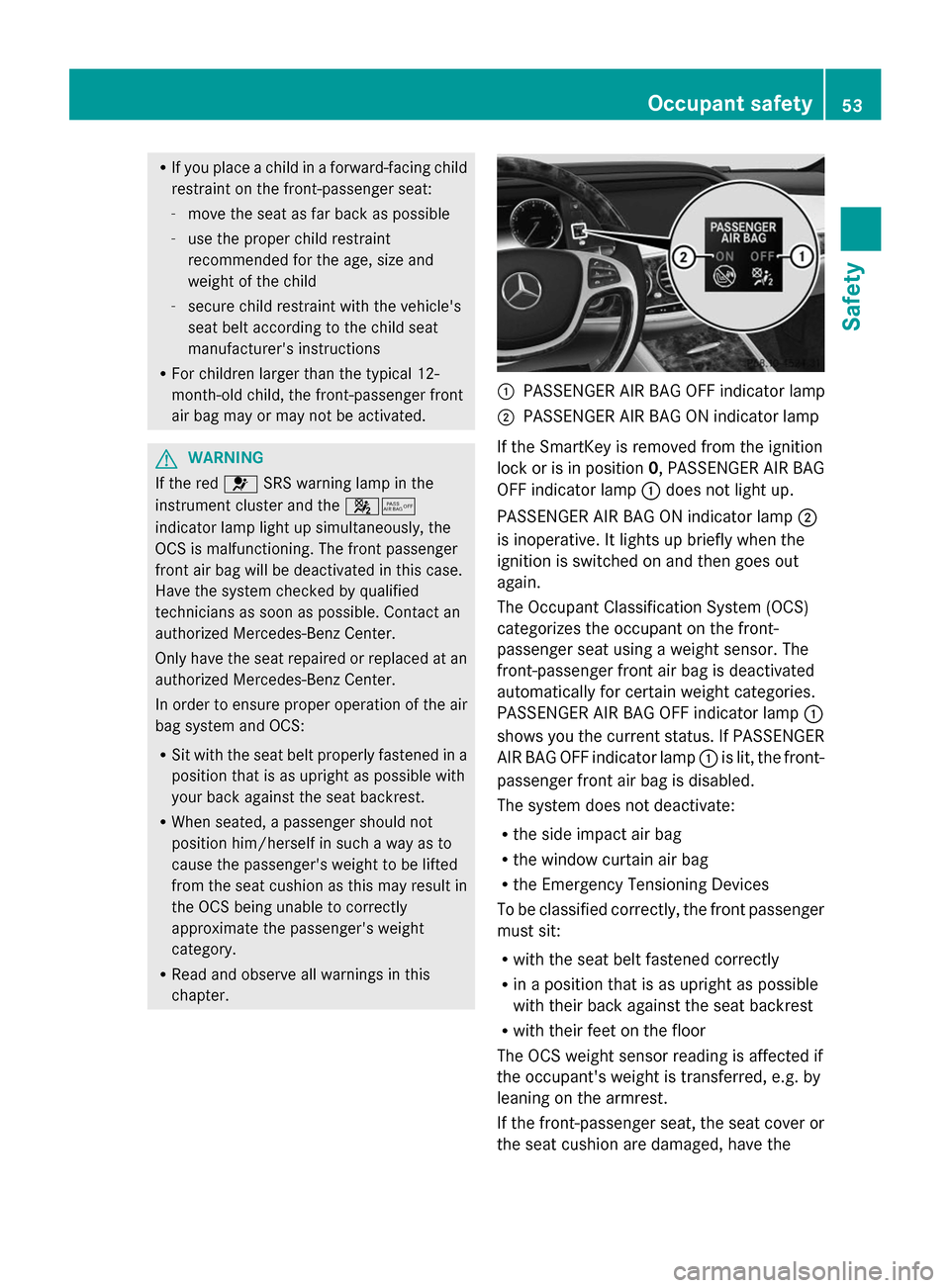
PASSENGER AIR BAG OFF indicator lamp
0044 PASSENGER AIR BAG ON indicator lamp
If the SmartKey is removed from the ignition
lock or is in position 0, PASSENGER AIR BAG
OFF indicator lamp 0043does not light up.
PASSENGER AIR BAG ON indicator lamp 0044
is inoperative. It lights up briefly when the
ignition is switched on and then goes out
again.
The Occupant Classification System (OCS)
categorizes the occupant on the front-
passenger seat using a weight sensor. The
front-passenger front air bag is deactivated
automatically for certain weight categories.
PASSENGER AIR BAG OFF indicator lamp 0043
shows you the current status. If PASSENGER
AIR BAG OFF indicator lamp 0043is lit, the front-
passenger front air bag is disabled.
The system does not deactivate:
R the side impact air bag
R the window curtain air bag
R the Emergency Tensioning Devices
To be classified correctly, the front passenger
must sit:
R with the seat belt fastened correctly
R in a position that is as upright as possible
with their back against the seat backrest
R with their feet on the floor
The OCS weight sensor reading is affected if
the occupant's weight is transferred, e.g. by
leaning on the armrest.
If the front-passenger seat, the seat cover or
the seat cushion are damaged, have the Occupant safety
53Safety Z
Page 56 of 434
necessary repair work carried out at a
qualified specialist workshop.
For safety reasons, Mercedes-Benz
recommends that you only use seat
accessories that have been approved by
Mercedes-Benz.
Both the driver and the front passenger
should always observe the PASSENGER AIR
BAG OFF indicator lamp as an indication of
whether or not the front passenger is
positioned correctly. Observe also the air bag
display messages that can be displayed in the
instrument cluster (Y page 279).
If the driver's air bag deploys, this does not
mean that the front-passenger front air bag
will also deploy.
The OCS may have detected that the seat:
R is empty or occupied by the weight of a
typical child up to twelve months old,
seated in a child restraint system.
R is occupied by a small individual, such as a
young teenager or a small adult.
R is occupied by a child in a child restraint
system whose weight is greater than that
of a typical twelve month old child.
These are examples of when the OCS
deactivates the front-passenger front air bag.
Deactivation takes place although the
collision fulfills the criteria for deploying the
driver's air bag.
For further information, see "Air bag display
messages" (Y page 279).
System self-test G
WARNING
If the 00730074indicator lamp does not
illuminate, the system is not functioning. You
must contact an authorized Mercedes-Benz
Center before seating any child on the front
passenger seat. G
WARNING
Never place anything between seat cushion
and child seat (e.g. a pillow), since it reduces the effectiveness of the OCS. The underside
and rear side child restraint system must be
placed entirely on the seat cushion and the
backrest of the front-passenger seat
backrest.
If necessary, adjust the tilt of the passenger
seat backrest.
An incorrectly mounted child seat could cause
injuries to the child in case of an accident,
instead of increasing protection for the child.
Follow the manufacturer's instructions for
installation of child restraint systems.
The PASSENGER AIR BAG OFF indicator lamp
lights up:
R if the Start/Stop button is pressed once or
twice
or
R if you turn the SmartKey in the ignition lock
to position 1or 2
R if an adult is seated properly on the front-
passenger seat and the OCS classifies the
occupant as an adult
The PASSENGER AIR BAG OFF indicator lamp
goes out again after approximately six
seconds.
If the seat is not occupied and the OCS
detects that the front-passenger seat is
empty, the PASSENGER AIR BAG OFF
indicator lamp will continue to light up. The
PASSENGER AIR BAG OFF indicator lamp will
not go out.
For more information about the OCS, see
"Problems with the Occupant Classification
System" (Y page 55). 54
Occupant safetySafety
Page 58 of 434
PRE-SAFE
®
(anticipatory occupant
protection system)
Introduction PRE-SAFE
®
takes preemptive measures to
protect occupants in certain hazardous
situations.
Important safety notes !
Make sure that there are no objects in the
footwell or behind the seats when resetting
the seats. There is a risk that the seats
and/or the objects could be damaged.
Despite your vehicle being equipped with the
PRE-SAFE ®
system, the possibility of
personal injuries occurring as a result of an
accident cannot be eliminated.
Always adapt your driving style to suit the
prevailing road and weather conditions and
maintain a safe distance from the vehicle in
front. Drive carefully.
Function PRE-SAFE
®
intervenes:
R in emergency braking situations, e.g. when
BAS is activated.
R in critical driving situations, e.g. when
physical limits are exceeded and the
vehicle understeers or oversteers severely.
R vehicles with the Driving Assistance
package: when a driver assistance system
intervenes powerfully or the radar sensor
system detects an imminent danger of
collision in certain situations
PRE-SAFE ®
takes the following measures
depending on the hazardous situation
detected:
R the front seat belts are pre-tensioned.
R if the vehicle skids, the panorama roof with
power tilt/sliding panel and the side
windows are closed so that only a small gap
remains.
R the front-passenger seat is adjusted if it is
in an unfavorable position. R
vehicles with electrically adjustable
rear seats: the outer rear seats are
adjusted if they are in an unfavorable
position.
R vehicles with a multicontour seat: the
air pressure in the side bolsters of the
backrest is increased.
R vehicles with seat belt extenders: the
seat belts of the outer rear seats are pre-
tensioned.
If the hazardous situation passes without
resulting in an accident, PRE-SAFE ®
slackens
the belt pre-tensioning. On vehicles with
multicontour seats, the air pressure in the
side bolsters is reduced again. All settings
made by PRE-SAFE ®
can then be reversed.
If the seat belts are not released:
X When the vehicle is stationary, move the
backrest or seat back slightly.
The seat belt pre-tensioning is reduced and
the locking mechanism is released.
The seat-belt adjustment is an integral part of
the PRE-SAFE ®
convenience function. More
information about seat-belt adjustment can
be found under "Seat-belt adjustment"
(Y page 60).
More information about PRE-SAFE ®
PLUS
(Y page 56). PRE-SAFE
®
PLUS (anticipatory
occupant protection system PLUS)
General information PRE-SAFE
®
PLUS is only available in vehicles
with the Driving Assistance package.
Using the radar sensor system, PRE-SAFE ®
PLUS is able to detect that a head-on or rear-
end collision is imminent. In certain
hazardous situations, PRE-SAFE ®
PLUS takes
pre-emptive measures to protect the vehicle
occupants. 56
Occupant safetySafety
Page 59 of 434
Important safety notes
The intervention of PRE-SAFE
®
PLUS cannot
prevent an imminent collision.
The driver is not warned when PRE-SAFE ®
PLUS intervenes.
PRE-SAFE ®
PLUS does not intervene:
R if the vehicle is backing up
R when the vehicle is towing a trailer and
there is a risk of a rear-end collision
PRE-SAFE ®
PLUS does not perform braking
actions while the vehicle is in motion or when
Parking Guidance is active.
Function PRE-SAFE
®
PLUS intervenes in certain
situations if the radar sensor system detects
an imminent head-on or rear-end collision.
PRE-SAFE ®
PLUS takes the following
measures depending on the hazardous
situation detected:
R If the radar sensor system detects that a
head-on collision is imminent, the seat
belts are pre-tensioned.
R If the radar sensor system detects that a
rear-end collision is imminent:
-the brake pressure is increased if the
driver applies the brakes when the
vehicle is stationary.
- the seat belts are pre-tensioned.
The PRE-SAFE ®
PLUS braking application is
canceled in the following situations:
R if the accelerator pedal is depressed when
a gear is engaged
R if the risk of a collision passes or is no
longer detected
R if DISTRONIC PLUS indicates an intention
to pull away
If the hazardous situation passes without
resulting in an accident, the original settings
are restored. Automatic measures after an
accident
Immediately after an accident, the following
measures are implemented, depending on
the type and severity of the impact:
R by activating the hazard warning lamps
R the emergency lighting is activated
R the vehicle doors are unlocked
R the front side windows are lowered
R the electrically adjustable steering wheel is
raised
R the engine is switched off
R vehicles with seat belt extenders: the
seat-belt buckles for the outer rear seats
are illuminated and extend forwards
R vehicles with mbrace: automatic
emergency call
R vehicles with the hybrid drive system:
the hybrid system is deactivated Seat belts
Important safety notes G
WARNING
Objects next to the front seat that block the
belt buckle or the moving belt anchorage on
the front seat impair the function of the
Emergency Tensioning Devices. The
Emergency Tensioning Devices may not
function as intended and the seat belt may no
longer provide the intended protection. This
poses an increased risk of injury or even fatal
injury.
Before starting the journey, make sure that
there are no objects around the belt buckle or
between the front seat and door. G
WARNING
The seat belt does not offer the intended level
of protection if the backrest is not in the
upright position. When braking or in the event
of an accident, you could slide underneath the
seat belt and sustain abdomen or neck Occupant safety
57Safety
Z
Page 62 of 434
X
Engage belt tongue 0044in buckle 0087.
Seat-belt adjustment: if necessary, the
driver's and front-passenger seat belts
automatically adjust to the upper body
(Y page 60).
X If necessary, adjust the seat belt to the
appropriate height (Y page 60).
X If necessary, pull upwards on the shoulder
section of the seat belt to tighten the belt
across your body.
All seat belts except the driver's seat belt are
equipped with a special seat belt retractor to
securely fasten child restraint systems in the
vehicle. Further information on the "Special
seat belt retractor" (Y page 66).
Information on releasing the seat belt with
release button 0085(Ypage 60).
Seat belt adjustment The seat-belt adjustment function adjusts the
driver's and front-passenger seat belt to the
upper body of the occupants.
The belt strap is tightened slightly when:
R you engage the belt tongue in the belt
buckle and you then turn the SmartKey to
position 2in the ignition lock.
R the SmartKey is in position 2in the ignition
lock and you then engage the belt tongue
in the buckle.
The seat-belt adjustment will apply a
retraction force if any slack is detected
between the occupant and the seat belt. Do
not hold on to the seat belt tightly while it is
adjusting. Information on activating and
deactivating the seat-belt adjustment
function can be found in the separate
COMAND operating instructions.
The seat-belt adjustment is an integral part of
the PRE-SAFE ®
convenience function. More
information about PRE-SAFE ®
(Y page 56). Belt height adjustment
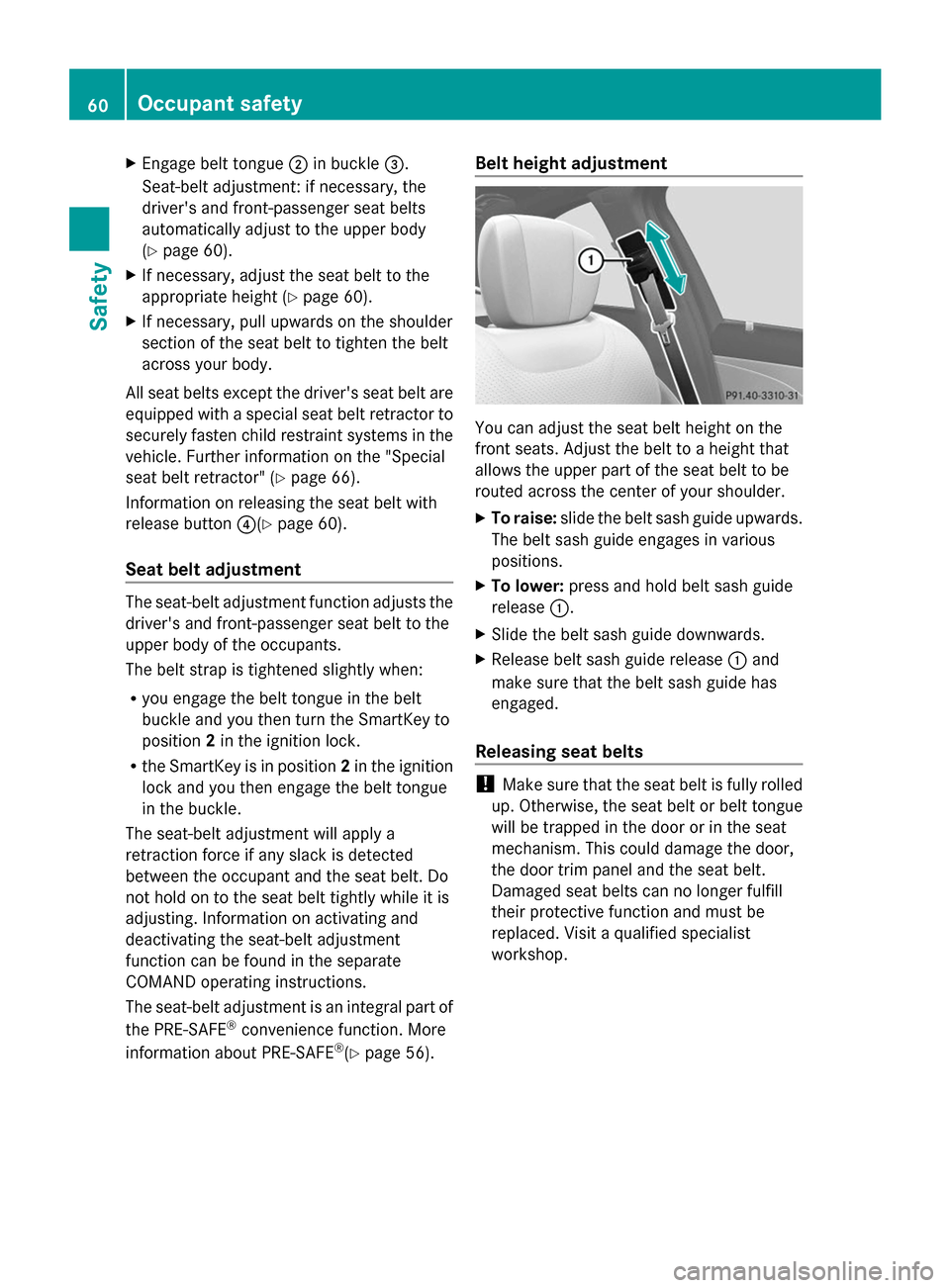
You can adjust the seat belt height on the
front seats. Adjust the belt to a height that
allows the upper part of the seat belt to be
routed across the center of your shoulder.
X To raise: slide the belt sash guide upwards.
The belt sash guide engages in various
positions.
X To lower: press and hold belt sash guide
release 0043.
X Slide the belt sash guide downwards.
X Release belt sash guide release 0043and
make sure that the belt sash guide has
engaged.
Releasing seat belts !
Make sure that the seat belt is fully rolled
up. Otherwise, the seat belt or belt tongue
will be trapped in the door or in the seat
mechanism. This could damage the door,
the door trim panel and the seat belt.
Damaged seat belts can no longer fulfill
their protective function and must be
replaced. Visit a qualified specialist
workshop. 60
Occupant safetySafety
Page 64 of 434
belt warning lamp flashes again if the vehicle
speed again exceeds 15 mph (25 km/h).
The 0076 seat belt warning lamp only goes
out if:
R both the driver and the front passenger
have fastened their seat belts.
or
R the vehicle is stationary and a door is open.
i For more information on the 0076seat
belt warning lamp, see "Warning and
indicator lamps in the instrument cluster,
seat belts" (Y page 302).
Emergency Tensioning Devices, seat
belt force limiters G
WARNING
Pyrotechnic Emergency Tensioning Devices
that have been deployed are no longer
operational and are unable to perform their
intended protective function. This poses an
increased risk of injury or even fatal injury.
Therefore, have pyrotechnic Emergency
Tensioning Devices which have been
triggered immediately replaced at a qualified
specialist workshop.
! If the front-passenger seat is not
occupied, do not engage the seat belt
tongue in the buckle on the front-
passenger seat. Otherwise, in the event of
an accident the different stages of the
Emergency Tensioning Devices could be
triggered.
i An electric motor is used by PRE-SAFE ®
to trigger the tightening of the seat belt in
hazardous situations. This procedure is
reversible.
The front seat belts and the outer seat belts
in the rear are equipped with Emergency
Tensioning Devices and seat belt force
limiters.
The ETDs tighten the seat belts in an accident,
pulling them close against the body. The ETDs do not correct incorrect seat
positions or incorrectly fastened seat belts.
The ETDs do not pull vehicle occupants back
towards the backrest.
If the seat belt is also equipped with a seat
belt force limiter and this is triggered, the
force exerted by the seat belt on the vehicle
occupant is reduced.
When triggered, seat belt force limiters help
to reduce the force exerted by the seat belt
on the vehicle occupant.
The seat belt force limiters for the front seats
are synchronized with the front air bags,
which absorb part of the deceleration force.
This results in the force exerted on the
occupant being distributed over a greater
area.
The ETDs can only be activated when:
R
the ignition is switched on
R the restraint systems are operational; see
"SRS warning lamp" (Y page 45)
R the front-passenger seat is occupied and
the belt tongue is engaged in the buckle on
the front-passenger side
R the belt tongue is engaged in the buckle on
each of the three-point seat belts in front
The ETDs on the outside seats in the rear
compartment are triggered independently of
the lock status of the seat belts.
The various stages of the Emergency
Tensioning Devices are triggered depending
on the type and severity of an accident:
R in the event of a head-on or rear-end
collision if the vehicle decelerates or
accelerates rapidly in a longitudinal
direction during the initial stages of the
impact.
R in the event of a side impact if the vehicle
decelerates or accelerates rapidly in a
lateral direction on the side opposite to the
impact.
R in certain situations where the vehicle rolls
over if the system determines that it can
provide additional protection. 62
Occupant safetySafety