air condition MERCEDES-BENZ S CLASS 2019 Owner's Manual
[x] Cancel search | Manufacturer: MERCEDES-BENZ, Model Year: 2019, Model line: S CLASS, Model: MERCEDES-BENZ S CLASS 2019Pages: 578, PDF Size: 23.31 MB
Page 349 of 578
%Ifthere is a malfunction inthe emergencycall system (e.g. a malfunction withthespeaker, microphone, airbag, SOS button), acorresponding message appearsinthe mul‐tifunction display ofthe instrument cluster.
Triggering an automatic emergency call
RequirementsRThe ignition is switched on.
RThestarter battery is sufficientlycharged.
Ifrestraint systems such as airbags or Emer‐gencyTensioning Devices havebeen activatedafter an accident,the Mercedes-Benz emer‐gency call system may automatically initiate anemergency call.
The emergency call has been made:
RAvoice connection is madetothe Mercedes-Benz emergency call center.
RA messagewith accident data is transmittedtothe Mercedes-Benz emergency call center.
The Mercedes-Benz emergency call centercan transmitthevehicle position datatooneofthe emergency call centers.
The SOS button intheoverhead control panelflashes untilthe emergency call isfinished.
It is not possibletoimmediately end an auto‐matic emergency call.
If no connection can be madetothe emergencyservices either, a corresponding messageappearsinthe media display.
#Dialthe local emergency number onyourmobile phone.
If an emergency call has been initiated:
RRemain inthevehicle iftheroad and trafficconditions permityoutodo so until avoiceconnection is established withthe emer‐gency call center operator.
RBased onthe call,the operator decideswhether it is necessarytocallrescueteamsand/orthe policetothe accident site.
RIf novehicle occupant answers, an ambu‐lance is senttothevehicle immediately.
Triggering a manual emergency call#Press and holdthe SOS button intheover‐head control panelfor at leastone second.
The emergency call has been made:
RAvoice connection is madetothe Mercedes-Benz emergency call center.
RA messagewith accident data is transmittedtothe Mercedes-Benz emergency call center.
The Mercedes-Benz emergency call centercan transmitthevehicle position datatooneofthe emergency call centers.
RRemain inthevehicle iftheroad and trafficconditions permityoutodo so until avoiceconnection is established withthe emer‐gency call center service provider.
ROnthe basis ofthe call,the service providerdecides whether it is necessarytocallres‐cueteams and/orthe policetothe accidentsite.
If no connection can be madetothe emergencyservices either, a corresponding messageappearsinthe media display.
#Dialthe local emergency number onyourmobile phone.
Multimedia system347
Page 398 of 578
Rfrequent operation in mountainousterrain oron poorroad surfaces
Rwhenthe engine is often leftidlingfor longperiods
Roperation in particularly dusty conditionsand/or if air-recirculation mode is frequentlyused
Inthese or similar operating conditions, havetheinterior airfilter, engine air cleaner, engine oiland oilfilteretc.changed more frequently. Thetires must bechecked more frequently ifthevehicle is operated under increased loads.Fur‐ther information can be obtained at aqualifiedspecialistworkshop.
Battery disconnection periods
The ASSYST PLUS service interval displaycan only calculatethe service due datewhenthe batteryis connected.
#Notedownthe service due date displayed onthe instrument display before disconnectingthe battery (→page 395).
Engine compartment
Active hood (pedestrian protection)
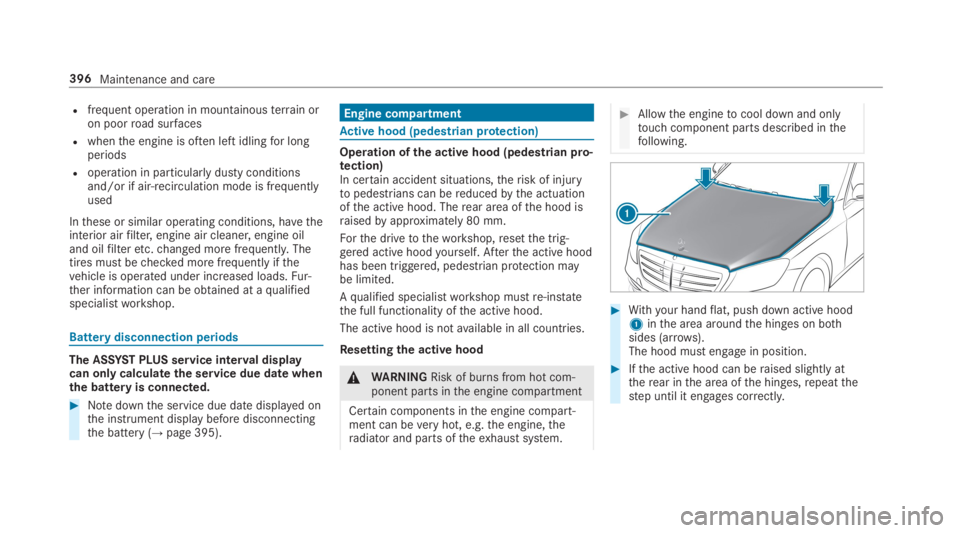
Operation ofthe active hood (pedestrian pro‐tection)In certain accident situations,therisk of injurytopedestrians can bereducedbythe actuationofthe active hood. Therear area ofthe hood israisedbyapproximately 80 mm.
Forthe drivetotheworkshop,resetthe trig‐gered active hoodyourself. Afterthe active hoodhas been triggered, pedestrian protection maybe limited.
Aqualified specialistworkshop mustre-instatethe full functionality ofthe active hood.
The active hood is notavailable in all countries.
Resettingthe active hood
&WARNINGRisk of burns from hot com‐ponent parts inthe engine compartment
Certain components inthe engine compart‐ment can beveryhot, e.g.the engine,theradiator and parts oftheexhaust system.
#Allowthe enginetocool down and onlytouch component parts described inthefollowing.
#Withyour handflat, push down active hood1inthe area aroundthe hinges on bothsides (arrows).The hood must engage in position.
#Ifthe active hood can beraised slightly attherear inthe area ofthe hinges,repeatthestep until it engages correctly.
396Maintenance and care
Page 405 of 578
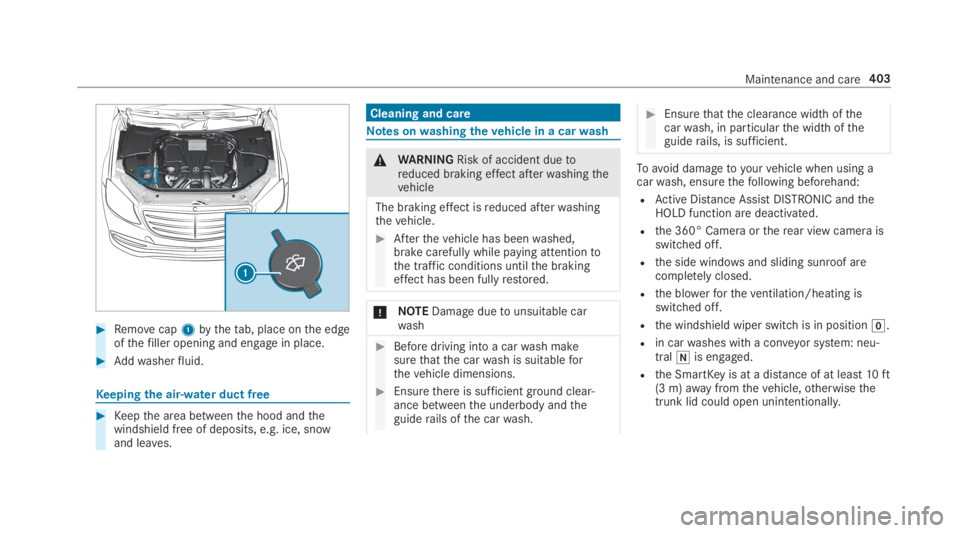
#Removecap1bythetab, place onthe edgeofthefiller opening and engage in place.
#Addwasherfluid.
Keepingthe air-water duct free
#Keepthe area betweenthe hood andthewindshield free of deposits, e.g. ice, snowand leaves.
Cleaning and care
Notes onwashingthevehicle in a carwash
&WARNINGRisk of accident duetoreduced braking effect afterwashingthevehicle
The braking effect isreduced afterwashingthevehicle.
#Afterthevehicle has beenwashed,brake carefully while paying attentiontothe traffic conditions untilthe brakingeffect has been fullyrestored.
*NOTEDamageduetounsuitable carwash
#Before driving into a carwash makesurethatthe carwash is suitableforthevehicle dimensions.
#Ensurethere is sufficient ground clear‐ance betweenthe underbody andtheguiderails ofthe carwash.
#Ensurethatthe clearance width ofthecarwash, in particularthe width oftheguiderails, is sufficient.
Toavoid damageto yourvehicle when using acarwash, ensurethefollowing beforehand:
RActive Distance AssistDISTRONIC andtheHOLD function are deactivated.
Rthe 360° Camera ortherear view camera isswitched off.
Rthe side windowsand sliding sunroof arecompletelyclosed.
Rthe blowerfortheventilation/heating isswitched off.
Rthe windshield wiper switch is in positionZ.
Rin carwashes with a conveyor system: neu‐tral\\is engaged.
Rthe SmartKeyis at a distance of at least10ft(3 m)awayfromthevehicle,otherwisethetrunk lid could open unintentionally.
Maintenance and care403
Page 409 of 578

Observethefollowing information:
CleaningAvoiding damagetothe decorativefoil
RFor cleaning, use plenty ofwater and a mild cleaning agent withoutadditives or abrasivesubstances, e.g. a car shampoo approvedforMercedes-Benz.
RRemovedirt immediately, where possible, whilstavoidingrubbingtoo hard. There isotherwise arisk of damagingthe decorativefoilirreparably.
RIfthere is dirt onthefinish or ifthe decorativefoil is dull: usethePaint Cleanerrecommended and approvedfor Mercedes-Benz.
RInsectremains: soak with insectremover andrinse offthe treatedareas afterwards.
RBird droppings: soak withwater andrinse off afterwards.
RTopreventwaterstains, dry afoil-wrappedvehicle with a soft,absorbent clothaftereverycarwash.
RThe service life and color of decorativefoils are impairedby:
-sunlight
-temperature, e.g. hot air blower
-weather conditions
-stonechippings and dirt
-chemical cleaning agents
-oily products
RDo not use polish on matte decorativefoil.Polishing will havethe effectof shiningthefoil-wrapped surface.
RDo not treat matte orstructured decorativefoils withwax.Permanentstains may occur.
Scratches, corrosive deposits, areas affectedbycorrosion and damage causedbyincorrect carecannot alwaysbe completelyrepaired. In suchcases, visit aqualified specialistworkshop.
You can obtain more information on care andcleaning products fromthe manufacturer.
Inthe case offoil-wrapped surfaces, optical dif‐ferences may occur betweenthe surfacesthatwerenot protectedbya decorativefoil afterremoving a decorativefoil.
%Haveworkorrepairstodecorativefoils car‐ried out at aqualified specialistworkshop,e.g. in an authorized Mercedes-Benz Center.
Maintenance and care407
Page 438 of 578
RThe tires maywearexcessively and/orunevenly,which maygreatlyimpair tiretraction.
RThe drivingcharacteristics, aswell assteering and braking, may be greatlyimpaired.
#Comply withtherecommended tirepressure andcheckthe tire pressure ofall tires includingthe spare wheelregu‐larly:
Rat least once a month
Rwhenthe loadchanges
Rbefore embarking on a longer journey
Rif operating conditionschange, e.g. off-road driving
#Adjustthe tire pressure as necessary.
Driving withtire pressurethat istoo high ortoolow can:
RShortenthe service life ofthe tires.
RCause increased tire damage.
RAdversely affect drivingcharacteristics andthus driving safety,e.g. dueto hydroplaning.
&WARNINGRisk of an accident duetoinsufficient tire pressure
Tires with pressurethat istoo low canover‐heat and burstas aresult.
In addition,theyalso suffer fromexcessiveand/or irregularwear, which can significantlyimpairthe braking properties andthe han‐dlingcharacteristics.
#Avoidexcessively low tire pressures inallthe tires, includingthe spare wheel.
Tirepressure which istoo low can cause:
RTiredefects as aresult ofoverheating
RImpaired handlingcharacteristics
RIrregularwear
RIncreased fuel consumption
&WARNINGRisk of accident fromexces‐sive tire pressure
Tires withexcessively high pressure canburst becausetheyare damaged more easilybyhighwayfill, pot holesetc.
In addition,theyalso suffer from irregularwear, which can significantly impairthe brak‐ing properties andthe handlingcharacteris‐tics.
#Avoidexcessively high tire pressures inallthe tires, includingthe spare wheel.
Excessively high tire pressure canresult in:
RIncreased braking distance
RImpaired handlingcharacteristics
RIrregularwear
RImpaired driving comfort
RSusceptibilitytodamage
436Wheels and tires
Page 440 of 578
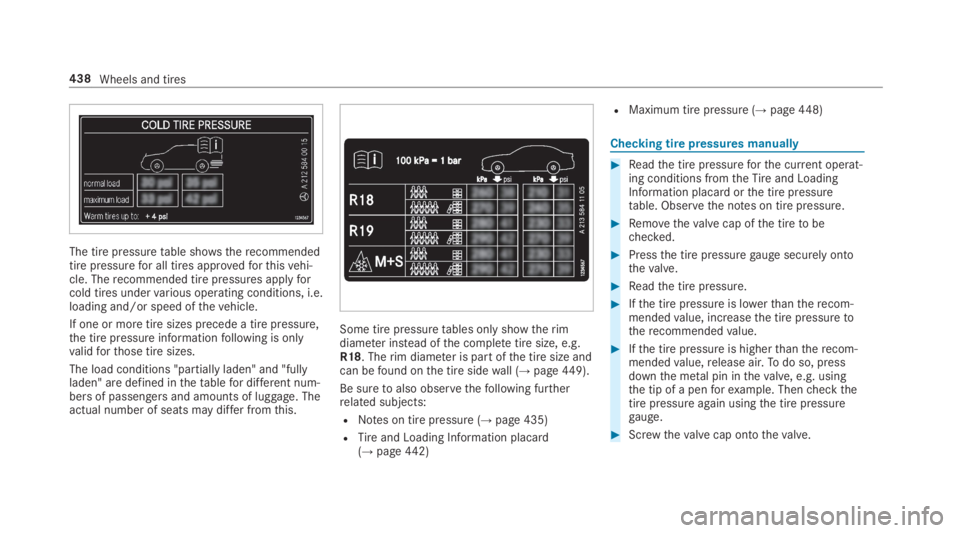
The tire pressuretable shows therecommendedtire pressurefor all tires approvedforthisvehi‐cle. Therecommended tire pressures applyforcold tires undervarious operating conditions, i.e.loading and/or speed ofthevehicle.
If one or more tire sizes precede a tire pressure,the tire pressure informationfollowing is onlyvalidforthose tire sizes.
The load conditions "partially laden" and "fullyladen" are defined inthetablefor different num‐bersof passengers and amounts of luggage. Theactual number of seats may differ fromthis.
Some tire pressuretables only showtherimdiameter instead ofthe completetire size, e.g.R18. Therim diameter is part ofthe tire size andcan befound onthe tire sidewall (→page449).
Be suretoalso observethefollowing furtherrelated subjects:
RNotes on tire pressure (→page 435)
RTireand Loading Information placard(→page442)
RMaximum tire pressure (→page448)
Checkingtire pressures manually
#Readthe tire pressureforthe current operat‐ing conditions fromtheTireand LoadingInformation placard orthe tire pressuretable. Observethe notes on tire pressure.
#Removethevalve cap ofthe tiretobechecked.
#Pressthe tire pressuregauge securely ontothevalve.
#Readthe tire pressure.
#Ifthe tire pressure is lowerthantherecom‐mendedvalue, increasethe tire pressuretotherecommendedvalue.
#Ifthe tire pressure is higherthantherecom‐mendedvalue,release air.Todo so, pressdownthe metal pin inthevalve, e.g. usingthe tip of a penforexample. Thencheckthetire pressureagain usingthe tire pressuregauge.
#Screwthevalve cap ontothevalve.
438Wheels and tires
Page 454 of 578
UniformTireQuality GradingStandards:auniformstandardtogradethequality of tireswithregardtotreadquality,tire traction andtemperaturecharacteristics. Thequality gradingassessment is madebythe manufacturerfollow‐ing specifications fromtheU.S. government. Thequalitygrade of a tire is imprinted onthe sidewall ofthe tire.
Recommended tire pressure:therecommen‐ded tire pressure isthe tire pressure specifiedforthe tires mountedtothevehicle atthefac‐tory.
The tire and informationtable containstherec‐ommended tire pressuresfor cold tires,the max‐imum permissible load andthe maximum per‐missiblevehicle speed.
The tire pressuretable containstherecommen‐ded tire pressuresfor cold tires undervariousoperating conditions, i.e. loading and/or speedofthevehicle.
Increasedvehicleweight duetooptionalequipment:the combinedweight of allstandardand optional equipmentavailableforthevehicle,
regardless of whether it is actually installed onthevehicle or not.
Rim:the part ofthe wheel on whichthe tire isinstalled.
GAWR (Gross AxleWeightRating):the GAWRisthe maximum permissible axle load. Theactual load on an axle must neverexceedthegrossaxleweightrating. The gross axleweightrating can befound onthevehicle identificationplate onthe B‑pillar onthe driver's side.
Speedrating:the speedrating is partofthe tireidentification. It specifiesthe speedrangeforwhich a tire is approved.
GVW (GrossVehicleWeight):the grossvehicleweight comprisestheweight ofthevehicleincluding fuel,tools,the spare wheel, accesso‐ries installed, occupants, luggage andthe trailerdrawbar noseweight, if applicable. Thegrossvehicleweight must notexceedthe grossvehicleweightratingGVWR as specified onthevehicleidentification plate onthe B‑pillar onthe driver'sside.
GVWR (GrossVehicleWeightRating):theGVWR isthe maximum permitted grossweight
ofthe fully ladenvehicle (weight ofthevehicleincluding all accessories, occupants, fuel, lug‐gageandthe trailer drawbar noseweight if appli‐cable). Thegrossvehicleweightrating is speci‐fied onthevehicle identification plate ontheB‑pillar onthe driver's side.
Maximumweight ofthe ladenvehicle:themaximumweight isthe sum ofthe curbweightofthevehicle,theweight ofthe accessories,themaximum load andtheweight of optional equip‐ment installed atthefactory.
Kilopascal (kPa):metric unitfor tire pressure.6.9 kPa correspondsto1 psi. Another unitfortire pressureis bar.100 kilopascal (kPa) equals1 bar.
Load index:in additiontothe load-bearingindex,the load index may also be imprinted onthe sidewall ofthe tire. This specifiesthe load-bearing capacity ofthe tire more precisely.
Curbweight:theweight of avehicle withstand‐ard equipment includingthe maximum capacityof fuel, oil and coolant. It also includesthe airconditioning system and optional equipment if
452Wheels and tires
Page 486 of 578
Display messagesPossible causes/consequences andPPSolutions
#Havethe brake systemchecked immediately at aqualified specialistworkshop.
#Drive on carefully.
#Visit aqualified specialistworkshop immediately.
'
(USA only)
M
(Canada only)
Check Brake Fluid Level
*There is insufficient brakefluid inthe brakefluidreservoir.
&WARNINGRisk of an accident duetolow brakefluid level
Ifthe brakefluid level istoo low,the braking effect andthe brakingcharacteristics may be impaired.
#Pullover andstopthevehicle safely as soon as possible, paying attentiontoroad and traffic conditions.Do not continue driving under any circumstances.
#Consult aqualified specialistworkshop.
#Do not add brakefluid.
#Pullover andstopthevehicle safely as soon as possible, paying attentiontoroad and traffic conditions. Do notcontinue driving under any circumstances.
#Do not add brakefluid.
#Consult aqualified specialistworkshop.
Radar Sensors Dirty SeeOperator's Manual
*Theradar sensor system is malfunctioning.Possible causes are:
RDirt onthe sensors
RHeavyrain or snow
484Display messages andwarning/indicator lamps
Page 492 of 578
Display messagesPossible causes/consequences andPPSolutions
NEVER use arearwardfacingchildrestraint on a seat protectedbyanACTIVE FRONT AIRBAG; DEATH or SERI‐OUS INJURYtotheCHILD can occur.
#Pullover andstopthevehicle safely as soon as possible, paying attentiontoroad and traffic conditions.
#Checkthestatus ofthe automatic front passenger airbag shutoff (→page 43).
#If necessary,consult aqualified specialistworkshop immediately.
Front Passenger Airbag Dis-abled See Operator's Man-ual
*The front passenger airbag andthe knee airbag are deactivated, although an adult or a person with an adultstatureis onthe front passenger seat. If additionalforces are appliedtothe seat,theweightthe system detects may betoo low.
&WARNINGRisk of injuryorfatal injury duetoa disabled front passenger airbag
Ifthe front passenger airbag is disabled,the front passenger airbag will not be deployed intheevent of an acci‐dent and cannotperformits intended protective function.
A person inthe front passenger seat couldthen,forexample, come into contact with thevehicle's interior,especially ifthe person is sittingtoo closetothe cockpit.
#Make sure, bothbefore and duringthe journey,thatthestatus ofthe front passenger airbag is correct.
#Pullover andstopthevehicle safely as soon as possible, paying attentiontoroad and traffic conditions.
#Checkthestatus ofthe automatic front passenger airbag shutoff (→page 43).
#If necessary,consult aqualified specialistworkshop immediately.
490Display messages andwarning/indicator lamps
Page 499 of 578

Display messagesPossible causes/consequences andPPSolutions
Oncethe cause ofthe problem is no longer present, driving systems and driving safety systems will beavailableagain.
Ifthe display message does not disappear:
#Pullover andstopthevehicle safely as soon as possible, paying attentiontoroad and traffic conditions.
#Cleanthe windshield.
Active Lane Keeping AssistInoperative
*Active LaneKeeping Assist is malfunctioning.
#Consult aqualified specialistworkshop.
Malfunction Drive at Max.50 mph
*AIRMATIC is functioning onlytoa limitedextent. Thevehicle's handlingcharacteristics may be affected.
*NOTEThe tires ofthe front axle orthe frontfenderscould be damagedbylargesteering movements
#Avoid largesteering movements while driving and listenfor scraping sounds.
#Ifyou hear scraping sounds, pullover andstopthevehicle safely, paying attentiontoroad and traffic con‐ditions, and set a highervehicle level if possible.
#Drive in a manner appropriateforthe current level, but do notexceed 50mph (80 km/h).
#Visit aqualified specialistworkshop.Active Body Control is malfunctioning. Thevehicle's handlingcharacteristics may be affected.
*NOTEThe tires ofthe front axle orthe frontfenderscould be damagedbylargesteering movements
#Avoid largesteering movements while driving and listenfor scraping sounds.
Display messages andwarning/indicator lamps497