roof MERCEDES-BENZ S CLASS 2019 Owner's Manual
[x] Cancel search | Manufacturer: MERCEDES-BENZ, Model Year: 2019, Model line: S CLASS, Model: MERCEDES-BENZ S CLASS 2019Pages: 578, PDF Size: 23.31 MB
Page 131 of 578
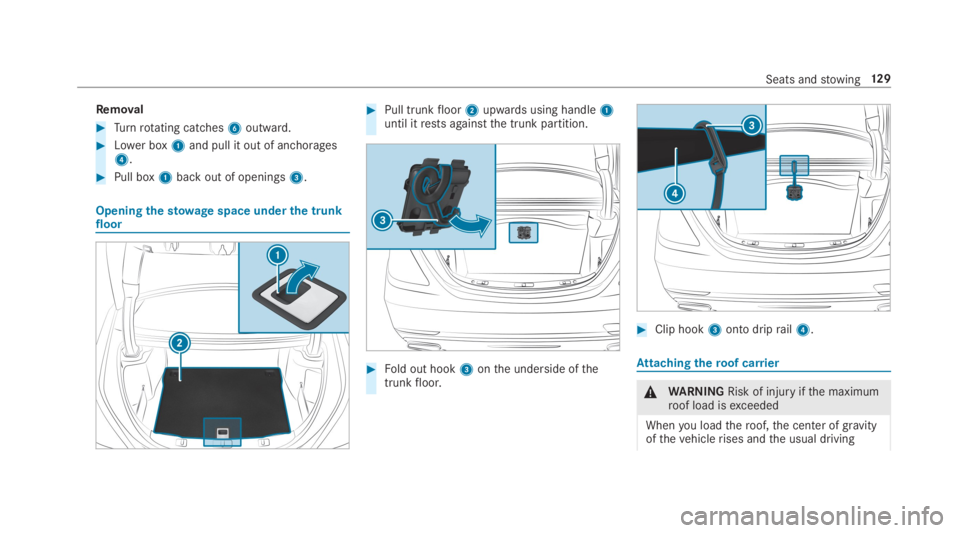
Removal
#Turnrotating catches6outward.
#Lower box1and pull it out of anchorages4.
#Pull box1back out of openings3.
Openingthestowagespace underthe trunkfloor
#Pull trunkfloor2upwards using handle1until itrests againstthe trunk partition.
#Fold out hook3onthe underside ofthetrunkfloor.
#Clip hook3onto driprail4.
Attachingtheroof carrier
&WARNINGRisk of injuryifthe maximumroof load isexceeded
Whenyou loadtheroof,the center of gravityofthevehiclerises andthe usual driving
Seats andstowing12 9
Page 132 of 578
characteristics aswell asthesteering andbrakingcharacteristicschange. During cor‐nering,thevehicle tilts morestrongly andmayreact more sluggishlytosteering move‐ments.
Ifyouexceedthe maximumroof load,thedrivingcharacteristics, aswell asthesteer‐ing and brakingcharacteristics, will begreatlyimpaired.
#Always comply withthe maximumroofload and adjustyour drivingstyle.
You willfind information onthe maximumroofload inthe "Technical data" section.
*NOTEVehicle damage from non-approvedroofracks
Thevehicle could be damagedbyroofrackswhich havenot beentested and approvedbyMercedes-Benz.
#Only useroofrackstested andapprovedbyMercedes-Benz.
#Depending onthevehicle equipment,ensurethat whentheroofrackis instal‐led:RThe sliding sunroof can be fullyraised.
RThe trunk lid can be fully opened.
#Positionthe load ontheroofrackinsuch awaythatthevehicle will not sus‐tain damageeven when it is in motion.
*NOTEDamagetothe sliding sunroofwhen aroofrackis installed
The sliding sunroof may be damagedbytheroofrackifyou attempttoopen it whentheroofrackis installed.
#Do not openthe sliding sunroof whentheroofrackis installed.
In ordertoallowventilation ofthevehicleinterior,you canraisethe sliding sunroof.
*NOTEDamagetothe covers
The coversmay be damaged and scratchedwhen being opened.
#Do not use metallic or hard objects.
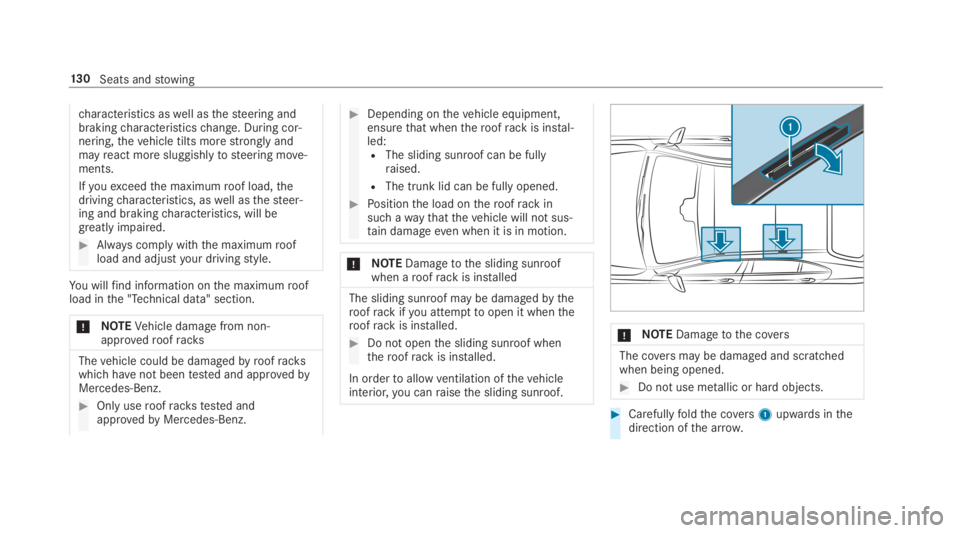
#Carefullyfoldthe covers1upwards inthedirection ofthe arrow.
13 0Seats andstowing
Page 133 of 578
#Securetheroofracktothe anchorage pointsunder covers1.
#Comply withtheroofrackmanufacturer'sinstallation instructions.
#Securethe load ontheroofrack.
Cup holder
Installingthe cup holder in orremoving itfrom the center console
&WARNING‑ Risk of accident or injurywhen usingthe cup holder whilethevehicle is moving
The cup holder cannot secure containerswhilethevehicle is moving.
Ifyou use a cup holder whilethevehicle ismoving,the container may beflung aroundand liquids may be spilled. Thevehicle occu‐pants may come into contact withthe liquidand if it is hot,theycould be scalded.Yo ucould be distracted from traffic conditionsandyou may lose control ofthevehicle.
#Only usethe cup holder whenthevehi‐cle isstationary.
#Only usethe cup holderfor containersoftheright size.
#Closethe container, particularlyiftheliquid is hot.
Observethefollowingfor Mercedes-Maybachvehicles equipped withchampagneflutes:
Rdo not usethechampagneflutes whilethevehicle is in motion
Rdo not usechampagneflutes made of break‐ableglass, andstorethem inthe trunk if pos‐sible
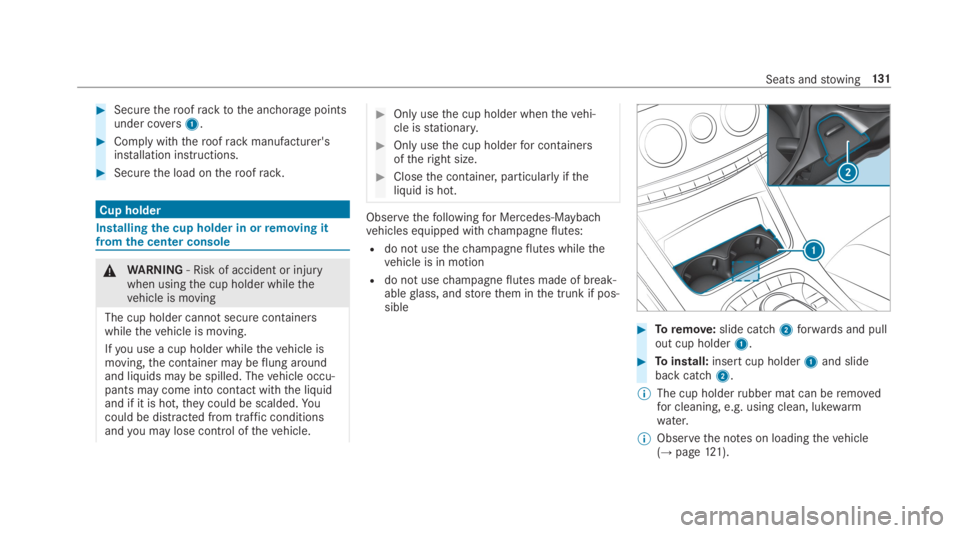
#Toremove:slide catch2forwards and pullout cup holder1.
#Toinstall:insert cup holder1and slideback catch2.
%The cup holderrubber mat can beremovedfor cleaning, e.g. using clean, lukewarmwater.
%Observethe notes on loadingthevehicle(→page121).
Seats andstowing131
Page 172 of 578
RThestarter battery is sufficientlycharged.
%You can also setthetemperature withyoursmartphone. Information on Mercedes meconnect andother services: http://www.mercedes.meThis function is notavailablefor all models.
Chargingthe batterybefore commencingyour journey
%This function is notavailable in all countries.
RIfthevehicle battery is discharged,youreceivea message onyour smartphone.
RYou canthenstartthevehicle withthesmartphonetochargethe battery.
RThevehicle is automatically switched offafterten minutes.
Ensurethefollowing beforestartingthe engine:
RThe legalstipulations inthe area whereyourvehicle is parked allow enginestarting viasmartphone.
RIt is safetostart andrunthe engine whereyourvehicle is parked.
RThe fueltank is sufficientlyfilled.
Startingthevehicle
&WARNINGRisk of crushing or entrap‐ment duetounintentionalstarting oftheengine
Limbs could be crushed or trapped iftheengine isstarted unintentionally duringservice or maintenancework.
#Always securethe engine against unin‐tentionalstarting before carrying outmaintenance orrepairwork.
Requirements:RParkposition]is selected.
RThe anti-theft alarm system is not activated.
RThe panic alarm is not activated.
RThe hazardwarning lights are switched off.
RThe hood is closed.
RThe doors are closed and locked.
RThe windowsand sliding sunroof are closed.
#Startthevehicle usingthe smartphone:
RAftereveryvehiclestart,the enginerunsforten minutes.
RYou can carryout a maximum of two consec‐utivestarting attempts. Thevehicle must bestarted once withthe SmartKeybefore tryingtostartthevehicle again withthe smart‐phone.
RYou canstopthevehicle again at any time.
RFurther information can befound inthesmartphone app.
Securingthe engine againststarting beforecarrying out maintenance orrepairwork:#Switch onthe hazardwarning lights.
or
#Unlockthe doors.
or
#Open a side window orthe sliding sunroof.
Breaking-in notes
Mercedes-AMGvehicles:observethe notes inthe Supplement. Otherwise,you mayfailtorec‐ognize dangers.
17 0Driving and parking
Page 186 of 578
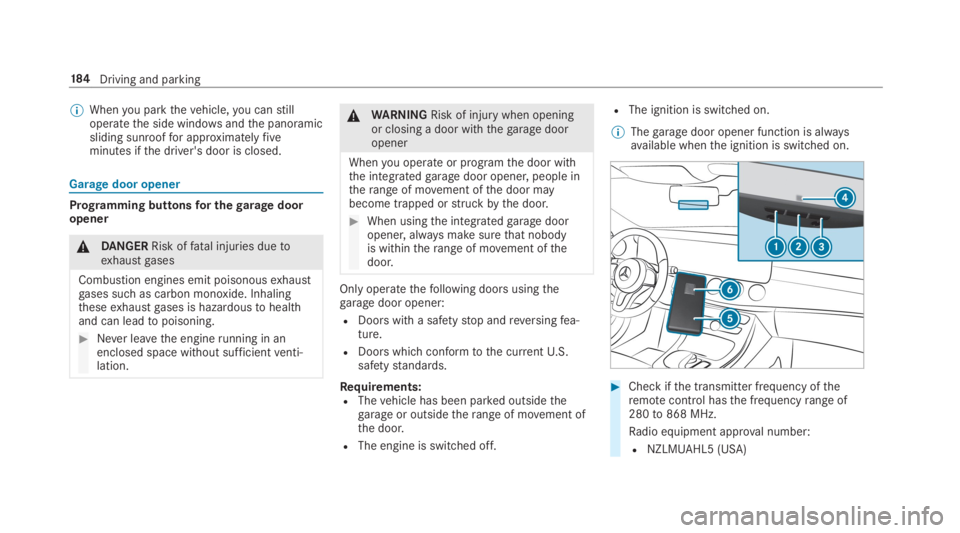
%Whenyou parkthevehicle,you canstilloperatethe side windowsandthe panoramicsliding sunrooffor approximatelyfiveminutes ifthe driver's door is closed.
Garage door opener
Programming buttonsfor thegaragedooropener
&DANGERRisk offatal injuries duetoexhaustgases
Combustion engines emit poisonousexhaustgases such as carbon monoxide. Inhalingtheseexhaustgases is hazardoustohealthand can leadtopoisoning.
#Never leavethe enginerunning in anenclosed space without sufficientventi‐lation.
&WARNINGRisk of injurywhen openingor closing a door withthegaragedooropener
Whenyou operate or programthe door withthe integratedgaragedoor opener, people intherange of movement ofthe door maybecome trapped orstruckbythe door.
#When usingthe integratedgaragedooropener, always make surethat nobodyis withintherange of movement ofthedoor.
Only operatethefollowing doors usingthegaragedoor opener:
RDoors with a safetystop andreversingfea‐ture.
RDoors which conformtothe currentU.S.safetystandards.
Requirements:RThevehicle has been parked outsidethegarageor outsidetherange of movement ofthe door.
RThe engine is switched off.
RThe ignition is switched on.
%Thegaragedoor opener function is alwaysavailable whenthe ignition is switched on.
#Check ifthe transmitter frequency oftheremotecontrol hasthe frequencyrange of280to868 MHz.
Radio equipment approval number:
RNZLMUAHL5 (USA)
184Driving and parking
Page 291 of 578
#Confirmchanges whenexitingthe menu.
The date is set automatically via GPS.
Activating/deactivatingvoice amplificationtotherear passenger compartment
RequirementsMercedes-Maybachvehicles andvehicleswith a long wheelbase only
RYourvehicle is equipped withthe Burmester®
surround sound system orthe Burmester®
high-end 3D surround sound system.
RThe ignition is switched on.
RDoors, side windowsandthe panoramaroofwith power tilt/sliding panel are closed.
Multimedia system:
,System.Audio.Voice Amplification
to Rear
The function supports communication betweenthe driver/front passenger andvehicle occu‐pants intherear passenger compartment. Whenvoice amplificationtorear passenger compart‐
ment is activated,the signals picked upbythemicrophone are amplified and played backoverthe speakers intherear passenger compart‐ment, depending uponvehicle noise levels. Anautomatic adjustment occurs based on speakervolume and ambient noise in ordertoimprovespeech intelligibility and maintainthe natural‐ness of speech.
#Activatesor deactivateSthe function.
Connectivity
Switching transmission ofthevehicle posi‐tion on/offMultimedia system:
,System.öConnectivity
#SelectTransmit Vehicle Pos..
#Activatesor deactivateSthe function.
Bluetooth®
Information about Bluetooth®
Bluetooth®technology is astandardfor short-range wireless data transfer uptoapproximately32.8ft(10 m).
You can use Bluetooth®toconnectyour mobilephonetothe multimedia system and usethefol‐lowing functions,forexample:
Rhands-free system with accesstothefollow‐ing options:
-contacts (→page334)
-call lists (→page 336)
-text messages
RInternet connection
Rlisteningtomusic via Bluetooth®audio(→page 364)
Rtransferring business cards (vCards) intothevehicle
Bluetooth®is aregistered trademark of Blue‐tooth Special Interest Group (SIG) Inc.
Multimedia system289
Page 405 of 578
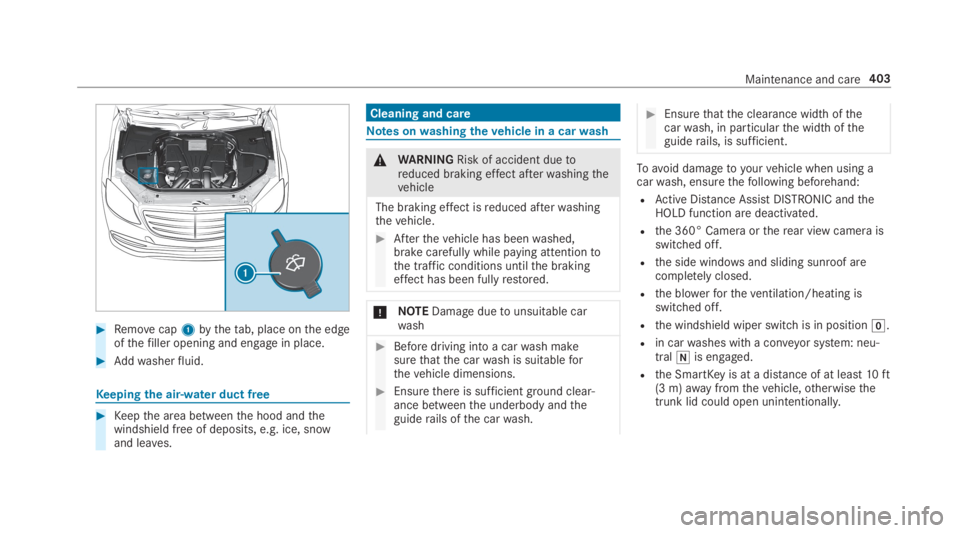
#Removecap1bythetab, place onthe edgeofthefiller opening and engage in place.
#Addwasherfluid.
Keepingthe air-water duct free
#Keepthe area betweenthe hood andthewindshield free of deposits, e.g. ice, snowand leaves.
Cleaning and care
Notes onwashingthevehicle in a carwash
&WARNINGRisk of accident duetoreduced braking effect afterwashingthevehicle
The braking effect isreduced afterwashingthevehicle.
#Afterthevehicle has beenwashed,brake carefully while paying attentiontothe traffic conditions untilthe brakingeffect has been fullyrestored.
*NOTEDamageduetounsuitable carwash
#Before driving into a carwash makesurethatthe carwash is suitableforthevehicle dimensions.
#Ensurethere is sufficient ground clear‐ance betweenthe underbody andtheguiderails ofthe carwash.
#Ensurethatthe clearance width ofthecarwash, in particularthe width oftheguiderails, is sufficient.
Toavoid damageto yourvehicle when using acarwash, ensurethefollowing beforehand:
RActive Distance AssistDISTRONIC andtheHOLD function are deactivated.
Rthe 360° Camera ortherear view camera isswitched off.
Rthe side windowsand sliding sunroof arecompletelyclosed.
Rthe blowerfortheventilation/heating isswitched off.
Rthe windshield wiper switch is in positionZ.
Rin carwashes with a conveyor system: neu‐tral\\is engaged.
Rthe SmartKeyis at a distance of at least10ft(3 m)awayfromthevehicle,otherwisethetrunk lid could open unintentionally.
Maintenance and care403
Page 455 of 578
these are installed onthevehicle, but does notinclude passengers or luggage.
Maximum tire load:the maximum tire load isthe maximum permissibleweight in kilograms orlbsfor whicha tire is approved.
Maximum permissible tire pressure:maxi‐mum permissible tire pressurefor one tire.
Maximum load on one tire:maximum load onone tire. This is calculatedbydividingthe maxi‐mum axle load of one axlebytwo.
PSI (pounds per square inch):standard unit ofmeasurementfor tire pressure.
Aspectratio:ratio between tire height and tirewidth in percent.
Tirepressure:pressure insidethe tire applyingan outwardforcetoeverysquare inch ofthe tire.The tire pressure is specified in pounds persquare inch (psi), in kilopascals (kPa) or in bar.The tire pressure should only be corrected whenthe tires are cold.
Cold tire pressure:the tires are cold whenthevehicle has been parkedfor at least3 hours
without direct sunlight onthe tires orthevehiclehas been drivenfor lessthan 1 mile (1.6 km).
Tirecontact surface:the part ofthe tirethatcomes into contact with theroad.
Tirebead:the purpose ofthe tire bead istoensurethatthe tire sits securely onthe wheelrim. There are several wire cores inthe tire beadtopreventthe tire fromchanging length onthewheelrim.
Sidewall:the part ofthe tire betweenthe treadandthe tire bead.
Weight of optional equipment:the combinedweight ofthe optional equipmentweighing morethanthereplacedstandard parts and morethan5 lbs (2.3kg).This optional equipment, such ashigh-performance brakes, level control system, aroof luggagerackor high-performance batteries,is not included inthe curbweight andtheweightofthe accessories.
TIN (Tire IdentificationNumber):a uniqueidentification number which can be usedby atire manufacturertoidentify tires,forexample,in a productrecall, andthus identifythe pur‐chasers. The TIN is made up ofthe manufactur‐
er's identity code, tire size, tire type code andthe manufacturing date.
Load-bearing index:the load-bearing index is acodethat containsthe maximum load-bearingcapacity of a tire.
Traction:traction isthe gripresulting from fric‐tion betweenthe tires andtheroad surface.
Wear indicator:narrowbars (treadwear bars)that are distributedoverthe tire contact surface.Ifthe tire tread is level withthe bars,thewearlimit of 1/16in (1.6 mm) has beenreached.
Distribution ofvehicle occupants:distributionofvehicle occupantsover designated seat posi‐tions in avehicle.
Maximum permissible payloadweight:nomi‐nal load and luggage load plus150 lb (68kg)multipliedbythe number of seats inthevehicle.
Wheels and tires453
Page 467 of 578
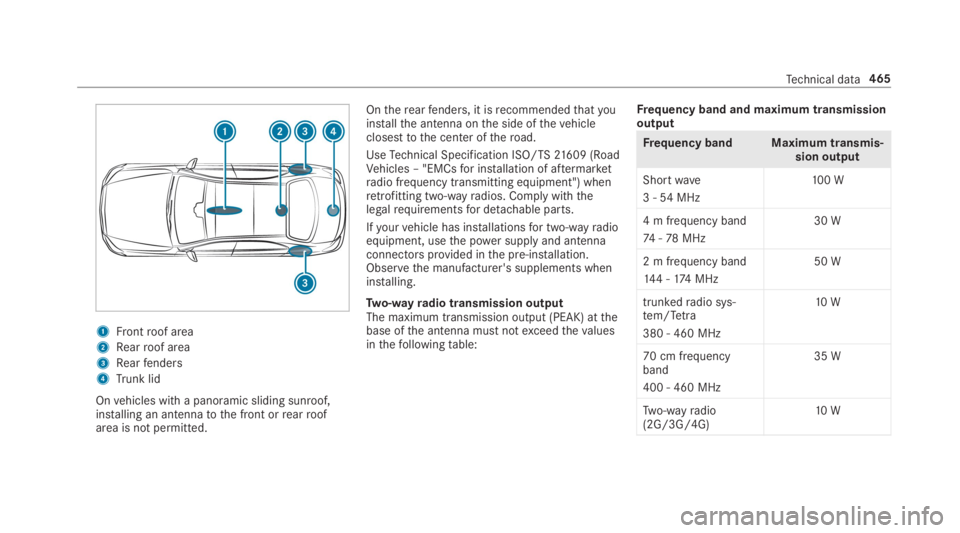
1Frontroof area
2Rearroof area
3Rearfenders
4Trunk lid
Onvehicles with a panoramic sliding sunroof,installing an antennatothe front orrearroofarea is not permitted.
Ontherearfenders, it isrecommendedthatyouinstallthe antenna onthe side ofthevehicleclosesttothe center oftheroad.
UseTechnical Specification ISO/TS21609 (RoadVehicles – "EMCsfor installation of aftermarketradio frequency transmitting equipment") whenretrofitting two-wayradios. Comply withthelegalrequirementsfor detachable parts.
Ifyourvehicle has installationsfor two-wayradioequipment, usethe power supplyand antennaconnectorsprovided inthe pre-installation.Observethe manufacturer's supplements wheninstalling.
Two-wayradio transmission outputThe maximum transmission output (PEAK) atthebase ofthe antenna must notexceedthevaluesinthefollowingtable:
Frequency band and maximum transmissionoutput
Frequency band Maximum transmis‐sion output
Shortwave
3 -54MHz
100 W
4 m frequency band
74-78MHz
30 W
2 m frequency band
144 -174 MHz
50 W
trunkedradio sys‐tem/Tetra
380 - 460 MHz
10 W
70 cm frequencyband
400 - 460 MHz
35 W
Two-wayradio(2G/3G/4G)10 W
Technical data465
Page 479 of 578
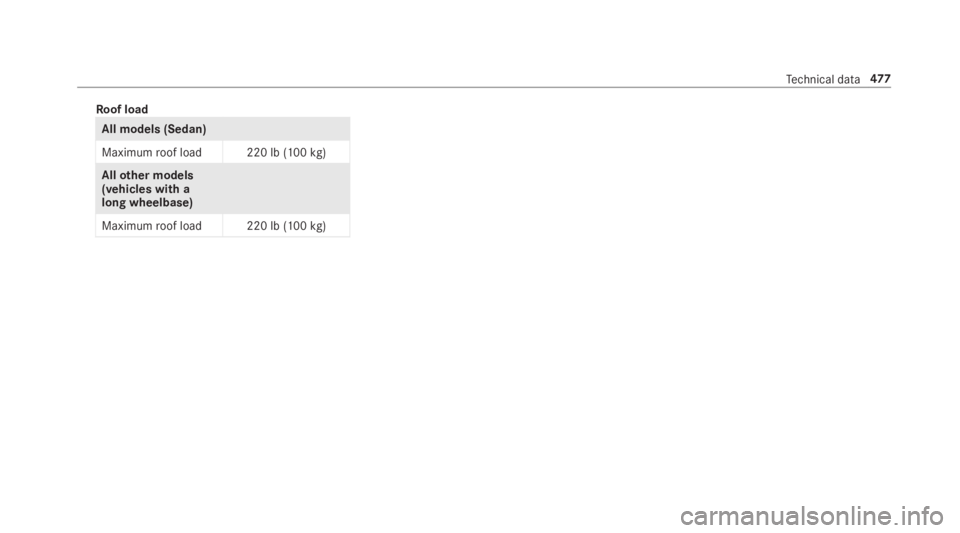
Roof load
All models (Sedan)
Maximumroof load 220 lb (100kg)
Allother models(vehicles with along wheelbase)
Maximumroof load 220 lb (100kg)
Technical data477