sensor MERCEDES-BENZ S CLASS 2019 Owner's Manual
[x] Cancel search | Manufacturer: MERCEDES-BENZ, Model Year: 2019, Model line: S CLASS, Model: MERCEDES-BENZ S CLASS 2019Pages: 578, PDF Size: 23.31 MB
Page 246 of 578
tone sounds once. Ifthe turn signal indicatorremains switched on, allother detectedvehiclesare indicated onlybytheflashing oftheredwarning lamp.
Ifyouovertake avehiclequickly,nowarning isgiven.
&WARNINGRisk of accident despiteBlindSpot Assist
Blind Spot Assistdoes notreacttovehiclesapproaching andovertakingyou at agreatlydifferent speed.
As aresult, Blind Spot Assist cannotwarndrivers inthis situation.
#Always pay careful attentiontothe traf‐fic situation and maintain a safe dis‐tance atthe side ofthevehicle.
Blind Spot Assist andActive Blind Spot Assistare onlyaids. They mayfailtodetect somevehi‐cles and are no substitutefor attentive driving.Always ensurethatthere is sufficient distancetothe sideforotherroad users and obstacles.
ExitwarningTheexitwarning is an additional function ofBlind Spot Assist and canwarnvehicle occu‐pants about approachingvehicles when leavingthevehicle whenstationary.
&WARNINGRisk of accident despiteexitwarning
Theexitwarningreacts neithertostationaryobjects nortovehicles approachingyou at agreatlydifferent speed.
As aresult,theexitwarning cannotwarndrivers inthese situations.
#Always pay particular attentiontothetraffic situation when openingthe doorsand make surethere is sufficient clear‐ance.
Ifthere is avehicle inthe monitoringrange,thisis indicated inthe outside mirror.If avehicleoccupant opensthe door onthe side withthewarning, awarningtone sounds andthewarninglamp inthe outside mirrorstartstoflash.
This additional function is onlyavailable whenBlind Spot Assist is activated and uptoa maxi‐mum ofthree minutes afterthe ignition hasbeen switched off. Theexitwarning is no longeravailable oncethewarning lamp inthe outsidemirrorflashesthree times.
Theexitwarning is only an aid and not a substi‐tuteforthe attention ofvehicle occupants. Theresponsibilityfor opening and closingthe doorsandfor leavingthevehicleremains withthevehi‐cle occupants.
System limitations
Blind Spot Assist andActive Blind Spot Assistmay be limited inthefollowing situations:
Rifthere is dirt onthe sensors orthe sensorsare obscured
Rin poor visibility, e.g. duetofog, heavyrain orsnow
Rifthere are narrowvehicles, e.g. bicycles ormotorbikes
Riftheroad hasverywide or narrowlanes
Rifvehicles are not driving inthe middle oftheir lane
244Driving and parking
Page 247 of 578
Warnings may be issued in error when drivingclosetocrash barriers or similar solid lane bor‐ders. Always make surethatthere is sufficientdistancetothe sideforother traffic or obsta‐cles.
Warnings may be interrupted when driving along‐side longvehicles,forexample trucks,for a pro‐longed time.
Blind Spot Assist is not operational whenreversegear is engaged.
Theexitwarning may be limited inthefollowingsituations:
RWhenthe sensors are coveredbyadjacentvehicles in narrowparking spaces.
RWhen people approachthevehicle.
RIntheevent ofstationary or slowly movingobjects.
Function of brake application (Active BlindSpot Assist)IfActive Blind Spot Assistdetects arisk of a sideimpact inthe monitoringrange, a course-cor‐recting brake application is carried out. This isdesignedtohelpyouavoid a collision.
The course-correcting brake application isavaila‐ble inthe speedrange between approximately20mph (30 km/h) and125mph (200 km/h).
&WARNINGRisk of accident despitebrake application ofActive Blind SpotAssist
A course-correcting brake application cannotalways prevent a collision.
#Alwayssteer, brake or accelerateyour‐self, especially ifActive Blind SpotAssistwarnsyou or makes a course-correcting brake application.
#Always maintain a safe distance atthesides.
&WARNINGRisk of accident despiteActive Blind Spot Assist
Active Blind Spot Assistdoes notreacttothefollowing:
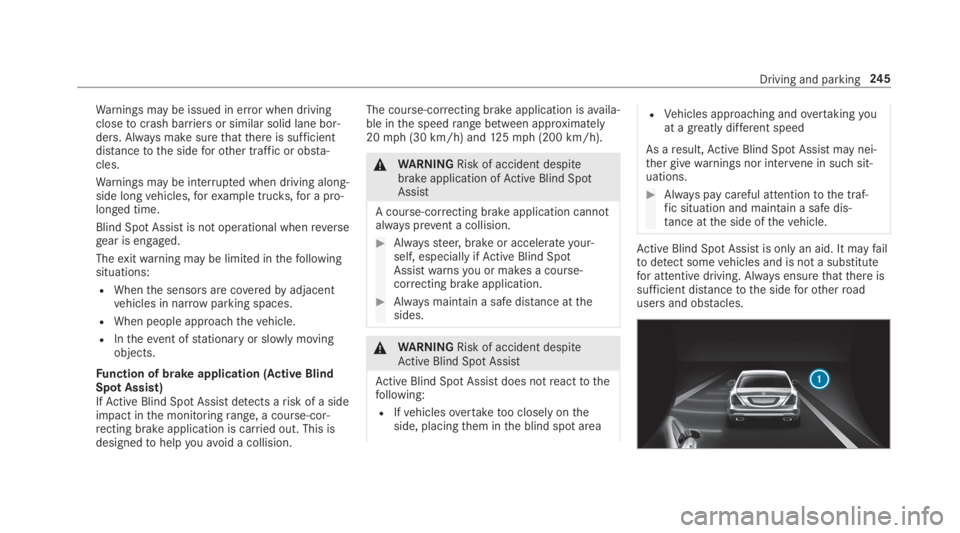
RIfvehiclesovertaketoo closely ontheside, placingthem inthe blind spot area
RVehicles approaching andovertakingyouat agreatly different speed
As aresult,Active Blind Spot Assistmay nei‐ther givewarnings nor intervene in suchsit‐uations.
#Always pay careful attentiontothe traf‐fic situation and maintain a safe dis‐tance atthe side ofthevehicle.
Active Blind Spot Assistis only an aid. It mayfailtodetect somevehicles and is not a substitutefor attentive driving. Always ensurethatthere issufficient distancetothe sideforotherroadusers and obstacles.
Driving and parking245
Page 250 of 578
RYou haveadopted a sporty drivingstyle withhigh cornering speeds or highrates of accel‐eration.
RWhen ESP®is deactivated.
RIf a loss of tire pressure or afaulty tire hasbeen detected and displayed.
The system may be impaired or may not functioninthefollowing situations:
RIfthere is poor visibility, e.g. duetoinsuffi‐cient illumination oftheroad, ifthere arehighlyvariable shade conditions or inrain,snow,fog or heavy spray.
RIfthere isglare, e.g. from oncoming traffic,the sun orreflections.
RIfthe windshield inthe area ofthe multifunc‐tion camera is dirty, or ifthe camera isfog‐ged up, damaged or covered.
RIfthere are no lane markings, or severalunclear lane markings are presentfor onelane, e.g. aroundroadworks.
RIfthe lane markings areworn, dark or cov‐ered.
RIfthe distancetothevehicle in front istooshort andthusthe lane markings cannotbedetected.
RIfthe lane markingschangequickly,e.g.lanes branch off, cross one another ormerge.
RIftheroadwayisverynarrow and winding.
Vehicles with Driving Assistance packageorDriving Assistance Plus package:Active LaneKeeping Assist usesradar sensorstomonitorseveral areas aroundthevehicle. Iftheradarsensors intherear bumper are dirty or coveredwith snow,the system may be impaired or maynot function. If an obstacle inthe lane in whichyou are driving has been detected, no lane-cor‐recting brake application occurs.
Activating/deactivatingActive LaneKeepingAssist (vehicles withParking AssistPARKTRONIC)
&WARNINGRisk of accident despiteActive LaneKeeping Assistwarning
A lane-correcting brake application cannotalwaysbringthevehicle back intothe origi‐nal lane.
#Alwayssteer, brake or accelerateyour‐self, especially ifActive LaneKeepingAssistwarnsyou or makes a lane-cor‐recting brake application.
&WARNINGRisk of accident despiteinter‐vention ofActive LaneKeeping Assist
Active LaneKeeping Assist does not detecttraffic conditions orroad users. Inveryrarecases,the system may make an inappropri‐ate brake application, e.g. after intentionallydrivingover a solid lane marking.
The brake application can be interrupted atany time ifyousteer slightly inthe oppositedirection.
248Driving and parking
Page 320 of 578
RRear Seat Entertainment System
%Received destinations are saved inthe previ‐ous destinations.
A promptappears onthe media display.
#A destination has beenreceived withoutpicture information:selectYes.
#Ifroute guidance is not active, selectStartRoute Guidance.Theroutetothe destination is calculated.The map shows theroute.Route guidancethen begins.
or
#Ifroute guidance is active, selectStart NewRoute GuidanceorSet as Next Way Point.Start New Route Guidance:thereceived des‐tination address is set as a new destination.The previous destinations and intermediatedestinations are deleted.Route guidancetothe new destination begins.
Set as Next Way Point:thereceived destina‐tion address is set asthe next intermediatedestination.Route guidance begins.
#A destination has beenreceived with pic‐tureinformation:selectStart Route Guid-ance.Route guidancestarts.#Aroute has beenreceived:selectStartRoute Guid. from Beginning of Route.
or
#SelectStart Route Guidance from CurrentPosition.Route guidancestarts fromthe selectedposition.
Route guidance with current trafficreports
Traffic informationoverviewTrafficreports arereceived using LiveTrafficInformation and are usedforroute guidance.
This service is unavailable in some countries.
There may be differences betweenthe trafficreportsreceived andthe actualroad and trafficconditions.
Important information on LiveTraffic Informa‐tion:
RCurrent trafficreports arereceived viatheInternet connection.
RThe traffic situation is updated at short,regu‐lar intervals.
RThe subscription information shows thesta‐tus (→page318).
Information onthevehicle's position isregularlysenttoDaimlerAG. The datais immediatelyren‐dered anonymousbyDaimlerAGandforwardedtothe traffic data provider. Usingthis data, traf‐ficreportsrelevanttothevehicle's position aresenttothevehicle. Thevehicle acts as a sensorfortheflowof traffic and helpstoimprovethequality ofthe trafficreports.
Ifyou do not wishtotransmityourvehicle posi‐tion,you can havethis service deactivated at anauthorized Mercedes-Benz Center.
Displaying subscription information
Requirements:RThevehicle is equipped with LiveTrafficInformation.
318Multimedia system
Page 402 of 578
RParkthevehicle on a level surface.
RLeavethe enginerunning at idle speed.
On-board computer:
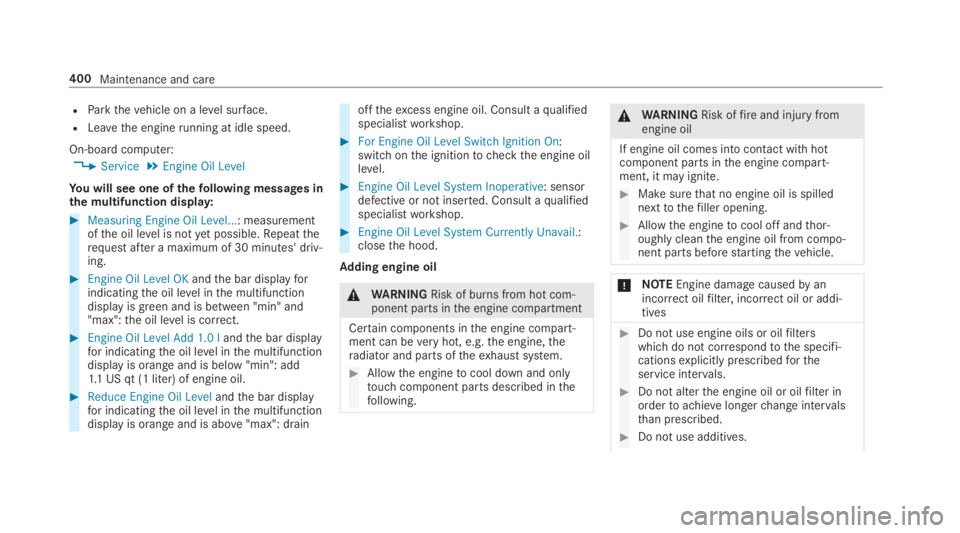
,Service.Engine Oil Level
You will see one ofthefollowing messages inthe multifunction display:
#Measuring Engine Oil Level...: measurementofthe oil level is notyet possible.Repeattherequest after a maximum of 30 minutes' driv‐ing.
#Engine Oil Level OKandthe bar displayforindicatingthe oil level inthe multifunctiondisplay is green and is between "min" and"max":the oil level is correct.
#Engine Oil Level Add 1.0 landthe bar displayfor indicatingthe oil level inthe multifunctiondisplay is orange and is below "min": add1.1 US qt (1 liter) of engine oil.
#Reduce Engine Oil Levelandthe bar displayfor indicatingthe oil level inthe multifunctiondisplay is orange and is above"max": drain
offtheexcess engine oil. Consult aqualifiedspecialistworkshop.
#For Engine Oil Level Switch Ignition On:switch onthe ignitiontocheckthe engine oillevel.
#Engine Oil Level System Inoperative: sensordefective or not inserted. Consult aqualifiedspecialistworkshop.
#Engine Oil Level System Currently Unavail.:closethe hood.
Adding engine oil
&WARNINGRisk of burns from hot com‐ponent parts inthe engine compartment
Certain components inthe engine compart‐ment can beveryhot, e.g.the engine,theradiator and parts oftheexhaust system.
#Allowthe enginetocool down and onlytouch component parts described inthefollowing.
&WARNINGRisk offireand injury fromengine oil
If engine oil comes into contact withhotcomponent parts inthe engine compart‐ment, it may ignite.
#Make surethat no engine oil is spillednexttothefiller opening.
#Allowthe enginetocool off andthor‐oughly cleanthe engine oil from compo‐nent parts beforestartingthevehicle.
*NOTEEngine damagecausedbyanincorrect oilfilter, incorrect oil or addi‐tives
#Do not use engine oils or oilfilterswhich do not correspondtothe specifi‐cationsexplicitly prescribedfortheservice intervals.
#Do not alterthe engine oil or oilfilter inordertoachievelongerchange intervalsthan prescribed.
#Do not use additives.
400Maintenance and care
Page 412 of 578
Notes on cleaning and careAvoidingvehicle damage
Exterior lightingCleanthe lenses with awet sponge and mild cleaning agent,e.g. car shampoo.Only use cleaning agents or cleaning clothsthat are suitablefor plastic lenses.
SensorsCleanthe sensors inthe front andrear bumper and intheradiator grill with a soft clothand car shampoo.When using a powerwasher, maintain a minimum distance of11.8 in (30 cm).
Rear view cameraand360° CameraROpenthe camera cover withthe multimedia system(→page 231).
RUse cleanwater and a soft clothtocleanthe camera lens.
Do not use a powerwasher.
TailpipesClean with cleaning agentsrecommendedbyMercedes-Benz,particularlyinthe winter and afterwashingthevehicle.Do not use acidic cleaning agents.
Notes on care ofthe interior
&WARNINGRisk of injuryfrom plasticparts breaking off afterthe use of sol‐vent-based care products
Careand cleaning products containing sol‐vents can cause surfaces inthe cockpittobecome porous.
Whenthe airbags are deployed, plastic partsmay breakaway.
#Do not use any care or cleaning prod‐ucts containing solventstocleanthecockpit.
&WARNINGRisk of injuryor death frombleached seat belts
Bleaching or dyeing seat belts can severelyweakenthem.
This can,forexample, cause seat beltstotear orfail in an accident.
#Never bleachor dye seat belts.
41 0Maintenance and care
Page 442 of 578
The systemchecksthe tire pressure andthe tiretemperature ofthe tires installed onthevehiclebymeans of a tire pressuresensor.
New tire pressure sensors, e.g. in winter tires,are automaticallytaught-in duringthefirst jour‐neytheyare used.
The tire pressure appears inthe multifunctiondisplay (→page 255).
Ifthere is a substantial pressure loss or ifthetiretemperature isexcessive,you will bewarnedinthefollowingways:
Rvia display messages (→page511)
Rviathewwarning lamp inthe instrumentcluster (→page 533)
The tire pressuremonitoring system is only anaid. It isthe driver'sresponsibilitytosetthe tirepressuretotherecommended cold tire pressuresuitableforthe operating situation. Setthe tirepressurefor cold tires using a tire pressuregauge. Notethatthe correct tire pressureforthecurrent operating situation mustfirst betaught-intothe tire pressure monitoring system.
In most cases,the tire pressure monitoring sys‐tem will automatically updatethe newreferencevalues afteryou havechangedthe tire pressure.You can, however,also updatethereferenceval‐uesbyrestartingthe tire pressure monitoringsystem manually (→page441).
System limitations
The system may be impaired or may not functioninthefollowing situations:
RIfthe tire pressure is set incorrectly
RIfthere is a sudden pressure loss caused,forexample,byaforeign object penetratingthetire
RIfthere is a malfunction causedbyanotherradio signal source
Make suretoobservethefollowing furtherrela‐ted subject:
RNotes on tire pressure (→page 435)
Checkingthe tire pressure withthe tire pres‐sure monitoring system
Requirements:RThe ignition is switched on.
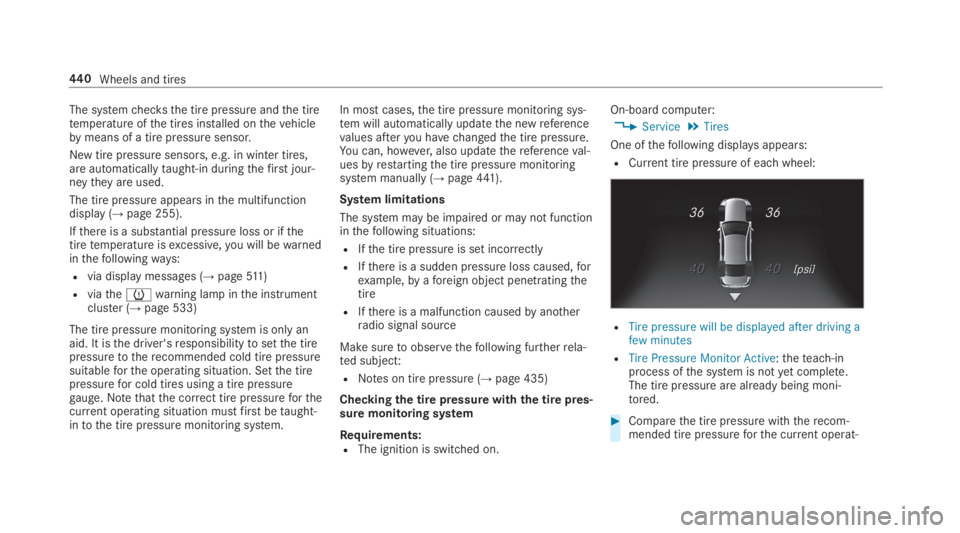
On-board computer:
,Service.Tires
One ofthefollowing displaysappears:
RCurrent tire pressure of eachwheel:
RTire pressure will be displayed after driving afew minutes
RTire Pressure Monitor Active:theteach-inprocess ofthe system is notyet complete.The tire pressure are already being moni‐tored.
#Comparethe tire pressure withtherecom‐mended tire pressureforthe current operat‐
440Wheels and tires
Page 458 of 578
Observethefollowing when selecting, installingandreplacing tires:
ROnly use tires and wheels ofthe same type(summer tires, winter tires, MOExtendedtires) andthe same make.
ROnly install wheels ofthe same size on oneaxle (left andright).
It is only permissibletoinstall a differentwheel size intheevent of aflat tire in ordertodrivetothe specialistworkshop.
ROnly install tires ofthe correct size ontothewheels.
RVehicles with a tire pressure monitoringsystem:All installed wheels must be equip‐ped with functioning sensorsforthe tirepressure monitoring system.
RAttemperatures below 45 °F (7 °C), use win‐ter tires or all-season tires marked M+Sforall wheels.
Winter tires bearingtheMsnowflake sym‐bol in additiontothe M+S marking providethe best possible grip in wintryroad condi‐tions.
RFor M+S tires, only use tires withthe sametread.
RObservethe maximum permissible speedforthe M+S tires installed.
Ifthis is belowthevehicle's maximum speed,this must be indicatedbyan appropriatelabel inthe driver'sfield of vision.
RBreak in new tires at moderate speedsforthefirst 60 miles (100 km).
RReplacethe tires after sixyears atthe latest,regardless ofwear.
RWhenreplacing with tires that do notfea‐turerun-flatcharacteristics:vehicles withMOExtended tires are not equipped with aTIREFIT kit atthefactory.Equipthevehiclewith a TIREFIT kit afterreplacing with tiresthat do notfeaturerun-flatcharacteristics,e.g. winter tires.
For more information on wheels and tires, con‐tact aqualified specialistworkshop.
Be suretoalso observethefollowing furtherrelated subjects:
RNotes on tire pressure (→page 435)
RTireand Loading Information placard(→page442)
RTiresize designation, load-bearing capacity,speedrating and load index (→page449)
RTirepressuretable (→page 437)
Notes onrotating wheels
&WARNINGRisk of injurythrough differ‐ent wheel sizes
Interchangingthe front andrear wheels ifthewheels or tires havedifferent dimensionsmay severely impairthe drivingcharacteris‐tics.
The wheel brakes or wheel suspension com‐ponents may also be damaged.
#Rotatefront andrear wheels onlyifthewheels and tires are ofthe same dimen‐sions.
456Wheels and tires
Page 476 of 578
*NOTEBlocked spraynozzles causedbymixing windshieldwasherfluids
#Do not mix MB SummerFit and MBWin‐terFit withother windshieldwasherflu‐ids.
Do not use distilled or de-ionizedwater asthefilllevel sensor may be triggered erroneously.
Recommended windshieldwasherfluid:
RAbovefreezing point: e.g. MB SummerFit
RBelow freezing point: e.g. MBWinterFit
Forthe correct mixingratio,refertothe informa‐tion onthe antifreeze container.
Mixthewasherfluid withthe windshieldwasherfluid allyearround.
Refrigerant
Notes onrefrigerantsObservethe notes on operatingfluids(→page 468).
*NOTEDamageduetoincorrectrefriger‐ant
If a non-approvedrefrigerant is used,the cli‐mate control system may be damaged.
#Only usetherefrigerant R‑134a
*NOTEDamagetothe climate controlsystem duetoincorrectrefrigerant com‐pressor oil
#Only userefrigerant compressor oilthathas been approvedbyMercedes-Benz.
#Do not mixthe approvedrefrigerantcompressor oil with a differentrefriger‐ant compressor oil.
Workonthe climate control system may be car‐ried out onlybyaqualified specialistworkshop.All applicableregulations, aswell asSAEstand‐ard J639, must be adheredto.
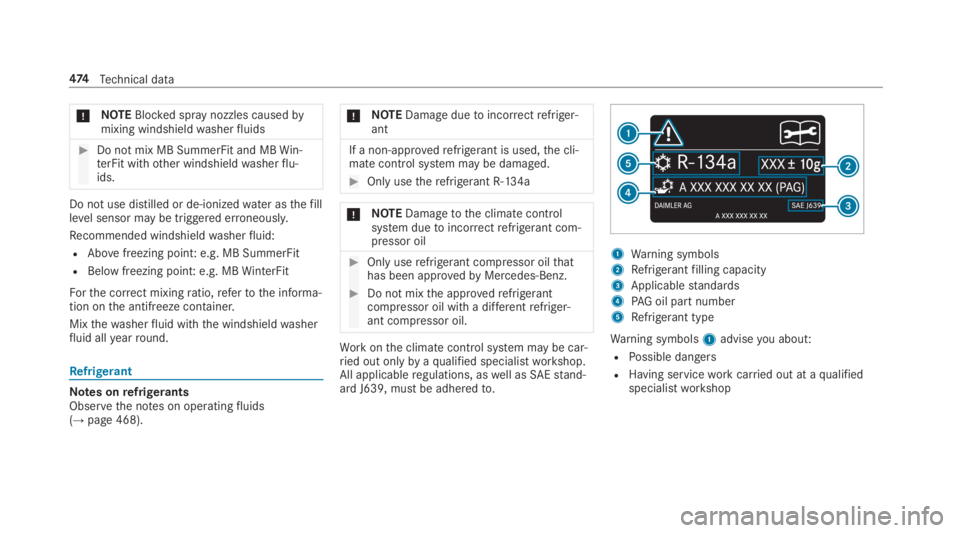
1Warning symbols
2Refrigerantfilling capacity
3Applicablestandards
4PAG oil part number
5Refrigerant type
Warning symbols1adviseyou about:
RPossible dangers
RHaving serviceworkcarried out at aqualifiedspecialistworkshop
474Technical data
Page 486 of 578
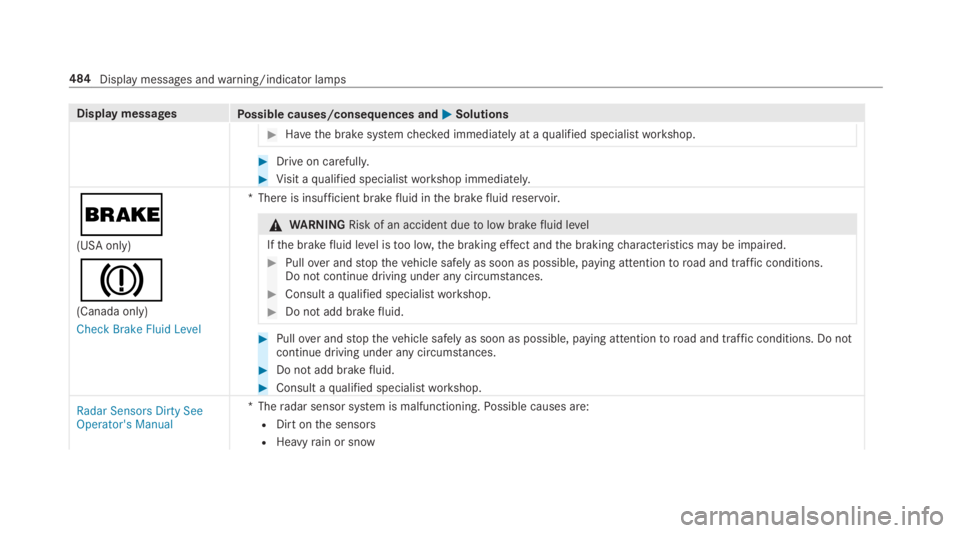
Display messagesPossible causes/consequences andPPSolutions
#Havethe brake systemchecked immediately at aqualified specialistworkshop.
#Drive on carefully.
#Visit aqualified specialistworkshop immediately.
'
(USA only)
M
(Canada only)
Check Brake Fluid Level
*There is insufficient brakefluid inthe brakefluidreservoir.
&WARNINGRisk of an accident duetolow brakefluid level
Ifthe brakefluid level istoo low,the braking effect andthe brakingcharacteristics may be impaired.
#Pullover andstopthevehicle safely as soon as possible, paying attentiontoroad and traffic conditions.Do not continue driving under any circumstances.
#Consult aqualified specialistworkshop.
#Do not add brakefluid.
#Pullover andstopthevehicle safely as soon as possible, paying attentiontoroad and traffic conditions. Do notcontinue driving under any circumstances.
#Do not add brakefluid.
#Consult aqualified specialistworkshop.
Radar Sensors Dirty SeeOperator's Manual
*Theradar sensor system is malfunctioning.Possible causes are:
RDirt onthe sensors
RHeavyrain or snow
484Display messages andwarning/indicator lamps