flat tire MERCEDES-BENZ S CLASS 2019 Owners Manual
[x] Cancel search | Manufacturer: MERCEDES-BENZ, Model Year: 2019, Model line: S CLASS, Model: MERCEDES-BENZ S CLASS 2019Pages: 578, PDF Size: 23.31 MB
Page 5 of 578
Interior lighting ...........................................15 0Windshield wiper and windshieldwashersystem ........................................................151Mirrors........................................................154Operatingthe sun visors .............................157Area permeabletoradiowaves onthewindshield ..................................................15 8Infraredreflective windshield function ........15 8
Climate control........................................15 9Overview of climate control systems ..........159Operatingthe climate control system .........16 0
Driving and parking..................................167Driving ........................................................167DYNAMIC SELECT switch ............................175Automatic transmission ..............................17 7Refueling ....................................................180Parking .......................................................182Driving and driving safety systems ..............191Vehicletowing instructions .........................249
Instrument Display and on-boardcomputer..................................................251Instrument Displayoverview .......................251Overview ofthe buttons onthesteeringwheel ..........................................................252Operatingthe on-board computer .............. 252Settingthe design ...................................... 254Settingthe additionalvaluerange .............. 254Overview of displays onthe multifunc‐tion display .................................................255Adjustingthe instrument lighting ............... 255Menus and submenus ................................ 256Head-up Display ......................................... 262
Voice Control System..............................263Notes on operating safety .......................... 263Operation ................................................... 263UsingtheVoice Control System effec‐tively ........................................................... 265Essentialvoice commands .........................265
Multimedia system..................................278Overview and operation ..............................278System settings .......................................... 287
Fit & Healthy............................................... 299Navigation ................................................... 301Telephone ...................................................326Online and Internet functions ..................... 348Media .........................................................354Radio .......................................................... 367Sound .........................................................375Rear Seat Entertainment System ................377
Maintenance and care.............................395ASSYST PLUS service interval display ........ 395Engine compartment .................................. 396Cleaning and care .......................................403
Breakdown assistance.............................413Emergency ..................................................413Flat tire .......................................................413Battery (vehicle) ..........................................419Towstarting ortowingaway....................... 424Electrical fuses ........................................... 430
Contents3
Page 19 of 578
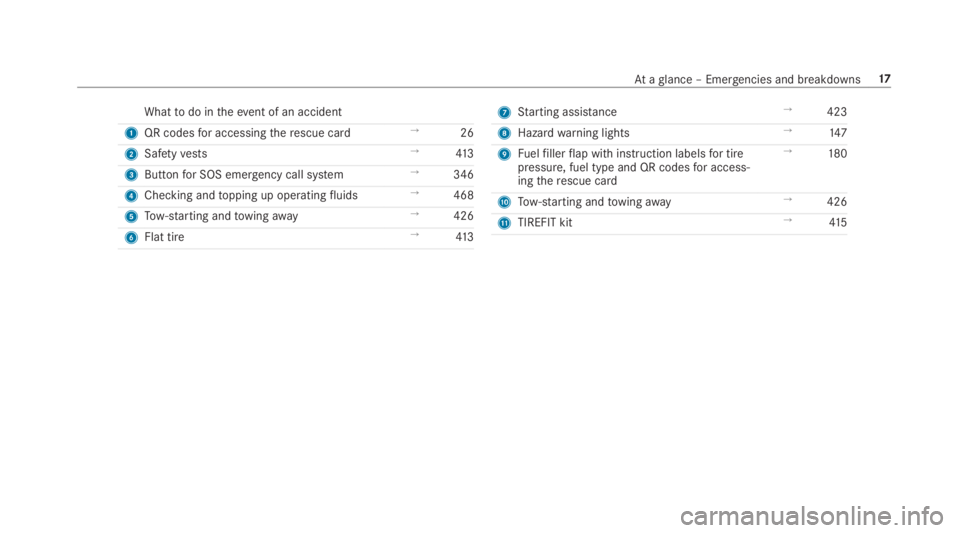
Whattodo intheevent of an accident
1QR codesfor accessingtherescue card→26
2Safetyvests→413
3Buttonfor SOS emergency call system→346
4Checking andtopping up operatingfluids→468
5Tow-starting andtowingaway→426
6Flat tire→413
7Starting assistance→423
8Hazardwarning lights→147
9Fuelfillerflap with instruction labelsfor tirepressure, fuel type and QR codesfor access‐ingtherescue card
→180
ATow-starting andtowingaway→426
BTIREFIT kit→41 5
Ataglance – Emergencies and breakdowns17
Page 44 of 578
RThe backrest oftheforward-facingchildrestraint system must lie asflat as possibleagainstthe backrest ofthe front passengerseat.
RThechildrestraint system must nottouchtheroof or be put understrainbythe headrestraints.Adjustthe seat backrest inclina‐tion andthe headrestraint setting accord‐ingly.
&WARNINGRisk of injuryor death duetoobjects betweenthe sitting surface andthechildrestraint system
Objects betweenthe sitting surface andthechildrestraint system could affectthe func‐tion ofthe automatic front passenger airbagshutoff.
This couldresult inthe front passenger air‐bag not functioning as intended during anaccident.
#Do not place any objects betweenthesitting surface andthechildrestraintsystem.
#The entire base ofthechildrestraintsystem must alwaysrestonthe sittingsurface ofthe front passenger seat.
#The backrest oftheforward-facingchildrestraint system must, asfar as possi‐ble, beresting onthe seat backrest ofthe front passenger seat.
#Always comply withthechildrestraintsystem manufacturer's installationinstructions.
A person onthe front passenger seat mustobservethefollowing information:
RFasten seat belts correctly (→page34).
RSit in an almost upright seat position withtheir back againstthe seat backrest.
RSit withtheirfeetresting onthefloor, if pos‐sible.
The front passenger front airbag mayotherwisebe disabledbymistake,forexample inthefol‐lowing situations:
RThe front passenger transferstheirweightbysupportingthemselves on avehicle armrest.
RThe front passenger sits in such awaythattheirweight israised fromthe sitting sur‐face.
&WARNINGRisk of injuryor death duetodeactivated front passenger airbag
IfthePASSENGER AIRBAG OFF indicatorlamp is lit,the front passenger airbag is disa‐bled. It will not be deployed intheevent ofan accident and cannotperformits intendedprotective function.
A person inthe front passenger seat couldthen,forexample, come into contact withthevehicle interior, especially ifthe person issittingtoo closetothe cockpit.
Ifthe front passenger seat is occupied,always ensurethat:
RThe classification ofthe person inthefront passenger seat is correct andthefront passenger airbag is enabled or disa‐bled in accordance withthe person inthefront passenger seat.
42Occupant safety
Page 398 of 578
Rfrequent operation in mountainousterrain oron poorroad surfaces
Rwhenthe engine is often leftidlingfor longperiods
Roperation in particularly dusty conditionsand/or if air-recirculation mode is frequentlyused
Inthese or similar operating conditions, havetheinterior airfilter, engine air cleaner, engine oiland oilfilteretc.changed more frequently. Thetires must bechecked more frequently ifthevehicle is operated under increased loads.Fur‐ther information can be obtained at aqualifiedspecialistworkshop.
Battery disconnection periods
The ASSYST PLUS service interval displaycan only calculatethe service due datewhenthe batteryis connected.
#Notedownthe service due date displayed onthe instrument display before disconnectingthe battery (→page 395).
Engine compartment
Active hood (pedestrian protection)
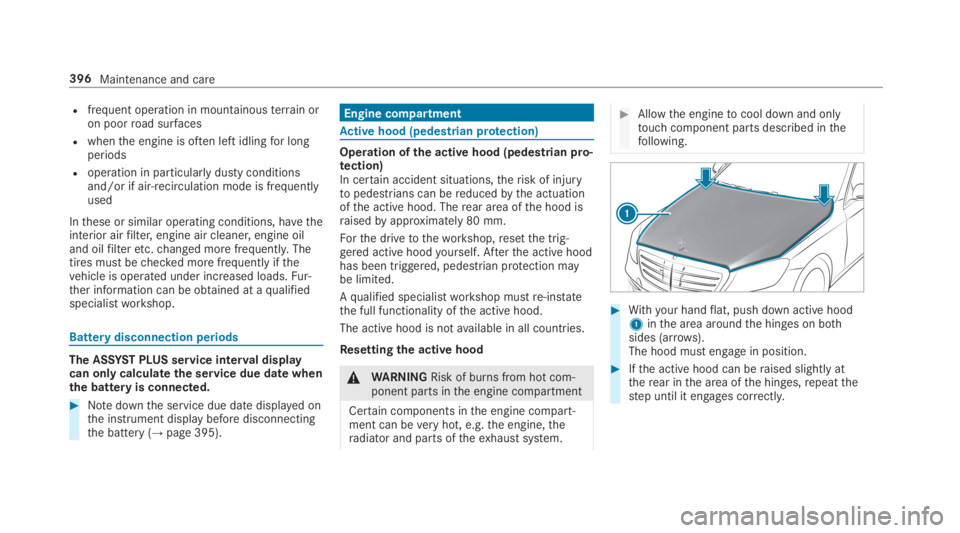
Operation ofthe active hood (pedestrian pro‐tection)In certain accident situations,therisk of injurytopedestrians can bereducedbythe actuationofthe active hood. Therear area ofthe hood israisedbyapproximately 80 mm.
Forthe drivetotheworkshop,resetthe trig‐gered active hoodyourself. Afterthe active hoodhas been triggered, pedestrian protection maybe limited.
Aqualified specialistworkshop mustre-instatethe full functionality ofthe active hood.
The active hood is notavailable in all countries.
Resettingthe active hood
&WARNINGRisk of burns from hot com‐ponent parts inthe engine compartment
Certain components inthe engine compart‐ment can beveryhot, e.g.the engine,theradiator and parts oftheexhaust system.
#Allowthe enginetocool down and onlytouch component parts described inthefollowing.
#Withyour handflat, push down active hood1inthe area aroundthe hinges on bothsides (arrows).The hood must engage in position.
#Ifthe active hood can beraised slightly attherear inthe area ofthe hinges,repeatthestep until it engages correctly.
396Maintenance and care
Page 415 of 578
Emergency
Removing the safetyvest
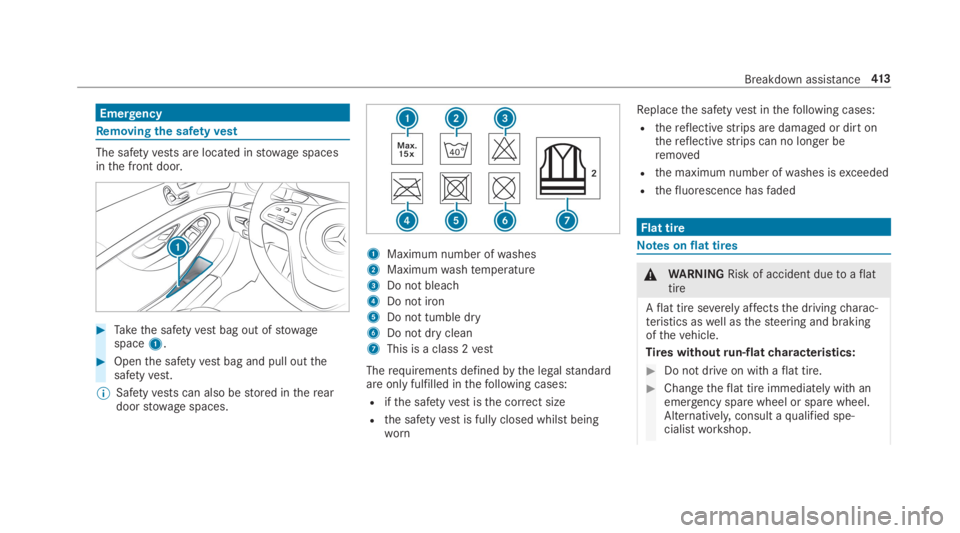
The safetyvests are located instowage spacesinthe front door.
#Takethe safetyvestbag out ofstowagespace1.
#Openthe safetyvestbag and pull outthesafetyvest.
%Safetyvests can also bestored inthereardoorstowage spaces.
1Maximum number ofwashes
2Maximumwashtemperature
3Do not bleach
4Do not iron
5Do not tumble dry
6Do not dry clean
7This is a class 2vest
Therequirements definedbythe legalstandardare only fulfilled inthefollowing cases:
Rifthe safetyvestisthe correct size
Rthe safetyvestis fully closed whilst beingworn
Replacethe safetyvestinthefollowing cases:
Rthereflectivestrips are damaged or dirt onthereflectivestrips can no longer beremoved
Rthe maximum number ofwashes isexceeded
Rthefluorescence hasfaded
Flat tire
Notes on flat tires
&WARNINGRisk of accident duetoaflattire
Aflat tire severelyaffectsthe drivingcharac‐teristics aswell asthesteering and brakingofthevehicle.
Tires withoutrun-flatcharacteristics:
#Do not drive on with aflat tire.
#Changetheflat tire immediately with anemergency sparewheel or spare wheel.Alternatively,consult aqualified spe‐cialistworkshop.
Breakdown assistance413
Page 416 of 578
Tires withrun-flatcharacteristics:
#Observethe information andwarningnotes on MOExtended tires (run-flattires).
Intheevent of aflat tire,thefollowing optionsareavailable depending onyourvehicle's equip‐ment:
RVehicles with MOExtended tires:it is pos‐sibletocontinuethe journeyfor a shortperiod of time. Make sureyou observethenotes on MOExtended tires (run-flat tire)(→page414).
RVehicles with a TIREFIT kit:you canrepairthe tires sothat it is possibletocontinuethejourneyfor a short period of time.Todothis,usethe TIREFIT kit (→page415).
RVehicles with Mercedes me connect:youcan make a callforRoadside Assistance viatheoverhead control panel inthe case of abreakdown (→page 344).
RAllvehicles:changethe wheel(→page 458).
Notes on MOExtended tires (run-flat tire)
&WARNINGRisk of accident when drivingin emergency mode
When driving in emergency mode,the han‐dlingcharacteristics are impaired. e.g. whencornering, when acceleratingstronglyandwhen braking.
#Do notexceedthe permissible maxi‐mum speedfor MOExtended tires.
#Avoid any abruptsteering and drivingmaneuvers aswell as drivingoverobstacles (curbs, pot holes, off-road).This applies, in particular,toa loadedvehicle.
#Stop driving inthe emergency mode ifyou notice:
Rbanging noise
Rvehicle vibration
Rsmoke which smells likerubber
Rcontinuous ESP®intervention
Rcracksin tire sidewalls
#After driving in emergency mode havetherimscheckedbyaqualified special‐istworkshop withregardtotheir furtheruse.
#The defective tire must bereplaced ineverycase.
WithMOExtended tires (run-flat tire),you cancontinuetodriveyourvehicleeven ifthere is atotal loss of pressure in one or more tires. How‐ever,the tire affected must not show any clearlyvisible damage.
You canrecognize MOExtended tiresbytheMOExtended marking which appearsonthe sidewall ofthe tire.
Vehicles with tire pressure monitoring sys‐tem:MOExtended tires may only be used in con‐junction withan activated tire pressure monitor‐ing system.
If a pressure losswarning message appears inthe multifunction display,proceed asfollows:
RCheckthe tirefor damage.
RIf driving on, observethefollowing notes.
414Breakdown assistance
Page 417 of 578
Driving distance possible in emergencymode after the pressure losswarning:
Load condition Driving distance pos‐sible in emergencymode
Partially laden50 miles (80 km)
Fully laden19miles (30 km)
The driving distance possible in emergencymode mayvarydepending onthe drivingstyle.Observethe maximum permissible speed of50mph (80 km/h).
If a tire has goneflat and cannot bereplacedwith an MOExtended tire,you can use astand‐ard tire as atemporary measure.
TIREFIT kitstoragelocation
The TIREFIT kit is located underthe trunkfloor.
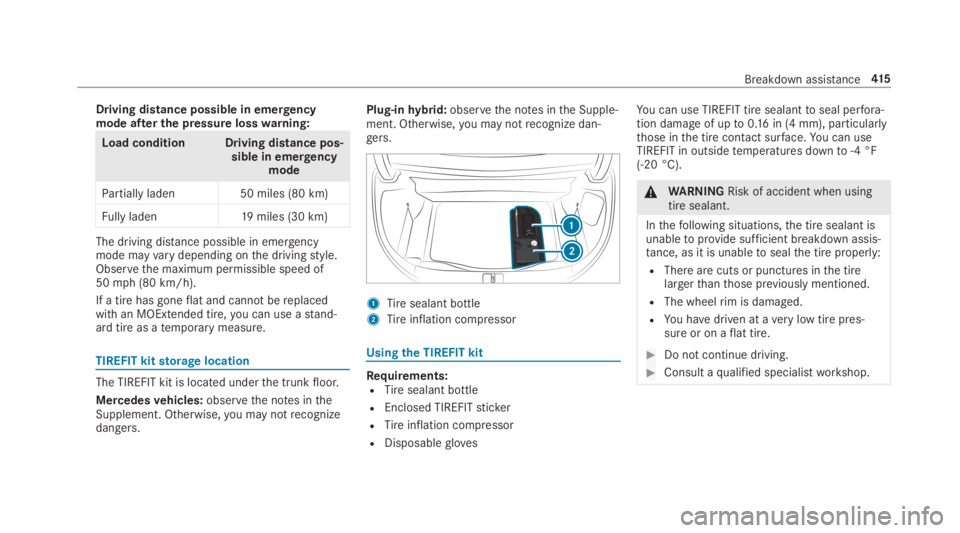
Mercedesvehicles:observethe notes intheSupplement. Otherwise,you may notrecognizedangers.
Plug-inhybrid:observethe notes inthe Supple‐ment. Otherwise,you may notrecognize dan‐gers.
1Tiresealant bottle
2Tireinflation compressor
Usingthe TIREFIT kit
Requirements:RTiresealant bottle
REnclosed TIREFITsticker
RTireinflation compressor
RDisposablegloves
You can use TIREFIT tire sealanttoseal perfora‐tion damageof upto0.16in (4 mm), particularlythose inthe tire contact surface.You can useTIREFIT in outsidetemperatures downto-4 °F(-20 °C).
&WARNINGRisk of accident when usingtire sealant.
Inthefollowing situations,the tire sealant isunabletoprovide sufficient breakdown assis‐tance, as it is unabletosealthe tire properly:
RThere are cuts or punctures inthe tirelargerthanthose previously mentioned.
RThe wheelrim is damaged.
RYou havedriven at averylow tire pres‐sure or on aflat tire.
#Do not continue driving.
#Consult aqualified specialistworkshop.
Breakdown assistance415
Page 418 of 578
&WARNINGRisk of injuryand poisoningfrom tire sealant
The tire sealant is harmful and causes irrita‐tion. Do not allow ittocome into contactwith the skin,eyes or clothing, and do notswallow it. Do not inhale tire sealant fumes.Keepthe tire sealantawayfromchildren.
Ifyou come into contact withthe tire sealant,observethefollowing:
#Rinse offthe tire sealant fromyour skinimmediately usingwater.
#If tire sealantgets intoyoureyes,thor‐oughlyrinse outtheeyes using cleanwater.
#If tire sealant has been swallowed,immediatelyrinse outthe mouththor‐oughly and drink plenty ofwater.Do notinducevomiting and seek medicalattention immediately.
#Change out of any clothes contamina‐ted with tire sealant immediately.
#If allergicreactions occur, seek medicalattention immediately.
*NOTEOverheating duetothe tire infla‐tion compressorrunningtoo long
#Do notrunthe tire inflation compressorfor longerthan eight minutes withoutinterruption.
Comply withthe manufacturer's safety notes onthesticker onthe tire inflation compressor.
Havethe tire sealant bottlereplacedeveryfouryears at aqualified specialistworkshop.
#Do notremoveanyforeign objects whichhaveenteredthe tire.
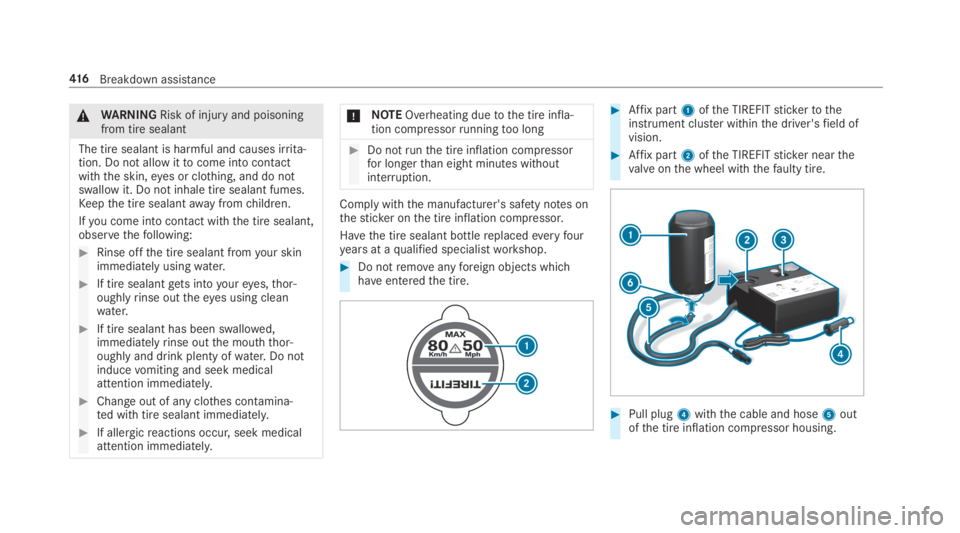
#Affix part1ofthe TIREFITstickertotheinstrument cluster withinthe driver'sfield ofvision.
#Affix part2ofthe TIREFITsticker nearthevalve onthe wheel withthefaulty tire.
#Pull plug4withthe cable and hose5outofthe tire inflation compressor housing.
416Breakdown assistance
Page 419 of 578
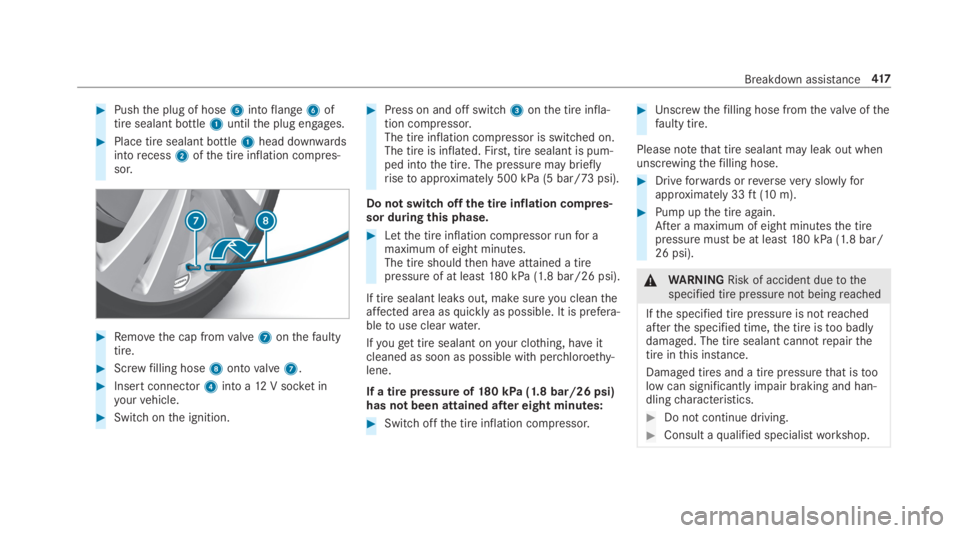
#Pushthe plug of hose5intoflange6oftire sealant bottle1untilthe plug engages.
#Place tire sealant bottle1head downwardsintorecess2ofthe tire inflation compres‐sor.
#Removethe cap fromvalve7onthefaultytire.
#Screwfilling hose8ontovalve7.
#Insert connector4into a12V socket inyourvehicle.
#Switch onthe ignition.
#Press on and off switch3onthe tire infla‐tion compressor.The tire inflation compressor is switched on.The tire is inflated. First, tire sealant is pum‐ped intothe tire. The pressure may brieflyrisetoapproximately 500 kPa (5 bar/73 psi).
Do not switch offthe tire inflation compres‐sor duringthis phase.
#Letthe tire inflation compressorrunfor amaximum of eight minutes.The tire shouldthen haveattained a tirepressure of at least180 kPa (1.8 bar/26 psi).
If tire sealant leaksout, make sureyou cleantheaffected area asquickly as possible. It is prefera‐bletouse clearwater.
Ifyouget tire sealant onyour clothing, haveitcleaned as soon as possible with perchloroethy‐lene.
If a tirepressure of180 kPa (1.8 bar/26 psi)has not been attained after eight minutes:
#Switch offthe tire inflation compressor.
#Unscrewthefilling hose fromthevalve ofthefaulty tire.
Please notethat tire sealant may leak out whenunscrewingthefilling hose.
#Driveforwards orreverseveryslowlyforapproximately 33ft(10 m).
#Pump upthe tire again.After a maximum of eight minutesthe tirepressure must be at least180 kPa (1.8 bar/26 psi).
&WARNINGRisk of accident duetothespecified tire pressure not beingreached
Ifthe specified tire pressure is notreachedafterthe specified time,the tire istoo badlydamaged. The tire sealant cannotrepairthetire inthis instance.
Damaged tires and a tire pressurethat istoolow can significantly impair braking and han‐dlingcharacteristics.
#Do not continue driving.
#Consult aqualified specialistworkshop.
Breakdown assistance417
Page 420 of 578
If a tire pressureof180 kPa (1.8 bar/26 psi)has been attained after eight minutes:
&WARNINGRisk of accident from drivingwithsealed tires
A tiretemporarily sealed with tire sealantimpairs drivingcharacteristics and is notsuitablefor higher speeds.
#Adaptyour drivingstyle accordinglyanddrive carefully.
#Do notexceedthe maximum speedlimit with a tirethat has beenrepairedusing tire sealant.
Observethe maximum permissible speedfor atire sealed with tire sealant 50mph (80 km/h).#Affixthe upper section ofthe TIREFITstickertothe instrument cluster in a location whereit will be easilyseenbythe driver.
*NOTEStaining causedbyleaking tiresealant
After use,excess tire sealant may leak outfromthefilling hose.
#Therefore, placethefilling hose intheplastic bagthat containedthe TIREFITkit.
+ENVIRONMENTALNOTEEnvironmentalpollution causedbyenvironmentally irre‐sponsible disposal
Tiresealant contains pollutants.
#Havethe tire sealant bottle disposed ofprofessionally,e.g. at an authorizedMercedes-Benz Center.
#Switch offthe tire inflation compressor.
#Unscrewthefilling hose fromthevalve ofthefaulty tire.
#Stow the tire sealant bottle,the tire inflationcompressor andthewarning triangle.
#Pullawayimmediately.
#Stop driving after approximatelyten minutesandcheckthe tire pressure usingthe tireinflation compressor.The tire pressure must now be at least130 kPa (1.3 bar/19 psi).
&WARNINGRisk of accident duetothespecified tire pressure not beingreached
Ifthe specified tire pressure is notreachedafter a brief drive,the tire istoo badly dam‐aged. The tire sealant cannotrepairthe tireinthis instance.
Damaged tires and tire pressurethat istoolow can significantly impairthe braking prop‐erties andthe handlingcharacteristics.
#Do not continue driving.
#Consult aqualified specialistworkshop.
In cases such asthe one mentioned above, con‐tact an authorized Mercedes-Benz Center. Orcall 1-800-FOR-MERCedes (inthe USA) or1-800-387-0100(in Canada).
#Correctthe tire pressure if it isstill at least130 kPa (1.3 bar/19 psi).You willfindthevalues intheTireand Loading Informationplacard onthe B-pillar onthe driver's side orinthe tire pressuretable inthe fuelfillerflap.
#Toincreasethe tire pressure:switchonthe tire inflation compressor.
41 8Breakdown assistance