fuel pressure MERCEDES-BENZ S-CLASS CABRIOLET 2019 Owner's Manual
[x] Cancel search | Manufacturer: MERCEDES-BENZ, Model Year: 2019, Model line: S-CLASS CABRIOLET, Model: MERCEDES-BENZ S-CLASS CABRIOLET 2019Pages: 518, PDF Size: 13.78 MB
Page 5 of 518
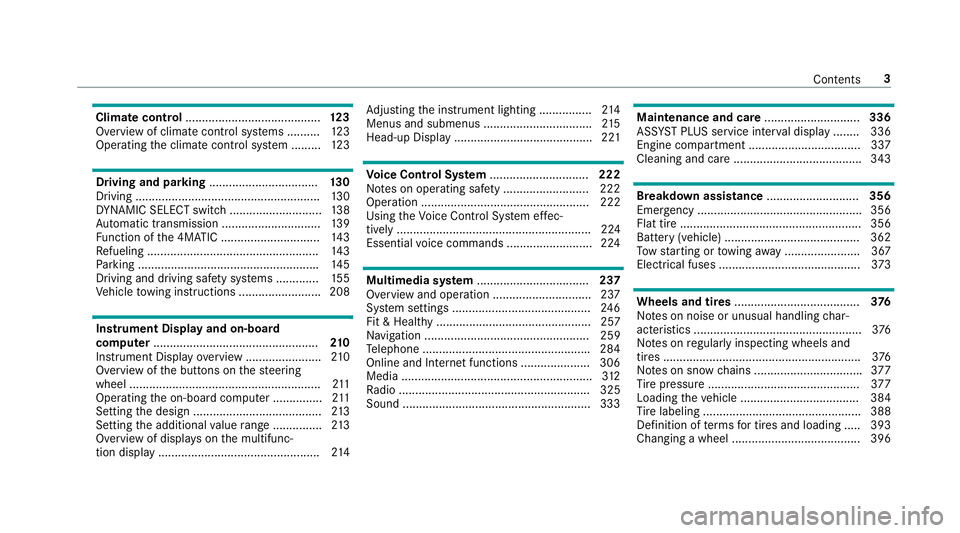
Climate control
......................................... 12 3
Overview of climate contro l systems ..........1 23
Operating the climate control sy stem ......... 12 3 Driving and pa
rking ................................. 13 0
Driving ........................................................ 13 0
DY NA MIC SELECT switch ............................1 38
Au tomatic transmission .............................. 13 9
Fu nction of the 4MATIC .............................. 14 3
Re fueling .................................................... 14 3
Pa rking ...................................................... .145
Driving and driving saf ety sy stems .............1 55
Ve hicle towing instructions ........................ .208 Instrument Display and on-board
comp uter.................................................. 210
Instrument Display overview ...................... .210
Overview of the buttons on thesteering
wheel ..........................................................2 11
Operating the on-board computer ............... 211
Setting the design ....................................... 213
Setting the additional value range ............... 213
Overview of displa yson the multifunc‐
tion display .................................................2 14Ad
justing the instrument lighting ................2 14
Menus and submenus ................................. 215
Head-up Display .......................................... 221 Vo
ice Control Sy stem .............................. 222
No tes on operating saf ety .......................... 222
Ope ration ................................................... 222
Using theVo ice Cont rol Sy stem ef fec‐
tively ........................................................... 224
Essential voice commands .......................... 224 Multimedia sy
stem .................................. 237
Overview and operation .............................. 237
Sy stem settings .......................................... 24 6
Fit & Healt hy............................................... 257
Na vigation .................................................. 259
Te lephone .................................................. .284
Online and Internet functions ..................... 306
Media ..........................................................3 12
Ra dio .......................................................... 325
Sound .........................................................3 33 Maintenance and care
.............................336
ASS YST PLUS service inter val display ........ 336
Engine compartment .................................. 337
Cleaning and care ...................................... .343 Breakdown assi
stance ............................ 356
Emergency ................................................. .356
Flat tire ....................................................... 356
Battery (vehicle) ......................................... 362
To w starting or towing away ....................... 367
Electrical fuses ........................................... 373 Wheels and tires
...................................... 376
No tes on noise or unusual handling char‐
acteristics .................................................. .376
No tes on regular lyinspecting wheels and
tires ............................................................ 376
No tes on snow chains ................................ .377
Ti re pressure .............................................. 377
Loading theve hicle .................................... 384
Ti re labeling ................................................ 388
Definition of term sfo r tires and loading ..... 393
Changing a wheel ....................................... 396 Contents
3
Page 13 of 518
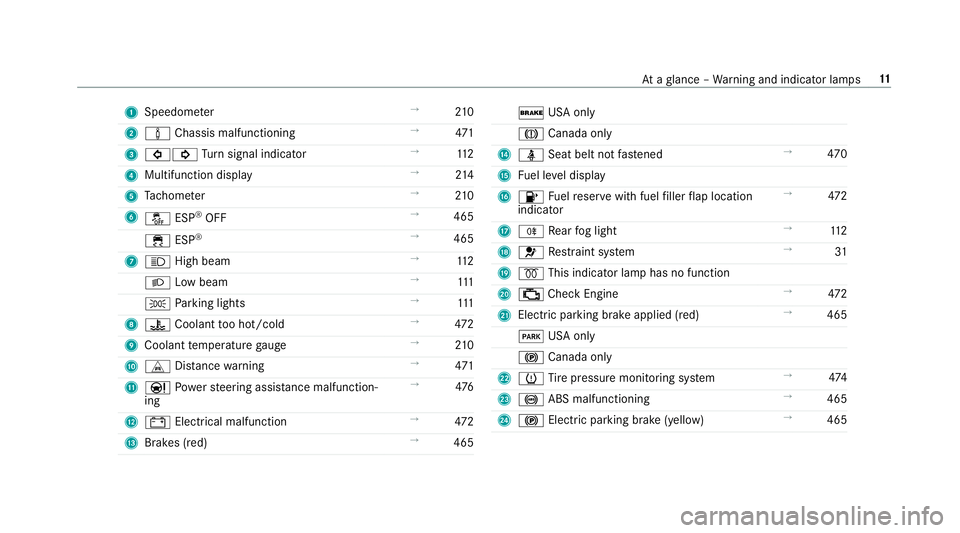
1
Speedom eter →
210
2 00CC Chassis malfunctioning →
471
3 003E003D Turn signal indicator →
11 2
4 Multifunction display →
214
5 Tach ome ter →
210
6 00BB ESP®
OFF →
465
00E5 ESP®
→
465
7 0057 High beam →
11 2
0058 Low beam →
111
0060 Parking lights →
111
8 00AC Coolant too hot/cold →
472
9 Coolant temp erature gauge →
210
A L Distance warning →
471
B 00CC Powe rst eering assis tance malfunction‐
ing →
476
C 003D Electrical malfunction →
472
D Brakes (red) →
465 0027
USA only
004D Canada only
E 00E9 Seat belt not fastened →
470
F Fuel le vel display
G 00B6 Fuelreser vewith fuel filler flap location
indicator →
472
H 005E Rear fog light →
11 2
I 0075 Restra int sy stem →
31
J 0028 This indicator lamp has no function
K 00B9 Check Engine →
472
L Electric pa rking brake applied (red) →
465
0049 USA only
0024 Canada only
M 0077 Tire pressure monitoring sy stem →
474
N 0025 ABS malfunctioning →
465
O 0024 Electric pa rking brake (yellow) →
465 At
aglance – Warning and indicator lamps 11
Page 21 of 518
Pr
otecting the environment
+ ENVIRONMENTAL
NOTEEnvironmental
dama gedue tooperating conditions and
personal driving style The pollutant emission of
your vehicle is
directly related tothewa yyo u operate your
ve hicle.
Help toprotect the environment byoperating
yo ur vehicle in an environmentally responsi‐
ble manner. Please obser vethefo llowing rec‐
ommendations on ope rating conditions and
pe rsonal driving style.
Operating conditions: #
Make sure that the tire pressure is cor‐
re ct. #
Do not car ryany unnecessary weight
(e.g. roof luggage rack s once you no
lon ger need them). #
Adhere tothe service inter vals.
A regularly serviced vehicle will contri b‐
ute toenvironmen tal pr otection. #
Alw ays ha vemaintenance workcar ried
out at a qualified specialist workshop.
Pe rsonal driving style: #
Do not depress the accelera tor pedal
when starting the engine. #
Do not warm upthe engine while the
ve hicle is stationar y. #
Drive carefully and maintain a suitable
di st ance from theve hicle in front. #
Avoid frequent, sudden acceleration
and braking. #
Change gear in good time and use each
ge ar on lyup to00C3 of its maximum
engine speed. #
Switch off the engine in stationary traf‐
fi c, e.g. byusing the ECO start/ stop
function. #
Drive fuel-ef ficiently. Obser vethe ECO
display for a fuel-ef ficient driving style. Environmental issues and
recommendations:
It is recommended that youre -use or recycle
materials ins tead of just disposing of them.
The releva nt environmental guidelines and regu‐
lations ser vetoprotect the environment and
must be strictly obser ved. Genuine Mercedes-Benz parts
+ ENVIRONMEN
TALNO TEEnvironmental
dama gecaused bynot using recycled
re conditioned components Daimler
AGoffers recycled reconditioned
components and pa rts with the same quality
as new parts. The same entitlement from the
Limited Warranty is valid as for new parts. #
Use recycled reconditioned compo‐
nents and pa rts from Daimler AG. Gene
ral no tes 19
Page 144 of 518

#
Toactivate: pullsteering wheel paddle
shif ter1 or2.
Manual gearshifting is activated for a short
time. The cur rent gear is displa yed in the
multifunction displa y.
% How long the manual gearshifting stay s acti‐
va ted is dependent on the driving style. #
Toshift up: pullsteering wheel paddle
shif ter2. #
Toshift down: pullsteering wheel paddle
shif ter1. #
Todeactivate: pullsteering wheel paddle
shif ter2 and hold it in place.
The transmission position 005Bappears in the
multifunction displa y.
Pe rm anent setting: #
Change todrive prog ram =(→ page138). #
Select drive program Manual(→page 139).
Mercedes-AMG vehicles: observeth e no tes in
th e Supplement. Otherwise, you may failto rec‐
ognize dangers. Gearshi
ftrecommendation Mercedes
-AMG vehicles: observeth e no tes in
th e Supplement. Otherwise, you may failto rec‐
ognize dangers.
The gearshift recommendation assists you in
adopting an economical driving style. #
Ifge arshift recommendation message 1is
shown on the multifunction displa y,shift to
th ere commended gear. Using kickd
own Mercedes-AMG
vehicles: observeth e no tes in
th e Supplement. Otherwise, you may failto rec‐
ognize dangers. #
Maximum acceleration: depress the accel‐
erator pedal be yond the pressure point.
The automatic transmission shifts up tothe next
ge ar when the maximum engine speed is
re ached toprotect the engine from overrev ving. Glide mode function
Wi
th an anticipatory driving style, glide mode
helps youto reduce fuel consum ption.
Glide mode is characterized bythefo llowing:
R The combustion engine is disconnected from
th e driv etra in and theve hicle continues to
ro ll in neut ral.
R The transmission position 005Bis displa yed in
green in the multifunction displa y.14 2
Driving and pa rking
Page 147 of 518
*
NO
TEFuel may spr ayout when you
re mo vethe fuel pump nozzle. #
Only fill th e fuel tank until the pump
nozzle switches off. Re
quirements:
R The vehicle is unloc ked.
% Do not get into theve hicle again during the
re fueling process. Otherwise, electros tatic
ch arge could build up again.
Obser vethe no tes on operating fluids
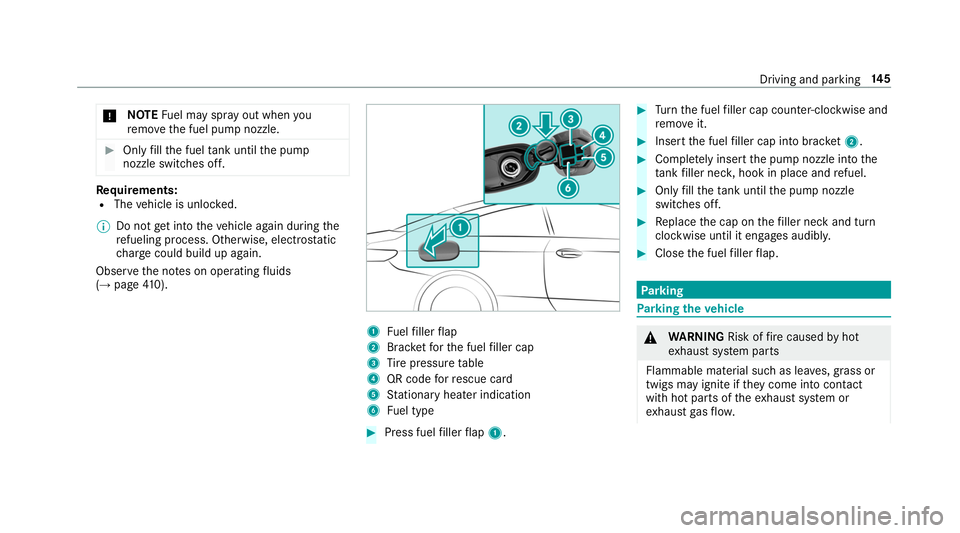
(→ page 410). 1
Fuelfiller flap
2 Brac ketfo rth e fuel filler cap
3 Tire pressure table
4 QR code forre scue card
5 Stationary heater indication
6 Fuel type #
Press fuel filler flap 1. #
Turn the fuel filler cap coun ter-clockwise and
re mo veit. #
Insert the fuel filler cap into brac ket2. #
Comp lete ly inse rtthe pump nozzle into the
ta nk filler nec k,hook in place and refuel. #
Only fill th eta nk until the pump nozzle
switches off. #
Replace the cap on thefiller neck and turn
clockwise until it engages audibl y. #
Close the fuel filler flap. Pa
rking Pa
rking theve hicle &
WARNING Risk offire caused byhot
ex haust sy stem parts
Flammable material such as lea ves, grass or
twigs may ignite if they come into contact
wi th hot parts of theex haust sy stem or
ex haust gasflow. Driving and pa
rking 14 5
Page 363 of 518
If a tire pressu
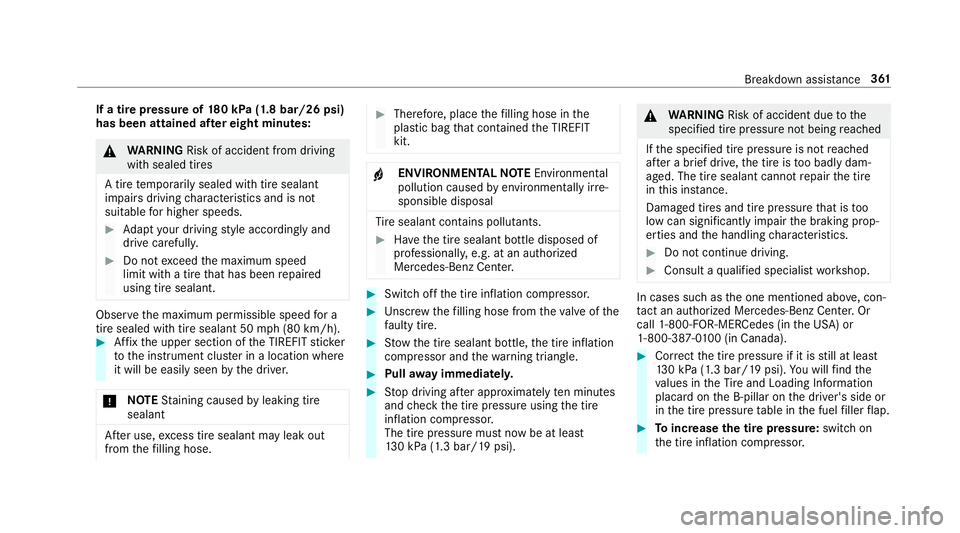
reof180 kPa (1.8 bar/26 psi)
has been attained af ter eight minutes: &
WARNING Risk of accident from driving
wi th sealed tires
A tire temp orarily sealed with tire sealant
impairs driving characteristics and is not
suitable for higher speeds. #
Adapt your driving style according lyand
drive carefull y. #
Do not exceed the maximum speed
limit with a tire that has been repaired
using tire sealant. Obser
vethe maximum permissible speed for a
tire sealed with tire sealant 50 mph (8 0 km/h). #
Affix th e upper section of the TIREFIT sticker
to the instrument clus ter in a location where
it will be easi lyseen bythe driver.
* NO
TEStaining caused byleaking tire
sealant Af
ter use, excess tire sealant may leak out
from thefilling hose. #
Therefore, place thefilling hose in the
plastic bag that con tained the TIREFIT
kit. +
ENVIRONMEN
TALNO TEEnvironmental
pollution caused byenvironmen tally ir re‐
sponsible disposal Ti
re sealant contains polluta nts. #
Have the tire sealant bottle disposed of
professionall y,e.g. at an authorized
Mercedes-Benz Center. #
Switch off the tire inflation compressor. #
Unscr ew thefilling hose from theva lve of the
fa ulty tire. #
Stow th e tire sealant bottle, the tire inflation
compressor and thewa rning triangle. #
Pull away immediatel y. #
Stop driving af ter appro ximately ten minu tes
and check the tire pressure using the tire
inflation compressor.
The tire pressure must now be at least
13 0 kPa (1.3 bar/19 psi). &
WARNING Risk of accident due tothe
specified tire pressure not being reached
If th e specified tire pressure is not reached
af te r a brief drive, the tire is too badly dam‐
aged. The tire sealant cannot repair the tire
in this ins tance.
Dama ged tires and tire pressure that is too
low can significantly impair the braking prop‐
erties and the handling characteristics. #
Do not continue driving. #
Consult a qualified specialist workshop. In cases such as
the one mentioned abo ve, con‐
ta ct an au thorized Mercedes-Benz Center. Or
call 1-800-FOR-MERC edes (inthe USA) or
1-800-387-0 100(in Canada). #
Cor rect the tire pressure if it is still at least
13 0 kPa (1.3 bar/19 psi). You will find the
va lues in theTire and Loading In form ation
placard on the B-pillar on the driver's side or
in the tire pressure table in the fuel filler flap. #
Toincrease the tire pressure: switchon
th e tire inflation compressor. Breakdown assis
tance 361
Page 380 of 518
R
The tires may wearexc essively and/or
une venly, which may greatlyimpair tire
traction.
R The driving characteristics, as well as
st eering and braking, may be greatly
impaired. #
Comply with there commended tire
pressure and check the tire pressure of
all tires including the spare wheel regu‐
larly:
R at least once a month
R when the load changes
R before embarking on a lon ger journey
R if operating conditions change, e.g. off-
ro ad driving #
Adjust the tire pressure as necessar y.Driving wi
thtire pressu rethat is too high or too
low can:
R Sho rten the service life of the tires.
R Cause increased tire damage. R
Adversely af fect driving characteristics and
th us driving saf ety, e.g. due to hydroplaning. &
WARNING Risk of an accident due to
insuf ficient tire pressure
Ti re s with pressure that is too low can over‐
heat and bur stas a result.
In addition, they also suf fer from excessive
and/or ir regular wear, which can significantly
impair the braking properties and the han‐
dling characteristics. #
Avoid excessively low tire pressures in
all the tires, including the spare wheel. Ti
re pressure which is too low can cause:
R Tire defects as a result of overheating
R Impaired handling characteristics
R Irre gular wear
R Increased fuel consum ption &
WARNING Risk of accident from exces‐
sive tire pressure
Ti re s with excessively high pressure can
bu rst because they are damaged more easily
by highw ayfill, pot holes etc.
In addition, they also suf fer from ir regular
we ar, which can significantly impair the brak‐
ing properties and the handling characteris‐
tics. #
Avoid excessively high tire pressures in
all the tires, including the spare wheel. Excessively high tire pressure can
result in:
R Increased braking dis tance
R Impaired handling characteristics
R Irre gular wear
R Impaired driving com fort
R Susceptibility todamage 378
Wheels and tires
Page 381 of 518
&
WARNING Risk of accident caused by
re peated drop in tire pressure
If th e tire pressure drops repeatedl y,the
wheel, valve or tire may be damaged.
Insuf ficient tire pressure can cause the tires
to bur st. #
Inspect the tire for signs of fore ign
objects. #
Check whe ther the wheel or valve has a
leak. #
Ifyo u are unable torectify the damage,
conta ct aqualified specialist workshop. Yo
u can find information on tire pressure forthe
ve hicle's factor y-ins talled tires on thefo llowing
labels:
R Tire and Loading In form ation placard on the
B‑pillar of your vehicle (→ page 384).
R Tire pressure table on the inside of the fuel
fi ller flap (→ page379).
Obse rveth e maximum tire pressure
(→ page 390). Use a suitable tire pressure
gauge tocheck the
tire pressu re. The ou ter appearance of a tire
does not permit any reliable conclusion about
th e tire pressure.
Ve hicles with a tire pressure monitoring sys‐
te m: You can also check the tire pressure using
th e on-board computer.
Only cor rect tire pressure when the tires are
cold. Conditions for cold tires:
R The vehicle has been par ked with the tires
out of direct sunlight for at least thre e hours.
R The vehicle has tr aveled less than 1 mile
(1.6 km).
A rise in the tire temp erature of 18°F (10 °C)
increases the tire pressure byappr ox.10 kPa
(0.1 bar/1.5 psi). Take this into account when
ch ecking the tire pressure of warm tires.
The tire pressu re recommended for increased
load/speed in the tire pressure table can af fect
th eride comfort. &
WARNING Risk of accident from unsuita‐
ble accesso ries on the tire valves
If yo u mount unsuitable accessories on totire
va lves, the tire valves may be overloaded and
malfunction, which can cause tire pressure
loss. Tire pressure monitoring sy stems for
re trofitting will cause the tire valve toremain
open. This can also result in tire pressure
loss. #
Only scr ewstandard valve caps or valve
caps specifically appr ovedby
Mercedes-Benz foryo ur vehicle onto
th e tire valve. Ti
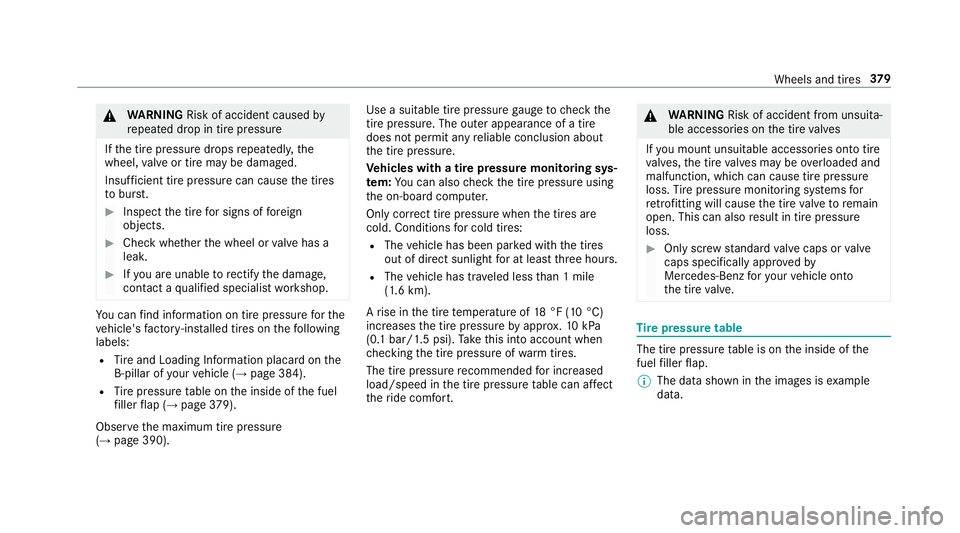
re pressure table The tire pressure
table is on the inside of the
fuel filler flap.
% The data shown in the images is example
data. Wheels and tires
37 9
Page 383 of 518
Fu
rther related subjects:
R Notes on tire pressure (→ page377)
R Tire pressure table (→ page379)
R Tire and Loading In form ation placard
(→ page 384) Ti
re pressure moni toring sy stem Fu
nction of the tire pressure moni toring sys‐
tem &
DANG ER Risk of accident due toincor‐
re ct tire pressure
Every tire, including the spare (if pr ovided),
should be checked when cold at least once a
month and inflated tothe pressure recom‐
mended bytheve hicle manufacturer (see
Ti re and Loading In form ation placard on the
B-pillar on the driver ’sside or the tire pres‐
sure label on the inside of the fuel filler flap
of your vehicle). If your vehicle has tires of a
dif fere nt size than the size indicated on the
Ti re and Loading In form ation placard or the tire pressu
retable, you need todeterm ine
th e proper tire pressure forth ose tires.
As an added saf etyfe ature, your vehicle has
been equipped with a tire pressure monitor‐
ing sy stem (TPMS) that illuminates a low tire
pressure indicator lamp when one or more of
yo ur tires are significantly underinflated.
Ac cording ly, if the low tire pressure indicator
lamp lights up, you should stop and check
yo ur tires as soon as possible, and inflate
th em tothe proper pressure. Driving on a
significant lyunderinflated tire causes the tire
to ov erheat and can lead totire failure.
Un derinflation also increases fuel consump‐
tion and reduces tire tread life, and may
af fect theve hicle's handling and braking abil‐
ity. Please no tethat the TPMS is not a substi‐
tute for proper tire maintenance, and it is the
driver's responsibility tomaintain cor rect tire
pressure, even if underinflation has not
re ached the le velto trig ger illumination of
th e TPMS low tire pressure indicator lamp.
Yo ur vehicle has also been equipped with a
TPMS malfunction indicator toindicate when th
e sy stem is not operating proper ly. The
TPMS malfunction indica tor is combined with
th e low tire pressure indicator lamp. When
th e sy stem de tects a malfunction, the indica‐
to r lamp will flash for appro ximately a minute
and then remain continuously illumina ted.
This sequence will continue upon subsequent
ve hicle start-ups as long as the malfunction
ex ists.
When the malfunction indicator is illumina‐
te d, the sy stem may not be able todetect or
signal low tire pressure as intended. TPMS
malfunctions may occur for a variet y of rea‐
sons, including the ins tallation of incompati‐
ble replacement or alternate tires or wheels
on theve hicle that pr eventthe TPMS from
functioning properly.
Alw aysch eck the TPMS malfunction warning
lamp af terre placing one or more tires or
wheels on your vehicle toensure that the
re placement or alternate tires and wheels
allow the TPMS tocontinue tofunction prop‐
erly. Wheels and tires
381
Page 396 of 518
Un
iform Tire Quality Grading Standards: a
uniform standard tograde thequ ality of tires
with rega rd totread qualit y,tire traction and
te mp erature characteristics. The quality grading
assessment is made bythe manufacturer follow‐
ing specifications from theU. S. go vernment. The
qu ality grade of a tire is imprinted on the side
wa ll of the tire.
Re commended tire pressu re:there commen‐
ded tire pressure is the tire pressure specified
fo rth e tires mounted totheve hicle at thefa c‐
to ry.
The tire and information table con tains there c‐
ommended tire pressures for cold tires, the max‐
imum permissible load and the maximum per‐
missible vehicle speed.
The tire pressure table con tains there commen‐
ded tire pressures for cold tires under various
operating conditions, i.e. loading and/or speed
of theve hicle.
Increased vehicle weight due tooptional
equipment: the combined weight of all standard
and optional equipment available forth eve hicle, re
ga rdless of whe ther it is actually ins talled on
th eve hicle or not.
Rim: the part of the wheel on which the tire is
ins talled.
GA WR (Gross Axle Weight Rating): the GAWR
is the maximum permissible axle load. The
actual load on an axle must ne verexc eed the
gross axleweight rating. The gross axle weight
ra ting can be found on theve hicle identification
plate on the B‑pillar on the driver's side.
Speed rating: the speed rating is pa rtof the tire
identification. It specifies the speed range for
which a tire is appr oved.
GV W (Gross Vehicle Weight): the gross vehicle
we ight comprises thewe ight of theve hicle
including fuel, tools, the spare wheel, accesso‐
ri es ins talled, occupants, luggage and the trailer
dr aw bar nose weight, if applicable. The gross
ve hicle weight must not exceed the gross vehicle
we ight rating GVWR as specified on theve hicle
identification plate on the B‑pillar on the driver's
side.
GV WR (Gross Vehicle Weight Rating): the
GV WR is the maximum permitted gross weight of
the fully laden vehicle (weight of theve hicle
including all accessories, occupants, fuel, lug‐
ga ge and the trailer dr awbar nose weight if appli‐
cable). The grossvehicle weight rating is speci‐
fi ed on theve hicle identification plate on the
B‑pillar on the driver's side.
Maximum weight of the laden vehicle: the
maximum weight is the sum of the curb weight
of theve hicle, thewe ight of the accessories, the
maximum load and thewe ight of optional equip‐
ment ins talled at thefa ctor y.
Kilopascal (kPa): metric unitfor tire pressu re.
6.9 kPa cor responds to1 psi. Ano ther unit for
tire pressu reis bar. 100 kilopascal (kPa) equals
1 bar.
Load index: in additiontothe load-bearing
index, the load index may also be imprinted on
th e side wall of the tire. This specifies the load-
bearing capacity of the tire more precisel y.
Curb weight: thewe ight of a vehicle with stand‐
ard equipment including the maximum capacity
of fuel, oil and coolant. It also includes the air
conditioning sy stem and optional equipment if 394
Wheels and tires