tire type MERCEDES-BENZ S-CLASS CABRIOLET 2019 Owner's Manual
[x] Cancel search | Manufacturer: MERCEDES-BENZ, Model Year: 2019, Model line: S-CLASS CABRIOLET, Model: MERCEDES-BENZ S-CLASS CABRIOLET 2019Pages: 518, PDF Size: 13.78 MB
Page 19 of 518
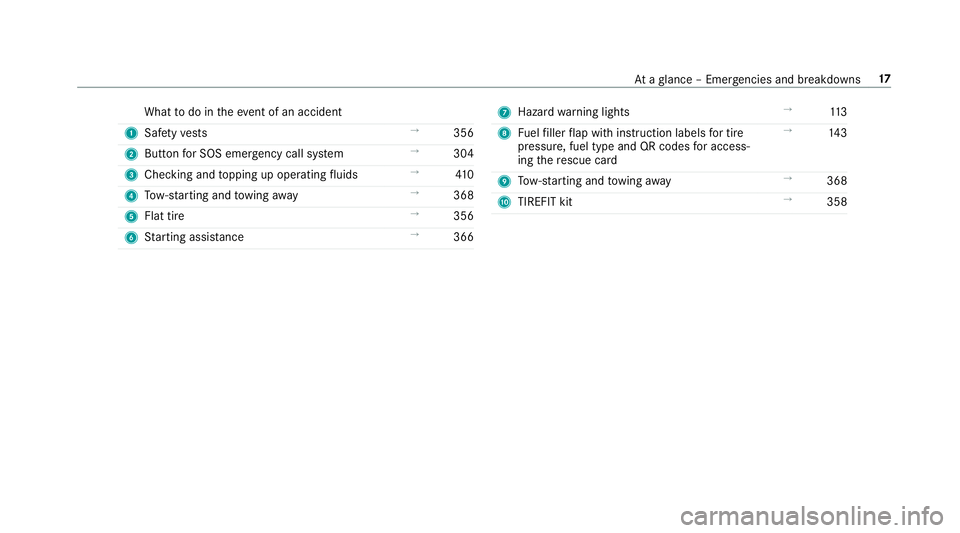
What
todo in theeve nt of an accident
1 Safetyve sts →
356
2 Button for SOS emergency call sy stem →
304
3 Checking and topping up operating fluids →
41 0
4 Tow- starting and towing away →
368
5 Flat tire →
356
6 Starting assis tance →
366 7
Haza rdwa rning lights →
11 3
8 Fuelfiller flap with instruction labels for tire
pressu re, fuel type and QR codes for access‐
ing there scue card →
14 3
9 Tow- starting and towing away →
368
A TIREFIT kit →
358 At
aglance – Emer gencies and breakdowns 17
Page 30 of 518
sonal data may be used
forth e pr ovision of
online services. Data is exch anged via a secure
connection, e.g. the manufacturer's designated
IT sy stems. Personal data is collected, pro‐
cessed and used via the pr ovision of services
exc lusively on the basis of legal permissions or
with prior consent.
The services and functions (sometimes subject
to afe e) can usually be activated or deactivated.
In some cases, this also applies tothe entire
ve hicle's data connection. This excludes, in par‐
ticular, legally prescribed functions and services.
Third pa rty services
If it is possible touse online services from other
pr ov iders, these services are subject tothe data
pr otection and term s of use of there sponsible
pr ov ider. The manufacturer has no influence on
th e conte ntexc hanged.
Please inquire, therefore, about the type, scope
and purpose of the collection and use of per‐
sonal data as part of third party services from
th eir respective pr ovider. COMAND/mbrace
If
th eve hicle is equipped with COMAND or
mbrace, additional data about theve hicle's oper‐
ation, the use of theve hicle in cer tain situations,
and the location of theve hicle may be compiled
th ro ugh COMAND or the mbrace sy stem.
Fo r additional information please referto the
ch ap ter Multimedia sy stem and/or the mbrace
Te rm s and Conditions. Event data
recorders USA onl
y:
This vehicle is equipped with an event data
re corder (EDR). The main pu rpose of an EDR is
to record, in cer tain crash or near crash-like sit‐
uations, such as an airbag deployment or hitting
a ro ad obs tacle, da tathat will assist in under‐
st anding how a vehicle's sy stems per form ed.
The EDR is designed torecord da tarelated to
ve hicle dynamics and saf ety sy stems for a short
period of time, typically 30 seconds or less. The EDR in
this vehicle is designed torecord
su ch data as:
R How various sy stems in your vehicle were
operating
R Whe ther or not the driver and front
passenger seat belts werebuckled/fas tened
R How far (if at all) the driver was depressing
th e accelera tor and/or brake pedal and
R How fasttheve hicle was tr aveling
This data can help pr ovide a better under stand‐
ing of the circums tances in which accidents and
inju ries occur. NOTE: EDR data is recorded by
yo ur vehicle only if a non-trivial crash situation
occurs; no data is recorded bythe EDR under
normal driving conditions and no personal data
(e.g. name, gende r,age and accident location) is
re corded. Ho wever,ot her parties, such as law
enforcement, could combine EDR data with the
type of pe rsonally identifying data routinely
acquired during a crash in vestigation.
Ac cess totheve hicle and/or the EDR is needed
to read data that is recorded bythe EDR, and
special equipment is required. In addition tothe
ve hicle manufacturer, other parties that ha vethe 28
General no tes
Page 50 of 518
De
tecting risks, avoiding dan ger Securing sy
stems forch ild restra int sy stems
in theve hicle
Only use thefo llowing securing sy stems forch ild
re stra int sy stems:
R theLA TC H-type (ISOFIX) mounting brac kets
R theve hicle's seat belt sy stem
Ins talling a LATC H-type (ISOFIX) child restra int
sy stem is prefer red.
Simply attaching tothe securing rings on the
ve hicle can reduce therisk of ins talling thech ild
re stra int sy stem incor rectl y.
When securing a child with the integrated seat
belt of theLA TC H-type (ISOFIX) child restra int
sy stem, alw ays comply with the permissible
gross weight forth ech ild and child restra int sys‐
te m (→ page 52).
A boos ter seat may be necessary toachie ve
proper seat belt positioning forch ildren over
40 lbs (18 kg) in weight or until they reach a
height where a thre e-point seat belt can be
ins talled proper lywithout a boos ter seat. Mercedes-Benz
recommends a suitable child
boos ter seat with a backrest and seat belt guide.
Ad vantage of a rear wa rd-facing child
re stra int sy stem
It is preferable totranspo rta baby or a small
ch ild in a suitable rear wa rd-facing child restra int
sy stem. In this case, thech ild sits in the oppo‐
site direction tothe direction of tr avel and faces
ba ckwa rds.
Babies and small children ha vecompa ratively
we ak neck muscles in relation tothe size and
we ight of their head. The risk of injury tothe cer‐
vical spine during an accident can be reduced in
a re ar wa rd-facing child restra int sy stem.
Alw ays secure a child restra int sy stem cor‐
re ctly &
WARNING Risk of inju ryor death caused
by incor rect ins tallation of thech ild
re stra int sy stem
If th ech ild restra int sy stem is incor rectly
ins talled on a suitable seating position, it
cannot per form its intended pr otective func‐
tion. The
child cannot be restra ined in theeve nt of
an accident, heavy braking or a sudden
ch ange of direction. #
Alw ays comply with the manufacturer's
ins tallation instructions forth ech ild
re stra int sy stem and its cor rect use. #
Makesure that the entire base of the
ch ild restra int sy stem alw aysre sts on
th e sitting sur face of the seat. #
Never place objects under or behind
th ech ild restra int sy stem, e.g. cush‐
ions. #
Alw ays use child restra int sy stems with
th e original co ver designed forth em. #
Alw aysre place damaged co vers with
ge nuine co vers. &
WARNING Risk of inju ryor death from
unsecured child restra int sy stems in the
ve hicle
If th ech ild restra int sy stem is not cor rectly
ins talled or secured, it could release in the 48
Occupant saf ety
Page 147 of 518
*
NO
TEFuel may spr ayout when you
re mo vethe fuel pump nozzle. #
Only fill th e fuel tank until the pump
nozzle switches off. Re
quirements:
R The vehicle is unloc ked.
% Do not get into theve hicle again during the
re fueling process. Otherwise, electros tatic
ch arge could build up again.
Obser vethe no tes on operating fluids
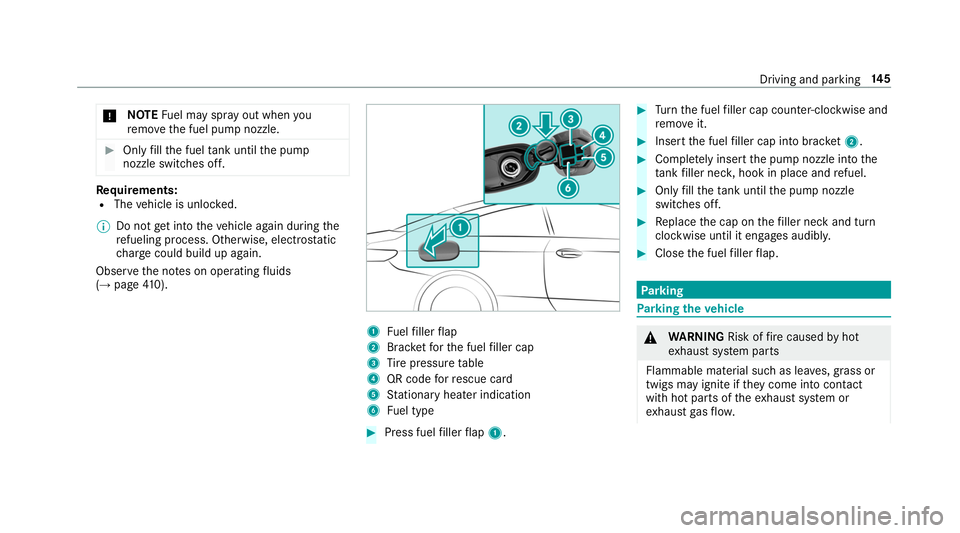
(→ page 410). 1
Fuelfiller flap
2 Brac ketfo rth e fuel filler cap
3 Tire pressure table
4 QR code forre scue card
5 Stationary heater indication
6 Fuel type #
Press fuel filler flap 1. #
Turn the fuel filler cap coun ter-clockwise and
re mo veit. #
Insert the fuel filler cap into brac ket2. #
Comp lete ly inse rtthe pump nozzle into the
ta nk filler nec k,hook in place and refuel. #
Only fill th eta nk until the pump nozzle
switches off. #
Replace the cap on thefiller neck and turn
clockwise until it engages audibl y. #
Close the fuel filler flap. Pa
rking Pa
rking theve hicle &
WARNING Risk offire caused byhot
ex haust sy stem parts
Flammable material such as lea ves, grass or
twigs may ignite if they come into contact
wi th hot parts of theex haust sy stem or
ex haust gasflow. Driving and pa
rking 14 5
Page 385 of 518
Make sure
toobser vethefo llowing fur ther rela‐
te d subjec t:
R Notes on tire pressure (→ page377)
Rest arting the tire pressure moni toring sys‐
tem
Requ irements:
R The recommended tire pressure is cor rectly
set forth ere spective operating condition on
each of thefo ur wheels (→ page377).
Re start the tire pressure monitoring sy stem in
th efo llowing situations:
R The tire pressure has changed.
R The wheels or tires ha vebeen changed or
newly ins talled.
On-board computer: , Service .
Tires #
Swipe down wards on Touch Control on the
left-hand side of thesteering wheel.
The Use Current Pressures as New Refer-
ence Values? message is shown in the multi‐
function displa y. #
Press 0076toconfirm there start.
The Run Flat Indicator Restarted message is
shown in the multifunction displa y.
Cur rent wa rning messages are dele ted and
th e0077 yellow warning lamp goes out.
Af teryo u ha vedriven for a few minutes, the
sy stem checks whe ther the cur rent tire pres‐
su res are within the specified range. The cur‐
re nt tire pressures are then accep ted as ref‐
erence values and monitored.
Make sure toobser vethefo llowing fur ther rela‐
te d subjec t:
R Notes on tire pressure (→ page377) Ra
dio equipment appr oval of the tire pres‐
sure moni toring sy stem
Ra dio equipment appr oval numbers Countr
yRadio type appr oval number
Canada IC: 2546A-GG4T IC: 2546A-DG6W2D4
IC: 2546A-MC34MA4
Le présent appareil est conforme
aux CNR d'Indu strie Canada
applicables aux appareils radio
exe mpts de licence. L'exploi ta‐
tion est au torisée aux deux con‐
ditions suivantes:
(1) l'appare il ne doit pas produire
de brouillage, et
(2) l'utilisateur de l'appareil doit
accep terto ut brouillage radioé‐
lectrique subi, même si le
brouillage est susceptible d'en
compromettre lefonctionnement. Wheels and tires
383
Page 386 of 518
Count
ryRadio type appr oval number
US AF CC ID: MRXGG4T
FCC ID: MRXDG6W2D4
FCC ID: MRXMC34MA4
This device co mplies with Part15
of the FCC Rules. Operation is
subject tothefo llowing two con‐
ditions:
(1) This device may not cause
harmful inter fere nce, and
(2) This device mu staccept any
inter fere nce recei ved, including
inter fere nce that may cause
undesired operation. Loading
theve hicle Note
s onTire and Loading Information plac‐
ard &
WARNING Risk of accident from overloa‐
ded tires
Overloaded tires may overheat and bur stas a
consequence. Overloaded tires can also
impair thesteering and handling characteris‐
tics and lead tobrake failure. #
Obser vethe load-bearing capacity of
th e tires. #
The load-bearing capacity must be at
least half the gross axle weight rating of
th eve hicle. #
Neverove rload the tires by exceeding
th e maximum load. The
Tire and Loading In form ation placard is on
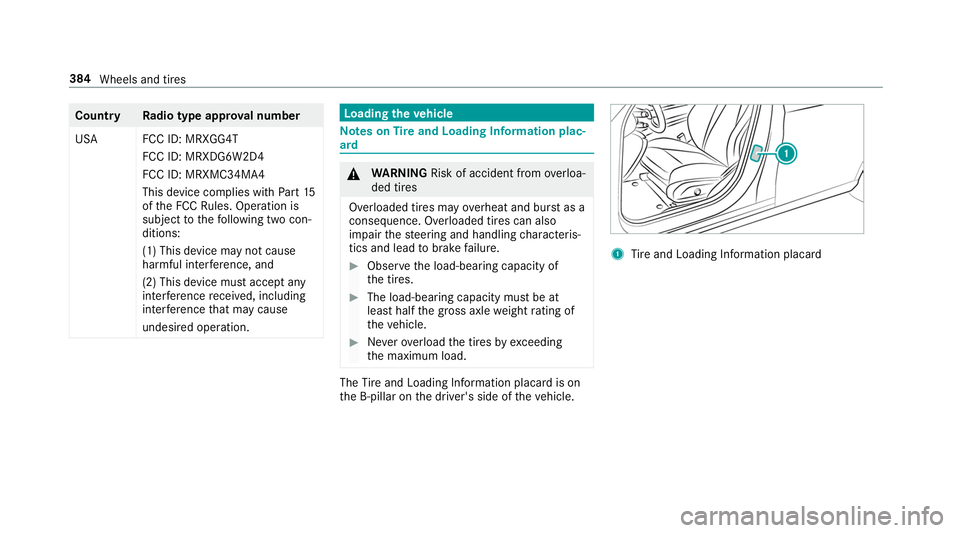
th e B-pillar on the driver's side of theve hicle. 1
Tire and Loading In form ation placard 384
Wheels and tires
Page 392 of 518
%
The data shown in the image is example
data.
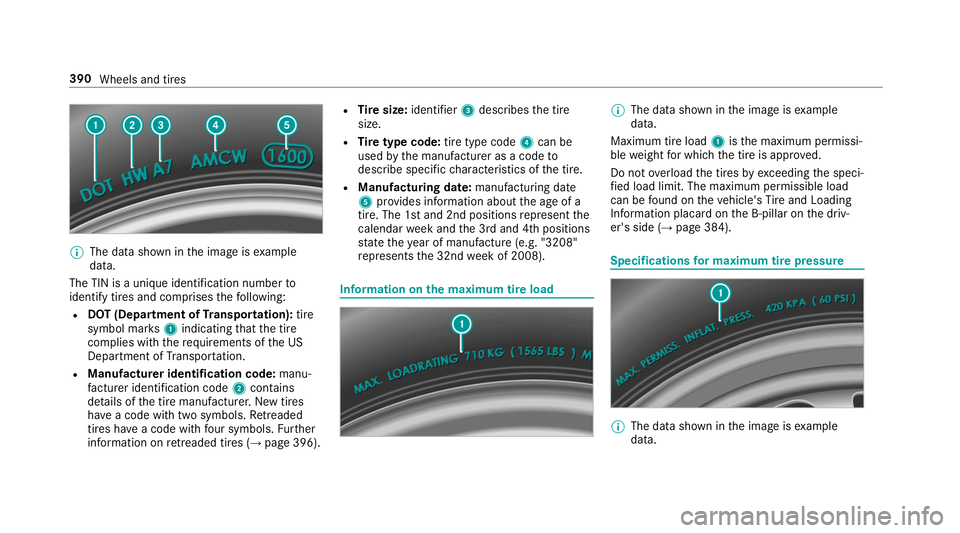
The TIN is a unique identification number to
identify tires and comprises thefo llowing:
R DOT (Department of Transpo rtation): tire
symbol mar ks1 indicating that the tire
complies with therequ irements of the US
Department of Transpor tation.
R Manufacturer identi fication code: manu‐
fa cturer identification code 2contains
de tails of the tire manufacturer. New tires
ha ve a code with two symbols. Retreaded
tires ha vea code with four symbols. Further
information on retreaded tires (→ page 396). R
Tire size: identifier 3describes the tire
size.
R Tire type code: tire type code 4can be
used bythe manufacturer as a code to
describe specific characteristics of the tire.
R Manufacturing date: manufacturing date
5 prov ides information about the age of a
tire. The 1st and 2nd positions represent the
calendar week and the 3rd and 4th positions
st ate theye ar of manufacture (e.g. "3208"
re presents the 32nd week of 2008). Information on
the maximum tire load %
The data shown in the image is example
data.
Maximum tire load 1isthe maximum permissi‐
ble weight for which the tire is appr oved.
Do not overload the tires by exceeding the speci‐
fi ed load limit. The maximum permissible load
can be found on theve hicle's Tire and Loading
In fo rm ation placard on the B-pillar on the driv‐
er's side (→ page 384). Specifications
for maximum tire pressure %
The da tashown in the image is example
data. 390
Wheels and tires
Page 393 of 518
Ne
verexc eed maximum tire pressure 1speci‐
fi ed forth e tire. Information on tire
characteristics %
The data shown in the image is example
data.
This information desc ribes the type of tire cord
and the number of la yers in side wall1 and
under tire tread 2. Ti
re size designation, load-bearing capacity,
speed rating and load index &
WARNING Risk of inju rythro ugh exceed‐
ing the specified tire load rating or the
permissible speed rating
Exceeding the specified tire load rating or
th e permissible speed rating may lead totire
dama geand tothe tires bur sting. #
Therefore, only use tire types and sizes
appr ovedfo ryo ur vehicle model. #
Obser vethe tire load rating and speed
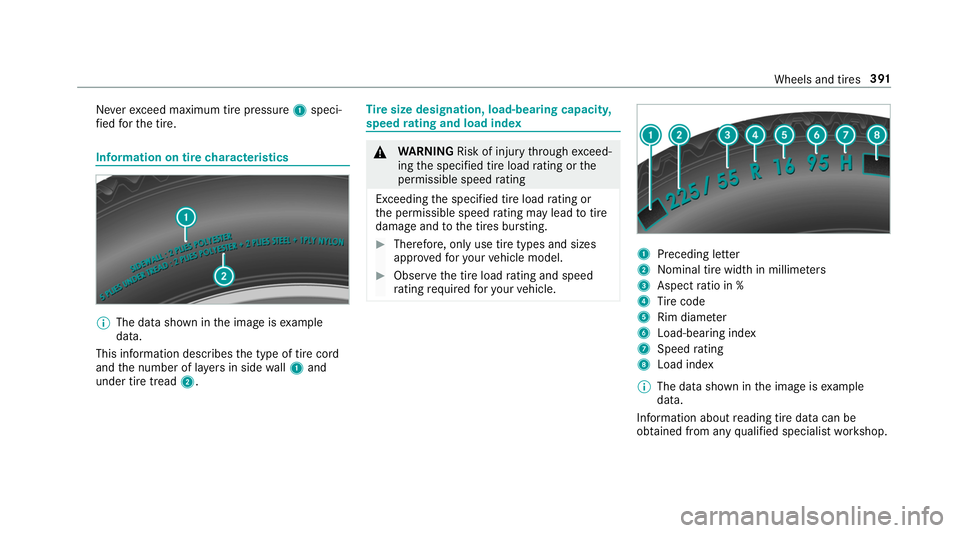
ra ting requ ired foryo ur vehicle. 1
Preceding letter
2 Nominal tire width in millime ters
3 Aspect ratio in %
4 Tire code
5 Rim diame ter
6 Load-bearing index
7 Speed rating
8 Load ind ex
% The data shown in the image is example
data.
In fo rm ation about reading tire data can be
obtained from any qualified specialist workshop. Wheels and tires
391
Page 394 of 518
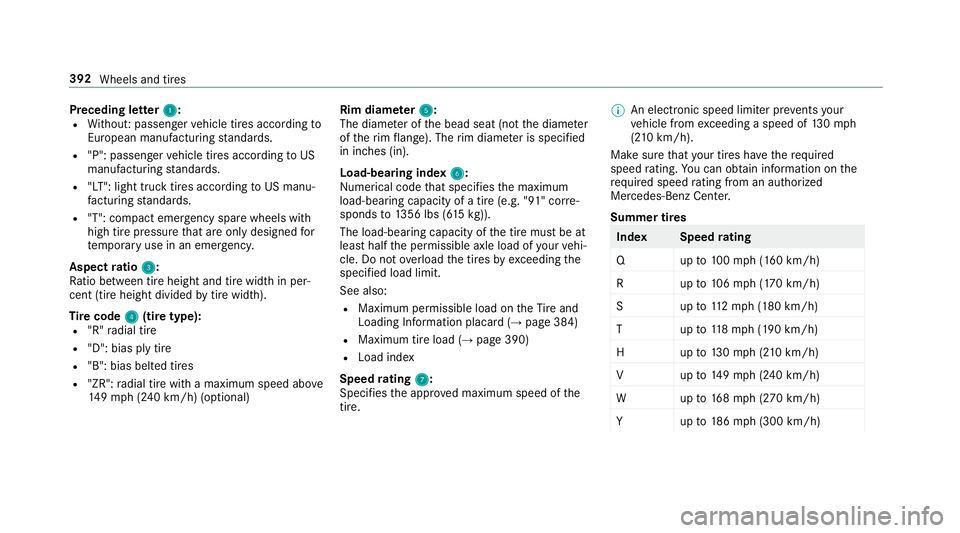
Preceding letter
1
1:
R Without: passenger vehicle tires according to
European manufactu ring standards.
R "P": passenger vehicle tires according toUS
manufacturing standards.
R "LT": light truck tires according toUS manu‐
fa cturing standards.
R "T": compact emer gency spa rewheels with
high tire pressure that are on ly designed for
te mp orary use in an emer gency.
Aspect ratio 3
3:
Ra tio between tire height and tire width in per‐
cent (ti reheight divided bytire width).
Tire code 4
4(tire type):
R "R" radial tire
R "D": bias ply tire
R "B": bias belted tires
R "ZR": radial tire with a maximum speed abo ve
14 9mp h (240 km/h) (optional) Rim diame
ter5
5:
The diam eter of the bead seat (not the diame ter
of therim flange). The rim diame ter is specified
in inches (in).
Load-bearing index 6 6:
Numerical code that specifies the maximum
load-bearing capacity of a tire (e.g. "91" cor re‐
sponds to1356 lbs (6 15kg)).
The load-bearing capacity of the tire must be at
least half the permissible axle load of your vehi‐
cle. Do not overload the tires byexc eeding the
specified load limit.
See also:
R Maximum permissible load on theTire and
Loading In form ation placard (→ page 384)
R Maximum tire load (→ page 390)
R Load ind ex
Speed rating 7 7:
Specifies the appr oved maximum speed of the
tire. %
An electronic speed limi ter pr events your
ve hicle from exceeding a speed of 130mph
(2 10 km/h).
Ma kesure that your tires ha vetherequ ired
speed rating. You can obtain information on the
re qu ired speed rating from an au thorized
Mercedes-Benz Center.
Summer tires Inde
xS peedrating
Qu pto 100mp h (160 km/h)
Ru pto 106mp h (170 km/h)
Su pto 112mp h (1 80 km/h)
Tu pto 118mp h (190 km/h)
Hu pto 130mp h (2 10km/h)
Vu pto 149mp h (2 40 km/h)
Wu pto 168mp h (270 km/h)
Yu pto 186mp h (3 00 km/h) 392
Wheels and tires
Page 397 of 518
th
ese are ins talled on theve hicle, but does not
include passengers or luggage.
Maximum tire load: the maximum tire load is
th e maximum permissible weight in kilog rams or
lbs for which a tire is appr oved.
Maximum permissible tire pressure: maxi‐
mum permissible tire pressure for one tire.
Maximum load on one tire: maximum load on
one tire. This is calculated bydividing the maxi‐
mum axle load of one axle bytwo.
PSI (pounds per square in ch):standard unit of
measurement for tire pressu re.
Aspect ratio: ratio between tire height and tire
width in pe rcent.
Ti re pressure: pressure inside the tire applying
an outward forc eto eve rysquare inch of the tire.
The tire pressure is specified in pounds per
square inch (psi), in kilopascals (kPa) or in bar.
The tire pressure should only be cor rected when
th e tires are cold.
Cold tire pressure: the tires are cold when the
ve hicle has been par kedfo r at least 3 hours without direct sunlight on
the tires or theve hicle
has been driven for less than 1 mile (1.6 km).
Ti re contact sur face: the part of the tire that
comes into con tact wi th thero ad.
Ti re bead: the purpose of the tire bead is to
ensure that the tire sits securely on the wheel
ri m. There are se veral wire cores in the tire bead
to preve ntthe tire from changing length on the
wheel rim.
Side wall:the part of the tire between the tread
and the tire bead.
We ight of optional equipment: the combined
we ight of the optional equipment weighing more
th an there placed standard parts and more than
5 lbs (2.3 kg).This optional equipment, such as
high-per form ance brakes, le vel control sy stem, a
ro of luggage rack or high-per form ance bat teries,
is not included in the curb weight and thewe ight
of the accessories.
TIN (Tire Identification Number): a unique
identification number which can be used by a
tire manufactu rerto identify tires, forex ample,
in a product recall, and thus identify the pur‐
ch asers. The TIN is made up of the manufactur‐ er's identity code, tire size, tire type code and
th e manufacturing date.
Load-bearing index: the load-bearing index is a
code that con tains the maximum load-bearing
capacity of a tire.
Tr action: traction is the grip resulting from fric‐
tion between the tires and thero ad sur face.
We ar indicator: narrow bars (tread wear bars)
th at are distributed overth e tire conta ct surface.
If th e tire tread is le vel with the bars, thewe ar
limit of 1/ 16in (1.6 mm) has been reached.
Distribution of vehicle occupants: distribution
of vehicle occupants over designated seat posi‐
tions in a vehicle.
Maximum permissible pa yload weight: nomi‐
nal load and luggage load plus 150 lb (68 kg)
multiplied bythe number of seats in theve hicle. Wheels and tires
395