ignition MERCEDES-BENZ S-CLASS COUPE 2015 Owners Manual
[x] Cancel search | Manufacturer: MERCEDES-BENZ, Model Year: 2015, Model line: S-CLASS COUPE, Model: MERCEDES-BENZ S-CLASS COUPE 2015Pages: 417, PDF Size: 13.42 MB
Page 15 of 417
General notes ................................ 330
Important safety notes .................. 330
Opening/closing the garage door .. 332
Programming (button in the rear-
view mirror
) ................................... 330
Synchronising the ro lling code .......331
Gear indicator (on-board com-
puter, Mercedes-AMG vehicles) ....... 265
Gearshift program
SETUP (on-board computer) .......... 265
Genuine Mercedes-Benz parts ........... 23
Glove compartment .......................... 317H
HANDS-FREE ACCESS .......................... 96
Hazard warning lamps ......................128
Head restraints
Adjusting ....................................... 111
Adjusting (manually) ..................... .111
Adjusting (rear) .............................. 112
Head-up display
Adjusting the brightness ................ 262
Displays and operating .................. 247
Function/notes ............................ .247
Important safety notes .................. 247
Selecting displays .......................... 261
Setting the position ....................... 262
Storing settings (memory func-
tion) ............................................... 123
Headbag
Display message ............................ 277
Headlamp flasher .............................. 128
Headlamps
Misting up ...................................... 132
see Automatic headlamp mode
Heater booster function ................... 153
Heating
see Climate control
High-pressure cleaners .................... 347
Hill start assist .................................. 164
HOLD function
Activating ....................................... 206
Activation conditions ..................... 206
Deactivating ................................... 206
Display message ............................ 291
Function/notes ............................ .205
General notes ................................ 205 Horn
...................................................... 30
HUD
see Head-up display I
Ignition lock see Key positions
Immobiliser .......................................... 80
Indicator and warning lamp
Restraint system ............................ 309
Indicator and warning lamps
COLLISION PREVENTION ASSIST
PLUS .............................................. 312
Coolant .......................................... 310
Engine diagnostics ......................... 310
Indicator lamps
Display message ............................ 280
see Warning and indicator lamps
Indicators
see Turn signals
Insect protection on the radiator .... 340
Instrument cluster
Overview .......................................... 32
Warning and indicator lamps ........... 33
Instrument cluster lighting .............. 244
Intelligent Light System
Activating/deactivating ................. 262
Display message ............................ 282
Overview ........................................ 129
Setting the dipped-beam head-
lamps for driving on the right/left .. 263
Interior lighting
Control .......................................... .132
Emergency lighting ........................ 133
Overview ........................................ 132
Reading lamp ................................. 132
Interior motion sensor
Deactivating ..................................... 82
Function .......................................... .81
Priming ............................................ 81
Switching off .................................... 82
ISOFIX child seat securing system ....62 J
Jack Storage location ............................3 5712
Index
Page 16 of 417
Using ............................................. 387
Jump starting (engine) ......................366 K
Key Changing the battery ....................... 88
Checking the battery ....................... 88
Convenience closing feature .......... 101
Convenience opening feature ....... .100
Display message ............................ 301
Door central locking/unlocking ....... 85
Emergency key element ................... 87
Important safety notes .................... 84
KEYLESS-GO start function .............. 86
Loss ................................................. 89
Modifying the programming ............. 86
Overview .......................................... 84
Positions (ignition lock) ................. 161
Problem (malfunction) ..................... 89
Starting the engine ........................ 163
Key positions
Key ................................................ 161
Start/Stop button .......................... 161
KEYLESS-GO
Convenience closing ..................... .101
Deactivation ..................................... 85
General notes .................................. 85
Locking ............................................ 85
Start function ................................... 86
Unlocking ......................................... 85
Kickdown
Driving tips ................................... .173
Kneebag ............................................... 50 L
Lamps see Warning and indicator lamps
Lane Keeping Assist
see Active Lane Keeping Assist
Licence plate lamp (display mes-
sage) ................................................... 281
Light sensor (display message) ....... 282
Lighting
see Lights Lights
Activating/deactivating the Intel-
ligent Light System ........................ 262
Active light function ....................... 129
Adaptive Highbeam Assist PLUS .... 130
Automatic headlamp mode ............ 127
Cornering light function ................. 129
Dipped-beam headlamps .............. .127
Driving abroad ............................... 126
Foglamps (extended range) ........... 130
General notes ................................ 126
Hazard warning lamps ................... 128
Headlamp flasher ........................... 128
Intelligent Light System (func-
tion) ............................................... 129
Light switch ................................... 126
Main-beam headlamps ................... 128
Misted up headlamps .................... 132
Motorway mode ............................ .130
Parking lamps ................................ 128
Rear foglamp ................................. 127
Setting exterior lighting ................. 126
Side lamps ..................................... 127
Switching the spotlight on/off ....... 263
Turn signals ................................... 128
see Interior lighting
see Replacing bulbs
LIM indicator lamp
Cruise control ................................ 189
DISTRONIC PLUS ........................... 196
Variable SPEEDTRONIC ................. 192
Limiting the speed
see SPEEDTRONIC
Loading guidelines ............................ 316
Locking
see Central locking
Locking (doors)
Automatic ........................................ 92
Emergency locking ........................... 93
From inside (central locking but-
ton) ................................................. .91
Locking centrally
see Central locking
Luggage net hooks ............................ 321
Lumbar support
Adjusting the 4-way lumbar sup-
port ................................................ 113 Index
13
Page 33 of 417
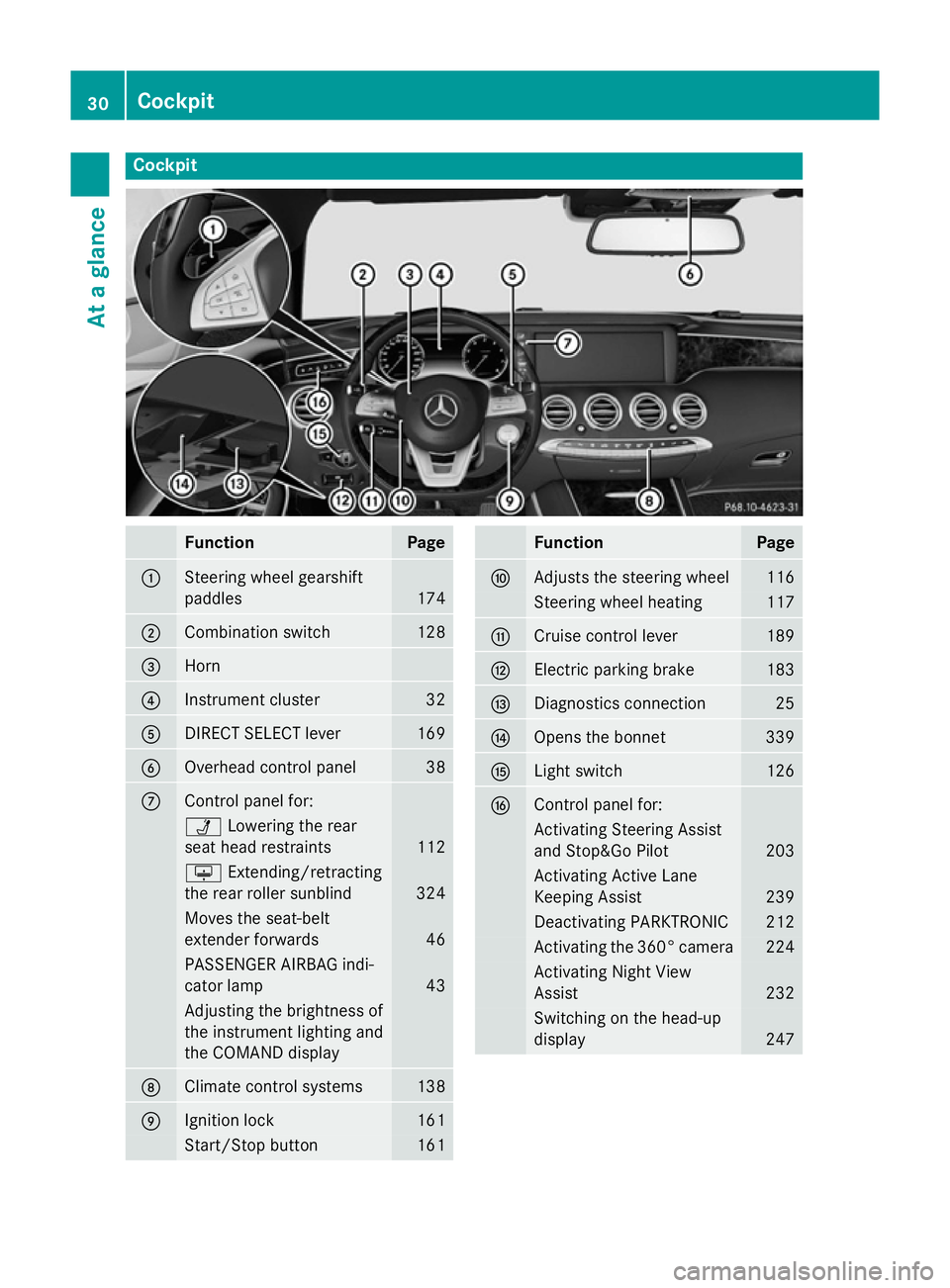
Cockpit
Function Page
:
Steering wheel gearshift
paddles
174
;
Combination switch 128
=
Horn
?
Instrument cluster 32
A
DIRECT SELECT lever 169
B
Overhead control panel 38
C
Control panel for:
Ü
Lowering the rear
seat head restraints 112
u
Extending/retracting
the rear roller sunblind 324
Moves the seat-belt
extender forwards 46
PASSENGER AIRBAG indi-
cator lamp
43
Adjusting the brightness of
the instrument lighting and
the COMAND display D
Climate control systems 138
E
Ignition lock 161
Start/Stop button 161 Function Page
F
Adjusts the steering wheel 116
Steering wheel heating 117
G
Cruise control lever 189
H
Electric parking brake 183
I
Diagnostics connection 25
J
Opens the bonnet 339
K
Light switch 126
L
Control panel for:
Activating Steering Assist
and Stop&Go Pilot
203
Activating Active Lane
Keeping Assist 239
Deactivating PARKTRONIC 212
Activating the 360° camera 224
Activating Night View
Assist 232
Switching on the head-up
display
24730
CockpitAt a glance
Page 34 of 417
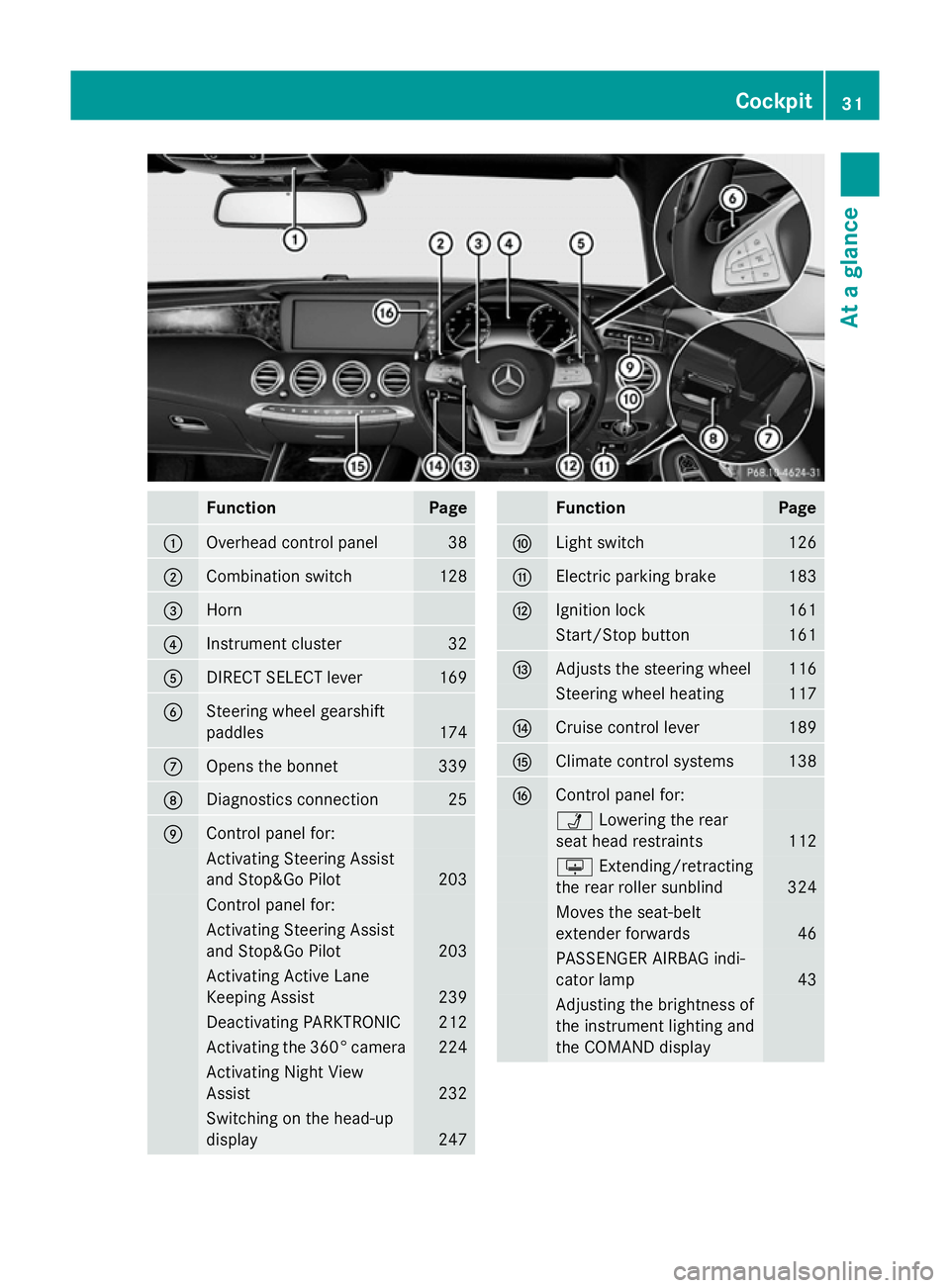
Function Page
:
Overhead control panel 38
;
Combination switch 128
=
Horn
?
Instrument cluster 32
A
DIRECT SELECT lever 169
B
Steering wheel gearshift
paddles
174
C
Opens the bonnet 339
D
Diagnostics connection 25
E
Control panel for:
Activating Steering Assist
and Stop&Go Pilot 203
Control panel for:
Activating Steering Assist
and Stop&Go Pilot
203
Activating Active Lane
Keeping Assist
239
Deactivating PARKTRONIC 212
Activating the 360° camera 224
Activating Night View
Assist
232
Switching on the head-up
display
247 Function Page
F
Light switch 126
G
Electric parking brake 183
H
Ignition lock 161
Start/Stop button 161
I
Adjusts the steering wheel 116
Steering wheel heating 117
J
Cruise control lever 189
K
Climate control systems 138
L
Control panel for:
Ü
Lowering the rear
seat head restraints 112
u
Extending/retracting
the rear roller sunblind 324
Moves the seat-belt
extender forwards
46
PASSENGER AIRBAG indi-
cator lamp
43
Adjusting the brightness of
the instrument lighting and
the COMAND display Cockpit
31At a glance
Page 46 of 417
Important safety notes
G
WARNING
If the restraint system is modified, it may no
longer work as intended. The restraint system
may then not perform its intended protective function by failing in an accident or triggering
unexpectedly, for example. There is an
increased risk of injury, possibly even fatal.
Never modify parts of the restraint system. Do not attempt to modify the wiring as well as
electronic components or their software.
If it is necessary to modify an airbag system to
accommodate a person with disabilities, con- tact a Mercedes-Benz Service Centre for
details. Restraint system warning lamp
The functions of the restraint system are
checked after the ignition is switched on and
at regular intervals while the engine is run-
ning. Therefore, malfunctions can be detec-
ted in good time.
The 6 restraint system warning lamp in
the instrument cluster lights up when the igni- tion is switched on. It goes out no later than afew seconds after the vehicle is started. The
components of the restraint system are in
operational readiness.
A malfunction has occurred if the 6
restraint system warning lamp:
R does not light up after the ignition is
switched on
R does not go out after a few seconds with
the engine running
R lights up again while the engine is running G
WARNING
If the restraint system is malfunctioning,
restraint system components may be trig-
gered unintentionally or might not be trig-
gered at all in the event of an accident with a high rate of vehicle deceleration. This can
effect belt tensioners or airbags, for example. There is an increased risk of serious or even
fatal injuries.
Have the restraint system checked and
repaired immediately at a qualified specialist
workshop.
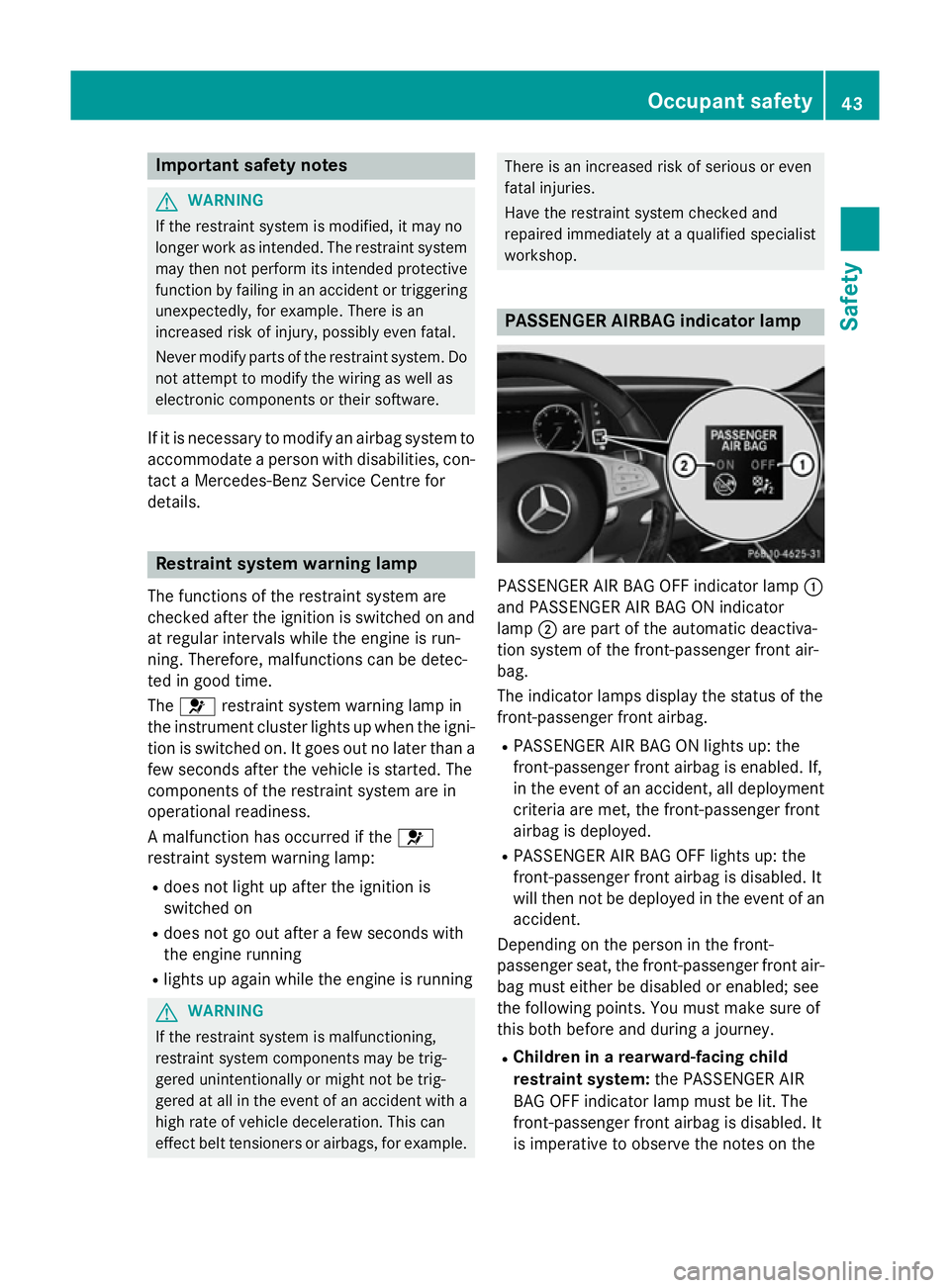
PASSENGER AIRBAG indicator lamp
PASSENGER AIR BAG OFF indicator lamp
:
and PASSENGER AIR BAG ON indicator
lamp ;are part of the automatic deactiva-
tion system of the front-passenger front air-
bag.
The indicator lamps display the status of the
front-passenger front airbag.
R PASSENGER AIR BAG ON lights up: the
front-passenger front airbag is enabled. If,
in the event of an accident, all deployment
criteria are met, the front-passenger front
airbag is deployed.
R PASSENGER AIR BAG OFF lights up: the
front-passenger front airbag is disabled. It
will then not be deployed in the event of an
accident.
Depending on the person in the front-
passenger seat, the front-passenger front air-
bag must either be disabled or enabled; see
the following points. You must make sure of
this both before and during a journey.
R Children in a rearward-facing child
restraint system: the PASSENGER AIR
BAG OFF indicator lamp must be lit. The
front-passenger front airbag is disabled. It
is imperative to observe the notes on the Occupant safety
43Safety Z
Page 49 of 417
R
the seat belt is not twisted.
Only then can the forces produced during
an accident be distributed across the sur-
face of the seat belt.
R the shoulder section of the belt is routed
across the centre of your shoulder.
The shoulder section of the belt should not
touch the neck nor be routed under your
arm.
R the lap belt is fastened closely and routed
as low as possible across your lap, i.e.
across your hips.
The lap belt must always be routed across
the hip joints and never across your stom-
ach or abdomen. This is of particular impor-
tance for pregnant women. If necessary,
push the lap belt downwards into your pel-
vic area and pull it tight using the shoulder section of the belt.
R the seat belt is not routed across sharp-
edged, pointed or breakable objects.
Should you have such objects on or in your
clothing, e.g. pens, keys or spectacles,
stow these in a suitable place.
R only one person uses each seat belt at any
one time.
Infants and children must never travel sit-
ting on the lap of another vehicle occupant. In the event of an accident, they could be
crushed between vehicle occupant and
seat belt.
R never to secure objects with a seat belt if
the seat belt is also being used by a vehicle
occupant
Also make sure that there are never any
objects between a person and the seat, e.g. pillows.
Seat belts are solely intended to secure and
restrain vehicle occupants. When securing
objects, luggage or loads, always observe the instructions and safety notes in "Loading
guidelines" (Y page 316). Fastening seat belts Observe the safety notes on the seat belt
(Y
page 44) and the notes on correct use of
seat belts (Y page 45). G
WARNING
If the seat-belt extender extends during the
journey, the seat belt is not sitting correctly
across your body. The seat belt then cannot
perform its intended protective function.
There is an increased risk of injury, possibly
even fatal.
During a journey, make sure that the seat-belt extender is retracted. Seat-belt extender
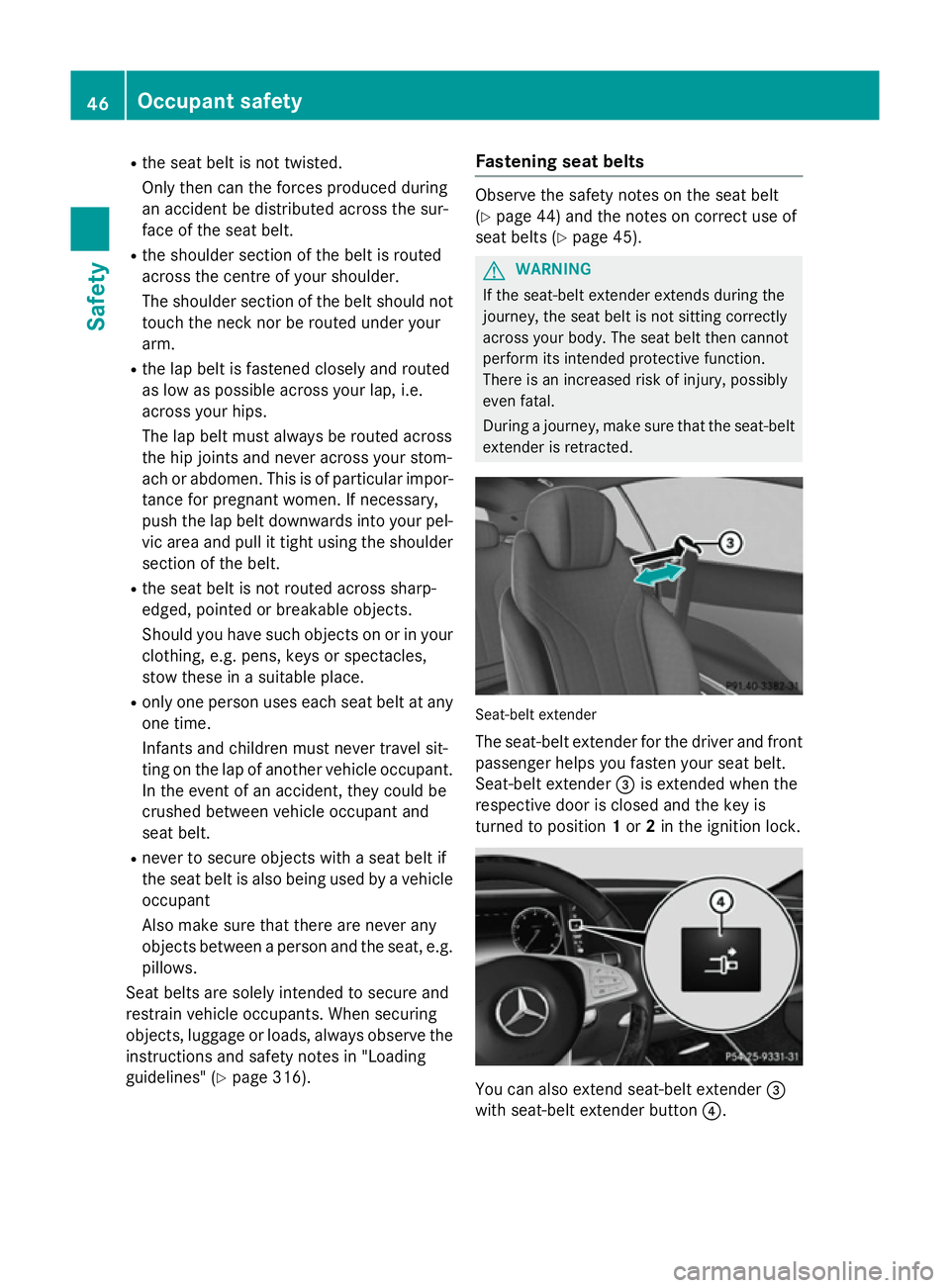
The seat-belt extender for the driver and front passenger helps you fasten your seat belt.
Seat-belt extender =is extended when the
respective door is closed and the key is
turned to position 1or 2in the ignition lock. You can also extend seat-belt extender
=
with seat-belt extender button ?.46
Occupant safetySafety
Page 50 of 417
X
Press seat-belt extender button ?.
Seat-belt extender =extends.
Seat-belt extender =is retracted again if:
R the belt tongue is engaged in the seat belt
buckle
R the belt tongue is not engaged in the seat
belt buckle within 60 seconds
In this case, you can extend seat-belt
extender =again. Press seat-belt
extender button ?again.
R the respective door is opened
R the key is turned to position 0in the ignition
lock
R you release the seat backrest and fold it
forwards
R the front-passenger seat remains unoccu-
pied after approximately five seconds
If you press seat-belt extender button ?
after this, seat-belt extender =will not
extend. Basic illustration
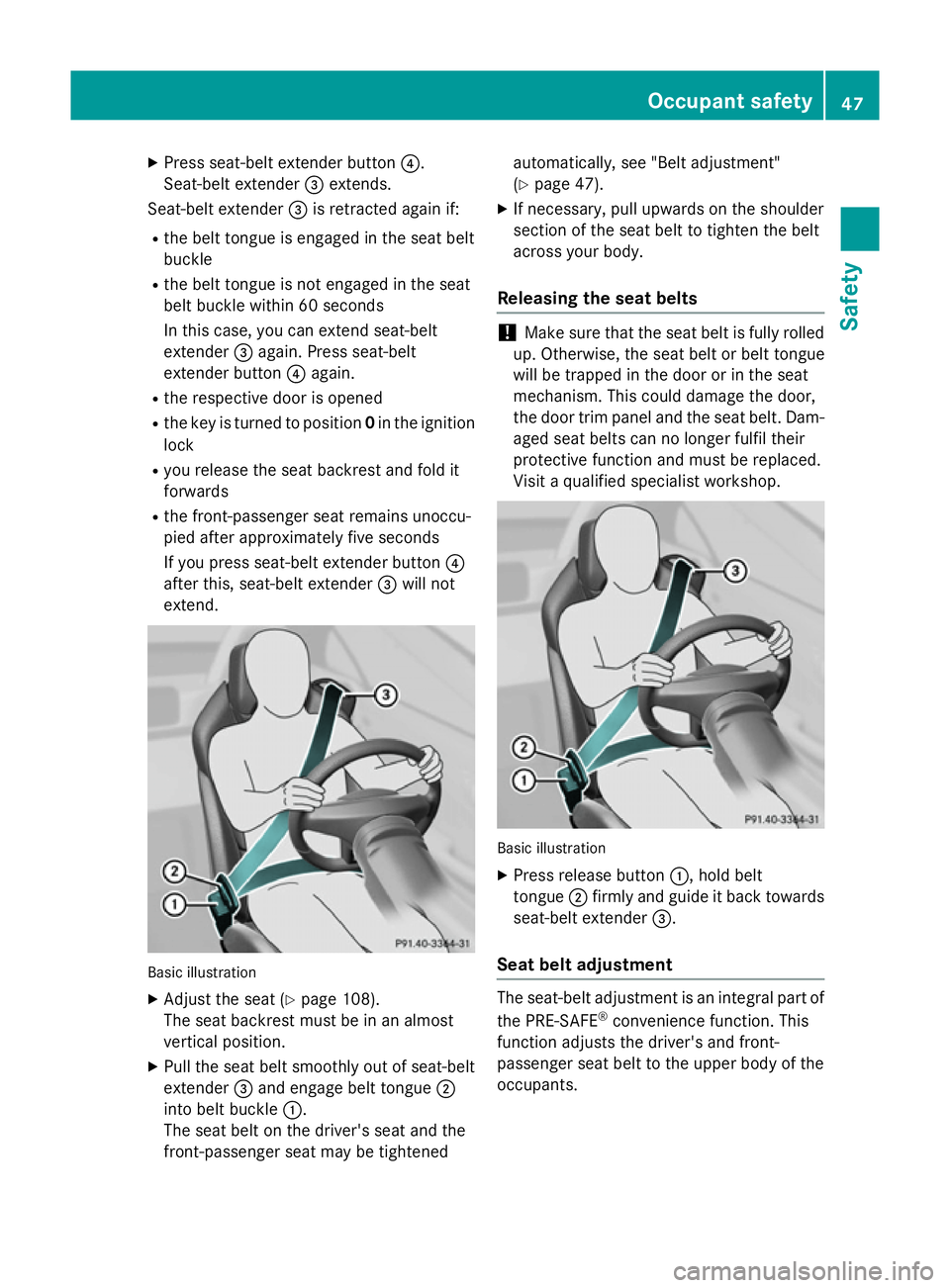
X Adjust the seat (Y page 108).
The seat backrest must be in an almost
vertical position.
X Pull the seat belt smoothly out of seat-belt
extender =and engage belt tongue ;
into belt buckle :.
The seat belt on the driver's seat and the
front-passenger seat may be tightened automatically, see "Belt adjustment"
(Y
page 47).
X If necessary, pull upwards on the shoulder
section of the seat belt to tighten the belt
across your body.
Releasing the seat belts !
Make sure that the seat belt is fully rolled
up. Otherwise, the seat belt or belt tongue
will be trapped in the door or in the seat
mechanism. This could damage the door,
the door trim panel and the seat belt. Dam- aged seat belts can no longer fulfil their
protective function and must be replaced.
Visit a qualified specialist workshop. Basic illustration
X Press release button :, hold belt
tongue ;firmly and guide it back towards
seat-belt extender =.
Seat belt adjustment The seat-belt adjustment is an integral part of
the PRE-SAFE ®
convenience function. This
function adjusts the driver's and front-
passenger seat belt to the upper body of the
occupants. Occupant safety
47Safety Z
Page 51 of 417
The belt strap is tightened slightly when:
R with a retracted seat-belt extender, the
seat belt tongue is engaged in the belt
buckle and
R the ignition is switched on
The seat-belt adjustment will apply a certain
tightening force if any slack is detected
between the vehicle occupant and the seat
belt. Do not hold on to the seat belt tightly
while it is adjusting.
You can switch the seat-belt adjustment on
and off using COMAND Online. Information
on activating and deactivating the seat-belt
adjustment function can be found in the Dig-
ital Owner's Manual.
Belt warning for the driver and front
passenger The
7 seat belt warning lamp in the instru-
ment cluster is a reminder that all vehicle
occupants must wear their seat belts. It may
light up continuously or flash. In addition, a
warning tone may sound.
The 7 seat belt warning lamp goes out and
the warning tone ceases when the driver and
the front passenger have fastened their seat
belts.
i For more information on the
7seat
belt warning lamp, see "Warning and indi-
cator lamps in the instrument cluster, seat
belt" (Y page 302).
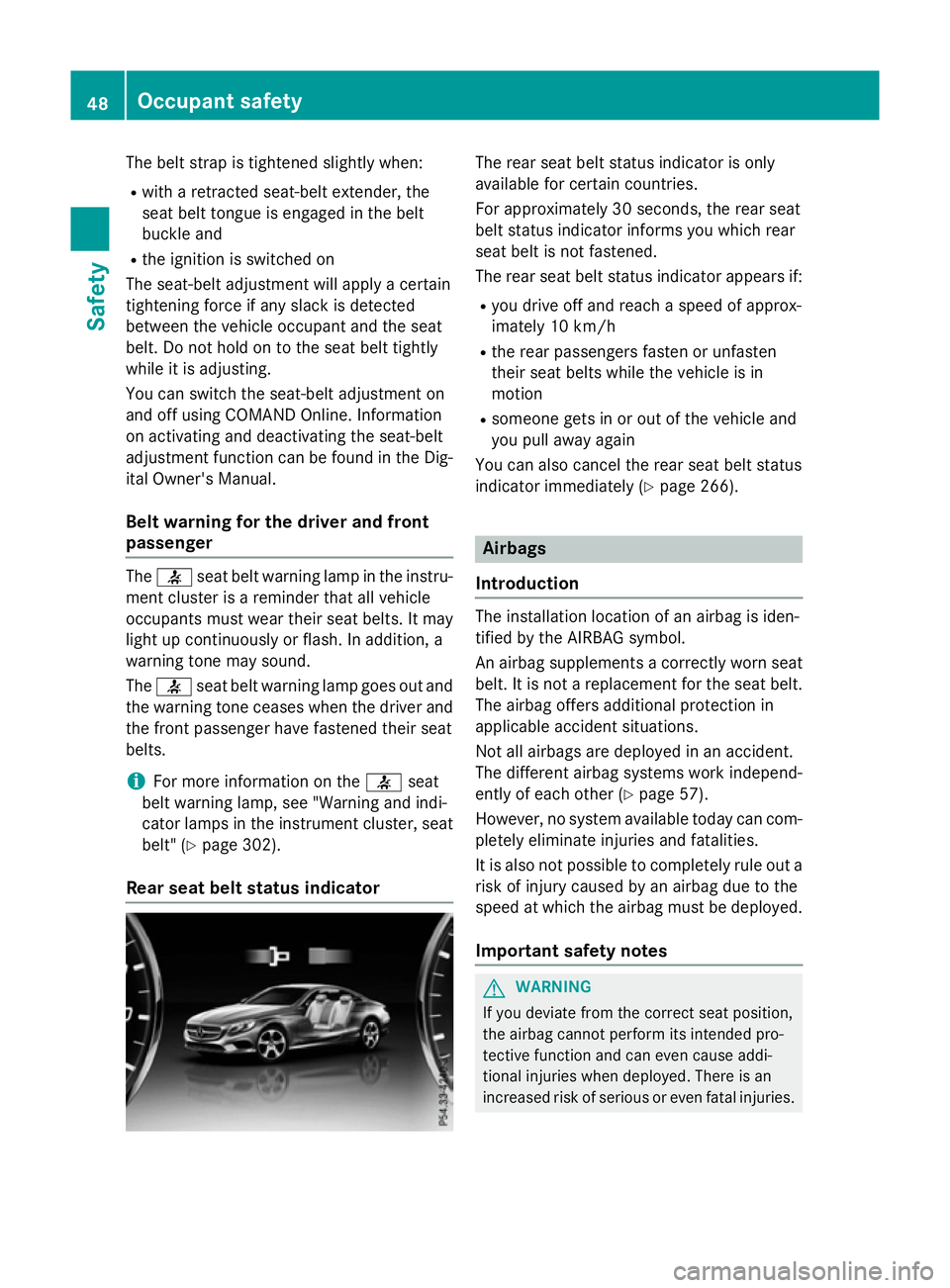
Rear seat belt status indicator The rear seat belt status indicator is only
available for certain countries.
For approximately 30 seconds, the rear seat
belt status indicator informs you which rear
seat belt is not fastened.
The rear seat belt status indicator appears if:
R you drive off and reach a speed of approx-
imately 10 km/h
R the rear passengers fasten or unfasten
their seat belts while the vehicle is in
motion
R someone gets in or out of the vehicle and
you pull away again
You can also cancel the rear seat belt status
indicator immediately (Y page 266). Airbags
Introduction The installation location of an airbag is iden-
tified by the AIRBAG symbol.
An airbag supplements a correctly worn seat
belt. It is not a replacement for the seat belt.
The airbag offers additional protection in
applicable accident situations.
Not all airbags are deployed in an accident.
The different airbag systems work independ-
ently of each other (Y page 57).
However, no system available today can com- pletely eliminate injuries and fatalities.
It is also not possible to completely rule out a
risk of injury caused by an airbag due to the
speed at which the airbag must be deployed.
Important safety notes G
WARNING
If you deviate from the correct seat position,
the airbag cannot perform its intended pro-
tective function and can even cause addi-
tional injuries when deployed. There is an
increased risk of serious or even fatal injuries. 48
Occupant safetySafety
Page 55 of 417
The system does not disable:
R the sidebag
R the windowbag
R the seat belt tensioner
Make sure that your vehicle is equipped with
the automatic front-passenger front airbag
deactivation system (Y page 63). If this is
not the case, always install a child restraint
system on a suitable rear seat (Y page 65).
If it is absolutely necessary to fit a child
restraint system on the front-passenger seat,
be sure to observe the correct positioning of
the child restraint system. Never place
objects under or behind the child restraint
system, e.g. a cushion. Fully retract the seat
cushion length. The entire base of the child
restraint system must always rest on the seat cushion of the front-passenger seat. The
backrest of the forward-facing child restraint
system must, as far as possible, be resting on the backrest of the front-passenger seat. The
child restraint system must not touch the roof or be put under strain by the head restraint.
Adjust the angle of the seat backrest and the
head restraint position accordingly. Only then is the correct function of the automatic front- passenger front airbag deactivation system
guaranteed. Always observe the information
on suitable positioning of the child restraint
system (Y page 65) in addition to the child
restraint system manufacturer's installation
instructions. Operation of automatic front-passenger
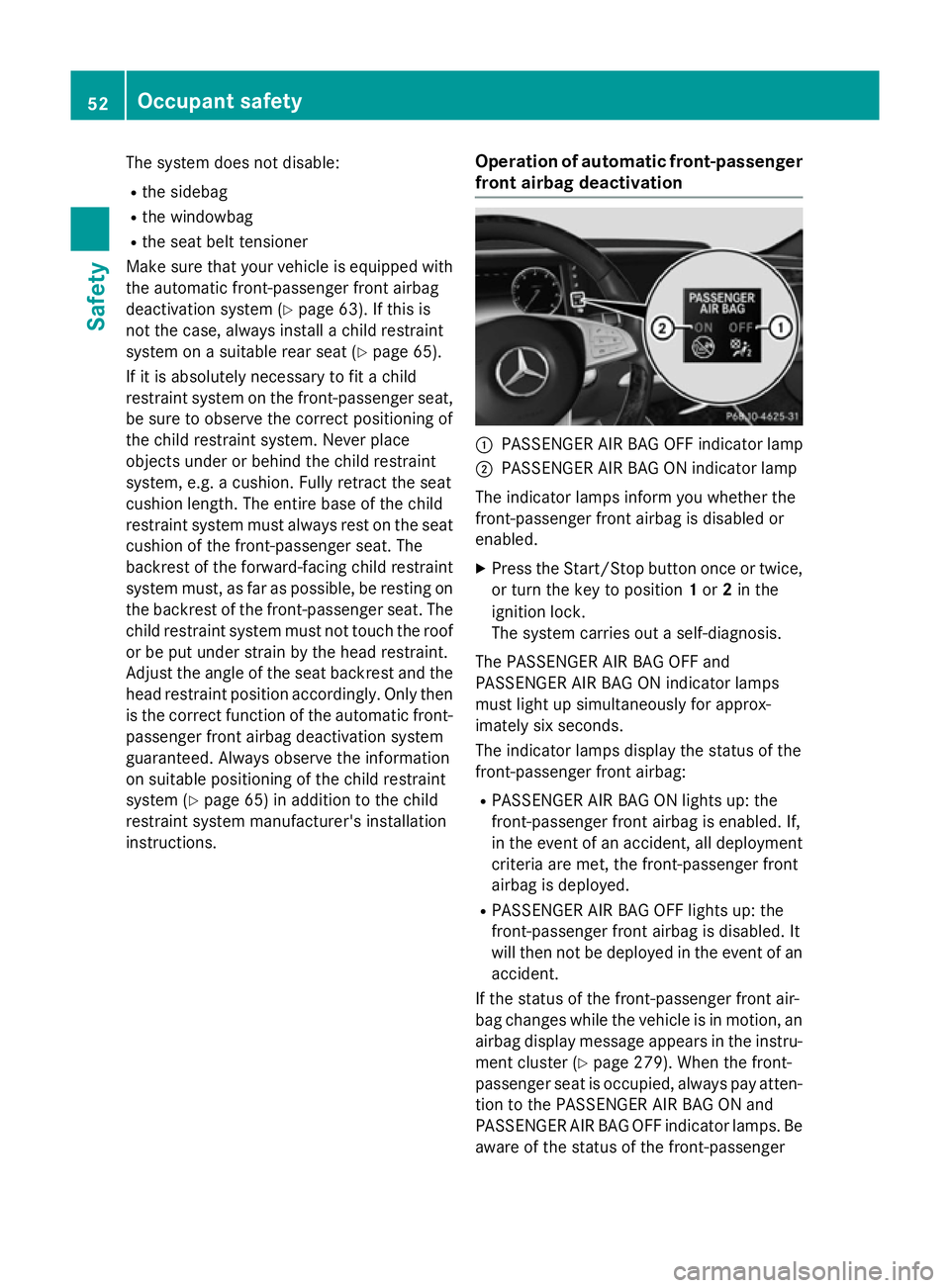
front airbag deactivation :
PASSENGER AIR BAG OFF indicator lamp
; PASSENGER AIR BAG ON indicator lamp
The indicator lamps inform you whether the
front-passenger front airbag is disabled or
enabled. X Press the Start/Stop button once or twice,
or turn the key to position 1or 2in the
ignition lock.
The system carries out a self-diagnosis.
The PASSENGER AIR BAG OFF and
PASSENGER AIR BAG ON indicator lamps
must light up simultaneously for approx-
imately six seconds.
The indicator lamps display the status of the
front-passenger front airbag:
R PASSENGER AIR BAG ON lights up: the
front-passenger front airbag is enabled. If,
in the event of an accident, all deployment
criteria are met, the front-passenger front
airbag is deployed.
R PASSENGER AIR BAG OFF lights up: the
front-passenger front airbag is disabled. It
will then not be deployed in the event of an accident.
If the status of the front-passenger front air-
bag changes while the vehicle is in motion, an
airbag display message appears in the instru-
ment cluster (Y page 279). When the front-
passenger seat is occupied, always pay atten-
tion to the PASSENGER AIR BAG ON and
PASSENGER AIR BAG OFF indicator lamps. Be aware of the status of the front-passenger 52
Occupant safetySafety
Page 60 of 417
Deployment of belt tensioners and air-
bags
Important safety notes G
WARNING
After the airbag deploys, the airbag parts are
hot. There is a risk of injury.
Do not touch the airbag parts. Have a
deployed airbag replaced at a qualified spe-
cialist workshop as soon as possible. G
WARNING
Pyrotechnic seat belt tensioners that have
been deployed are no longer operational and
are unable to perform their intended protec-
tive function. This poses an increased risk of
injury or even fatal injury.
Therefore, have pyrotechnic belt tensioners
which have been triggered immediately
replaced at a qualified specialist workshop.
Mercedes-Benz recommends that you have
the vehicle towed to a qualified specialist
workshop after an accident. Take this into
account, particularly if a seat belt tensioner
was triggered or an airbag was deployed.
An electric motor is used by PRE-SAFE ®
to
trigger the tightening of the seat belt in haz-
ardous situations. This procedure is reversi-
ble.
If the belt tensioners are triggered or an air-
bag is deployed, you will hear a bang, and a
small amount of powder may also be
released. The 6restraint system warning
lamp lights up.
Only in rare cases will the bang affect your
hearing. In general, the powder released is
not hazardous to health but may cause short- term breathing difficulties to persons suffer-
ing from asthma or other pulmonary condi-
tions. Provided it is safe to do so, you should
leave the vehicle immediately or open the
window in order to prevent breathing difficul- ties. Operation During the first stage of a collision, the
restraint system control unit evaluates impor-
tant physical data relating to vehicle deceler-
ation or acceleration, such as:
R duration
R direction
R intensity
Based on the evaluation of this data, the
restraint system control unit triggers the seat
belt tensioners in the event of a head-on or
rear collision.
A seat belt tensioner can only be triggered if:
R the ignition is switched on
R the components of the restraint system are
operational; see "Restraint system warning
lamp" (Y page 43)
R the belt tongue has engaged in the belt
buckle of the respective front seat
The seat belt tensioners in the rear compart-
ment are triggered independently of the lock
status of the seat belts.
If the restraint system control unit detects a
high severity of an accident, in certain head-
on collisions, additional components of the
restraint system are deployed independently
of each other:
R Front airbags and driver's kneebag
R Windowbag, if the system determines that
deployment can offer additional protection
to that provided by the seat belt
On vehicles with the automatic front-
passenger front airbag deactivation system:
depending on the person in the front-
passenger seat, the front-passenger front air-
bag is either disabled or enabled. The front-
passenger front airbag can only be deployed
in an accident if the PASSENGER AIR BAG ON indicator lamp is lit. Observe the information
on the PASSENGER AIR BAG indicator lamps
(Y page 43).
Your vehicle has two-stage front airbags. In
the first deployment stage, the front airbag is
filled with propellant gas to reduce the risk of Occupant safety
57Safety Z