height MERCEDES-BENZ S-CLASS COUPE 2018 Owner's Manual
[x] Cancel search | Manufacturer: MERCEDES-BENZ, Model Year: 2018, Model line: S-CLASS COUPE, Model: MERCEDES-BENZ S-CLASS COUPE 2018Pages: 502, PDF Size: 6.29 MB
Page 53 of 502
Toimpr oveprotection forch ildren younger than
12 years old or under 5 ft(1.50 m) in height,
Mercedes-Benz recommends you observ eth e
fo llowing information:
ROnly secure children using a child restra int
sy stem which is appropriate tothe height,
age and weight of thech ild and suitable for
Mercedes-Benz vehicles. Be sure toobser ve
th e instructions for cor rect use of thech ild
re stra int sy stem.
RAlw ays ins tall a child restra int sy stem on a
re ar seat if possible.
ROnly usethefo llowing securing sy stems for
ch ild restra int sy stems:
-The seat belt sy stem
-The LATC H-type (ISOFIX) mounting brack‐
et s
RThe manufacturer's ins tallation instructions
fo rth ech ild restra int sy stem.
RThe warning labels in theve hicle interior and
on thech ild restra int sy stem.
&
WARNING Risk of injury or death caused
by incor rect ins tallation of thech ild
re stra int sy stem
If th ech ild restra int sy stem is incor rectly
ins talled on a suitable seating position, it
cannot per form its intended pr otective func‐
tion.
The child cannot be restra ined in theeve nt of
an accident, heavy braking or a sudden
ch ange of direction.
#Alw ays comply with the manufacturer's
ins tallation instructions forth ech ild
re stra int sy stem and its cor rect use.
#Make surethat the entire base of the
ch ild restra int sy stem alw aysre sts on
th e sitting sur face of the seat.
#Ne ver place objects under or behind
th ech ild restra int sy stem, e.g. cush‐
ions.
#Alw ays use child restra int sy stems with
th e original co ver designed forth em.
#Alw aysre place damaged co vers with
ge nuine co vers.
&
WARNING Risk of injury or death from
unsecured child restra int sy stems in the
ve hicle
If th ech ild restra int sy stem is not cor rectly
ins talled or secured, it could release in the
ev ent of an accident, sudden braking or a
sudden change in direction.
The child restra int sy stem could be flung
around and hit vehicle occupants.
#Alw ays ins tallch ild restra int sy stems
cor rectl y,eve n when not in use.
#Alw ays comply with thech ild restra int
sy stem manufacturer's ins tallation
instructions.
& WARNING Risk of injury or death caused
by the use of damaged child restra int
sy stems
Child restra int sy stems or their retaining sys‐
te ms that ha vebeen subjec tedto a load in
an accident may then not be able toper form
th eir intended pr otective function.
Occupant saf ety 51
Page 54 of 502
Thechild cannot be restra ined in theeve nt of
an accident, heavy braking or a sudden
ch ange of direction.
#Alw aysre place child restra int sy stems
immediately that ha vebeen damaged or
in vo lved in an accident.
#Ha ve the securing sy stems forth ech ild
re stra int sy stems checked at a qualified
specialist workshop before ins talling a
ch ild restra int sy stem again.
A boos ter seat may be necessary toachie ve
proper seat belt positioning forch ildren over
40 lbs (18 kg) in weight or until they reach a
height where a thre e-point seat belt can be
ins talled proper lywithout a boos ter seat.
The following no tes must be obser ved:
RWhen ins talling a child restra int sy stem on
th e front passenger seat, the information on
ins talling a child restra int sy stem on the front
passenger seat (
→page 55).
RInstructions and saf etyno tes on the auto‐
matic front passenger front airbag shutoff
(
→page 43).
RSaf etyno tes on the seat belt (→page 35).
RInformation on the cor rect use of the seat
belt (→page 39).
Ac tivating/deactivating the child seat saf ety
fe ature of the seat belt
&
WARNING Risk of injury or death if a
seat belt is unfas tened while theve hicle
is in motion
If th e seat belt is released while theve hicle is
in motion, thech ild restra int sy stem is no
longer cor rectly secure d. Thechild seat
saf etyfe ature is deactivated and the seat
belt is dr awn in a bit bythe inertia reel.
It is therefore not possible toengage the seat
belt again.
#Pull over and stop theve hicle safely as
soon as possible, paying attention to
ro ad and traf fic conditions.
#Ac tivate thech ild seat saf etyfe ature
again and cor rectly secure thech ild
re stra int sy stem.
When enabled, thech ild seat saf etyfe ature
ensures that the seat belts of the front
passenger seat and rear seats do not slac ken
once thech ild restra int sy stem is secured.
Installing a child restra int sy stem:
#Alw ays comply with the manufacturer's
ins tallation instructions when ins talling and
re moving thech ild restra int sy stem.
#Pull the seat belt smoo thly from the seat belt
outlet.
#En gage the seat belt tongue in the seat belt
buckle.
Ac tivating the child seat saf etyfe ature:
#Pull the seat belt out fully and let the inertia
re el retract it again.
When thech ild seat saf etyfe ature is activa‐
te d,you should hear a ratcheting sound.
#Push thech ild restra int sy stem down until
th e seat belt sits tightly.
Deactivating the child seat saf etyfe ature:
#Press there lease button of the seat belt
buckle.
52 Occupant saf ety
Page 87 of 502
Seats
Adjusting the front seat electrically
&
WARNING Risk of becoming trapped if
th e seats are adjus tedby children
Children could become trapped if they adjust
th e seats, particularly when unattended.
#When leaving theve hicle, alw aysta ke
th e SmartK eywith you and lock the
ve hicle.
#Ne ver lea vechildren unatte nded inthe
ve hicle.
The seats can be adjus ted when the ignition is
switched off.
& WARNING Risk of becoming trapped
when adjusting the seats
When you adjust a seat, you or other vehicle
occupants could become trapped, e.g. on the
seat guide rail.
#Make sure when adjusting a seat that
no one has any body parts in the sweep
of the seat.
Obser vethe saf etyno tes on "Airbags" and "Chil‐
dren in theve hicle".
&
WARNING Risk of injury from adjusting
th eve hicle settings while theve hicle is in
motion
Yo u could lose cont rol of theve hicle in the
fo llowing situations:
Rifyo u adjust the driver's seat, the head
re stra int, thesteering wheel or the mir ror
while theve hicle is in motion
Rifyo ufa sten your seat belt while theve hi‐
cle is in motion
#Before starting the engine: adjust the
driver's seat, the head restra int, the
st eering wheel or the mir ror and fasten
yo ur seat belt.
&
WARNING Risk of becoming trapped if
th e seat height is adjus ted carelessly
If yo u adjust the seat height carelessly, you
or other vehicle occupants could be trapped
and thereby injured.
Children in particular could accidenta lly
press the electrical seat adjustment buttons
and become trapped.
#While moving the seats, make sure that
hands or other body parts do not get
under the le ver assembly of the seat
adjustment sy stem.
&
WARNING Risk of injury duetohead
re stra ints which are not ins talled or are
adjus ted incor rectly
If head restra ints are not ins talled or are
adjus ted incor rectly, the head restra ints can‐
not pr ovide pr otection as intended.
There is an increased risk of injury in the
head and neck area, e.g. in theeve nt of an
accident or when braking.
Seats and stowing 85
Page 88 of 502
#Always drive with the head restra ints
ins talled.
#Before driving off, make sure forev ery
ve hicle occupant that the center of the
head restra int supports the back of the
head at about eye le vel.
Do not swap the head restra ints of the front and
re ar seats. Otherwise, you cannot adjust the
height and angle of the head restra ints cor rectl y.
Ad just the head restra int fore -and-aft position so
th at it is as close as possible tothe back of your
head.
& WARNING Risk of injury or death dueto
incor rect seat position
The seat belt does not of ferth e intended
le ve l of pr otection if you ha venot mo vedth e
seat backrest toan almost vertical position.
When braking or in theeve nt of an accident,
yo u could slideunderneath the seat belt and
sus tain abdominal or neck injuries, forex am‐
ple.
#Ad just the seat proper lybefore begin‐
ning your journe y.
#Always ensure that the seat backrest is
in an almost vertical position and that
th e shoulder section of your seat belt is
ro uted across the center of your shoul‐
der.
* NO
TEDama getothe seats when moving
th e seats back
The seats may be damaged byobjects when
moving the seats bac k.
#When moving the seats bac k,make
sure that there are no objects in the
fo ot we ll or under or behind the seats.
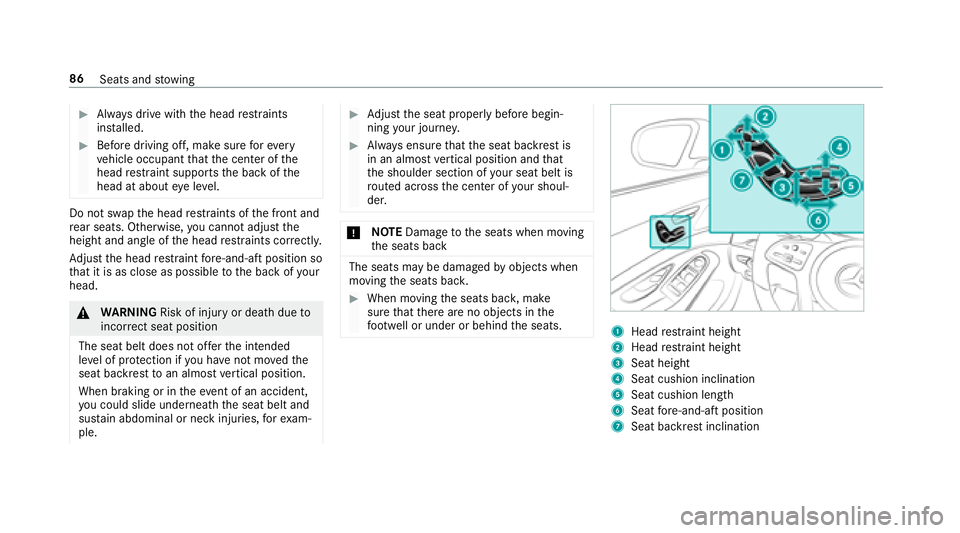
1Head restra int height
2Head restra int height
3Seat height
4Seat cushion inclination
5Seat cushion length
6Seat fore -and-aft position
7Seat ba ckrest inclination
86
Seats and stowing
Page 89 of 502
#Save the settings with the memory function
(→page 96).
% The head restra int height is adjus ted auto‐
matically when you adjust the seat height or
th e seat fore -and-aft position.
Ad justing the front passen ger seat from the
driver's seat electrically
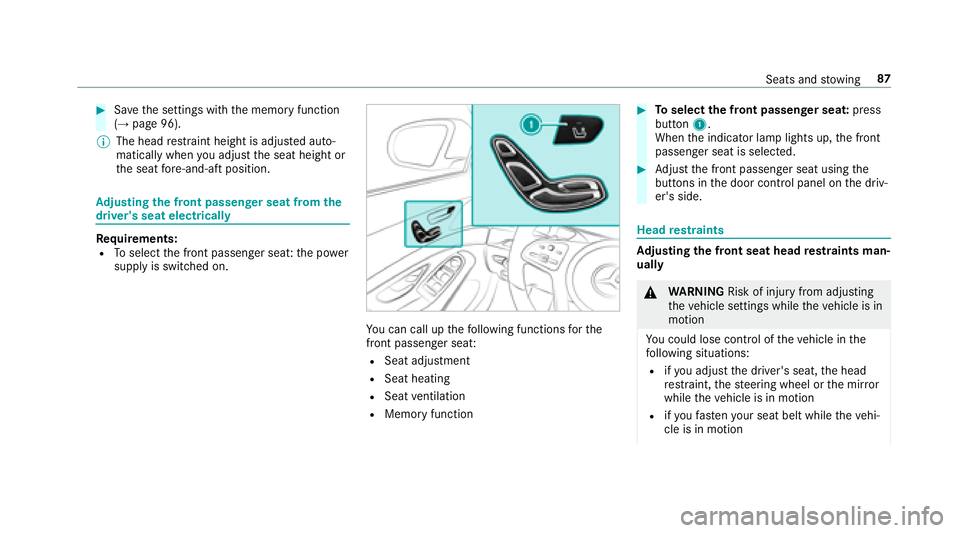
Re quirements:RTo select the front passenger seat: the po wer
supply is switched on.
Yo u can call up thefo llowing functions forth e
front passenger seat:
RSeat adjustment
RSeat heating
RSeat ventilation
RMemory function
#To select the front passenger seat: press
button 1.
When the indicator lamp lights up, the front
passenger seat is selected.
#Ad just the front passenger seat using the
buttons in the door control panel on the driv‐
er's side.
Head restra ints
Ad justing the front seat head restra ints man‐
ually
& WARNING Risk of injury from adjusting
th eve hicle settings while theve hicle is in
motion
Yo u could lose cont rol of theve hicle in the
fo llowing situations:
Rifyo u adjust the driver's seat, the head
re stra int, thesteering wheel or the mir ror
while theve hicle is in motion
Rifyo ufa sten your seat belt while theve hi‐
cle is in motion
Seats and stowing 87
Page 90 of 502
#Beforestarting the engine: adjust the
driver's seat, the head restra int, the
st eering wheel or the mir ror and fasten
yo ur seat belt.
&
WARNING Risk of injury duetohead
re stra ints which are not ins talled or are
adjus ted incor rectly
If head restra ints are not ins talled or are
adjus ted incor rectly, the head restra ints can‐
not pr ovide pr otection as intended.
There is an increased risk of injury in the
head and neck area, e.g. in theeve nt of an
accident or when braking.
#Alw ays drive with the head restra ints
ins talled.
#Before driving off, make sure forev ery
ve hicle occupant that the center of the
head restra int supports the back of the
head at about eye le vel.
Do not rotate the head restra ints of the front and
re ar seats. Otherwise, you cannot adjust the
height and angle of the head restra ints cor rectl y. Ad
just the head restra int fore -and-aft position so
th at it is as close as possible tothe back of your
head.
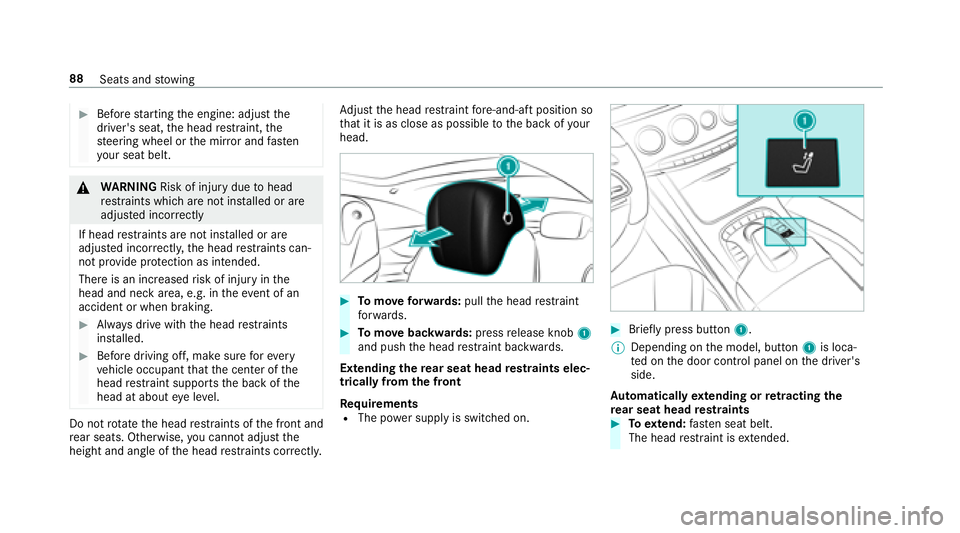
#To mo veforw ards: pullthe head restra int
fo rw ards.
#To mo vebackwards: pressrelease knob 1
and push the head restra int backwards.
Extending there ar seat head restra ints elec‐
trically from the front
Re quirements
RThe po wer supply is switched on.
#Brief lypress button 1.
% Depending on the model, button 1is loca‐
te d on the door control panel on the driver's
side.
Au tomatically extending or retracting the
re ar seat head restra ints
#To extend: fasten seat belt.
The head restra int is extended.
88
Seats and stowing
Page 96 of 502
Steering wheel
Adjusting the steering wheel electrically
&
WARNING Risk of injury from adjusting
th eve hicle settings while theve hicle is in
motion
Yo u could lose cont rol of theve hicle in the
fo llowing situations:
Rifyo u adjust the driver's seat, the head
re stra int, thesteering wheel or the mir ror
while theve hicle is in motion
Rifyo ufa sten your seat belt while theve hi‐
cle is in motion
#Before starting the engine: adjust the
driver's seat, the head restra int, the
st eering wheel or the mir ror and fasten
yo ur seat belt.
&
WARNING Risk of entrapment forch il‐
dren when adjusting thesteering wheel
Children could injure themselves if they
adjust thesteering wheel.
#Ne ver lea vechildren unatte nded inthe
ve hicle.
#When leaving theve hicle, alw aysta ke
th e SmartK eywith you and lock the
ve hicle.
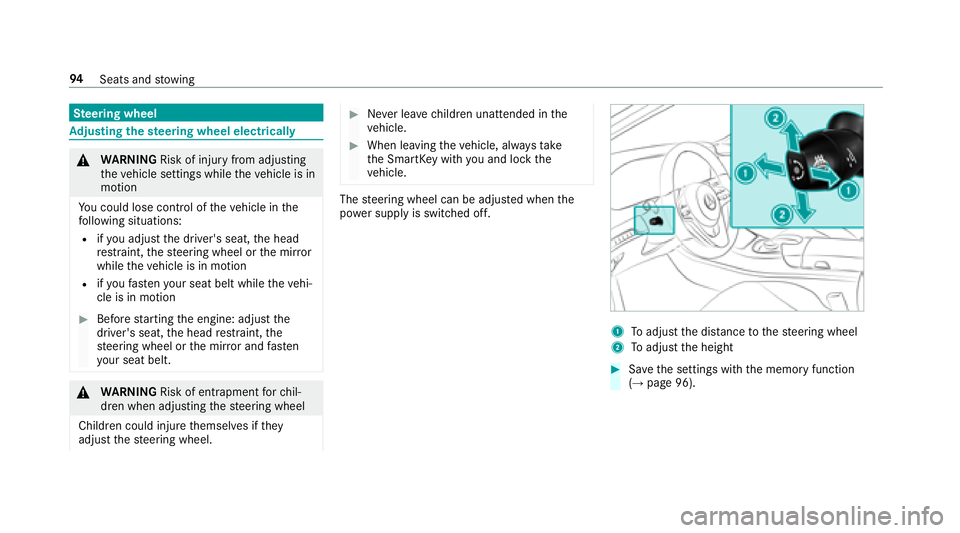
The steering wheel can be adjus ted when the
po we r supp lyis switched off.
1To adjust the dis tance tothesteering wheel
2To adjust the height
#Sa ve the settings with the memory function
(→page 96).
94 Seats and stowing
Page 129 of 502
Adjusting the AIRSCARF vents
&
WARNING Risk of burn s causedbythe
heating output from AIRSCARF being too
high
When AIRSCARF is switched on, very hot air
can flow from the outlet opening in the head
re stra ints.
This could result in burns in the immediate
vicinity of the outlet opening.
#Tu rn the heating output down in good
time.
#Maintain a suitable dis tance from the
outlet opening.
* NO
TEDama gecaused toAIRSCARF by
th e use of pr otective co vers
If a pr otective co ver is placed overth e front
seat head restra ints, theflow of air from the
AIRSCARF vent is hinde red.
This can cause AIRS CARF toove rheat and be
damaged.
#Do not use pr otective co vers on head
re stra ints with AIRSCARF.
Make sure that there are no objects co vering the
intake grille on the back of the head restra int.
Make sure that objects do not enter theve nts in
th e head restra ints.
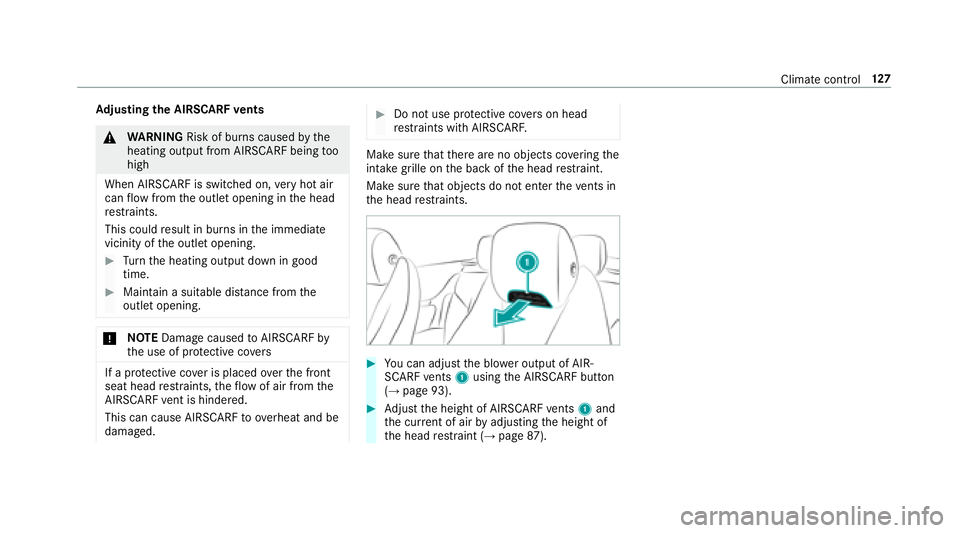
#Yo u can adjust the blo wer output of AIR‐
SCARF vents 1using the AIRSCARF button
(
→page 93).
#Ad just the height of AIRSCARF vents 1and
th e cur rent of air byadjusting the height of
th e head restra int (
→page 87).
Climate control 12
7
Page 179 of 502
&WARNING Risk of entrapment from vehi‐
cle lo wering
Ve hicles with AIR BODY CONT ROL or
le ve l control sy stem: When you unload lug‐
ga ge or lea vetheve hicle, theve hicle firs t
ri ses slightly and then returns tothe set le vel
shortly af terw ards.
Yo u or an yone else in the vicinity of the
wheel ar ches or the underbody could thus
become trapped.
The vehicle can also be lo wered af ter being
loc ked.
#When leaving theve hicle, make sure
th at nobody is in the vicinity of the
wheel ar ches or the underbody.
Re quirements:RThe vehicle has been star ted.
RThe vehicle must not be moving fasterthan
50 mph(8 0 km/h). Ra
ising theve hicle
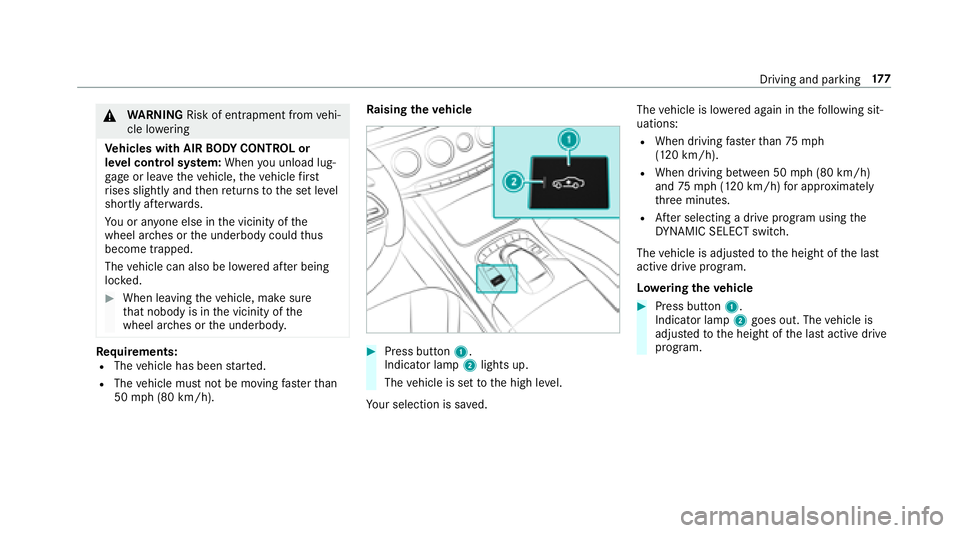
#Press button 1.
Indicato r lamp2lights up.
The vehicle is set tothe high le vel.
Yo ur selection issave d. The
vehicle is lo wered again in thefo llowing sit‐
uations:
RWhen driving fasterthan 75 mph
(120 km/h).
RWhen driving between 50 mph (80 km/h)
and 75mph(120 km/h) for app roxima tely
th re e minutes.
RAf ter selecting a drive program using the
DY NA MIC SELECT switch.
The vehicle is adjus tedto the height of the last
active drive prog ram.
Lo weri ngtheve hicle
#Press button 1.
Indicato r lamp2goes out. The vehicle is
adjus tedto the height of the last active drive
program.
Driving and parking 17
7
Page 187 of 502
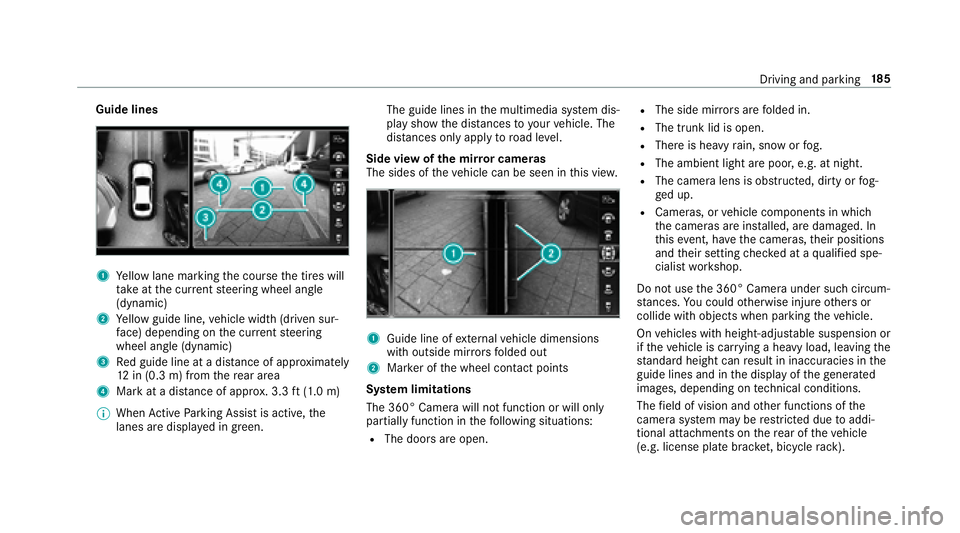
Guide lines
1Yellow lane marking the course the tires will
ta ke atthe cur rent steering wheel angle
(dynamic)
2Ye llow guide line, vehicle width (driven sur‐
fa ce) depending on the cur rent steering
wheel angle (dynamic)
3Re d guide line at a dis tance of appr oximately
12 in (0.3 m) from there ar area
4Mark at a distance of appr ox. 3.3 ft(1.0 m)
% When Active Parking Assist is active, the
lanes are displa yed in green. The guide lines in
the multimedia sy stem dis‐
play show the dis tances toyour vehicle. The
dis tances only apply toroad le vel.
Side view of the mir ror cameras
The sides of theve hicle can be seen in this vie w.
1Guide line of extern al vehicle dimensions
with outside mir rors folded out
2Mar ker of the wheel conta ct points
Sy stem limitations
The 360° Camera will not function or will only
partially function in thefo llowing situations:
RThe doors are open.
RThe side mir rors are folded in.
RThe trunk lid is open.
RThere is heavy rain, snow or fog.
RThe ambient light are poor, e.g. at night.
RThe camera lens is obstructed, dirty or fog‐
ge d up.
RCameras, or vehicle components in which
th e cameras are ins talled, are damaged. In
th is eve nt, ha vethe cameras, their positions
and their setting checked at a qualified spe‐
cialist workshop.
Do not use the 360° Camera under such circum‐
st ances. You could otherwise injure others or
collide with objects when parking theve hicle.
On vehicles with height-adjus table suspension or
if th eve hicle is car rying a heavy load, leaving the
st andard height can result in inaccuracies in the
guide lines and in the display of thege nerated
ima ges, depending on tech nical conditions.
The field of vision and other functions of the
came rasystem may be restricted due toaddi‐
tional attachments on there ar of theve hicle
(e.g. license plate brac ket, bicycle rack ).
Driving and parking 18
5