display MERCEDES-BENZ S-Class MAYBACH 2017 W222 Comand Manual
[x] Cancel search | Manufacturer: MERCEDES-BENZ, Model Year: 2017, Model line: S-Class MAYBACH, Model: MERCEDES-BENZ S-Class MAYBACH 2017 W222Pages: 230, PDF Size: 8.27 MB
Page 14 of 230
Setting up ...................................... 128
SPLITVIEW
From the driver's side ...................... 26
Switching on/off .............................. 26
Transferring a destination to the
driver ............................................... 27
State/province
Selecting .......................................... 76
Station list ......................................... 156
Stop function
Video DVD ..................................... 191
Storing stations
Radio ............................................. 156
Switching between summer time
and standard time ............................... 41
Switching on media mode
Starting at a different seat ............. 166
Using the Media button ................. 164
Via the device list .......................... 165
Via the main function bar ............... 165
Via the number keypad .................. 165
System settings
Automatic volume adjustment ......... 46
Bluetooth
®....................................... 45
Date ................................................. 41
Importing/exporting data ................ 48
Language ......................................... 46
Text reader speed ............................ 43
Time ................................................. 41
Time zone ........................................ 41
Voice Control System ...................... 43
T
Telephone
Accepting a call (COMAND) ........... 118
Adding a call .................................. 121
Adjusting the volume for calls .......... 24
Authorizing a mobile phone (con-
necting) ......................................... 116
Call lists ......................................... 126
Call waiting .................................... 122
Calls with several participants ....... 121
Conference calls ............................ 122
Connecting a mobile phone (gen-
eral information) ............................ 113
De-authorizing (disconnecting) a
mobile phone ................................. 117 Deleting a speed dial preset .......... 128
Deleting messages ........................ 135
Displaying Bluetooth
®connection
details ............................................ 118
Downloading messages manually .. 130
E-mail ............................................. 129
E-mail requirements ....................... 129
E-mail settings ............................... 129
Ending an active call ...................... 122
Entering a number ......................... 119
Entering phone numbers ................ 119
Establishing the connection from
the mobile phone ........................... 116
Function restrictions ...................... 113
Functions available during a call .... 120
General notes ................................ 112
Incoming call during an existing
call ................................................. 122
Making a call ................................. 119
Message conditions ....................... 129
Message settings ........................... 129
Operating options .......................... 113
Phone book .................................... 123
Reading messages ......................... 131
Reception and transmission vol-
ume ............................................... 118
Reconnecting a mobile phone
automatically ................................. 117
Rejecting a call (COMAND) ............ 119
Safety notes .................................. 112
Sending DTMF tones ...................... 121
Setting up a speed dial .................. 128
Switching between calls (call wait-
ing) ................................................ 121
Switching between mobile
phones ........................................... 117
Switching the microphone on/of f..1 21
Telephone menu overview ....... ...... 113
Text message conditions .............. .129
Text message settings ................... 129
Text messages (SMS) .................... 129
Toggling ......................................... 121
Using the telephone ....................... 118
Writing e-mails ............................... 133
Writing text messages ................... 132
Telephone keypad overview
COMAND ......................................... 23
12Index
Page 15 of 230
Telephone numberEntering ......................................... 119
Text messages (SMS)
Calling the sender .......................... 134
Calling up the settings menu ......... 129
Configuring the text messages
displayed ....................................... 130
Deleting ......................................... 135
Displaying details ........................... 132
Downloading manually ................... 130
Editing text templates .................... 134
Inbox .............................................. 131
Reading .......................................... 131
Reading aloud ................................ 132
Settings ......................................... 129
Storing sender in address book ..... 135
Storing the sender as a new
address book entry ........................ 134
Using a phone number in the text .. 134
Using text templates ...................... 134
Writing ........................................... 132
Time
Setting ............................................. 42
Setting the format ............................ 42
Setting the time ............................... 42
Setting the time zone ....................... 41
Setting the time/date format .......... 42
Switching automatic time on/off ..... 41
Touchpad
Calling up quick access for audio
and telephone .................................. 29
Changing the input language for
handwriting recognition ................... 32
Changing the station/music
track ................................................ 32
Character suggestions ..................... 31
Deleting characters ......................... 31
Entering a space .............................. 31
Entering characters ......................... 31
Gesture control ................................ 28
Handwriting recognition ................... 30
Moving the map ............................... 30
Operating the touchpad ................... 28
Overview .......................................... 28
Quick access for audio and tele-
phone .............................................. 32
Switching ......................................... 28
Switching input line ......................... 31 Zooming in on the map .................... 30
Zooming out of the map ................... 30
Tow-away alarm
Arming/disarming (COMAND) ......... 55
Track information .............................. 223
Traffic jam function ............................. 95
Traffic reports
Calling up a li st ................................ 97
Real-time traffic report .................... 97
Trunk lid opening height restric-
tion
Activating/deactivating
(COMAND) ....................................... 55
U
Updating the digital map .................. 108
USB audio mode
Selecting a track ............................ 172
USB devices
Connecting to the Media Inter-
face ............................................... 170
V
VehicleData acquisition ............................... 16
Vehicle settings
Calling up ......................................... 51
Video
see Video DVD
Video AUX
Activating/deactivating full
screen mode .................................. 186
Setting options .............................. 186
Video DVD
Control option ................................ 187
DVD functions ............................... 190
DVD menu ..................................... 190
DVD's control menu ...................... 190
Function restrictions ...................... 188
Menu options ................................. 189
Notes on discs ............................... 187
Operation ....................................... 187
Overview ........................................ 188
Pause function ............................... 191
Picture settings .............................. 189
Playing conditions .......................... 187
Index13
Page 16 of 230
Safety notes .................................. 187
Selecting a scene/chapter ............ 191
Stop function ................................. 191
Switching to ................................... 188
Video menu ................................... 190
Video-AUX
Connecting an external video
source ............................................ 185
Switching to ................................... 186
Voice amplification
Switching on/off .............................. 56
Voice Control System
Settings ........................................... 43
Volume, adjusting
Navigation messages ....................... 24
W
Weather map (SIRIUS)Activating/deactivating display
levels ............................................. 203
Calling up ....................................... 202
Legend ........................................... 207
Moving ........................................... 202
Showing/hiding the menu ............. 202
Storm overview .............................. 208
Storm watch areas ......................... 208
Time stamp .................................... 207
Weather memory (SIRIUS)
Selecting an area ........................... 202
Storing an area .............................. 202
Web browser
Entering a web address ................. 149
WiFi
Activating ......................................... 43
Connecting the device ..................... 44
14Index
Page 17 of 230
Operating safety
Important safety notes
GWARNING
If you operate information systems and com-
munication equipment integrated in the vehi-
cle while driving, you will be distracted from
traffic conditions. You could also lose control
of the vehicle. There is a risk of an accident.
Only operate the equipment when the traffic
situation permits. If you are not sure that this
is possible, park the vehicle paying attention
to traffic conditions and operate the equip-
ment when the vehicle is stationary.
You must observe the legal requirements for the
country in which you are currently driving when
operating the multimedia system.
The multimedia system calculates the route to
the destination without taking account of the
following, for example:
Rtraffic lights
Rstop and yield signs
Rmerging lanes
Rparking or stopping in a no parking/no stop-
ping zone
Rother road and traffic rules and regulations
Rnarrow bridges
The multimedia system can give incorrect navi-
gation commands if the actual street/traffic sit-
uation does not correspond with the digital
map's data. Digital maps do not cover all areas
nor all routes in an area. For example, a route
may have been diverted or the direction of a one-
way street may have changed.
For this reason, you must always observe road
and traffic rules and regulations during your
journey. Road and traffic rules and regulations
always have priority over the system's driving
recommendations.
Navigation announcements are intended to
direct you while driving without diverting your
attention from the road and driving.
Please always use this feature instead of con-
sulting the map display for directions. Looking
at the icons or map display can distract you from
traffic conditions and driving, and increase the
risk of an accident. Bear in mind that at a speed of only 30 mph
(approximately 50 km/h)
, your vehicle covers a
distance of 44 feet (approximately 14 m) every
second.
This equipment complies with FCC radiation
exposure limits set forth for uncontrolled equip-
ment and meet st
he FCC radio frequency (RF)
Exposure Guidelines in Supplement C to OET65.
This equipment has very low levels of RF energy
that is deemed to comply without maximum
permissive exposure evaluation (MPE). How-
ever, it is recommended to install it at a distance
of at least 8 inches (approx. 20 cm) between the
radiation source and a person's body (not
including limbs such as hands, wrists, feet and
legs).
GWARNING
Modifications to electronic components, their software as well as wiring can impair their
function and/or the function of other net-
worked components. In particular, systems
relevant to safety could also be affected. As a
result, these may no longer function as inten-
ded and/or jeopardize the operating safety of
the vehicle. There is an increased risk of an
accident and injury.
Never tamper with the wiring as well as elec-
tronic components or their software. You
should have all work to electrical and elec-
tronic equipment carried out at a qualified
specialist workshop.
Declarations of conformity
Vehicle components which receive
and/or transmit radio waves
USA only: The wireless devices of this vehicle
comply with Part 15 of the FCC Rules. Operation
is subject to the following two conditions:
1) These devices may not cause interference,
and
2) These devices must accept any interference,
including interference that may cause undesired
operation of the device.
Changes or modifications not expressly
approved by the party responsible for compli-
ance could void the user's authority to operate
the equipment.
Introduction15
Z
Page 21 of 230
Overview
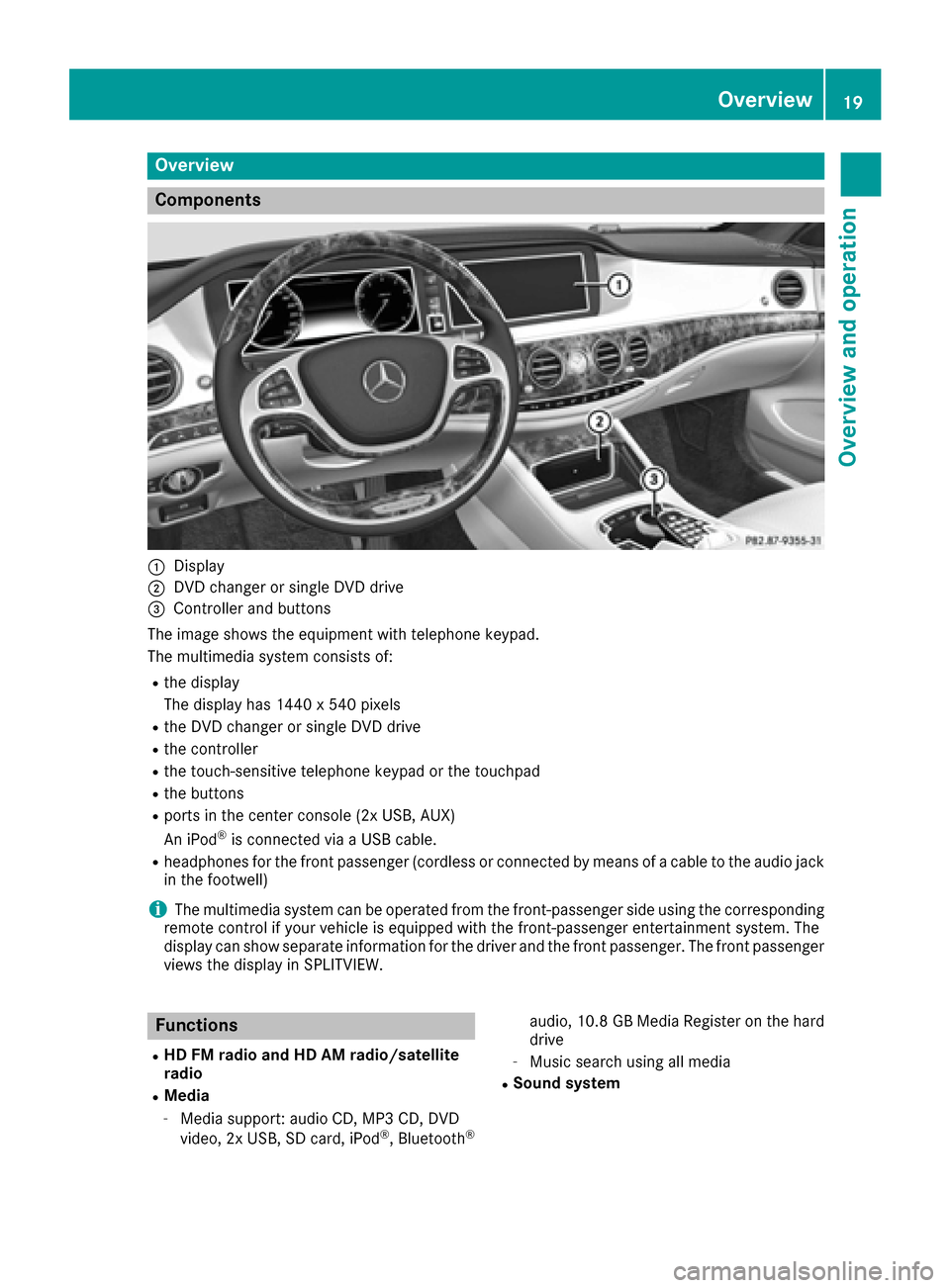
Components
:Display
;DVD changer or single DVD drive
=Controller and buttons
The image shows the equipment with telephone keypad.
The multimedia system consists of:
Rthe display
The display has 1440 x 540 pixels
Rthe DVD changer or single DVD drive
Rthe controller
Rthe touch-sensitive telephone keypad or the touchpad
Rthe buttons
Rports in the center console (2x USB, AUX)
An iPod®is connected via a USB cable.
Rheadphones for the front passenger (cordless or connected by means of a cable to the audio jack
in the footwell)
iThe multimedia system can be operated from the front-passenger side using the corresponding
remote control if your vehicle is equipped with the front-passenger entertainment system. The
display can show separate information for the driver and the front passenger. The front passenger
views the display in SPLITVIEW.
Functions
RHD FM radio and HD AM radio/satellite
radio
RMedia
-Media support: audio CD, MP3 CD, DVD
video, 2x USB, SD card, iPod®, Bluetooth®
audio, 10.8 GB Media Register on the hard
drive
-Music search using all media
RSound system
Overview19
Overview and operation
Page 22 of 230
You can select from three sound systems:
-Standard sound system
-Burmester®surround sound system
-Burmester high-end 3D surround sound
system for ultimate listening pleasure
RNavigation system
-Destination entry using keyword search
-Realistic 3D map with textured city models
-Personal POIs and routes using SD memory
card
-Navigation functions for passengers, e.g.
Drive Information
-Dynamic route guidance via SIRIUS satel-
lite radio
RCommunication
-Data transfer via NFC
-Messaging functions (text messages,
email)
-Address book
-Internet browser
-Mercedes-Benz Apps with online search,
weather, Facebook, stock prices, news and
much more
-Wi-Fi interface for connecting a smart-
phone to the multimedia system and the
option of remote control for the front
passenger (SPLITVIEW) and the Rear Seat
Entertainment System
-Mercedes-Benz Mobile Website
-Wi-Fi hotspot functionality to connect a
tablet PC or laptop in order to enable
access to the Internet using the customer's
mobile phone
-Mercedes-Benz Companion app
RSIRIUS Weather
-Weather data as an information chart (cur-
rent forecast, 5-day preview, detailed infor-
mation)
-Weather data on the weather map, e.g. rain
radar data, storm characteristics and thetrack of tropical cyclones (hurricanes,
typhoons)
RVehicle functions
-Vehicle settings, such as ambient lighting,
belt adjustment and tow-away alarm
-360° camera
-Rear view camera
-Climate control functions, e.g. climate
mode, perfume atomizer
-Setting the multicontour seat with new
massage program
RFavorites button
-Faster access to up to twelve favorite func-
tions using the favorites button and the
number keys on the telephone keypad or
the favorites button on the touchpad.
RMulti-Seat Entertainment System
-All passengers have access to the multi-
media system's entertainment sources
-Digital remote control operation and digital
cordless headphones
Display
General notes
!Do not use the space in front of the display
for storage. Objects placed here could dam-
age the display or impair its function. Avoid
any direct contact with the display surface.
Pressure on the display surface may result in
impairments to the display, which could be
irreversible.
Wearing polarized sunglasses may impair your
ability to read the display.
The display has an automatic temperature-con-
trolled switch-off feature. The brightness is
automatically reduced if the temperature is too
high. The display may temporarily switch off
completely.
20Overview
Overview and operation
Page 23 of 230
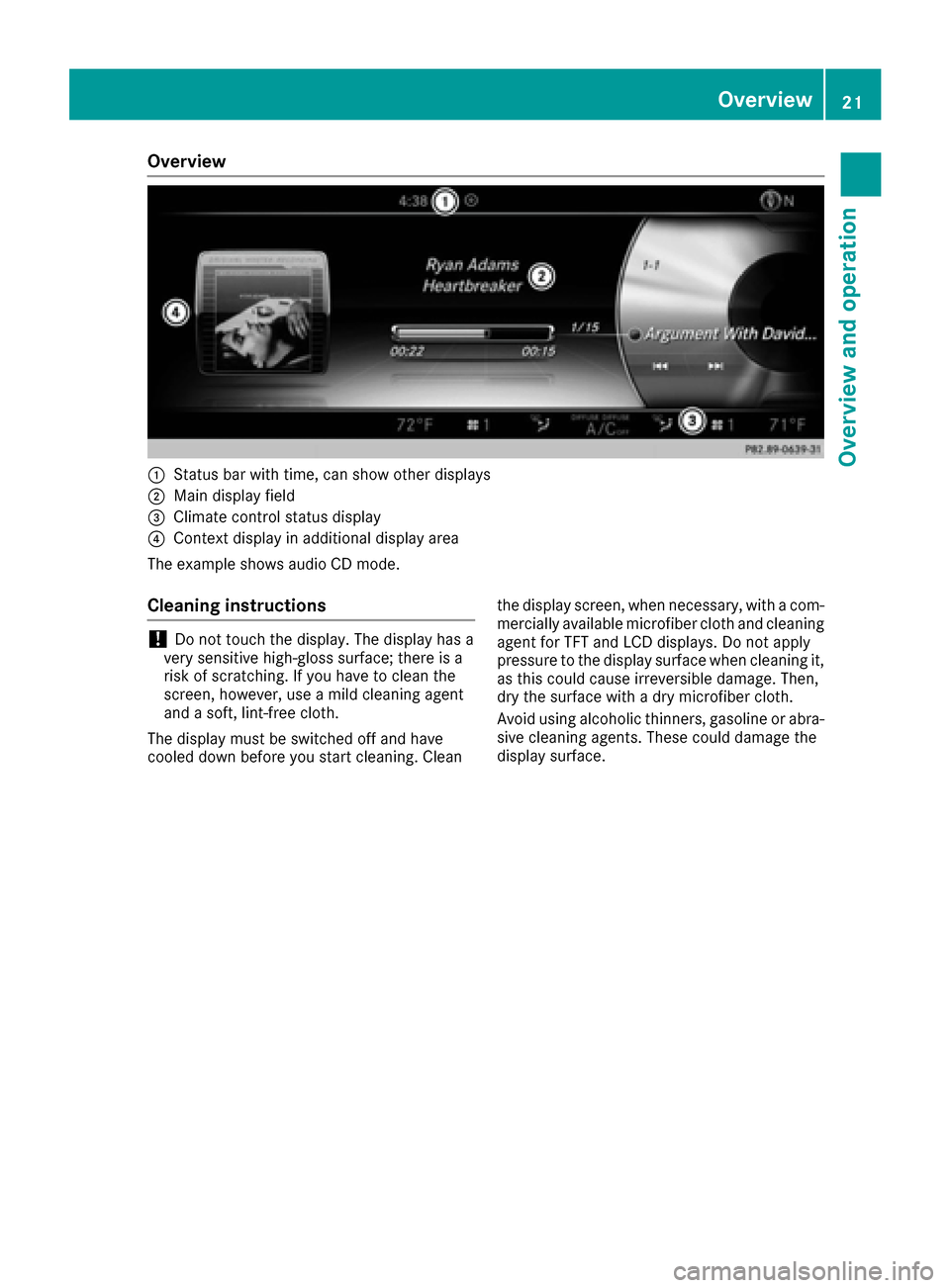
Overview
:Status bar with time, can show other displays
;Main display field
=Climate control status display
?Context display in additional display area
The example shows audio CD mode.
Cleaning instructions
!Do not touch the display. The display has a
very sensitive high-gloss surface; there is a
risk of scratching. If you have to clean the
screen, however, use a mild cleaning agent
and a soft, lint-free cloth.
The display must be switched off and have
cooled down before you start cleaning. Clean the display screen, when necessary, with a com-
mercially available microfiber cloth and cleaning
agent for TFT and LCD displays. Do not apply
pressure to the display surface when cleaning it,
as this could cause irreversible damage. Then,
dry the surface with a dry microfiber cloth.
Avoid using alcoholic thinners, gasoline or abra-
sive cleaning agents. These could damage the
display surface.
Overview21
Overview and operation
Page 25 of 230
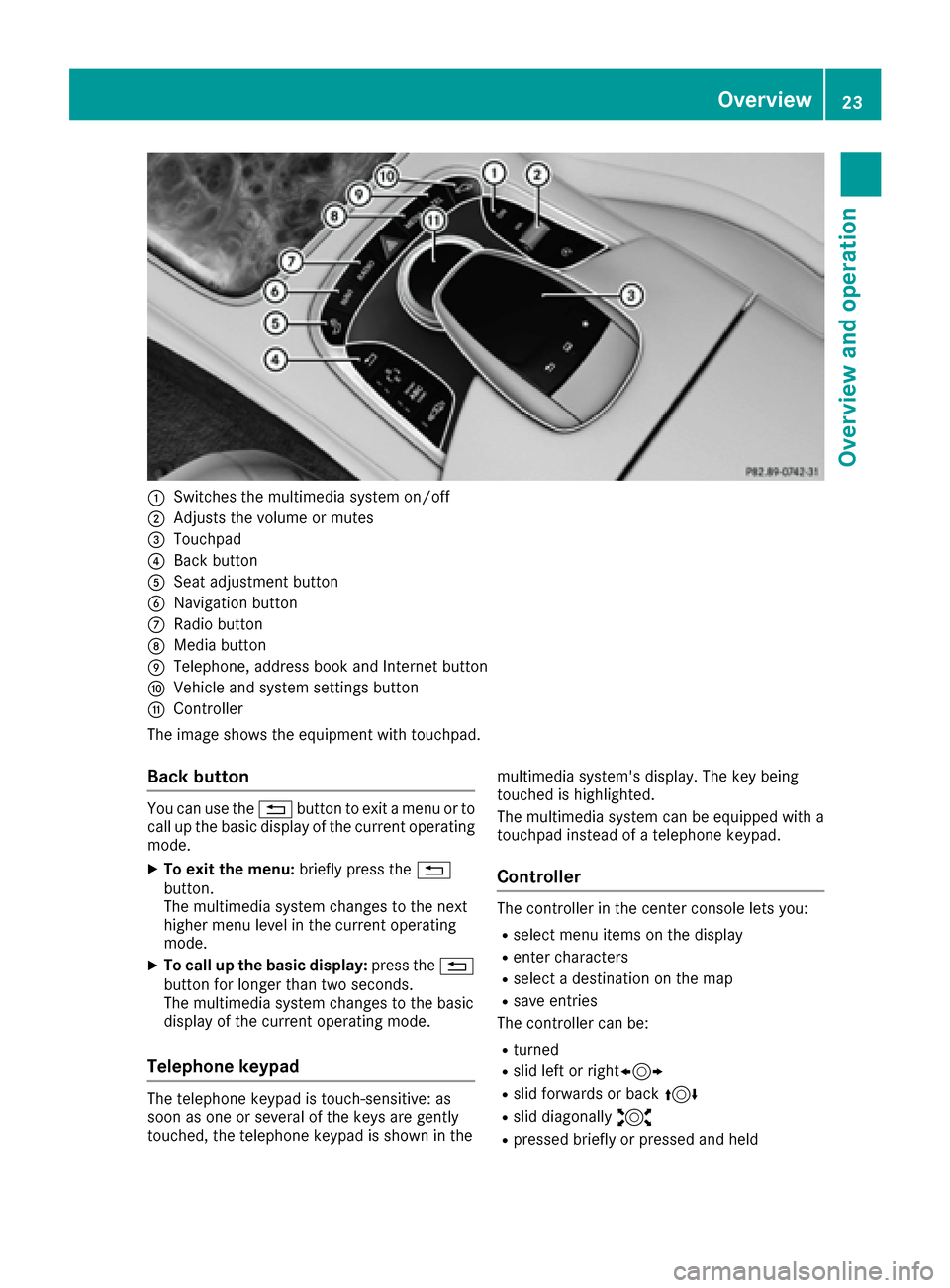
:Switches the multimedia system on/off
;Adjusts the volume or mutes
=Touchpad
?Back button
ASeat adjustment button
BNavigation button
CRadio button
DMedia button
ETelephone, address book and Internet button
FVehicle and system settings button
GController
The image shows the equipment with touchpad.
Back button
You can use the %button to exit a menu or to
call up the basic display of the current operating
mode.
XTo exit the menu: briefly press the%
button.
The multimedia system changes to the next
higher menu level in the current operating
mode.
XTo call up the basic display: press the%
button for longer than two seconds.
The multimedia system changes to the basic
display of the current operating mode.
Telephone keypad
The telephone keypad is touch-sensitive: as
soon as one or several of the keys are gently
touched, the telephone keypad is shown in the multimedia system's display. The key being
touched is highlighted.
The multimedia system can be equipped with a
touchpad instead of a telephone keypad.
Controller
The controller in the center console lets you:
Rselect menu items on the display
Renter characters
Rselect a destination on the map
Rsave entries
The controller can be:
Rturned
Rslid left or right1
Rslid forwards or back 4
Rslid diagonally2
Rpressed briefly or pressed and held
Overview23
Overview and operation
Page 27 of 230
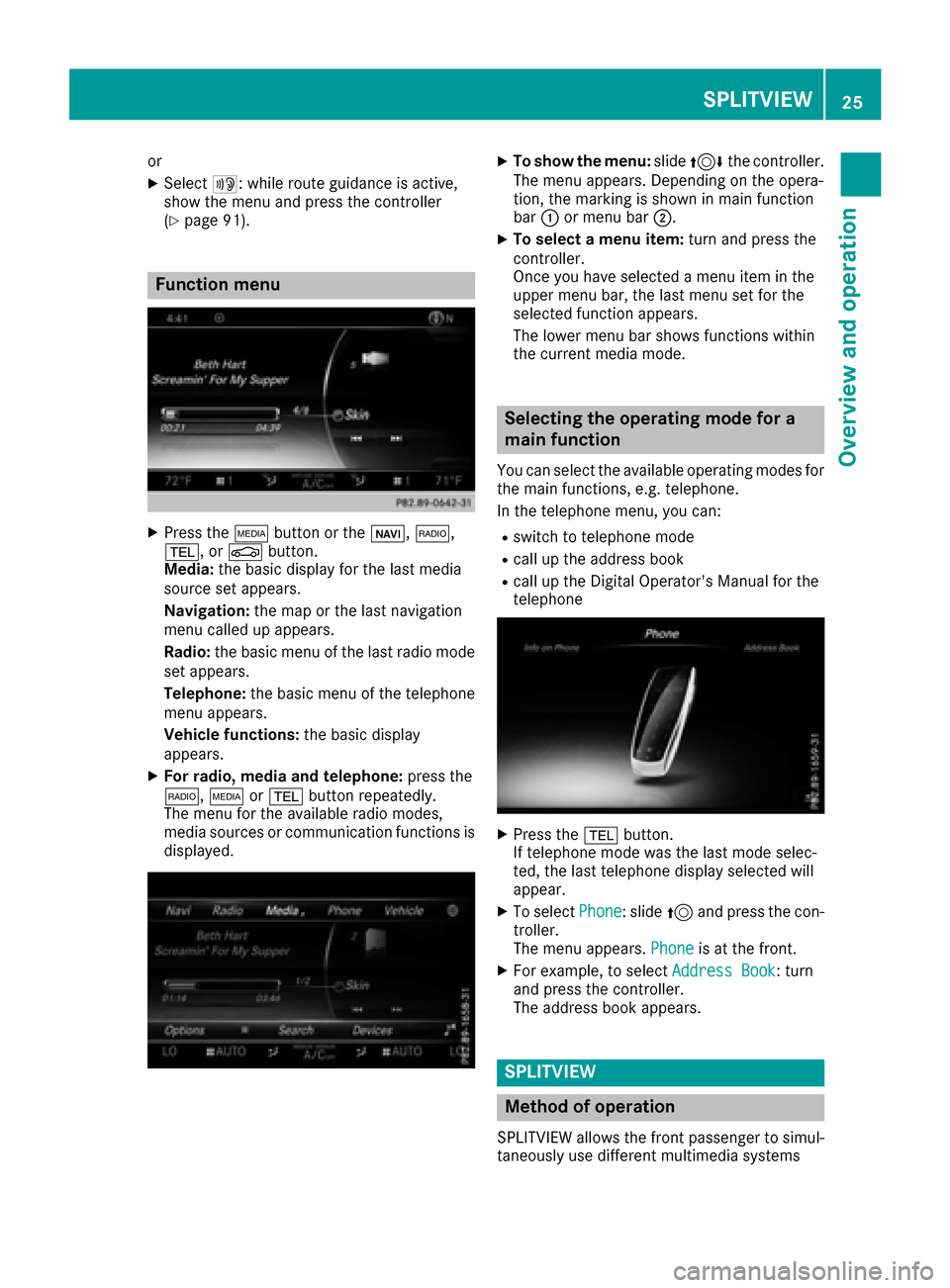
or
XSelect+: while route guidance is active,
show the menu and press the controller
(
Ypage 91).
Function menu
XPress the Õbutton or the ß,$,
%, or Øbutton.
Media: the basic display for the last media
source set appears.
Navigation: the map or the last navigation
menu called up appears.
Radio: the basic menu of the last radio mode
set appears.
Telephone: the basic menu of the telephone
menu appears.
Vehicle functions: the basic display
appears.
XFor radio, media and telephone: press the
$, Õor% button repeatedly.
The menu for the available radio modes,
media sources or communication functions is displayed.
XTo show the menu: slide4 the controller.
The menu appears. Depending on the opera-
tion, the marking is shown in main function
bar :or menu bar ;.
XTo select a menu item: turn and press the
controller.
Once you have selected a menu item in the
upper menu bar, the last menu set for the
selected function appears.
The lower menu bar shows functions within
the current media mode.
Selecting the operating mode for a
main function
You can select the available operating modes for
the main functions, e.g. telephone.
In the telephone menu, you can:
Rswitch to telephone mode
Rcall up the address book
Rcall up the Digital Operator's Manual for the
telephone
XPress the %button.
If telephone mode was the last mode selec-
ted, the last telephone display selected will
appear.
XTo select Phone: slide5and press the con-
troller.
The menu appears. Phone
is at the front.
XFor example, to select Address Book: turn
and press the controller.
The address book appears.
SPLITVIEW
Method of operation
SPLITVIEW allows the front passenger to simul-
taneously use different multimedia systems
SPLITVIEW25
Overview and operation
Page 28 of 230
than the driver. Different content is seen
depending on your perspective when viewing
the display.
The navigation function, for example, can be
used from the driver's side while a video is
watched from the front-passenger side.
SPLITVIEW is operated with the COMAND
remote control from the front-passenger side.
To do so, use the special radio headphones.
Using the headphones on the correct sides
ensures an optimal sound.
You can connect your own headphones to a
special headphones jack. You can use the
COMAND remote control to operate them.
Points to remember
RYou can only adjust the volume for the head-
phones supplied, directly on the headphones.
ROnly entertainment functions, i.e. radio, TV,
video and Internet, for example, may be usedwith SPLITVIEW.
RVideos cannot be shown on the driver's side
while the vehicle is in motion.
RIf media from different sources are used,
these can be used separately from the driv-
er's and front-passenger sides.
Example:
A medium is being played on the DVD changeron the driver's side. It is not possible for the
front passenger to play any other medium
that is inserted in the DVD changer from the
front-passenger side. However, other media
can be used on the front-passenger side at
the same time, including the radio, memory
card, MEDIA REGISTER, Media Interface, USB
or AUX.
RIf you use the same medium on both the driv-
er's and front passenger sides, settings can
be made from both sides. In this case, the last
setting made takes precedence.
RRequirement for Internet use (USA): mbrace
must be activated for Internet access in the
multimedia system on the driver's side
(
Ypage 142).
RRequirement for Internet use (Canada): a
mobile phone must be connected via Blue-
tooth
®or USB to the multimedia system on
the driver's side (Ypage 142).
RThe Internet can be separately used by both
the driver and front passenger at the same
time.
RThe multifunction steering wheel can be used
to control the functions which relate to the
driver's side, but not for the front-passenger
side.
RThe driver can lock or unlock the other
screens (override feature) (Ypage 63).
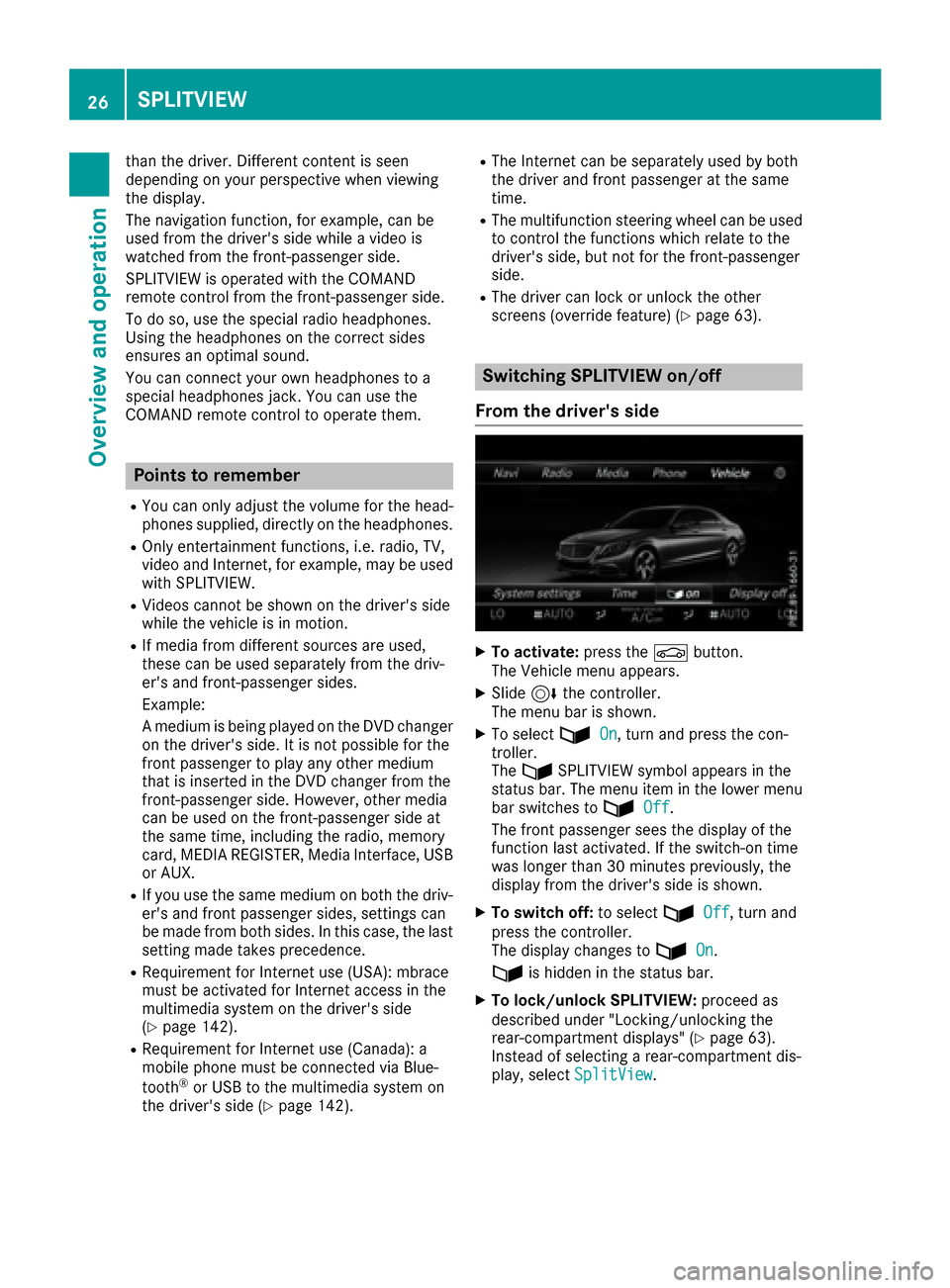
Switching SPLITVIEW on/off
From the driver's side
XTo activate: press theØbutton.
The Vehicle menu appears.
XSlide 6the controller.
The menu bar is shown.
XTo select ùOn, turn and press the con-
troller.
The ù SPLITVIEW symbol appears in the
status bar. The menu item in the lower menu
bar switches to ù
Off.
The front passenger sees the display of the
function last activated. If the switch-on time
was longer than 30 minutes previously, the
display from the driver's side is shown.
XTo switch off: to selectùOff, turn and
press the controller.
The display changes to ù
On.
ù is hidden in the status bar.
XTo lock/unlock SPLITVIEW: proceed as
described under "Locking/unlocking the
rear-compartment displays" (
Ypage 63).
Instead of selecting a rear-compartment dis-
play, select SplitView
.
26SPLITVIEW
Overviewand operation