ESP MERCEDES-BENZ S-CLASS SALOON LONG 2020 User Guide
[x] Cancel search | Manufacturer: MERCEDES-BENZ, Model Year: 2020, Model line: S-CLASS SALOON LONG, Model: MERCEDES-BENZ S-CLASS SALOON LONG 2020Pages: 609, PDF Size: 10.5 MB
Page 49 of 609
#
Only one person should use each seat
belt at any one time. Seat belt adjust
ment functionVe
hicles with PRE-SAFE ®
:af te r a front seat
belt has been fastened, the automatic seat belt
adjustment may apply a cer tain tigh tening forc e.
Do not hold the seat belt tight lywhile it is
adjusting.
Yo u can activate and deactivate the seat belt
adjustment function using the multimedia sys‐
te m (/ page 46). Ac
tivating/deactivating seat belt adjustment
via the multimedia sy stem Multimedia sy
stem:
4 © 5
Settings 5
Vehicle
5 Occupant protection #
Activate or deacti vate Belt adjustment. Re
leasing seat belts #
Press there lease button in the seat belt
buckle and guide the seat belt back with the
seat belt tongue. Seat belt
warning function for the driver and
front passen ger The
ü seat belt warning lamp in the driver's
display is a reminder that all vehicle occupants
must weartheir seat belts cor rectly.
In addition, a warning tone may sound.
As soon as the driver and front passenger fasten
th eir seat belts, the seat belt warning goes out. Fu
nction of there ar seat belt status display The
rear seat belt status display is on lyavailable
fo r cer tain countries. When
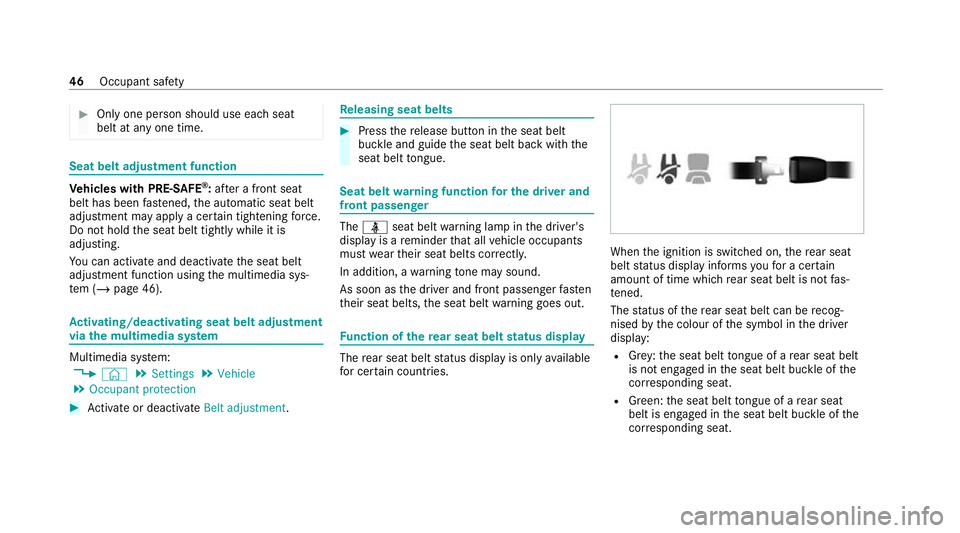
the ignition is switched on, there ar seat
belt status display informs youfo r a cer tain
amount of time which rear seat belt is not fas‐
te ned.
The status of there ar seat belt can be recog‐
nised bythe colour of the symbol in the driver
display:
R Grey:th e seat belt tongue of a rear seat belt
is not engaged in the seat belt buckle of the
cor responding seat.
R Green: the seat belt tongue of a rear seat
belt is engaged in the seat belt buckle of the
cor responding seat. 46
Occupant saf ety
Page 53 of 609
The ins
tallation location of an airbag is identified
by the AIRB AGsymbol (/ page47). &
WARNING Risk of inju ryor death due to
th e use of unsuitable seat co vers
Due tounsuitable seat co vers,th e airbags
cann otprotect vehicle occupants as inten‐
ded.
In addition, the operation of the automatic
front passenger airbag shutoff could be
re stricted. #
You should on lyuse seat co vers that
ha ve been appr oved forth e cor respond‐
ing seats byMercedes-Benz. &
WARNING Risk of inju rydue tomalfunc‐
tioning sensors in the door
The function of the airbags can be impaired
due tomodifications or incor rect wo rkper‐
fo rm ed on the doors or door trim, or if the
doors are damaged. #
Never modify the doors or parts of the
doors. #
Alw ays ha vewo rkon the doors or door
trim car ried out at a qualified specialist
wo rkshop. &
WARNING Risk of inju rydue todeplo yed
airbag
A deplo yed airbag no longer of fers any pro‐
te ction. #
Have theve hicle towe dto aqu alified
specialist workshop in order tohave the
deplo yed airbag replaced. Ha
ve deplo yed airbags replaced immediately. St
atus of the front passenger front airbag Fu
nction of the automatic front passenger
airbag shu toff
The automatic front passenger airbag shutoff is
able todetect whe ther the front passenger seat
is occupied bya person or a child restra int sys‐
te m. The front passenger airbag is enabled or
disabled accordingly. &
WARNING Risk of inju ryor death due to
objects under the co-driver seat
Objects trapped under the co-driver seat can
inter fere with the function of the automatic
co-driver airbag shutoff or damage the sys‐
te m. #
Do not store any objects under the co-
driver seat. #
When the co-driver seat is occupied,
make sure that no objects are trapped
under the co-driver seat. When
fitting a child restra int sy stem tothe front
passenger seat, alw ays make sure of thefo llow‐
ing:
R Ensure that thech ild restra int sy stem is posi‐
tioned cor rectly (/ page 62).
R Alw ays comply with thech ild restra int sys‐
te m manufacturer's ins tallation instructions.
R Never place objects (e.g. cushions) under or
behind thech ild restra int sy stem.
R Fully retract the seat cushion length adjust‐
ment. 50
Occupant saf ety
Page 54 of 609
R
The entire base of thech ild restra int sy stem
must alw aysre st on the sitting sur face of the
front passenger seat.
R The backrest of thefo rw ard-facing child
re stra int sy stem must, as far as possible, be
re sting on the seat backrest of the front
passenger seat.
R The child restra int sy stem must not touch the
ro of or be put under stra in by the head
re stra ints. Adjust the seat backrest inclina‐
tion and the head restra int setting accord‐
ing ly. &
WARNING Risk of inju ryor death due to
objects between the seat sur face and
th ech ild restra int sy stem
Objects between the sitting sur face and the
ch ild restra int sy stem could af fect the func‐
tion of the automatic co-driver airbag shut‐
off. #
Do not place any objects between the
sitting sur face and thech ild restra int
sy stem. #
The entire base of thech ild restra int
sy stem must alw aysre st on the sitting
sur face of the co-driver seat. #
The backrest of thefo rw ard-facing child
re stra int sy stem must, as far as possi‐
ble, be resting on the seat backrest of
th e co-driver seat. #
Alw ays comply with thech ild restra int
sy stem manufacturer's ins tallation
instructions. A person on
the front passenger seat must
obser vethefo llowing information:
R Fasten seat belts cor rectly (/ page 42).
R Sit in an almost upright seat position with
their back against the seat backrest.
R Sit with their feet resting on thefloor, if pos‐
sible.
The front passenger airbag may otherwise be
disabled bymis take ,fo rex ample, in thefo llow‐
ing situations:
R The front passen ger transfers their weight by
supporting themselves on a vehicle armrest. R
The front passenger sits in such a wayth at
th eir weight is raised from the sitting sur‐
fa ce. &
WARNING Risk of inju ryor death due to
a disabled front passenger airbag
The front passenger airbag is disabled when
th ePA SSENGER AIR BAG OFF indicator lamp
is lit.
A person in the front passenger seat could
th en, forex ample, come into con tact wi th
th eve hicle interior, especially if the person is
sitting too close tothe cockpit.
If th e front passenger seat is occupied,
alw ays ensure that:
R the classification of the person in the
front passenger seat is cor rect and the
front passenger airbag is enabled or disa‐
bled in accordance with the person in the
front passenger seat.
R the front passenger seat has been mo ved
as far back as possible.
R the person is seated cor rectly. Occupant saf
ety51
Page 57 of 609
and
the front passenger seat accord‐
ingly. #
Alw ays comply with thech ild restra int
sy stem manufacturer's ins tallation
instructions. When
fitting a child restra int sy stem tothe front
passenger seat, obser vetheve hicle-specific
information (/ page72).
If a person is sitting on the front passenger
seat: PASSENGER AIR BAG OFF may be lit con‐
tinuously or be off, depending on the person's
st ature.
A person on the front passenger seat must
alw ays obser vethefo llowing information:
R Ifth e front passenger seat is occupied byan
adult or a person with a stature cor respond‐
ing tothat of an adult, thePA SSENGER AIR
BA G OFF indicator lamp must be off. This
indicates that the front passenger airbag is
enabled.
If th ePA SSENGER AIR BAG OFF indicator
lamp is lit continuousl y,an adult or person with a build cor
responding tothat of an adult
must not use the front passenger seat.
Ins tead, they should use a rear seat.
R Ifth e front passenger seat is occupied by a
person of smaller stature (e.g. a teenager or
small adult), thePA SSENGER AIR BAG OFF
indicator lamp is either lit continuously or
re mains off, depending on the classification.
- Ifth ePA SSENGER AIR BAG OFF indicator
lamp is off: mo vethe front passenger
seat as far back as possible, or the per‐
son of smaller stature should use a rear
seat.
- Ifth ePA SSENGER AIR BAG OFF indicator
lamp is lit continuously: the person of
smaller stature should not use the front
passenger seat. &
WARNING Risk of inju ryor death when
th ePA SSENGER AIR BAG OFF indicator
lamp is lit
If th ePA SSENGER AIR BAG OFF indicator
lamp remains lit af terth e self-test, the front
passenger airbag is disabled. If
th e front passenger seat is occupied,
alw ays ensure that:
R The classification of the person in the
front passenger seat is cor rect and the
front passenger airbag is enabled or disa‐
bled in accordance with the person in the
front passenger seat.
R The person is sea ted properly with a cor‐
re ctly fastened seat belt.
R The front passenger seat has been mo ved
as far back as possible. Be sure
toalso obse rveth efo llowing fur ther
re lated subjects:
R Child restra int sy stem on the front passenger
seat (/ page72)
R Suitable positioning of thech ild restra int sys‐
te m (/ page 62) 54
Occupant saf ety
Page 79 of 609
#
Make sure that thech ild saf ety loc ksare
wo rking properly.
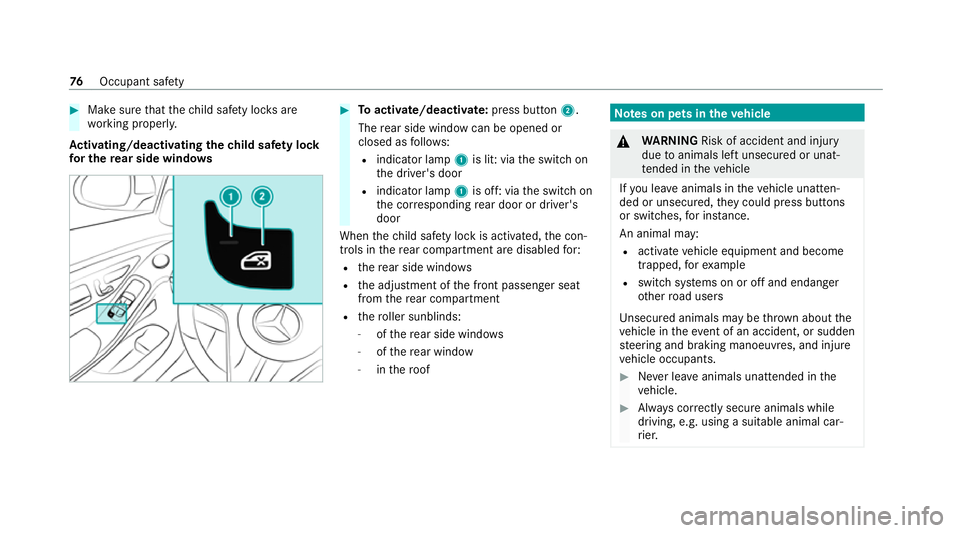
Ac tivating/deactivating the child saf ety lock
fo r the rear side windo ws #
Toactivate/deacti vate:press button 2.
The rear side wind owcan be opened or
closed as follo ws:
R indicator lamp 1is lit: via the switch on
th e driver's door
R indicator lamp 1is off: via the switch on
th e cor responding rear door or driver's
door
When thech ild saf ety lock is activated, the con‐
trols in there ar compartment are disabled for:
R there ar side wind ows
R the adjustment of the front passenger seat
from there ar compartment
R thero ller sunblinds:
- ofthere ar side wind ows
- ofthere ar wind ow
- inthero of Note
s on pets in theve hicle &
WARNING Risk of accident and inju ry
due toanimals left unsecured or unat‐
te nded in theve hicle
If yo u lea veanimals in theve hicle unatten‐
ded or unsecured, they could press buttons
or switches, for ins tance.
An animal may:
R acti vate ve hicle equipment and become
trapped, forex ample
R swit chsystems on or off and endanger
ot her road users
Un secured animals may be throw n about the
ve hicle in theev ent of an accident, or sudden
st eering and braking manoeuvres, and injure
ve hicle occupants. #
Never lea veanimals unat tended in the
ve hicle. #
Alw ays cor rectly secu reanimals while
driving, e.g. using a suitable animal car‐
ri er. 76
Occupant saf ety
Page 83 of 609
There is a
risk of fata l injur y. #
Keep batteries out of there ach of chil‐
dren. #
Ifth e co ver and/or lid of the battery
compartment does not close securel y,
do not use theke y and keep it away
from children. #
If batteries are swallo wed, seek medical
attention immediately. +
ENVIRONMEN
TALNO TEEnvironmental
dama gedue toimproper disposal of bat‐
te ries Batteries conta
in pollutants. It is
illegal todispose of them with the household
ru bbish. #
Dispose of batteries in an
environmen tally responsible manner.
Ta ke dischar ged batteries toaqu alified
specialist workshop or toa collection
point for used batteries. Re
quirements:
R Yourequ ire a CR 2032 3 V cell batter y.
Mercedes-Benz recommends that you ha vethe
battery replaced at a qualified specialist work‐
shop. #
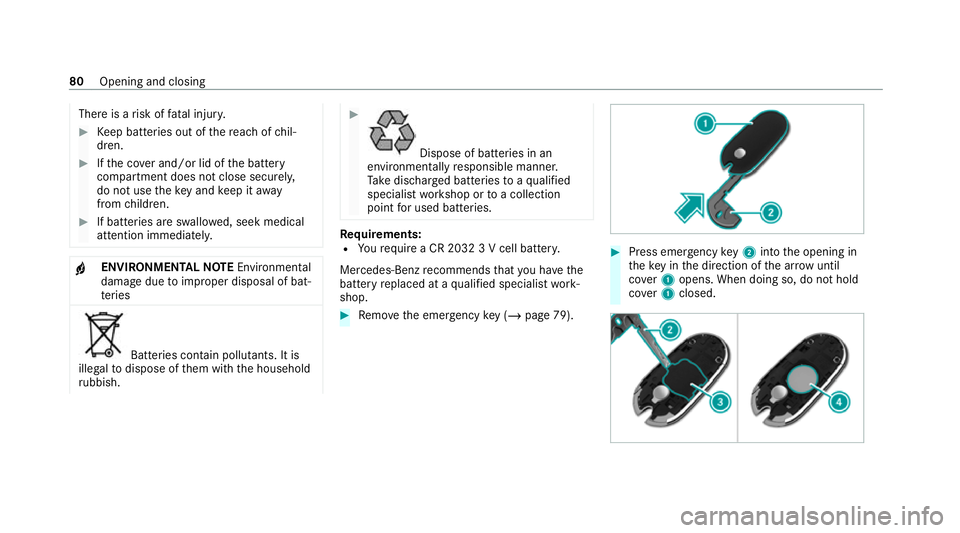
Remo vethe emer gency key ( / page 79). #
Press eme rgency key2 into the opening in
th eke y in the direction of the ar row until
co ver1 opens. When doing so, do not hold
co ver1 closed. 80
Opening and closing
Page 90 of 609
#
Tolock theright-hand side of theve hicle:
turn the emer gency key anti-clo ckwise as far
as it will go.
If th e loc ked door is then closed, it can no longer
be opened from the outside. Boot
Opening
the boot lid &
DANG ER Risk of exhaust gas poisoning
Combustion engines emit poisonous exhaust
ga ses such as carbon monoxide. Exhaust
ga ses can enter theve hicle interior if the
boot lid is open when the engine is running,
especially if theve hicle is in motion. #
Alw ays switch off the engine before
opening the boot lid. #
Never drive with the boot lid open. *
NO
TEDama getothe boot lid byobs ta‐
cles ab ovetheve hicle The boot lid swings upwards when it is
opened.
#
Therefore, make sure that there is suf fi‐
cient clearance ab ovethe boot lid. #
Pull the boot lid handle. #
Vehicles with HANDS-FREE ACCESS: make
a kicking mo vement with your foot below the
bumper (/ page 90). Ve
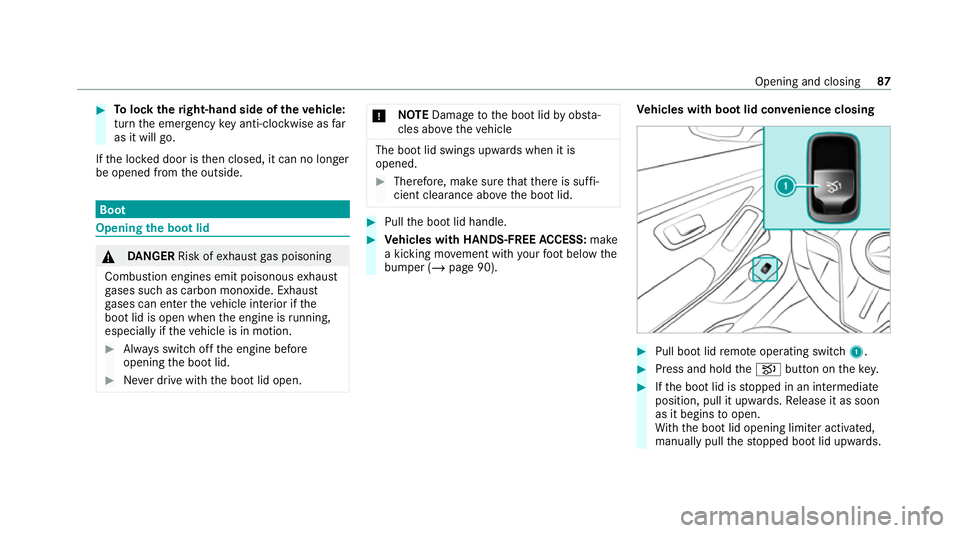
hicles with boot lid conv enience closing #
Pull boot lid remo teoperating switch 1. #
Press and hold theH button on thekey. #
Ifth e boot lid is stopped in an intermediate
position, pull it upwards. Release it as soon
as it begins toopen.
Wi th th e boot lid opening limiter activated,
manually pull thestopped boot lid upwards. Opening and closing
87
Page 92 of 609
#
Ifth e boot lid is stopped in an intermediate
position, push it down wards.
The boot lid will continue toclose. #
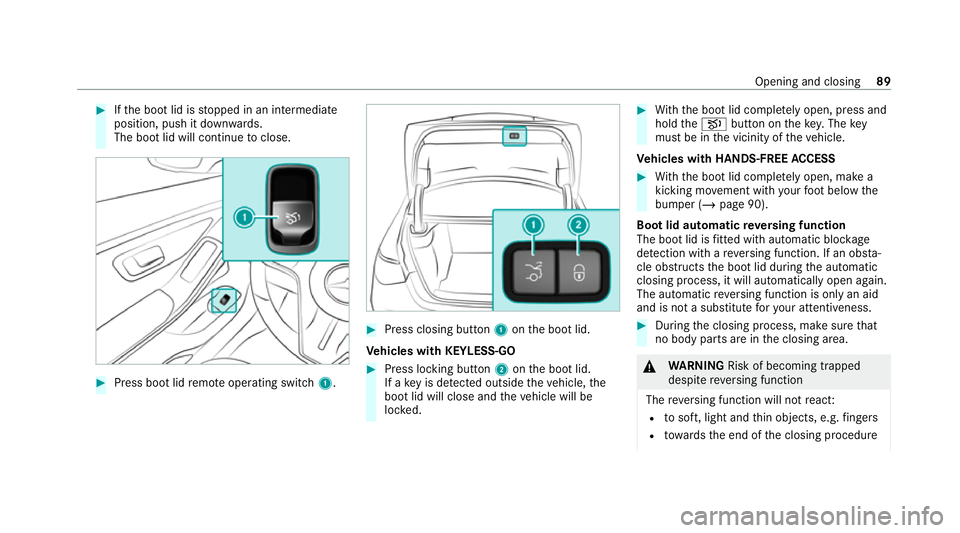
Press boot lid remo teoperating switch 1. #
Press closing button 1onthe boot lid.
Ve hicles with KEYLESS-GO #
Press locking button 2onthe boot lid.
If a key is de tected outside theve hicle, the
boot lid will close and theve hicle will be
loc ked. #
With th e boot lid comple tely open, press and
hold theH button on thekey. Thekey
must be in the vicinity of theve hicle.
Ve hicles with HANDS-FREE ACCESS #
With th e boot lid comple tely open, make a
kicking mo vement with your foot below the
bumper (/ page 90).
Boot lid automatic reve rsing function
The boot lid is fitted wi thautomatic bloc kage
de tection wi thare ve rsing function. If an obs ta‐
cle obstructs the boot lid during the automatic
closing process, it will automatically open again.
The automatic reve rsing function is only an aid
and is not a substitute foryo ur attentiveness. #
During the closing process, make sure that
no body parts are in the closing area. &
WARNING Risk of becoming trapped
despi tereve rsing function
The reve rsing function will not react:
R tosoft, light and thin objects, e.g. fingers
R towa rdsth e end of the closing procedure Opening and closing
89
Page 97 of 609
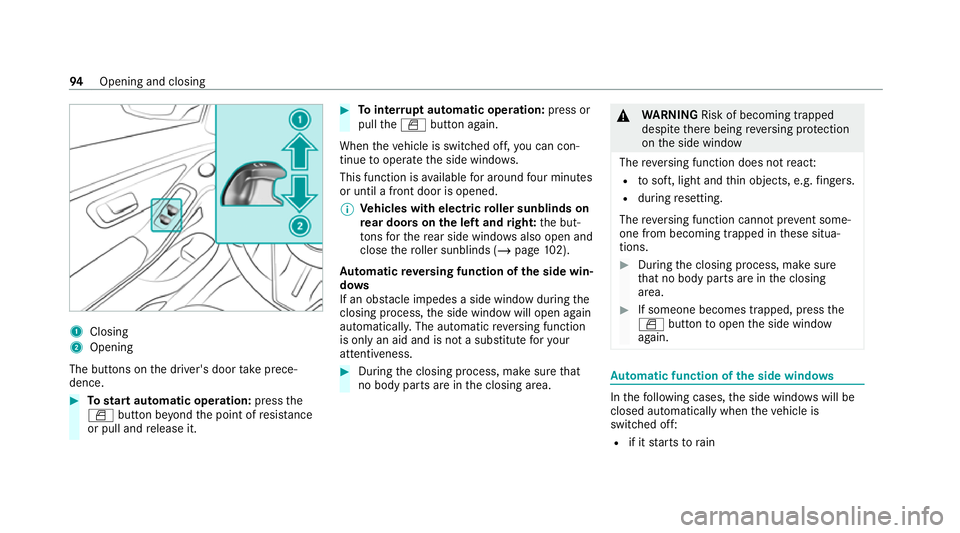
1
Closing
2 Opening
The but tons on the driver's door take prece‐
dence. #
Tostart automatic operation: pressthe
W button be yond the point of resis tance
or pull and release it. #
Tointer rupt automatic operation: press or
pull theW button again.
When theve hicle is switched off, you can con‐
tinue tooperate the side windo ws.
This function is available for around four minutes
or until a front door is opened.
% Ve
hicles with electric roller sunblinds on
re ar doors on the left and right: the but‐
to ns forth ere ar side wind owsalso open and
close thero ller sunblinds (/ page102).
Au tomatic reve rsing function of the side win‐
do ws
If an obs tacle impedes a side window du ring the
closing process, the side window will open again
automaticall y.The automatic reve rsing function
is only an aid and is not a substitute foryo ur
attentiveness. #
During the closing process, make sure that
no body parts are in the closing area. &
WARNING Risk of becoming trapped
despi tethere being reve rsing pr otection
on the side window
The reve rsing function does not react:
R tosoft, light and thin objects, e.g. fingers.
R during resetting.
The reve rsing function cannot pr event some‐
one from becoming trapped in these situa‐
tions. #
During the closing process, make sure
th at no body parts are in the closing
area. #
If someone becomes trapped, press the
W button toopen the side window
again. Au
tomatic function of the side windo ws In
thefo llowing cases, the side windo wswill be
closed automatically when theve hicle is
switched off:
R if it starts torain 94
Opening and closing
Page 102 of 609
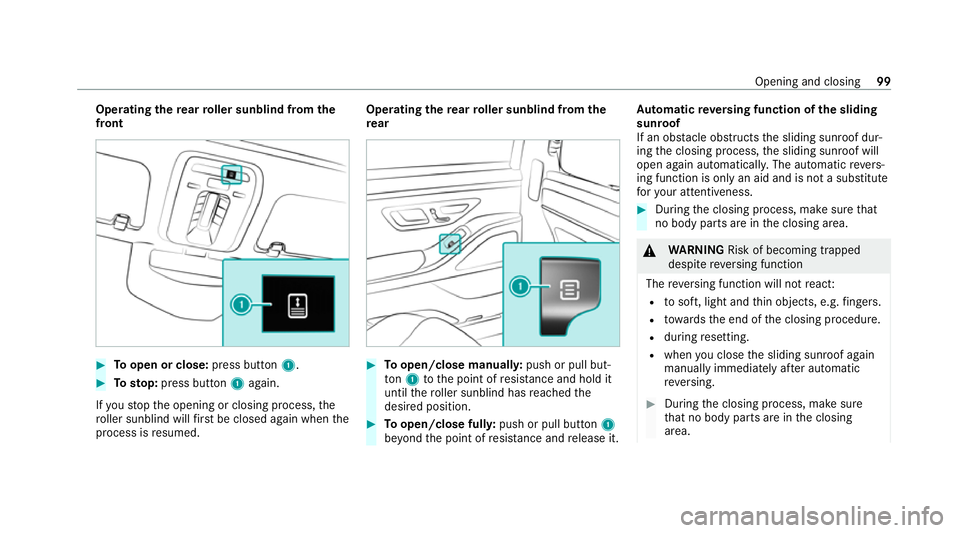
Operating
there ar roller sunblind from the
front #
Toopen or close: press button1. #
Tosto p:press button 1again.
If yo ustop the opening or closing process, the
ro ller sunblind will firs t be closed again when the
process is resumed. Operating
there ar roller sunblind from the
re ar #
Toopen/close manuall y:push or pull but‐
to n1 tothe point of resis tance and hold it
until thero ller sunblind has reached the
desired position. #
Toopen/close ful ly:push or pull button 1
be yond the point of resis tance and release it. Au
tomatic reve rsing function of the sliding
sunroof
If an obs tacle obstructs the sliding sunroof dur‐
ing the closing process, the sliding sunroof will
open again automaticall y.The automatic reve rs‐
ing function is only an aid and is not a substitute
fo ryo ur attentiveness. #
During the closing process, make sure that
no body parts are in the closing area. &
WARNING Risk of becoming trapped
despi tereve rsing function
The reve rsing function will not react:
R tosoft, light and thin objects, e.g. fingers.
R towa rdsth e end of the closing procedure.
R during resetting.
R when you close the sliding sunroof again
manually immediately af ter auto matic
re ve rsing. #
During the closing process, make sure
th at no body parts are in the closing
area. Opening and closing
99