abs MERCEDES-BENZ S-CLASS SALOON LONG 2020 Owners Manual
[x] Cancel search | Manufacturer: MERCEDES-BENZ, Model Year: 2020, Model line: S-CLASS SALOON LONG, Model: MERCEDES-BENZ S-CLASS SALOON LONG 2020Pages: 609, PDF Size: 10.5 MB
Page 12 of 609
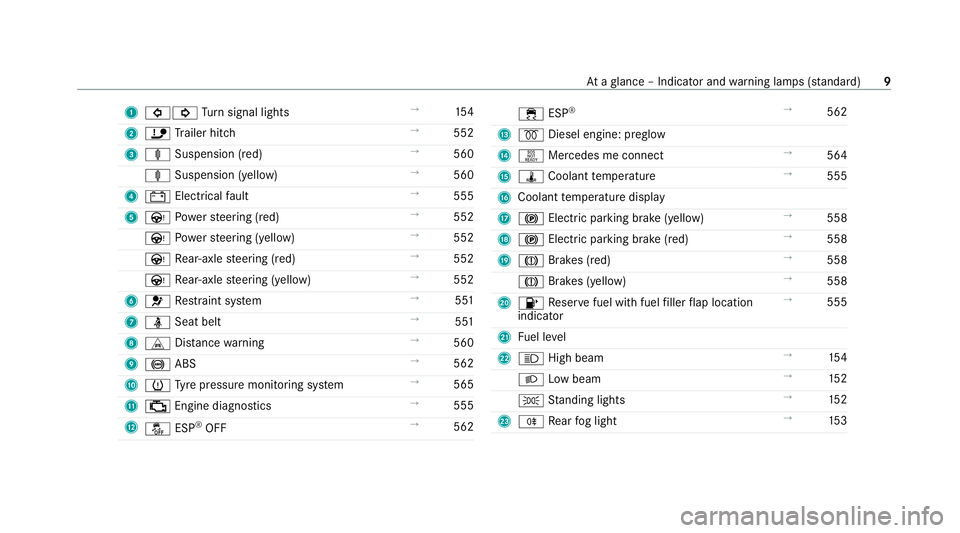
1
#! Turn signal lights →
154
2 ï Trailer hit ch →
552
3 ä Suspension (red) →
560
ä Suspension (yell ow) →
560
4 # Electrical fault →
555
5 Ù Powe rst eering (red) →
552
Ù Powe rst eering (yellow) →
552
Ù Rear-axle steering (red) →
552
Ù Rear-axle steering (yellow) →
552
6 6 Restra int sy stem →
551
7 ü Seat belt →
551
8 L Distance warning →
560
9 ! ABS →
562
A h Tyre pressure monitoring sy stem →
565
B ; Engine diagnostics →
555
C å ESP®
OFF →
562 ÷
ESP®
→
562
D % Diesel engine: preglow
E H Mercedes me connect →
564
F ÿ Coolant temp erature →
555
G Coolant temp erature display
H ! Electric pa rking brake (yellow) →
558
I ! Electric parking brake (red) →
558
J J Brakes (red) →
558
J Brakes (yellow) →
558
K 8 Reser vefuel with fuel filler flap location
indicator →
555
L Fuel le vel
M K High beam →
154
L Low beam →
15 2
T Standing lights →
15 2
N R Rear fog light →
15 3 At
aglance – Indicator and warning lamps (s tanda rd) 9
Page 14 of 609
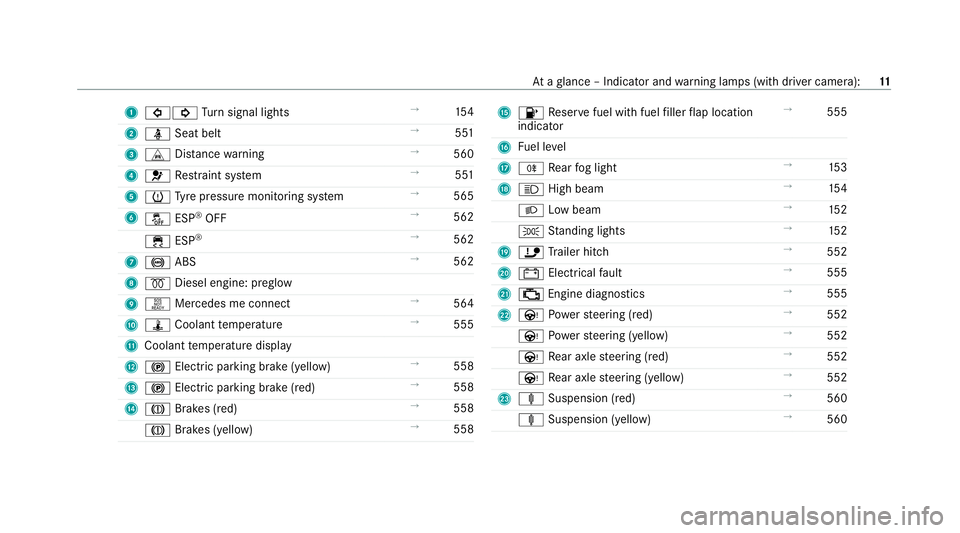
1
#! Turn signal lights →
154
2 ü Seat belt →
551
3 L Distance warning →
560
4 6 Restra int sy stem →
551
5 h Tyre pressure monitoring sy stem →
565
6 å ESP®
OFF →
562
÷ ESP®
→
562
7 ! ABS →
562
8 % Diesel engine: preglow
9 H Mercedes me connect →
564
A ÿ Coolant temp erature →
555
B Coolant temp erature display
C ! Electric pa rking brake (yellow) →
558
D ! Electric parking brake (red) →
558
E J Brakes (red) →
558
J Brakes (yellow) →
558 F
8 Reser vefuel with fuel filler flap location
indicator →
555
G Fuel le vel
H R Rear fog light →
15 3
I K High beam →
154
L Low beam →
15 2
T Standing lights →
15 2
J ï Trailer hit ch →
552
K # Electrical fault →
555
L ; Engine diagnostics →
555
M Ù Powe rst eering (red) →
552
Ù Powe rst eering (yellow) →
552
Ù Rear axle steering (red) →
552
Ù Rear axle steering (yellow) →
552
N ä Suspension (red) →
560
ä Suspension (yellow) →
560 At
aglance – Indicator and warning lamps (with driver camera): 11
Page 27 of 609
Operating saf
ety&
WARNING Risk of inju rydue tomalfunc‐
tions or sy stem failure
In order toavo id malfunctions or sy stem fail‐
ures: #
Alw ays ha vethe specified service/
maintenance workas well as any nec‐
essary repairs car ried out at a qualified
specialist workshop. &
WARNING Risk of accident or inju rydue
to improper modifications toelectronic
components
Modifications toelectronic components,
th eir software or wiring can impair their func‐
tionality and/or the functionality of other
networ ked components or saf ety-re leva nt
sy stems.
This can endanger theve hicle's operating
saf ety. #
You must not tamp er with wiring, elec‐
tronic components, or their software. #
Alw ays ha vewo rkon electrical and
electronic devices car ried out at a quali‐
fi ed specialist workshop. If
yo u modify the on-board electronics, thege n‐
eral operating pe rmit is rende red in valid.
Obser vethe "On-board electronics" section in
"Technical data". &
WARNING Risk offire due toflammable
materials on hot parts of theex haust
sy stem
Flammable material such as lea ves, grass or
twigs may ignite if they come into contact
wi th hot parts of theex haust sy stem. #
When driving on unpa vedro ads or off-
ro ad, regular lych eck theve hicle under‐
side. #
Remo vetrapped plants or other flam‐
mable material, in particular. #
Ifth ere is damage, consult a qualified
specialist workshop immediately. *
NO
TEDama getotheve hicle due todriv‐
ing toofast and due toimpacts tothe
ve hicle underbody or suspension compo‐
nents In
thefo llowing situations, in particular, there
is a risk of damage totheve hicle:
R theve hicle becomes grounded, e.g. on a
high kerb or an unpa vedro ad
R theve hicle is driven toofast over an
obs tacle, e.g. a kerb, speed bump or pot‐
hole
R a heavy object strike sth e underbody or
suspension components
In situations such as these, damage tothe
body, underbody, suspension components,
wheels or tyres may not be visible. Compo‐
nents damaged in this wa y can unexpec tedly
fa il or, in the case of an accident, may no lon‐
ge r absorb there sulting forc e as intended. 24
General no tes
Page 34 of 609
Information about
the specific absor ption
rate
Fo rFr ance on ly: The
values weredeterm ined and tested in
accordance with the Décre t n° 2019-118 6guide‐
line rega rding the indication of the specific absor
ption rate (SAR) of wireless vehicle compo‐
nents.
Information about the specific absor ption rate Ve
hicle comp onent (designation in accordance with EU DoC) SARva lue in W/kg
Ra dio data transmission telephone sy stem < 0.4 W/kg
Hermes 2. 1< 0.4 W/kg
Compensator ECE DE003 & ECE DE004 < 0.4 W/kg
Ta blet PC SM-T230NZ < 0.82 W/kg
DA I RSE <1.8 W/kg Jack
Copy and translation of
the original declaration
of confo rmity:
EC declaration of conformity
1.
The undersigned, representing
Manufacturer: BRANO a.s.
74
741 Hradec nad Mor avicí, Opa vská 1000,
The Czech Republic
ID No.: 64-387-5933
VA T No.: CZ64-387 -5933
her ewith declares under our sole responsibility
th at the product: 2. a)
Na
me:
Car jack
Ty pe, Number:
A) A 164 580 02 18, A 166 580 0118
B) A 240 580 00 18
C) A 639 580 02 18 Gene
ral no tes 31
Page 73 of 609
R
Only use a child restra int sy stem appr oved
by Mercedes-Benz.
R Obser vethe no tes in "Overview of recom‐
mended child restra int sy stems"
(/ page 60).
R Secure a rear wa rd-facing child restra int sys‐
te m with the ISOFIX or the i-Size child
re stra int sy stem.
R Secure a forw ard-facing child restra int sys‐
te m with the ISOFIX or the i-Size child
re stra int sy stem and, if present, theTo p
Te ther anchorage.
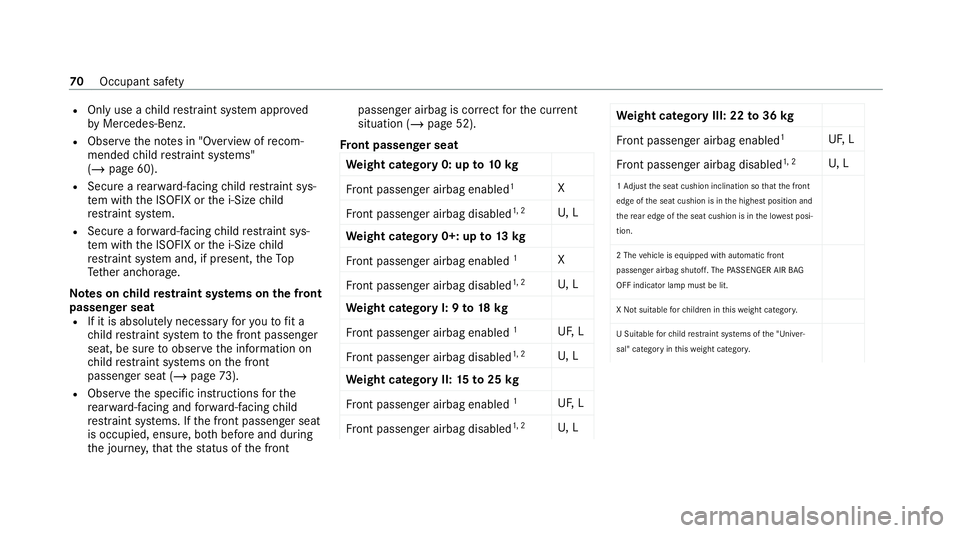
Note s onchild restra int sy stems on the front
passenger seat R If it is absolutely necessary foryo uto fit a
ch ild restra int sy stem tothe front passenger
seat, be sure toobser vethe information on
ch ild restra int sy stems on the front
passenger seat (/ page73).
R Obse rveth e specific instructions forthe
re ar wa rd-f acing and forw ard-facing child
re stra int sy stems. If the front passenger seat
is occupied, ensure, bo thbefore and during
th e journe y,that thest atus of the front passenger airbag is cor
rect forth e cur rent
situation (/ page 52).
Fr ont passenger seat
We ight category 0: up to10 kg
Fr ont passenger airbag enabled 1
X
Fr ont passenger airbag disabled 1, 2
U, L
We ight category 0+: up to13 kg
Fr ont passenger airbag enabled 1
X
Fr ont passenger airbag disabled 1, 2
U, L
We ight category I: 9 to18 kg
Fr ont passenger airbag enabled 1
UF, L
Fr ont passenger airbag disabled 1, 2
U, L
We ight category II: 15to25 kg
Fr ont passenger airbag enabled 1
UF, L
Fr ont passenger airbag disabled 1, 2
U, L We
ight category III: 22 to36 kg
Fr ont passenger airbag enabled 1
UF, L
Fr ont passenger airbag disabled 1, 2
U, L
1 Ad just the seat cushion inclination so that the front
edge of the seat cushion is in the highest position and
th ere ar edge of the seat cushion is in the lo west posi‐
tion.
2 The vehicle is equipped with automatic front
passenger airbag shutoff. The PASSENGER AIR BAG
OFF indicator lamp must be lit.
X Not suitable forch ildren in this we ight categor y.
U Suitable forch ild restra int sy stems of the "Univer‐
sal" category in this we ight categor y. 70
Occupant saf ety
Page 76 of 609
Obser
vethe specific instructions forth ere ar‐
wa rd-facing and forw ard-facing child restra int
sy stems (/ page73). Wa
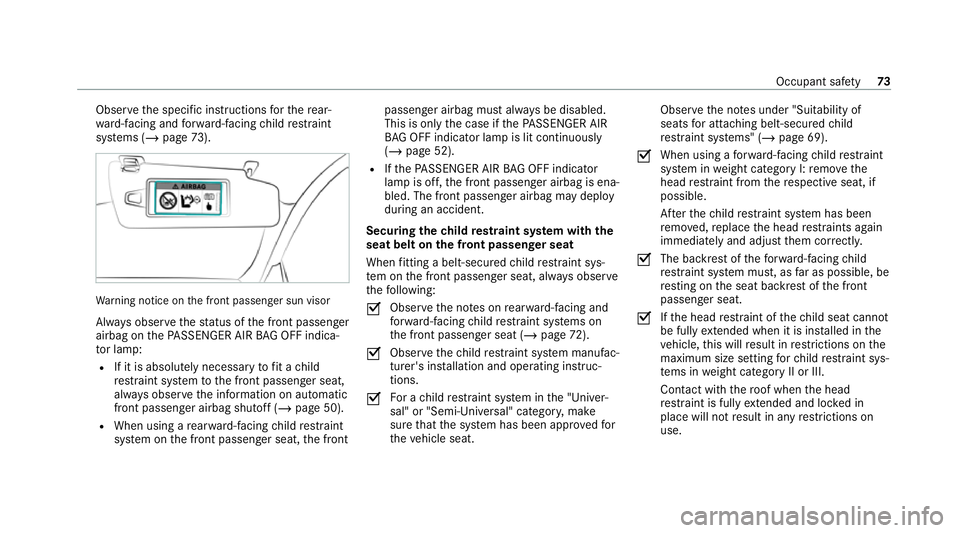
rning notice on the front passenger sun visor
Alw ays obser vethest atus of the front passenger
airbag on thePA SSENGER AIR BAG OFF indica‐
to r lamp:
R If it is absolutely necessary tofit a child
re stra int sy stem tothe front passenger seat,
alw ays obser vethe information on automatic
front passenger airbag shutoff (/ page 50).
R When using a rear wa rd-facing child restra int
sy stem on the front passenger seat, the front passenger airbag must alw
ays be disabled.
This is only the case if thePA SSENGER AIR
BA G OFF indicator lamp is lit continuously
(/ page 52).
R Ifth ePA SSENGER AIR BAG OFF indicator
lamp is off, the front passenger airbag is ena‐
bled. The front passenger airbag may deploy
during an accident.
Securing thech ild restra int sy stem with the
seat belt on the front passenger seat
When fitting a belt-secu redch ild restra int sys‐
te m on the front passenger seat, alw ays obser ve
th efo llowing:
O Obser
vethe no tes on rear wa rd-facing and
fo rw ard-facing child restra int sy stems on
th e front passenger seat (/ page72).
O Obser
vethech ild restra int sy stem manufac‐
turer's ins tallation and operating instruc‐
tions.
O Fo
r a child restra int sy stem in the "Univer‐
sal" or "Semi-Universal" categor y,make
sure that the sy stem has been appr ovedfor
th eve hicle seat. Obser
vethe no tes under "Suitability of
seats for attaching belt-secu redch ild
re stra int sy stems" (/ page 69).
O When using a
forw ard-facing child restra int
sy stem in weight category I: remo vethe
head restra int from there spective seat, if
possible.
Af terth ech ild restra int sy stem has been
re mo ved, replace the head restra ints again
immediately and adjust them cor rectl y.
O The backrest of
thefo rw ard-facing child
re stra int sy stem must, as far as possible, be
re sting on the seat backrest of the front
passenger seat.
O If
th e head restra int of thech ild seat cannot
be fully extended when it is ins talled in the
ve hicle, this will result in restrictions on the
maximum size setting forch ild restra int sys‐
te ms in weight category II or III.
Contact with thero of when the head
re stra int is fully extended and lo cked in
place will not result in any restrictions on
use. Occupant saf
ety73
Page 84 of 609
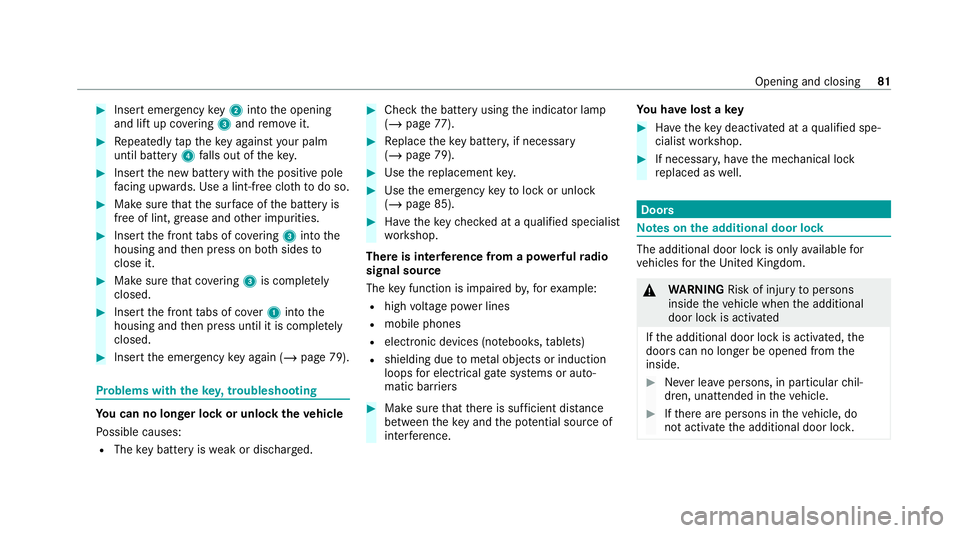
#
Insert emergency key2 into the opening
and lift up co vering 3 and remo veit. #
Repeatedly taptheke y again styour palm
until bat tery 4 falls out of thekey. #
Insert the new battery with the positive pole
fa cing up wards. Use a lint-free clo thtodo so. #
Make sure that the sur face of the battery is
free of lint, grease and other impurities. #
Insert the front tabs of co vering 3 into the
housing and then press on bo thsides to
close it. #
Makesure that co vering 3 is compl etely
closed. #
Insert the front tabs of co ver1 into the
housing and then press until it is comple tely
closed. #
Insert the emer gency key again ( /page 79). Problems with
theke y,troublesho oting Yo
u can no lon ger lo ckor unlock theve hicle
Po ssible causes:
R The key bat tery iswe ak or dischar ged. #
Check the battery using the indicator lamp
(/ page 77). #
Replace theke y bat tery, if necessary
(/ page 79). #
Use there placement key. #
Use the emer gency keyto lock or unlock
(/ page 85). #
Have theke ych ecked at a qualified specialist
wo rkshop.
There is inter fere nce from a po werful radio
signal source
The key function is impaired by,fo rex ample:
R high voltage po wer lines
R mobile phones
R electronic devices (no tebooks, tablets)
R shielding due tome tal objects or induction
loops for electrical gatesystems or auto‐
matic bar riers #
Make sure that there is suf ficient di stance
between theke y and the po tential sou rce of
inter fere nce. Yo
u ha velost a key #
Have theke y deacti vated at a qualified spe‐
cialist workshop. #
If necessar y,ha ve the mechanical lock
re placed as well. Doors
Note
s onthe additional door lock The additional door lock is only
available for
ve hicles forth eUni ted Kingdom. &
WARNING Risk of inju ryto persons
inside theve hicle when the additional
door lock is activated
If th e additional door lock is activated, the
doors can no longer be opened from the
inside. #
Never lea vepersons, in particular chil‐
dren, unat tended in theve hicle. #
Ifth ere are persons in theve hicle, do
not activate the additional door loc k. Opening and closing
81
Page 224 of 609
Make sure
that there are no overhanging loads
pr otru ding into the de tection range.
If th ere is damage toa bumper or thera diator
grille, or af ter an impact, ha vethe function of
th e sensors checked at a qualified specialist
wo rkshop. Ha vedamage or stone chipping in the
area of the cameras on the front and rear win‐
do ws repaired at a qualified specialist workshop. Overview of driving sy
stems and driving
saf ety sy stems R
ABS (Anti-lock Braking System)
(/ page 221)
R BAS (Bra keAssist System) (/ page 222)
R ESP ®
(Electronic Stability Program)
(/ page 222)
R ESP ®
Crosswind Assist (/ page 223)
R ESP ®
trailer stabilisation (/ page 223)
R EBD (Electronic Brakeforc eDistribution)
(/ page 224)
R STEER CONTROL (/ page 224)
R HOLD function (/ page 224) R
Hill Start Assist (/ page 225)
R Adaptive Brake Lights (/ page 226)
R ATTENTION ASSIST (/ page 226)
R Limiter (/ page 228)
R Traf fic Sign Assi st (/ page 247)
R Traf fic light view (/ page 251)
R AIRMATIC (/ page 258)
Driving Assistance pac kage
R Active Dis tance Assi stDISTRONIC
(/ page 229)
R Active Speed Limit Assi st(countr y-depend‐
ent) (/ page 234)
R Route-based speed adap tation (countr y-
dependent) (/ page 235)
R Active Brake Assi st (/ page 243)
R Active Steering Assist (count ry-dependent)
(/ page 237)
R Active Emergency Stop Assist (countr y-
dependent) (/ page 239)
R Active Lane Change Assi st(countr y-depend‐
ent) (/ page240) R
Active Stop-and-Go Assist (countr y-depend‐
ent) (/ page 236)
R Active Blind Spot Assi stwith exitwa rning
(/ page 251)
R Active Lane Keeping Assist (/ page 255)
R PRE-SAFE ®
Impulse Side (/ page 56)
Pa rking Package
R Reversing camera (/ page 260)
R 360° Camera (/ page 262)
R Parking Assist PARKTRONIC (/ page 267)
R Active Parking Assist (/ page271)
R Remo teParking Assist (/ page275) Fu
nction of ABS The Anti-lock Brake Sy
stem (ABS) regulates the
brake pressure in critical driving situations:
R During braking, e.g. at full brake application
or insuf ficient tyre traction, the wheels are
pr ev ented from locking.
R Vehicle steerability while braking is ensured. Driving and parking
221
Page 225 of 609
If ABS inter
venes when braking, you will feel a
pulsing in the brake pedal. The pulsating brake
pedal can be an indication of hazardous road
conditions and can ser veas a reminder totake
ex tra care while driving. Fu
nction of BAS The Brake Assist Sy
stem (BAS) supports your
eme rgency braking situation with additional
brake forc e.
If yo u depress the brake pedal quickl y,BA S is
acti vated:
R BAS au tomatical lyboosts the brake pres‐
sure.
R BAS can sho rten the braking dis tance.
R ABS pr events the wheels from locking.
The brakes will function as usual once you
re lease the brake pedal. BAS is deactivated. Fu
nction of ESP ®
(Electronic Stability Pro‐
gr am) &
WARNING Risk of skidding if ESP ®
is
deactivated
If yo u deactivate ESP ®
, ESP ®
cannot car ry
out vehicle stabilisation. #
ESP ®
should on lybe deactivated in the
fo llowing situations. ESP
®
can monitor and impr ovedriving stability
and traction in thefo llowing situations, within
ph ysical limits:
R When pulling away on wet or slippe rycar ria‐
ge wa ys.
R When braking.
If th eve hicle deviates from the direction desired
by the driver, ESP ®
can stabilise theve hicle by
inter vening in thefo llowing ways:
R One or more wheels are braked.
R The engine output is adap ted according to
th e situation. When ESP
®
is deactivated, theå warning
lamp lights up continuously:
R Driving stability will no lon ger be impr oved.
R The drive wheels could spin.
R ETS/4ETS traction control is still active.
% When ESP ®
is deactivated, you are still assis‐
te dby ESP ®
when braking.
When the÷ warning lamp flashes, one or
se veral wheels has reached its grip limit:
R Adapt your driving style to suit the cur rent
ro ad and weather conditions.
R Do not deactivate ESP ®
.
R Only depress the accelerator pedal as far as
is necessary when pulling away.
Deactivate ESP ®
in thefo llowing situations to
impr ovetraction:
R When using snow chains.
R In deep sn ow.
R On sand or gr avel. 222
Driving and parking
Page 359 of 609
R
Make sure thera dar sensors function
(/ page 220). Note
s on cleaning decorative foils Obser
vethe no tes on matt finish care in the
ch ap ter "No tes on paintwork/matt finish paint‐
wo rkcare" (/ page 355). They also app lyto
matt decorative foils.
Obser vethe no tes on cleaning decorative foils to
avo idvehicle damage.
Cleaning R For cleaning, use plenty of water and a mild
cleaning agent without additives or abrasive
subs tances, e.g. a car sha mpoo appr ovedfor
Mercedes-Benz.
R Remo vedirt immediatel y,where possible,
whilst avoiding rubbing too hard. There is
ot herwise a risk of damaging the decorative
fo il ir reparably.
R Ifth ere is dirt on thefinish or if the decora‐
tive foil is dull: use thePa int Cleaner recom‐
mended and appr ovedfo r Mercedes-Benz. R
Insect remains: soak with insect remo ver and
ri nse off the treated areas af terw ards.
R Bird droppings: soak with water and rinse off
af te rw ards.
R Topreve ntwate rst ains, dry a foil-wrapped
ve hicle with a soft, absorbent clo thafter
eve rycar wash.
Av oiding dama getothe decorative foil
R The service life and colouring of decorative
fo ils are impaired by:
- sunlight
- temp erature, e.g. hot air blo wer
- weather conditions
- stone chippings and dirt
- chemical cleaning agents
- oily products
R Do not use polish on matt decorative foil.
Po lishing will ha vethe ef fect of shining the
fo il-wrapped sur face.
R Do not treat matt or stru ctured deco rative
fo ils with wax.Pe rm anent stains may occur. Sc
ratches, cor rosive deposits, areas af fected by
cor rosion and damage caused byincor rect care
cannot al ways be comple tely repaired. In such
cases, visit a qualified specialist workshop.
Yo u can obtain more information on care and
cleaning products from the manufacturer.
In the case of foil-wrapped sur faces, optical dif‐
fe re nces may occur between the sur faces that
we renot pr otected bya decorative foil af ter
re moving a decorative foil.
% Have wo rkor repairs todecorative foils car‐
ri ed out at a qualified specialist workshop,
e.g. in a Mercedes-Benz Service Centre. Note
s on care of car parts &
WARNING Risk of entrapment if the
windscreen wipers are swit ched on while
th e windscreen is being cleaned
If th e windscreen wipers are set in motion
while you are cleaning the windscreen or
wiper blades, you can be trapped bythe
wiper arm. 356
Maintenance and care