ESP MERCEDES-BENZ S-CLASS SEDAN 2018 Owner's Manual
[x] Cancel search | Manufacturer: MERCEDES-BENZ, Model Year: 2018, Model line: S-CLASS SEDAN, Model: MERCEDES-BENZ S-CLASS SEDAN 2018Pages: 562, PDF Size: 7.41 MB
Page 2 of 562
Publication details
Internet
Fu rther information about Mercedes-Benzv ehi‐
cles and about Daimler AGcan be found on the
fo llowing websites:
http://www.mbusa.com (US Aonly)
http://www.mercedes-benz.ca (Canada only)
Editorial of fice
©Daimler AG:Notto be reprinted, translated or
ot herwise reproduced, in whole or in part, with‐
out written permission from Daimler AG.
Ve hicl em anufacturer
Daimler AG
Mercedesstrasse 137
7032 7Stuttgart
Ge rmany
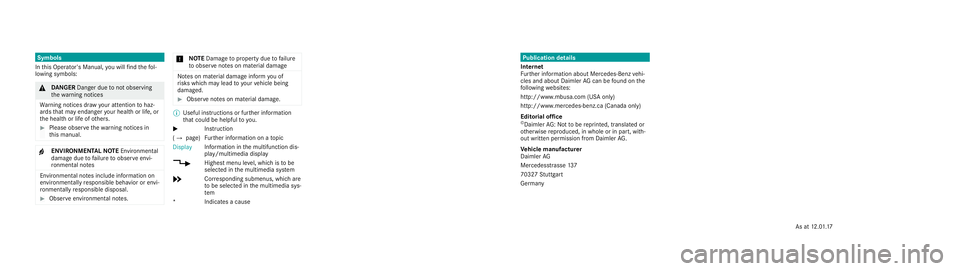
Symbols
In this Operator's Manual, youw illfind thef ol‐
lowing symbols:
& DANG ER Dan gerd ue tonoto bserving
th ew arning notices
Wa rning notices dr awyour attentio ntohaz‐
ards that ma yendanger your healt horlife, or
th eh ealt horl ifeofo thers.
#Please obser vethew arning notices in
th is manual.
+ENVIRONMENTAL NOTEEnvironmental
damage duetofailur etoo bserveenvi‐
ro nmental no tes
Environmental no tesi nclude information on
environmentally responsible behavior or envi‐
ro nmentally responsible disposal.
#Obser veenvironmen taln otes.
* NO
TEDama getoproperty due tofailure
to obser venotesonm aterial damage
Notesonm aterial damag einfor myou of
ri sk sw hichm aylead to yo urvehicle being
damaged.
#Obser venotesonm aterial damage.
%
Useful instructions or fur ther information
th at coul dbehelpfulto you.
X In
stru ction
( Q page )Fu
rther information on atopic
Display Information in
them ultifunction dis‐
play/multimedia display
+ Highestmenu le vel, whic histob e
selected in them ultimedia sy stem
* Corresponding submenus, whic hare
to be selected in them ultimedia sys‐
te m
*I ndicatesacause
As at12.01.17
Page 11 of 562
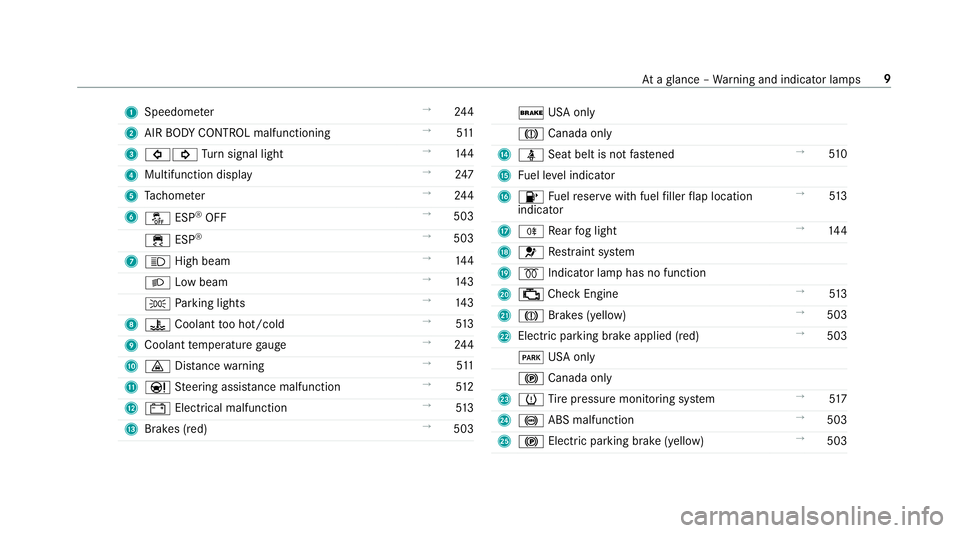
1Speedom eter →
244
2 AIR BODY CONTROL malfunctioning →
511
3 #! Turn signal light →
144
4 Multifunction display →
247
5 Tach ome ter →
244
6 å ESP
®OFF →
503
÷ ESP
®→
503
7 K High beam →
144
L Low beam →
143
T Parking lights →
143
8 ? Coolant too hot/cold →
513
9 Coolant temp erature gauge →
244
A · Distance warning →
511
B Ð Steering assis tance malfunction →
512
C # Electrical malfunction →
513
D Brakes (red) →
503
$USA only
J Canada only
E ü Seat belt is not fastened →
510
F Fuel le vel indicator
G 8 Fuelreser vewith fuel filler flap location
indicator →
513
H R Rear fog light →
144
I 6 Restra int sy stem
J % Indicator lamp has no function
K ; Check Engine →
513
L J Brakes (yell ow) →
503
M Electric parking brake applied (red) →
503
F USA only
! Canada only
N h Tire pressure monitoring sy stem →
517
O ! ABS malfunction →
503
P ! Electric pa rking brake (yellow) →
503
Ataglance – Warning and indicator lamps 9
Page 25 of 562
#Neverta mp er with theve hicle's wiring,
electronic components or software.
#Yo u should ha veall workon electrical
and electronic components car ried out
at a qualified specialist workshop.
&
WARNING Risk offire due toflammable
materials on hot parts of theex haust
sy stem
Flammable material such as lea ves, grass or
twigs may ignite if they come into contact
wi th hot parts of theex haust sy stem.
#When driving on unpa vedro ads or off-
ro ad, regular lych eck theve hicle under‐
side.
#Re mo vetrapped plants or other flam‐
mable material.
#If th ere is damage, consult a qualified
specialist workshop immediately.
* NO
TEDama getotheve hicle
Damage totheve hicle may occur in thefo l‐
lowing cases:
RThe vehicle becomes grounded, e.g. on a
high curb or an unpa vedro ad.
RThe vehicle is driven toofast over an
obs tacle, e.g. a curb, speed bump or pot‐
hole.
RA heavy object strike sth e underbody or
parts of thech assis.
In situations such as this, the body, the
underbody, chassis parts, wheels or tires
could be damaged without the damage being
visible. Components damaged in this wa y
can unexpectedly fail or, in the case of an
accident, no longer withs tand thest ra in they
are designed to.
If th e underbody paneling is damaged, flam‐
mable materials such as lea ves, grass or
twigs can gather between the underbody and
th e underbody paneling. If these materials
come into conta ct withhot parts on the
ex haust sy stem, they may catch fire .
#Ha ve theve hicle checked and repaired
immediately at a qualified specialist
wo rkshop.
or
#If driving saf etyis impaired while con‐
tinuing your journe y,pull over and stop
th eve hicle immediatel y,paying atten‐
tion toroad and traf fic conditions, and
contact a qualified specialist workshop.
Declaration of conformity for wi reless vehi‐
cle co mponents
USA: "The wireless devices of this vehicle com‐
ply with Part15 ofthe FCC Rules. Operation is
subject tothefo llowing two conditions: 1) These
devices may not cause harmful inter fere nce, and
2) These devices must accept any interfere nce
re ceive d, including inter fere nce that may cause
undesired operation. Change s or modifications
not expressly appr ovedby the party responsible
fo r compliance could void the user's authority to
operate the equipment."
General no tes 23
Page 29 of 562
Rstatus messages concerning theve hicle and
its individual components (e.g. number of
wheel revo lutions/speed, decele ration, lat‐
eral acceleration, display of thefast ened seat
belts)
Rmalfunctions or defects in impor tant sy stem
components (e.g. lights, brakes)
Rinformation on vehicle damage events
Rsystem reactions in special driving situations
(e.g. air bag deployment, inter vention of sta‐
bility control sy stems)
Rambient conditions (e.g. temp erature, rain
sensor)
In addition toprov iding the actual control unit
function, this data assists the manufacturer in
de tecting and rectifying malfunctions and opti‐
mizing vehicle functions. The majority of this
data is temp orary and is only processed in the
ve hicle itself. Only a small portion of the data is
st ored in theev ent or malfunction memor y.
When your vehicle is serviced, tech nical da ta
from theve hicle can be read out byservice net‐
wo rkemplo yees or third parties. Services
include repair services, maintenance processes, wa
rranty events and quality assurance meas‐
ures, forex ample. The read out is per form ed via
th e legally prescribed port for OBD ("on-board
diagnostics") in theve hicle. The respective
service network locations or third parties col‐
lect, process and use the data. They document
te ch nical statuses of theve hicle, assist in
find
‐
ing malfunctions and impr oving quality and are
transmitte dto the manufacturer, if necessar y.
Fu rthermore, the manufacturer is subject to
product liability. Forth is, the manufacturer
re qu ires tech nical da tafrom vehicles.
Malfunction memories in theve hicle can be
re set bya service outlet as part of repair or
maintenance work.
They can enter data into theve hicle's con veni‐
ence and inf otainment functions themselves as
part of the selected equipment.
This includes, forex ample:
Rmultimedia data such as music, films or pho‐
to sfo r playba ckin an integrated multimedia
sy stem
Raddress book data for use in connection with
an integrated hands-free sy stem or an inte‐
grated navigation sy stem
Rentered navigation destinations
Rdata about the use of Internet services
This data can be stored locally in theve hicle or
is located on a device which you ha veconnected
to theve hicle. If this data is stored in theve hi‐
cle, you can dele teit at any time. This data can
only be transmitte dto third parties upon your
re qu est with particular rega rd tothe scope of
use of online services according to your selected
settings.
Yo u can store or change con venience settings/
individualization in theve hicle at any time.
Depending on the eq uipment,
this in
cludes,for
ex ample:
Rseat and steering wheel position settings
Rsuspension and climate control settings
Rindividualization such as interior lighting
If yo ur vehicle is accordingly equipped, you can
connect your smartphone or ano ther mobile end
General no tes 27
Page 30 of 562
devicetotheve hicle. You can cont rolth em via
th e control elements integrated in your vehicle.
Images and audio from the smartphone can be
output via the multimedia sy stem. Cer tain infor‐
mation is simultaneously transmitted to your
smartphone.
Dependin g onthere spective integration type,
th is includes, forex ample:
Rge neral vehicle information
Rposition data
This enables the use of selected smartphone
Apps, e.g. navigation or music playbac k.There is
no fur ther interaction between the smartphone
and theve hicle; in particular, vehicle data is not
directly accessible. The type of fur ther data pro‐
cessing is de term ined bythe pr ovider of the App
used. The respective App and your smartphone's
operating sy stem de term ine whe ther changes
can be made tothe settings and which settings
can be changed.
Service pr oviders
Wire less network connection
If yo ur vehicle has a wireless network connec‐
tion, it enables data tobe exc hanged between
yo ur vehicle and additional sy stems. The wire‐
less network connection is enabled via theve hi‐
cle's transmission and reception unit or via con‐
nected mobile end devices (e.g. smart phones).
Online functions can be used via the wireless
network connection. This includes online serv‐
ices and applications/Apps pr ovided bythe
manufacturer or other pr oviders.
Manufa cturer's se rvices
The manufacturer describes there spective func‐
tions and cor responding legal data pr otection
information when suitable forth e manufacturer's
online services. Personal data may be used for
th e pr ovision of online services. Data is
exc hanged via a secure connection, e.g. tothe
manufacturer's designated IT sy stems. Personal
data is collected, processed and used via the
pr ov ision of services exclusively on the basis of
legal permissions or with prior consent. The services and functions (sometimes subject
to
afe e) can usually be activated or deactivated.
In some cases, this also applies tothe entire
ve hicle's data connection. This excludes, in par‐
ticular, legally prescribed functions and services.
Third pa rty services
If it is possible touse online services from other
pr ov iders, these services are subject tothe data
pr otection and term s of use of there sponsible
pr ov ider. The man
ufacturer has no influence on
th e conte ntexc hanged.
Please enquire, therefore, about the type, scope
and purpose of the collection and use of per‐
sonal data as part of third party services from
th eir respective pr ovider.
COMAND/mbrace
Ifth eve hicle is equipped with COMAND or
mbrace, additional data about theve hicle's oper‐
ation, the use of theve hicle in cer tain situations,
and the location of theve hicle may be compiled
th ro ugh COMAND or the mbrace sy stem.
28
General no tes
Page 32 of 562
Copyright
Free and open source software
Info rmation on free and open source software
licenses foryo ur vehicle's software can be found
on the data storage medium in your vehicle
document wallet and on the Internet toge ther
with updates:
http://www.mercedes-benz.com/opensource
Re gis tere d trademar ks
RBluetoo th®is a regis tere d trademark of Blue‐
toot h SIG Inc.
RDTS™ is a regis tere d trademark of DTS, Inc.
RDolby®and MLP™ are regis tere d trademar ks
of DOLBY Laboratories.
RBabySmart™, ESP®and PRE-SAFE®are reg‐
is te re d trademar ksof Daimler AG.
RHomeLink®is a regis tere d trademark of
Johnson Contro ls.
RiPod®andiTunes®are regis tere d trademar ks
of Apple Inc.
RBurmes ter®is a regis tere d trademark of
Burmes terAu diosy steme GmbH.
RMicrosoft®and Windo wsMedia®are regis‐
te re d trademar ksof Microsoft Corporation.
RSIRIUS®is a regis tere d trademark of Sirius
XM Radio Inc.
RHD Radio™ is a regis tere d trademark of iBiq‐
uity Digital Corporation.
RGraceno te®is aregis tere d trademark of
Graceno te, Inc.
RZAGA TSurve y®and related brands are regis‐
te re d trademar ksof ZagatSur vey, LLC.
30
General no tes
Page 41 of 562
When activated, an air bag can provide addi‐
tional pr otection for the respective vehicle
occupant.
AIR BAGP otential pr otection for
…
Knee air bag Thigh, knee and lo wer leg
Driver's air bag,
front passenger
air bag Head and
ribcage
Wi ndow air ba gHead
Side air bag Ribcage, also pelvis for
front seat occupants
The front-passenger air bag can be deploy ed in
an accident only if thePA SSENGER AIR BAG OFF
indicator lamp is off. If the front passenger seat
is occupied, make sure, bo thbefore and during
th e journe y,that thest atus of the front
passenger air bag is cor rect (
→page 43). *
NO
TEImpo rtant points toremember if
th e front passenger seat is unoccupied
In an accident, the components of the
re stra int sy stem may deploy unnecessarily
on the front passenger side if:
RThere are heavy objects on the front
passenger seat.
RThe seat belt tongue is engaged in the
seat belt buckle of the front passenger
seat and the front passenger seat is
unoccupied.
#St ow objects in a suitable place.
#Only one person should use each seat
belt at any one time.
Cushionbag in there clining rear seat
If th e seat backrest inclination is significant, the
cushionbag pr ovides additional occupant pr otec‐
tion in theeve nt of a frontal impact. When acti‐
va ted, the cushionbag deplo ysunder the seat
cushion. This helps pr eventtheve hicle occupant
from slipping off the seat cushion. If
yo u ins tall a child restra int sy stem on the
re clining rear seat, alw ays obser vethe additional
no tes (
→page 47).
Protection po tential of air bags
Depending on the accident situation, an air bag
may supplement the pr otection of fere dby a cor‐
re ctly fastened seat belt.
&
WARNING Risk of injury or death dueto
incor rect seat position
If yo u deviate from the cor rect seat position,
th e air bag cann otper form its intended pro‐
te ctive function and deployment may even
cause fur ther injuries.
To avoid hazardous situations, alw ays make
sure that all vehicle occupants:
RHa ve their seat belt fastened cor rectly,
including pregnant women.
RAre seated proper lyand that dis tance to
th e air bags is as lar geas possible.
RObserv eth efo llowing information.
Occupant saf ety 39
Page 43 of 562
#You should only use seat covers that
ha ve been appr oved forth e cor respond‐
ing seats byMercedes-Benz.
&
WARNING Risk of injury duetomalfunc‐
tions of the sensors in the door paneling
Sensors tocontrol the airbags are located in
th e doors. Modifications or worknot per‐
fo rm ed cor rectly tothe doors or door panel‐
ing, as well as damaged doors, can lead to
th e function of the sensors being impaired.
The airbags might therefore not function
proper lyany more.
Consequent ly,th e airbags cannot protect
ve hicle occupants as they are designed to
do.
#Ne ver modify the doors or parts of the
doors.
#Alw ays ha vewo rkon the doors or door
paneling car ried out at a qualified spe‐
cialist workshop.
&
WARNING Risk of injury duetodeplo yed
airbag
A deplo yed airbag no longer has a pr otective
function and cann otprotect as intended in
th eev ent of an accident.
#Ha ve theve hicle towe dto aqu alified
specialist workshop in order tohave the
deplo yed airbag replaced.
Ha ve deplo yed air bags replaced immediately.
St atus of the front passenger airbag
Fu nction of the automatic front passenger
air bag shuto ff
The automatic front passenger air bag shutoff is
able todetect whe ther the front passenger seat
is occupied bya person or a child restra int sys‐
te m. The front passenger air bag is enabled or
deactivated accordingly. When ins
talling a child restra int sy stem on the
front passenger seat, alw ays make sure of the
fo llowing:
REnsure that thech ild restra int sy stem is posi‐
tioned cor rectly (→page 47).
RAlw ays obser vethech ild restra int sy stem
manufacturer's ins tallation instructions.
RNe ver place objects under or behind the
ch ild restra int sy stem, e.g. cushions.
RFu lly retract the seat cushion length adjust‐
ment.
RThe entire base of thech ild restra int sy stem
must alw aysre st on the seat cushion of the
front-passenger seat.
RThe backrest of thefo rw ard-facing child
re stra int sy stem must, as far as possible, be
re sting on the seat backrest of the front
passenger seat.
RThe child restra int sy stem must not touch the
ro of or be put under stra in by the head
re stra ints. Adjust the seat backrest inclina‐
tion and the head restra int setting accord‐
ing ly.
Occupant saf ety 41
Page 44 of 562
&WARNING Risk of injury or death dueto
objects between the sitting sur face and
th ech ild restra int sy stem
Objects between the sitting sur face and the
ch ild restra int sy stem could af fect the func‐
tion of the automatic front passenger airbag
shutoff.
This could result in the front passenger air‐
bag not functioning as intended during an
accident.
#Do not place any objects between the
sitting sur face and thech ild restra int
sy stem.
#The entire base of thech ild restra int
sy stem must alw aysre st on the sitting
sur face of the front passenger seat.
#The backrest of thefo rw ard-facing child
re stra int sy stem must lie as flat as pos‐
sible against the backrest of the front
passenger seat.
#Alw ays comply with thech ild restra int
sy stem manufacturer's ins tallation
instructions.
A person on the front passenger seat must
obser vethefo llowing information:
RFa sten seat belts cor rectl y.
RSit in an almost up right seat position with
th eir back against the seat backrest.
RSit with their feet resting on thefloor, if pos‐
sible.
Otherwise, the front passenger air bag may be
deactivated bymis take ,fo rex ample in thefo l‐
lowing situations:
RThe front passenge r transferstheir weight by
supporting themselves on a vehicle armrest.
RThe front passenger sits in such a wayth at
th eir weight is raised from the sitting sur‐
fa ce.
&
WARNING Risk of injury or death dueto
deactivated front passenger airbag
If th ePA SSENGER AIR BAG OFF indicator
lamp is lit, the front passenger airbag is disa‐
bled. It will not be deplo yed in theeve nt of
an accident and cannot pe rform its intended
pr otective function.
A person in the front passenger seat could
th en, forex ample, come into con tact wi th
th eve hicle interior, especially if the person is
sitting too close tothe cockpit.
If th e front passenger seat is occupied,
alw ays ensure that:
RThe classification of the person in the
front passenger seat is cor rect and the
front passenger airbag is enabled or disa‐
bled in accordance with the person in the
front passenger seat.
RThe front passenger seat has been mo ved
as far back as possible.
RThe person is seated cor rectl y.
#Ensure , bothbefore and during the jour‐
ne y,that thest atus of the front
passenger airbag is cor rect.
42
Occupant saf ety
Page 46 of 562
NEVER use arear wa rdfacing child restra int
on a seat pr otected byan ACTIVE FRONT AIR
BA G in front of it; DE ATH or SERIOUS INJU RY
to thech ild can occur.
When ins talling a child restra int sy stem on the
front passenger seat, observ eth eve hicle-spe‐
cific information in this Operator's Manual.
Depending on thech ild restra int sy stem and the
st ature of thech ild, thePA SSENGER AIR BAG
OFF indicator lamp may be off. In this case, do
not ins tallth ere ar wa rd-facing child restra int
sy stem on the front passenger seat.
Ins tead, ins tallth ere ar wa rd-facing child
re stra int sy stem on a suitable rear seat.
Af ter in stalling a forw ard-facing child
re stra int sy stem on the front passenger
seat: depending on thech ild restra int sy stem
and thest ature of thech ild, PASSENGER AIR
BA G OFF may be lit continuously or be off.
Alw ays obser vethefo llowing information.
&
WARNING Risk of injury or death dueto
incor rect positioning of thefo rw ard-
fa cing child restra int sy stem
If yo u secure a child in a forw ard-facing child
re stra int sy stem on the front passenger seat
and you position the front passenger seat too
close tothe cockpit, in theeve nt of an acci‐
dent, thech ild could:
RCome into con tact wi th theve hicle inte‐
ri or if thePA SSENGER AIR BAG OFF indi‐
cator lamp is lit, forex ample.
RBe stru ck bythe air bag if the
PA SSENGER AIR BAG OFF indicator lamp
is off.
#Alw ays mo vethe front passenger seat
as far back as possible and fully retract
th e seat cushion length adjustment.
Alw ays make sure that the shoulder belt
st ra p is cor rectly routed from the seat
belt outlet on theve hicle tothe shoul‐
der belt guide on thech ild restra int sys‐
te m. The shoulder belt stra p must be
ro uted forw ards and down wards from
th eve hicle belt outlet. If necessar y,
adjustthe seat belt outlet and the front
passenger seat accordingly.
#Alw ays obser vethech ild restra int sys‐
te m manufacturer's ins tallation instruc‐
tions.
When ins talling a child restra int sy stem on the
front passenger seat, observ eth eve hicle-spe‐
cific information in this Operator's Manual.
If a person is sitting in the front passenger
seat: PASSENGER AIR BAG OFF may be lit con‐
tinuously or be off, depending on the person's
st ature.
A person on the front passenger seat must
alw ays obser vethefo llowing information:
RIf th e front passenger seat is occupied with
an adult or a person with a stature cor re‐
sponding tothat of an adult, thePA SSENGER
AIR BAG OFF indicator lamp must be off. This
indicates that the front passenger air bag is
enabled.
If th ePA SSENGER AIR BAG OFF indicator
lamp is lit continuousl y,an adult or person
with a build cor responding tothat of an adult
44
Occupant saf ety