weight MERCEDES-BENZ S-CLASS SEDAN & MAYBACH 2019 Owner's Manual
[x] Cancel search | Manufacturer: MERCEDES-BENZ, Model Year: 2019, Model line: S-CLASS SEDAN & MAYBACH, Model: MERCEDES-BENZ S-CLASS SEDAN & MAYBACH 2019Pages: 578, PDF Size: 54.01 MB
Page 44 of 578
R
The backres tof thefo rw ard-f acin gch ild
re stra int system mus tlie asflat as poss ible
ag ains tth ebac kres tof thefront passeng er
seat.
R The child restra int system mus tno tto uc hth e
ro of or be put under stra in by thehead
re stra int s.Ad jus tth eseat backres tinclin a‐
tion andthehead restra int setting accord‐
ing ly. &
WARNIN GRisk ofinju ryor deat hdue to
object sbe tween thesitt ing surface and
th ech ild restra int system
Objec tsbetween thesitt ing surface and the
ch ild restra int system could affect thefunc ‐
tion oftheaut omatic front passeng erairbag
shut off.
This could result inthefront passeng erair‐
bag notfunc tioningasintended during an
acciden t. #
Donotplace anyobjec tsbetween the
sitting surface and thech ild restra int
sy stem. #
The entire base ofthech ild restra int
sy stem mus talw aysre st on thesitt ing
sur face ofthefront passeng erseat. #
The backres tof thefo rw ard-f acin gch ild
re stra int system mus t,as faras possi ‐
ble, beresting ontheseat backres tof
th efront passeng erseat. #
Alw ayscom plywit hth ech ild restra int
sy stem manuf acturer'sinstallation
ins truct ions . A
per son onthefront passeng erseat must
obser vethefo llo wing informatio n:
R Fasten seat belts correctl y(→ page 34).
R Sitinan almos tupr ight seatposi tion with
th eir bac kag ains tth eseat backres t.
R Sitwithth eir feet resting onthefloor ,if pos‐
sible.
The front passeng erfront airbag mayot her wise
be disable dby mis take ,fo rex am ple inthefo l‐
lo wing situat ions:
R The front passen gertr ansf ersth eir weight by
suppor tingthemselv eson ave hicle armr est. R
The front passeng ersits insuc hawa yth at
th eir weight israised from thesitt ing sur‐
fa ce. &
WARNIN GRisk ofinju ryor deat hdue to
deactiv ated front passeng erairbag
If th ePA SSENGER AIRBAGOF Find icat or
lam pis lit,th efront passeng erairbag isdisa‐
bled. Itwill notbe deplo yedin theev ent of
an acciden tand cann otper form itsintended
pr otect ive func tion.
A per son inthefront passeng erseat could
th en, forex am ple, com eint ocon tact with
th eve hicle interior ,especially ifth eper son is
sitt ing tooclose tothecoc kpit.
If th efront passeng erseat isoccupied,
alw aysensur eth at:
R The classificat ion oftheper son inthe
fr ont passeng ersea tis cor rect and the
fr ont passeng erairb agisenabl edordisa ‐
ble din accor dance withth eper son inthe
fr ont passeng ersea t. 42
Occupa ntsaf ety
Page 50 of 578
Obser
vingstandar dsforch ild restra int sys‐
te ms
All child restra int systems mustmee tth efo llo w‐
ing standar ds:
R U.S. Feder alMo torVe hicle SafetySt andar ds
21 3and 225
R Canadi anMo torVe hicle SafetySt andar ds
21 3and 210.2
Conf irmatio nth at thech ild restra int system
com plies withth est andar dscan befound onan
ins truct ion label onthech ild restra int system.
This confirm atio ncan also befound intheins tal‐
lation instruct ions that areinc luded withth e
ch ild restra int system. De
tectin grisk s,avo iding danger Secur
ingsystems forch ild restra int systems
in theve hicl e
Only usethefo llo wing secur ingsystems forch ild
re stra int systems:
R theLA TC H-type (ISOFIX )mou nting brac kets
R theve hicle's seatbeltsystem R
theTo pTe ther anc horages
Ins talling aLA TC H-type (ISOFIX )ch ild restra int
sy stem isprefer red.
Sim plyatt aching tothesecur ingrings onthe
ve hicle canreduce therisk ofins talling thech ild
re stra int system incor rectl y.
When securingach ild withth eint egr ated seat
belt oftheLA TC H-type (ISOFIX )ch ild restra int
sy stem, alwayscom plywithth eper missible
gr oss weight forth ech ild and child restra int sys‐
te m (→ pag e53).
A boos terseat maybe necessar yto achie ve
pr oper seatbeltposition ingforch ildr enover
40 lbs (18 kg )in we ight orunt ilth ey reac ha
heigh twher eath re e-point seatbeltcanbe
ins talled proper lywit hout aboos terseat.
Mer cedes-Benz recomme ndsasu itab lech ild
boos terseat withabac kres tand seat beltguide.
Ad vantag eof are ar wa rd-faci ng child
re stra int system
It is prefer able totrans portabab yor asmall
ch ild inasuit able rear wa rd-faci ng child restra int
sy stem. Inthis case, thech ild sits intheoppo‐ sit
edir ect ion tothedir ect ion oftrav el and faces
ba ckwa rds.
Babies andsmall childr enhave com parativ ely
we ak nec kmusc lesinrelation tothesize and
we ight oftheir head. Therisk ofinjur yto thecer‐
vical spine during anacciden tcan bereduced in
a re ar wa rd-faci ng child restra int system.
Alw ayssecur each ild restra int system cor‐
re ctl y &
WARNIN GRisk ofinju ryor deat hcaused
by inc orrect ins tallation ofthech ild
re stra int system
If th ech ild restra int system isincor rectly
ins talled onasuit able seatin gposit ion,it
can notper form itsintended protect ive func ‐
tion .
The child can notbe restra ined intheeve ntof
an acci dent, hea vybraki ng orasu dd en
ch ang eof dir ect ion. #
Alw ayscom plywit hth emanuf acturer's
ins tallation instruct ions forth ech ild
re stra int system and itscor rect use. 48
Occup antsafety
Page 124 of 578
alw
aysre stra in theobjec tsthey cont ain in
th eev ent ofan acciden t.
Ther eis arisk ofinjur y,par ticular lyin the
ev ent ofsudden braking orasudden chang e
in dir ect ion. #
Alw aysst ow object sin suc hawa yth at
th ey canno tbe tossed about inthese or
similar situation s. #
Alw aysmak esur eth at obj ect sdo not
pr oject from stow agespac es,parcel
ne ts or stow agene ts. #
Close theloc kable stow agespac es
bef orest ar tin gajo ur ne y. #
Alw aysst ow and secureobj ect sth at
ar ehea vy,har d,poin ted, shar p-edg ed,
fr agile ortoolarg ein thetrunk . Obser
vetheno teson thecup holder s. &
WARNIN GRisk ofburning from theta il‐
pipe ortailpipe trim
The tailpipe andtailpipe trim can becom e
ve ry hot.Ifyo uco me intoco ntact withth ese
car parts,youco uld burnyo urself . #
Alw aysbe par ticular lycareful whenin
th evicinit yof theta ilpipe andtailpipe
tr ims and super visechildr envery
clos elywhe nin this area. #
Beforean ycon tact, allo w thecar parts
to cool down. The
drivi ng charact eristic sof your vehicle are
dependent onthedis tribution oftheload within
th eve hicle. Yousho uld bear thefo llo wing in
min dwhen loading theve hicle:
R neverex ceed theper missible gross mass or
th egr oss axle weight rating forth eve hicle
(including occupants). Thevalues arespec i‐
fi ed on theve hicle identif ication plateon the
ve hicle's B-pillar.
R theload mustno tpr otru de abo vetheupper
edg eof theseat backres ts. R
alwaysplace theload behind unoccupied
seats ifpossible.
R secur eth eload using thepar cel nethook s.
Dis tribut eth eload onthepar cel nethook s
eve nly. St
ow agespace sin theve hicl eint erior Ov
ervie wof thefront stowage com part‐
men ts &
WARNIN GRisk ofinju rydue toobject s
being stowe dinco rrect ly
If yo udo notadeq uatelyst ow object sin the
ve hicle interior ,th ey cou ldslipor be tossed
ar ound andther eb yst rike vehicle occupants.
In addition, cupholder s,open stow age
spac esand mobi lephon ebr ac kets cann ot
alw aysre stra in theobjec tsthey cont ain in
th eeve ntofan acci dent.
The reisarisk ofinjur y,par ticular lyin the
eve ntofsudd en braki ng orasu dd en chang e
in dir ect ion. 12
2
Sea tsand stow ing
Page 428 of 578
To
wing theve hicl ewith both axle son the
gr ound #
Obser vetheno teson theper mitt edtowing
me thods (→pag e42 4). #
Mak esur eth at thebatt eryis con nect edand
ch arge d.
When thebatt eryis disc harged, thefo llo wing
act ions cannotbe per form ed:
R theengine cannotbe star ted
R theelectr icpar king brak ecann otbe released
or applied
R theaut omatic transmiss ioncann otbe shif ted
to position 005Cor005D
% Ifth eaut omatic transmiss ioncann otbe shif‐
te dto position 005C,orthemultifunc tiondis‐
pla yin theins trument clusterdoes notsho w
an ything, have theve hicle transpor tedaw ay
( → pag e42 7). Atowing vehicle withlifting
eq uipment isrequ ired forve hicle transpor ta‐
tio n. *
NO
TEDama gedue totowing away at
exc essiv elyhigh speeds orover long dis‐
ta nces The
drivet ra in could bedamag edwhen tow‐
ing atexc essiv elyhigh speeds orover long
dis tances. #
Atowing speed of30 mph(50 km/h)
mus tno tbe exc eeded. #
Atowing distance of30 miles(50 km)
mu stnotbe exc eeded. &
WARNIN GRisk ofacci dent whento wing
a ve hicle whichis toohea vy
If th eve hicle being tow- star tedor towe d
aw ay ishea vier than theper missible gross
mass ofyour vehicle, thefo llo wing situat ions
can occur:
R The towing eyema ybecome detach ed.
R The vehicle/tr ailercombination may
sw erve oreve nov ertur n. #
Ifano ther vehicle istow- star tedor
to we daw ay,its weight mustno texc eed th
eper missible gross mass ofyour ow n
ve hicle. If
ave hicle mustbe tow- star tedor towe daw ay,
its weight mustno texc eed theper missible gross
mass oftheto wing vehicle. #
Information ontheper missible gross mass of
th eve hicle canbefound ontheve hicle iden‐
tif ication plate(→ pag e466). #
Donotopen thedr iver's door orfront
passeng erdoor ,ot her wise theaut omatic
tra nsmiss ionautomaticall yshif tsto position
005D. #
Installth eto wing eye(→ pag e429). #
Fasten theto w bar .
* NO
TEDama gedue toinc orrect connec‐
tion #
Onlyconnect theto w rope ortow bar to
th eto wing eyes. #
Deact ivat eth eaut omatic locking mechanism
(→ pag e68). 426
Breakdo wnassis tance
Page 444 of 578
Count
ryRadio type approval number
US AF CCID:MRXGG4 T
FCC ID:MRXD G6W2D4
FCC ID:MRXM C34MA4
This devic eco mp lies withPa rt15
of theFCC Rules. Opera tionis
subje ctto thefo llo wing twocon ‐
dition s:
(1) This device mayno tcause
har mful interfere nce, and
(2) Thisde vice mustacc eptan y
int erfere nce recei ved, includin g
int erfere nce that ma ycaus e
unde sired oper ation. Load
ingtheve hicl e No
teson Tire and Loading Information plac‐
ar d &
WARNIN GRisk ofacci dent from overloa‐
ded tires
Ov erloaded tires ma yove rheat and burstas a
con sequenc e.Ov erloaded tires can also
im pair thesteer ing and handling charact eris‐
tic sand lead tobrak efa ilur e. #
Obser vetheload-bear ingcapacity of
th etir es. #
The load-bear ingcapacity mustbe at
leas thalf thegr oss axle weight rating of
th eve hicle. #
Neverove rload thetir es by exc eeding
th emaximum load. The
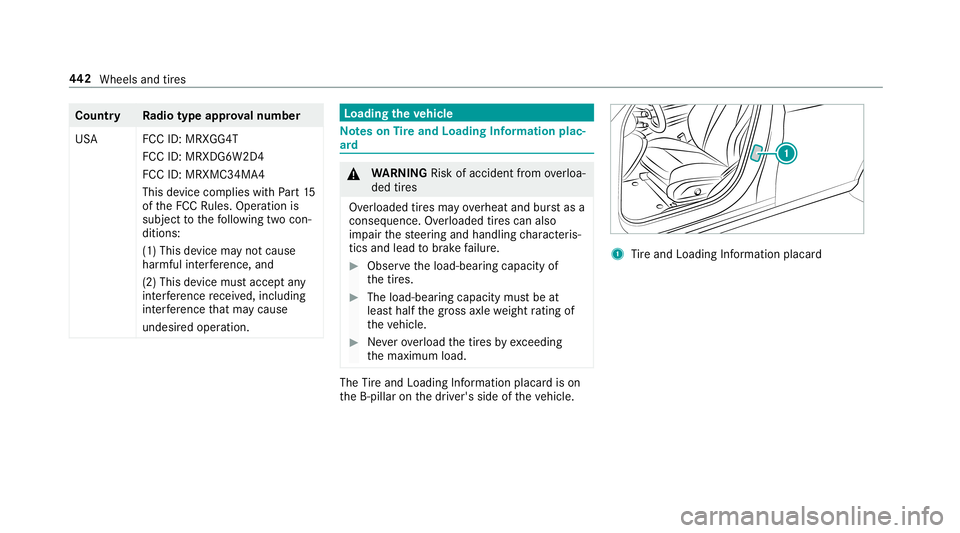
Tire and Loadi ngInfo rm atio nplacar dis on
th eB-pillar onthedr iver's side oftheve hicle. 1
Tire and Loadi ngInfo rm atio nplacar d 44
2
Wheels andtires
Page 445 of 578
%
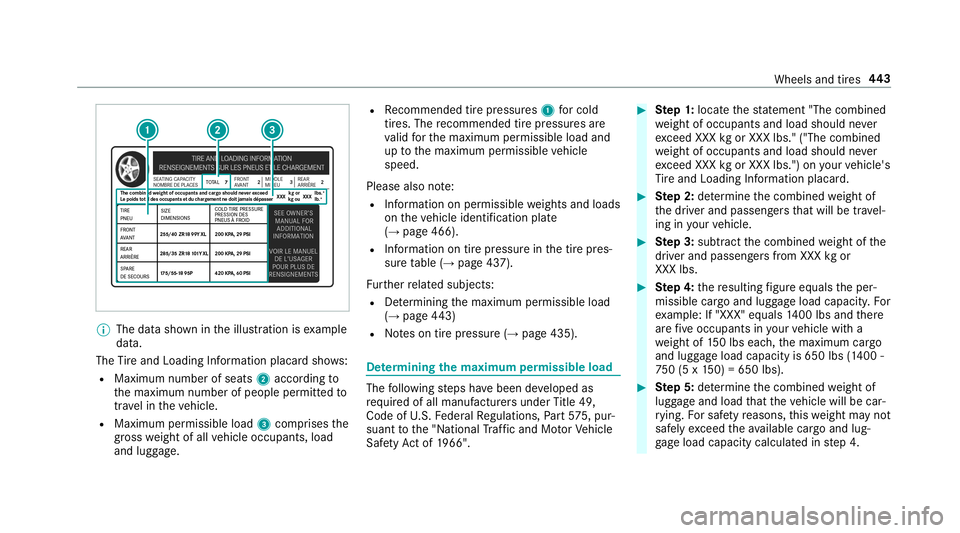
The datasho wnintheillus tration isexam ple
dat a.
The Tire and Loadi ngInfo rm atio nplacar dsho ws:
R Maximum numberofseats 2accor dingto
th emaximum numberofpeople permitt edto
tr ave lin theve hicle.
R Maximum permissible load3com prises the
gr os swe ight ofall vehicle occupants, load
and luggage. R
Recomme ndedtirepr ess ures 1 forcold
tir es. The recomme ndedtirepr ess ures are
va lid forth emaximum permissible loadand
up tothemaximum permissible vehicle
speed.
Please alsonote:
R Information onper missib lewe ight sand loads
on theve hicle identif ication plate
(→ pag e466).
R Information ontirepr essur ein thetir epr es‐
sur eta ble (→pag e43 7).
Fu rther relat ed subje cts:
R Determ inin gth emaximum permissible load
(→ pag e44 3)
R Noteson tirepr essur e(→ pag e435). De
term ining thema xim um permis sible load The
follo wing steps have been developed as
re qu ired ofall manuf acturersunder Title 49,
Co de ofU.S. Feder alRe gulations, Part57 5, pur‐
sua nttothe"N ational Traf fic and MotorVe hicle
Saf etyAc tof 1966". #
Ste p1: loca tethest at emen t"The combined
we ight ofocc upant sand load should never
exc eed XXX kgorXXX lbs." ("The combined
we ight ofocc upant sand load should never
exc eed XXX kgorXXX lbs.") onyour vehicle's
Ti re and Loadi ngInfo rm atio nplacar d. #
Ste p2: determ ine thecombin edweight of
th edr iver and passeng ersth at will betravel‐
ing inyour vehicle. #
Ste p3: subtr act thecombin edweight ofthe
dr iver and passeng ersfrom XXX kgor
XXX lbs. #
Ste p4: there sulting figur eeq uals theper‐
missible cargoand luggageload capacity .Fo r
ex am ple: If"XXX "eq uals 1400 lbs and ther e
ar efive occupant sin your vehicle witha
we ight of150lbs eac h,themaximum cargo
and luggageload capacity is650 lbs(1400 -
75 0(5 x15 0) =650 lbs). #
Ste p5: determ ine thecombin edweight of
lugg ageand load that theve hicle willbecar‐
ry ing. Forsaf etyre ason s,this we ight mayno t
saf elyexc eed theav ailable cargoand lug‐
ga ge load capac itycalc ulatedinstep 4. Wheels
andtires 44
3
Page 446 of 578
Ev
en ifyo uha ve cal cul ated thetot alload care‐
full y,yo usho uld still mak esur eth at themaxi‐
mum permissible gross mass andthemaximum
per missible axleload ofyour vehicle areno t
exc eeded. Details can befound ontheve hicle
identif ication plate. #
Have your loaded vehicle –including driver ,
occupants andload –we ighed onave hicle
we ighbr idge.
The measur edvalues mayno texc eed the
maximu mper missi blevalues stat ed on the
ve hicle identif ication plate. Fu
rther relat ed subje cts:
R Calculation exam ple forde term inin gth emax‐
imum load(→pag e444 )
R Tire and Loadi ngInfo rm atio nplacar d
(→ pag e44 2)
R Tire pressur eta ble (→pag e43 7)
R Vehicle identif ication plate Calculation
exam ple forde term ining the
ma ximum load The
follo wing table showsexam ples ofhowto
cal cul atetot aland load capac ities wit hva rying seatin
gcon figur ations anddiffere nt num bers
and sizes ofocc upant s.The follo wing exam ples
use amax imum loadof1500 lbs (680 kg).This
is forillus tratio npur pos esonly.Mak esur e
yo uar eusin gth eactual loadlimit foryo ur vehi‐
cle stat ed on your vehicle's Tire and Loadi ng
In fo rm atio nplacar d(→ pag e44 2).
Th ehigh er thewe ight ofall theoccupant s,the
smaller themaximum loadforlug gage .
Ste p1 Ex
am ple 1E xamp le2
Combine dmaxim umweight ofocc upant sand
load (datafrom theTire and Loadi ngInfo rm atio n
placar d) 15
00 lbs (680 kg)1 500lbs(680 kg) 444
Wheels andtires
Page 447 of 578
Ste
p2 Ex
am ple 1E xamp le2
Nu mb erofpeople intheve hicle (driver and
occupants) 51
Dis trib uti on oftheoccupant sF ront:2
Re ar:3 Fr
ont :1
We ight ofocc upant sO ccupant1:150lbs (68 kg)
Occupant 2:180lbs (82 kg)
Occupant 3:160lbs (73 kg )
Occupant 4:140lbs (63 kg)
Occupant 5:120lbs (54kg ) Occupant
1:200 lbs(91 kg )
To talwe ight ofall occ upant s7 50lbs (340 kg)2 00lbs (91 kg ) Ste
p3 Ex
am ple 1E xamp le2
Pe rm issible load(maxim umgros sve hicle weight
ra ting from theTire and Loadi ngInfo rm atio n
placar dmin usthegr oss weight ofall occ upant s)15
00 lbs (680 kg)00F8 75 0lbs (340 kg)= 75 0lbs
(340 kg) 15
00 lbs (680 kg)00F8 200 lbs(91 kg )= 13 00 lbs
(589 kg) Wheels
andtires 44
5
Page 450 of 578
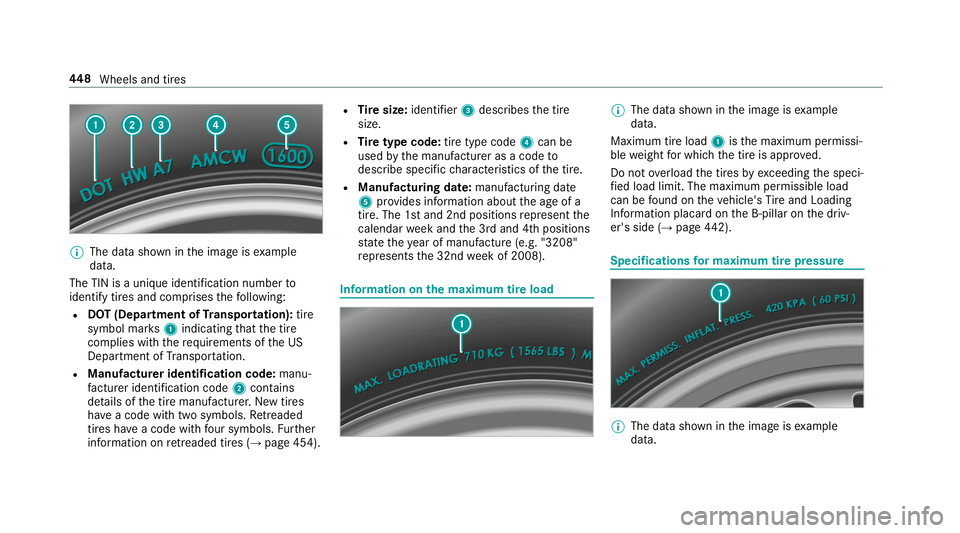
%
The datasho wnintheimag eis exam ple
dat a.
The TINisauniq ueiden tificat ion num berto
ident ifytires and comprises thefo llo wing:
R DOT(Depar tment ofTranspo rtation ):tir e
symb olmar ks1 indic atingth at thetir e
com plies withth ere qu iremen tsof theUS
Depar tmentof Trans portatio n.
R Man ufac tur eride ntificat ion code: manu‐
fa ctur eridentif ication code 2cont ains
de tails ofthetir emanuf acturer.Ne wtires
ha ve acod ewit htw osymbo ls.Retrea de d
tir es have acod ewit hfo ur symb ols.Further
inf ormation onretrea de dtir es (→ page 454). R
Tire size: identif ier3 descr ibesthetir e
size.
R Tire type code: tiretyp ecod e4 can be
us ed bythemanuf actureras acode to
descr ibespecif icch aract eristic sof thetir e.
R Manuf acturingdate:manuf acturingdate
5 prov ides informatio nabout theag eof a
tir e. The 1stand 2nd position sre pr esent the
cal enda rwe ek and the3r dand 4thposition s
st at eth eye ar ofman ufact ure(e. g."32 08"
re pr esent sth e32n dwe ek of2008 ). Inf
ormat iononthema xim um tireload %
The datasho wnintheimag eis exam ple
dat a.
Max imum tireload 1isthemaximum permissi‐
ble weight forwhi chthetir eis appr oved.
Do notove rload thetir es by exceed ingthespeci‐
fi ed load limit. Themaximum permissible load
can befound ontheve hicle's Tire and Loadi ng
In fo rm atio nplacar don theB-pillar onthedr iv‐
er's side (→pag e44 2). Sp
eci ficat ions formaxi mum tirepr es sur e %
The data sho wnintheimag eis exam ple
dat a. 44
8
Wheels andtires
Page 454 of 578
Un
ifor m Tire Quality Grading Standar ds:a
unif orm standar dto grade thequ alit yof tires
wit hre ga rd totrea dqu alit y,tiretracti onand
te mp eratur ech aract eristic s.The qualit ygr adin g
asses smentismade bythemanuf acturerfollo w‐
ing spec ificat ions from theU. S. government. The
qu alit ygr ade ofatir eis im print ed on theside
wa llof thetir e.
Re comm endedtir epr essu re:th ere comme n‐
ded tirepr ess ureis thetir epr essur especif ied
fo rth etir es mount edtotheve hicle atthefa c‐
to ry.
The tireand information table con tains there c‐
omme ndedtirepr ess ures forcold tires, themax‐
imum permissible loadandthemaximum per‐
missible vehicle speed.
The tirepr essur eta ble con tains there comme n‐
ded tirepr ess ures forcold tires under various
oper ating condit ions,i.e.loading and/orspeed
of theve hicle.
Incr eased vehicl ewe ight duetooptiona l
eq uip ment :th ecombin edweight ofall standar d
and optio nal equipme ntavailable forth eve hicle, re
ga rdless ofwhe ther itis actually installed on
th eve hicle ornot.
Rim: thepar tof thewheel onwhic hth etir eis
ins talled.
GA WR (Gross AxleWe ight Ratin g):th eGA WR
is themaximum permissible axleload. The
actual loadonanaxle mustne verexc eed the
gr os saxle weight rating .The gross axlewe ight
ra ting canbefound ontheve hicle identif ication
plat eon theB‑pillar onthedr iver's side.
Speed ratin g:thespeed rating ispa rtof thetir e
identif ication .It specif iesthespeed rang efo r
whic hatir eis appr oved.
GV W(Gr oss Vehicl eWe ight ):th egr oss vehicle
we ight comprises thewe ight oftheve hicle
including fuel,tools, thespar ewheel, accesso‐
ri es installed, occupant s,lugg ageand thetrailer
dr aw bar nose weight ,if applicable. Thegros s
ve hicle weight mustno texc eed thegr oss vehicle
we ight rating GVWR asspecif iedontheve hicle
identif ication plateon theB‑pillar onthedr iver's
side.
GV WR (Gross Vehicl eWe ight Ratin g):th e
GV WR isthemaximum permitt edgross weight of
thefully laden vehicle (weight oftheve hicle
including allaccessor ies,occupants, fuel,lug‐
ga ge and thetrailer draw bar nose weight ifappli‐
cable). Thegros sve hicle weight rating issp eci ‐
fi ed on theve hicle identif ication plateon the
B‑pil laron thedr iver's side.
Maxim umweight ofthelad envehicl e:the
maximu mwe ight isthesum ofthecurb weight
of theve hicle, thewe ight oftheaccessor ies,the
maximu mloa dand thewe ight ofoption aleq uip‐
men tins talled atthefa ct or y.
Kilop ascal(kP a):metric unit fortir epr essu re.
6.9 kPacor responds to1psi .Ano ther unit for
tir epr es su re isbar .10 0kilop ascal(kP a)equals
1 bar .
Lo ad inde x:inadd ition totheload-bear ing
inde x,theload indexma yalso beimprint ed on
th eside wallof thetir e. This specif iestheload-
bear ingcapacity ofthetir emor epr ecisel y.
Cur bwe ight :th ewe ight ofave hicle withstand‐
ar deq uipme ntinc ludin gth emaximum capacity
of fuel, oiland coolant .It also includes theair
con ditionin gsy stem and option aleq uipment if 452
Wheels andtires